




Abstract
Graph theory has provided chemist with a variety of useful tools, such as topological indices. A topological index Top(G) of a graph G is a number with the property that for every graph H isomorphic to G, Top(H) = Top(G). In this article, we present exact expressions for some topological indices of carbon compound graphene. We compute first Zagreb index, second Zagreb index, first multiple Zagreb index, second multiple Zagreb index, augmented Zagreb index, harmonic index and hyper-Zagreb index of graphene. These are some topological indices based on degrees.
Keywords
Introduction
Graphene is an atomic-scale honeycomb lattice made of carbon atoms. It is one of the most promising nanomaterials because of its unique combination of excellent properties, which opens a way for its exploitation in a wide spectrum of applications ranging from electronics to optics, sensors and biodevices. Also, it is the most effective material for electromagnetic interference shielding.
A graph invariant is any function on a graph that does not depend on a labelling of its vertices. A topological index is a graph invariant applicable in chemistry. By IUPAC terminology, a topological index is a numerical value associated with chemical constitution purporting for correlation of chemical structure with various physical properties, chemical reactivity or biological activity. In an exact phrase, if graph denotes the class of all finite graphs, then a topological index is a function Top from graph into real numbers with this property that Top(G) = Top(H), if G and H are isomorphic. Obviously, the number of vertices and the number of edges are topological indices.
Topological indices are the molecular descriptors that describe the structures of chemical compounds, and they help us to predict certain physico–chemical properties such as boiling point, enthalpy of vaporization, stability, and so on. Molecules and molecular compounds are often modelled by molecular graph. A molecular graph is a representation of the structural formula of a chemical compound in terms of graph theory, whose vertices correspond to the atoms of the compound and edges correspond to chemical bonds. Note that hydrogen atoms are often omitted. All molecular graphs considered in this article are finite, connected, loopless and without multiple edges. Let G =
Zagreb indices
Much studied and in chemistry much applied graph invariants are the pair of molecular descriptors (or topological index), known as the first Zagreb index
Definition 1.1
For a simple connected graph G, the first and second Zagreb indices were defined as follows

where dv denotes the degree (number of first neighbours) of vertex v in G.
Multiple Zagreb indices
In 2012, Ghorbani and Azimi 11 defined the multiple Zagreb topological indices of a graph G based on degree of vertices of G.
Definition 1.2
For a simple connected graph G, the first and second multiple Zagreb indices were defined as follows

Properties of the first and second multiple Zagreb indices may be found in the work by Eliasi et al. 12 and Gutman. 13
Augmented Zagreb index
The augmented Zagreb index was introduced by Furtula et al. 14 This graph invariant has proven to be a valuable predictive index in the study of the heat of formation in octanes and heptanes and is a novel topological index in chemical graph theory, whose prediction power is better than atom–bond connectivity index. Some basic investigations implied that AZI index has better correlation properties and structural sensitivity among the very well-established degree-based topological indices.
Definition 1.3
Let G =

Further studies can be found in the work of Huang et al. 15 and the references cited there in.
Harmonic index
The Harmonic index was introduced by Zhong. 16 It has been found that the harmonic index correlates well with the Randic index and the π-electron energy of benzenoid hydrocarbons.
Definition 1.4
Let G =

Further studies on
Hyper-Zagreb index
Shirdel et al. 18 introduced a new distance based on Zagreb indices of a graph G named hyper-Zagreb index.
Definition 1.5
The hyper-Zagreb index is defined as follows

Main results
Theorem 2.1
The first Zagreb index of graphene with ‘t’ rows of benzene rings and ‘s’ benzene rings in each row is given by

Proof
Consider a graphene with t rows and s benzene rings in each row. Let


Two dimensional structure of graphene with “t” rows and “s” benzene rings in each row.
∴ Clearly from the above table,
Case 1
The first Zagreb index of graphene for

Case 2
For

Two dimensional structure of graphene with one row of “s” benzene rings.
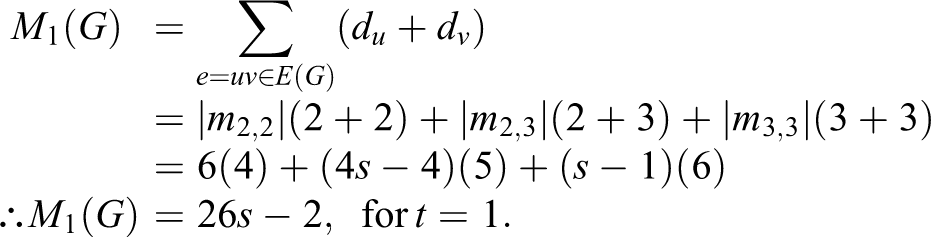
The first Zagreb index of graphene for t = 1 is
Theorem 2.2
The second Zagreb index of graphene with t rows of benzene rings and s benzene rings in each row is given by

Proof. Case 1
The second Zagreb index of graphene for t ≠ 1 is

Case 2
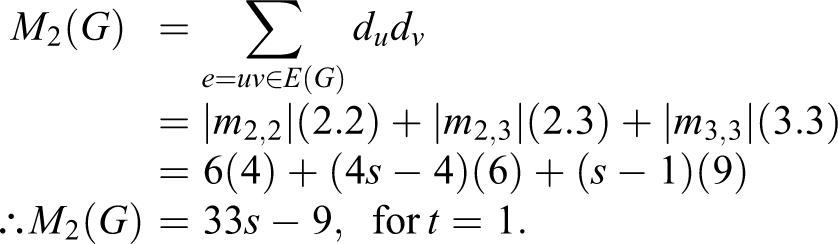
The second Zagreb index of graphene for t = 1 is
Theorem 2.3
The first multiple Zagreb index of graphene with t rows of benzene rings and s benzene rings in each row is given by

Proof. Case 1
The first multiple Zagreb index of graphene for t ≠ 1 is

Case 2
The first multiple Zagreb index of graphene for t = 1 is

Theorem 2.4
The second multiple Zagreb index of graphene with t rows of benzene rings and s benzene rings in each row is given by

Proof. Case 1
The second multiple Zagreb index of graphene for t ≠ 1 is

Case 2
The second multiple Zagreb index of graphene for t = 1 is

Theorem 2.5
The augmented Zagreb index of graphene with t rows of benzene rings and s benzene rings in each row is given by

Proof. Case 1
The augmented Zagreb index of graphene for t ≠ 1 is


Case 2
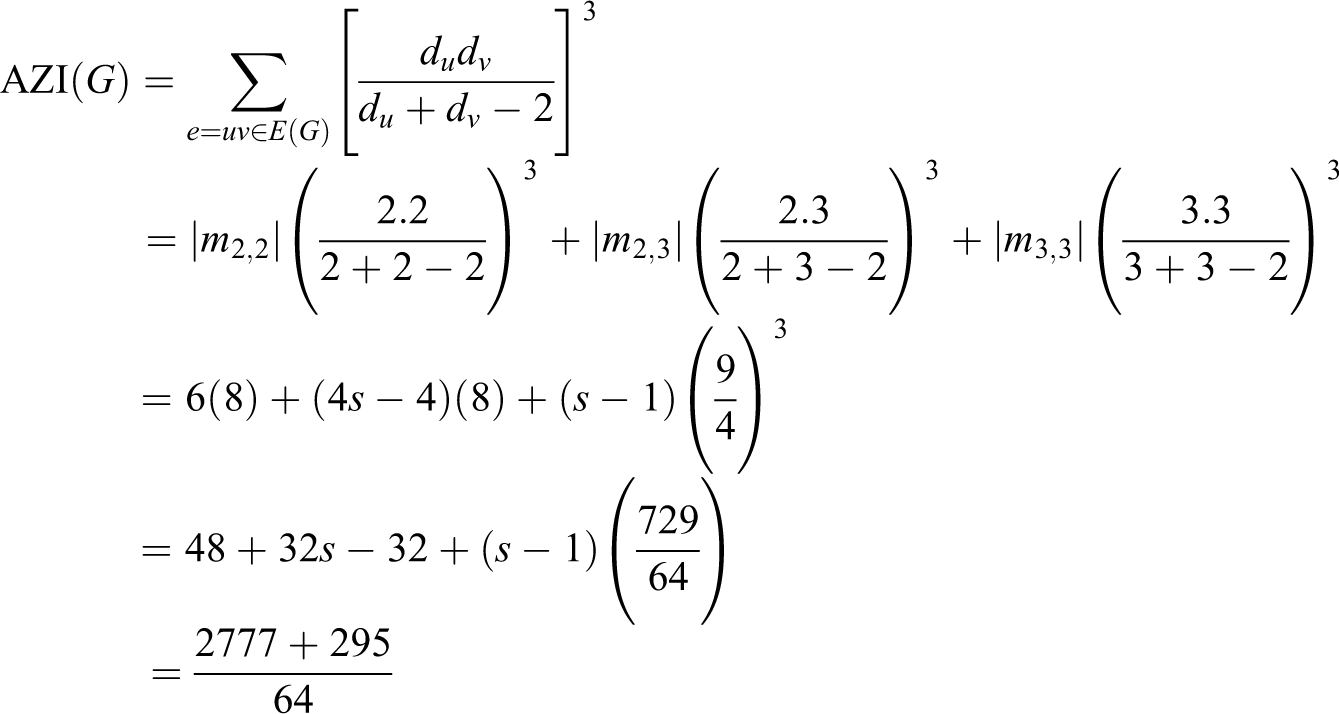
The augmented Zagreb index of graphene for t = 1 is

Theorem 2.6
The harmonic index of graphene with t rows of benzene rings and s benzene rings in each row is given by

Proof. Case 1
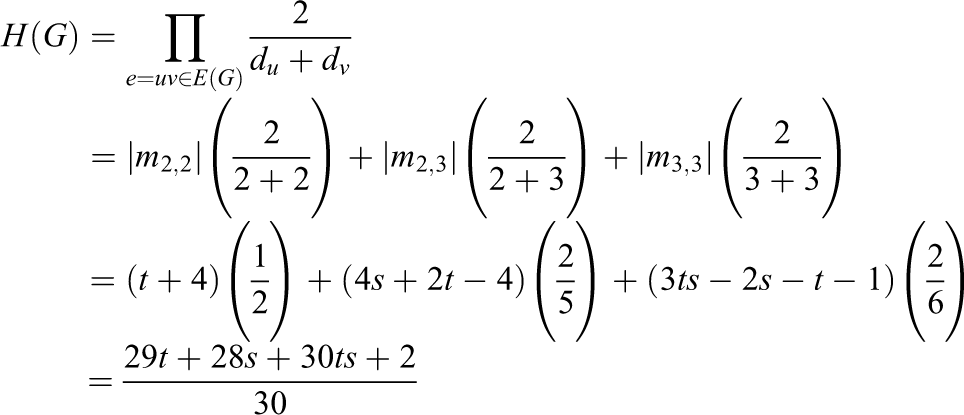
The harmonic index of graphene for t ≠ 1 is

Case 2
The harmonic index of graphene for t = 1 is


Theorem 2.7
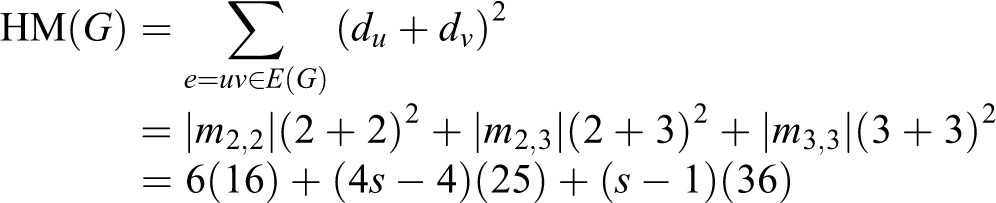
The hyper-Zagreb index of graphene with t rows of benzene rings and s benzene rings in each row is given by

Proof. Case 1
The hyper-Zagreb index of graphene for t ≠ 1 is


Case 2
The hyper-Zagreb index of graphene for t = 1 is

Conclusion
The problem of finding the general formula for first Zagreb index, second Zagreb index, first multiple Zagreb index, second multiple Zagreb index, augmented Zagreb index, harmonic index and hyper-Zagreb index of graphene is solved here analytically without using computers.
Footnotes
Authors' Contributions
All the authors worked together for the preparation of the manuscript and all of us take the full responsibility for the content of the article. However, the first and third authors typed the article and all of us read and approved the final manuscript.
Declaration of conflicting interests
The author declared no potential conflicts of interest with respect to the research, authorship, and/or publication of this article.
Funding
The author received no financial support for the research, authorship, and/or publication of this article.