




Abstract
The rise of sustainability in the luxury sector presents a paradox: for decades, luxury has been seen as antithetical to sustainability, yet younger socially conscious consumers increasingly demand eco-friendly and ethical practices from luxury brands. This study investigates the factors influencing consumer adoption of sustainable luxury products, with a focus on generational differences. We developed a framework identifying five categories of drivers of sustainable purchase intent and generated - using AI techniques - a simulated survey dataset of 1000 luxury consumers spanning four generations (Boomers, Gen X, Millennials, Gen Z). Using this dataset, we trained an ensemble of machine learning models - Random Forest and Neural Network - to test the possibility to predict purchase propensity and identify key drivers of sustainable luxury adoption. Feature importance analysis revealed that ethical sourcing was the top driver of purchase intent, followed by environmental impact and product quality. According to consumer segmentation, younger generations exhibited a higher propensity to adopt sustainable luxury, confirming a generational shift toward stronger sustainability values. Consumer adoption of sustainable luxury hinges on brands delivering superior quality and prestige alongside authentic sustainability commitments. The adaptive AI-driven profiling and forecasting can help tailor strategies to consumer segments, guiding the luxury sector toward more sustainable consumption. Across the identification of luxury value constructs and dimensions, we proposed strategies tailored on specific customer segments to predict luxury consumers behaviors and, eventually, to promote acceptance of sustainable practices.
Keywords
Introduction
The circular economy paradigm has emerged as a critical response to the environmental impacts of linear consumption models. It is oriented toward social, economic and environmental sustainability mindset and behavior of both consumers and producers, resulting in added value creation. 1 Product circularity refers to the reintegration of end-of-use products or materials into the market after undergoing a recovery process that re-creates their value. 2 While institutional efforts such as the EU Circular Economy Action Plan 3 promote these strategies, consumer acceptance remains a critical enabler of successful implementation. Indeed, consumer engagement is central to the functioning of closed-loop supply chains (CLSCs), 4 where behavior 5 and demand unpredictability significantly impacts reverse logistics and resource planning. While consumer acceptance of sustainability has been studied extensively in mass-market contexts, 6 its adoption within the luxury sector remains challenging. For instance, Mrad et al. 7 remarked the paucity of research on luxury product repairs. Also, Sharma et al. 8 studied the repurchase intentions towards luxury retail brands. Despite this clear academic interest in understanding consumers’ behavior towards sustainable practices, studies addressing explicitly how sustainability can be effectively integrated within the luxury market remain limited. 9
Luxury consumption and production are rooted in principles of excess and exclusivity, traits seemingly antithetical to the altruism, sobriety, ethics, and moderation emphasized by the sustainability paradigm, thus resulting in the sustainable luxury paradox. 10 Such a contradiction forms the springboard of this study’s motivation, leading to understand consumers’ behavior and acceptance requirements and drivers toward sustainable luxury products. Moreover, the widespread adoption of advanced technologies and tools, enhancing the reliability of predictive models, suggests the opportunity to leverage those capabilities - such as adaptive AI and ensemble machine learning - for forecasting consumer behavior.
Background: Reconceptualizing luxury consumption and production in the sustainability era
Luxury has traditionally been related to specific features such as high price, exclusivity, craftsmanship or symbolic value. Wang 11 defined luxury as “expensive and exclusive products and brands that are differentiated from other offers”, also defining luxury products features, i.e. “…exquisite design and craftmanship, sensory appeal, and distinct socio-cultural narratives”. He also identified core competences among luxury consumers, i.e. luxury expertise, sensitivity to luxury symbolism and aesthetic discernment. Furthermore, he distinguished between wealth-based and competencies-based drivers of luxury consumption, shaped by individual and social factors. Purchasing decision depends on consumption goals, product evaluation and usage, and perceived outcomes. Given their purchasing power, brand loyalty and acute value sensitivity, luxury consumers represent a particular case study in acceptance of “circular” products, such as the remanufactured or second-hand ones.
Luxury consumers have been demonstrated to be value-driven, as investigated by Wiedmann et al., 12 who provided a comprehensive model of luxury value including financial, functional, individual and social dimensions, each of which may interact differently with sustainability claims. From such a framework, Loureiro and Araújo 13 marked the individual value and the social value as characterizing principles of luxury value, together with consumer’s past experience. They also highlighted the links of those values with the consumers’ attitude, behavior and subjective norms, leading to the critical judgment on the product. However, sustainability aspects were not considered in such leading, but out-of-date, studies. More recent research, in fact, has shown that younger generations are redefining the luxury paradigm to include other values like authenticity, transparency, sustainability and purpose. 14 Such a generational shift is contributing to new forms of status signaling - such as a “green conspicuousness”-, where eco-conscious consumption enhances social prestige, 15 making sustainability a new marker of exclusivity in luxury. Nevertheless, other recent studies suggest that the perceived luxury sustainability is strongly context-related, and often negatively influences traditional luxury values perception such as self-expression, hedonism, conspicuousness, uniqueness and social value. 16
Such a gap between luxury consumers’ awareness and action underscores the need for a deeper understanding of the factors that shape sustainable luxury consumption. In this research effort, segmenting luxury consumers is essential to uncover the heterogeneous motivations and barriers to sustainable behavior. Early works, such as that by Thurston and De La Torre, 17 segmented consumers as technophiles, utilitarians and environmentalists, based on their utility priorities. Current models often build values-based segmentation that introduces psychological and socio-demographic dimensions, as proposed by Furman et al. 18 Generational attitudes have also gained significance in consumers segmentation research. Kapferer and Michaut, 19 for instance, found that Millennials luxury consumers recognize the importance of sustainability, yet continue to prioritize brand heritage and emotional gratification at the point of sale, suggesting that traditional drivers still overshadow sustainable attributes. Younger generations such as the digital-native Generation Z exhibit a similarly complex dynamic. Kumar et al. 20 highlighted that, although they express strong preferences for authenticity, ethical values and environmental responsibility, their purchasing decisions remain significantly influenced by social media and factors such as peer validation and desire for self-expression. Therefore, while sustainability remains an important value marker for Gen Z, it seems not to be always a decisive factor in actual luxury consumption. These trends collectively signal a pivotal shift: sustainability and circularity are no longer niche concerns but are becoming integral to the future of luxury consumption.
On the production side, D’Arpizio et al. in the LuxCo2030 report 21 outline five strategic imperatives for luxury brands to thrive in the era of sustainable megatrends 22 : (1) redefining brand purpose towards the greek kalokagathia concept, i.e.: luxury is what is beautiful and good both for people and the planet; (2) decoupling growth from production volume, instead investing on circular business models promoting resale, rental, reuse and remanufacturing.
The item’s life-cycle value is expected to increase the revenue by 65% in re-marketing in 2030. (3) Making the supply chain fully transparent and traceable by sharing with customers data on the environmental and social impact of supply, production and use of the product. (4) Maximizing environmental and social commitments: the former can be achieved by reducing greenhouse gas emissions using renewable energy and using sustainable raw materials, (e.g., reuse of end-of-life parts and materials in reverse logistics approaches); the latter can involve inclusivity as marketing strategy embracing updated beauty standards. (5) Creating economic value from sustainability, shifting from seeing sustainability as a cost to a long-term contributor of revenues. Following this approach, in 2022 the concept of “positive luxury” has been spread 23 to understand how can luxury businesses and sustainable growth have a mutual benefit and support. In particular, the paradigm of Transformative Luxury Research (TLR) has been proposed to explore how luxury businesses can shift to positive practices and thinking.
Accordingly, the luxury industry has responded by pioneering new sustainable materials, cutting waste and water use, and investing in community well-being initiatives. Notably, luxury goods are crafted to prioritize, or at least to include, the environmental value, i.e., the value acquired by the environment from its non-polluted or pollution-free state, 24 measurable through life cycle assessment (LCA) studies. 25
Given the depicted scenario, the present study investigates consumer’s purchase decision drivers and perceived barriers toward sustainable luxury products. For the sake of clarity, the research questions underlying this study are explicated as: RQ1: What are the purchase decision drivers and the perceived barriers determining the consumers’ choice of sustainable luxury products? RQ2: How can brands leverage positive drivers to encourage sustainable luxury acceptance?
The remainder of the paper is organized as follows. The Methodology section presents the multi-step methodological approach, progressively unveiling research design and procedure. Next, results are presented and subsequently discussed. Finally, the last section concludes the paper highlighting key points and future development.
Methodology
The objectives of this study required a multi-step methodological approach, summarized in Figure 1 and presented in following sub-sections. In detail, Figure 1 reports four main steps, indicated as 1 to 4. The first (1) identifies the basic model based on literature mapping, providing relevant purchase drivers and barriers, customer clusterization, and defining the segments of sustainable luxury acceptance. The second (2) assigns product/service specifications - linked to the specific context - to measurable constructs and operational items to build the dataset and generate the AI-supported survey queries. The next (3) applies the ensemble learning approach to preprocess and integrate data, and assigns bias based on segment attributes, also measuring strategic levers. Finally, the last (4) runs and trains the sustainable luxury learning model on dynamic biases, evaluates the model’s performance, and predicts sustainable luxury acceptance by merging customer propensity, value perception, and sustainability level. Four-step workflow. 1- Identify the basic model (drivers/barriers, customer clusterization, acceptance segments); 2 - assign context-specific specifications to constructs/items and build the dataset (AI-supported survey); 3 - apply ensemble learning to preprocess/integrate data and assign segment bias while measuring strategic levers; 4 - run/train, evaluate, and predict sustainable luxury acceptance on dynamic biases. The numbers in squares – in diverse colours - identify the main steps elements.
Literature mapping review
As a first step of our methodological approach, we conducted a literature mapping review
26
aimed at identifying the key decision drivers and perceived barriers influencing consumer acceptance of sustainable luxury products. This review not only contextualizes the current academic discourse but also supports the subsequent phases of our research design. The Scopus database was selected as the primary knowledge source due to its broad interdisciplinary coverage and indexing rigor.
27
The search strategy was articulated through four logical dimensions, each reflecting a core conceptual pillar of our study: 1. Context: Luxury Sector. TITLE-ABS-KEY (“luxury product” OR “luxury fashion” OR “premium product”) To capture the relevant industry domain, we focused on literature addressing fashion, luxury products, and premium products. This scope included conventional luxury in term of high-end goods, while deliberately excluding the service sector to maintain focus on physical items amenable to environmental impact assessment. 2. Focus: Sustainability Adoption. TITLE-ABS-KEY(“sustainab*” OR “green” OR “environment*”) Here, we included literature referencing sustainability in all its dimensions: economic, social, and - especially – environmental. 3. Agent: Consumer Perspective. TITLE-ABS-KEY (“consumer” OR “customer” OR “client”) The query was constrained to consumer-centric studies, aligning with our aim to explore the demand-side and acceptance drivers and barriers of sustainable luxury. 4. Scope: Decisional Drivers. TITLE-ABS-KEY (“accept*” OR “attitude*” OR “perception*” OR “behavior” OR “decision” OR “willingness to pay”) AND TITLE-ABS-KEY (“factor*” OR “driver*” OR “motivation*” OR “barrier*” OR “challenge*” OR “influence*”)
Finally, to capture both observable behavioral outcomes and the underlying cognitive-affective mechanisms, we formulated a composite search as reported above.
The combination of the four above-listed queries within “title, abstract and keywords” returned 115 documents.
Then, we applied the exclusion criteria: - Year of Publication: in light of the UN Sustainable Development Goals (SDGs) launched in 2015,
28
we considered only papers published from 2015 onwards, narrowing the sample to 107. - Language: only English-language papers were included, resulting in 105 documents. - Title and abstract screening: we reviewed titles and abstracts for alignment with our focus on consumer decision-making in sustainable luxury. This final filter yielded a refined corpus of 59 papers.
Survey generation
Literature provided a set of value constructs and dimensions that act as strategic levers for sustainable luxury adoption, fixed specific consumer segments and targets. Accordingly, purchase decision drivers and barriers need to be tested, per consumer segments, across data collection. Due to practical constraints in surveying a sufficiently large and representative sample of luxury consumers within this study’s timeframe, we generated a simulated dataset to approximate the survey results of 1000 luxury customers using Python 3.13.2 version. On this, prior literature applied simulated survey as effective means to refine design and analytical study in the absence of real respondents. 29
Decision drivers and perceived barriers identified in the literature contributed to evaluate relevant categories and related questions to build a structured survey. In detail, clusterization of consumers based on segment assignment and product/service specifications, allowed to generate the instances underlying survey questions. Simulation allowed to incorporate known sets of barriers, purchase drivers and trends (from prior research) into the data while maintaining a realistic variability. The sample of 1000 luxury consumers was segmented across four generational cohorts, since the generational propensity towards sustainable luxury was highlighted as a key factor in the literature. In particular, we considered: Baby Boomers, GenX, Millennials, and GenZ. Generation was determined by age (which was part of the generated profile data) and encoded as a categorical variable. In generating responses, we introduced generational biases grounded in empirical insights deduced from the literature analysis: older consumers were assigned slightly lower average ratings on sustainability-oriented questions, whereas younger consumers had progressively higher average ratings on those same items. This reflects findings that older luxury buyers tend to be less inclined toward sustainable purchases, while younger generations attribute greater importance to sustainability factors. For example, on questions about environmental impact or ethical sourcing, Boomers might average a moderate interest level, whereas GenZ averages a very high interest. We implemented this by sampling responses from truncated normal (Gaussian) distributions centered at generation-specific means for each question. The random variations ensure not all young consumers answer identically, but the overall trend favors higher sustainability concern among the youth. Likewise, to mirror realistic conditions, we assumed younger luxury consumers (being digital natives) are more likely to engage with such a questionnaire or AI tool, and therefore they are slightly over-represented in the simulated dataset compared to the oldest cohort (though each generation had a minimum representation to allow comparison).
Each simulated respondent’s data consists of: (a) demographic info (age, generation, gender) and (b) answers to the 10 decision driver questions (each on a 1–10 scale). From these answers, we computed an individual’s sustainability propensity score – effectively the target variable for our predictive models. That score represents the consumer’s overall propensity or likelihood to choose a sustainable luxury product. It derived from a weighted sum of the 10 responses, where each question’s response was multiplied by a normalization weight reflecting that question’s relative importance (initially hypothesized based on our literature review). We normalized the final score to a 0–1 range for subsequent use in machine learning models. For instance, if a respondent indicated high importance for ethics and environment and also willingness to pay more, their propensity score would be higher, whereas someone who cares only about quality and not sustainability aspects would score lower. By design, this constructed score should correlate with actual likelihood of purchasing sustainable luxury, though in a real study it could be validated against observed behavior.
Machine learning models pre-processing and integration
The subsequent step consisted in analyzing and predicting consumers’ purchase propensity, according to the collected data. To this end, we implemented the Random Forest Regression (RFR) and Forward Neural Network (FNN), chosen for their complementary strengths in capturing relationships in the data 30 and for their recognized capability in modelling complex interactions of features. 31
The RFR was chosen for its ability to build multiple decision trees and to combine their outputs (through averaging for regression) to produce a more accurate and stable prediction than any individual tree. 32 This bagging-based approach reduces model variance and helps prevent overfitting, enabling RFR models to achieve high predictive accuracy even in high-dimensional feature spaces. Also, RFR regressors demonstrated their ability to evaluate feature importance: by analysing the contribution of each input feature to the splits in the decision trees, the RFR can rank features by importance, offering insight into which predictors most strongly influence the output. 33
The FNN is a type of neural network where information moves in only one direction, i.e., from input layer through any hidden layers to the output layer. FNNs can model complex interactions among features through its hidden layers, potentially capturing higher-order patterns that - instead - decision trees might miss. Their primary strength lies in learning from large datasets and generalizing the learned patterns to new - or unseen - data. 34 During training, the network adjusts its weights to minimize error, enabling it to capture intricate interactions between features. Such a flexibility allows neural networks to achieve high accuracy given sufficient data and proper tuning.
Figure 2 reports the machine learning modelling logic. Machine learning modelling procedure.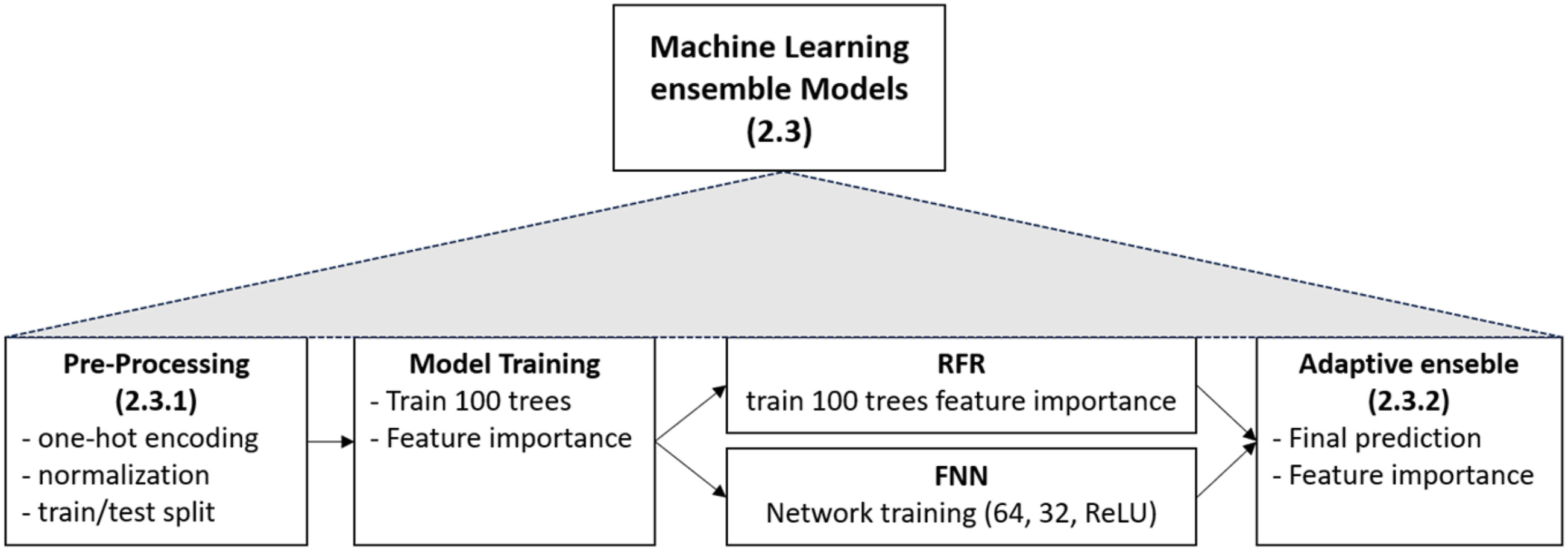
Model pre-processing
Before modelling, we performed data pre-processing by encoding categorical features and normalizing numerical ones. However, these settings are not universally generalizable. For specific luxury sectors and products whose acceptance is being studied, the pre-processing steps must be carefully and specifically tuned.
For our purpose, generation category variables were defined as follows: Boomers for births between 1926 and 1964; GenX for the range 1965-1980; Millennials 1981-1996 and GenZ 1997-2012. The probability of occurrence in the survey assigned to each generation was set to 0.15 for Boomers, 0.22 for GenX, 0.34 for Millennials, 0.29 for GenZ. Also, the average response score was tailored according to the generational group of the interviewed, as per literature review deductions: the average rating was set equal to 4.5 for Boomers; 5.5 for GenX; 7 for Millennials, 8 for GenZ. Each categorical variable was converted into numeric form creating binary indicator columns for each category so that the models could process these features. Numerical features were scaled as per Anggoro et Supriyanti, 35 using z-score normalization, transforming their distributions to have mean 0 and standard deviation 1. Z-score normalization ensures that features with larger numeric ranges do not dominate those with smaller ranges. In order to prioritize questions more relevant to understand consumers’ propensity features toward sustainable luxury, in the chosen sector, we assigned weights to each question as follows: 0.9 to Q1, 0.7 to Q2, 0.8 to Q3, 0.3 to Q4, 0.2 to Q5, 0.8 to Q6, 0.4 to Q7, 0.5 to Q8, 0.2 to Q9, 0.7 to Q10.
The dataset was split 80/20 into a training set and test set to evaluate model performance on unseen data.
Elaborating on the approach proposed by Abu-Dalbouh et al., 36 we utilized an adaptive AI method, combining the mentioned learning techniques to predict consumers’ propensity to buy sustainable luxury items based on those drivers. By analyzing model outcomes and feature importances, we evaluated which factors most strongly impact consumer decisions, thus providing insights for overcoming acceptance barriers of sustainability in luxury products.
The RFR was configured with n_estimators (trees) equal to 100. As per Probst et al. 37 we set and test that value trying to balance performance measures and the precision of the variable importance. We reduced variance via bootstrap aggregating and per-split random feature selection. Each tree learns a mapping from the 10 question features (plus generation dummies) to the propensity score by recursively splitting the data on feature values to minimize prediction error (measured by variance reduction or mean squared error in regression). By aggregating the predictions of many trees, the RFR yields a robust prediction with reduced overfitting. We also extracted the feature importance from the trained RFR, which indicates how much each question contributed to reducing prediction error across all trees. This represented a crucial output for understanding which drivers have the most influence on purchase propensity in the model’s eyes.
The FNN model was designed with one input layer, two hidden layers and one output neuron. The input layer size corresponds to the number of features per respondent (in our case, 10 questions + 4 generation dummy variables = 14 inputs). The first hidden layer had 64 neurons and the second one had 32 neurons, both using Rectified Linear Unit (ReLU) activation, and the output layer had a single neuron with sigmoid activation to produce a propensity value between 0 and 1. We trained the network using backpropagation (gradient descent) on the training data, minimizing mean squared error loss. Regularization techniques – e.g., early stopping or dropout - were considered given the relatively small feature set, but the risk of overfitting in this simple scenario was low. This kind of approach allowed to capture complex behavioral dynamics correlations (e.g.: a combination of high ethical concern and high willingness to pay might lead to purchase decision).
Adaptive ensemble approach
To leverage the complementary strengths of the RFR and FNN models, we implemented an ensemble method to combine their outputs. As per Naderalvojoud et Hernandez-Boussard, 38 Ensemble Learning is a technique where multiple models are combined to produce a single prediction, often yielding higher accuracy and more robust results than any individual model alone. For our research, we used a simple averaging ensemble: for each data point, the predicted values from the trained RFR and FNN were averaged to produce the final prediction. Averaging the predictions of two different models helps to reduce variance in the output and can compensate for errors that one model might make but the other avoids. Therefore, if the RFR and FNN have uncorrelated prediction errors, the ensemble can smooth out these errors, leading to improved overall performance and stability. Ensemble averaging is a straightforward yet effective way to improve generalization, shown to increase reliability of predictions in many scenarios by pooling the strengths of multiple models. 39
Performance evaluation strategy
We evaluated model performance using a train/test split strategy. The dataset was divided into a training set for model fitting and a test set for performance evaluation (Figure 3). Performance evaluation flow.
The model learns patterns from the training data and is then tested on the hold-out test data to assess how well it generalizes to unseen samples. 40 We used this approach - rather than evaluating on the training data - to obtain an unbiased estimate of the model’s predictive ability. By comparing training and test results, we also monitored overfitting: if the RFR or FNN performed much better on training data than on test data, it would indicate overfitting. Using a dedicated test set thus validated that the chosen models and preprocessing steps generalize well and are not merely memorizing the training data.
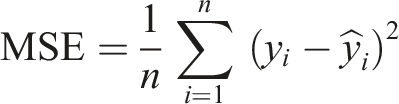
Model performance was evaluated using regression metrics: Mean Squared Error (MSE) to measure average prediction error, and Coefficient of Determination (R^2) to measure explained variance. 41 For context, an R^2 near 1 and very low MSE would indicate the model can almost perfectly predict the propensity score, which would be expected if the survey responses strongly determine purchase intent – and in a simulation where some noise is present but underlying patterns are clear. Additionally, for the RFR, we examined the ranked feature importances (expressed as a percentage contribution sum to 100%) to identify the top drivers in predicting sustainable purchase propensity. These importance values are derived from the cumulative reduction in prediction error each feature contributes across all the trees. Finally, although not a primary focus for this paper, we visually evaluated the distribution of responses and propensities by generation to verify that the simulated data reflected presumed generational trends and to see how predicted propensity differed among age groups.
Results
Mapping drivers and barriers to sustainable luxury adoption
Following, we present the output of the literature analysis, summarizing the key contributions of each study in terms of purchase decision drivers and perceived barriers to the acceptance of sustainable luxury products.
Jin and Ryu 42 delve into the psychological and behavioral characteristics that shape consumer attitudes toward luxury fashion on Instagram, identifying vanity, materialism and social comparison as central decision-making drivers. These factors deepen consumer engagement with brands and enhance purchase interest through the visual and social nature of the platform. However, a significant obstacle to the integration of sustainability within luxury consumption lies in the very foundation of these drivers, which are often rooted in conspicuous consumption. This emphasis on self-image and social validation tends to marginalize ethical concerns and sustainability considerations. Similarly, De Angelis et al. 43 demonstrate that when sustainable luxury products maintain design continuity, i.e., retaining aesthetic elements consistent with a brand’s previous luxury offerings, consumers are more likely to accept them. This familiarity acts as a powerful decision driver. In contrast, when green designs deviate too much, especially when they echo aesthetics more typical of mass-market eco-brands, consumers may perceive a mismatch with luxury brand identity. Such perceptual gaps act as barriers, emphasizing the importance of maintaining brand heritage and visual coherence to foster sustainable luxury acceptance.
Turning to the field of virtual consumption, Liu et al. 44 explore decision drivers in virtual luxury purchases and motivations drivers such as social value (status signaling), emotional attachment to avatars and the appeal of aesthetic novelty: such elements lead to innovative expressions of luxury. Conversely, the intangible nature of virtual goods may diminish sustainability concerns altogether, potentially weakening consumer accountability for environmental impacts and presenting a challenge for sustainable adoption in digital luxury. Similarly, Zhang et al. 45 explore digital luxury fashion, where environmental awareness, social value and personalization through avatar customization are growing drivers. But the lack of physical ownership and concerns over the environmental cost of digital infrastructure present substantial challenges. Hu and Phanniphong 46 underscore the important role of interactive communication, influencer trust and digital policy in building consumer confidence in virtual luxury. But digital misinformation and privacy issues can reduce trust and positive behavior toward sustainable luxury, particularly when transparency is lacking.
Cultural factors also significantly influence luxury purchase decisions. Chaisuriyathavikun and Punnakitikashem 47 find that consumers are drawn to luxury gold purchases due to cultural symbolism and the perception of long-term investment value, leading to keep loyalty to traditional luxury habits. Yet, sustainability is often sidelined, primarily because of low awareness regarding sourcing ethics and environmental consequences - making such concerns virtually invisible in consumer decision-making. Similarly, Appiah-Nimo 48 remarks local authenticity and cultural heritage as valuable decision drivers in sustainable luxury markets. However, systemic barriers such as operational inefficiencies, poor branding strategies or under-resourced supply chains hinder the effective communication and implementation of sustainability within local luxury ecosystems.
From a neuroscientific perspective, Balconi et al. 49 prove that ethically-inclined consumers exhibit stronger emotional and cognitive reactions to sustainable brand messages. Nonetheless, the broader market is held back by a lack of awareness and emotional disengagement among less sustainability-focused consumers, who often fail to internalize or act on ethical cues. Schulte et al. 50 emphasize the relevance of ethical sourcing concerns and the willingness to pay more among ethically-minded consumers. While these are significant decision drivers, they are moderated by income levels: many middle-income consumers demonstrate a mismatch between intentions and behavior. Furthermore, enduring issues like supply chain opacity and historical controversies, such as conflict diamonds, continue to hinder sustainable progress in the luxury jewelry sector.
Psychological motivators also come into play, as shown by Giri et al., 51 who find that desires for uniqueness, legacy and a sense of accomplishment are key drivers of sustainable luxury purchases. However, despite such intrinsic motivations, an attitudinal-behavioral gap remains, acting as a persistent obstacle: consumers advocate for sustainability in principle, but do not consistently reflect these values in their purchasing behavior.
Access-based models such as resale and rental are highlighted by Hu et al. 52 as promising avenues for sustainable luxury, driven by benefits like affordability and waste reduction. Nevertheless, the perception that second-hand luxury items undermine the prestige and authenticity central to traditional luxury presents a substantial barrier. Rental-based consumption was also explored by Ruan et al., 53 who combine theories of luxury and collaborative consumption, identifying motivations such as sustainability, uniqueness and hedonic benefits, alongside affordability and social acceptability, particularly appealing younger demographics. Yet, barriers remain in the form of rental stigma, reduced perceived exclusivity and concerns over hygiene.
Cassidy 54 shows that enduring values - such as quality, craftsmanship, and heritage - are key decision drivers for sustainable luxury. Yet, the fast-paced nature of the fashion industry, characterized by mass production and discounting, diminishes consumers’ ability to appreciate long-term product value, undermining sustainability’s appeal. Perez et al. 55 find that consumers better respond when eco-friendly attributes are central to the product and reflect sincere manufacturer intentions: product authenticity emerges as a critical decision driver. However, when such features are seen as superficial or promotional, trust deteriorates, undermining the product’s appeal and representing a major adoption barrier. Similarly, Henninger et al. 56 identify trust, durability, quality and self-expression through ethical consumption as compelling motivations for sustainable luxury. Despite this, confusion over sustainability claims and the persistent association of luxury with status and conspicuousness often hinder behavioral alignment with ethical intentions. Also, Kaur et al. 57 emphasize the power of emotional connection to ethical values and environmental awareness as effective marketing drivers in sustainable luxury. However, skepticism around greenwashing and the perceived tension between exclusivity and ethics continue to challenge consumer acceptance.
Ali et al. 58 stress that factors such as status motivation and cultural values influence high-involvement green-luxury purchases. Yet, the challenge lies in reconciling materialistic values with sustainability, especially when consumers perceive an inherent trade-off between green features and luxury attributes. Wu and Zhao 59 shed light on the effects of value consciousness and social risk perception. Consumers who prioritize price and performance may undervalue authenticity, making them susceptible to counterfeits. This not only weakens sustainable adoption but also highlights the importance of reinforcing the exclusive and ethical value of genuine luxury goods. Schmidt et al., 60 still, argue that values like authenticity, quality and social justice allow luxury and fair trade to coexist. Moral identity and value congruence are compelling drivers, but the legacy of indulgence in luxury branding remains a core obstacle.
Malhotra and Shaiwalini 61 turn to the second-hand luxury market, where environmental concern and product quality, when supported by brand trust, are powerful drivers. Nonetheless, concerns over authenticity, condition and social stigma remain barriers, requiring greater transparency and reassurance from brands to foster trust. Yan et al. 62 investigate second-hand luxury in China, where drivers such as emotional attachment, quality perception, and recycling awareness encourage sustainable choices. Here, subjective norms - typically strong in collectivist societies - have limited impact, indicating a lack of social support for second-hand consumption and the persistence of stigma. Donzelli et al., 63 similarly, show that economic and social motivations encourage second-hand luxury purchases. But, surprisingly, environmental and personal factors were proved to have less influence. Even with guarantees of authenticity and anonymity, barriers like distrust and stigma persist. Lou et al. 64 focus on the second-hand market, where perceived green, social, emotional and quality value support sustainable luxury. Yet, risks surrounding hygiene and authenticity still deter many consumers, emphasizing the importance of logistic and process transparency. Stolz 65 finds that perceived behavioral control, subjective norms and ethics drive second-hand luxury intentions. Yet, concerns over hygiene, authenticity and counterfeit risk persist, fostering an ambiguous social status of pre-owned luxury, which deters many potential buyers.
Lee and Furukawa 66 find that subjective well-being and life satisfaction positively correlate with sustainable luxury behavior, with novelty-seeking serving as a mediating factor. However, specific cultural contexts affect how well-being translates into ethical behavior, particularly when indulgence and pro-environmental values collide. Jain 67 synthesizes four overarching dimensions influencing sustainable luxury: cultural, personal, social and economic. Decision drivers range from self-expression to environmental concern, yet perceived cost and doubts about authenticity hinder deeper engagement with sustainable offerings.
Minton and Geiger-Oneto 68 explore the role of religiosity in luxury disposal, finding that intrinsic religious values support pro-environmental behavior through guilt and moral responsibility. However, cases of extrinsic religiosity, focused more on appearances than ethics, can foster behaviors inconsistent with sustainability, underscoring the ambivalent influence of religion. Algumzi 69 showed that personal growth and modernity serve as strong motivators in young women’s luxury consumption. However, longstanding associations of luxury with wealth and religious values, in specific regional contexts, remain hurdles to integrating sustainability.
Lim et al. 70 note that green advertising in luxury contexts enhances behavioral intention - especially when messages are clear and perceived as trustworthy. Yet, skepticism and confusion, particularly when greenwashing is suspected, undermine effectiveness.
Bonisoli et al. 71 highlight environmental concern and social norms as key motivators, though greenwashing significantly erodes trust. This is particularly problematic in emerging markets, where regulatory oversight of sustainability claims is limited.
Cohen 72 provides an overview on sustainable attributes acting as decision drivers, among which we mention craftsmanship, durability and ethical sourcing as the most attractive ones. However, brands’ inconsistent and sometimes late responses to sustainability reduce credibility, demanding more authentic integration across the sector.
Jansom and Pongsakornrungsilp 73 demonstrate how influencer marketing drives trust and perceived value in sustainable luxury. Nonetheless, influencers’ credibility can be questioned, especially if followers detect insincerity, diluting the sustainability message. Osburg et al. 74 confirm that sustainable features boost perceived value in luxury products globally, with stronger effects in developed markets. In emerging markets, weak infrastructure and limited brand trust act as formidable barriers.
Abdelmeguid et al. 75 identify craftsmanship, timelessness, and innovation as compelling drivers in luxury fashion’s pivot toward sustainability. These attributes naturally align with the slow fashion ethos. Yet, only a fraction of brands actively emphasize circularity, with underinvestment and a lack of industry-wide standards impeding broader systemic integration. As such, the sector’s full potential remains unrealized despite favorable foundations.
Quintal and Cheah 76 highlight how branding and consumer decision-making intersect with emotional gratification and identity alignment in luxury. These factors act as core motivators. However, conflicts arise when traditional notions of luxury - rooted in excess and indulgence - clash with sustainability values, creating cognitive dissonance that limits behavioral consistency.
Achabou 77 investigates attitudes toward animal welfare in luxury, revealing a tension between ethical considerations and perceptions of luxury: while some consumers are drawn to ethically sourced animal products, others prefer synthetics. However, synthetic materials often lack the tactile prestige of traditional ones, creating a trade-off between ethics and perceived luxury value that complicates decision-making.
Gupta et al. 78 synthesize key insights across the sustainable luxury literature, identifying emotional resonance, aesthetic value and exclusivity as enduring decision drivers. Yet, sustainability often remains peripheral in luxury branding. The failure to integrate it into core narratives reinforces conspicuous consumption and undermines deeper consumer alignment with ethical values.
Jain and Mishra 79 focus on millennials’ adoption of rental models, found to be driven by social projection, perceived pleasure and cost efficiency. However, barriers such as hygiene concerns, perceived authenticity and social stigma still hinder rental models’ growth. Even with a history of sustainable behaviors, used luxury remains tainted by associations with lesser value. Keeping the focus on this generation, Sun et al. 80 find that Indonesian millennials value symbolic, social and financial benefits in luxury purchases. While ethical concerns are acknowledged, they often remain secondary to brand prestige and self-identity needs, revealing the persistent dominance of status-driven consumption over sustainable intention. Schemken and Berghaus 81 find that millennials express strong expectations for CSR and transparency. Yet, they remain ambivalent when reconciling their ideals with traditional luxury’s indulgent image. This cognitive dissonance, and their context-dependent behavior adds complexity to sustainable engagement. Salah et al. 82 show that environmental concern boosts perceived value of second-hand luxury, especially among Gen Z and millennials. However, authenticity concerns and weak consumer attitudes mediate this effect, showing that values alone are insufficient without trust. Mishra et al. 83 compare regional preferences showing that, for instance, UAE consumers prioritize social status in rentals, while Indian millennials value environmental impact. Despite differing drivers, both markets face infrastructural and awareness-related barriers that prevent rental models from achieving mainstream legitimacy.
Brandão and Magalhães 84 show that experiential value and sustainability boost brand equity among younger consumers. However, if the brand is not perceived as “luxurious enough,” sustainability messaging loses efficacy, illustrating the fragility of green positioning when decoupled from symbolic capital.
Essiz and Senyuz 85 identify multiple value dimensions, i.e. functional, emotional, epistemic, and green, as influential in sustainable luxury intentions. A key driver is the ethical alignment between consumers and brands. Yet, skepticism toward green advertising and the limited role of social value continue to erode trust and inhibit conversion.
Al-Issa 86 finds that when sustainability enhances core luxury traits like quality and durability, consumer perception improves. However, it also dilutes exclusivity and prestige, especially in cultures where status signaling remains central. The resultant value conflict represents a key adoption barrier.
Bishnoi and Guru, 87 while focusing on fast fashion, illustrate an indirect challenge for sustainable luxury: affordability, trendiness and identity expression keep youth anchored to unsustainable consumption, reinforcing behaviors that directly compete with green luxury offerings.
Zhao et al. 88 outline five determinants, i.e. material use, recycling, CSR, advertising, and brand promise, that shape luxury consumers’ purchase intention. Transparency and ethical commitments resulted to be crucial drivers, yet fears that sustainability weakens exclusivity continue to diminish perceived luxury value.
Vera-Martínez et al. 89 demonstrate how personality traits such as egoism and sustainability orientation interact with motives like self-expression. While self-efficacy and environmental concern motivate ethical consumption, anthropocentrism and low ecological awareness weaken the intention-behavior link, acting as psychological hurdles.
Da Silva et al. 90 confirm that luxury boosts powerful decision drivers such as social attractiveness and sense of dominance. Yet, this very emphasis on social signaling reinforces conspicuous consumption, directly clashing with sustainability principles and making ethical adoption difficult.
Pantano and Stylos 91 explore spontaneous online comments to reveal that rental motivations include sustainability, novelty and experiential access. Renting is seen as progressive, but concerns over social perception, hygiene, and exclusivity remain persistent barriers.
Madzharov et al. 92 show how sensory elements like ambient scents can elevate preference for premium brands by influencing perceptions of space and power. However, such subconscious luxury triggers often overshadow sustainability considerations, creating indirect but potent psychological barriers.
Park et al. 93 highlight that perceived scarcity strengthens the link between positive attitudes and sustainable luxury purchasing. When sustainability is framed as exclusive, it enhances desirability. Conversely, the absence of scarcity cues weakens motivation and follow-through.
Silva et al. 94 categorize motivations for pre-loved luxury into bargain hunting, treasure seeking and individualism. Still, fragmented consumer perceptions of resale legitimacy and diminished exclusivity continue to restrict broader adoption.
Cleveland et al. 95 explore how Japanese ethnic identity and global consumer culture shape luxury behaviors. Cultural hybridity acts as a driver - global trends promote materialism, while traditional values support ethical restraint. The conflict between these forces complicates sustainable adoption.
Cao et al., 96 applying dual-process theory, find that emotional triggers and in-store stimuli drive impulse purchases in affordable luxury. These fast-processing decisions overshadow slower, rational sustainability considerations, making impulsivity a significant psychological barrier.
Bhaduri and Stanforth 97 show that artisanal cues like “handcrafted” enhance value perceptions for highly involved consumers, in terms of product quality and uniqueness. Yet, low involvement consumers remain less responsive to these cues, limiting the scalability of such sustainability narratives.
Hasbullah et al. 98 emphasize the power of user-generated content on social media. Peer trust in authentic messages is a major driver, while scepticism toward corporate sustainability claims, especially when not backed by action, remains a powerful barrier to adoption.
Hur and Ha 99 reveal that consumer empowerment via co-creation and crowdsourcing deepens engagement and psychological ownership mechanisms, supporting sustainable luxury involvement. Still, brands must avoid diluting exclusivity, as the perception of luxury can be undermined if democratization is not managed carefully.
Liu et al. 100 show that perceived scarcity in luxury activates consumers’ psychological need for control, motivating sustainable purchases as a form of emotional compensation. However, this response varies: individuals with internal locus of control or lower economic mobility may not respond in the same way, indicating that scarcity as a purchase decision driver has limited universal appeal.
Mapping of decision drivers and barriers categories to luxury value dimensions.

Survey questions
Based on the findings from the literature review, we developed a targeted survey, AI-supported, to evaluate luxury consumers’ propensity toward purchasing sustainable luxury products. Each survey question aligns specifically with the purchase decision drivers and perceived barriers identified in the literature, thus enabling an accurate analysis of factors influencing consumer decisions. After defining each question, we employed ChatGPT version 4o as a drafting tool to harmonize item wording, reduce ambiguity and standardize scale anchors. All prompts constrained the model to rephrase only - no content changes-, and all the authors approved the final wording. We selected GPT-4o for its strong text performance and faster iteration relative to prior GPT-4 variants, with improved support for non-English phrasing where relevant. This step was essential to test the consistency of the proposed questions and to fine-tune them by giving proper emphasis to the key terms.
Initially, the survey captures demographic details of respondents to contextualize their profiles. Subsequently, we formulated ten questions (from Q1 to Q10) to measure consumers’ inclination toward sustainable luxury, organized into clear thematic categories reflecting identified barriers and motivations. These items utilize quantitative response formats (Likert-scale ratings from 1 to 10), making the data suitable for predictive modeling. The categories and corresponding survey questions are detailed below: - Category 1: Economic/Qualitative. These questions were formulated to test whether consumers require sustainable options to match traditional luxury quality and whether they accept to pay a higher price for sustainability. • Quality – Q1: “How important is product quality to you?” • Price – Q3: “How much extra are you willing to pay for a sustainable luxury product, with the same quality of a non-sustainable one?” - Category 2: Social/Cultural. These questions serve to assess the role of luxury’s long-term value (aligned with circular economy ideals) and social proof or norms in sustainable purchase decisions. • Product durability – Q8: “How important is the durability/longevity of the product to you?”; • Peer influence – Q5: “How much do others’ opinions (reviews, recommendations) influence your purchase?” - Category 3: Psychological/Emotional. These questions probe personal values and emotional investment in sustainability, reflecting internal motivators or reservations (such as skepticism or moral commitment). • Environmental impact – Q2: “How much do you care about the environmental impact of a luxury product?” • Ethical origin – Q6: “How important is knowing the ethical origin (fair labor, humane practices) of the luxury product you are buying?” - Category 4: Practical/Structural. This category examines the appeal of innovation (often tied to sustainability advances) and perceived market availability or convenience of sustainable options. • Innovation desire – Q4: “How strongly do you prioritize innovative, cutting-edge luxury products (which may include new sustainable materials)?”; • Functional quality – Q10: “How reliable, in terms of functional quality and performance, do you consider sustainable luxury products?” - Category 5: Informational/Cognitive. These measure the consumer’s need for information and trust in brands’ sustainability efforts, addressing knowledge gaps and potential mistrust. • Traceability – Q9: “How important is full transparency/traceability of a product’s supply chain to you?”; • Brand effort – Q7: “How important is to you the luxury brands effort in reducing waste and emissions?”
The set of survey questions presented above can be assumed as a representative example to study consumers’ propensity toward sustainable luxury. Instead, response elaboration settings and machine learning logic need to be adjusted based on the specific luxury sector and product. Below, we present the results of a case study within a luxury fashion product to illustrate the validity of the proposed methodology.
Models performance evaluation
After submitting the survey questions to the generated sample of interviewees, machine learning approaches elaborated results, demonstrating very good performance in predicting a consumer’s propensity to purchase sustainable luxury, with the ensemble model showing near-perfect accuracy on the simulated dataset.
The accuracy of both models is measured using the following metrics: - Mean Squared Error (MSE), measuring the average squared difference between the predicted and actual values. A low MSE indicates that the model’s predictions are close to the actual values. - Coefficient of Determination (
The 
The RFR and FNN each provided, respectively, MSE equal to 0.0035 and equal to 0.0004, values very close to 0 on test data. The RFR (left) and FNN (right) performance results in terms of MSE and R-squared. Ensemble model results in terms of MSE and R-squared.

In practical terms, the accuracy of results reveals that, given a set of answers about a customer’s priorities on product purchase decision, the AI can predict with high confidence that customer’s inclination towards buying a sustainable luxury product. The high value of
Sustainable luxury purchase: Key decision drivers
The RFR’s feature importance (Figure 6) output provides insight into which factors most strongly influence sustainable purchase propensity, for the specific case study set. RFR feature importance results.
The most influential factor, across generations, resulted to be the ethical origin of the product (question Q6), which significantly outranked all other features in importance. The model attributed the highest weight (in terms of importance percentage) to the survey question about ethical sourcing, meaning that how a customer answered the “ethical” question, had the greatest impact on predicting their propensity to buy sustainable luxury. In essence, the AI learned that consumers who highly value ethical production (fair labor, animal welfare, etc.) are far more likely to be inclined toward sustainable luxury purchases. This finding underscores ethics as a critical acceptance requirement: a luxury product’s perceived ethical sourcing is a decisive driver for consumers when considering sustainability.
Following ethical origin, the next most important driver was deduced by question Q1, i.e., product quality. While a traditional luxury attribute, quality emerged as a key factor as well – but interestingly, in this context, high quality works as an enabler for sustainability acceptance. The data and model reflect that consumers will embrace sustainability in luxury only if it does not come at the expense of quality. This aligns with earlier observations that when a luxury buyer perceives sustainability in harmony with top-tier quality, the supposed contradiction between luxury and sustainability diminishes. Quality might not directly increase propensity (since all luxury buyers expect it), but lack of quality would certainly be a deal-breaker.
The third factor regards Q3, i.e., how much extra a consumer is willing to pay for a sustainable luxury product, with the same quality of a non-sustainable one. The importance of this driver implies the fundamental role of quality in sustainability acceptance, confirming that sustainability should be and added value, rather than a substitutive value.
The environmental impact concern (Q2) strongly correlates with willingness to choose sustainable options, as expected. Following, Q10: product reliability, in terms of functional quality and performance, represents another important concern, also confirming (as per Q1), that traditional luxury values cannot be substituted.
Other features played supporting roles. Product durability and longevity concern (Q8) contributes to sustain the centrality of functional quality requirements. Traceability interest (Q9) was important for some segments, aligning with the notion that lack of information can hinder sustainable choice. Those who strongly seek traceability tend to reward brands that provide it (Q7), as well as may go away from those that do not. The social influence driver (Q5) had a measurable but smaller effect – the model did capture that, for instance, a consumer highly swayed by peer opinions could be more likely to buy a sustainable luxury item if such behavior is seen positively in their social circle. This corresponds with the idea of green conspicuousness: as sustainable luxury gains social acceptance, peer influence could amplify adoption. Innovation desire (Q4), likewise, showed a small influence: some consumers are drawn to sustainability because it often accompanies innovative design or novel materials.
Read by question category, the patterns mirror the item-level results: Ethical/Impact (e.g., Q6) dominates; Quality/Function (e.g., Q1, Q3, Q10, Q8) operates as a necessary enabler rather than a trade-off; Informational/Traceability (e.g., Q9 with related proof points such as Q7) reduces cognitive barriers. Finally, Social/Normative and Individual/Psychological elements play supporting roles.
Generational segmentation and propensity toward sustainable luxury
Distribution of responses per question, by generation. Histograms with overlaid density curves; colors encode generations (blue boomers, yellow Gen X, green millennials, red Gen Z).
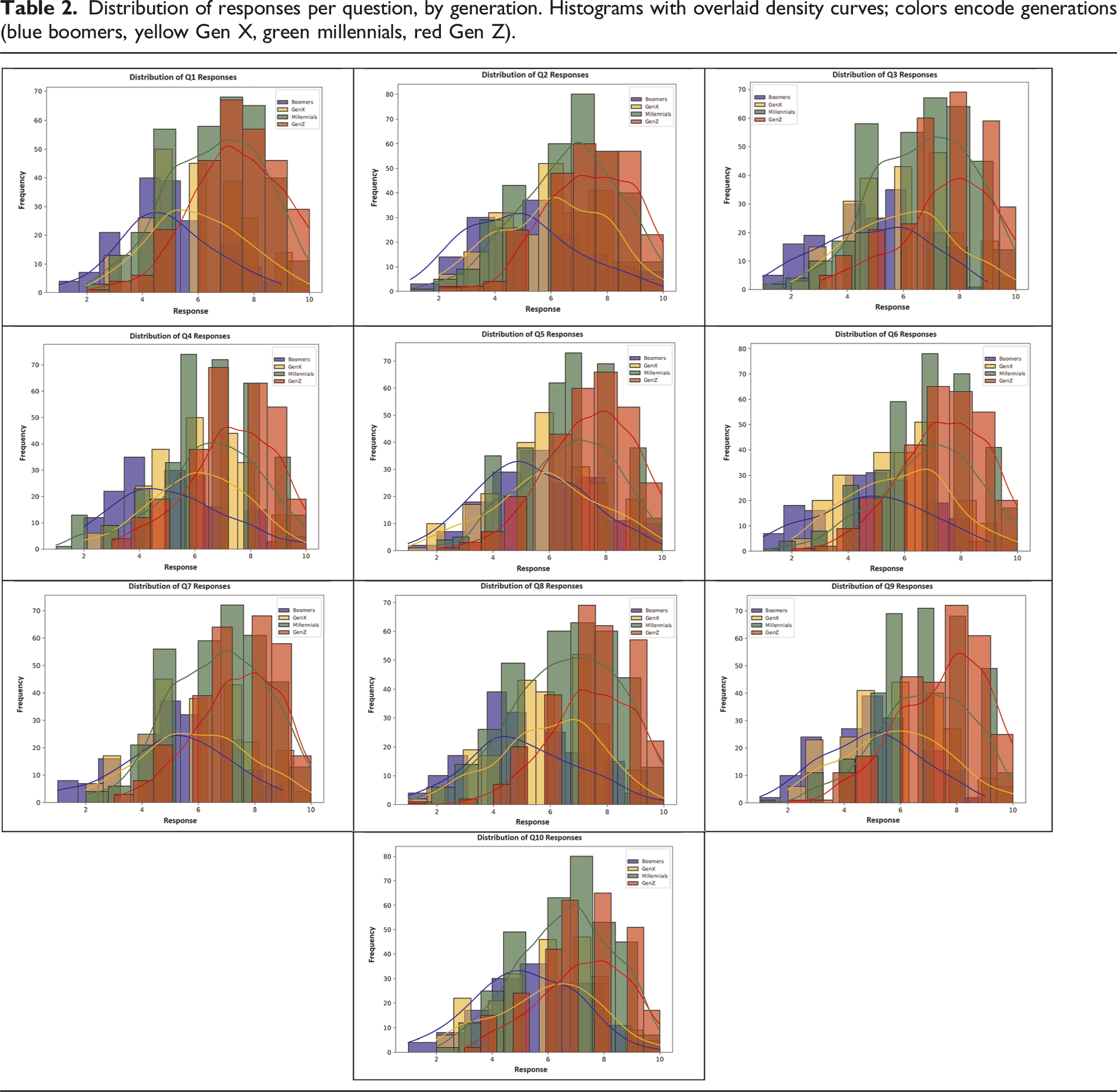
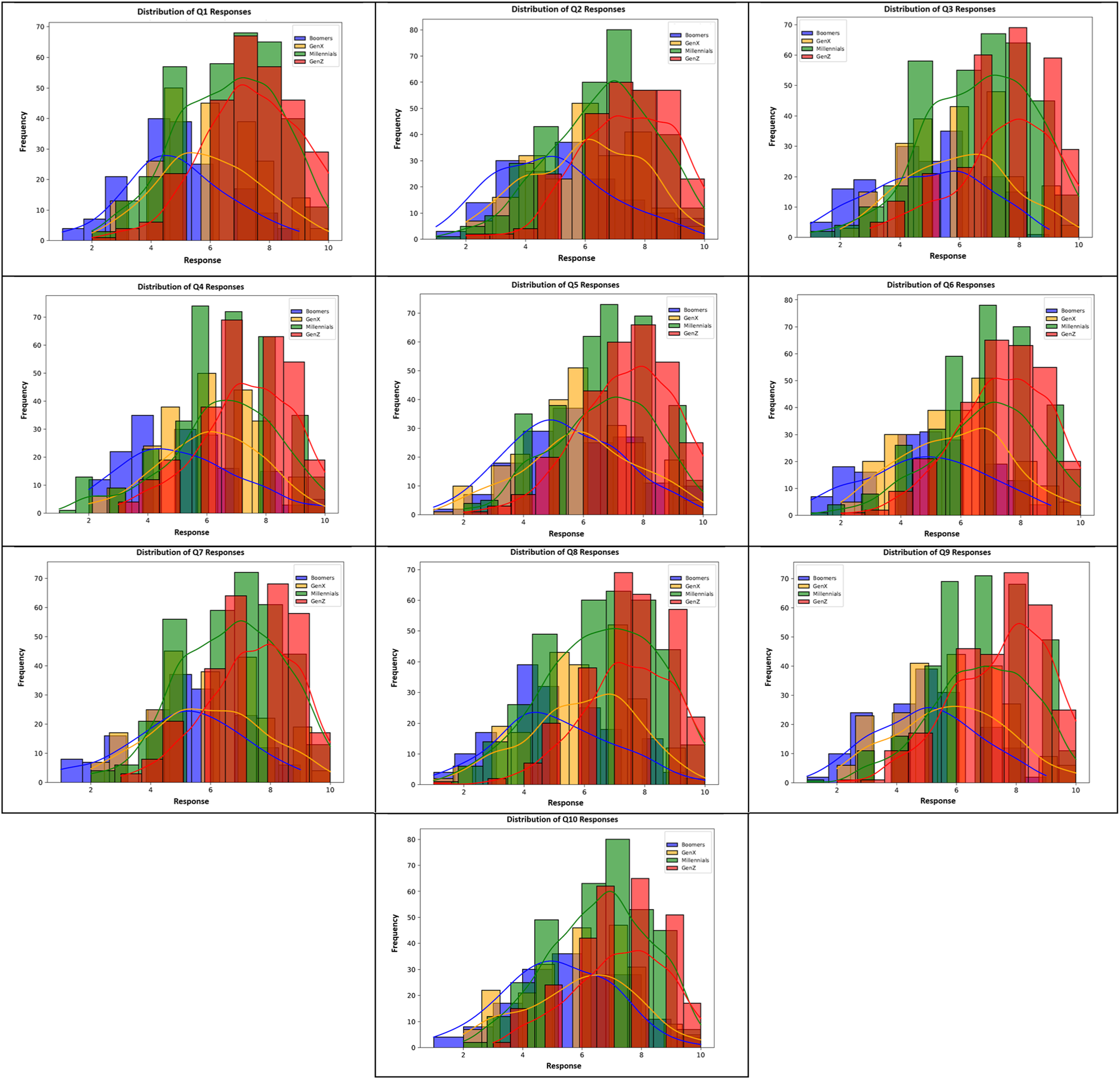
It can be observed that the ethical concern (Q6), resulted as the most relevant driver from the previous analysis, is strongly required by GenZ, followed by Millennials, GenX and Boomers. In general, younger generations in our sample gave higher ratings to sustainability-related questions on average, whereas older generations were more lukewarm. The following drivers, quality (Q1) and willingness to pay for quality-equivalent sustainable items (Q3), is prioritized by Millennials (closely followed by GenZ), confirming the literature review insights about Millennials behavior protecting traditional luxury values.
We classify predicted propensity into three categories: Inclined (≥70%), Uncertain (31–69%), and Reluctant (≤30%). In Figure 7, stacked bars report each generation’s share in these categories; segment labels show within-generation percentages. Overall, younger consumers show higher predicted propensity: Gen Z has the largest share of Inclined; Millennials split mainly between Inclined and Uncertain; Gen X and Boomers are mostly Uncertain/Reluctant. These differences suggest generation-tailored strategies—highlight sustainability credentials for younger clients and provide additional assurance on value for older clients. Propensity toward sustainable luxury by generation. Stacked bars show, for each generation, the share of consumers classified as Inclined (≥0.70), Uncertain (0.31–0.69), and Reluctant (≤0.30).
Within Millennials, attitudes are heterogeneous - some are highly sustainability-oriented while others are indifferent - indicating psychological barriers (e.g., cynicism or apathy) for part of the cohort. Gen Z appears more uniformly high in inclination, likely reflecting socialization in an era of climate activism and transparency.
To make the generational contours explicit, we synthesize the observed drivers and barriers by cohort, drawing only on the reported item-level evidence (Q1–Q10), the feature importances (Figure 6), the response distributions (Table 2), and the propensity shares in Figure 7. - Gen Z. Ethical/Impact considerations (Q6, supported by Q2) are the primary driver of adoption. When paired with non-negotiable Quality/Function (Q1, Q10, Q8), Gen Z perceives no trade-off. Traceability (Q9) with credible proof points (Q7) addresses informational hurdles. Social signals (Q5) can amplify acceptance, while the main friction is trust when proof is weak. - Millennials. Quality/Function (Q1) and willingness to pay at quality parity (Q3) are central. Ethical/Impact (Q6) is important but heterogeneous across the cohort. Traceability and credible claims (Q9, Q7) help convert interest into intention. Openness to innovation (Q4) is modest and typically contingent on quality. Frictions more often reflect cynicism or apathy in a subset rather than outright rejection. - Gen X. Quality/Function (Q1, Q10, Q8) operates as a prerequisite. Environmental impact (Q2) is supportive but less salient than for younger cohorts. Clear information and traceability (Q9) act as enablers, while the main frictions are perceived trade-offs, information gaps and a more conservative stance on willingness to pay (Q3). - Boomers. Quality, craftsmanship and durability (Q1, Q10, Q8) dominate the decision frame. Straightforward traceability (Q9) reduces uncertainty, but Ethical/Impact signals (Q6, Q2) are less salient, and scepticism toward novel materials (Q4) is more common. Social cues (Q5) play a weaker role and strong assurance on value is often required.
Discussion
Consumer engagement with sustainable luxury resulted to be governed by a complex blend of purchase decision drivers and perceived barriers. Figure 8 summarizes this, and integrates our review findings and model insights into a consumer-centric map linking the recognized five luxury value dimensions - financial, functional, individual, social, ethical - to drivers (value-augmenting) and barriers (value-reducing). Shapes and colors distinguish categories (economic/qualitative, practical/structural, psychological/emotional, social/cultural, informational/cognitive). This framework can be used as a legend to interpret which levers brands can pull and which frictions could persist, in specific contexts. The figure is aligned with Table 1 terminology for quick cross-reference. Drivers versus barriers across luxury value dimensions. Consumer-centric map linking the five value dimensions to luxury purchase drivers (value-augmenting) and barriers (value-reducing).
The findings of this study provide a comprehensive view of what decisional drives and barriers influence consumers to accept and purchase sustainable luxury products, across value constructs and dimensions, per specific customer segments, and how brands might leverage these insights, supported by AI tools. In following subsections, we identify and discuss three main contribution dimensions of this research. The first, theoretical, provides insights on key requirements for sustainable luxury consumption research. The second, methodological, highlights the advantages of using adaptive AI for consumers profiling and behavior prediction. The third regards managerial and practical implications for luxury brands’ strategy within the Sustainable Era.
Theoretical insights: key requirements for sustainable luxury consumption research
From this study a clear deduction emerged: sustainable luxury products need to deliver both on traditional luxury attributes and on sustainability requirements. Consumers are not willing to sacrifice those core luxury values discussed by Wiedmann et al. 12 Our results, in fact, remark that product functional and aesthetic quality is a basic condition. Any hint of lower quality or diminished exclusivity in the name of sustainability could turn luxury consumers away. This leads to fix another acceptance requirement: sustainability in luxury should be “value-additive”, not substitutive. In other words, luxury consumers seek for a surplus, that is mainly revealed in ethical and eco-friendly features on top of an already excellent product. When this synergy is achieved (e.g., a beautifully-designed handbag that is also made from ethically sourced, eco-friendly materials), it enhances the luxury proposition rather than detracting from it. An ethically-produced item can grant the consumer a sense of “green pride” 101 and justification for their purchase, helping to remove a major psychological barrier: the skepticism or guilt that the purchase might be contributing to harm. Instead, the purchase can be framed as actively contributing to positive change, giving the consumer an emotional reward beyond the product’s tangible benefits.
The environmental impact driver is closely related. Increasingly, luxury consumers demand that brands take concrete actions to reduce their carbon footprint, pollution, and resource depletion. Given the globalized nature of production and commerce, initiatives such as sustainable logistics 102 and energy-saving technologies adoption 103 have emerged as critical enablers of sustainable practices within the luxury sector. Luxury buyers are increasingly informed about sustainability issues and expect brands not only to respect environmental standards but also to actively protect and promote environmental stewardship. If a product comes with evidence of a low environmental impact - for example, creating its Digital Product Passport, 104 it can significantly sway the purchase decision. The inclusion of traceability as a driver supports the addressing of such an informational barrier.
The psychological/emotional dimension of consumer decision-making clearly emerged in both the literature and our model. A fraction of consumers remains skeptical about the impact of their individual purchase on global issues, which can dampen their motivation to seek sustainable options. Such a mentality is a barrier that brands can overcome through engagement and education - showcasing collective impact or providing personalized feedback. Emotional barriers also include fear of change or habit disruption. Some loyal luxury customers may resist new materials or unfamiliar concepts - e.g., Millennials when buying vegan leather luxury products 105 - out of fear that it won’t deliver the same experience. Overcoming this requires strategic change management on the part of brands: limited edition trials, allowing customers to touch and feel sustainable materials, or highlighting how innovation can enhance luxury. There is also a trust deficit to contend with: consumers often doubt brands’ sincerity in sustainability, suspecting greenwashing where companies portray a greener image than reality. The study of Srisathan et Naruetharadhol, 106 for instance, confirmed that if consumers believe a brand is just superficially marketing sustainability, their emotional barrier of distrust will prevent them from buying the product. Thus, again, authenticity is key: luxury brands have to implement concrete actions to build credibility.
Another key result highlighted in this research is the importance of the societal context: luxury purchases are influenced by societal norms, cultural expectations, religious values and peer behaviors. Historically, as noted, sustainability wasn’t part of the luxury norm, but this is changing. Social influence can act as both a barrier and a purchase decision driver. 107 On one hand, if sustainable luxury products are scarce or not endorsed by one’s peers or influencers, a consumer might feel hesitant to deviate from the norm of traditional luxury. On the other hand, as sustainable products gain visibility and endorsement by trendsetters, they can quickly become desirable. The concept of green conspicuousness is an example of leveraging social influence as a positive driver: when high-status individuals showcase sustainable luxury items as the latest mark of prestige, others are motivated to follow. This turns sustainability into a culturally reinforced element of luxury consumption. Luxury brands can facilitate this by highlighting prominent figures or testimonials that celebrate sustainable choices, and by cultivating communities (online or offline) where sustainable luxury owners share their experiences. Another cultural shift remarked is the acceptance of second-hand luxury and re-commerce, which historically might have been stigmatized among affluent consumers. But, as our cited statistics show, a majority of luxury consumers (especially in Europe) are now open to second-hand purchases or renting, perceiving it as both economically savvy and ethically responsible. Such changes indicate a broader cultural move toward viewing circular practices as compatible with a luxury lifestyle. Further research on how to embracing those practices can support reducing the practical barriers holding back sustainable luxury consumption.
Methodological contributions: the role of adaptive AI in consumer profiling and forecasting
A central contribution of this research is the demonstration that AI technology can be applied to profile consumers and forecast their sustainable purchase behavior. The implemented adaptive AI-driven consumer profiling and purchase behavior forecasting provides several implications both for consumption research and for luxury brands practitioners. 1. Personalized consumer insight. By analyzing a consumers’ responses (or, even, observed behaviors) across key drivers, an AI model can generate a personalized sustainability propensity score or profile. In a practical scenario, this could be deployed as an interactive tool. This not only helps the consumer discover products that fit their profile, but also raises their self-awareness about their own values. As suggested by our findings, when consumers see a quantified reflection of their sustainability inclination, it might reinforce their intent to act accordingly. Essentially, the AI can act both as a mirror and a guide leading consumers toward sustainable choices matching their revealed preferences. 2. Decision-support tool for luxury companies. The aggregate data from such AI profiling is extremely valuable for luxury companies. By collecting and analyzing responses from thousands of clients, brands can discern which drivers are most important in their customer base and segment the market more intelligently. Our model, for instance, pointed to ethical sourcing as a top priority driver – a brand noticing this trend might invest more in that area. If a brand learns that traceability is crucial for a large segment of its consumers, it can implement blockchain tracking for its products to provide that transparency, as remarked by Chen et al.
108
If innovation appeal is high for younger clients, a brand can emphasize cutting-edge sustainable materials in its streetwear lines to capture that interest. Additionally, AI forecasting can predict emerging trends by simulating how changes in one factor could affect purchase likelihood. 3. Overcoming barriers through AI engagement. AI tools - like chatbots or even adaptive e-commerce interfaces - can help mitigate some of the perceived barriers identified in the literature review. For instance, a chatbot can provide informational support – if a customer is unsure about a product’s sustainability features, they can ask and get immediate, accurate answers - addressing the cognitive barrier of lacking information. AI can also handle personalization at scale: much as a skilled salesperson would adapt their pitch to a client’s concerns, an AI system can detect that a particular customer is worried about, say, durability and then highlight the product’s warranty or timeless design, whereas with another customer who values trendiness, it might highlight the innovative sustainable material that’s also fashionable. By tailoring the conversation, the AI increases the chance of acceptance by tackling the specific concern or value that matters to that customer.
Managerial implications for luxury brands’ strategy in Sustainable Era
Combining the consumer-driver insights with AI capabilities suggests strategic actions for luxury brands. 1. Emphasize ethical and sustainable brand identity. Brands should clearly communicate their ethical sourcing, fair labor practices and environmental initiatives. This could be done through initiatives and actions such as product labeling, Digital Product Passport
104
or dedicated sections on their website about sustainability. Over time, a strong ethical reputation becomes a brand asset that draws in the growing segment of conscientious luxury buyers. 2. Maintain excellence in quality and design. R&D should focus on innovative materials that meet luxury standards (e.g., lab-grown diamonds
109
), challenging designers to create sustainable items that are as aesthetically appealing as the rest of the collection. If anything, sustainable products could be positioned as more exclusive or cutting-edge, to entice luxury consumers. For example, limited runs of a bag using upcycled rare materials could become a coveted item. This ties sustainability to the emotional excitement of novelty and rarity. 3. Address psychological barriers directly. Brands could run campaigns or provide information that empowers consumers’ trust. Any scandal or revelation of unsustainable practices can severely damage consumer confidence and set back progress, so commitments must be transparent and genuine. Engaging in third-party assessments or industry sustainability rankings and sharing those results can provide external validation. 4. Leverage social influence and make sustainability the new norm. Since luxury brands are known for excelling at creating aspirational images, now, they should make sustainability aspirational. This will involve influencer marketing with eco-conscious fashion influencers, featuring sustainable products on red carpets and in high-profile events, as well as celebrating customers who choose sustainable options. Over time, this can shift cultural perceptions so that opting for the eco-friendly version of a product is seen as the sophisticated choice. 5. Enhance accessibility and convenience. Some practical barriers like limited availability can be solved by integrating sustainable options widely. Rather than a niche capsule collection hidden in one corner, sustainable choices should be offered in core product lines - if applicable. Train sales staff to proactively present sustainable alternatives. Online, ensure that filtering or searching for sustainable items is easy, and consider partnerships with rental or resale platforms to give consumers alternative access. The easier and more normal it is to find a sustainable version, the more likely consumers will choose it by default. 6. Use AI & Data for continuous improvement. Implement AI systems in customer service roles (chatbots, recommendation systems) and analyze the data streams.
110
For example, if many users ask a chatbot about a product’s material sourcing, it signals high interest in that info – perhaps the brand should make that info more prominently available or push more products with known sourcing. If the AI finds that a certain subset of users always switches to view the “standard” product instead of the sustainable one, investigate the cause and address it. AI can also forecast inventory needs
111
: if it predicts rising interest in a certain sustainable product attribute, brands can prepare supply chains accordingly. In summary, adaptive AI creates a feedback loop where consumer preferences and decision drivers are continuously learned and the business can adapt in near-real-time, making sustainability integration more dynamic and responsive.
Conclusion
This work proposed an approach to predict luxury consumers’ propensity toward sustainable luxury supported by AI and machine learning technologies. Generational consumer profiling emerged as a key segmentation factor for contextualizing purchasing behavior related to sustainable luxury. In our approach, we illustrated how the elaborated framework and the designed connections are capable of collecting data, generating targeted survey instances and using the resulting responses as inputs to an end-to-end ensemble machine learning model. The collected data are then used to forecast consumer acceptance of specific products based on value perception and sustainability performance.
Our findings, grounded in a literature-driven framework and modeled through ensemble approaches, revealed that consumers are significantly more likely to favor sustainable luxury when they trust the ethical origins of a product and perceive a genuine reduction in its environmental impact. Younger generations, in particular, show a markedly higher inclination toward sustainable luxury, indicating a generational shift in values. However, across all consumer segments, sustainability must complement - not compromise - the traditional attributes of luxury, such as quality, exclusivity and craftsmanship. The system is conceived to adaptively learn on segment assignments.
Methodologically, this research introduced an adaptive AI-based approach leveraging survey data - including simulated responses - and ensemble learning. By combining a Random Forest model with a Neural Network, the study achieved high predictive accuracy in estimating purchase propensity and identifying the most influential decision-making factors, highlighting the value of interpretable feature importance even when real-world data are scarce. This underscores the potential of AI modeling to enhance consumer behavior analysis, even in contexts where real-world data is scarce or unavailable.
This study offers a proof-of-concept pipeline to identify, assign, estimate and evaluate acceptance drivers and barriers for sustainable luxury. Next steps should prioritize external validation with real data, benchmarking predictive accuracy and calibration against our simulated baseline. Cross-cultural replication is needed to test whether the relative weight of drivers – such as ethical origin, environmental impact, quality - generalizes across regions and product categories. Longitudinal designs can track segment drift and how propensity changes after brand actions like Digital Product Passports, helping to close the attitude–behavior gap. To move beyond association, field observation and experiments should estimate the causal lift of specific interventions on the shares of Inclined, Uncertain and Reluctant consumers by generation. Methodologically, adding uncertainty quantification and domain-adaptation tests will assess portability across brands; deploying managerial dashboards would enable continuous learning loops between consumer signals and strategic levers and help surface overlooked or context-specific variables.
Footnotes

Funding
The author(s) received no financial support for the research, authorship, and/or publication of this article.
Declaration of conflicting interests
The author(s) declared the following potential conflicts of interest with respect to the research, authorship, and/or publication of this article: editorial responsibilities/membership of the editorial board of the journal.