




Abstract
Multiple factors contribute to the occurrences of disruptions in workflow management within the e-commerce system that focuses on the distribution of goods and other fast-moving consumer goods (FMCG). These disruptions have particularly affected and increased lead times and caused frequent shipment delays. The causes of these disruptions, especially in the context of distribution of goods and FMCG towards inventory control, have been widely speculated upon in recent years. Given the recent interruptions, the study presented in this paper used a methodology called statistical model analysis (SMA) to study the impact of human factors (HFs) on the system performance in a warehouse distribution system. A case study was taken on a particular company called ABC and XYZ to model the impact of some specific HF such as job fatigue, and job rotation to name a few and to uncover the underlying reasons behind the ongoing disruptions within the distribution system. Specifically, the result of this study aims to provide a data-driven understanding of these issues and one of the contributions of this study is to enhance our understanding of the significance of these HFs, rather than focusing on the equipment and materials as seen in prior research. Through this data-based approach study, stakeholders in operations management, e-commerce, and the supply chain system would be well-informed in many ways to resolve the challenges faced by humans in the system towards enhancing their overall system performance.
Introduction
The studies of Human Factors (HF) in the field of electronic commerce, commonly known as E-commerce has been poorly considered when making decisions in a distribution environment such as E-commerce. E-commerce refers to the online buying and selling of goods and services, as well as the transfer of funds or data, primarily conducted over the Internet.
1
However, to execute an E-commerce transaction, humans are needed to perform data entry, as well as distribution planning and scheduling which are the two most important operational tasks required in a warehouse system. Therefore, humans are one of the crucial factors to take into consideration in a service system that incorporates distribution and inventory planning, especially when it comes to a holistic supply chain business network.2,3 A supply chain (SC) system involves overseeing the movement of goods among businesses, procurement, distribution centers (DCs), and logistics.4,5 In this paper, SC system can be seen as a system that encompasses the various stages, which include the acquisition of different stock-keeping units (SKUs), receiving products, storing inventory, order processing (picking and packing), distribution to last-mile locations (i.e., delivering the products to end-users) which can be seen as one type of E-commerce model, in this case business-to-business (B2B) model as illustrated in Figure 1.6–9 A B2B model is considered in this work as an important model to explain the E-commerce processes in a specific distribution system. The main purpose of the B2B E-commerce model is to make decisions on how to transact between businesses, typically conducted online, and the B2B model plays a significant role in modern E-commerce, supply chain management and operations. Types of E-commerce models used in E-commerce system.
E-commerce represents a digitalized business model that facilitates transactions between organizations and individuals by utilizing the internet. Also, it encompasses a wide range of activities, including product distribution, sales, purchases, marketing, and customer service, all of which are conducted through electronic interfaces. 13 However, the scope of E-commerce extends far beyond just the acquisition of goods from manufacturers and suppliers, but rather, it involves aspects such as logistics, manufacturing, warehousing, collaboration with retail partners, and most importantly, serving end customers10,11 which all involves human participation, and to improve products delivery time and increase the quality of products ordered online within the domain of supply chain system.2,3,12–14 It is very important to incorporate HF early in decision-making and apply them to equipment and job tasks to improve the system performance.
In this paper, the concept of HF would be focused on. HF is defined by the International Ergonomics Association (IEA) Council in 2014, 15 as “the scientific discipline concerned with the understanding of interactions among humans and other elements of a system, and the profession that applies theory, principles, data, and methods of design to optimize human well-being and overall system performance”. Therefore, considering HF is crucial in systems designs.16,17 Also, HF consideration in a service system (for example, supply chain system) could help reduce human errors during operations such as picking, packing, shipping, and enhancing the performance of warehouse operations.
In addition, the use of technologies in E-commerce also played a crucial role in the operations of businesses, especially as consumer preferences shift from traditional brick-and-mortar shopping to online platforms. 1 The use of various technological tools has allowed distribution system to offer high-quality and punctual services to their customers. 18 However, despite the integration of sophisticated tools to ensure customer satisfaction, most of the existing studies show that there is still a critical challenge for all other business models, such as traditional brick-and-mortar stores and online shopping platforms as related to HF.19,20 In addition, most of these service systems 17 aim to provide the highest level of satisfaction to their customers which is influenced by various factors such as service quality from workers, but HF such as workers satisfaction has been neglected in decision making. For example, in a typical service system, worker satisfaction is usually a wide aspect of HF to be considered. It is noted that satisfied employees are more engaged, productive, and less likely to leave their jobs. 21 In fact, some factors contribute to worker satisfaction which includes fair compensation, a safe working environment to mention a few. Although service quality as mentioned earlier is seen as a measure used to assess the excellence of service and determine if users are content with the service they receive. 5 However, customer satisfaction is influenced also by a range of factors, including customer value, customer experience, user experience, brand image, pricing, productivity, trust, and HF such as workers’ skills, job rotation, and job fatigue amongst workers.22–24 Since the skill level of workers is assumed as a fundamental factor affecting job performance in a system, it is assumed that skilled workers are more efficient, and can handle complex tasks with greater ease. 25 For instance, a worker trained in the use of advanced warehouse management system (WMS) can quickly locate items, manage inventory more accurately, and streamline the picking and packing process. However, this assumption does not hold true in many cases. 5 Furthermore, job rotation overtime has been seen as a strategy adopted to mitigate any physical and mental strain in a repetitive task by periodically moving workers between different roles. 26 According to Ogbeyemi et al, 5 job rotation can lead to higher job satisfaction and lower turnover rates in warehouse settings. Also, job rotation has not only helped in reducing monotony but also allows workers in both service system and manufacturing system to develop a broader skill set. For example, a warehouse worker might alternate between tasks such as operating a forklift, managing inventory, and packing orders. So, it is assumed that factors such as job rotation can prevent job fatigue, and reduce the risk of repetitive strain injuries, which at the end would enhance job satisfaction and increasing the skills level. Also, management of some service system have been making use of different techniques, 27 and tools such as robots, 28 to handle heavy lifting and transportation of goods within the system, while the workers focus on tasks that require packing, goods delivery, and decision-making, yet HF have not been fully considered in most service system.
The primary objective of this study is to analyze and explore the impact of certain HFs on the performance of a distribution system that specializes in fast-moving consumer goods (FMCG) in a warehouse, and inventory management provided that HFs have not been considered fully in the real world of inventory system, especially in distribution process in a warehouse. 29 To achieve this aim, specific inquiries were formulated, including investigations into the relationships between the independent variables (such as workers’ skills and satisfaction, job fatigue, and job rotation) and the dependent variable (i.e., job performance) in the system. Also, a mixed research approach was employed to gather and analyze data that involves conducting a significance test utilizing a two-way ANOVA. Additionally, the research seeks to ascertain whether each independent variable specifically influences the dependent variable (i.e., job performance) of the warehouse workers and to examine if the independent variables contribute to the ongoing disruption in the distribution system.
The rest of this paper is organized as follows: First, we presents some background knowledge as well as a literature review. Second, a case study is presented to give more details on the problem description. Third, the methodology is presented to demonstrate how the statistical model works. Fourth, we presents the results and discussion, and Finally, the conclusion and suggestions for future research were presented.
Background and literature review
In the domain of E-commerce, there are several challenges encountered during the operations. Hence, it is very important to understand how these challenges could impact both customer behavior (customer goals) and organizational profitability (business goals), while exploring potential solutions. According to Tsagkias et al, 1 some specific challenges include the influence of regulatory and business constraints on E-commerce operations. These constraints often dictate which products can be presented to customers. For example, certain items like hunting knives may not be legally sold online in the UK, and some regions in the US restrict the online sale of alcohol and certain drugs to adults only.
To better understand challenges in E-commerce operations online, most websites implement business rules during the checkout process to control product purchases, displaying products that customers ultimately cannot buy which can lead to a dissatisfying experience. Dayarian and Pazour, 30 discusses several challenges in her research. These challenges include: (a) Cybersecurity: E-commerce businesses cannot afford downtime due to cyberattacks, as each transaction contributes significantly to their financial success. (b) Competition: The E-commerce landscape has become highly competitive, making it challenging for businesses to differentiate themselves from rivals and attract new customers. (c) Order Fulfillment: Timely and accurate order fulfillment is crucial, as delays and incorrect product shipments can result in customer dissatisfaction. (d) Inventory Visibility: When inventory is not visible, either physically or on the website, customers may turn to other E-commerce platforms, resulting in reduced sales.
Also, 31 focuses on specific challenges related to facilitation and logistics in E-commerce: (a) Undeveloped Legal Infrastructure: Legal regulations enabling E-commerce transactions are essential, and the absence of such infrastructure can hinder E-commerce activities. (b) National Quality Infrastructure: E-commerce consumers demand product traceability and adherence to international standards, which instills confidence, and the absence of these standards may drive customers to competitors. (c) Poor Integration of Postal Services with Border Agencies: Effective coordination between postal services and border agencies is necessary for smooth cross-border E-commerce transactions. (d) Improving In-flight Connectivity: Air freight plays a pivotal role in cross-border shipments, necessitating enhancements in in-flight connectivity. (e) Limited Logistics and Postal Distribution in Remote Areas: Underdeveloped logistics infrastructure in isolated regions of developing countries hinders their ability to benefit from E-commerce.
Nguyen et al.
32
delved into customer satisfaction with last-mile delivery in the E-commerce sector. Their study highlighted factors such as tangibility, reliability, safety, empathy, responsiveness, and perceived value towards the performance of the system. These factors encompass elements that customers directly experience, the reputation and accuracy of service delivery, the ability to respond promptly to customer needs, ensuring safety and peace of mind, and the level of care and attention provided by staff. Also, Bingi et al.
33
emphasized on four major challenges facing the E-commerce industry such as economic, technological, social, and legal. These challenges apply broadly to both B2B and business-to-B2C scenarios. A good way to understand the impact of these factors on E-commerce performance is illustrated in Figure 2. Four major factors affecting E-commerce (adapted from Bingi et al.,
33
).
Outcomes of a survey conducted for an online retailer showing customer satisfaction and dissatisfaction.

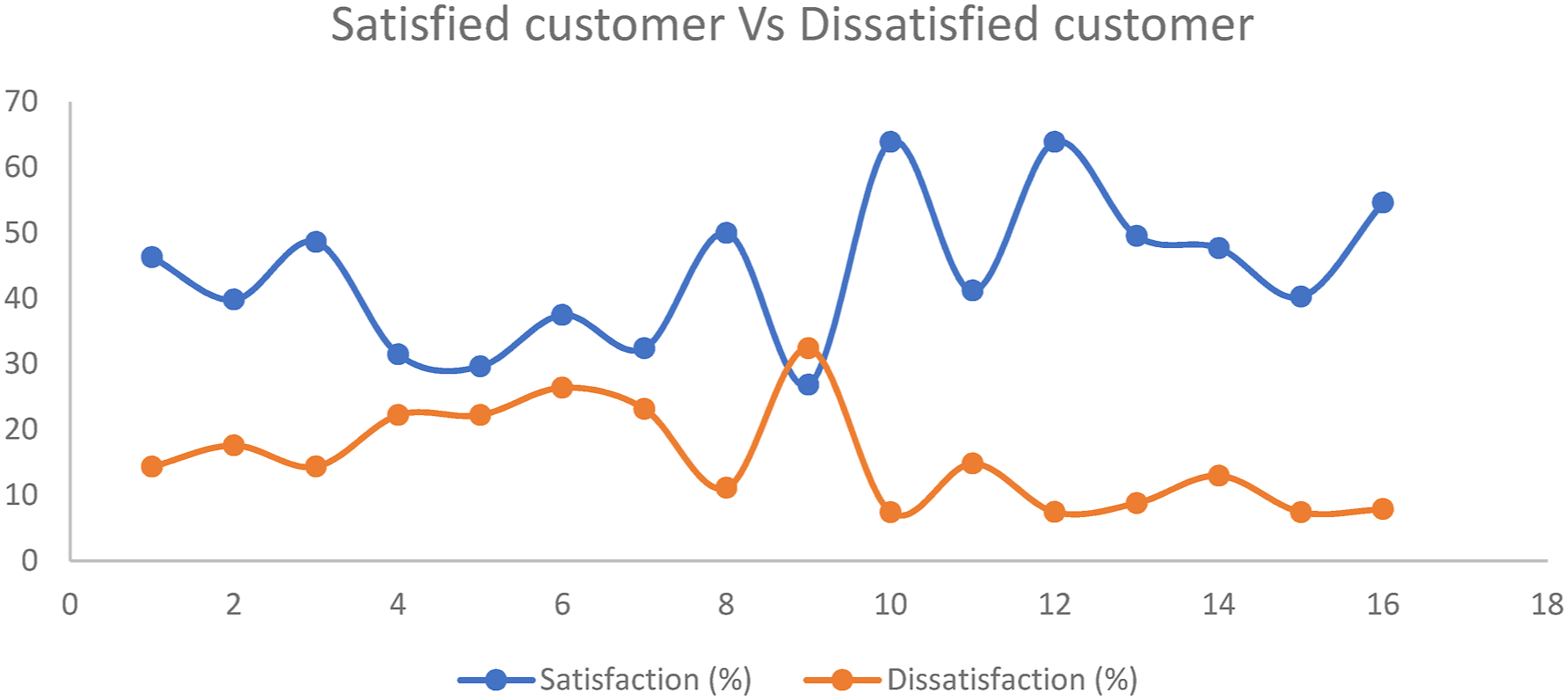
Graphical representation of customer satisfaction and dissatisfaction.
In practice, again according to Ogbeyemi et al. 5 the E-commerce industry faces various challenges, notably the labor-intensive inventory tracking methods which must depend on multiple software and spreadsheets. This method is not only time-consuming but also prone to errors, leading to delayed deliveries and a decrease in warehouse efficiency. Additionally, the complexity of inventory management, involving multiple steps like receiving, picking, packing, and shipping, can also result in incomplete, inaccurate, or delayed shipments, as well as inventory losses due to factors like wastage, damage, or theft. 5
Despite the above reviews, the studies of HF are literally missing from them, therefore, in this paper, we further studied and focused on human-related concepts such as the physical human-machines relationship found in most manufacturing systems 35 for our E-commerce system. HF in the E-commerce industry has witnessed exponential growth, revolutionizing the way business is conducted globally. As technology continues to shape this industry, the role of HF becomes increasingly crucial. Also, several studies have explored the relationship between HF and job performance within the E-commerce settings. Lu and Lin 36 highlighted the impact of stress on performance effectiveness, a concept that resonates with the E-commerce sector, where workers often encounter high-pressure situations. Additionally, worker satisfaction has been recognized as a key determinant of job performance. 37 Employee contentment and motivation have also been shown to positively correlate with enhanced performance, and employees who derive satisfaction from their work may exhibit greater commitment and productivity. 38
In the E-commerce industry, workers may face demanding schedules and workloads, which as a result increases job fatigue and influences job performance. Job fatigue is often linked to factors such as long hours and repetitive tasks, which can negatively affect job performance. 39 In addition, job rotation has also been proposed as a strategy to enhance job performance. 40 According to Ravenhill and Liu 40 job rotation can provide workers with a broader skill set and reduce monotony. However, the extent to which job rotation positively affects job performance in E-commerce, characterized by specialized tasks and roles, remains a subject of inquiry. Meanwhile, the importance of job skills on job performance is evident in various industries. 17 Skilled workers are often more adaptable and effective in handling complex tasks. 41 Therefore, the concept of HF generally is speculated to be used to broaden skill sets and reduce monotony in a B2B E-commerce system. So, to show the importance of this HF-related concept, a study on the impacts of HF among workers in a distribution warehousing system is required, which would either validate the speculation or not.
Considering the relationship between worker skills and job performance in E-commerce, both are closely related concepts in the workplace. Workers’ skills refer to the specific abilities and knowledge that are necessary to perform a particular job or task effectively. These skills may include technical skills such as proficiency in computer software, mechanical skills such as the ability to operate machinery, or soft skills such as communication and problem-solving. On the other hand, job performance refers to how well an employee performs in their job. This can be measured by their ability to meet or exceed expectations, achieve targets, produce high-quality work, and contribute positively to their team or organization. However, job performance in a B2B E-commerce is more than completing tasks; it is about contributing positively to the organization’s mission and fostering success in a highly competitive area. The markers of job performance include meeting or surpassing set targets, producing high-quality work, and enhancing team dynamics. 42 Employees who excel in these areas are indispensable assets in the B2B E-commerce landscape. However, simply having the required worker skills is not enough to guarantee excellent job performance. 43 An individual’s job performance also depends on HFs such as motivation, attitude, work ethic, and ability to work well with others. Any service system will likely have efficiency and increased performance as one of its primary goals. The performance of the job or system is equivalent to that of the individual worker, therefore, workers’ performance is understood to be a complicated entity linked to other individualized characteristics, such as skills and workers’ satisfaction44,45 which are both considered to be essential components of workers’ performance. The completion of a task within the required completion time by a worker on the warehouse floor is referred to as job performance in this study.
One important factor to also consider in an E-commerce system is job rotation amongst workers in the warehouse. It is also anticipated that its deployment will improve work performance. Job rotation refers to the practice of moving employees between different positions or departments within an organization, to broaden their experience and skill set. According to Song et al 46 job rotation has also been used to sustain and upgrade the various latent skills and experience of workers who have been on the job for a long time. One potential benefit of job rotation is that it can help employees develop a more comprehensive understanding of the organization, as well as a broader range of skills and knowledge. This can in turn lead to greater job satisfaction and motivation, as well as improved performance. However, there are also potential downsides to job rotation. For example, frequent changes in responsibilities can be stressful for some employees and may lead to decreased job satisfaction and performance. One limitation of job rotation is that it may lead to decreased productivity as employees are learning new tasks and becoming familiar with new work environments. 47
The effect of fatigue among warehouse workers is also an important factor to be considered in the E-commerce system especially in a FMCG sector due to complexity in job schedule. Job fatigue in a service system is caused by task overload, which can lead to workers’ injury. 48 There are several factors that can contribute to job fatigue, including long work hours, high job demands, lack of control over work tasks, and a poor work-life balance. Employers can help reduce job fatigue by implementing strategies such as providing flexible work arrangements, encouraging breaks throughout the day, and promoting a healthy work-life balance. On an individual level, there are also strategies that employees can use to manage job fatigue and improve job performance. These may include taking breaks when needed, prioritizing tasks, setting realistic goals, and practicing good sleep hygiene. One limitation of job fatigue is that it can lead to decreased job satisfaction and increased turnover intentions. 49 This can be especially true for employees who experience chronic fatigue, as they may feel that their work demands are not manageable and may seek other employment opportunities. Additionally, job fatigue can result in increased errors and accidents on the job, as employees may be less alert and less able to make good decisions. 50 Another potential limitation of job fatigue is that it can lead to negative health outcomes, such as cardiovascular disease, depression, and anxiety. 51
Furthermore, the above reviews show that issues such as inaccurate data and limited visibility exacerbate these problems. It is worth mentioning that despite the utilization of advanced management tools in the E-commerce and inventory distribution system today, the challenges regarding HF have not received adequate attention. Remarkably, prior research often overlooks the role of HF when addressing some system challenges such as late delivery and system downtime. 17 Also, many studies preferred to concentrate primarily on system processes and technology, while neglecting the significant impact of human actions within the E-commerce system. This study aims to bridge this gap by incorporating insights from existing literature and considering HFs like worker fatigue, satisfaction, and rotation as crucial elements to address these issues affecting the system performance.
Case study and problem description
Overview of the case study
In this paper, we examine two service systems referred to as ABC and XYZ for the purpose of illustrating this case study. The actual identities of ABC and XYZ will remain undisclosed due to privacy and security considerations. 52 ABC is a service system operating in the domain of E-commerce in West Africa, specializing in the delivery of goods and FMCG through online purchases. On the other hand, XYZ is also an E-commerce service system in West Africa, dealing with a wide range of product categories. In this section, we took companies ABC and XYZ to describe the various challenges faced by both companies and we intend to propose solutions to address these issues.
Over the past decade, West Africa has witnessed the emergence of numerous E-commerce companies. Notably, ABC has distinguished itself as the sole E-commerce company exclusively dedicated to the distribution of FMCG. ABC was established during the COVID-19 pandemic to assist retailers in procuring FMCG and other consumable goods, which were in high demand during that period. In addition, ABC implemented a well-known distribution model called the Hub and Spoke model,
53
to reduce delivery times and enhance customer satisfaction. As shown in Figure 4, the workflow depicts the end-to-end (E2E) process flow of ABC. In Region A, the procurement team collaborates with vendors to purchase products, which are then sent to the warehouse via suppliers. The inbound team receives the products, verifies them against the purchase order (PO), and generates a goods receipt note (GRN) for inventory accuracy and financial reporting. In Region C, the inventory team stores the received products in their designated locations (racks and pallets). In Region B, when a customer places an order on the website, the order processing unit (OPU) team picks and packs the items for the customer’s shipment. In Region E, shipments are handed over to the logistics team, loaded into vans, and dispatched for last-mile delivery to customers. In Region D, if a customer rejects any product for any reason, refunds or replacements are processed, and the product is returned to the warehouse. However, the general goal of an E-commerce distribution system is to be able to ensure that the entire process as described in Figure 4 achieves its objective. Therefore, the motivation of this work is to address the challenges faced by ABC by focusing on factors that have not been adequately explored in previous research. The end-to-end (E2E) E-commerce workflow of ABC.
Furthermore, it is worth mentioning that while both service systems share similar operations, the primary focus of this study will be on ABC. XYZ’s inclusion is aimed at facilitating a comparative analysis of the challenges encountered by both companies and validating the findings.
Problem description
HFs play a pivotal role in shaping the e-commerce models of both ABC and XYZ. They influence everything from user interface design to order fulfillment processes, ensuring a seamless interaction between workers and automation systems. An effective HF approach enhances the user experience, making it intuitive, efficient, and error-resistant, ultimately boosting customer satisfaction and operational efficiency. By considering ergonomic principles, cognitive load, and user-centered design, both companies can optimize their e-commerce processes, improve user engagement, and reduce errors that might lead to customer dissatisfaction and increased costs. The resilience of ABC and XYZ’s e-commerce models relies on their ability to balance profitability and customer satisfaction.
When implementing efficient and user-friendly platforms through HF integration, there is a tendency to improve usage of the system, resulting in higher customer satisfaction and loyalty. Additionally, HF principles can help to streamline operational processes, by reducing errors and enhancing productivity, thus positively impacting profitability. So, ABC’s expansion in West Africa during the COVID-19 pandemic has encountered challenges due to factors like ignoring effects from a human perspective, overhead costs, and capital expenditures not being adequately considered. ABC faces a dilemma as it grows, with increasing overhead costs and the need for high productivity. Balancing a productive workforce while optimizing profitability is a delicate task for ABC. ABC’s downsizing approach was intended for cost optimization, also when issues such as reduced job satisfaction, increased job fatigue, and disrupted job rotation were observed. This new approach negatively affects ABC’s operational efficiency, while impacting order processing, last-mile delivery, and customer satisfaction.
Meanwhile, the critical importance of holistic decision-making in ABC’s situation should have been guided by HF principles, while emphasizing on the interconnectedness between workforce dynamics, operational efficiency, and customer satisfaction. However, it was observed that HF and workforce dynamics,
5
resiliency,
2
are closely intertwined and crucial for navigating the complexities faced by both ABC and XYZ. Also, Figures 5 and 6 are used to provide historical knowledge of the monthly net salaries of workers, operational running costs, and the value of orders delivered to customers on a month-to-month basis. For instance, the analysis in Figure 5 illustrates the company’s financial performance, when comparing the monthly profits with the operating costs over 6 months. This analysis reveals that the company operated at a loss from May to October, as the monthly profits were less than the operating costs. In contrast, Figure 6 shows a forecast of breaking even if the job performance of ABC increases by 48%. The figure shows the relationship between monthly orders and profits, which indicates the potential for an increase in profitability with higher order volumes. In addition, the visual representation helps in interpreting data towards decision-making over time. The chart of company ABC running at lost. The chart of the revenue increased at 48% performance.

Despite this upward trend in sales, the company struggled to break even due to the substantial operational running costs. These high operational costs indicated that the revenue generated fell below the expected budget. To improve productivity and performance, the company would need to increase projected revenue by approximately 40% to 48%. Achieving this increase implies a need to consider HF principles and adjust the capital expenditures. Also, Figure 6 illustrates a forecast of how the company could reach a break-even point if performance were to increase by 48%. Addressing the operational issues requires a careful adjustment of running costs while taking HF into account to ensure operational efficiency and increased system performance. It’s important to note that HF should be a key consideration during cost adjustments to avoid operational downtime.
Another important fact to also consider in ABC’s operations is that many processes are still manual due to limitations in material handling tools absenteeism amongst warehouse workers, and loss of skilled workers due to sudden resignations. These challenges have led to shortages of manpower and hindered proper capacity planning to achieve ABC’s business goals. Late deliveries have also been attributed to issues related to HF and when reflecting on these challenges a significant portion can be traced back to human errors. These errors have resulted in customer-initiated order rejections and subsequent delays in delivering orders to valued clients. So, to maximize the overall performance and efficiency in the e-commerce system such as ABC and XYZ, investigating the impact of some HF on warehouse workers is crucial for improving system performance. Therefore, it is assumed that when HF is considered in practice, it can lead to optimized ecommerce processes, improved profitability, and enhanced customer satisfaction.
Methodology
This paper adopts a method known as statistical model analysis (SMA).54,55 SMA serves as a crucial modelling tool aimed at outlining the methodology employed in this study to identify some HF among workers within the warehouses of both ABC and XYZ. The method establishes the research hypotheses, forming the fundamental basis for the entire study. Following this, it delves into the research design and the chosen sampling technique on how data was gathered from the target population. Subsequently, it elaborates on the methods and procedures employed for data collection, encompassing the development and pilot testing of the questionnaire.
Research questions
Several e-commerce models have been widely used by so many companies since post-pandemic COVID-19, however, there are several questions about the model, which are to be addressed in this research. This study aimed to examine and investigate how the effect of HF amongst warehouse workers influences job performance. To achieve this goal, the following questions were raised. • Question 1: What is the significant impact of HF, including workers’ skills, workers’ satisfaction, job rotation, and job fatigue, on influencing job performance within the modern B2B e-commerce model of companies ABC and XYZ? • Question 2: What is the significant impact of HF in understanding the levels of job satisfaction, job fatigue, and job rotation among warehouse workers within the modern B2B e-commerce model of companies ABC and XYZ? • Question 3: What is the combined contribution of each of the independent variables including workers’ skills, workers' satisfaction, job rotation and job fatigue to the determination of the dependent variable (i.e., job performance) of the workers within the modern B2B e-commerce model of companies ABC and XYZ?
Research hypothesis
One of the essential tools in research, which underpins investigation-based studies, is the research hypothesis.55,56 This study’s primary objective is to explore and analyze the impact of certain HFs on job performance among warehouse employees in a service system (i.e., ABC and XYZ). To establish the existence of this relationship and to answer the research questions in this paper, three hypotheses were formulated and tested. Given the presumption that HFs might contribute to the issues discussed in section 3, an extensive work review was conducted to identify pertinent theories and empirical data to substantiate these hypotheses. Furthermore, the hypotheses were scrutinized within the domain of HFs to ensure their suitability for the study. Consequently, the following three hypotheses were crafted.
Hypothesis One
Ho: There is no statistically significant impact between workers’ skills, workers’ satisfaction, job rotation, and job fatigue on influencing job performance within the B2B e-commerce model of companies ABC and XYZ.
Hi: There is a statistically significant impact of workers skills, workers satisfaction, job rotation, and job fatigue on influencing job performance within the B2B e-commerce model of companies ABC and XYZ.
The first hypothesis posits that there is a statistically significant impact of workers’ skills, workers’ satisfaction, job rotation, and job fatigue on job performance of the warehouse workers. This hypothesis was developed based on extensive literature review and theoretical considerations.
Hypothesis Two
Ho: There is no statistically significant impact on the levels of workers’ satisfaction, workers’ skills, job fatigue, and job rotation among warehouse workers within the modern B2B e-commerce model of companies ABC and XYZ.
Hi: There is a statistically significant impact on the levels of workers’ satisfaction, workers’ skills, job fatigue, and job rotation among warehouse workers within the modern B2B e-commerce model of companies ABC and XYZ
The second hypothesis examines the impact of workers’ skills, workers’ satisfaction, job rotation, and job fatigue on the level of job performance among warehouse workers. We hypothesized that these HFs significantly influence the current level of job performance in ABC and XYZ.
Hypothesis Three
Ho: The combined influence of workers’ skills, workers' satisfaction, job rotation, and job fatigue does not significantly impact the determination of job performance among workers in the B2B e-commerce of companies ABC and XYZ.
Hi: The combined influence of workers’ skills, workers’ satisfaction, job rotation, and job fatigue significantly affect the determination of job performance among workers in the B2B e-commerce model of companies ABC and XYZ.
Finally, the third hypothesis investigates the combined effect of predictor variables on the determination of job performance. We proposed that these combined factors significantly affect job performance in the distribution system considered in this paper.
Research design
The research design in this paper is used to specify the approach towards fulfilling the research objectives. 57 The research design involved the utilization of a cross-sectional survey design. This design was also selected due to its suitability for gathering data from a sizable population while facilitating data collection at a single point in time.
Sampling technique
This study aimed to include all employees working within ABC and XYZ in West Africa as the target population. To determine the sample size for this study, the sample size determination table according to Krejcie and Morgan, 58 was utilized, which resulted in a calculated sample size of 40. To select participants, a stratified random sampling approach was employed. Firstly, a sample frame was created by compiling a list of e-commerce systems operating in the region. Secondly, these e-commerce systems were categorized into strata based on their respective sizes. Subsequently, a proportional sampling method was applied to choose participants from each section. Lastly, within each section, participants were randomly selected using a simple random sampling technique.
Method of data collection
This study used a questionnaire to collect data on workers’ skills, workers’ satisfaction, job rotation, and job fatigue among warehouse workers. Participants were informed about the study’s purpose and had the opportunity to review and consent to the questionnaire. A total of 40 questionnaires were distributed to employees at both companies, ABC and XYZ, and responses were collected over a 3 – 4 week period. The questionnaire consisted of closed-ended questions with specific response options (i.e., Likert scales), chosen for its convenience in reaching warehouse workers and collecting data on the effect of HF, while data on job performance were obtained from warehouse supervisors.
Measurement metric of rating.

Data analysis technique
The study employed a statistical modelling analysis method, which includes a reliability statistics test, descriptive statistics and regression analysis for data collection and analysis. Descriptive statistics such as means, and standard deviations are used to summarize and describe the characteristics of the data among warehouse workers. Furthermore, a reliability statistics test, specifically Cronbach’s alpha coefficient, was applied to measure the internal consistency of each variable in the questionnaire used in this study. Cronbach’s alpha is widely accepted for evaluating the internal consistency of a questionnaire, while ensuring that the items measure the same construct. To explore the relationship between the independent and dependent variables in this study, Pearson product-moment correlation generated a correlation matrix. The research hypotheses were tested using both Pearson product-moment correlation and multiple linear regression analysis.
Results and discussion
Shows the reliability statistics.

To answer the research questions in this paper, three hypotheses were tested. Firstly. (Ho): There is no statistically significant impact between workers’ skills, workers’ satisfaction, job rotation, and job fatigue on influencing job performance within the B2B e-commerce model of companies ABC and XYZ. (Hi): There is a statistically significant impact of workers skills, workers satisfaction, job rotation, and job fatigue on influencing job performance within the B2B e-commerce model of companies ABC and XYZ.
The result from the correlation analysis conducted indicated that the four independent variables (i.e., workers’ skills, workers’ satisfaction, job rotation, and job fatigue) studied in relation to the job performance showed positive relationships. However, it’s worth noting that three of these predictors (i.e., independent variables) did not exhibit statistically significant impact on the overall system performance. This suggests that while there is positive relationship between these predictors and job performance, their impact on the overall system performance in the case studies is not statistically significant.
Correlation showing the relationship between independent variables and dependent variable for ABC.

However, in case study 1 (ABC), the analysis further reveals a positive correlation (r = 0.364) between workers’ satisfaction and job performance. This implies that individuals reporting higher workers’ satisfaction tend to exhibit better job performance. Also, this correlation is only marginally significant (p = .057), suggesting a possibility that this relationship might have occurred by chance. Notably, the p-value of 0.057 exceeds the conventional significance threshold of 0.05, indicating that the evidence for a significant link between workers’ satisfaction and job performance in this sample could vary from time to time. While a positive correlation is observed, it does not attain statistical significance. Therefore, additional analysis with a larger sample size or more data might be necessary for more conclusive insights into the impact of workers’ satisfaction on job performance among ABC’s workers.
Furthermore, as shown in case study 1 (ABC), the analysis indicates a positive correlation (r = 0.195) between job fatigue and job performance. However, like the previous correlations, this relationship between job fatigue and job performance did not show statistical significance (p = .205). This implies that, based on the sample data, there is no strong evidence to support the idea of a significant link between job fatigue and job performance among workers. It is also possible that the observed correlation could be due to chance, and further investigation or a larger sample size might be necessary to arrive at more definitive conclusions regarding the impact of job fatigue on job performance.
Again, in case study 1 (ABC), the analysis also reveals a positive correlation (r = 0.278) between job rotation and job performance. However, like the other correlations, the relationship between job rotation and job performance did not reach statistical significance (p = .118). This suggests that, based on the obtained results, there is no substantial evidence to suggest a significant link between job rotation and job performance among the workers. The observed correlation could potentially be attributed to chance, and further investigation on a larger sample size may also be necessary to draw more definitive conclusions regarding the impact of job rotation on job performance.
Correlation showing the relationship between independent variables and dependent variable for XYZ.

Also, for case study 2 (XYZ), the examination of the effect of workers’ satisfaction on job performance also reveals a positive correlation (r = 0.252) between these variables. This suggests that individuals with higher workers satisfaction tend to exhibit better job performance. However, it’s essential to note that this correlation coefficient of 0.252 doesn’t reach statistical significance at the conventional level of 0.05. The associated p-value of 0.142 is greater than 0.05, indicating a possibility that the observed relationship between workers' satisfaction and job performance could be due to chance. Consequently, the data does not provide strong evidence to support the hypothesis that workers’ satisfaction significantly impacts job performance among workers at XYZ. It is important to conclude that the data might be limited in terms of sample size or other factors that could influence the relationship between workers’ satisfaction and job performance. Therefore, further analysis with a larger sample or additional data may be required to obtain more definitive results and establish the true effect of workers’ satisfaction on job performance among XYZ’s workers.
Additionally, in case study 2 (XYZ), we examined the effect of job fatigue on job performance. The correlation coefficient between job fatigue and job performance is −0.126, suggesting a weak negative relationship between these variables. This implies that higher levels of job fatigue are associated with slightly lower job performance. However, it is crucial to note that this correlation coefficient of (r = −0.126) does not attain statistical significance at the conventional threshold of 0.05. The associated p-value of 0.298 is greater than 0.05, indicating a lack of strong evidence to show a significant relationship between job fatigue and job performance. Based on these results, we cannot confidently conclude that job fatigue significantly affects job performance among the workers. It is plausible that other unexamined factors or variables may have a more substantial influence on job performance. Therefore, further research incorporating a larger sample size, additional data, and the consideration of other potential factors may be necessary to gain a more comprehensive understanding of the relationship between job fatigue and job performance among workers.
Again, in case study 2 (XYZ), we explore the effect of job rotation on job performance. The correlation coefficient between job rotation and job performance though is −0.099, indicates a weak negative relationship between these variables. This implies that there might be a slight decrease in job performance associated with job rotation. However, it is important to note that this correlation coefficient of −0.099 did not attain a statistical significance at the conventional significance level of 0.05. The associated p-value of 0.339 is greater than 0.05, suggesting inadequate evidence to establish a significant relationship between job rotation and job performance in the given sample. Based on these results, we cannot conclusively state that job rotation significantly affects job performance among workers. Therefore, there are other unexamined factors or variables that may exert a more substantial influence on job performance. Consequently, further exploration with a larger sample size, additional data, and consideration of other pertinent factors may be required to obtain a more comprehensive understanding of the relationship between job rotation and job performance among workers.
Based on the R-values, all the 4 independent variables reveal that there is a positive correlation with the dependent variable. Therefore, the null hypothesis (Ho) is not rejected since the p-value is greater than 0.05 while the alternative hypothesis (Hi) is not accepted. This means that the workers skills, job fatigue, job rotation and workers satisfaction all have positive relationship on job performance of the workers, and they are not statistically significant with job performance except workers satisfaction with a marginal significance.
Regarding research question 2, the null hypothesis was devised. (Ho): There is no statistically significant impact on the levels of workers’ satisfaction, workers’ skills, job fatigue, and job rotation among warehouse workers within the modern B2B e-commerce model of companies ABC and XYZ. (Hi): There is a statistically significant impact on the levels of workers’ satisfaction, workers’ skills, job fatigue, and job rotation among warehouse workers within the modern B2B e-commerce model of companies ABC and XYZ.
Item statistics for study 1 (ABC).
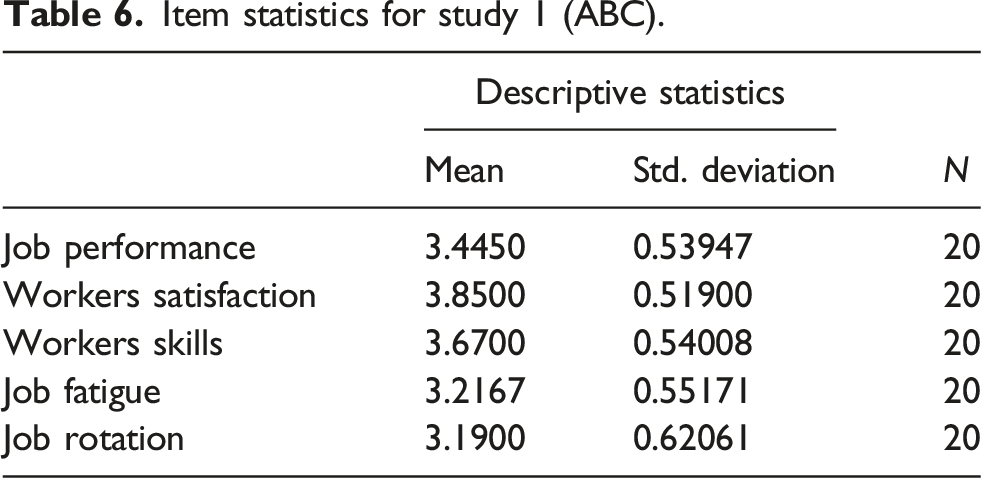
Item statistics for (XYZ).

Based on the mean values and the standard deviation values, all the 4 independent variables reveal that there is an impact on the levels of each of the predictors on the dependent variable. Therefore, Ho in this case is rejected since the mean scores of the independent variables are greater than the expected average score of 2.50 while the Hi is accepted. This means there is an impact on the levels of workers’ satisfaction, workers’ skills, job fatigue, and job rotation among warehouse workers within the modern B2B e-commerce model of companies ABC and XYZ
Regarding research question 3, the null hypothesis was devised. (Ho): The combined influence of workers’ skills, workers' satisfaction, job rotation, and job fatigue does not significantly impact the determination of job performance among workers in the B2B e-commerce of companies ABC and XYZ. (Hi): The combined influence of workers’ skills, workers’ satisfaction, job rotation, and job fatigue significantly affect the determination of job performance among workers in the B2B e-commerce model of companies ABC and XYZ.
The effect of HFs and its prediction on job performance of workers in ABC.
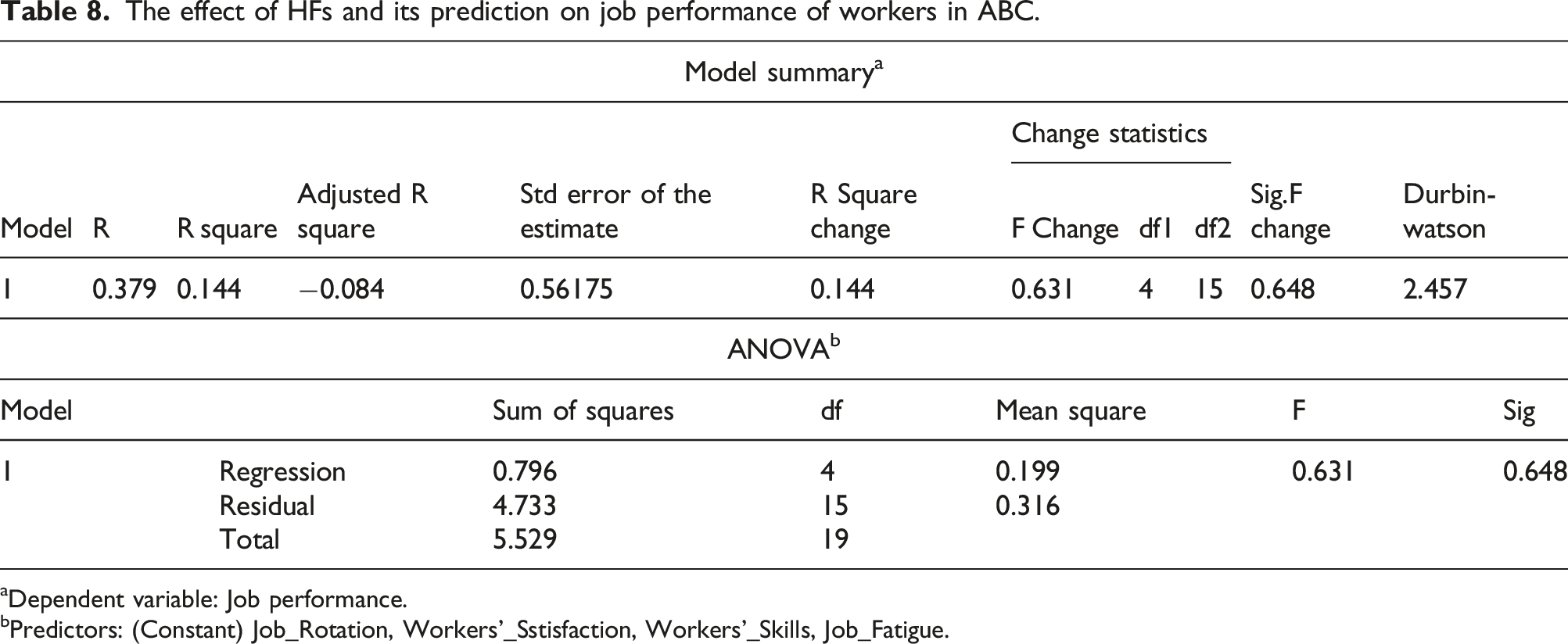
aDependent variable: Job performance.
bPredictors: (Constant) Job_Rotation, Workers’_Sstisfaction, Workers’_Skills, Job_Fatigue.
Comparison of the correlation coefficients and p-values for each variable between study 1 (ABC) and study 2 (XYZ).
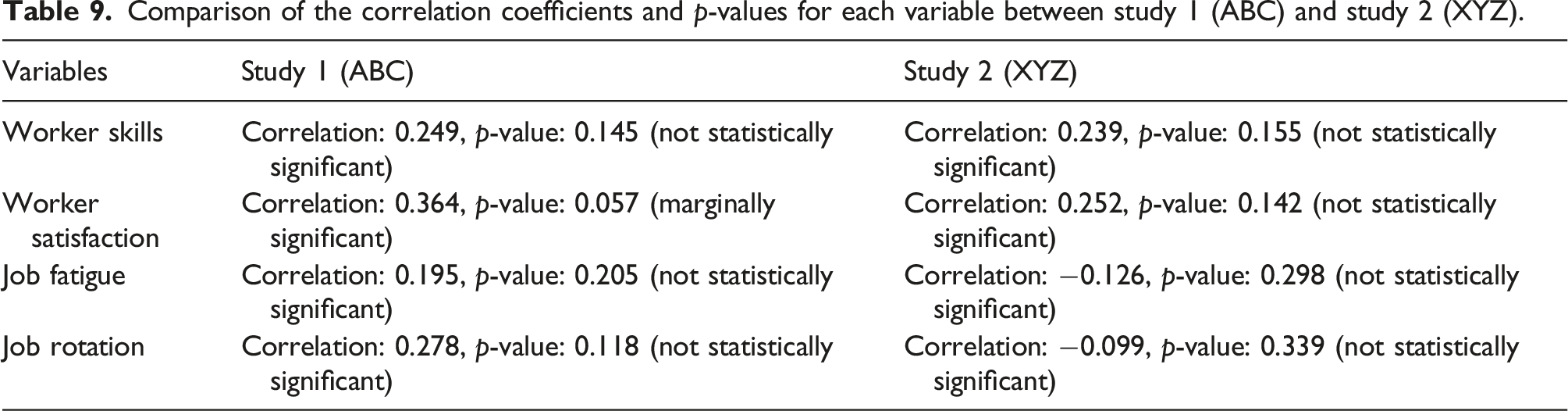
In XYZ which is like ABC, there’s a positive correlation between worker skills and the other variable(s) under investigation, but it is not statistically significant at the conventional level. Also, there is a positive correlation between workers’ satisfaction and the other variable(s), but it is not statistically significant at the conventional level. Interestingly, there is a negative correlation between job fatigue and the other variable(s), however, it is not statistically significant at the (p < .05) level. Also, we tested a negative correlation between job rotation and the other variable(s) being studied, but as with the others, it is also not statistically significant.
Regarding the analysis performed in Table 9, workers’ satisfaction seems to be the most consistently correlated variable across ABC and XYZ, with a moderately positive correlation in Study 1 and a slightly lower positive correlation in Study 2. However, worker satisfaction reaches marginal significance in Study 1. Also, job fatigue and job rotation show inconsistent correlations across the studies and are not statistically significant in either study but worker skills show consistent positive correlations across both studies but are not also statistically significant.
Although there are some patterns of correlation between these variables, however, they generally fail to reach statistical significance, suggesting that the relationships observed may be due to random chance rather than true associations. Therefore, further research with larger sample sizes or different methodologies may be needed to confirm or refute these findings.
In addition, according to Figure 7, the histogram of standardized residuals visually represents the distribution of these residuals. It reveals that most data points are centered around the mean (0.000) with a standard deviation of 0.889. This suggests that the residuals, which represent the differences between actual and predicted job performance, are close to zero, indicating a reasonably good fit of the model to the data. This plot helps us evaluate the adequacy of the regression model. An ideal plot would have a symmetric, bell-shaped curve. Deviations from this ideal shape could indicate the presence of outliers or errors in the model. Simple histogram and standardized residual plot.
According to Figure 8, the Normal P-P plot helps evaluate the distribution of standardized residuals for Job Performance. If the points closely adhere to the 45-degree line, the normality assumption is met. However, the Normal P-P indicate that the residuals of the regression model are normally distributed. Normal P-P plot of regression standardized residual for Job performance.
Conclusion, recommendation, and future work
This study aimed to investigate the complex relationships among warehouse workers—HF job rotation, job fatigue, workers’ satisfaction, workers’ skills, and job performance—between these factors in the operational contexts of two different organisations, ABC and XYZ. To achieve this goal, we developed and put through a rigorous testing process that served as a framework for our inquiry into how job rotation, job fatigue, workers' satisfaction, and workers’ skills affect job performance. First hypothesis: In the contemporary B2B e-commerce model of businesses ABC and XYZ, there is no statistically significant effect of HF on job performance. This includes workers' skills, workers’ satisfaction, job rotation, and job fatigue. Strong evidence was shown by the empirical findings to the contrary. A statistically significant relationship between these independent variables and the dependent variable was found by the investigation. This finding emphasizes the significant impact these HFs can have on warehouse employees’ ability to execute their jobs. This is consistent with the literature, which highlights the relationship between worker productivity and well-being. Although the result implies that other factors not considered in this study may have a more substantial influence on the overall system performance.
In the contemporary B2B e-commerce model of companies ABC and XYZ, there is no statistically significant effect of HF on the levels of job satisfaction, job fatigue, and job rotation among warehouse workers. Understanding how the workers’ skills, workers’ satisfaction, job rotation, and job fatigue interact through the descriptive analysis can significantly emphasize the complexity of employee performance. This underscores the need for a comprehensive approach to work and job design to achieve optimal job performance. Organisational decision-makers must recognize that a variety of dynamic elements interact to drive job performance rather than a single factor acting alone.
The assessment of job performance among employees in the B2B e-commerce of companies ABC and XYZ is not considerably impacted by the combined influence of workers’ skills, workers’ satisfaction, job rotation, and job fatigue. This study found that while individual characteristics did not all have a substantial impact on job performance, they all have a significant combined effect. This emphasizes the notion that improving job performance requires a harmonious alignment of workers’ skills, workers’ satisfaction, job rotation, and job fatigue. Moreover, it suggests that companies should implement plans that deal with these elements in their entirety rather than concentrating on specific elements. The results indicate that HFs have a critical role in determining job performance. Consequently, the study emphasises on how important it is for companies to put their employees’ health and wellbeing conditions first, particularly those in the transportation and warehousing unit. Higher job performance is certain when a skilled and contented staff is provided with opportunities for job rotation while minimising job tiredness. In other words, the need for sophisticated technology or software tools for warehouse planning and shipping scheduling in ABC and XYZ should probably consider the effect of HF among the users of the technology or tool in the system. In addition, the findings from the correlation coefficients and p-values for each variable in study 1 (ABC) as shown in Table 7 depicts that all the HF variables have a positive relationship with the performance of the system, and they all contributed to explain variations in job performance. However, in study 2 (XYZ), job fatigue and job rotation have a negative relationship job performance when considered independently. Therefore, the results in the comparison table show that satisfaction among workers in ABC is an integral part of the inventory system and management of any inventory control system should increase the awareness of equal workload when incorporating job rotation in warehouse planning and shipping scheduling. Additionally, this study revealed that in the absence of considering some of these factors into inventory system, there may be some disruption in the entire E-commerce system or distribution system due to dissatisfaction of workers. Also, the findings in this study will be used by warehouse and inventory managers in their decision-making process and policies to consider the workers well-being in terms of job satisfaction and safety. Consequently, this study also underscores the need for businesses, especially in the warehouse and logistics sector, to prioritize the well-being and work environment of their employees. Furthermore, investing in continuous training programs would ensures that employees are up to date with the latest technologies and practices, which not only boosts their performance but also increases their job satisfaction. A satisfied and skilled workforce, offered opportunities for job rotation while mitigating job fatigue, will undoubtedly lead to higher job performance. In conclusion, this research not only supports the hypotheses we set forth but also provides empirical insights into the dynamic significance between HF and job performance in diverse organizational settings. One of the limitations of this study is that the current study was conducted with a relatively small sample size. Therefore, it is recommended to expand the sample size to enhance the generalizability of the findings. A larger sample would provide a more robust analysis and improve the accuracy of the results. Also, there are several future studies under plan. Firstly, there is a need to consider additional variables that may have an impact on job performance such as remuneration, social factors etc. For a fact, factors such as organizational culture, leadership style, and work-life balance could also be included to provide a more comprehensive analysis. Secondly, there is a need to supplement the quantitative analysis with qualitative research methods such as individual interviews or focus groups interview. In general, this would help gather in-depth insights into the experiences and perceptions of the participants, while providing a richer understanding of the correlation between the variables. Thirdly, in future similar research as this, there is a need to consider different industries or sectors,27,60 to determine if the correlation between the variables hold true across various contexts. This would provide valuable insights into the generalizability of the findings and their applicability in different organizational settings. The findings from this study can be used in recommending to future researchers to consider comparative analysis in their work. A comparative analysis between different groups or subgroups based on demographic factors or job characteristics can provide insights into potential variations to determine the correlation between variables. One contribution of this study is to significantly advance research in the fields of Operations Management (OP) and Supply Chain Management (SCM), especially in the context of e-commerce. Also, policymakers in OP and SCM can use the findings in this study in their decision-making process and policies. In addition, this study could help OP and SCM managers to be aware of how variables are correlated. Also, the results have shown important factors that determine work performance. For example, the job fatigue does not exhibit a statistically significant link with job performance in warehousing systems, although workers’ skills, workers' satisfaction, and job rotation have been found to have a positive effect on system performance. This discovery advances the understanding of the variables affecting employees’ job success and system performance. In conclusion, to improve job performance in any service system, the significance of taking workers’ skills, and satisfaction, and job rotation into process design is needed. Also, more research is necessary to determine the consequences of job fatigue and how it can affect an employee’s ability to execute their job. Finally, future work should add empirical evidence to support the correlation between certain variables such as specific warehouse environment (e.g., automation levels, task complexity), especially during the application of other techniques in decision-making,61–63 when considering both subjective and objective management optimization technique to develop sustainable and resilient warehousing systems. Another important future work is on the optimal design of the interface of such an e-commerce system, which has two parts: operator-computer interface and user-computer interface. In literature, technologies for developing interfaces are available,64,65 but they need to be updated to the modern era of information, which is characterized by big data, privacy and security awareness, mobile systems, and AI.66–68
Footnotes
Declaration of conflicting interests
The author(s) declared no potential conflicts of interest with respect to the research, authorship, and/or publication of this article.
Funding
The author(s) received no financial support for the research, authorship, and/or publication of this article.
