



Abstract
This study set out to determine how Emotional Intelligence (EI) impacts the success of construction projects. This study showed that organisational culture has a role in moderating the relationship between team cohesion and project success, and its significance in this regard was also examined. Workers on several construction projects in Pakistan were contacted and provided information for this study. The data was analysed utilising the regression analysis in SPSS and partial least squares in SMART PLS, and it has been found that emotional intelligence significantly influences project success. Relationships between emotional intelligence and project success are both favourable and statistically significant. Emotionally astute colleagues can help teams to build stronger bonds with one another. Furthermore, the organisational culture positively and significantly impacts the relationship between a successful project and a cohesive team.
Keywords
Introduction
As a result of globalisation and the growing industry in the world, many projects are being implemented and completed in diverse fields of construction, IT, security, and the social sector. 1 Because of globalisation, project-based management systems are also becoming increasingly used in the global economy, and current project management approaches require a company’s heightened capability for opportunity and risk response. The overall project budget has been increased, and in 2009, the share of projects in the global economy was 30% of the total world economy.2,3 In this regard, the required competencies and portfolio of project managers have become more crucial as more businesses are required to use technology and project-based management systems. 4
To characterise the competencies and skills required by project managers, the academics have emphasised mainly, and some authors have accentuated the significance and application of emotional intelligence (EI) in project management.5–7 The EI is a project manager capability by which the project manager may effectively understand and perceive the emotions and sentiments of employees and stakeholders and shall utilise that information to provide guidance and support in their behavioural choices and for better productivity and success of the project. 8 According to the, 9 managers having strong EI perform better than managers with lower EI. We are still only beginning to understand the extent to which managers with high emotional intelligence would be more valued assets than managers with lower emotional intelligence, despite mounting evidence that emotional intelligence competency has the potential to improve performance on both a personal and organisational level project management. 9 Therefore, EI-based decisions and the success of a project may be influenced by a cohesive workplace and overall corporate culture.
A cohesive workplace allows employees to work well together and feel they contribute to the organisation’s overall success. Therefore, project success will never be the individual attainment. However, a project manager with EI would be a good team player, and the team performance may depend on his team’s cohesiveness. 10 This team cohesiveness in organisational success has already been explored, but it has rarely been investigated in a project management setting. In this study, a mediating role of team cohesiveness would be tested to attain the project’s success. 11
In corporations, especially in Toyota Japan, it is strongly believed that the organisation’s success depends on a healthy organisational culture.12,13 A healthy organisational culture encourages employees to participate in activities and offers them vision, rewards and incentives for promoting innovative ideas.14,15 In project management success, the organisational culture’s role is rarely explored. So, exploring the mediating and moderating effects of team cohesiveness and organisational culture from a project management perspective is the rationale of the current study.
The EI represents a compelling and practical concept in project management tools that holds promise across several domains. Incorporating EI into project management tools and simulations can generate valuable insights and enhancements, notably influencing decision-making and interpersonal dynamics within project management. The following points warrant EI consideration and influence, e.g., Decision-Making, Training and Development, Resilience and Adaptability, Ethical Considerations, and Decision-Making support. As previously indicated, this notion has been examined within disaster management.16,17 Expanding its application to project management is a rational progression, considering its potential advantages in enhancing decision-making processes, fostering effective teamwork, and ultimately increasing project outcomes. Furthermore, the study should explore the ethical and privacy implications of collecting and utilising emotional data within project management.
Literature review
Emotional intelligence and project success
Emotional intelligence refers to an individual’s capacity to perceive and discern the emotions and sentiments of others effectively and afterwards utilise this understanding to provide guidance or support in their behavioural choices. 8 Interpersonal communication is a significant managerial ability that substantially impacts how managers engage with one another.
According to Salovey and Mayer (1990), emotional intelligence is the ability to perceive and distinguish one’s and others' emotions and moods and effectively utilise this information to direct one’s cognition and behaviour. Despite being first overlooked, emotional intelligence has consistently been acknowledged as a crucial quality in management, significantly influencing how leaders engage with people. This phenomenon is especially prevalent within intricate project environments. 18 Based on the accumulation of relevant facts, it is reasonable to conclude that managerial effectiveness in project management is not solely contingent upon technical methods or talents but also relies on emotional abilities and capabilities. 19 The authors 20 have found a correlation between emotional intelligence, as a personal characteristic of project managers, and the effectiveness of project management in complicated projects. Specifically, the research conducted by the individual highlights the importance of a project manager’s capacity to identify and regulate emotions, as this skill contributes to the generation of higher-quality outcomes and the establishment of effective relationships with both internal and external stakeholders. 21
Many more projects are being completed due to globalisation and the growing industry in fields as diverse as construction, IT, security, and the social sector. According to Salovey and Mayer (1990), recent data, project-based management systems are increasingly widely used in the global economy. Project management approaches require a company’s heightened capability for opportunity and risk response. 8 The inclusion of external interruptions introduces an element of unpredictability to the process of project planning. Therefore, contemporary project managers face conventional obstacles and the complexities of a constantly changing global environment influenced by political and social dynamics. Consequently, the capacity to adapt enterprise integration and comprehend these elements comprehensively becomes imperative for effective project management. 22 The overall project budget has increased to billions of dollars. These project budgets show constant growth year after year. These numbers demonstrate the rising desire for better, quicker, and less expensive projects, which makes it harder for project managers to maintain their positions. 18 Project managers become more crucial as more businesses use project-based management systems. 19 Academics have primarily characterised the competencies and skills required by project managers to see them through to completion, and some authors have emphasised the significance and application of emotional intelligence (EI) in projects. 23 As early as the 1900s, institutions and academics began to recognise the significance of project management. 24 Efforts using project management techniques have increased dramatically globally in recent years. According to, 3 the global economy currently depends on projects to an extent of 30%. On the other hand, it’s both exhilarating and unsettling that project failures outnumber successes. The management has begun to take the issue, and the part project managers play seriously due to the rising project failure rate. 25 Every endeavour is different, so failure is more likely. Despite the huge risk of failure they confront, businesses keep starting new ventures at an increasing rate. This tendency is explained by the fact that businesses now value projects more than typical company activities in terms of their impact on their bottom lines and the whole economy. 26 Spending has increased as a result of the notion that initiatives are essential for fostering process management innovation and change. So, the EI’s role in the project success and in the decision making of a project management would be question of research and it will be tested in this study.
Emotional intelligence and team cohesiveness
When employees work in a project-based working environment rather than focus on their success, when employees are in a cohesive work environment - they focus more on the group’s goals and become motivated by the efforts put forth for the team. 27 In project management, cohesion is defined as “a project manager’s stance on the degree of attraction of a team to its members and the familiarity of personal links among team members”. 28 If project team members get along, they’ll be more effective. They will be better able to accomplish their goals if everyone on the team shows more compliance. 29 The benefits of having a cohesive team can include increased innovation, higher enthusiasm, increased motivation, and a propensity for change, as well as improved awareness of challenges. Recent studies have shown that team performance and composition may impact a team’s cohesion. 30 From an individual standpoint, frequent definitions of team cohesion include positive emotions, feelings for project team members, and utilising such emotions by team members; this definition emphasises the significance of public enclosure and internalisation, along with normative procedures. Thus, the affective elements of group exercises are enhanced by strong team bonds. 31 Cohesion is said to result from shared goals and expectations among team members; it is positively related to the team’s practices and performance, as well as the members' participation and contribution in smaller group activities.
People on cohesive teams are typically more productive by (1) encouraging team members to have emotional discussions, (2) establishing group norms, (3) building confidence in the group’s moral integrity, and (4) emotionally savvy leaders promote team cohesion. 32 Emotional intelligence is crucial because it predicts better team performance, according to. 33 By setting expectations for employees to follow, emotionally intelligent managers may be able to influence team cohesion. These norms govern how a group manages its social customs, occasions, pursuits, and conflicts. Cooperation is encouraged when group members consistently uphold the standards set by an emotionally intelligent leader. Emotionally intelligent leaders can establish workplace norms that are well-received by their employees. Employees with low emotional intelligence may be either unaware of what is causing the hostility or unable to change it. In contrast, emotionally intelligent team members may be able to identify and eliminate the negative emotional environment when pressures and complications occur within teams. 34
Similarly, research on emotional intelligence is increasingly emphasised on teams, with emotional intelligence being defined and assessed as the average of each team member’s EI. When intelligent individuals collaborate, obstacles don’t deter them (i.e., team cohesion). A person who doesn’t work for the government is called “independent.” Holding colleagues accountable motivates them to perform at their highest level. 35 Recent psychological studies have found a correlation between high levels of team cohesion and effective team performance. 35 Therefore, the relationship between EI and team cohesiveness concerning project management shall be tested, and the hypothesis is framed below.
Team cohesiveness and project success
The ability of the team to collaborate effectively has been essential to accomplishing recent projects. Personality traits of researchers have inconsistent implications on productivity across domains. 36 According to surveys, social cohesion and undertaking cohesion are two indicators of team attachment. 37 Social cohesion is the extent to which individuals are pulled to the group due to favourable social connections among its members (defined as the degree to which members are drawn to the group because of assignment responsibility). 38 The degree to which people are drawn to a group by tasks and the assignment’s common promise is a measure of task cohesiveness, and this kind of cohesion will probably result in improved group performance. 39 Based on the few surviving studies that emphasise the significance of task coherence to team performance, we hypothesise that commitment to the project mediates the relationship between team dynamics and creative output (i.e., item thought freshness and convenience to clients and handiness to firms). 40
For a group to operate well, there must be some degree of cohesion, and most managers “generally view cohesion as an essential criterion for team formation.” Managers can foster group cohesion by creating varied teams and encouraging members to contribute their special viewpoints. 41 The degree to which employees work together to accomplish shared objectives is referred to as group cohesiveness. It is a dynamic process symbolised by a group’s propensity to congregate and stick together while pursuing its instrumental goals and meeting the emotional needs of its members. It makes sense that a strong team will be essential to the result. 42 The connection between team cohesion, viewed as a fundamental driver for group engagement, and corporate performance has been the subject of much discussion. According to, 43 cohesiveness and achievement are frequently linked. They recommended using techniques for a circular model to link the two components to examine the relationships between cohesiveness and development. However, team cohesion has various effects on firm performance, giving us a distinctive viewpoint on the connection between team cohesion and growth. The distinctive cohesion links of diverse researchers have a variety of application-related effects. The research’s analysis produces two distinct assessments of team member cohesion: social (i.e., how coworkers are brought into the group by the group’s participants' positive social ties) and duty (i.e., how colleagues are drawn into the group by assigned responsibility). Teams function more effectively when members have a common interest in and dedication to the task at hand, as seen by high levels of task cohesiveness. 44
Team cohesiveness as a mediator between emotional intelligence and project success
Numerous studies have shown that emotional intelligence significantly affects the rate at which projects are completed. 45 asserts that a person’s emotional intelligence may be responsible for up to 80% of his performance in life. It was discovered that if management exhibited high levels of emotional intelligence themselves, their managers' emotional intelligence had a more significant positive impact on the job satisfaction of representatives. 46 After classifying emotional intelligence as a social capacity, 47 concentrated on the importance of emotional intelligence in management. They found that higher emotional intelligence was associated with better comprehension, communication, and adaptation. It is also widely acknowledged that success in many fields and professions requires high emotional intelligence. Yes, it is the answer. 46 found a significant link between EI, job satisfaction, and workplace productivity (success). According to, 48 an emotionally intelligent workplace is characterised by a welcoming environment that directly affects team members' job happiness as well as management effectiveness and business expansion. 49 looked into how emotional intelligence (EI) in the workplace, leadership, the workforce at large, employee satisfaction in the workplace, and team performance are related (success). Researchers found that team members' job success and happiness were correlated with their EI.
The study’s authors claim that a project’s effectiveness and success can be related to team cohesion in non-project situations. Strong levels of team cohesion enhance project team performance, job satisfaction, and growth, claim.13,50 Similarly, teams with high levels of cohesion frequently adhere to generational norms and experience higher levels of regular or consistent production among their members. Additionally, how information is delivered impacts the relationship between individual performance and team cohesion. It is unknown, however, if team cohesion also predicts project performance, team efficiency, or job satisfaction in a project setting where time and resources are constrained. 51
Each team member must have the necessary general and specialised abilities and skills to complete the required processes if the project is to be successful. While meeting project objectives is crucial for outcome control, less qualified or inexperienced staff are unlikely to recognise their importance without expert guidance. 52 People who work well together are more willing to exert extra effort. 53
According to a study by, 54 team cohesiveness was a mediator between emotional intelligence and project success (Success). According to the writers, a strong sense of collaboration ensures that group members can cooperate effectively to accomplish their common goals (success). In a study between employee attitude and project success, 55 employed team cohesion as a mediator and discovered that the more cohesive a team was, the better its results were. They also talked about how employee attitudes could hamper teamwork and affect project success. The likelihood that everyone will approach the assignment positively increases with team cohesion.
Organisational culture as a moderator between team cohesiveness and project success
Organisational culture is a part of the larger organisational structure, according to. 56 They define culture as a tool that fosters teamwork, fosters member relationships and professional development, and creates possibilities for communication among various groups. Open communication can reduce interpersonal conflict, which can also increase team and project output. The 57 compares organisational culture to an artistic medium in which multiple layers of culture cause disruptions in the functioning of the organisation and its members. The study’s authors conclude that a significant factor in the project’s failure was construction firms' ignorance of the influence that culture has on project outcomes. 58 Pakistan’s building industry produces subpar results even for medium-sized and small-scale projects. Project managers perform best when given the freedom to choose and take risks.59–61
Project team members behave in accordance with their worldviews, beliefs, and ethical standards. These are all aspects of the firm that exhibit the corporate culture. Firms value effective teams. Organisational context elements include management strategies, organisational culture, and a business’s structure, including the approaches for emergency management.62,63 The relationship between job satisfaction and operational management has been a topic of considerable scholarly inquiry across diverse sectors, encompassing manufacturing enterprises. Comprehending the relationship between job satisfaction and operational management can substantially influence various aspects of organisational functioning, including productivity, quality, staff retention, and overall performance.64,65 The following elements are noteworthy regarding this association: Productivity, Quality, Employee Retention, Safety and Compliance, Innovation and Problem-Solving, Employee Morale, and Customer Satisfaction. 66
Organisational adaptability, task and goal orientation, and team member involvement and participation are the three cultural elements proposed by. 67 High-involvement human resource practices, such as information sharing, choosing team members based on merit, and creating self-managed work teams, were highlighted by a study. 68 These practices promote a postive organisational culture. According to, 69 an organisation’s OC consists of items like its dress code, tales of significant events, official regulations and standards, casual code of conduct, formality, roles, pay systems, jirgas, and humour to maintain social ties among its members. 70 asserts that an organisation’s culture, built on the group’s shared experience of problem-solving successes and failures, is its driving ideology.
The authors 71 defined a construction company’s culture as its “unique pattern of key concepts” for problem-solving. According to a study, a group of unified national, local, and occupational values comprise an organisation’s culture.72,73 argued that organisational culture affects project performance more than national culture. According to a study, 74 a team’s culture comprises a set of shared values, norms, beliefs, and norms for interacting with one another.
Through this research, the author assumes that organisational culture in the Pakistani construction industry will reduce the negative effects of conflicts and strengthen teams, enabling project managers to adopt efficient techniques for dealing with and benefiting from them. In light of this, the author proposed:
Conceptual Framework.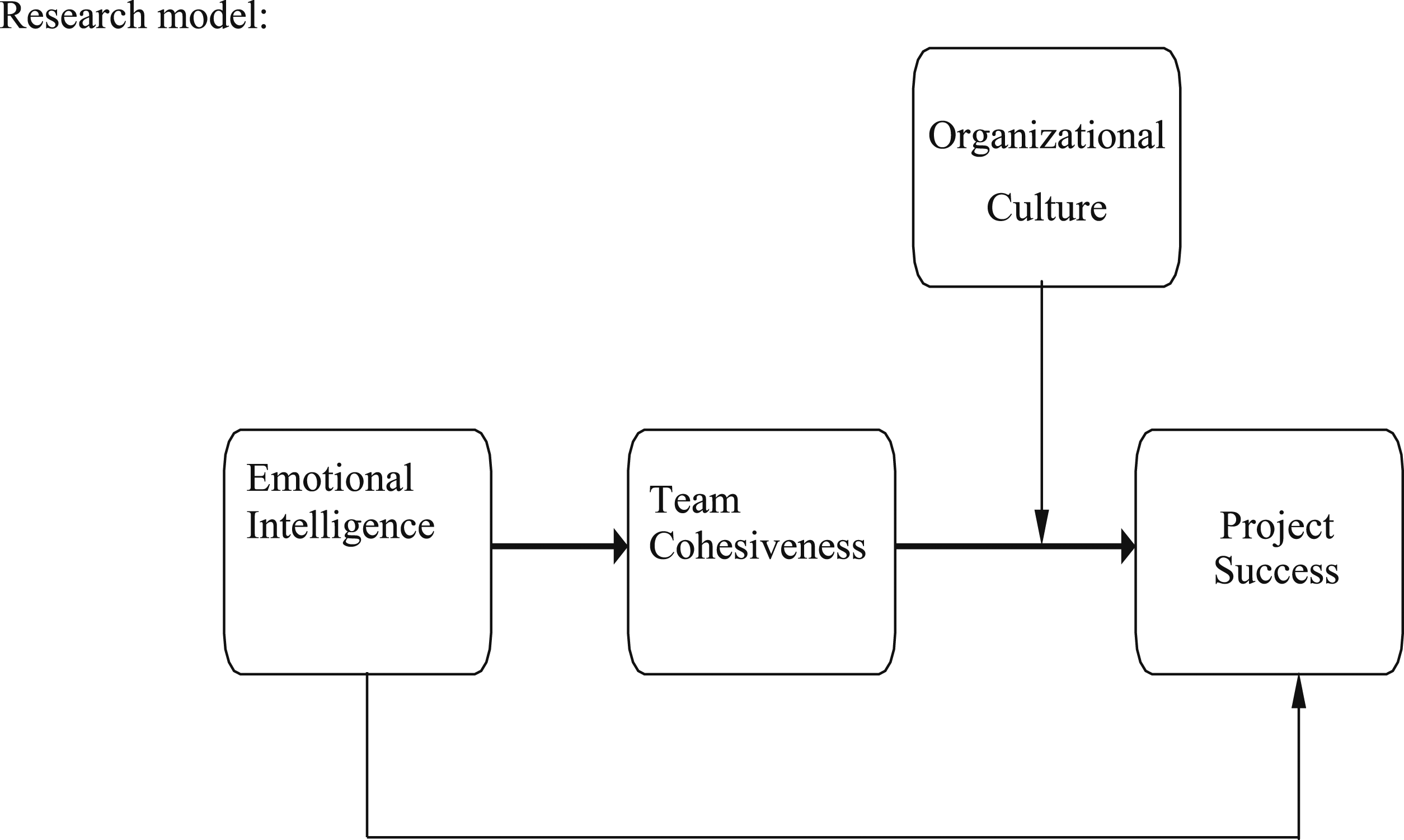
Methodology
This research is quantitative. We used the questionnaire survey techniques. The data was collected from the construction industry employees working on different projects in Islamabad, Minawali, and Rawalpindi, Pakistan. All professionals (including project managers, coordinators, consultants, and team members) from the public & private construction industry took part in this study. According to James Stevens' sample size general rule of 15 cases per variable (Stevens, 1996), 175 responses were required. Using professional contacts of the author in the construction industry and snowball sampling techniques, more than 800 construction industry professionals circulated the questionnaires by email and WhatsApp groups employing the sharing facilities of Google Forms. Each response to an item of a questionnaire was scored on a five-point Likert scale. The four demographic parameters were also declared, and gathered information from a questionnaire, such as gender, age, level of education, and employment history of respondents.
A response rate of 66% was achieved by ongoing coordination, follow-up, and polite reminders, which resulted in 530 professionals responding. A decision was made to reject replies from experts with less than 2 years of construction business experience to concentrate on the quality issues, and 470 responses were declared final for the analysis. For example, a person’s emotional intelligence was evaluated using a 16-item multi-factor questionnaire created by researchers 75 to measure the link between the factors. Four-item scale questionnaire designed by a study 76 was used to measure team cohesion. As a result, a five-point scale of 13 items established by 77 was utilised to measure organisational culture. For the measurement of the project’s success, we adopted the scale of, 78 which was also rated on 5 five-point Likert scale ranging from 1 (Strongly disagree) to 5 (Strongly Agree).
The data was analysed using the two statistical packages, SPSS and SMART PLS. The analysis was conducted to build the PLS-SEM To validate our conceptual model. According to,79,80 PLS-SEM is a promising and pertinent data analytical approach, ideal for giving empirical evidence for an emerging theory. PLS-SEM is prediction-oriented in nature and is not constrained by a large number of strict and unworkable assumptions. According to, 81 it is a valuable technique for context-driven predictions and for estimating relationships between the endogenous (dependent) and exogenous (independent) variables under study.
Results and analysis
The results and analysis are derived and explained into three sections, e.g. descriptive analysis, confirmatory factor analysis, correlation analysis and structural equation model. A detailed description of each result is given below.
Descriptive analysis
Quantitative analysis is done on the project participants' data set. Understanding the histories and personalities of the respondents is aided by this division. In addition to the following information regarding the distribution of demographic variables: gender, age, qualifications, and experience, quantitative data (mean, standard deviation, etc.) are also provided on other variables such as emotional intelligence, organisational culture, team cohesion, and project success. We present quantitative information in tables in the following sections, one table per demographic characteristic. The means and standard deviations of the variables utilised in this study were determined using descriptive statistics on tabular data.
Demographic statistics.

Confirmatory factor analysis
Confirmatory analysis.


Algorithem, Reflective Model
Discriminant validity.

Correlation analysis
Correlation analysis.

Mediation and moderation regression analysis.

N = 470. SD = Standard Deviation, EI = Emotional Intelligence, PS = Project Success, TC = Team Cohesiveness and OC = Organisational culture.
Structural equation model.
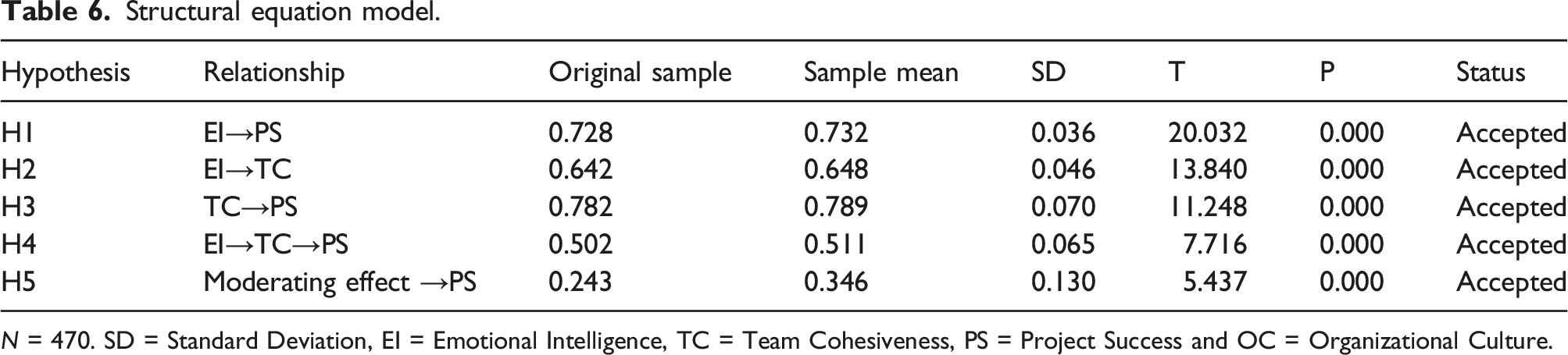
N = 470. SD = Standard Deviation, EI = Emotional Intelligence, TC = Team Cohesiveness, PS = Project Success and OC = Organizational Culture.

Bootstrapping results model.
Discussion
This study aimed to examine the relationship between Emotional Intelligence (EI) and project success using team cohesion as a mediator and organisational culture as a moderator. Statistical analysis demonstrates that EI contributes to both group cohesion and project completion. The association between project performance and overall organisational success was also found to be moderated by organisational culture.
According to the findings, managers with high levels of emotional intelligence are excellent project success predictors due to their ability to adjust to and get beyond new obstacles and problems while also encouraging and motivating their teams. 83 Similarly to a study, 20 scholars found evidence to support their claim that project managers' positive emotions have a favourable effect on the project’s outcome while researching the link between their emotional intelligence and project success.
Our research demonstrates that emotionally intelligent leaders foster a positive and supportive environment, motivating staff to perform at their highest level. Similarly, strong emotional intelligence raises employee collaboration and trust, creating a more enjoyable workplace. Emotional intelligence affects employees' attachment to teammates, which in turn affects project success factors, claim. 84 Team motivation and trust are influenced by various elements, including communication procedures, objectivity, how to address challenges, and top management support.
In light of what we’ve learned about the significance of emotional intelligence in project success, we need to reevaluate our hiring practices. A high level of emotional intelligence is ideal for professionals working on projects because it enables them to empathise with clients and coworkers, producing better results. According to a study, 85 choosing project managers with high emotional intelligence is critical. Selecting an emotional intelligence project manager can help them keep the project on pace and adjust to unforeseen issues. Our results also confirmed the original theory that an individual’s level of emotional intelligence positively correlates with the success of their endeavours.
Emotional intelligence must be applied to overcome the obstacles that develop during a project. The scholars 86 conclude that project complexity is rising and that the only project managers who can successfully negotiate these challenges are those who have emotional intelligence. According to their results, senior management must acknowledge the value of emotionally intelligent project managers and their part in project success. Project managers with high levels of emotional intelligence are the people executives should hire if they are serious about seeing their projects through to completion.
Emotionally savvy initiatives don’t worry about the bad feelings and tension among team members. Despite difficulties at work, managers with emotional intelligence can control their emotions. When their teams are experiencing negative emotions, emotionally intelligent managers will notice and work to create more opportunities for those individuals to open up and express their feelings within the context of the team. Project managers can communicate with their teams more effectively and promptly if they can explain themselves. By encouraging employees to share their feelings honestly, managers may strengthen team unity and, as a result, project success. 87 Emotional intelligence is the ability to manage one’s emotions and those of others. On large construction projects, the challenges and complexity of the workplace significantly impact worker productivity and the project’s success as a whole. Emotionally intelligent employees can better express their feelings at work, which decreases workplace aggravation, challenges, and misunderstandings and increases project team cohesion. 88
Large and complex construction projects require a project manager capable of handling the intricacies and new issues that arise, whether they are managerial or technical. A manager with vital emotional intelligence can motivate their team and effectively lead them. The team’s inability to effectively interact and communicate resulted in the project’s failure. After carefully examining how EI affects employees' attitudes and productivity at work, 89 concluded that EI is essential to the success of both individuals and teams. As a result, our second hypothesis—that higher levels of emotional intelligence are linked to greater group cohesion—is also confirmed.
Our results are startling regarding how crucial team cohesion is to project success. Positive attitudes and feelings for other project team members, or equivalent attitudes and sentiments among team members, are conventional definitions of team cohesion. It makes sense that a strong team would be essential to the result. The relationship between team cohesion, which is viewed as a crucial component of group involvement, and firm performance has been the subject of much discussion. 90
According to a study, 91 cohesive teams exhibit regular work that believes any lack of zeal or interest. Our study shows that a cohesive team is more likely to foster a positive work atmosphere where employees look forward to taking on tasks and giving their all. Cohesion increases team performance because it demonstrates how strongly individuals are drawn to and invested in the task at hand. 44 In a similar vein, we think that a strong team dynamic influences a successful project outcome.
A person’s capacity to mentally and emotionally get ready for work is just as important to the success of any project as team cohesion. Any endeavour needs motivated workers to be successful. Determining whether or not a person is accountable for their acts is called “responsibility”. 92
Implication
By first conceptualising the influence of emotional intelligence on project success, this study makes an important contribution to the discipline of project management. Current research closes a gap in the literature and supports the influence of emotional intelligence on project success. The second finding was a connection between emotional intelligence and team cohesion, a subject currently neglected in project management literature. Our results confirmed the relationship between an effective team and a successful project—a topic that hasn’t gotten much attention in the project management literature to date. In addition, we examined the hitherto researched mediation impact of team cohesiveness in the project management literature to confirm a link between emotional intelligence and project success. Finally, we investigate if organisational culture functions as a moderator between team cohesiveness and project success. The findings support this. Some applications of effective project management in the real world can be found by investigating the link between emotional intelligence and project outcomes. According to our research, employers should be picky when looking for project managers with high levels of EI because doing so increases the likelihood of a productive and content workforce. Hiring managers should prefer applicants with high emotional intelligence. 85 Emotional intelligence is key to team cohesion and cooperation in the construction industry, particularly in challenging and complicated work environments. High emotional intelligence managers can resolve challenging workplace situations and motivate their staff to approach their work positively. 93
The results of our study also point to the importance of project managers' emotional intelligence, which supports project success in challenging circumstances by, for example, fostering greater team cohesion, trust, and cooperation among team members. The results of this study have significant ramifications for the field of project management as well as future project leader training, particularly in the area of emotional intelligence.
Limitations and future research directions
The research techniques used in this study are excellent. In order to mitigate the effects of standard operating procedures and single-source bias, we first gathered data on emotional intelligence, team dynamics, organisational culture, and project success from the managers and staff of the temporary company. Only one mediator and one moderator were investigated due to time constraints; however, future studies could expand the model by looking into additional moderators like job satisfaction and trust and mediators like trust. Time restrictions might considerably impact the results of research projects. These restrictions include restricted data collection, experimentation, available resources, and sample sizes that may need to be increased, which might bias the results and reduce their generalizability. Additionally, researchers might feel pressured to use streamlined approaches, compromising the range and quality of their research. These constraints highlight the importance of giving time management in research projects serious thought to produce stable and reliable outcomes.
The researcher can utilise temporal lag because the data is cross-sectional. Additionally, the research might enhance the data collection procedure and gather data from many nations. Finally, the data was only collected from three cities in Pakistan. Finally, we acknowledge that the administrative aspect was a primary concern where we concentrated. The consequences on personnel below the managerial level and how they affect project outcomes should be studied by researchers in the future.
Footnotes
Author’s note
The data is based on Dr. Muhammad Shafiq, International Expert-Lecturer in the Faculty of Logistics and Digital Supply Chain at Naresuan University, Thailand.
Declaration of conflicting interests
The author(s) declared no potential conflicts of interest with respect to the research, authorship, and/or publication of this article.
Funding
The author(s) received no financial support for the research, authorship, and/or publication of this article.
