



Abstract
The study aimed to investigate the relationship between content, teaching, and LMS platform, and student achievement in online classes. To accomplish this, the study drew upon the transactional distance theory and the community of inquiry framework. Using log data from the LMS platform, the study analyzed the impact of student-faculty interaction, student-content interaction, and student-systems interaction on learning outcomes. The sample consisted of online classes offered in the Department of International Marketing at B University in Korea during the spring semester of 2022. The study specifically targeted classes with 40 or more students to ensure an adequate sample size. The researchers used parallelism tests to confirm the validity of the research model, followed by a goodness of fit test with an ordinal Logit model. The results indicated that all three factors of interaction (content, teaching, and platform) had a significant positive effect on learning outcomes, while student-Zoom interaction did not. The interaction between learners and content was found to be the most important predictor of learning achievement, suggesting that student engagement with course materials plays a crucial role in their academic success. The study’s findings have important implications for educators who are interested in improving online teaching and learning. The study recommends expanding the empirical analysis of the research model from the existing structural equation or multiple regression model to the ordinal logit model to provide a more comprehensive understanding of the impact of these factors on student achievement. Overall, the study highlights the importance of considering the complex interaction between content, teaching, and platform in designing and delivering effective online courses that promote student engagement and achievement.
Keywords
Introduction
The present study is situated in the context of online learning, which has become increasingly popular in recent years. As the COVID-19 pandemic has pushed more institutions to move their courses online, it has become more important than ever to understand the factors that contribute to effective online learning environments. In traditional face-to-face education, students benefit from interactions with peers and faculty, leading to the formation of learning communities that enhance learning outcomes. However, the ways in which interactions occur in the online environment are different, and it is crucial to explore how online interactions impact learning outcomes in order to create effective online learning environments. Building such a learning community is a very important part of improving online education and learning outcomes in the online curriculum. Therefore, our research questions are: How do student-student, student-faculty, student-content, and student-system interactions affect learning outcomes in online education? How can we create an effective online learning environment that enhances online presence and improves student performance through online interaction? To answer these questions, we will use two pedagogical models, the community of inquiry (CoI) model and the learner-centered interaction model. We will also analyze student interaction data from CANVAS, an online learning system, to investigate the relationship between interactivity and learning outcomes, which previous studies based on questionnaires or interviews have not shown.
Using two pedagogical models, i.e., the CoI model and the learner-centered interaction model, the present study suggests an effective online learning environment in which online interaction can enhance online presence and improve student performance. According to Moore, 1 the interactions that occur in online learning include student-student, student-faculty, and student-content interactions. Student-student interaction is an exchange of knowledge between students. 2 Student-faculty interaction is related to the level of student-faculty engagement.3,4 Student-content interaction occurs when students work with digital documents, assessments, videos, audio materials, e-books, or other learning materials. 5 Moreover, Hillman, Willis, & Gunawardena 6 proposed a student-system interaction that additionally reflects student use of a system with interfaces on top of the three elements described by Moore. 1 These interactions were explored in the CoI framework, which is an effective way to explain the success of online teaching and learning. 6
To date, a majority of studies on CoI and interactivity have been empirical studies based on questionnaires or interviews.2,7,8 However, it has been noted that the effect of interactivity on learning performance or satisfaction in online learning has not been fully explored in the literature. To justify this gap, several relevant studies have suggested the importance of interaction in online learning, including the work of Çakiroğlu and Kahyar, 9 Swan, 10 and Rugube et al. 11 In this study, we aim to fill this gap by exploring the effect of interactivity on student achievement by extracting student interaction data from CANVAS, an online learning system.
This paper is structured as follows. The next section will explore the theoretical background on interactivity, CoI, and the relationship between CoI and interaction, identify gaps in the existing literature, and describe the purpose of this study. The third section will describe the research methodology, including the research model as well as the data collection and research methods. The fourth section will conclude with analysis results and discussion, and the fifth section concludes with implications, limitations, and directions for future works.
Theoretical background and research hypotheses
According to Rourke et al. 12 the CoI consists of three overlapping core elements: cognitive presence, social presence, and teaching presence. In-depth and meaningful learning is created through the interaction of these three key elements within a community. Community building is an essential consideration in online courses. To foster community in the classroom, it is important to emphasize the co-development of cognitive presence, social presence, and teaching presence. This can help students feel comfortable in the curriculum, build relationships with peers, and openly discuss learning contents. The CoI framework developed by Garrison et al. 13 is a theoretical framework that describes the online learning experience in terms of the interactions between teaching as well as social and cognitive presence. The CoI framework is the most cited model for describing online learning experiences, and extensive research has examined each individual presence.8,14,15 Arbaugh et al. 7 validated the CoI framework by collecting and analyzing data from multiple institutions using a survey tool.
Building online interactive opportunities is an essential aspect of developing online learning communities and enhancing online social presence, cognitive presence, and teaching presence. Learners are highly motivated to learn by online interactive opportunities. Moore
1
suggested three types of interactions that are important for learning and engagement: learner-content, learner-teacher, and learner-learner. Moore’s classification of online interactions has become one of the most cited frameworks for studying online interactions. However, Moore
1
did not consider the interaction between the learner and the platform.
6
Swan
10
presented a new perspective on the three types of interaction and suggested a way to integrate the interactivity framework of Moore
1
with the CoI framework described by Rourke et al.
12
Swan
10
suggested that cognitive presence is the same as interaction with contents, teaching presence is the same as interaction with faculty, and social presence is the same as interaction with students or/and instructors. These associations illustrate how they all work together to support online learning (see Figure 1). These online interactions are essential to a successful and satisfactory online learning experience, and the development of online interactions fosters online community building. Relationship between presence and interaction.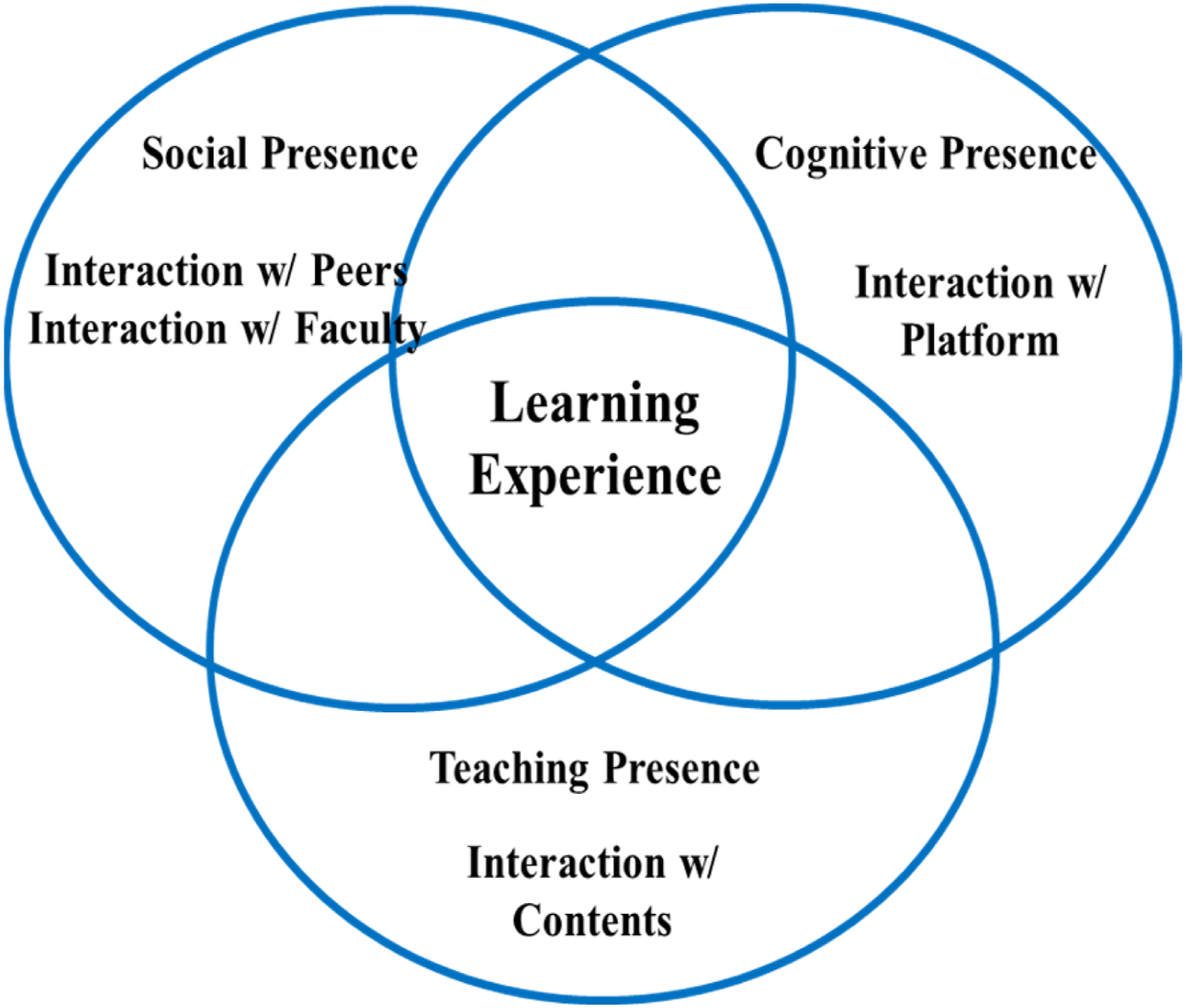
Çakiroğlu & Kahyar 9 revealed the relationship between presence and interaction using the Euclidean distance model and correspondence analysis. According to the results of the study, cognitive presence is at the center of CoI framework, and the relationship with student-system (technology) interaction is more prominent than those with other interactions. Social presence was found to be mostly related to learner-learner interaction and learner-teacher interaction. Teaching presence was found to be similar to learner-content interaction. 9 The difference from the study results of Swan 10 can be attributed to the learning analytics approach and log data based on LMS.
Student-contents interaction
An interaction between student and contents is the outcome of students reviewing and researching teaching contents.16,17 This type of interaction is one of the most common forms of interaction that occurs in distance education. Student-contents interaction can greatly assist students in achieving their goals through careful selection of learning contents and activities in online education. Therefore, student-contents interaction is an essential element of the educational process. That is, the intellectual participation of students in lecture notes is the basis of all educational processes. 1 This enables a holistic understanding of the student’s change and the personal construction of knowledge by interacting with the learning contents. Interactions between students and learning contents provide a space in which to respond to the content and develop an understanding of the content read. 18 In summary, students interact with learning contents by engaging in learning activities such as reading, watching videos, using software programs, participating in simulations, exploring resources, and working on curriculum assignments. 19 The student-contents interaction can be manifested through the teaching presence. The teaching presence is influenced by the activities, interactions, learning outlines, and learning facilitation of the learning environment. 13
Moore 1 defined three types of interactivity, and Dailey-Hebert 20 argued that mixing interactivity types improved motivation, satisfaction, and achievement in online courses. Student-student interactions in online learning environments include students working with peers within teams/groups through discussions, role-playing opportunities, scenario building, team projects, or other collaborative activities. 20 During these interactions, students seek knowledge and meaning together without relying on specialized professors to impart knowledge. This type of interaction can be either formal or informal. 21 A student-content interaction involves students interacting with content in online learning. 20 According to Moore, 1 student-content interactions are interactions that potentially enable students to acquire knowledge using learning materials. This is the process by which learners intellectually interact with content, or change their understanding, perspective, or cognitive structure of the mind. Student-content interaction occurs when a student creates new knowledge by combining existing knowledge with new information with the aid of a professor. 22 Moore 1 and Van den Berg 22 argue that, in online learning, teaching or learning does not occur without student-content interaction. Ekwunife-Orakwue & Teng 23 and Sebastianelli et al. 24 found that student-content interaction had a greater impact on learning performance than any other type of interaction. A recent study suggested that student-content interaction has a significant positive effect on perceived learning and learner satisfaction.9,25 In the LMS platform, student-content interaction is related to downloading lecture notes and watching lecture videos corresponding to learning content. Therefore, we established the following hypotheses:
Student-content interaction has a positive effect on academic achievement.
Student-lecture note interactions have a positive effect on academic achievement.
Student-lecture video interactions have a positive effect on academic achievement.
Student-faculty interaction
Instructors act as facilitators, guiding students through independent or group learning activities and providing direct feedback to students. The student-faculty interaction is a very important part of helping the instructor keep a student focused on the contents and to provide positive and perceptive feedback. According to Moore, 1 a learner-faculty interaction in an online environment is much more important than simply delivering content to students. Anything a professor gives, whether it be feedback, emphasis, or general guidance on a subject, is very important in helping students understand the contents. Faculty opinions are required to ensure that students are on the right track in every unit of learning in a subject.
The ability of learners to project themselves socially and emotionally and view other learners as real individuals is referred to as social presence, and it is also essential for establishing favorable student-faculty relationships in online learning settings. Faculty can cultivate a stimulating and encouraging online learning atmosphere by promoting social presence, allowing students to feel at ease and driven to engage actively in their academic work. Student-faculty interactions are about student-faculty relationships, and these serve as the basis of online course learning. 20 Instructor guidance is needed to determine whether learners have correctly understood the content, how to study specific content, and how to discuss the content. Regardless of whether or not an instructor is physically present, they play an important role in supporting learning. In online learning, student-faculty interaction has been shown to improve student learning, educational satisfaction, student achievement, and persistence. 26 An important factor that promotes the quality of learning is teaching and social presence. 26 Interactions such as students receiving timely feedback from professors and various evaluation methods have all been shown to contribute to student satisfaction. 26 According to the studies of Ekwunife-Orakwue & Teng 23 and Çakiroğlu & Kahyar, 9 they found that student-faculty interaction plays an important role in perceived learning outcomes. On the LMS platform, student-faculty interaction occurs through the messenger and Zoom conferencing software in the LMS. Therefore, we established the following hypotheses:
Student-faculty interaction has a positive effect on academic achievement.
Student-faculty interaction using messenger has a positive effect on academic achievement.
Student-faculty interactions using Zoom have a positive effect on academic achievement.
Student-platform interaction
Van den Berg 22 argued that interaction with technology should be added to Moore’s three types of interaction. 1 Here, technology refers to web-based learning platforms, learning management systems (LMS), interfaces, etc. Hence, we must consider that the three interactions suggested by Moore 1 are mediated by technology. 22 Because technology is an important mediator between these interactions, students must learn and be helped through interactions with technology. Therefore, instructors must be able to use technology well in both teaching and learning activities, and students must also be able to use technology effectively to improve learning. Students must also be able to use technology to benefit from the three interactions described by Moore. 1 Therefore, the technology itself should be treated equally as a fourth type of interaction.
According to Alhih et al. 21 student-interface (technology) interactions occur in the medium or technology provided by technology tools that provide opportunities for students to share, talk, discuss, or communicate ideas. Some examples of the technology used in student-technology interactions include learning management platforms, accessible library resources, webcams, search engines, and web sites. Students interact with machines or digital artifacts. 22 Strachota 27 found that student-interface (skill) interaction had a minimal impact on learner satisfaction at the level of 9%. However, other studies have argued that student-interface interactions represent one of the important predictors of learning outcomes. 28 Student-interface interaction also influences learners’ perceived learning through pre-computer education.9,29 Students’ interaction with the LMS platform can be seen through the number of page views in the LMS and the length of time spent in the LMS. Based on this background, we propose the following hypotheses:
Student-LMS platform interaction has a positive effect on academic achievement.
Student’s page views in the LMS have a positive effect on academic achievement.
Student’s dwelling time in the LMS has a positive effect on academic achievement.
The Figure 2 presents a conceptual research model to explain the different types of interactions that occur in online learning environments. The diagram visually represents the different types of interactions such as student-student, student-content, student-faculty, and student-interface interactions. Diagram of conceptual research model.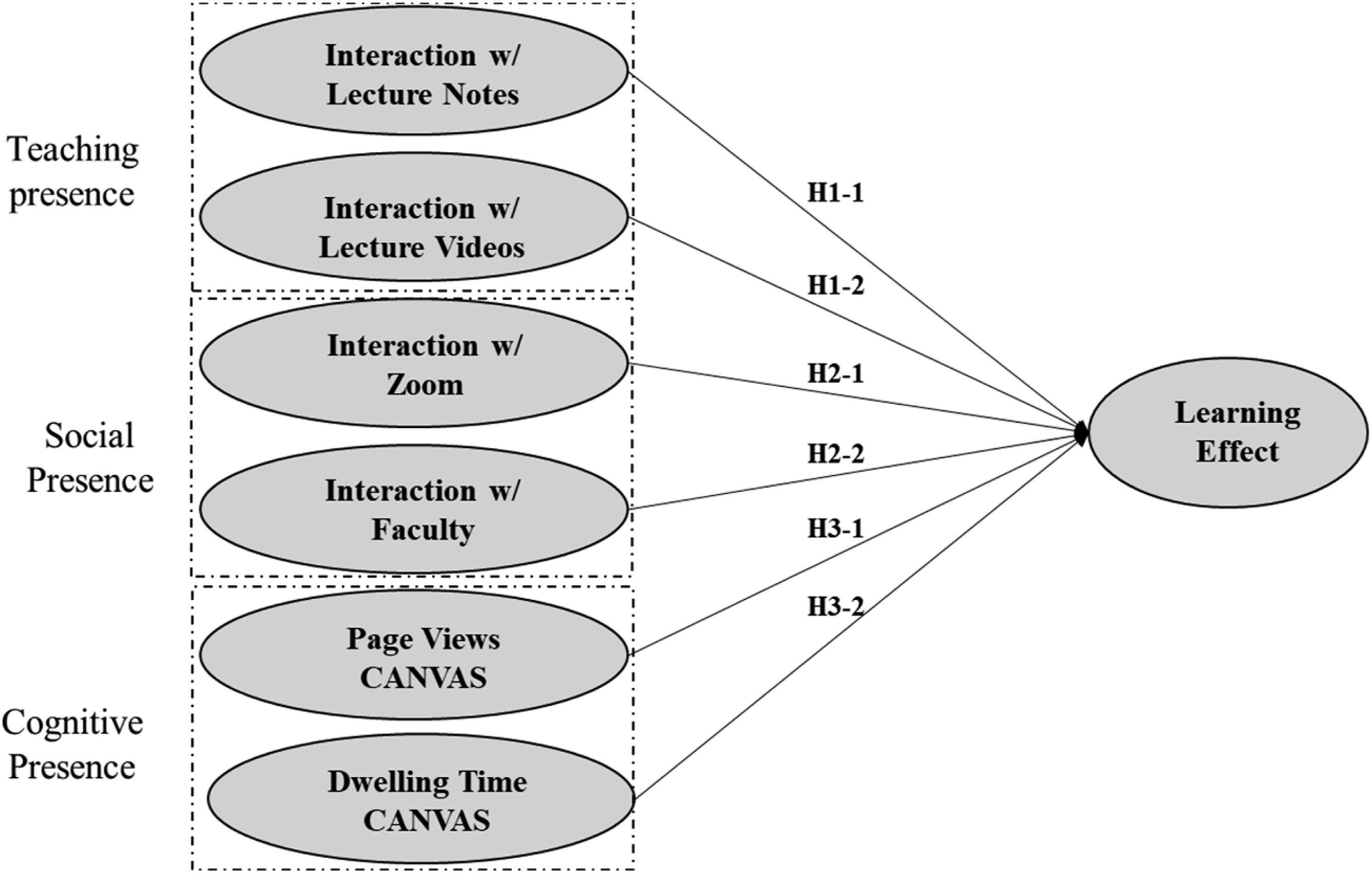
Research methodology
Data collection
Demographic descriptive statistics.

Descriptive statistics of platform.

Ordinal logit regression model
Multiple regression analysis requires that the dependent variable be a continuous variable and a variable measured on an interval scale. Because student performance is a categorical variable, it cannot be analyzed using multiple regression analysis. Therefore, since grade is a sequential nominal variable as a dependent variable, ordinal Logit analysis is an appropriate method. Moreover, since the dependent variable in this study has a multinomial categorical order, the ordinal logit model
30
provides useful results. The ordinal logit model is as shown in Equation (1) when the dependent variable is categorical and ordinal (j = 1, 2, 3, 4, 5).

The model fit of the ordinal logit model is tested using chi-Square (χ2). Ordinal Logit regression analysis must satisfy the basic assumption that each independent variable is equally affected when the dependent variable changes by one unit. It is necessary to conduct a parallelism test to statistically confirm whether these assumptions are satisfied. If the p-value of the parallelism test result is greater than 0.05, then the basic assumption is satisfied, while if the p-value is less than 0.05, the assumption is violated, so an analysis method other than ordinal Logit regression analysis should be used.
In the present study, the dependent variable, learning performance, has categorical characteristics with an ordered structure in the research model (Figure 2), while all independent variables have continuous characteristics. Therefore, the most appropriate model that meets these characteristics is the logit model 31 analyzed using SPSS21.
Results and discussions
Results of the goodness-of-fit test of the model.

Parallelism test.

Correlation analysis.
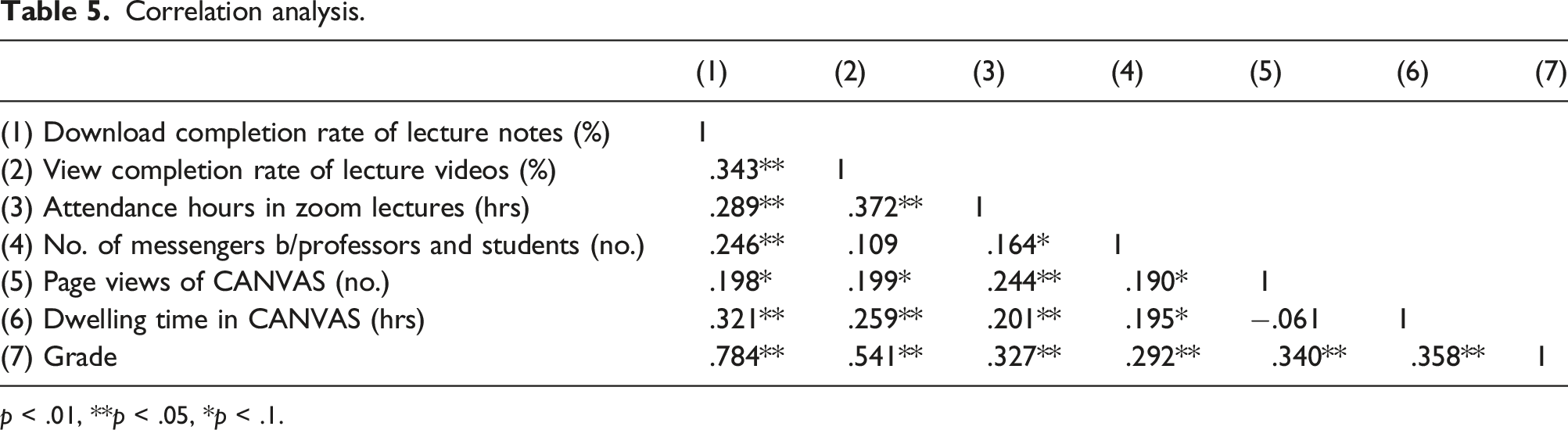
p < .01, **p < .05, *p < .1.
Hypothesis test results.

p < .01, **p < .05, *p < .1.
Regarding the hypotheses of the research model, the results showed that both student-lecture materials (Hypothesis 1-1) and student-videos (Hypothesis 1-2), which are student-contents interactions (Hypothesis 1), have a significant effect on academic achievement. Student-content interaction is an essential element in online learning. 1 This finding is consistent with those obtained in the studies by Kumar et al. 25 and Çakiroğlu & Kahyar. 9 These studies found that student-content interaction has a significant effect and the strongest effect on student satisfaction.
Among the student-faculty interactions (hypothesis 2), the student-messenger interaction (hypothesis 2-1) was accepted, but the student-zoom interaction (hypothesis 2-2) was rejected. This finding suggests that interaction by messenger, where one-to-one communication occurs in an online environment, affects academic achievement, while real-time (synchronous) one-to-many interaction does not affect academic achievement. This is partially consistent with the results of Kauffman 26 and Ekwunife-Orakwue and Teng, 23 but the format of synchronous learning—such as Zoom—does not affect academic achievement when conducted in the same manner as face-to-face classroom instruction.
Among student-platform interactions (Hypothesis 3), students’ page views (Hypothesis 3-1) as well as students’ dwelling time in the LMS (Hypothesis 3-2) were both found to have a significant effect on academic achievement. These interactions refer to how many times the student viewed various pages in the online learning system along with how much time the student dwelled in the online learning system. These findings suggest that the interaction with the university's online learning system (platform) is an essential factor in online learning, which was not present in Moore. 1
Conclusions, implications, limitations, and future works
Based on the interactivity model of the transactional distance theory and the CoI framework, this study explored the influence of student interaction with content, faculty, and platform on students’ academic performance. The results of this study show that all three factors of interaction (content, faculty, and platform) have a significant positive effect on learning outcomes. However, the student-zoom interaction was not found to be significant. The results of this study showed the importance of the role of interaction attributes in students’ learning outcomes. We found that interaction between students and content in online learning has the greatest impact on learning outcomes. We found that, in online learning, interaction between students and content has the greatest impact on learning outcomes. This is similar to student-faculty interaction in face-to-face classes. The next most influential attribute was the number of times the page provided by the online learning system was viewed, and communication with the professor through messenger was confirmed.
This study has several implications for academic research. First, it builds upon the work of Çakiroğlu and Kahyar, 9 Swan, 10 and Rugube et al. 11 by utilizing a learning analytics approach to empirically analyze the interactivity attributes that influence learning outcomes, based on Moore’s 1 interactivity model and Garrison et al.’s 13 CoI framework theory.
Interactivity in online learning refers to the bidirectional communication that fosters active learner engagement and cognitive processes on digital platforms. Interactions in online learning can be categorized differently based on the learning environment, including learner-instructor, learner-learner, and learner-content interactions. Learner-instructor interactions encompass dialogues, participation, feedback, and motivation within the learning process, making it the most easily established form of interaction. Learner-learner interactions involve information sharing and opinion exchange among learners. Research has shown that smooth interactions among learners, instructors, and learning materials positively influence learners’ effective learning experiences and achievement in online courses. This implies that instructors and the learning environment should play a supportive role in facilitating learners’ learning processes. Various software and interaction methods, such as voting, discussions, quizzes, and real-time comments, can be utilized in online learning. Instead of focusing solely on finding new methods to provide successful learning experiences to learners, it is essential to first consider the content aspects, such as the purpose of online learning, the preferred instructional approach, and the topics to be covered. By examining these aspects, instructors can derive strategies for close interactions among themselves, learners, and learning materials, thus ensuring educational outcomes in online learning. Garrison et al.’s 13 proposed three elements of the CoI model: Teaching Presence, Cognitive Presence, and Social Presence. These three components can be realized through interactions in online learning. Teaching presence is manifested through interactions with uploaded learning materials, such as lecture notes and videos, on the LMS. Social presence can be demonstrated through interactions among instructors and peers on the LMS, including messaging, email, social media, and ChatBots. Cognitive presence can be exhibited through interactions with the LMS itself.
Second, it provides an importance ranking of interactivity attributes through the use of odds ratio values obtained from ordinal Logit regression analysis. The importance of interaction attributes was found to be prioritized in the following order: interaction with course content, including lecture notes and videos, was identified as the most crucial. This study emphasizes that interaction with content relies on instructors uploading the content for students to access. To enhance students' interaction with content, active participation in learning activities should be encouraged, fostering self-directed learning. The next significant form of interaction is the interaction with the LMS or technology, which enhances cognitive presence. To promote high levels of interaction with systems or technology, equitable accessibility and usability for all students should be ensured. Lastly, the interaction between instructors and students is another vital factor. This study focused on interaction through the messaging feature on the LMS. However, it is essential to enhance social presence through interaction using various media beyond messaging.
Third, it provides insights into the relationship between interactivity attributes and learning outcomes, expanding our understanding of how online learning environments can be optimized for student success. It was found that students’ interaction with content and the LMS system significantly influences learning outcomes. To enhance students’ learning outcomes, it is crucial to facilitate students’ active participation in the LMS, allowing them to freely engage with content and promote self-directed learning through interaction.
In terms of practical applications, this study has several implications for universities and instructional designers. First, it suggests that investing in the quality of learning content, such as lecture videos and notes, can have a significant impact on learning outcomes. To better understand students’ behavioral engagement in situations where there is no interaction between students and instructors or peers in an online learning environment, it is important to investigate the nature of student-content interaction. The two key aspects of online student-content interaction explored in the research are as follows: (a) the download completion rate of lecture notes and (b) the view completion rate of lecture videos. The amount of time students devoted to engaging with lecture notes and videos had the most significant impact on their academic performance. Therefore, it is crucial to establish an LMS that allows students to freely access various content and engage in self-directed learning based on the provided materials.
Second, it highlights the importance of creating user-friendly pages within the online learning system and optimizing social media connectivity to improve students’ engagement with course materials. To enhance students’ learning outcomes, it is imperative to develop a user-friendly LMS that allows seamless access and active participation in learning activities across various platforms such as PCs, mobile devices, and tablets.
Third, it provides guidance on how instructors can design and facilitate online discussions to promote active and meaningful learning. To improve learning outcomes through personalized and customized instruction for students, it is essential to conduct learning analysis that diagnoses students’ academic patterns and competency levels. This analysis enables the design of customized lessons and interventions specific to each student’s needs.
Fourth, it offers recommendations for how learning analytics can be used to inform instructional design decisions and improve student outcomes. Fifth, it emphasizes the importance of ongoing evaluation and assessment to ensure that online learning environments are meeting the needs of students and achieving desired learning outcomes. To enable individualized adaptive learning, experiential learning, and collaborative learning, it is crucial to establish a system that maximizes interaction between students and between students and instructors.
This study was conducted using web log data of students belonging to a department in a university. This result is difficult to generalize. Therefore, it is judged that analysis using the data of all universities will be meaningful. The second limitation was that it was difficult to obtain data for interactions between students because they were using their own media. More meaningful results are expected to be obtained if students acquire and reflect interaction data between peers. Finally, the analysis in this study was conducted solely using student log data. If further research were to be combined with instructor log data, richer implications could be found from the both instructor’s point of view and the student’s point of view.
Footnotes
Declaration of conflicting interests
The author(s) declare no potential conflicts of interest with respect to the research, authorship, and/or publication of this article.
Funding
The author(s) received no financial support for the research, authorship, and/or publication of this article.
