




Abstract
In industrial design, perceived quality is driven by color, material, and finishing (CMF). Extant literature on CMF in the automobile industry has primarily focused on hue. Accordingly, the present study focused on color brightness with the goal of assessing whether light reflection brightness of sport utility vehicles (SUVs) positively affects consumers’ purchase intentions due to an expectation of premium design. Additionally, it was hypothesized that light reflection brightness of compact cars would negatively affect consumers’ purchase intentions, as they would expect a cost-effective design. Subsequently, multiple car designs—with the same style but different levels of light reflection brightness—were created, and randomized controlled trials were conducted through an online research environment in Japan. The results confirmed the study hypotheses, indicating that while light reflection brightness of SUVs positively affected consumers’ purchase intentions, the same effect was not observed for compact cars. This suggests the importance of coherent embodiment based on product concepts. While some elements, such as safety and durability, are required in all products, compatibility with product characteristics needs to be examined for emotional elements, such as design.
Introduction
Perceived quality plays an extremely important role in product competitiveness. 1 For example, Apple has achieved perceived quality by carving a single aluminum plate to form a shape with enormous effort and cost, which distinguishes it from its competitors and improves its products’ competitiveness. 2 Consequently, perceived quality is an important management asset.3,4 However, unlike objective qualities such as durability, subjectivity such as beauty and comfort should be noted in perceived quality.5,6 Because of its subjectivity, perceived quality can be high for some consumers but low for others. 7 Therefore, in research on perceived quality, it is necessary to carefully consider the influence of the characteristics of the target product.
In industrial design, perceived quality is based on color, material, and finishing (CMF). 8 Of these, this study focuses on color. The dimensions that define color include hue, saturation, and lightness. 9 However, color comprises other aspects, such as gloss (light reflection)—a visual aspect of quality that depends on the ability of the surface to reflect light. 10 Compared to hue, saturation and lightness, and despite its common use as a design method in the practice of the automobile industry, research on light reflection brightness remains surprisingly scant. This study aims to fill this research gap by examining the effect and effective conditions of light reflection brightness of a car’s exterior design on the purchase intentions of consumers. As a condition, the influence of the body type of the car was considered. To the best of the author’s knowledge, this study is the first to focus on the effect of light reflection brightness in the context of car exterior design. From the subjectivity of perceived quality, it is necessary to understand the factors that increase a product’s value from a consumer’s perspective. Collected data can then be used to improve the perceived value of products. Indeed, as the results of this study show, even with identical factors, the effect varies depending on vehicle body type. As CMF is a factor common to industrial products, 8 the implications of this study will be useful for the automotive industry as well as other industrial products.
The layout of this article is as follows. A brief review of the relevant literature is provided along with the proposed hypotheses of this study. Following this, the methods and materials used to explore these hypotheses are presented. Next, the results of the analyses are provided and briefly discussed. Finally, the paper concludes with the limitations and implications of this study.
Literature review and hypotheses
Components of perceived quality
Consumers’ perception of a high-quality brand image not only depends on durability but also on emotional factors such as beauty and comfort, 11 that is, improving a product’s durability is not sufficient to improve its perceived quality. Perceived quality enhances consumers' purchase intentions12,13 and contributes to loyalty.14–17 From a management perspective, perceived quality increases stock returns 18 and assists brand building.19,20 Furthermore, perceived quality is a critical factor for improving competitiveness. Several important factors in perceived quality have been highlighted from a corporate perspective: brand recognition, 21 trust, 22 reputation, 23 product perspectives and quality, 24 region of origin,25,26 package size, 27 prices, 28 and discounts and coupons. 29 It is one of the most important aspects of product development that defines excellent design, even in industrial products such as automobiles. 30 Therefore, CMF has become an important source of product competitiveness in various industries, such as apparel, cosmetics, home appliances, cars, and aircrafts. 31
Components of the perceived quality of color
Since the beginning of the 21st century, research on color in the field of sensory marketing has grown rapidly. 32 Color has significant meaning, affects people’s emotions, 33 promotes purchase intentions, 34 and influences willingness to pay for products. 35 This influence may exceed the objective content of the product. The effect of color has especially been discussed in the context of food production. A study of the effect of the color of plastic cups filled with hot chocolate has revealed that orange and dark cream-colored cups enhanced the flavor. 36 In the context of coffee mugs, white cups are associated with a stronger coffee flavor than clear- and blue-colored cups. 37 In wine experiments, consumers’ sense of smell was more strongly influenced by the wine’s color than its raw materials. 38 Regarding orange juice, the color of the package label was found to affect the taste. 39 Thus, tableware, packaging, and even ambient colors and lighting affect consumers’ perception and appreciation. 40 Similar effects have been observed in other industries. In the pharmaceutical industry, warm colors are believed to have greater efficacy in medicines than cold colors. 41 Moreover, the impact of color on brand image is well known. For example, a study used fictitious product packages to determine that cold colors (e.g., blue) and dark colors (e.g., black) convey elegance and luxury, while bright colors (e.g., white) signify affordability. 42 A study of brand personality 43 examined fictitious logos and revealed that white denoted honesty, red denoted stimulation, blue denoted ability, black denoted refinement, and brown denoted sturdiness. 44 Therefore, color influences the competitiveness of products in various industries. In addition, color schemes have been found to provide a competitive advantage for online stores. 45
However, color is not defined solely by hue. The following three dimensions define color: hue (e.g., green, red, blue, or yellow), saturation (color intensity or saturation), and lightness (perceived intensity of the light9,10). As mentioned previously, hue produces various effects. However, it has been found that saturated and bright colors also influence consumer emotions and behavior. 46 For example, visual elements of food packages, such as high saturation and lightness, convey a healthy and pleasant impression.47,48 Similarly, the positive effects of saturated and bright colors have been confirmed for various kinds of products, such as personal computer screens, 49 print advertising, 50 market lighting, 51 and architecture. 52 As existing research on automobiles is limited to the hue of a product’s interior 53 and exterior, 54 the effect of light reflection remains unknown. However, because the effect of high brightness has been confirmed through abundant research, the following hypothesis for this research was derived:
H1: Light reflection brightness enhances purchase intentions for car exterior design.
To understand the effect of light reflection brightness, it is important to examine its difference based on product features. For example, effective hue differs according to a car’s body type. 54 Similarly, light reflection brightness does not affect consumer behavior for all cars. That is, irrespective of their function, the effects of different aspects of color cannot be completely utilized if they do not correspond to the product concept. 55 This phenomenon has been confirmed in the context of several industries. For example, studies of accommodation-sharing platforms, such as Airbnb, have reported that the consistency of property information and color impressions greatly influence purchasing behavior. 56 In fashion, brightly colored products in a warm environment increase consumer interest. 57 This study examines compact cars and sport utility vehicles (SUVs), which have considerably different features. Compact cars are small and emphasize affordability; contrastingly, SUVs are large and emphasize design. 58 Hence, the attractiveness of an SUV’s design can likely be easily enhanced using light reflection brightness. Additionally, saturation increases perceived product size. 59 Although the relationship between brightness and perceived product size has not been verified, it is presumed that they share a positive correlation. Therefore, it is assumed that a large SUV can more effectively convey such product features than a compact car. Accordingly, the following hypotheses for this study were derived:
H2-1: Light reflection brightness does not enhance purchase intentions for compact cars.
H2-2: Light reflection brightness enhances purchase intentions for SUVs.
Materials and methods
Design production
To test the hypotheses, multiple car designs were created with the same styling but different levels of light reflection brightness. To avoid bias based on brand images of existing cars, new car designs were created. The new car was newly built based on multiple existing cars, including the Honda FIT/Chevy Spark (compact) and Honda HR-V/Mazda CX5 (SUV). A brand logo was not displayed on the exterior. The exterior body comprised a metal flake layer and a clear coat (Figure 1); these two variables were used to continuously vary the level of light reflection (Table 1). The first variable was reflection from the metal flake layer. The metal flakes were very small pieces of metal (fine particles), usually aluminum, made by finely crushing aluminum foil. The larger the metal flake content, the higher the light reflection from this layer. The second factor was the refractive index of the clear coat. The larger this value, the more the light bends, causing internal reflection and producing a shine. The refractive index of vacuum is 1, water is 1.333, and diamond is 2.417. Figure 2 presents the car designs that were created by continuously changing these two variables. Autodesk Vred Design was used for the design production. Structural drawing of the exterior design. Light reflection settings. Three levels of light reflection brightness design (Upper: Compact car, Lower: Sport utility vehicle (SUV)).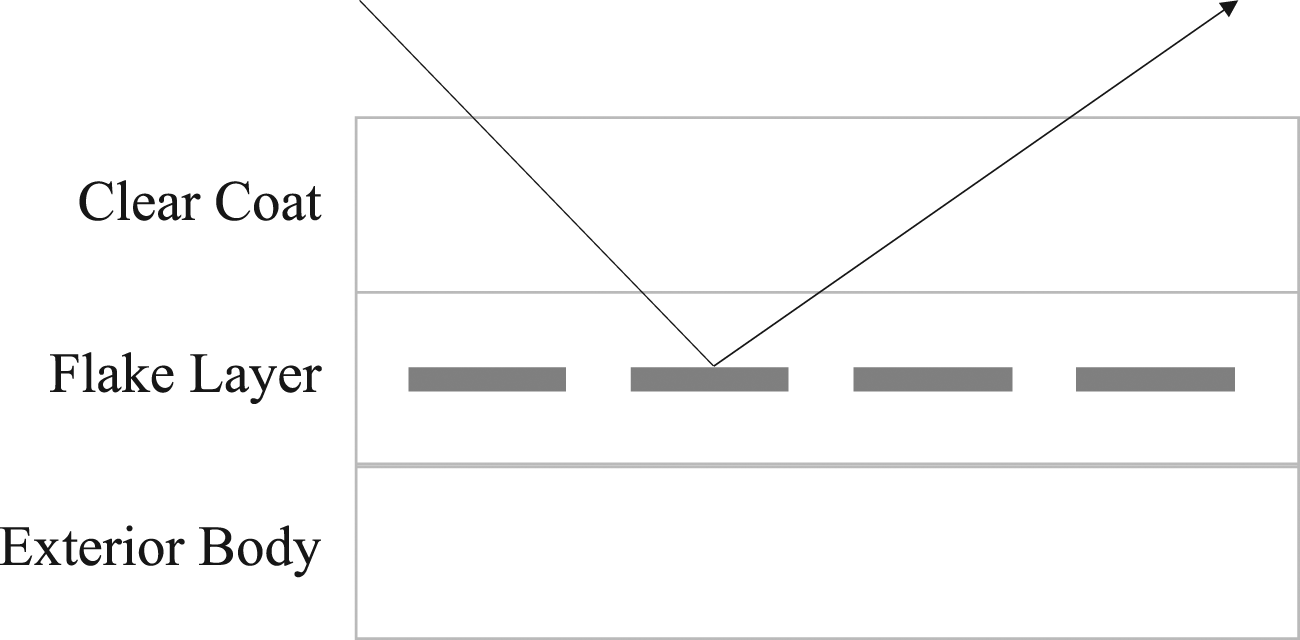


Survey and analysis
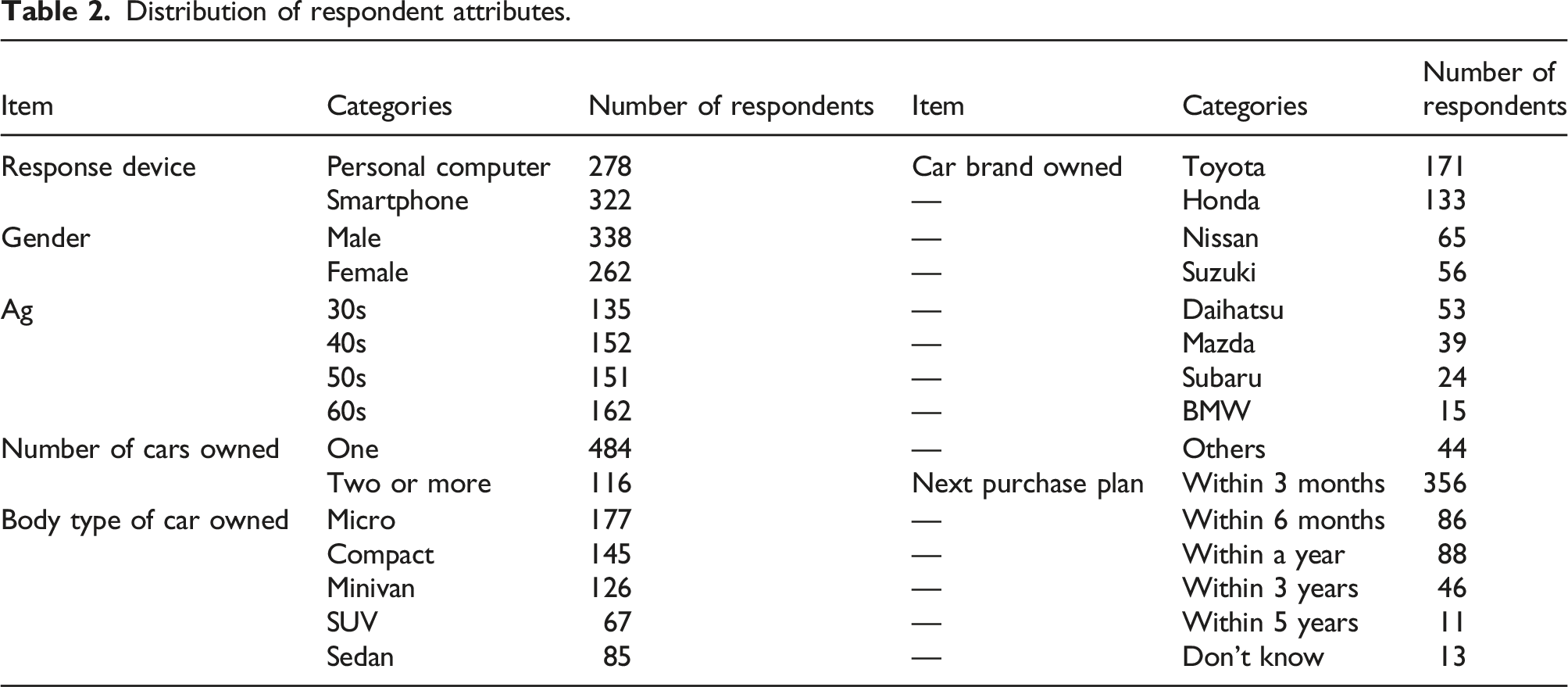
An online survey was conducted from August 5 to 10, 2021, targeting people between the ages of 30 and 60 in the Japanese market. The survey was e-mailed to a panel owned by a major Japanese research company. Respondents were chosen based on the following two conditions: (a) they must be between the ages of 30 and 60, and (b) they must own a car. Those in their 20s were excluded because of the low car ownership rate and less purchasing experience among people in this age group. However, the type of car owned was not a criterion for inclusion because the purpose was to verify the influence of product features. Therefore, it was necessary to align the features determined by respondents with the designs of both compact cars and SUVs. The sample size was 600 respondents (three brightness levels × two body types × 100).
Distribution of respondent attributes.

Emphasis points during purchase according to body type. Note: Wom = word of mouth.
List of variables and other statistics.

Note: SE = standard error; PC = personal computer; SP = smartphone; Wom = word of mouth.
Results
Results of the Chi-square test.

Note: SUV = sport utility vehicle. ***p < 0.001; **p < 0.01; *p < 0.05.
Results of the Steel test.

Note: ***p < 0.001; **p < 0.01; *p < 0.05.
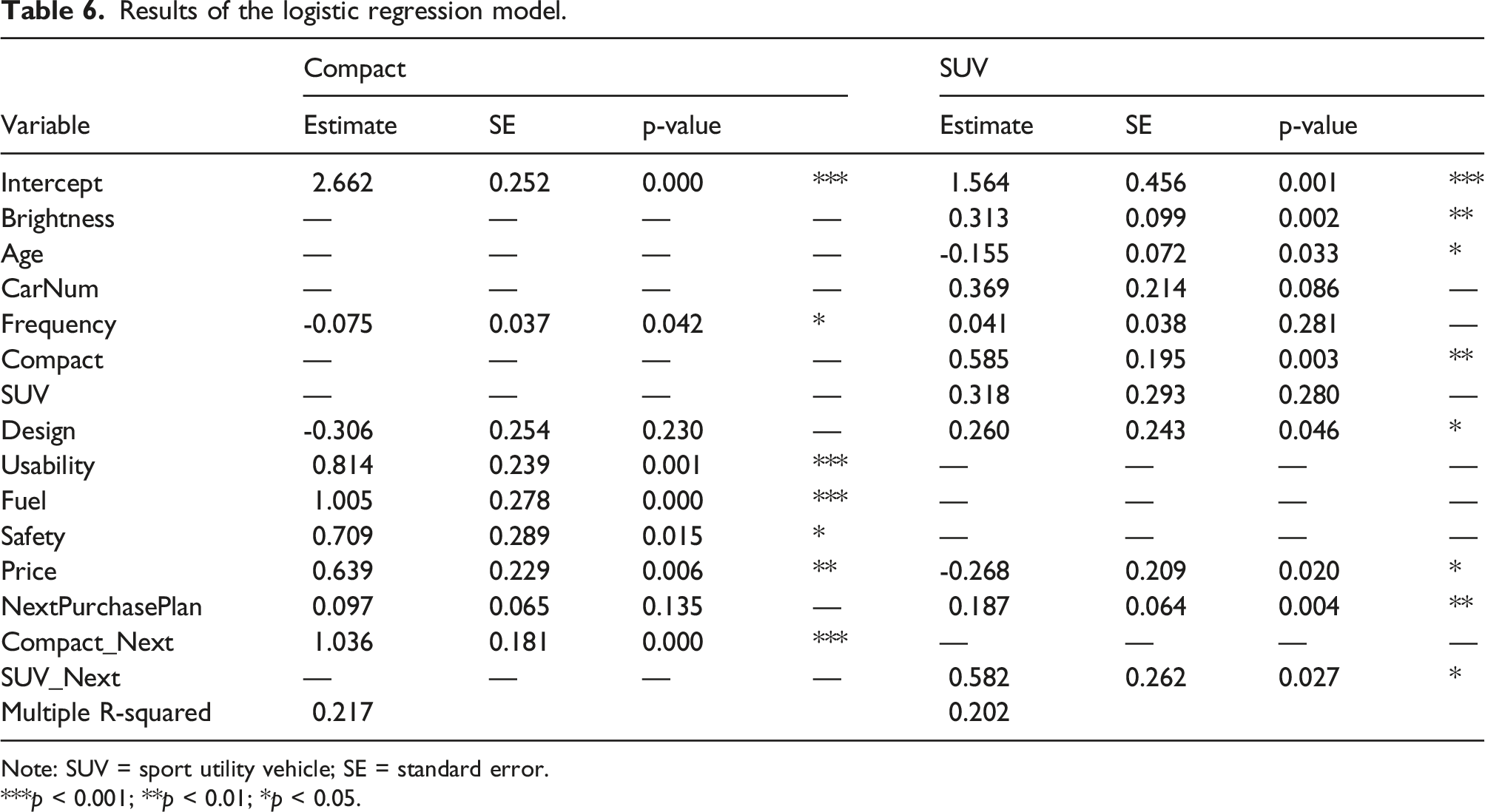
Results of the logistic regression model.
Note: SUV = sport utility vehicle; SE = standard error.
***p < 0.001; **p < 0.01; *p < 0.05.
In the context of automobile exterior design, light reflection brightness tends to contribute to the improvement of purchase intention. However, it is clear that this effect changes depending on the vehicle body type. No effect was detected in compact cars, where economic factors are important for consumers. However, a significant positive effect was detected for SUVs, for which design is emphasized at the time of purchase. To make the effect noticeable, it is necessary to change the level of light reflection brightness defined in this study from Low to High. Therefore, H1, H2-1 and H2-2 are supported.
Conclusion
Theoretical implications
Color continues to be an important theme in marketing academic research, as it has a significant impact on consumer behavior. Existing literature on color effects has focused on the three dimensions of color—hue,36–42,53,54 saturation, and lightness46–52; however, other factors also determine color. This study focused on the light reflection brightness factor, a design tool that is used in the automotive industry because this feature can be easily changed by adjusting flakes. Surprisingly, however, academic research has not explored this effect. This study filled this gap between business needs and academic research and added a new dimension to academic findings on the effect of color by confirming that increasing the light reflection brightness of a vehicle’s exterior design increased consumers’ purchase intentions. However, because design is a significant factor in consumer responses to SUVs and economic factors are significant in their responses to compact cars, light reflection brightness had a stronger effect for SUVs.
Practical implications
There are three practical implications of this study. First, perceived quality, in addition to styling, is important for product design. This study demonstrates that it is easy to attract consumers’ attention by modifying light reflection brightness. At the product design development site, discussions tend to focus on styling. However, practitioners should not underestimate the perceptual quality of light reflection brightness. Styling may not produce significant results relative to its investment; that is, improved styling is not guaranteed even when a company hires well-known designers or allocates a substantial styling budget to a project. Contrastingly, perceived quality produces a significant return on investment because it is possible to improve value in conjunction with price with high reproducibility by investing based on scientific evidence (such as that presented in this study). Consequently, the factors that increase a product’s value from a consumer’s perspective must be understood and subsequent collected data can be utilized to improve the perceived value of products.
Second, companies should hire CMF specialists to sustainably improve perceptual quality. Similar to styling specialists, perceived quality specialists also exist; however, their presence remains limited. For example, an examination of Indeed Jobs as of 31 July 2022 in the United States revealed 37,710 designers, 644 industrial designers, and only 56 CMF designers, among the posts advertised. 1 Because perceived quality is subjective, which factors to focus on remains unclear. Therefore, appropriate investment plans should be formulated based on scientific knowledge (i.e., the magnitude and condition of the effect of light reflection brightness), and experts should play an integral role in company planning.
Third, consistent embodiment based on product concept must be emphasized in product development. Although several elements, such as safety and durability, are commonly required for all products, this study demonstrates that resources could be wasted unless elements are effectively matched with product features, especially for emotional elements, such as design. Although the subject of this study was the exterior design of automobiles, the perceived quality by CMF is also common to industrial products 8 ; hence, similar effects can be expected with other products.
Limitations and future work
This study has the following five limitations. First, it is limited to two body types—compact cars and SUVs. Therefore, ongoing research should extend the scope to minivans, pickup trucks, or even sports cars.
Second, because this study focused on product features according to body type, a difference in the effect of consumer attributes, such as gender and annual household income, was not verified. Previous studies have shown that preferences related to hue and lightness vary by gender60,61 and region. 62 However, unlike apparel, expensive durable consumer goods, especially cars, become costly when they are made available in a wide variety of colors. Therefore, in the present globalized context, the most effective embodiment of each product type (car body type) should be discussed to ensure efficient product development.
Third, the threshold for light reflection brightness that affects consumers was not clarified. Because there is no accumulation of existing research, three reflection levels were set in this study. However, because this factor can change continuously, a threshold value at which positive and negative effects occur was considered. To clarify this threshold, more detailed reflection levels must be established.
Fourth, the difference in the effect due to the product’s surrounding environment was not examined. The brightness of the background color improves the perceived value of a product 63 ; hence, the relationship between the surrounding environment and the color of the product must be evaluated. In the automobile industry, both the offline environment, such as showrooms and motor shows, and the online environment, such as websites and social networking services, are designed to be attractive to the consumer; therefore, the effect of the background is important.
Fifth, this study did not verify the increased impact of light reflection brightness for SUVs based on the perceived product size. Because the survey was conducted in an online environment, it was difficult to investigate the effect of size on purchase intentions. To clarify the relationship between light reflection brightness and perceived product size, it is necessary to construct an actual vehicle and conduct a corresponding survey. Consequently, future research is required regarding how perceived product size influences purchasing behavior as it is an important management index for product development. 64
Footnotes
Declaration of conflicting interests
The author(s) declared no potential conflicts of interest with respect to the research, authorship, and/or publication of this article.
Funding
The author(s) disclosed receipt of the following financial support for the research, authorship, and/or publication of this article: This work was supported by Japan Society for the Promotion of Science KAKENHI under Grant [Number JP21K13381].
Data availability
The data that support the findings of this study are available from the corresponding author, Takumi Kato, on request.
