




Abstract
The creation of value is a critical factor that determines the competitive capacity of firms and their ability to survive. Notwithstanding its importance, value creation usually becomes a fuzzy concept that is difficult to grasp, especially when increasingly complex elements of reality are incorporated into its analysis. Building on the narrative of the firm as a complex adaptive system, this article provides empirical evidence showing value creation as emergent behavior resulting from hyper-connected value repositories. Several implications for scholars and practitioners are discussed. For scholars, expert knowledge is provided from 28 airline industry executives around the world together with a method based on fuzzy cognitive maps that allows modeling and simulating value creation in airlines through 26 value repositories and 77 interdependencies. For practitioners, the article raises awareness of the need to incorporate a complexity mindset into value creation analysis and smooths the transition towards a value performance management tool.
Introduction
The airline industry operates in a highly competitive environment subject to pervasive forces and rapid change. The many challenges and opportunities that airlines face every day make them one of the most dynamic industries of all. Not surprisingly, airline managers today are invariably forced to continually adapt their strategies amid a growing number of seemingly unpredictable external factors that threaten growth and competitiveness. Faced with this daunting prospect, the effects of a highly uncertain business environment have further exacerbated the challenges of running a profitable airline business.1,2 Ultimately, complexity has unequivocally seized an industry in which it is increasingly difficult to create, deliver, and capture value, and where having modeling tools that allow elucidating the creation of value and anticipating its impact on performance may seem a distant possibility.3–5 In this context, understanding “what” value is created and “how” value is created becomes of paramount importance.
Nonetheless, value creation is known to be a rather “liquid” process, full of ambiguities and misunderstandings.6,7 This results in a kind of slippery ground where the very idea of “value” quite often ends up meaningless and without the operational significance that it should really have. With so much at stake, this article delves into the essence of the value creation process in network (hub-and-spoke) airlines based on the conceptual and methodological foundations provided by the science of complexity. The approach is completed with empirical evidence that demonstrates its potential to support decision-making on value creation through the development of an airline value system modeling and simulation framework.
The results of this research are relevant to the value creation community, which will find in it a structured step-by-step value elucidation method built from the bottom up: from the extraction of expert knowledge on the building blocks of value creation, to the modeling and visual representation of the Airline Value Creation Network (AVCN) that allows value practitioners to simulate the impact of value creation on airlines’ performance. As such, this research addresses both key theoretical aspects that reinforce our understanding of value creation from a complexity perspective, and the specification of a practical computational method that could support airlines’ value creation policies.
The “Background” section provides an overview of the central ideas on which this research is built, specifically the relationship between theories of value, theories of the firm, the complexity paradigm, and the network-based visualization approach. Some lessons have been drawn from the reviewed literature review aimed at improving business value creation research and guiding the objectives and methodology of our work. Next an introduction to soft computing and, more specifically, to fuzzy cognitive maps (FCM) is also provided to illustrate a computational technique that may be well suited to modeling value creation in the firm. The “Objectives and Research Questions” section sets out the specific purposes pursued by this work, as well as the research questions. The “Method” section describes the empirical method used and the stages the research has gone through from the acquisition of relevant information to the modeling and simulation of the AVCN. The “Results” section presents an overview of the data collected from experts and the main results obtained after graphically visualizing the AVCN and simulating three real-life airline business scenarios using FCM inference. The “Discussion” section reviews the main findings from the research and examines the main implications for scholars and value practitioners, pointing out the main findings, implications and limitations of the AVCN-FCM framework. Finally, the “Future Research” section presents future directions to improve the quality of research on value creation in the firm and continue exploring with new methods of modeling and simulating value creation that may become operational.
Background
The study of value creation by firms is one of the most profuse branches of economic and business research and encompasses many schools of modern economic thought. The tradition is long and strong in relation to the economic theory of value, already present in the writings of the first economists, and in the theory of the firm, especially since the seminal works of Coase. 8 Theories of value have traditionally focused on understanding prices and the mechanisms that explain transactions and exchanges of goods and commodities. 9 Meanwhile, theories of the firm attempt to answer questions such as why firms exist, why they are organized as they are, and why they are so heterogeneous.10,11 From the fusion of both theoretical bodies is that some two dozen theories of the firm have emerged, most of them in the last decades, that try to explain how firms create value.
This abundance of theories of the firm raises important questions, such as whether they really help to explain the modern phenomena of value creation in firms, whether they are built on a sufficient empirical and analytical basis to be useful and not just conceptual exercises, whether they have stood the test of time in terms of their explanatory power, and whether they have a real practical use not only among academics but also among value practitioners. The fact is that each theory of the firm has its own assumptions to explain value creation. For example, behavioral theories of the firm assume that value is created to compensate for the cognitive limitations of individuals; entrepreneurial theories of the firm assume that value is created by entrepreneurs as they realize their vision; followers of the Austrian school believe that value is created when the judgments of various individuals come together; and value chain theories consider that value is created when the activities of the firm are improved and aligned. 12
At this point, one might ask if so many theories are really needed to explain value creation, or is it that they suffer from some methodological constraints that prevent them from explaining the phenomenon of value creation in an integrated way. The truth is that there have been attempts to approach an integrated theory of value creation that accommodates the perspectives of several of these theories,13,14 but in the end they still only explain a part of the phenomenon and none manages to offer a holistic, flexible and complex understanding of value creation that serves both scholars and value practitioners. Perhaps one of the problems lies in attributing the ability to create value to some predefined resources that the firm possesses (e.g., things, people), which would make these theories no longer valid whenever the internal or external environment of the firm changes in response to disruptive forces or high levels of uncertainty, e.g., catastrophic events, geopolitical instability, radical innovation, digitalization, etc.
An approach worth exploring to try to overcome these limitations in value creation theories is to view the firm as a complex adaptive value system (CAVS).15–17 The firm as a CAVS is characterized by creating value in a fluid and changing way, which means that the structural components of the value creation architecture and their interactions, whatever they may be at each moment of time and circumstances, are in continuous transformation and adaptation, creating and destroying themselves as the business environment changes. This article delves into the conception of value creation in the firm from the perspective of complexity and tests the validity of a CAVS analysis framework based on expert knowledge and soft computing tools for its modeling and simulation that may be useful for scholars and value practitioners to overcome some of the stated traditional limitations of value creation theories.
Value creation and complexity
Research on the theory of value creation and the theory of the firm from the perspective of complexity science has been scarcely explored in the literature. The search for bibliographical references in the main databases such as Web of Science, Scopus and Google Scholar using (BUSINESS OR FIRM) AND VALUE AND COMPLEXITY as the search string yields a very small number of results, without any of them providing a consistent theoretical-practical basis on which to build a complexity-based approach to value creation. Both the study on the complexity of the firm and on value creation have advanced separately, without the confluence between both branches having yet occurred, hence the opportunity of this work that seeks to enrich and raise awareness of the potential of this union.
The notion of “value creation” constitutes the basic element that gives life to the firm and its strategic direction, the exchange of which largely determines the behavior of the firm itself.18,19 From the perspective of complexity, the firm’s value system operates according to a value creation-exchange logic and a set of distinctive structural and behavioral properties, such as nonlinearity, emergence, many interacting components, hierarchical and multi-level network dependency, descriptive-predictive uncertainty, homeostasis, and differentiation by specialization. A more detailed discussion of these terms can be found in the article by Navarro-Meneses. 20 This characterization of value creation in the firm from the conceptual bases of complexity provides a broad theoretical background to address value creation in airlines in a more realistic and practical way and, as such, has guided the methodological approach used in this article.
According to Navarro-Meneses, 20 the structural components of value creation can be formally abstracted as value repositories (VRs), which are synthetic groups of activities, processes and resources that, from within and/or outside the boundaries of the firm, create and exchange unique and differentiated value. VRs represent an innovative way of specifying the basic structural components of value creation not used in the literature so far and are the result of a systematic process of extracting expert knowledge about the structure and behavioral traits of the firm’s CAVS. VRs have a liquid nature, thus materializing the idea that value creation is not a static or linear process but a fluid and non-linear one that takes place within a CAVS. VRs will change by industry and firm and even at different points in time due to the myriad of internal and external factors that affect value creation. According to this approach, the creation of value in the firm is not the result of fixed things or people, but of a whole set of known and unknown factors acting in an interconnected way all at the same time. This malleable conception of value creation implies that the way of understanding, analyzing, and acting on a firm’s CAVS may differ from other mainstream approaches used up to now, such as the behavioral, 21 resource-based 22 or the value chain 23 approaches.
For the sake of clarity, the complexity-based approach to value creation assumes that no two VRs create and exchange the same value, rather each reflects the inherent division and specialization that exist within the firm’s CAVS. As the basic building blocks of the airline’s CAVS, VRs can be assembled and decomposed in actual business operations according to the dominant forces of interaction (value exchange) between them, which can vary in intensity and direction in every moment of time. This can be best visualized when VRs are represented in a network structure as nodes in a dynamic and continuous process of creative destruction as the value exchanged between VRs varies.
Networks are an excellent visualization tool for interpreting the value creation-exchange logic in CAVS and the emergent behavior that results from its hyper-connected, multi-level architecture. They are also good visualization tools that can help scholars and value practitioners to graphically visualize the highly interconnected and hierarchical reality of CAVS in airlines, as well as the direction and strength of the connections between VRs over time. Therefore, a first step to effectively unravel the complexity of airline CAVS should be to elucidate the structure of the VRs network and its interconnections. This involves not only mapping the existing VRs into the AVCN, but also quantifying the strength and direction of the interactions between them.
Value creation and networks
The way scholars and value practitioners address value creation has evolved in last decades, from linear to network-based approaches. From the value chain-based conceptualization of the 1980s and 1990s, 23 according to which value creation is a sequential process of replicable but barely interconnected activities, the main concerns in the value creation community have progressively shifted towards incorporating increasingly realistic and complex elements into its analysis and formalization.
Novel approaches have been developed that recognize that value creation takes place in CAVS, which are in turn the result of the interaction between multiple activities and resources of the firm distributed in dynamic networks. 24 Although Porter’s seminal value-chain perspective has been gradually replaced by the increasingly realistic and more up-to-date view of the value network, a part of the value creation community still considers the value chain as an effective approach to identify competitive strengths and weaknesses at the firm level, more particularly in industrial settings. 25 One step further is the idea of constellation of Normann and Ramirez 26 which suggests that firms are at the epicenter of a constellation of services, goods, and design where customers act as suppliers, and suppliers as customers. According to these authors value is not created in sequential linear chains but in constellations, so that as value offerings become more varied and sophisticated, so do the interactions necessary to deliver them. If a firm wants to create highly effective value offerings, it will have to establish new combinations that involve customers, suppliers, and all kinds of allies, instead of providing everything by itself. Following a similar line of thought, Parolini 27 proposes the value net, defined as the set of activities that create value for the customer. Parolini conceives a network in which the activities and resources of the firm are the nodes, and the flows of goods, information and financial resources are the edges, thus outlining a method that divides the firm into a subset of value-creating activities.
Both scholars and value practitioners have continued to further develop alternative approaches in recent years to describe and analyze value creation in a network context. Some additional contributions that support the value network perspective considered in this work have been the following: 1. Value creation networks aimed at delivering superior value to the customer based on relationships and a set of core capabilities.
28
2. The role of networks of stakeholders (e.g., customers, suppliers, employees, etc.) to determine the “collective competency” of the firm and to enhance the firm’s value offerings to the customer.
29
These networks acquire an increasingly relevant role thanks to the global accessibility of digital networks that allow people and organizations from all over the world to be linked. 3. The four phases suggested by Helander
30
to realize value creation in networks: 1) the customer and what the customer considers valuable, 2) the activities that are necessary to create value for the customer, 3) the resources that are necessary to carry out those activities, and 4) who is capable of using the resources. 4. Value grids organized around vertical, horizontal and diagonal dimensions to help firms improve their level of performance.
31
Value grids could be mapped, according to the authors, following a dynamic and complex approach, thus allowing firms to rethink their value proposition and their organizational model. 5. The firm as a living system, according to which firms can be defined in terms of “patterns of exchanges”, whose “molecular level” consists of both tangible and intangible exchanges.
32
6. The four key building blocks pointed out by Herrala et al.
33
with an impact on the value chain of products and services: the customer, core competencies, relationships, and interactions. 7. The connection between network relationships and service innovation, and how networks play a mediating role between the value delivered to the customer and their level of satisfaction.
34
Furthermore, the central role that value networks play to co-create solutions with customers and partners.35,36
Another complementary assumption worth considering is the fuzzy nature that characterizes the creation and exchange of value within and between networks of firms. This has been an on-going discussion since the precursors of the theory of value back in the 18th and 19th centuries debated on the objective and subjective nature of value, an issue which stemmed from the philosophical controversy between axiological objectivists (Scheler, Hartmann) and subjectivists (Meinong, Ehrenfels) of value. This led some of the fathers of economics such as Adam Smith, David Ricardo, and John Stuart Mill to consider that value had an objective basis, either supported by production costs (Smith, Mill) or the labor factor (Ricardo), which was reflected in long-term market prices. On the other hand, advocates of the subjective view of value (Hutcheson, von Pufendorf, Say, Senior) based their analysis on the idea of relative scarcity and individual utility. 37 This discussion has continued to this day giving rise to other conceptual debates to clarify the fuzzy nature of value creation, such as the different types of values that are created in a firm, e.g., perceived use value, exchange value, captured value, customer value, benefits, bundled value, etc.7,38,39
Both ideas, that of the value network and that of value as a fuzzy concept, support some of the main arguments and the methodology presented in this article. More specifically, that airlines’ CAVS can materialize in the AVCN, and that FCM is a network-centric soft computing technique suitable for modeling and simulating a CAVS.40–44
Lessons for improving value creation research
Based on literature review, some lesson for improvement have been drawn that should be considered by future research studies on value creation in the firm, more specifically by that research focused on modeling and simulating complex value creation systems. Below are some of the main ones: 1. The literature on value creation is mainly based on business cases whose empirical evidence is mostly limited to the assumptions that are intended to be demonstrated. This hinders the possibility to develop a more holistic modeling process of value creation in the firm, whose outcomes could be extended to more business cases and scenarios. Therefore, more empirical evidence is needed that is not only oriented towards the construction of specific business cases but that can be used to advance our knowledge about the structure and behavior of the firm’s value network to more general circumstances and to model and simulate increasingly complex value creation systems.45–47 Furthermore, most of the business cases and scenarios presented in the firm value creation literature are limited in scope, leave out important elements of reality, and their conclusions are essentially descriptive. This frustrates their ability to deliver higher explanatory power on the real functioning of value creation systems in firms and to draw practical conclusions for management that can improve firms’ performance.
48
2. It is common to find that many of the descriptive models on value creation in the literature lack key information that is crucial to understanding how they have been built, how researchers’ biases have been managed, and how they can be replicated. It is not unusual to find that authors do not describe in detail how they have carried out the data collection processes, what tools they have used and how the data analysis and exploitation process have been performed. Without this critical information, it is a challenge for later researchers and practitioners to improve the work of their predecessors. To overcome these shortcomings, value systems researchers must provide comprehensive and accurate information on the types of data and sources used to measure how value is created in the firm and the criteria used to specify the basic components of value creation networks and their interactions.35,49 3. Detailed references to value systems modeling methods and computational techniques is practically absent in the literature on value creation in firms. This means that there is little evidence to show what computational techniques have the greatest potential and whether there are techniques with concrete advantages and limitations when modeling and simulating value systems in the firm. Value creation research should provide more and better references regarding the analysis and/or modeling tools that have been used to elucidate the value network and whether these have potential as management support tools.50–52 4. In general, the literature on value creation in the firm does not provide user feedback on the models presented. No articles have been identified in which the opinions of management teams are discussed, nor if they believe that the outcomes obtained from the models are valuable or help them improve the performance of their firms. Research on value creation in the firm should have an eminently practical nature, so ignoring the opinions and expertise of real-life value practitioners and failing to learn from them to improve research is something that should be taken seriously and acted upon.
53
The work presented in this article addresses the main lessons above in order to build a more scientifically sound AVCN-FCM model: • Lesson 1: Sound empirical evidence is provided in the section “Results” on the structure and behavior of the airline value network that is subsequently used to feed the modeling and simulation of the airlines value creation system. The investigation set up a systematic process of gathering and analyzing the evidence provided by the airline experts, and reduce the biases inherent in the capture of information. The scope of the data collected, and the interconnections established between the components of the value network, provide a high explanatory power on the real operation of the value creation system in airlines from which value practitioners can support decisions about firm performance. • Lesson 2: In the “Overview of data” section, the article presents a full and accurate description of the type of data collected and the sources used to elucidate the components of the value network. The criteria used to specify the basic components and their interconnections of the value creation network are provided in sections “Value Repositories (RQ1)” and “Links between VRs (RQ1)”, respectively. Additionally, each of the processes carried out throughout the research method and the construction of the AVCN-FCM model are described in the “The AVCN graph” and “AVCN testing scenarios” sections, thus facilitating its replicability. • Lesson 3: The “Construction and visualization of the AVCN” and “Modeling and testing the AVCN” sections provide references on the type of analysis and modeling tools used to elucidate the value creation network. Additionally, the ability of these tools to support management decision-making can be found in the “AVCN testing scenarios” section. • Lesson 4: This research relies on the knowledge and expertise provided by a group of airline experts who were selected according to the selection criteria detailed in the section “Selection of experts”. Additionally, the author collected the opinion and feedback of the experts on the usefulness of the AVCN-FCM model and its ability to support management decision-making through a mixed process of informal online interviews, and individual consultations by email when an interview was not possible due to agenda issues. The conclusions drawn from the opinions and feedback of the experts were considered in the design phase of the research, as well as in the data capture process and in the presentation of results.
Soft Computing and Fuzzy Cognitive Maps (FCM)
The intrinsic complexity of a CAVS and the flexibility necessary to manage it operationally make it difficult for “hard computing” techniques (i.e., modeling techniques based on precise measurements and calculations), to provide workable solutions.
54
Just as you would not eat a noodle soup with a knife, it does not seem appropriate that we approach a complex system with the same techniques of well-defined systems with abundant and well-documented information available. Instead, an alternative approach based on soft computing methods seems more adequate in this occasion: “the point of departure in soft computing is the thesis that precision and certainty carry a cost and that computation, reasoning, and decision making should exploit – wherever possible – the tolerance for imprecision and uncertainty” Zadeh.
55
FCM is a soft computing technique particularly well suited for modeling and simulating with imprecision and uncertainty, such as in the context of our research. FCM works best with those components of a system that are uncertain and difficult to capture through statistical analysis. In such cases, FCM provides possible states (or scenarios) that aim to avoid over or under prediction of a change scenario. 56
FCM places special emphasis on the integration of knowledge from different sources (e.g., interviews, group discussions) and on eliciting and communicating assumptions. The resulting knowledge maps consist of “concepts” (nodes) connected by arrows indicating the direction in which the different concepts influence each other. This research relies on the knowledge extracted from experts to determine the concepts (VRs) that make up the CAVS, and the interactions that take place between them.
An arrow connecting concept A with concept B with a positive (negative) sign would indicate that concept A causes concept B to increase (decrease). The strength of the causal links between A and B are reflected using the weights assigned to the arrows. Therefore, each concept represents a state and the interactions between them show the dynamics of a system. 57
FCMs are a form of neural network.
58
in which the concepts resemble neurons. However, unlike neurons that can take either a value of (1) “on” or (0) “off”, FCMs can take any state in-between. Ultimately, “fuzzy concepts are non-linear functions that transform the path-weighted activations directed towards them (their ‘‘causes’’) into a value in
In a FCM we quantify the influence of all other components on each other and calculate the state of each “concept” (node). This is done by resolving the equation (1).
60


It should be noted that in our study
Even though equation (1) is widely used in many FCM-based applications, it is not the only one. The literature on FCM provides many alternative formulations of equation (1), the use of which may be preferred by value practitioners in the airline industry, i.e. when it is recommended that the concepts take into account their own past activation value in addition to the weights and activation values from other concepts, or when they want to avoid the conflicts that arise in the case of inactive concepts. A review of the FCM inference equations available to value practitioners can be found in. 63
To mitigate some of the limitations that may arise when working with expert-based knowledge in FCMs, a Hebbian-based learning algorithm has been run that fine-tunes the resulting FCM weight matrix. Specifically, for the construction of the AVCN, we run an algorithm known as Differential Hebbian Learning (DHL). Other recent alternative learning rules used by the FCM community that could prove useful include learning algorithms for estimating the casual weights, 64 and the inverse learning rule. 65
The DHL algorithm presumes that when two concepts on the same edge change simultaneously, the weight of that edge increases. For every ith concept, a difference • If • If
During the period in which the DHL is learning, the value of the weights is updated iteratively until a desired equilibrium structure is reached. In our research, the values of all concepts (VRs) were used as outputs to determine equilibrium.
An adjacency matrix records, for each concept, the weights of the salient edges, which only changes when the value of the corresponding concept changes. 66 The weights in the matrix are made to vary in the interval [−1,+1] ,with 0 being the absence of any interaction between concepts.
Objectives and Research Questions
Although the study of value creation in the firm has a long tradition and there are many studies that have sought to build a formal framework that transcends conventional cause-effect (linear) approaches (see the “Background” section), there are still some weaknesses that make it difficult to achieve it. This article aims to build on top of this discussion by introducing three main but interrelated objectives: 1) to improve our theoretical-practical understanding of the real-life components and processes involved in creating value in airlines, 2) to provide a step-by-step method to elucidate and visualize the airline’s CAVS, and 3) to provide a soft-computing model that enables value practitioners to simulate value creation scenarios that support management decision-making.
These objectives are eminently practical, since they are aimed at generating new knowledge about the structural components and the behavior that characterizes the firm’s value network through empirical data provided by a group of experts. Moreover, a factor that distinguishes the objectives proposed in this work from other previous investigations is that they are integrated and not isolated objectives. This means that there is a direct connection between the theoretical investigations carried out on the structural components and behavioral traits of the CAVS, its modeling using soft computing techniques (FCM) and the testing of the model with real-life business scenarios. What is more, the resulting AVCN-FCM model is intended to become a usable method that can be implemented, fed with data, replicated, and tested in real-life airline business scenarios by value creation practitioners.
With these objectives in mind, these are the specific research questions this article attempts to address1,67–71: • Research Question 1 (RQ1): What are the basic components (VRs) that form the airline’s CAVS and what kind of interactions exist between them? • Research Question 2 (RQ2): What main contextual constraints affect value creation components (VRs) in airlines? • Research Question 3 (RQ3): How do the VRs in the value network impact the performance of the firm?
To adequately address these research questions, new data has been generated from airlines’ experts around the world on the structural components (VRs), constraints, and interconnections that exist between the VRs of the value network in a purely operational business context. Additionally, the relationships between the VRs and their impact on the operating margin have been analyzed and tested using three real-life business scenarios to demonstrate how the AVCN-FCM model works.
Method
The method used to address the research questions posed in this work consists of three stages: 1) Data and knowledge collection, 2) Construction and visualization of the AVCN, and 3) Modeling and testing of the AVCN.
Stage 1 starts with the conduct of a field work aimed at acquiring relevant data on the value creation process in airlines through expert knowledge and a Delphi process. Once essential data and knowledge have been collected from experts, an exploratory network data analysis is performed in Stage 2 to visually represent the AVCN. After Stages 1 and 2 are completed, the AVCN is built using a FCM inference model. Finally, a validation test is performed by simulating real-life business scenarios.
The tools used to support our method were: Qualtrics online survey management software, R statistical software, R graphics package, R network analysis and FCM packages, and Network Workbench (NWB) software for modeling and visualizing networks. Detailed information on each of the stages accomplished is provided in the following sections.
Data and knowledge collection (field research)
The first step of the method is to acquire relevant data and knowledge on value creation in airlines, for which a participatory field work (FR) is carried out that incorporates different levels of observation and participation with key worldwide experts and decision makers from the airline industry.
Those value practitioners who wish to apply this method to their own airline organization, division, or business unit, can use the members of their own firm’s management team as their main source of knowledge. In our case, we turned to airline industry experts geographically distributed around the world and belonging to different airlines, in order to collect high-quality data that could not have been obtained otherwise. 72
The Delphi method was the knowledge elicitation technique chosen in this research, on the following premises: 1) Delphi it is a resourceful method used in future scenario research with a proven track-record of solutions to problems in which knowledge is incomplete or scarce.73,74 2) Delphi excels when a large number of geographically dispersed experts is required to address research questions,75,76 3) Delphi works well when the research does not start from closed questions but instead requires an iterative process where each question arises from the answers obtained in previous rounds and some type of consensus is sought,76,77 4) knowledge of the Delphi method, due to its long history of proven success as a participatory technique, is widely spread among many industry professionals, who already know to one degree or another its operational dynamics and involvement needs, which greatly facilitates its implementation, 78 and 5) the author’s own past experience using Delphi on complex projects with distributed data collection.
While the Delphi method has a proven track record of success in participatory projects involving academia and industry experts, there are other approaches and workflows available to value practitioners that could be used to meet the objectives of the FR. Potentially useful are those included under the umbrella of Participatory Modeling, whose objective is to involve the implicit and explicit knowledge from stakeholders to create formalized and shared representations of reality. 79 Since there are various tools and methods that can be orchestrated within Participatory Modeling, applicable to different stages of the modeling process and with different scopes (e.g., qualitative, semi-quantitative, quantitative modeling), it is very convenient that value practitioners become familiar with the bases to choose one tool over another as shown in the article by Voinov et al. 80
The implementation of the Delphi method was carried out in four rounds of surveys organized around a panel of experts from the airline industry (Figure 1). The Delphi method was performed by a principal researcher and an assistant researcher, the former in charge of carrying out and monitoring the process of preparing, sending, and receiving the questionnaires the latter in charge of aggregating the results and synthesizing the insights obtained from the experts. At the end of each round of the Delphi process, both researchers validated the questionnaires by checking the identity of the expert, verifying errors in the submission of the questionnaires, incomplete responses, or duplicate questionnaires, as well as the internal consistency of the responses before incorporating the responses for further analysis. Delphi Workflow. Source: own elaboration.
Each expert on the panel completed the four rounds of questionnaires according to the following steps: first, the expert received the questionnaire and completed it in a limited period of time; second, once the deadline expired or all the experts submitted their questionnaires, the researchers aggregated the answers and the experts received a summary containing the aggregated responses of the panel; third, each expert confirmed the original answers given in the questionnaire or adjusted them. In this way, the process allowed all experts on the panel to weigh dissenting opinions based on their personal experience and knowledge.
Due to limited access and wide geographic distribution of the experts, the Delphi method was conducted online. For this purpose, a website was created that was also used as the main channel of communication with the experts. Evidence from the literature shows that an online Delphi improves the efficiency of the data collection process, better accommodates the availability of experts, and reduces churn rates. Moreover, there are no significant differences reported in the literature between the results obtained by the online and offline Delphi. 81
During this stage of the research work, special attention was devoted to helping the experts (respondents) to share their mental models about value creation in airlines. This made the knowledge capture activities included in the FR mainly aimed at making it easy for experts to share their ideas and subjectively improve them in each Delphi round.
The experts received introductory training through ad hoc documentation in cognitive mapping, which allowed them to identify the concepts (VRs) that were later documented in individual maps with nodes, edges, and loops. The causal connections and their weight were captured in the same step, thus trying to reduce the inconsistencies in the answers that could have occurred if both questions had been asked at different points in time. Lists of concepts were used during knowledge activation to keep the effort and dedication time of the experts to a minimum, given their status as high-ranking executives in their respective airlines.
Interactions between the interviewer and the experts were also limited, taking place mainly through written instructions and questionnaires. This allowed that the experts, without pressure from the interviewer, could take time to think about their own assumptions and reflectively articulate the knowledge that they would share with the interviewer and the panel.
Special consideration was given to making the construction of the AVCN-FCM model transparent for the experts, giving them the opportunity to learn about the progress made by the panel at each stage and thus be able to contrast their own subjective ideas with the consensus reached. In this regard, the Delphi technique greatly facilitated this work since it was designed with four rounds in which the experts received feedback.
Panel questions
The Delphi questionnaires were designed to identify the main structural components (VRs) of the AVCN and the interconnections between them. Each of the questions in the survey rounds, except for the first, was posed after an analysis of the data from previous rounds. The process was finalized after all data was exchanged between the experts and group stability had been achieved.75,82
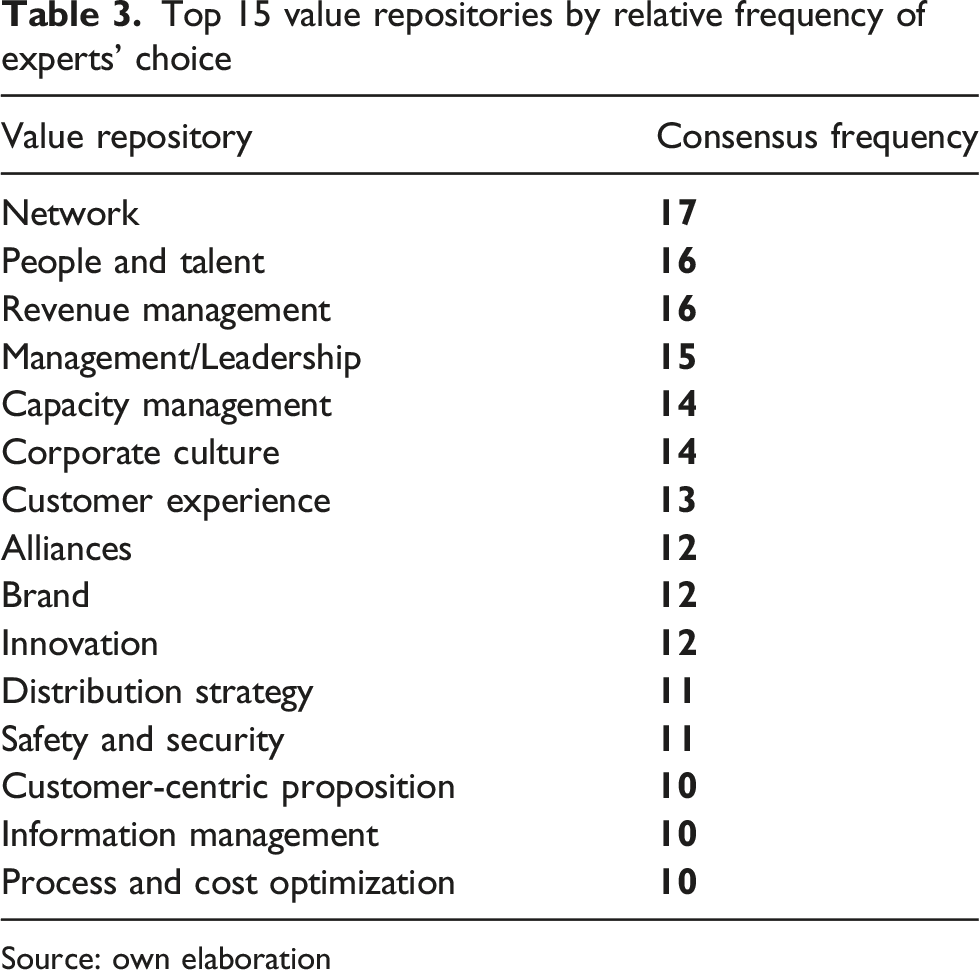
Round 1 consisted of a divergent thinking stage focused on panel members' discovery of as many VRs and value constraints as possible. Round 2 aimed to reach consensus among experts on the top 15 VRs and top 10 constraints to value creation in airlines identified in round 1. The limits of 15 and 10 were established to keep the analytical workload of the experts low in later rounds, as well as to avoid an overly complex AVCN that made simulation tasks too heavy.
Delphi questions

Source: own elaboration
Selection of experts
An important aspect of our FR design was establishing who could serve as a qualified member of the Delphi expert panel. To address this issue, the nature of the research questions was taken into main consideration and the following eligibility criteria were established in advance: 1) Hold a C-level or senior management position in the airline industry, 2) Have the willingness and capacity to participate in the FR, and 3) Have good communication skills, specifically the candidate’s ability to use the English language in his/her communication, the professionalism with which the candidate’s LinkedIn profile was written, and whether the candidate had made public statements through the press or the media, or even written articles or post on social networks.
The author used his own LinkedIn profile to carefully screen and invite candidates to the panel of experts who met the above criteria. 116 invitations were made, of which 33 were accepted. Following the invitation, the selected candidates who agreed to participate were asked to accept the terms and conditions of the panel of experts.
The selection process eventually brought together a very diverse number of high-profile international experts from the airline industry. The airlines and organizations represented in our research were among the top in the industry: Scandinavian Airlines, Qatar Airways, LATAM Airlines, Iberia Líneas Aéreas, Air Canada, Aeromexico, Avianca, LOT Polish Airlines, Aerolíneas Argentinas, Air Europa, United Airlines, SkyTeam, AirFrance/KLM, Lufthansa.
Construction and visualization of the AVCN
Step 2 aims to characterize and graphically represent the key structural components of the AVCN, that is, to get an in-depth understanding of VRs in airlines and how they interact. By graphing the AVCN, value practitioners can better understand value-related data, visually analyze the strengths and weaknesses of an airline’s value system and communicate more easily with key decision-makers.
Furthermore, the visual representation of the AVCN should enable value practitioners to address fundamental value management issues associated with airlines, such as: How are VRs organized? Which VRs are crucial to AVCN connectivity? What effects would the elimination of one/many VRs have on the AVCN? How many VRs, or links between them, would have to be removed to substantially affect AVCN connectivity?
The AVCN can also help airline managers figure out where the bottlenecks are in value creation and if there are inappropriate connections between VRs that make it difficult for an airline to implement actions in an appropriate and timely manner.
At this stage, it is important to choose one of the various network graph drawing algorithms that are available. To do this, some key aesthetic criteria that may influence our findings should be considered, including planarity, the display of symmetries, and keeping the number of bends and crossings in the network low.
Modeling and testing the AVCN
Stage 3 is performed only after the AVCN has been presented graphically and the analysis of its main topological measurements has been completed. Then, an adjacency matrix is formulated mathematically before applying FCM inference and proceeding with simulations of real-life business scenarios.
The FCM inference model runs on a single relational adjacency matrix that results from aggregating the weighted causal cognitive maps of each panel expert. Aggregation of the cognitive maps is carried out by first mathematically converting each expert map into a square adjacency matrix of the same size. The result is a new matrix, where the entries are the average of the weights given by the experts. A Likert scale with five different levels of strength is used: very strong (1), strong (0.75), weak (0.5), very weak (0.25) and zero (0). These numerical values show the degree of influence between a concept (VR) “A” and a concept (VR) “B”.
Readers should note at this point that there is an open debate in the FCM community on the true fuzzy nature of FCMs, specifically when a fuzzy operator is not used to do the reasoning, or when there is no clear fuzzy context behind the numerical variables. This issue seems to have greater impact on the design and interpretation of the FCM than on the results obtained from the inference. 83 Notwithstanding, value practitioners interested in applying FCM inference should be cautious when considering the fuzzy nature of FCM and, as suggested by Nápoles, Salmeron et al., 83 consider making explicit how the network can be understood as a fuzzy system.
The causal relationships between VRs are also modeled in the adjacency matrix by positive or negative signs. A positive causality between a VRA and a VRB means that an increase (decrease) in the value of VRA will cause an increase (decrease) in the value of VRB. A negative causality between VRA and a VRB means that an increase (decrease) in the value of VRA will cause a decrease (increase) in the value of VRB. If the panel members considered that there was no relationship between two VRs, the weight assigned by them was zero.
Testing the AVCN requires an initialization vector to feed the FCM inference model (see section “AVCN testing scenarios”). This initialization vector may echo a certain value creation constraint setting or an alteration in the interconnection between VRs, in response to an external shock or as part of a choice made by the management team. For example, a management team may want to test extreme value creation shocks (e.g., increased competition, regulatory risks) to simulate the impacts they have on the AVCN and on airline performance.
Airline value creation network testing scenarios
Source: own elaboration
Results
Overview of data
This section presents the data collected in Stage 1 of the method (field work) and shows both the profile of the experts who participated in the panel and the insights obtained from them that allowed determining the VRs that make up the AVCN (RQ1), as well as the constraints that affect the VRs (RQ2). Moreover, special attention is paid to the criteria used to avoid bias in the selection of experts that could affect the results of the research.
Profile of the experts and participation data
The number of experts who provided some type of response in the 4 rounds of the Delphi process was 33. This number must be adjusted to 28 if we consider only those who provided a valid response that could be processed, either complete or incomplete.
The functional profile of the experts was varied, covering a wide spectrum of areas within the airline industry. Experts with a commercial executive profile were the most numerous (32%), followed by experts in the network and revenue areas (25%), sales and distribution (18%), corporate (14%), and engineering (11%). This reflects the high functional diversity of the experts participating in the panel, which contributed to reducing bias in the FR.
The broad geographic origin of the experts also helped reduce research bias. There were experts from many geographies, with Europeans as the largest group (54%), followed by South Americans (26%), and North Americans and those from the Middle East (10% each). The geographic coverage remained practically unchanged throughout the Delphi process, thus providing consistency to our research work.
The variety of executive positions held by the experts led to a great heterogeneity in the composition of the panel and a reduction in bias. Given the disparity in the title of the positions held by the experts, it was necessary to homogenize the nomenclature of the executive positions. Vice-Presidents were the largest group of experts (54%), then Directors (28%), Managers (11%), and Senior Vice-Presidents (7%). This variety achieved in the executive positions held by the experts ensured that the data collected came from those with the best possible knowledge in the airline industry, as originally intended in our FR design.
Value repositories (RQ1)
Top 15 value repositories by relative frequency of experts’ choice
Source: own elaboration
Links between VRs (RQ1)
The consensus reached on the interconnections between VRs is presented in the heat map plot in Figure 2. A visual analysis of this graph shows a small number of weak interconnections (in red)), in contrast to the strong (pink) and very strong (light blue) interconnections that predominate in the graph. Strength of the Links Between VRs. Z: Zero; W: Weak; S: Strong; VS: Very Strong. Source: own elaboration.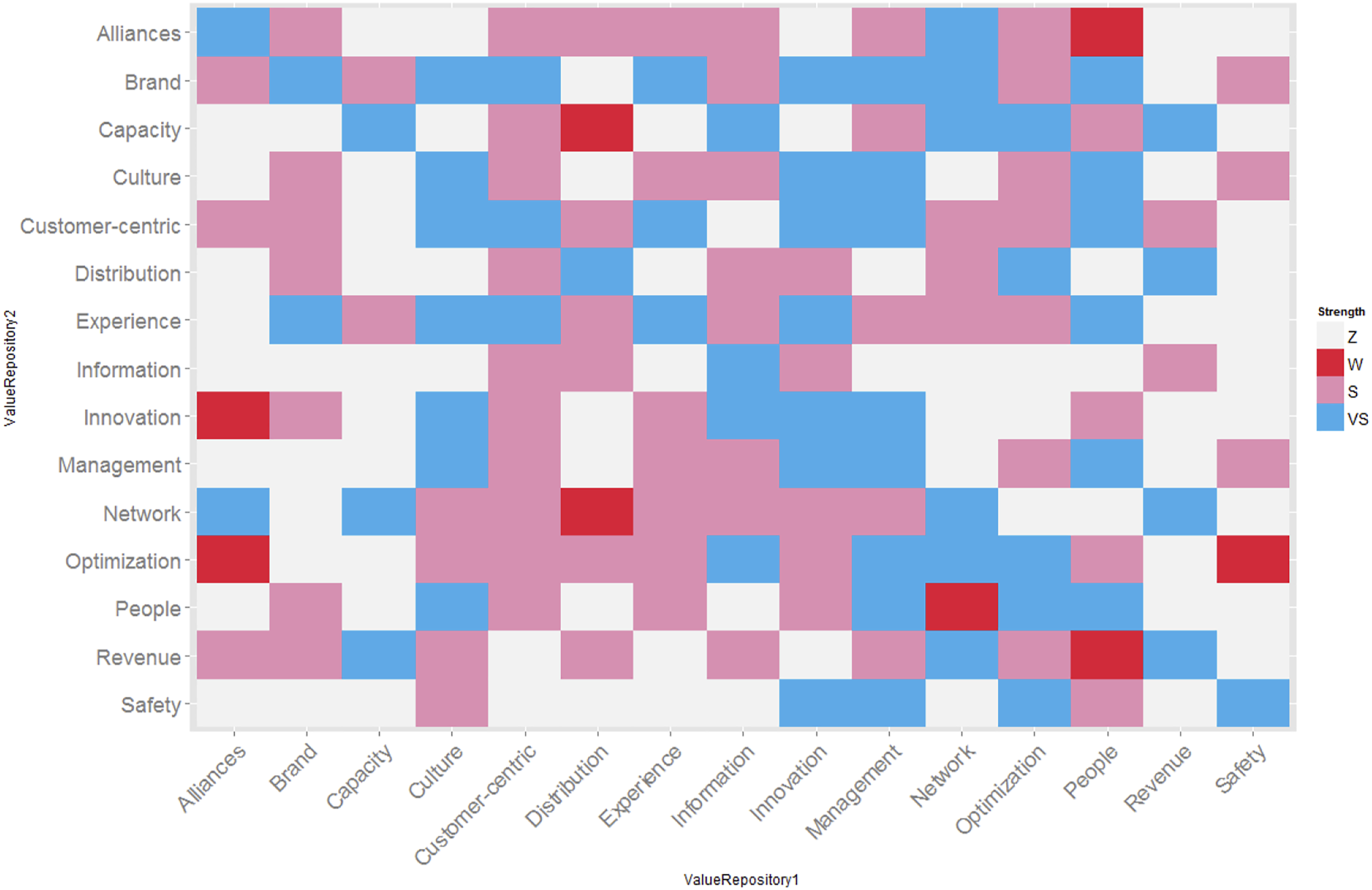
As per the graph, some VRs deserve special attention given their “high” interconnection strength, especially the Innovation, Management, and Culture VRs. Other VRs, such as Customer-Centricity and Experience also stand out for their high level of interconnection with others.
Value constraints (RQ2)
Top 10 value constraints by relative frequency of experts’ choice

Source: own elaboration
Interconnections between VRs and Value Constraints (RQ2)
The results obtained throughout the Delphi process on the strength of the interconnections between the VRs and the constraints show a moderate scattering. This is visually reflected in the heat map of Figure 3 because no color predominates over the rest. Strength of the Links Between VRs and Constraints. Z: Zero; VW: Very Weak; W: Weak; S: Strong; VS: Very Strong. Source: own elaboration.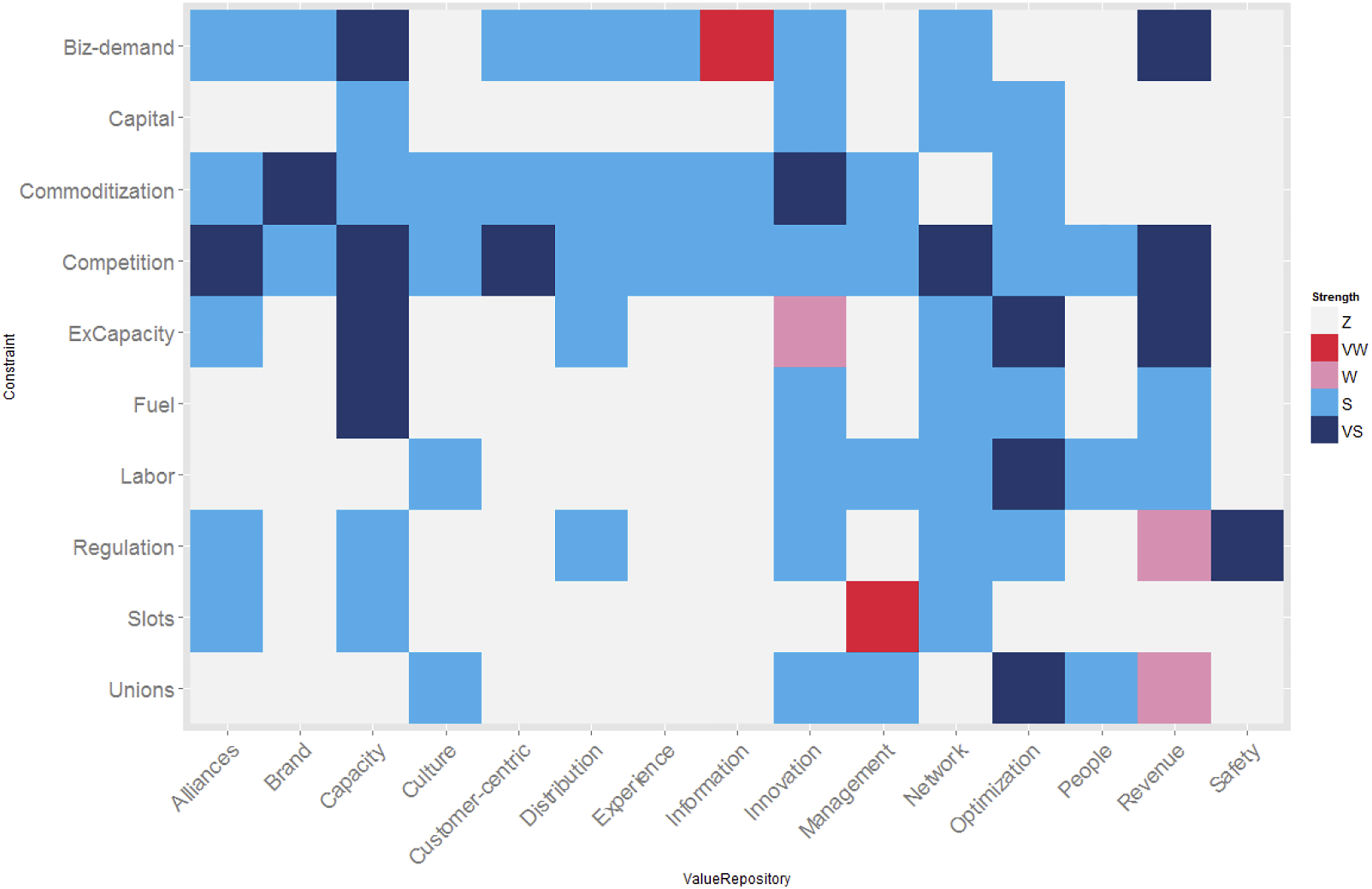
Experts reached a high degree of consensus in rounds 3 and 4 on the interconnections weighted as strong and very strong. On the other hand, the connections considered very weak and non-existent (zero strength) decreased and increased their weighting between these two rounds.
Competition, Excess Capacity, Commoditization, and Business Demand are the main constraints that affect most airlines’ VRs. On the contrary, Capital, Slots, and Unions are the constraints that least affect them according to the experts of the panel.
Interconnections between VRs and Operating Margin (RQ3)
The interconnections between the VRs and the operating margin mainly show very strong and strong levels, according to the answers of the experts. This is visually attested in Figure 4, where the interconnections in green (strong) and blue (very strong) colors seem to dominate. Strength of the Links Between VRs and Operating Margin. Z: Zero; VW: Very Weak; W: Weak; S: Strong; VS: Very Strong. Source: own elaboration.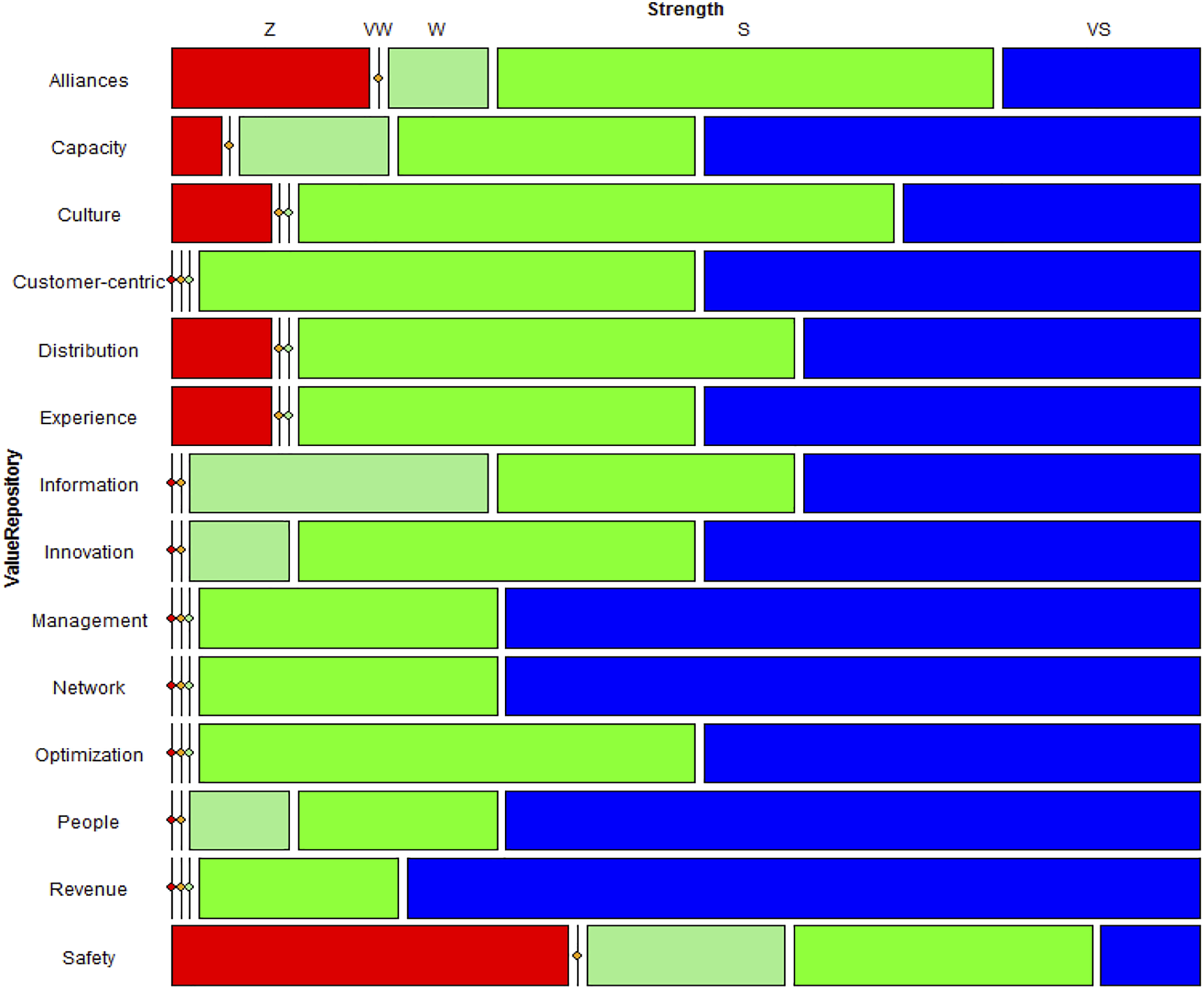
The VRs with the strongest connection with operating margin are Revenue, People, Network, and Management. On the other hand, Capacity, Culture, Distribution, Safety, and Experience are the VRs with the least interconnection strength.
The AVCN graph
The AVCN is presented as a digraph composed of nodes of three different types (constraints, VRs, and operating margin); and edges, which represent the interconnections between pairs of nodes according to the knowledge provided by the experts in the field work. Through the construction and visualization of the AVCN graph, value practitioners may obtain an idea of what the internal architecture of the value creation network is in airlines and what interactions exist between its basic components (VRs), thus responding to RQ1.
The best way to graph the AVCN is to choose an algorithm that provides a network aesthetic that can be easily interpreted by value practitioners. Among the many available, the Früchterman-Reingold algorithm was chosen, which resulted in an AVCN made up of 26 nodes and 77 very strong links and a network degree distribution of 5.92 (Figure 5). Network Algorithmic Method Applied to the Construction of the Airline Value Creation Network. Type: directed-weighted; Layout: Fruchterman-Reingold; Colors: Red-circle: constraints, Yellow-triangle: value repositories, Orange-square: Operating Margin; Nodes: 26; Edges: 77; 15 self-loops; 2 isolated; nodes; Degree: 5.92. Source: own elaboration.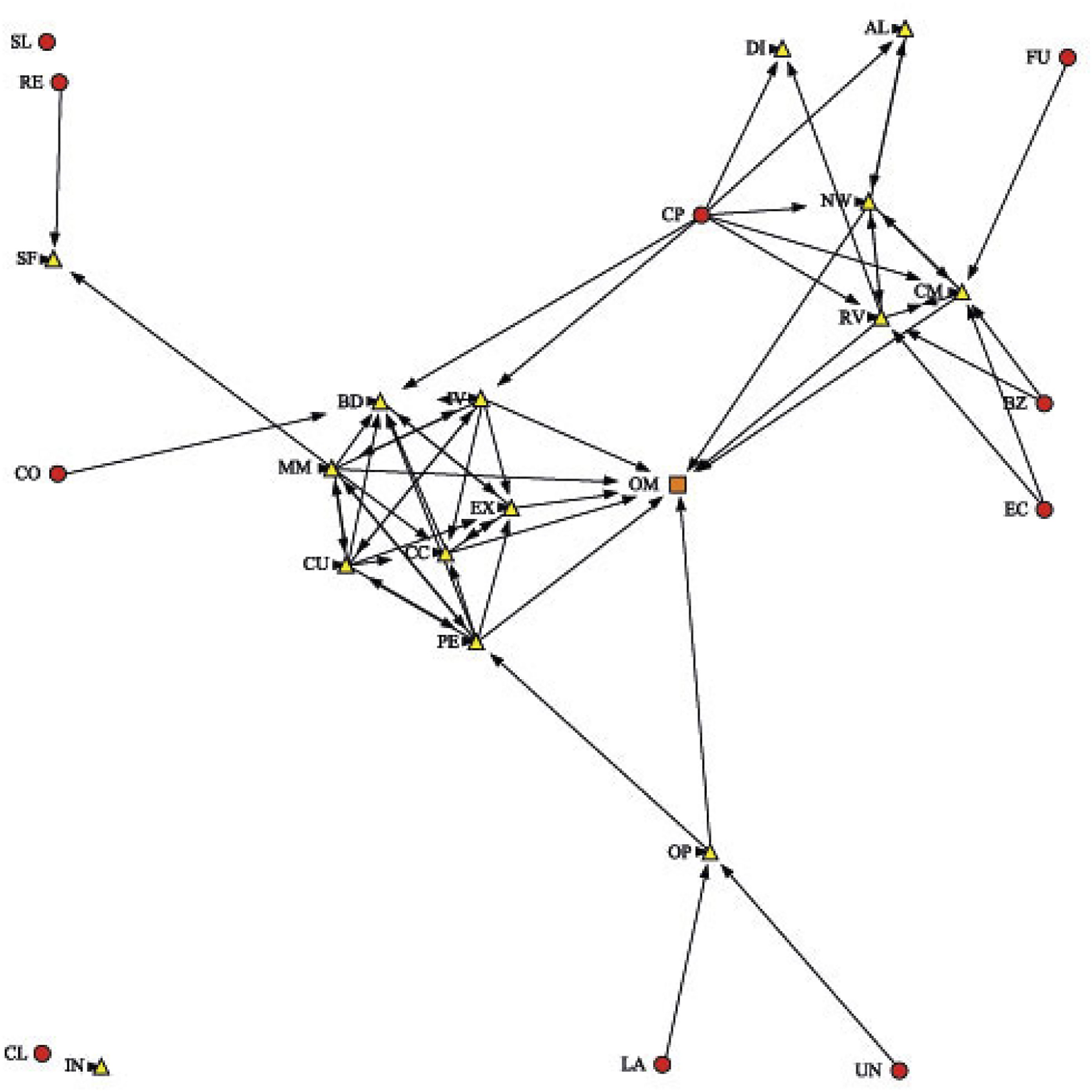
Value practitioners should note at this point that although choosing a network drawing algorithm and visualizing the AVCN are useful tasks to understand the phenomenon of value creation in airlines, they are not steps required to formulate the FCM inference.
Once the AVCN can be visualized, a useful next step is to apply hierarchical clustering (HC) and tree-like dendrogram techniques to gain more insight from the graphical analysis of the AVCN. The HC fastgreedy.community algorithm was chosen for this task because it is a bottom-up hierarchical approach in which communities are iteratively merged such that each successive merge is locally optimal. The algorithm is fast to compute and is widely used since it has no parameters to adjust. In addition, the algorithm stops when it is not possible to increase the modularity, thus generating a complete hierarchy of nested partitions within the AVCN structure that is valuable for value creation analysis (Figure 6). The results after HC calculations provide three clusters of VRs with “strong” and “very strong” interconnections (Figure 7). Airline Value Creation Network Clusters. Source: own elaboration. Airline Value Creation Network Tree-Like Dendrogram. Source: own elaboration.

AVCN testing scenarios
By testing the AVCN in different real-life airline business scenarios, it is possible to assess the impacts that external shocks have on the AVCN and on the operating margin of airlines, thus responding to RQ3. To do this, a combination of FCM inference and SA is used. First, we initialize the FCM inference model (see equations (1) and (2)) with a random vector to establish a baseline scenario. Second, a real-life scenario state vector is fed into the FCM inference model. Third, a comparison is made between the values of the concepts (i.e., the values of the VRs) in the baseline scenario and those in the real-life scenario. Fourth, the impacts on the AVCN are identified and a conclusion is reached.
Scenario 1: Airline value creation network outcome vector and differences with baseline scenario.

Source: own elaboration.
Scenario 2: Airline value creation network outcome vector and differences with baseline scenario.

Source: own elaboration.
Scenario 3: Airline value creation network outcome vector and differences with baseline scenario.

Source: own elaboration.
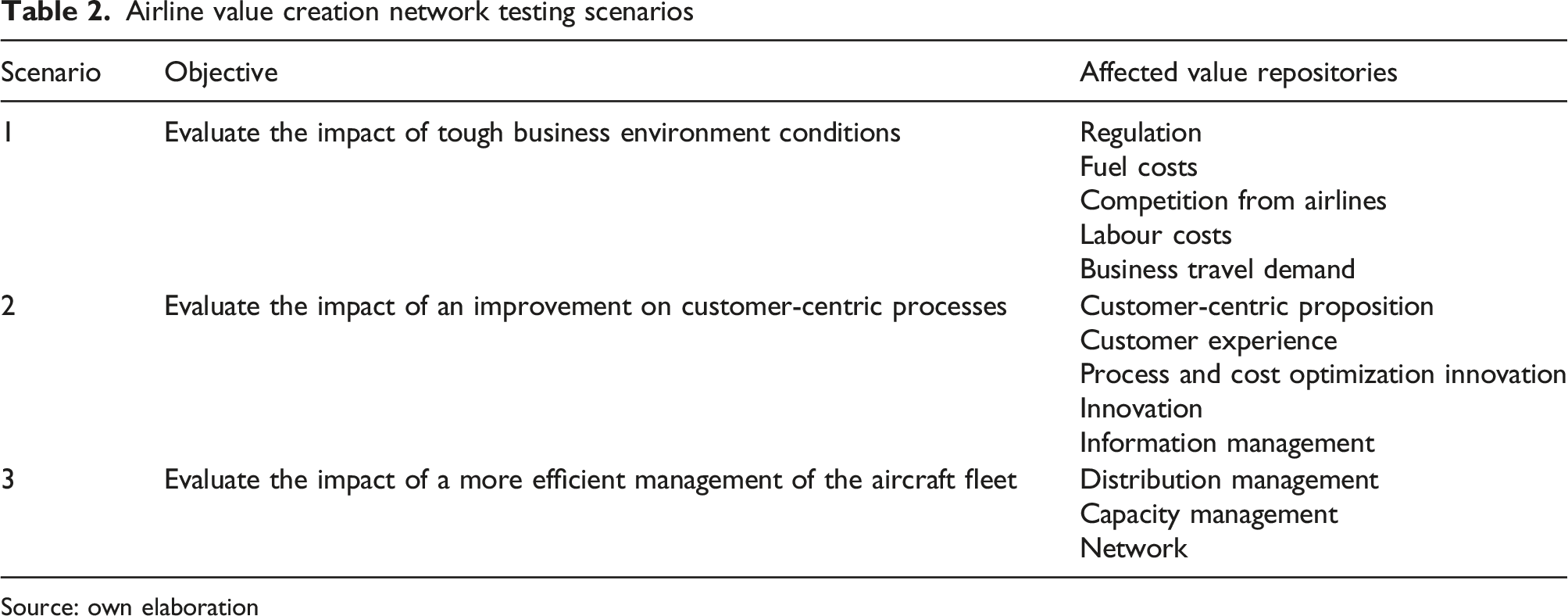
The real-life business scenarios used to test the AVCN are the following: • Scenario 1: tougher business context • Scenario 2: better customer-oriented processes • Scenario 3: more efficient fleet management
Scenario 1: Tougher business context
A tougher airline business context is characterized by the following effects on the VRs that make up the AVCN: lower business travel demand, higher competition from other airlines, higher cost of production resources, and stricter regulatory framework. The initialization vector for the FCM inference therefore implies a reduction in the values of said VRs as follows: Business travel demand (−0.9), Competition from other airlines (−0.9), Fuel (−0.9), Labour (−0.9), and Regulation (−0.9).
After 30 iterations of the AVCN-FCM model, the inference reached equilibrium, which means that the outcome is stable. Table 5 contains the resulting final state vector and the variations with respect to the baseline scenario.
Based on the results obtained from the simulation, the negative effects of a tougher business environment would primarily affect the customer-oriented VRs (e.g., Customer-Centric Proposition, Customer Experience, Brand), as well as those VRs focused on organizational improvement (e.g., Process and Cost Optimization, Information Management, Innovation). It is worth noting that the VR most negatively affected of all (−30.5%) is Capacity Management. This, in turn, would affect airline revenues, distribution, and resources, including those VRs closely related to people management, most likely due to workforce layoffs. AVCN’s simulated effects are in line with the −3.0% calculated impact on operating margin, thus negatively affecting airline profitability. Overall, these impacts largely match the effects that would be expected in a real airline business setting.84–87
Scenario 2: Better customer-oriented Processes
This real-life airline business scenario is based on the assumption that the values of the following VRs are positively affected as reflected by its initialization vector: Customer-Centric Proposition (0.9), Customer Experience (0.9), Innovation (0.9), Process and Cost Optimization (0.9), and Information Management (0.9). After 30 iterations of the FCM inference, stability in the VR values is reached. The resulting final state vector and the variations with respect the baseline scenario are shown in Table 6.
The effects obtained from this simulation show a positive impact on the people-related VRs (Corporate Culture, Management/Leadership, and People and Talent). This matches what airline managers would expect in a real life business setting and further helps explain the key role that people play in the implementation of customer-centric strategies in airlines.88,89
More positive impacts can be found in the consumer perception of the Brand VR, and in the Distribution and Revenue Management VRs, probably due to a higher business activity as the number of loyal customers increases. 90 All the effects described above are consistent with the positive 4.0% difference in operating margin with respect to the baseline scenario.
Scenario 3: More efficient fleet management
This simulation focuses on inferring the effects that more efficient fleet management practices can have on the values of the following VRs: Capacity Management, Network, Distribution Management and Revenue Management. The initialization vector for this simulation contains these values: Capacity management (0.9), Network (0.9), Distribution management (0.9), Revenue management (0.9). After 30 iterations of the FCM inference, equilibrium is reached in the values of VRs. Table 7 shows the final state vector and the variations with respect to the baseline scenario.
It should be noted that the impact of this simulated scenario on most VRs is small, with many VRs not being affected at all by the input vector. Notwithstanding, the impact on the operating margin is 2.9% with respect to the baseline scenario. Both outcomes seem consistent with what airlines’ managers would expect in a real-life business setting.91–93
Discussion
In this article, it has been shown that it is possible to elucidate the AVCN and generate a wealth of information to support key value creation decision-making in airlines by implementing a conceptual framework of value creation based on CAVS and modeling and simulation techniques based on FCM. In this section, we examine the main findings, the limitations found, and the implications for scholars and value practitioners.
Main findings
The results obtained in this research show that the use of the CAVS analysis framework based on AVCN-FCM overcomes some of the main limitations previously identified on theories of value creation in the firm, among them: • Holistic perspective: Since it allows the airline’s CAVS to be addressed as a whole and not in a partial approach focused on certain pre-established drivers. A motto of the AVCN-FCM model is that the more expert knowledge acquired and the higher its quality, the deeper and richer the vision of value creation in the firm is, the greater the degree of complexity that the model incorporates and the higher level of realism the results offer. • Flexibility: Since the AVCN-FCM modeling and simulation framework can be used in any environment and level of complexity in which the firm wishes to focus, whether at the departmental or business unit level, at the organization level, at the value network level, or even at the industry level. • Adaptation: Since the AVCN-FCM framework can quickly and painlessly incorporate into the CAVS modeling process those new elements that are relevant or have a significant impact for the creation-exchange of value in the firm when these are sensed by the experts. This capability allows the AVCN-FCM framework to always remain up-to-date when the firm has an established knowledge extraction modeling simulation interpretation decision-making workflow in place.
From an operational point of view, it has been shown that the AVCN-FCM framework can help airline value practitioners gain insight into: 1) the structural components (VRs) that make up the airline’s value creation network (AVCN), 2) the behavioral characteristics exhibited by the AVCN according to the relationships established between the structural components, and 3) the impact that a particular AVCN configuration may have on an airline’s performance.
Through the AVCN, value practitioners can identify the most important/critical VRs in airlines’ CAVS. This is a key and very useful structural indicator that can be calculated using the eigenvector centrality. This network metric uses the notion of “rank”, 94 according to which a VR becomes more central the more central its neighbors are. Another useful VR ranking metric is Katz’s feedback-based centrality, in which a node (VR) accumulates influence through incoming neighbors and, to a lesser extent, through more distant nodes, with a damping factor α that adjusts the influence of nodes as a function of distance. 95 By calculating both the eigenvector and feedback-based centrality metrics value practitioners could compare them and assess which one provides better results.
Most important/influential value repositories in the airline value creation network.

Source: own elaboration.
Understanding that there are some VRs that are more critical than others and identifying which are more influenced by external constraints, is another relevant input that the AVCN provides to scholars and value practitioners. In our case, only four external constraints account for the greatest impact on VRs (Business Travel Demand, Commoditized Offering, and Competition from Airlines). Meanwhile, the Process and Cost Optimization VR is the most affected and the Safety and Security VR is the least affected by external constraints.
Another valuable insight provided by the AVCN is to anticipate the impact that a certain configuration of the value network may have on the operating margin of airlines. As Figure 8 (left) shows, even though the top 15 VRs identified by experts have some impact on operating margin, there are only five VRs with “very strong” impact: People and Talent, Network, Revenue Management, Capacity Management, and Management/Leadership (Figure 8, right). Interconnectedness of Value Repositories and Operating Margin. Source: own elaboration.
In addition to the structural and behavioral intelligence provided by the AVCN, value practitioners may wish to use the AVCN-FCM model to simulate how certain real-life business scenarios may end up affecting airlines’ value creation and anticipate the positive/negative impact on operating margin. This would require converting the AVCN-FCM model into an operational intelligence tool capable of supporting decision-making, for which the model will need to be continuously fed and updated with relevant business data and have robust modeling and simulation capabilities, such as those presented in this research. The outcomes obtained by testing three simulated real-life business scenarios are consistent with the literature provided in scenarios 1, 2 and 3 and what airline managers might expect in a real business setting based on their feedback.
Implications
This article contains several implications for scholars and value practitioners. First, the concept of “value repository” (VR) has been introduced as the basic structural component of value creation in the AVCN-FCM model. As already noted, a VR is a “synthetic” cluster of activities, processes, and resources from inside and outside the boundaries of the firm, which means that it does not have to perfectly match the departments or organizational units of the firm. Instead, a VR deliberately transcends conventional departmental or divisional boundaries, which are generally determined by criteria based on the allocation of resources, to focus exclusively on the drivers of value creation.
The results presented in this article demonstrate that airline’s CAVS can be thoroughly decomposed into a network of unique, specialized, and autonomous VRs. Furthermore, our findings show that VRs are not only a construct that proves useful for decomposing the airline’s value network from a theoretical perspective in complex adaptive system, but an approach accepted and practically validated by the airline experts who participated in this research. The high level of involvement achieved by the members of the expert panel, the positive reviews received from them, and the quality of their insights, support our belief that the AVCN-FCM is a viable approach and an effective framework to elucidate value creation in airlines.
The AVCN provides a working basis to advance in a new theoretical-practical framework of value creation from the perspective of complexity. Through the elucidation of the AVCN, an attempt has been made to overcome some of the common burdens of conventional value creation theories, specifically those centered on the analogy of mechanics, stages, chains, equilibrium, and linear behavior. Instead, the AVCN explains the structural and behavioral dimension of value creation through an approach to the firm as a complex adaptive system and a network configuration.
Second, the eminently practical nature of the AVCN is designed to help value practitioners improve their understanding of the value creation process in a more realistic way, while having a step-by-step method at their disposal that supports decision-making and anticipates the impact of value creation on the performance of the firm. The ultimate goal of this article is to foster an open debate on the need for value practitioners to integrate complexity awareness into their way of thinking and to test hybrid research methods that elevate value creation to a more practical and operational level. The article also feeds the debate about how business leaders can shape their organizations to generate more and better value, and whether conventional perspectives of the firm are the best approach to modeling and simulating value creation.
Third, this article provides an integrated theoretical-practical framework that offers the opportunity to unravel the emergent mechanisms that create value in airlines. For this purpose, the use of Delphi and fuzzy cognitive maps smooth the transition from theory to practice. However, they are not the only tools available to make this possible. The field of quantitative and qualitative methods that can be applied to modeling and simulating value creation is large enough and continues to grow every day. This should pave the way for new explorations into the construction of the firm’s value network and continue experimenting with other methods in future research (e.g., agent-based modeling, business analytics, Big Data, and artificial intelligence methods) to further explore the potential of the AVCN as an operational and business decision-support tool.
Fourth, deciphering the value creation network in airlines, including the interactions between its basic building blocks (VRs), and turn it into a practical tool that supports decision-making is a process that has been successfully addressed in this article. An iterative data collection-network visualization-modeling-simulation loop has been developed, with the aid of fuzzy cognitive maps. The integrated components and functionalities developed in this research could provide software and systems developers the opportunity to integrate the AVCN into a management software application environment, either as a standalone tool or as part of an integrated package that includes data capture, data mining, graphical visualization, and modeling and simulation functionalities. This would greatly contribute to embed the AVCN-FCM model into a tool that can support management decisions, especially among C-level executives, management teams, and key stakeholders.
Last but not least, the AVCN-FCM model can serve as a benchmarking tool for value creation in airlines and many other industries. Modeling the AVCN from the knowledge obtained through a broad sample of airlines that compete in the same marketplace would allow airline managers to compare the data from their own AVCNs with that of the airline industry benchmark, thus detecting the strengths and weaknesses compared to other competitors when creating value. Additionally, managers could assess how sensitive or robust their AVCN’s VRs are, and the impact that certain business scenarios would have on operating margin relative to the industry benchmark. For example, an airline with an AVCN that is less resilient to external shocks or whose operating margin is affected much more than the airline industry average would be in a worse competitive position than the rest and should therefore take steps to restructure its AVCN to avoid it. In this way, value practitioners would gain confidence and improve their methods of informing airline value creation strategies without having to make too costly mistakes.
Limitations
Some of the main limitations found in this research have to do with the difficulty of generalizing the results obtained from the AVCN-FCM model to any particular airline, the potential bias introduced in the selection of panel experts, and the validation of the cognitive maps of the experts.
Few of the criticisms made of the Delphi process could also be applicable, especially those related to its somewhat “subjective” consensus method, 82 the limited size of the sample used, 96 or that its iterative process allows the researcher to shape the opinions to his/her liking. Furthermore, it could also be argued that the limits established in relation to the number of VRs (15), and the value constraints (10), could mean a loss of objectivity in the analysis of the findings. 97
Notwithstanding the above, it should be noted that this research does not aim to present the subjective experiences of the experts per se, but to abstract them into meaningful propositions that can be used in a practical way by value practitioners. This has been achieved through a process of constant iteration between data collection, analysis, and validation of the results against empirical evidence.
It seems obvious that if the questions asked in our Delphi survey had been asked differently, to different experts, or at another time, the results would have been different. But had not it been for a method like Delphi, this kind of knowledge could never have been collected and mined.
To minimize bias in the selection of experts, a protocol with selection criteria was established in advance, which included having experience in an executive position in the airline industry and having good skills in communication. Experts from as many geographies and functional areas as possible were also sought. As explained in the previous sections of this article, eligible experts were invited through the LinkedIn network. This, however, could add the risk that other relevant experts who were not on LinkedIn and who might have been valuable to the research have been left out.
Regarding some of the limitations related to consensus, some authors choose to assess the degree of agreement of each relationship by calculating the entropy of the response distribution.98,99 An entropy close to −1 would indicate that the response distribution is uniform for most experts, while an entropy close to 0 would indicate that some experts select one value, and the other experts choose another value. This metric may be a useful way for value practitioners to reduce the uncertainty associated with the true consensus reached by experts involved in the elucidation of value creation in airlines.
It is inherent to FCM that formal validation cannot be carried out, given the cognitive maps operate on different understandings of the system. 100 Instead, some level of validation can be achieved by: 1) ensuring that the capture of the information is carried out with transparency and that the resulting FCM adequately describes what the experts know about value creation, 56 and 2) a reality check that ensures that FCM’s behavior is qualitatively consistent with the empirically established relationships. 101 Throughout the present research it has been shown that the necessary means have been provided for the experts to share their knowledge in the most transparent way possible. Furthermore, that the results obtained from the testing of the AVCN-FCM model respond to what could be expected in real life according to the trends in the airline industry, the literature review, and the experience of the participating experts.
Future Research
One of the first areas that could open new avenues of research concerns the theoretical foundations of the basic structural components that create value in firms. Further research in this regard, supported with empirical evidence drawn from expert knowledge, should provide more insight into the complex nature, role, and inner dynamics of value repositories (VRs) within business organizations. By shedding more light on the theoretical underpinnings of the components and architectures of value creation, new opportunities will arise to continue diving deeper into the evolutionary behavior of the firm throughout the entire value life cycle, including value creation, exchange, and capture or destruction.
Adding such complexity to the analysis of value creation will require building a larger empirical base of business cases that enable scholars and practitioners answer questions such as: How do firms optimize their VRs architecture? How do they make organizational decisions about VRs? or, what kind of decisions impact (and how) the interactions between VRs, and between VRs and the marketplace itself? The above could have significant impact on the practical understanding of value creation processes, both at the macro level of business ecosystems and at the micro level of strategy, operations, finance, and the organizational aspects of business firms.
Further research should delve into the role of the key stakeholders that interact within the boundaries of the firm’s value network (e.g., partners, providers, suppliers, competitors) and how they and the surrounding context influence the shaping of the firm’s value creation network. More specifically, the study of the role of customers and their interactions with other stakeholders in the value network is an area of special interest that can help better understand the complexity inherent in value creation systems.
Another topic that requires more research is how key management functions impact value creation systems. Deepening our understanding of how different functions are involved in creating and exchanging value is, in fact, fundamental to our understanding of complexity of the firm. In addition, the way in which the firm’s organizational processes affect value creation deserves further investigation and, more specifically, how innovation processes and information technologies impact the architecture of VRs, their boundaries, and their dynamics.
All these research efforts should be aimed at reinforcing the theoretical-practical foundations required to model value systems in a more robust and reliable way, creating more opportunities to work with computational models that can be manipulated and used to support value creation decision-making by stakeholders. In so doing, better methodological approaches and tools will need to be developed. A great source of inspiration can come from disciplines with a proven tradition of dealing with issues related to complexity, including the natural sciences and finance. Adapting ideas and tools from other sciences could provide scholars and value practitioners with new means to address the complexity of the firm and encourage cross-pollination of knowledge and techniques that bring value creation studies closer to the reality in which firms operate.
More research is needed in developing hybrid computing tools that are increasingly idiosyncratic to the firm. This will require new reflections on the role of quantitative-qualitative methods in the study of value creation in the firm and, more specifically, those related to soft computing techniques and evidence-based methods. Particularly relevant is increasing research on modeling and simulation techniques that can further our understanding of the dynamics of firm behavior. One example is the AVCN-FCM model presented in this article, which has proven to be useful in increasing our understanding of firm’s behavior and could become operational in the future. Specifically, FCM-based models seem well suited to study feedbacks and test unintended side effects of diverse firm policy interventions. As such, FCMs might continue to be a good point of reference to guide scholars and practitioners cross the chasm between firm’s reality, qualitative experts’ knowledge, and quantitative models. Studies in value creation can continue to benefit from ongoing advances in FCM modeling theory and practice as new and more robust algorithms continue to emerge. This will require increased collaboration between scholars and soft computing research teams.
Further research into AVCN modeling and simulation may lead to future discussions between C-level executives and decision makers, testing simulations against stakeholder feedback and/or comparing the simulation results with existing known scenarios. Ultimately, a recommended next step in the evolution of AVCN research could be to experience its application in other industries. This could allow managers in other industries to draw conclusions for improvement and pinpoint specific adaptation needs. A joint research agenda between managers and scholars would be needed that bridges the gap between those who investigate the nature of value creation in firms and those who need to equip themselves with the tools to make better decisions to gain competitiveness. Perhaps this research can contribute to raising awareness of the opportunity ahead.
Supplemental Material
Supplemental material - Unraveling the airline value creation network with fuzzy cognitive maps
Supplemental material for Unraveling the airline value creation network with fuzzy cognitive maps by Francisco J Navarro-Meneses in International Journal of Engineering Business Management
Footnotes
Acknowledgement
The author would like to thank Dr Javier Carrillo-Hermosilla and Dr Federico Pablo-Mart for their helpful advice and comments on various technical issues examined in this article, and their continued support and guidance.
Declaration of conflicting interests
The author(s) declared no potential conflicts of interest with respect to the research, authorship, and/or publication of this article.
Funding
The author(s) received no financial support for the research, authorship, and/or publication of this article.

Supplemental material
Supplemental material for this article is available online.
References
Supplementary Material
Please find the following supplemental material available below.
For Open Access articles published under a Creative Commons License, all supplemental material carries the same license as the article it is associated with.
For non-Open Access articles published, all supplemental material carries a non-exclusive license, and permission requests for re-use of supplemental material or any part of supplemental material shall be sent directly to the copyright owner as specified in the copyright notice associated with the article.
