




Abstract
We examined the impact of firm-generated content on firm-related user-generated content. Researches have proven that firm-related user-generated content impacts firm revenue. Therefore, it is necessary to determine what factors stimulate the creation of firm-related user-generated content. Creating user-generated videos related to companies (e.g. E-sports) on Chinese online video platforms often includes the use of firm-generated videos as material. It may suggest that firm-generated content may play an essential role in influencing Internet users to create firm-related user-generated content. We collected a unique dataset using a Python web crawler and used the LSDV model for empirical analysis, including 2977 firm-generated videos and 49860 user-generated videos, to explore the impact of firm-generated video attributes on user-generated videos. The results show that some attributes of firm-generated video have a significant impact on user-generated video. The number of comments and coins on firm-generated videos positively affects user-generated videos, while the number of favorite on firm-generated videos negatively affects user-generated videos. We also found that the difference in how users feel about firm-generated videos affects the likelihood of users creating their original videos. User engagement and user brand identity in FGV positively impact stimulating user-generated videos. The authors suggest that companies can maximize the impact on user-generated content by targeting the creation of firm-generated content based on these video attributes. The authors also suggest that firms further investigate theories related to motivational factors, such as the impact of consumer engagement, brand identity, and perceived usefulness on user-generated content.
Introduction
The generated content in social media has become an important part of marketing. According to Digital, in 2020, the Internet has reached 60% of the world’s population, and social media has reached 50%. 1 In China, as of December 2021, the number of online video (including short videos) users reached 975 million, accounting for 94.5% of Internet users. People spend an average of two and a half hours a day on social media and are willing to receive and publish content through social media. Scholars have confirmed that generated content on social media has a significant impact on consumer loyalty, purchase intent, and other consumer behaviors. This impact will change the business paradigms of industries and companies. 2 Therefore, companies are increasingly valuing social-media-generated content. It is even more common in the experience goods industry (tourism, literature, films, and E-sports). If companies can encourage users to post user-generated content on social media, merchants can stimulate consumption to some extent. For example, previous researches in cultural economics have found a positive correlation between user engagement and user-generated content creation intentions3,4 and stimulation of user-generated content through the provision of consumer-branded content 5 ; omnichannel consumer displays and online displays have a positive impact on user-generated content creation intentions on social media. 6
This study focuses on the impact of firm-generated content on user-generated content in the E-sports industry. The phenomenon of company-generated content stimulating user-generated content exists in many industries, such as literature, film, and E-sports, as mentioned earlier. However, it is impossible to study all industries because there is massive data on user-generated content that re-creates firm-generated content on social media, so we chose the E-sports industry as a representative. E-sports is an emerging and rapidly evolving industry. According to Newzoo, 7 global E-sports revenue is estimated to grow to $1.084 billion in 2021, with $833.6 million of that revenue–more than 75% of the total market–coming from media rights and sponsorships. China will generate more than one-third of the global E-sports revenue. Globally, E-sports viewers reached 474 million, and E-sports enthusiasts reached 234 million, with China having the most significant number of E-sports enthusiasts at 92.8 million. China also has the most significant revenue market, with $360.1 million in 2021. Among the many sports, the League of Legends World Championship was the most prominent event in terms of live viewing time on Twitch and YouTube in 2020, with 91.9 million hours. The League of Legends Championship Summer Korea had the most live viewing time on Twitch and YouTube, generating 53.9 million hours of viewership.
In addition to being an excellent example of a large market for experience goods, the E-sports industry has characteristics that make it perhaps a more suitable subject for study than other industries. (1) Generated content is an essential foundation for companies within the E-sports industry to build user communities. FGC (firm-generated content: firm-created videos, comments, tweets) is produced under professional supervision and authority, while UGC (user-generated content: user-created videos, comments, original tweets) is freer because it focuses on user perspectives and is created by users rather than marketing professionals.8,9 Video is the most popular form of FGC and UGC in the E-sports industry. Typical firm-generated video (FGV), such as gameplay recordings from world champions or tweets from the most valuable players, allows users to engage with players and teams, which is critical to building an ecosystem of experience for E-sports companies. With these FGV materials, avid fans can use their video-editing skills to create videos related to players, teams, or companies. The UGV (user-generated video) will become valuable assets for the firm as they increase customer engagement, enhance customer loyalty, expand the fan base, and increase fan traffic, ultimately leading to profit for the firm. Second, the pandemic is related to a firm’s reliance on online content for its operations. During the pandemic, government lockdowns caused ratings to spike across platforms. More consumers were and still are confined to their homes, prompting them to spend more time on platforms such as Twitch, YouTube, and Huya. Therefore, companies must create more online content to cater to the needs of their users. In addition, the epidemic has made E-sports companies aware that the firm is particularly tied to the cyclical nature of the global economy, forcing them to seek alternative revenue streams, such as positioning themselves as lifestyle brands or moving to a content creator strategy.
7
(2) The E-sports industry can produce content consistently. The nature of E-sports leagues is similar to that of traditional sports, with a fixed number of matches every week, except for the 3 months of the off-season. In addition, companies and teams continue to introduce new content to users in a way that no other experiential goods industry can match. All E-sports companies, including league officials, game officials, and teams, have social media accounts to interact with viewers. They can upload their firm-generated content (FGC) to their accounts, including firm-generated videos (FGV), comments, and posts, implying a stable and continuous dataset. (3) Finally, firm-generated videos of the E-sports industry mainly posted on online video sites. Companies in the E-sports industry open their accounts on online video sites and upload firm-generated videos to increase brand awareness and better communicate with users. For example, in the League of Legends, the game’s officials, league officials, and all teams have their accounts on Bilibili and regularly post videos for marketing purposes, which is also their primary means of promotion. As a result, the E-sports industry is more capable and incentivized than other industries to create content in a significant and consistent way and build consumer communities and the E-sports ecosystem. (4) For users, the firm-generated content provided by the E-sports industry improves their community experience. In the E-sports industry’s marketplace, users can rely on firm marketing and media voices to provide at least some information about the firm. This information may come from a firm’s marketing activities, such as videos showing tournaments, player vlogs, or marketing videos. In any case, an increasing amount of company-produced content means that users will increasingly rely on firm-generated content, which is readily available to users in company-related communities when learning about and interacting with companies, and is a source of material for users to create original content. This suggests that firm-created content may play an increasingly important role in influencing user-generated content.
To date, most studies have focused on how FGC and UGC affect other research subjects. For example, Nagoya and Innocentius Bernarto 10 argue that FGC and UGC positively impact “values”. Radovic, Ljajic 11 found that content on social media (whether FGC or UGC) significantly impacts teenagers' attitudes and value systems. Diwanji and Cortese 12 found that FGV, rather than UGV, had a strong influence on corporate attitudes, after studying the effects of FGV and UGV on online shoppers’ perceptions, attitudes, and purchase intentions. Qu, Qi 13 suggested that the frequency of FGC-UGC interactions is a crucial factor in minimizing negative UGC communication; Irelli and Chaerudin 14 confirmed that consumers’ perceptions of FGC and UGC have a positive impact on purchase intention. However, there are some issues in the FGC and UGC research fields that scholars have addressed less. (1) Most researchers have studied FGC or UGC in the form of images or text but have rarely addressed videos and their related attributes. (2) There are already sufficient papers focusing on social media platforms such as Twitter, Facebook, and YouTube, but relatively few on China’s indigenous social media platforms. (3) Few studies have explored the impacts of FGC and UGC.
Our work explores the impact of FGV video properties on UGV creation. PyCharm was used to write a Python crawler program scrapy to crawl the data on an online video Web site. The data source is one of the most popular and influential online video platforms in China-Bilibili (https://www.Bilibili.com/). The dataset includes observations of firm-generated video properties and user-generated video for E-sports over a 7-quarter period. We used the LSDV model for the empirical analysis. Our findings suggest that the video attributes of FGV impact the number of UGV in the E-sports industry, and that managers can use the specific video attributes of FGV to stimulate the creation of UGV.
Our study extends the research on generated content on social media in two main ways. This study contributes to the literature on the E-sports industry and corporate marketing. First, this is the first attempt to empirically investigate the effect of firm-generated content on user-generated content. By comparing the number of firm-related user-generated content creations using the video attributes of firm-generated content, this study provides interesting insights into the use of firm-generated content to increase the production of user-generated content. Second, given the connection between the attributes of firm-generated content and other theories, we incorporate theories such as brand identity and consumer engagement to better understand how the creation of original user-generated content can be stimulated from the firm’s perspective. These theories dominate the existing theoretical explanations of the motivation for generated content in social media. The findings of this study can provide theoretical and practical recommendations for E-sports managers and companies seeking to optimize their operational and management strategies through firm-generated content.
The remainder of this paper is organized as follows. In the next section, we present earlier papers dealing with generated content and video properties, the Chinese online video industry, and the E-sports industry. The Hypotheses of FGV’s influence effect on UGV describes the hypotheses for the research problem. The Methods introduces the methodology and provides a detailed description of the data and its sources. In The Methods, we describe our approach to unravel the impact effects and report the results of our user-generated content creation estimates. We find positive impact effects from the attributes of firm-generated content in Bilibili. The Results presents the results. The Discussion presents the discussion. Finally, The Final concludes the study.
Existing studies and background
Currently, many people depend on social media for their social lives. Social media are needed for people to interact with each other and for firms to promote their products. This has led companies to focus on content marketing on social media and try to understand how to use content marketing to influence consumers. Content marketing includes two hot topics: FGC and UGC, which have been studied by scholars. User-generated content (UGC) refers to all types of communication generated by and between consumers on social media, 15 while UGV are defined as videos related to brands or products created by users. 16 Social media communication generated on the firm’s side is referred to as FGC 17 and FGV is video related to brands or products created by firms. Because the research on FGV and UGV is mainly based on the research on FGC and UGC, we will introduce the current research direction and academic progress on FGC and UGC in the rest of this section.
Existing studies of UGC and FGC
Many scholars are interested in studying the topic of UGC influencing user behavior, and some scholars have studied it from a marketing perspective. Previous research has demonstrated the multiple beneficial marketing effects of UGC and its ability to influence brand image. 18 UGC can influence users’ brand engagement19–22 and the effect is continuous 23 but subject to professionalism. 24 The impact of UGC on users can also have an impact on other user behaviors. An increase in user engagement can stimulate users’ purchase intention.25–27 Additionally, UGC can directly influence users’ purchase intentions.28,29 UGC not only affects users' behavior, but also their psychology. UGC also affects consumer satisfaction after the purchase is completed. Consumer satisfaction refers to the degree of consumers’ psychological feelings and expectations regarding a particular product or service.30,31 For example, UGC influences consumers' expectations, which indirectly affects consumer satisfaction 32 and contains information that helps companies understand user satisfaction. 33 Satisfaction also mediated the relationship between UGC and brand value. 34 Given all the benefits mentioned above, it is logical that companies want to promote their brand image by choosing UGC.35–37
With the potential marketing benefits of UGC, many researchers have taken an interest in determining the motivations and driving factors of UGC. For instance, Hennig-Thurau, Gwinner 38 found that the main reasons for eWOM are users’ need for social interaction, desire for economic benefits, concern for others, and willingness for self-improvement; Bazi, Filieri 39 advocate that the motivations of customers’ engagement on social media are grouped into several dimensions: perceived content relevancy, brand-customer relationship, hedonic, aesthetic, socio-psychological, brand equity, and technology factors; Nikolinakou and Phua 40 indicate that conservation, self-enhancement, openness to change, and self‐transcendence are significant drivers of brand‐related UGC. Antón, Camarero 41 showed that the intention to create UGC depends on on-site experience and satisfaction. Wang and Li, 42 Wang and Li 43 confirmed the impact of trust on UGC production using the self-determination theory (SDT). Although scholars have exhaustively studied psychological motivation to stimulate UGC, little research has been conducted on the topic of stimulating UGC for specific objects.
The number of FGC studies is relatively small compared to that of UGC, and some studies have been conducted together with UGC or for comparison, and they are mainly in the area of marketing and user psychology. For example, Sears, Walker 44 compared the frequency of marketing claims between user-generated and professional YouTube videos. Huang 45 examines FGC and UGC to investigate their effects on consumer brand attitude through the creation of brand authenticity, content authenticity, and source credibility. Similar to UGC, FGC also influences customer behavior, such as customer engagement, 46 purchase intention, 47 trust,48,49 and satisfaction. 8 Combined with the above conclusion that factors such as satisfaction and trust can influence UGC, we believe that there is a possibility that FGC can influence UGC.
The literature review above explores relevant studies on UGC and FGC, but these two aspects have been little studied by scholars. First, even though scholars have compared FGC and UGC,8,50 there are few articles discussing these correlations. Second, although FGC and brand-related UGC studies have gradually evolved from analyzing text reviews only to evaluating other forms of content, such as video, 12 FGC and UGC in video format are still seldom studied. Therefore, this study explores FGV and UGV from the perspective of video formats, explores the relationship between the two, and determines how to trigger more UGV creation among users.
Existing studies of online video attributes
Most online videos include the following attributes: like, share, reply, and view. These attributes represent users' perceptions of videos. This is an era in which social media is widely influencing people, and scholars want to study these social media-related attributes to explore the meaning behind them and the possible role of influencing users. For example, FGC can transform into UGC whenever a user reacts to the firms’ shared content through “likes,” “shares,” or content-related comments. 51 Most studies have been conducted in the field of consumer behavior and marketing, such as a study of the psychological impact of video attributes on consumers. There is fruitful research on how and to what extent different video attributes affect brand management and customer relationship management (CRM), and specific elements such as consumer engagement, brand loyalty, trust, and so on. Phua and Ahn 52 found correlations between online platform “likes” and firm attitudes, involvement levels, and trust. However, other scholars indicate that “like” may not be a very influential factor compared with other attributes. For example, Bunker, Rajendran 53 survey “likers” and find that only encouraging consumers to like a firm is not enough. In addition to this, scholars have focused on the impact of video attributes on user behavior. Nikolinakou and Phua 40 show that consumer engagement behaviors such as sharing, content creation, and reviews for brands are considered more valuable than “liking”. Likewise, Adweek 54 illustrates that firm content shared or created by users on an online platform stimulates more brand awareness and loyalty than “likes”. In addition, Niciporuc 55 analyzed Facebook posts and found that posts with pictures generated more user engagement (shares, likes, and comments) than the average posts. It can be seen that the impact of these video attributes on users is similar to the impact of FGC and UGC on users. This also leads us to the question of whether FGC in the form of video, that is, FGV, can influence users to generate UGC in the form of video, that is, UGV.
However, similar studies on whether video attributes produce specific behaviors for users, such as FGV, have an impact on UGV, are scarce. There is no adequate research on the specific video attributes that play key roles in the process of FGV influencing UGV. Therefore, this study will fill the gap: to determine whether FGV impacts UGV and which video features impact the most
Background of E-sports industry
We selected the E-sports industry to study the influence effect of FGV and UGV. There were four reasons for this choice.
First, E-sports is a brand-new and fast-growing industry, and according to the Global E-sports and Live Streaming Market Report 2021, Global E-sports revenues are expected to exceed $1 billion this year. 7 Social media users can enjoy games by playing themselves and watching gaming videos, especially high-level matches such as the world champion of LoL, PUBG, Overwatch, and other matches. The 2019 China Gaming Industry Report released by GPC demonstrates that E-sports has become a new driver of the growth of the gaming industry, the demand for watching world champions will increase tremendously, and the mass media’s dissemination of the game will expand further. In summary, the E-sports industry is gaining momentum to flourish in the future.
Second, in the E-sports sector, FGV influences UGV and not vice versa, making it more accessible for us to study their relationship. E-sports is similar to traditional sports in that the league decides and controls the match schedule. Moreover, all professional players must be trained most of the time, sparing no time to create videos. Thus, professional and official firms have designated the FGV as related to matches and players. In addition, most UGV materials are extracted from FGV. Therefore, it is safe to say that FGV is not likely to be affected by UGV. If there is an influence effect between the FGV and UGV, the FGV attributes will be independent, and the UGV is a dependent variable.
Third, the relationship between the E-sports industry and Chinese online video platforms is similar in several respects. The E-sports industry relies heavily on live streaming and video to create commercial value. Except for live streams of a commercial nature, such as Taobao Live, which does not have a category for E-sports, the major Chinese online video platforms and live streaming sites have dedicated sections for E-sports and a large amount of E-sports content.
Fourth, the E-sports industry is a suitable research object to study the influence of FGV on UGV in Chinese online video platforms. Because of the diversity of the contents of different industries, it is difficult for Chinese online video platforms to be represented by videos from one industry. It is also unrealistic to analyze videos from the entire platform. So there is no way for the E-sports industry to represent the entire Chinese online video platform. However, only some of the related industries on the Chinese online video platform have the influence of FGV to UGV, which is also a concern. The industries related to our research question are mainly experiencing product industries, such as the entertainment industry, including movies, TV, music, traditional sports, E-sports, and other industries. By searching on major Chinese online video platforms, we can find many E-sports-related FGV and UGV produced by users who create secondary content for FGV and live streams. Like other experience product companies, E-sports companies need to generate a large amount of content (e.g. FGV) to build an ecosystem of user experiences. Meanwhile, FGV in the E-sports industry is concentrated in official accounts of teams and leagues. These FGV generally carry a tag representing the team’s name for easy identification, similar to UGV, which facilitates our data collection.
Background of Bilibili
We chose Bilibili as our source of research data for three reasons.
First, many studies have examined social network platforms such as Twitter, Facebook, and YouTube, but these platforms do not reflect the status quo of Chinese social media and its UGV, nor the problems or insights.
Second, Bilibili is one of the top five Chinese online video platforms and arguably the largest platform with high-quality original UGV in China, representing the mainstream of the Chinese video market. The most popular online video platforms in China include iQIYI, Tencent Video, Bilibili, Imgo, and Youku. Bilibili is famous for its outstanding original UGV and its interactive virtual cultural community. Most importantly, as an instant comment-video Web site, it embraces a young culture-oriented community, with over 86% of users aged 35 and under on Bilibili in 2020. 56 Bilibili was just an instant commenting video creation and sharing Web site for animation and game content at an early stage. However, significant changes have been made since 2009. Thanks to users' strong willingness to create UGV and the rapid development and blooming of UGV creation cultures, Bilibili has developed into a comprehensive cultural community. A sophisticated and creative environment for high-quality UGC concerning creators was also built and attached to the Web site. The large number of UGV on Bilibili offers a good data source and raw material for our test. According to the China Statistical Report on Internet Development from the China Internet Network Information Center (CNNIC), the number of Chinese online video users reached 927 million in December 2020. The quality of online videos has significantly improved. 57 As online videos become more influential, it can be assumed that users are more willing to create and upload video content on online video platforms for information sharing, self-improvement, and brand identity.
Third, Bilibili’s robust financial performance proves that it is in good operating condition and will continue to play a crucial role in the Chinese video market. As of Q4 2021, the average monthly active users of Bilibili reached 272 million and was listed in the “BrandZ” report 2019 Top 100 Most Valuable Chinese Brands. 56 As of the closing of trading in Hong Kong on 17 December 2021, the market capitalization of Bilibili was US$4.1 billion. 58 Overall, Bilibili seems to be an ideal data source platform.
In conclusion, FGV and UGV enhance users’ E-sports experience by increasing accessibility, broadening information sources, and enriching content. In this sense, FGV and UGV can provide content about players, world champions, and teams on which users can rely to create their content and establish a tight tie between users and firms. Owing to the UGV, a firm’s influence can spread more widely and affect more users. In turn, the more users are attracted, the more UGV will be produced to influence an even larger proportion of users in the E-sports market. Therefore, UGV, which can be easily accessed in online E-sports communities, may play an increasingly important role in influencing the financial performance of E-sports firms. Massive E-sports UGV-based platforms are already emerging, and Bilibili is virtually one of the excellent representatives.
Hypotheses of FGV’s influence effect on UGV
Literature on motivating user-generated content has mainly been in the form of text. Motivating factors have also focused on user engagement and loyalty. Few studies have addressed the impact of firm-generated content on firm-related user-generated content.
Regarding the study of generated content, because many video attributes are linked to consumer engagement, brand identity, and perceived usefulness, we believe that we can combine these theories and propose research questions. According to Dichter’s theory of word-of-mouth generation motivation, users post original content that is driven by self-enhancement, helping others, product reviews, and spreading information. Therefore, we believe that motivated users post original user-generated videos.
From a practical point of view, many companies have begun to pay attention to the use of generated content in their business to increase company benefits; however, the use of video forms of generated content on social media for marketing in the user community has been less studied. In practice, the E-sports industry, for example, has seen a severe homogenization of generated content, and the response from users is not good. From this perspective, it is not sufficient to create generated content from a traditional perspective; however, creating more targeted firm-generated content to stimulate user-generated content is a problem that needs to be studied. In addition, the most easily spread form of content on social platforms is video; therefore, the study of how to stimulate user-generated content in the form of video is more valuable than comments.
This study aimed to determine whether FGV affects UGV, and more specifically, the relationship between FGV attributes and UGV. FGV attributes include share, reply, like, favorite, views, and coin (see Figure 1). Based on the findings of Jahn et al. and Kwon et al. in Facebook brand communities, we argue that FGV can provide value to users in four areas: engagement, perceived usefulness, popularity, and brand identity,59,60 leading us to propose four hypotheses. Hypothesis of the influence of FGV on UGV.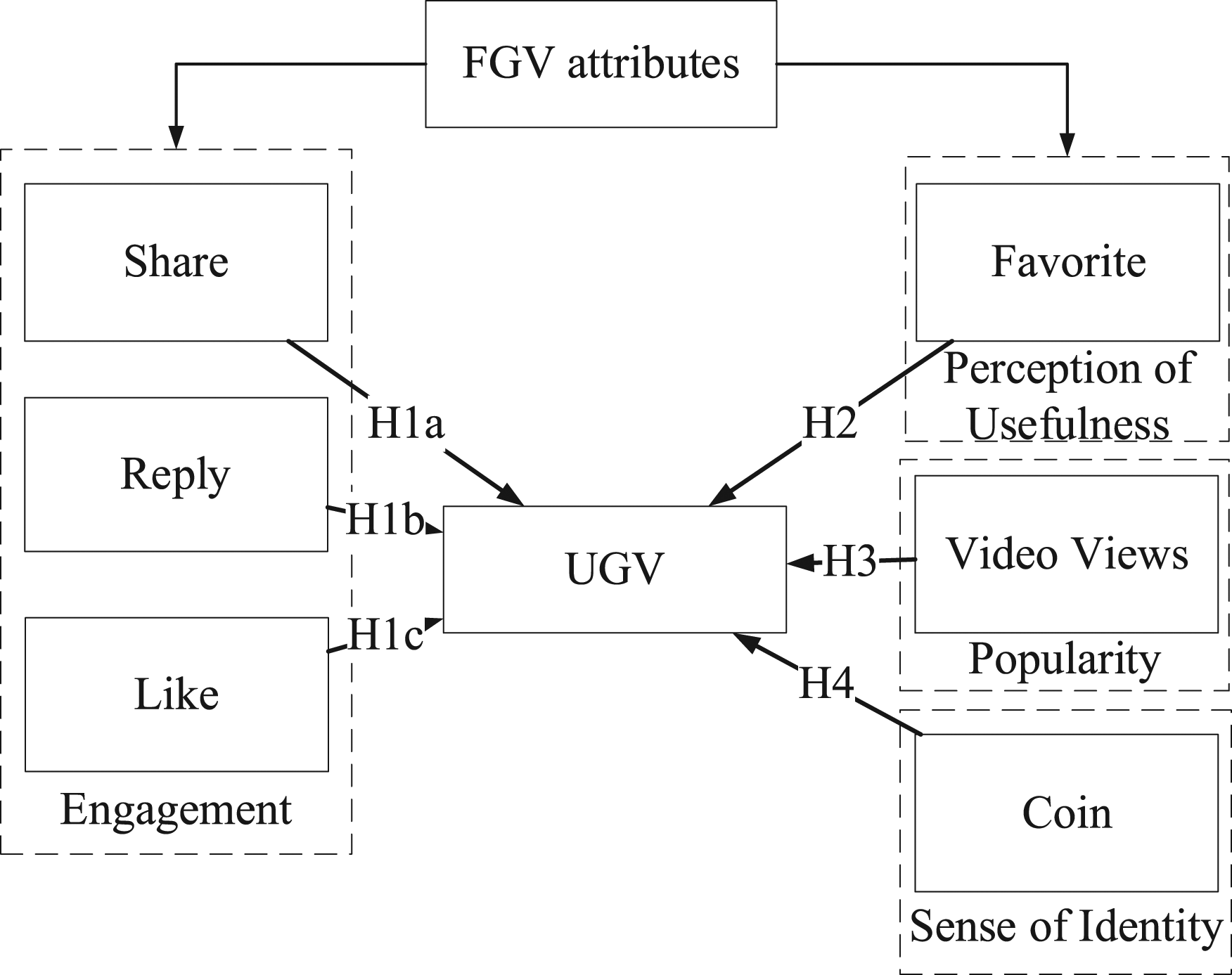
In the hypothesis of this study, brand identity as a motivating factor for user-generated content is a new assumption in the research field. In addition, the use of video attributes to represent user engagement, perceived usefulness, popularity, and brand recognition is a new assumption in the field.
Impact of FGV engagement on UGV
Research has focused on the impact of the generated content on consumer engagement. For example, marketers’ generated content affects customers' sentiments toward digital engagement. 61 FGC positively influences consumer engagement. 62 However, transactional content has a negative impact on consumer-contributed engagement, whereas entertainment content has a positive impact. 63 The above studies focus on the impact of firm-generated content in the text (product reviews, news reviews, social post comments, etc.) on consumer engagement. However, relevant studies have not addressed the issue of the impact of consumer engagement on the creation of user-generated content. Many companies and scholars have focused on how a company’s generated content directly influences users' consumption behavior. However, the impact of consumer engagement in firm-generated content on user-generated content has been overlooked. As companies increasingly rely on firm-generated content for marketing, the question of how to maximize the impact of user engagement in firm-generated content on user-generated content has become an issue of concern. Therefore, this study relates user engagement in firm-generated videos to user-generated videos, and leads to our research question.
Does user engagement with FGV affect user-generated content Krebs suggested that consumer engagement behaviors on social media include “like”, “share,” and “reply”. “Likes” according to,
52
the FGV attribute ‘like’ increases user engagement and trust in the company. Krebs and Lischka
64
also asserted that having more liked news generates stronger perceived brand loyalty. Thus, users engage in FGV through ‘likes’ and increase their engagement. The higher the user engagement, the more loyal users are to the brand and the more likely they are to publish the original content.65,66 Therefore, we associate the firm-generated video attribute ‘like’, which represents user engagement with user-generated videos. Moreover, empirical studies on whether the effect of the firm-generated video attribute ‘like’ on user-generated videos holds are lacking. Based on the above discussion, the first hypothesis is proposed.
The “like” attribute of firm-generated video can positively impact user-generated video. According to Krebs and Lischka
64
theory, ‘reply’ also represent user engagement, and the ‘reply’ attribute of FGV is also a factor of interest in the relevant literature. When a company publishes an FGV, the relevant replies section can facilitate user interaction with the company and other users.
67
Whenever users write brand-related comments in the FGV community, they create brand awareness within the user community.
68
When users reply to and comment on FGV, they create a strong sense of involvement and enhance their engagement. Therefore, we associate the firm-generated video attribute ‘reply’, which represents user engagement, with the user-generated video. Based on the theories of,65,66 we propose the following hypothesis:
The “reply” attribute of firm-generated videos can positively affect user-generated videos. According to Krebs and Lischka
64
theory, ‘share’ is also an act of user engagement with firm-generated content and represents user engagement. Besides, scholars have also studied the ‘share’ attribute of generated content from other directions. For example, FGV can provide value to users’ self-image; therefore, users can share FGV to enhance their self-image while also attracting the attention of others.
38
Krebs and Lischka
64
also assert that having more shared news generates stronger perceived brand loyalty. Although there have been studies focusing on the attribute of ‘share’ of generated video, no one has studied the effect of the ‘share’ attribute of firm-generated video on user-generated content. We believe that sharing firm-generated content with users represents engagement with firm-generated content. The attribute of ‘share’ firm-generated video increases user engagement and thus has the potential to stimulate users to create original content. We, therefore, associate the firm-generated video attribute ‘share’, which represents user engagement, with user-generated videos. Based on the theories of,65,66 we propose the following hypothesis:
The “share” attribute of firm-generated videos can positively influence user-generated videos.
Impact of FGV perceived usefulness on UGV
Favorite is not a feature of every social media. For example, YouTube has this feature, whereas Twitter does not. Therefore, this attribute has not been extensively studied. The study of this attribute provides a more comprehensive understanding of the impact of the attributes of firm-generated videos on user-generated videos. We believe that the ‘favorite’ attribute indicates that users find this information useful. Because users save FGV containing valuable information in their favorites list, for example, educational videos and fitness videos generally have more ‘favorite’. Bilibili offers a “favorite” button under its videos that allows users to record information in specific online folders so that they can watch it again if needed. We believe that this fits the definition of perceived usefulness in the technology acceptance model. Therefore, in this study, we borrow the concept of perceived usefulness and use the ‘favorite’ attribute of a video to represent perceived usefulness. Furthermore, according to the technology acceptance model, 69 perceived usefulness positively affects behavioral intentions. This suggests that perceived usefulness may influence users’ intention to create an original UGV because it can provide information value to users. 70 Therefore, the perceived usefulness of FGV might play a vital role in stimulating UGV creation. We thus propose our second research question and hypotheses.
Does users’ perceived usefulness of firm-generated content affect user-generated content?
The “favorite” attribute of a firm-generated video can positively influence user-generated videos.
Influence of FGV popularity on UGV
Popularity is an important indicator of video quality. Content popularity on UGC sites has been extensively studied. 71 Video popularity reflects the popularity of videos viewed by users, and the number of plays is typically used as a primary measure of video popularity. 72 The attractiveness of video content is related to the popularity of videos: user-made videos are more popular than those made by professional video producers. 73 Scholars have mainly focused on video popularity distribution, the prediction of video popularity, and factors affecting video popularity. 74 However, research on stimulating user-generated content is scarce. When a video has a large number of views, its popularity will also be high. On the one hand, most video sites now display the number of views next to the video, and users use the number of views as a signal to measure the quality of the video. On the other hand, the more views a video has, the more likely it is to be pushed to more users. As a result, users are more likely to watch videos that are more popular. Finally, users are likely to be influenced by the video once they watch it. Based on the above, we believe that the popularity of videos, that is, the number of video views, may be related to users' intention to create the original UGV, so the following research questions and hypotheses are proposed.
RQ3Whether popularity of firm-generated content affects user-generated content
The “views” attribute of firm-generated video can positively affect user-generated video.
Impact of FGV brand identity on UGV
Unlike other platforms, Bilibili has a unique special attribute – ‘coin’. ‘Coin’ is a virtual currency on the Bilibili platform that is the basis for many Web site features, such as changing account usernames, purchasing virtual medals, participating in events, supporting other creators, etc. For Bilibili users, there are two ways to earn ‘coin’. First, active Web site users can earn ‘coin’ by logging in daily. Second, users can earn ‘coin’ from other users. For example, when a registered user uploads his/her video on the Bilibili platform, other users can give ‘coin’ to that video to show their appreciation . 71 10 percent of the ‘coin’ received for the video will be distributed to the creator. For a viewer who never uploads a video, ‘coin’ are limited. Therefore, users will be more cautious about giving ‘coin’ to a video than giving “like”. So we believe that ‘coin’ may have stronger user sentiment included than “like” because of their scarcity. Third, according to Bilibili’s system rules, once a video gets a large number of ‘coin’ and reaches the standard number set by Bilibili, this video can be recommended by Bilibili and attract more viewers. 75 Scholars have conducted studies on the Bilibili attribute ‘coin’. Liu 76 uses XGBoost to classify unmentioned or unseen videos and then predict the value of the video (e.g. number of ‘coin’ clicked). ‘Coin’ represent the level of user satisfaction with a video. 75 Moreover, ‘coin’ are also the most indicative of popularity. 77 However, the current research on ‘coin’ mainly reflects the prediction effect, while relatively few scholars have studied the subject of ‘coin’ affecting users' creation of original UGV. For FGV, we believe that ‘coin’ reflect the popularity and satisfaction degree of videos and reflect the brand identity of FGV. Brand identity refers to consumers’ approval and recognition of the brand’s values, commitment to meet the audience’s needs and desires, functionality, appearance, and potency. Brand identity is also a psychological state in which consumers perceive, feel, and evaluate the sense of belonging provided by the brand concept and ideas through the brand’s products. 78 Several scholars have studied brand identity based on the generated content. For example, user-generated content (UGC) in the form of images and text on social media platforms is used to infer possible place brand identity. 79 The key to building customer-brand relationships and creating brand value is gaining customer identification and creating a strong resonance between the brand and customer. 80 Aaker 81 considers brand identity as an identity in which customers recognize and support the values, lifestyle, social status, and brand personality of the brand user. In addition, increasing users' identification with FGVs and brand communities also enhances trust in and loyalty to the company.68,82,83 Based on the previously mentioned fact that the coin attribute of Bilibili videos represents user satisfaction and appreciation, and combined with the definition of brand identity, we believe this emotion can also be interpreted as the user’s sense of brand identity. Brand identity is manifested as users create an original UGV. 84 While studies have addressed the relationship between brand identity and user-generated content, there have been no studies on brand identity as a motivating factor for user-generated content. Therefore, we propose the fourth question and hypothesis.
Does users’ brand identity with firm-generated content affect user-generated content?
The number of “coin” of firm-generated video can positively influence user-generated video.
Methods
Data source and Sample
First, we identified the data sources. We chose official and user videos related to the League of Legends tournaments from the Bilibili platform. Because different video platforms have different video attribute characteristics, our video data were collected only from the Bilibili platform to avoid different data structures. We found it feasible to collect data from Bilibili, because it is a spider-friendly Web site that provides APIs to make it easier for spiders to extract relevant data. The dataset was obtained from Bilibili’s web application programming interface (API) https://api.bilibili.com/.
https://api.bilibili.com/ is a crawler interface provided by Bilibili specifically to provide data on the site’s video properties, including the video attribute data we focus on in this article, the number of views, likes, replies, coins, favorites, shares, and UGV. We wrote a web crawler in Python and used this API to crawl the required video data.
Next, we obtained the data. We collected all videos posted by the official League of Legends accounts and videos posted by the League of Legends team accounts on Bilibili from October 2018 to July 2020 and all user-generated videos related to the team. Our official data come mainly from two league accounts and 17 team accounts: the League of Legends (LOL) account, the League of Legends Pro League (LPL: the Chinese division of the League of Legends competition), and the accounts of 17 professional E-sports teams, for a total of 19 accounts. The 17 LPL teams included BLG, DMO, EDG, ES, FPX, IG, JDG, LGD, LNG, OMG, RNG, RW, SN, TES, V5, VG, and WE. These 19 accounts contained all official data (FGV) from October 2018 to mid-July 2020. The FGV of each team was a video containing the video in the team account and the video with the corresponding team tag in the two official league accounts. The corresponding user-generated video data are the number of videos containing the team tag in the entire Bilibili video platform in the same quarter. We aggregated the time-invariant characteristics and number of UGVs of these FGVs' video attributes in each quarter to construct a balanced panel of video attribute data observations per quarter.
FGV and UGV collected by python web crawler.

Data source: Crawled from Bilibili’s API.
Data collection
All relevant data on FGV and UGV were collected using web crawlers through Bilibili APIs. Researchers can analyze consumer behavior directly from online platforms rather than through subjective reports because more communication already occurs online. User behavior can be transformed and interpreted using a dataset. 85 Malthouse and Li 86 also noted that online platforms can often provide accurate and efficient tools to assist researchers in conducting research more scientifically and effectively. Therefore, we used a web crawler to collect video data rather than a questionnaire to avoid the bias prevalent in self-reporting methods.

Data processing
In our data processing process, we take four steps: 1. We examine and group the data by quarter. 2. In terms of UGV data, we regarded the sum of videos from LPL teams as the scale of the UGV. For example, to calculate the number of IG’s UGV accurately, we used the video tags as an indicator to count how many times this LPL team appeared during our designated study period. 3. As for the different attributes of the FGV, counting and summing up were also applied to demonstrate the extent of influence. 4. Fourthly LSDV model is adopted due to our data traits.
On the one hand, with the rapid development of LPL, new teams will be built every once and a while. This leads to the dilemma that there will always be new teams and a lack of historical data, regardless of the period we choose. On the other hand, users pay attention to outstanding teams qualified to enter the world’s finals and neglect those that fail. Therefore, some teams did not have FGV or UGV data at the beginning of the study period. A test is then needed to determine whether our dataset is a balanced panel or an unbalanced panel. The results show that the panel was strongly balanced. Subsequently, Friedman’s test was used to determine the individual effects in the dataset. Finally, the LSDV model was adopted to account for the individual effects of our dataset. After using the Hausman test to solve heteroscedasticity, the LSDV model proved to be suitable. After processing the data, we proceeded with the data description phase.
Data description
Statistics summary and description for FGV attributes and UGV.

Dependent and key explanatory variables
The dependent variable used in the analysis was the natural logarithm (+1) of the number of new UGVs generated per quarter. The number of new UGVs generated per quarter is defined as the UGV associated with each team as our test for impact effects. As key explanatory variables, we include the natural logarithm of the summed per-team FGV attribute for each quarter, including views such as coin, favorite, share, and reply. We hope to identify the main drivers of FGV influencing UGV by examining each FGV attribute. As previously mentioned, Bilibili’s Web site videos include general video attributes. Any user who has logged in to their Bilibili account can visit the video’s page and watch, such as coin, favorite, share, repost, and reply to the video as they see fit. These feature data accumulate in quantity and can be crawled using the API. These video characteristics are user generated, straightforward, and observable. Finally, we performed a statistical analysis of each team’s FGV impact on UGV and overall impact.
Additionally, Bilibili allows video producers and users to apply descriptive tags to videos. Bilibili displays tags for each video and allows users to search for and sort videos using these tags. These tags are accurate descriptions of videos (e.g. team names and E-sports). Based on the number of teams in the league, we added 17 tags to each team. We sorted the videos by team category based on the video tags and assigned values inside the binary variables in Equation 1 as control variables to distinguish data from different teams.
Results
The model LSDV was proven to be appropriate in our analysis after verification using the Hausman test. Then, we try to establish a quantitative function to show FGV attributes’ influence effect on the UGV.
Hausman test
The Hausman test addresses heteroscedasticity issues to help select the appropriate model for our analysis. So we use the overidentification test with command “xtoverid” on stata and here is the result (Figure 2). Hausman test for FGV’s influence effect on UGV model.
As p-value equals to 0.0000, the result strongly rejects H0 “difference in coefficients not systematic”. Therefore, it is safe to say that the LSDV model is appropriate for our study, and the fixed effect model is more suitable.
Estimating the influence effects of different FGV attributes on UGV creation
To study the influence effect of FGV attributes on UGV, we use the LSDV model to estimate the team tmi observed in quarter t according to equation
1

Regression estimates for six FGV attributes’ influence effect on UGV creation.
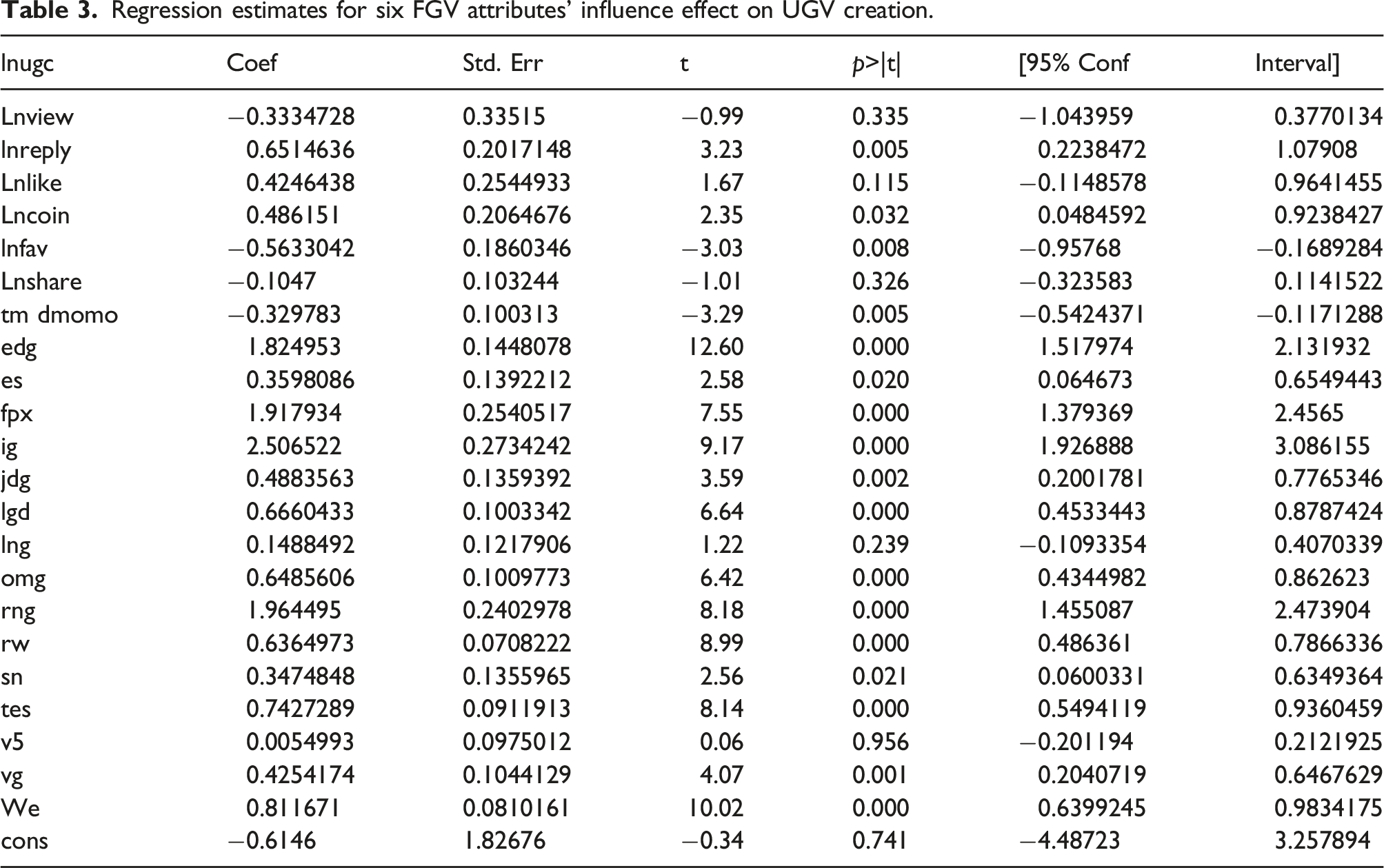
From Table 3, we can see that the p-value of Reply is 0.005 (<0.05), indicating that it is a significant independent variable. If there is a 100% increase in reply, the UGV will increase by 65.1%. This verifies our hypothesis H1b, indicating that replies to FGV stimulate UGV. However, this only partially verifies that FGV engagement affects UGV. We also found that like and share, which also represent engagement, did not stimulate UGV at the significance level, with p-values of 0.115 and 0.326 for like and share, respectively. This can be explained by the fact that although all three independent variables represent engagement, they represent different levels of engagement (Kitirattarkarn, Araujo, and Neijens, 2019). In terms of coin, the FGV influence effect is also significant as p = 0.032 < 0.05. Every 100% increase in the coin results in a 48.6% increase in the UGV. This confirms our hypothesis H2 that FGV coins can stimulate UGV.
However, it is surprising that a significant negative correlation exists between FGV favorite and UGV. The UGV will suffer a 56% reduction for every 100% increase in favorite. This may be because when users collect videos, they focus more on the usefulness of the video than on the content of the video itself, thus failing to elicit intrinsic motivation to create UGV and even reduce the desire to create.
The p-value of view was 0.335, which was below the significance level of 0.05. This indicates that the amount of FGV played does not indicate whether it can stimulate the UGV.
Regarding the teams listed in Table 3, among the 17 teams, only team LNG and V5 were found to have no significant impact of FGV on UGV. Except for these two, all other LPL teams show strong individual effects.
Discussion
From the results, it is clear that some FGV attributes have a significant influence effect on UGV. The findings can provide managers in the E-sports industry with profound business insights: not only help them better understand consumers’ psychology and behavior, but also inspire them to use FGV to stimulate more UGV and achieve strategic business goals.
The positive independent variable reply is often considered a symbol of user engagement, whether between firms and users, or just among users. It is a hot topic to study how reply boosts engagement in both FGC and UGC research areas: Aldous, An 87 used reply to represent user engagement to analyze the effects of social media posts topics on audiences. In Bilibili, communication and interaction in the reply session can create an engaging environment to strengthen users’ loyalty, maintain good customer relationships between firms and users, and increase users’ willingness and the possibility of creating UGV. It can also be seen that the influence of the reply on the UGV is more conspicuous than on any other attribute. E-sports firms can do many things to cater to users' need to express themselves. For example, a key opinion leader (KOL) can be employed to lead the discussions to create an intimate user ecosystem; official accounts can respond to users more frequently and actively in the reply session and always keep an eye on what concerns the users most to grasp the market trend; the users who reply most with highly qualified reply can receive some small gifts from the team: a free ticket for E-sports competition or other rewards.
In line with our expectations, the coin has a positive influence effect on UGV. Since the coin is a strong indicator of supportive action and brand identity for the content, firms that rely on user traffic and fan economy can pay attention to creating the FGV with great resonance with their target users” or satisfying users' brand identity.
Surprisingly, favorite, often associated with users’ perceived usefulness, is negatively related to UGV. Users usually “favorite” a video because of its high quality or other reasons that make them want to watch it again. Finally, perceived usefulness is a significant and most noticeable reason for the action of putting a video on the favorite list. Nevertheless, our study shows that useful FGV negatively influences UGV; perceived usefulness may discourage the creation of UGV. The reason may lie in this: users who stress on obtaining useful information from the Web site may be a “learner” or “taker” typed person and less of a “giver”; hence people who favorite are not the ones who make new UGV. Since favorite is not a favorable attribute for stimulating UGV, when a firm wants to create FGV to facilitate UGV, it should avoid making “favorite’-oriented FGV, such as practical videos concerning education, skill teaching, or similar video. Instead, it would be more effective to focus on content that can evoke a user’s brand identity rather than perceived usefulness. Otherwise, a more useful FGV may push the firm on the wrong track.
In terms of the three insignificant variable viewing numbers, like, and share, they do not have enough incentives to promote UGV creation. The reason may lie below: viewing number suggests that there are a considerable number of viewers who only enjoy watching FGV and seldom make their videos; like is a lower-cost action than coin, and thus it may generate less motivation for new UGV; from experience, share is not a frequently used function on Bilibili, which leads to its insignificant influence effect on UGV. Although like, share, and reply are all supposed to be linked to users’ engagement, in our study, only reply seems to be significantly and positively connected with UGV. Therefore, when E-sports firms try to create an FGV to stimulate more UGV, they can dismiss taking the view number, like, and share into primary consideration.
In summary, E-sports firms can encourage more UGV creation by producing FGV, which urges users to reply and give coins, discourages them from favoring, and ignores less relevant attributes such as view number, like, and share. Notably, managers of E-sports firms can use all means to motivate users to speak out in reply sessions: increase interaction frequency and enhance communication quality between firms and users; forge a friendly and blooming virtual community ecosystem to allow all schools of thought to contend, giving incentives to those who present good replies actively, and so on. It is also essential for firms to produce FGV, which win users’ recognition, appreciation, and coins. Firms must care about users' brand identity and accordingly produce FGV to satisfy them. Moreover, E-sports firms can avoid producing videos that stress practical use, especially educational content. Finally, using FGV to influence UGV is subtle, but there are numerous direct marketing campaigns to increase UGV and brand loyalty. For example, holding a UGV competition with a bonus can attract more users and enhance brand perception; holding live broadcasting of E-sports star players can impress enthusiastic fans.
Based on the above findings, brand identity and engagement with FGV are crucial for stimulating UGV. The generated content needs to meet users’ needs, 88 the creation of firm content should be done by someone who understands the firm’s core values and can increase brand identity and engagement.
Monitoring and correction are critical in any content marketing strategy. 89 The impact of FGV on the UGV was easily tested. Within 3 months of a firm releasing an FGV, the vast majority of the impact was accomplished based on the conclusion of the video’s lifespan. It is time to determine whether the firm’s goal of stimulating UGV has been achieved by checking the number of UGVs, as this is an indicator of the success of the FGV. If the target is not met, it is necessary to change the content theme and conduct in-depth discussions with users, such as reaching out to user communities, distributing questionnaires, and conducting in-depth interviews with users, to find ways to increase user recognition and engagement.
Although our test subjects, videos, and platforms were all Chinese, aspects of our results apply to global videos and platforms. Bilibili videos contain video characteristics very similar to global social media, including likes, favorites, reposts, replies, and view counts. Many of these characteristics can be found on well-known social media, such as YouTube, Twitter, Facebook, and Instagram. For video posts with the same video characteristics, our method can be used to examine whether FGV has an effect of FGV on UGV, and our findings can also provide some insight. However, since the study was mainly conducted on Chinese users and platforms, our findings may not be consistent with the rest of the world.
Conclusion
In recent years, the way companies market themselves has undergone a dramatic change, with generated content becoming an important tool for firm marketing. The increased time spent using the Internet and social media has changed the way users receive information and companies’ marketing strategies. Today’s use of social media-generated content may help build user loyalty and engagement. Simultaneously, companies posting large amounts of generated content on social media have lowered their entry barriers. Second, the future of the marketing approach using UGV is bright. With the rapid update and advancement of video editing technology and intelligent design of platform websites, the cost and threshold of UGV will continue to decrease. An increasing number of people are now willing to express themselves and impress others by making UGV, and want to enjoy a sense of participation and experience. This leads us to believe that UGV (or UGC) and the associated web traffic or economy will occupy an increasingly large share of tertiary services in the future. Our data include 2,977 firm-generated content and 49,860 user-generated content. Because user-generated content is an important foundation for companies to shape their user communities, and firm-generated content is the material from which user-generated content is produced, it is beneficial for companies to understand how to use it to stimulate the creation of user-generated content for marketing. Therefore, it is reasonable to expect that users will increasingly rely on firm-generated content. We conducted our research and made contributions using video data from a large online social media site.
This study makes a valuable contribution to the current academic literature. 1. First, it is clear from existing literature that there is still little understanding of how to use generated content in video form to stimulate the creation of other generated content. This study is one of the first attempts to fill this research gap by exploring which video attributes of generated content are more likely to stimulate the creation of user-generated content, and by looking at theories that suggest the reasons for these motivations. Two This paper presents how the video attributes of the FGV affect the UGV. Specifically, two video attributes, “reply” and “coin,” showed a positive correlation. Conversely, one attribute, “favorite,” shows that it hinders the increase in the UGV. The other three attributes, “View”, “Like,” and “Share,” do not have a significant relationship with UGV. In practice, companies can evaluate their FGV based on different attributes to determine which types of content or topics stimulate UGV most effectively, especially those with a high number of “reply,” “coin,” and a low number of ‘favorite’. 3. In this study, we explore the factors associated with the likelihood of firm-generated content influencing user-generated content in brand identity and consumer engagement theories. We argue that consumer engagement and brand identity are critical for better understanding the motivations that spur the creation of user-generated content. We find that the “reply” attribute of firm-generated content represents user engagement, suggesting that user engagement motivates user-generated content. Similarly, the ‘coin’ attribute of firm-generated content represents users' brand identity, suggesting that brand identity motivates user-generated content generation, which is in line with findings from past literature.
This study has practical implications for managers and offers pragmatic recommendations to managers. The findings of this study suggest that the video attributes of firm-generated content have an impact on stimulating users to create original UGV, and that different video attributes have different impacts. This finding has implications for the development of new social media platforms in China. First, Web site designers, whose interests are aligned with those of the firm, want to increase the number of user-generated videos and thus the impact of the site, both in terms of user size and site revenue, to be successful. To achieve this goal, Web site designers must take advantage of positive factors. For example, the number of comments and coins stimulates UGV generation more than any other attribute does. This means that site designers can assign higher weights to videos with high comment counts or coin counts when pushing videos. Second, marketing managers who want to use UGV as a new marketing tool. The most important task for marketing managers is to create a video that can have a broad reach to realize the value of firm-generated content. Currently, most managers refer to the number of views they use to determine the reach of a video. While it is true that a video with more views helps the video spread, it is not absolute. In addition to the distribution rate, managers must consider audience perceptions. In this regard, we can refer to the number of coins. If a video receives many coins, viewers are satisfied with the video, inspiring users to identify with the firm; even if the diffusion rate is not very good, such videos may show a better desire to stimulate users to create UGV. In the process of creating firm-generated content, attention must be paid to the attributes of firm-generated content that have a positive and negative impact on user-generated content. Owing to the differences in the effects of different factors, companies should adopt appropriate policies for generated content that will increase the impact of their videos and thus stimulate users to produce original firm-related user-generated content. In addition to user-generated content, the stimulation of user engagement by firm-generated content can also help firms develop new merchandise and improve their marketing strategies. 90 Third, for the new Chinese social media industry. For FGV attributes, most of the selected parameters are commonly used on other platforms. Therefore, our results can be applied to other online social media platforms. Second, E-sports is an ideal subject for analyzing the impact of FGV on UGV, and the findings may have implications for other media industries that emphasize user engagement and experience, especially entertainment industries such as movies, streaming media, and live sales.
This study has some limitations; our experimental sample only considered the E-sports industry. The data source was only one social media site. The video format used in this study only included Web site videos. Second, the data we studied did not include the corresponding commentary content of the videos. Therefore, future research should explore this phenomenon using more industries and platforms, including FGV and UGV, or short videos from other industries. Another future research direction is to combine FGV content with video analytics 91 to analyze potential FGV content on stimulated UGV by identifying specific scenarios. The large amount of data collected can be analyzed using machine learning and other techniques to obtain hidden information. 92 The topics and comments of videos can also be analyzed for emotional polarity using sentiment analysis. 93 The information obtained can be used to build predictive models to analyze which videos better stimulate user-generated content. 94 Finally, future research could also emphasize consumer attributes such as trust. 95
Supplemental Material
Supplemental Material - The influence of firm-Generated video on user-Generated video: Evidence from China
Supplemental Material for The influence of firm-Generated video on user-Generated video: Evidence from China by Zirui Ma and Bin Gu in International Journal of Engineering Business Management
Supplemental Material
Supplemental Material - The influence of firm-Generated video on user-Generated video: Evidence from China
Supplemental Material for The influence of firm-Generated video on user-Generated video: Evidence from China by Zirui Ma and Bin Gu in International Journal of Engineering Business Management
Supplemental Material
Supplemental Material - The influence of firm-Generated video on user-Generated video: Evidence from China
Supplemental Material for The influence of firm-Generated video on user-Generated video: Evidence from China by Zirui Ma and Bin Gu in International Journal of Engineering Business Management
Footnotes
Declaration of conflicting interests
The author(s) declared no potential conflicts of interest with respect to the research, authorship, and/or publication of this article.
Funding
The author(s) received no financial support for the research, authorship, and/or publication of this article.

Supplemental Material
Supplemental material for this article is available online.
References
Supplementary Material
Please find the following supplemental material available below.
For Open Access articles published under a Creative Commons License, all supplemental material carries the same license as the article it is associated with.
For non-Open Access articles published, all supplemental material carries a non-exclusive license, and permission requests for re-use of supplemental material or any part of supplemental material shall be sent directly to the copyright owner as specified in the copyright notice associated with the article.
