




Abstract
Many firms find it challenging to develop innovations, evidenced by the ever-mounting number of university-industry research alliances. This study examines the strategic choices of actors who participate in collaborative innovation alliances involving partnerships between industry and universities (U-I) based on a stochastic evolutionary game model. White noise was introduced to reflect uncertainty and the stochastic interferences caused by the differences between actors. Using the Itô stochastic differential equation theory, we analyze stability issues of player behaviors in the evolution of a collaborative innovation alliance. The results illustrate that improvements in innovation efficiency can contribute to U-I collaborative innovation alliances. High knowledge complementarity appears to be unbeneficial to the stability of these alliances, and controlling knowledge spillovers may suppress free-rider problems from both sides of the game. Our study contributes to innovation research by providing a decision-making reference for the design of U-I cooperation.
Keywords
Introduction
One of the main drivers of firm success in the present knowledge economy is the ability to innovate. While universities tend to support longer-term upstream research, industry-based innovation must satisfy firms’ clients in the short run. 1 Typically, universities’ focus is more on scientific challenges far from the market, pushing technological frontiers, and less on the commercialization of new products. 2 In addition, universities are considered more stable and reliable network partners because of their public funding. 3 University-industry (U-I) research partnerships are designed to generate outputs of high academic relevance and practical commercial-industrial application. Due to rapid growth in information technology and knowledge-based work, the concept of knowledge management and knowledge co-creation has gained momentum 4 in recent years. Researchers have shown that appropriate use of external knowledge has a positive impact on firms’ innovation performance,1,5–7 but that the effects of collaboration may differ depending on the nature of the specific U-I alliance players involved.
It is essential to understand better U-I alliances as fundamental knowledge generators and drivers for industry success. 8 Within open innovation frameworks, the transfer of knowledge, expertise, and technology from U-I is commonly regarded as an important source of knowledge creation.9,10 In U-I alliances, the aim is to tap into each other’s resources and enrich one’s mutual knowledge base.11,12 By developing collaborative links with universities, industries can leverage skills and knowledge to enhance their capabilities, expand network reach, and improve industry competitiveness.13–15 Empirical work shows that the benefits of U-I alliances can be increased sales, research productivity, patenting and learning.16–19 Innovation is considered an important determinant of competitive advantage. 20 Universities are typically cited as “safer” institutions for industrial collaboration. 21 Therefore, most research-led universities have created specific knowledge commercialization departments to further U-I alliances.
Collaboration between U-I has received much attention from academics. 22 One advantage of collaborating with universities is their ability to generate new knowledge and approaches to solve problems. 23 Confronted with reduced funding from the government, universities seek U-I collaborations to compete in an environment increasingly dependent on market forces. 24 The transfer of knowledge between U-I may involve different types of research cooperation, such as intellectual property rights, spin-offs, start-ups, and technology transfer. To facilitate such transfers, both universities and industry companies need an open culture, absorptive capacities, and mutual trust. 25 By its nature, R&D collaboration takes a long time to yield mutual benefits. 26 As universities and companies have diverse goals and motivations in collaborating, there is concern that opportunistic behavior and problems between U-I may fail such collaborations.
Universities are portrayed in networking theory as key nodes in external knowledge networks for industry within open innovation systems. 27 Research suggests that university engagement varies and is typically considered less important by companies than other sources of knowledge.17,28,29 Tensions in U-I collaborations undoubtedly exist as the industry seeks to commercially exploit knowledge,13,28,30 while universities are more interested in exploring its frontiers.14,31 Consequently, the process of U-I collaboration is not without friction 32 and demands further understanding. In this study, we investigate the evolution of knowledge exchange networks. We develop a model in which U-I actors share knowledge through R&D collaboration. Since such collaboration is costly for firms, they face a trade-off between the benefits of new partnerships and their costs.
While the literature has expanded over the past two decades, shedding significant light on the formation and facilitation of collaborative U-I alliances, there have been few attempts to model this activity to understand better the stability of these alliances. 33 To explore U-I alliances, we have chosen to utilize techniques from evolutionary game theory—which has proved its effectiveness in dealing with uncertainty and with those dynamic characteristics of firms endogenously generated by product innovations, processes, and organizational forms. 34 We argue that the research gap in the U-I cooperation literature stems from an incomplete understanding of implicit key constructs that affect the collaboration process itself. The motivation for developing a game theory modeling approach comes from the realization that most of the current literature on U-I innovation collaboration fails to adequately elucidate the underlying failure and success of seemingly comparable U-I alliances. For the specific context of U-I collaboration, Bruneel et al. 28 developed a game-based model to show that firms seek collaboration on projects that are more relevant to their core business, and are primarily interested in the most reputable and prestigious universities. Indeed, empirical evidence has shown that the quality of a university is a significant determinant of U-I innovation alliance success.35,36
Drawing on evolutionary game theory and human behavior modeling, which proved to be helpful for the understanding of various economic issues,37–39 we propose a conceptual framework that considers three factors: (1) innovation efficiency: the ease at which new knowledge is turned into new outputs by the firm; (2) knowledge complementarity: the homogeneity of partners’ knowledge base; and (3) knowledge spillovers: the extent to which unintentional sharing of knowledge takes place. Using this framework, we assess the circumstances under which firms follow an open innovation strategy through an alliance with a university or a closed strategy, where they work alone innovating in-house. Based on the assumption of bounded rationality, our model examines the evolution of the interaction between multiple U-I actors, providing a logical explanation for the mechanism of U-I innovation alliances’ success or failure based on knowledge spillovers.
The study makes three main contributions: first, it examines when higher levels of innovation efficiency promote a collaborative innovation strategy; second, it shows that the lower the degree of complementarity of knowledge between U-I partners, the higher the probability that both parties will choose to form a collaborative innovation alliance; and third, it shows that when the level of knowledge spillovers is high, a closed innovation strategy is more likely to be selected to obtain higher individual returns.
The paper is structured as follows: the literature review outlines the theory of U-I alliances. We then discuss the use of game theory to model collaborative innovation among U-I alliances, presenting both the conceptual underpinnings and the assumptions of the model. Subsequently, we analyze the stochastic evolutionary game model and discuss the stability problem of the equilibrium solutions from a theoretical point of view. Finally, we present the results from the simulation model, taking different scenarios into account and discussing the practical and theoretical contributions of the findings. We conclude by summarizing practical implications and suggesting future research.
Literature review
Universities are increasingly regarded as “anchor institutions” within innovation systems, which play a key role in enabling the development of new products, processes, and technologies by supplying the knowledge required to innovate.40–43 Knowledge is characterized as tacit, local, cumulative, and complex. 3 Historically, academic institutions focused on basic research where breakthrough concepts spill over into industry sporadically. Today, however, universities increasingly assume equity positions in firms using their intellectual property as a mechanism to generate revenues. Empirical evidence of the tangible benefits of U-I alliances is widespread. Researchers find that U-I alliances enhance firms’ competitiveness.13,29,44,45 Industry invests in internal R&D not only to generate innovation but also to develop absorptive capacities and identify external knowledge. 1 If a firm lacks internal resources, collaboration with outside partners becomes more attractive.12,46
With rapid changes in market demand and soaring development costs, it is increasingly difficult for firms to succeed by relying solely on internal capabilities and resources. 47 The extant literature suggests that the stability of U-I innovation alliances varies. 32 Indeed, instability may result from several factors. First, the U-I actors may be driven by different motives. The industry may be more focused on profit than on contributing to an existing body of knowledge.9,14,30,31 Second, given the heterogeneity of U-I actors, tensions may arise from having different mindsets and work methods, thus limiting cooperation.48,49 Third industry companies usually operate with stricter time constraints. 50 Fourth, different communication styles may cause misunderstandings, further undermining cooperation. 51 Finally, researchers in the industry may question the efficacy of academic research in solving practical problems.52,53
Researchers suggest that the stability of collaborative projects may hinge on the ability of U-I actors to understand each other’s practices.30,43,54 Knowledge complementarity between U-I actors, i.e., their closeness in terms of working practices, knowledge bases, 55 and technological capabilities, is a relevant factor for U-I collaboration success.56–60 Such complementarity enables the actors to understand each other better, thus reducing uncertainty in the cooperation.58,61,62 Empirical evidence suggests that universities appear to be more inclined to cooperate when projects are less aligned with their capabilities, as they comprise an opportunity to acquire new knowledge and skills. 63
It is thought that universities’ culture is dissimilar from that of industry. 26 Universities are seen as prime institutions for knowledge creation and dissemination. Nonetheless, they may be partially funded by the government, which may weaken their incentive to pursue profits and the ability to respond to changes. 25 Although aligned at times, U-I collaborations’ efforts are often categorized by friction leading to frustration. 24 Universities are principally concerned with the assimilation and distribution of new knowledge and the education of their students. U-I collaborations concentrate on the shift from basic research to applied research. 64 Collaboration between U-I focuses not only on knowledge sharing but also on preparing the industry workforce. 64 Academics may see such collaborations as compromising their academic integrity, limiting the dissemination of research results, narrowing research issues, and encouraging faculty migration to industry.
Knowledge sourcing from external parties has long been acknowledged as instrumental in successful innovation. 65 It is a relational benefit stemming from strategic inter-organizational networks that facilitate knowledge flow. Industry invests in internal R&D not only to generate innovations but also to develop the ability to identify external knowledge. 1 Some scholars claim that U-I knowledge spillovers are part of the open innovation mentality.15,44 They argue that because this is an externality, developing formal alliances to access such sources of knowledge is unnecessary.66–68 In other words, knowledge spillovers may produce less stable U-I alliances, as companies can source knowledge from their environment without formally engaging with a university partner.
Conversely, when knowledge spillovers are less prevalent, firms are driven toward formal U-I alliances with more stable partnerships.59,69 Both the resource-based view and the knowledge-based view of the firm emphasize that access to external knowledge is essential to innovation. 70 However, such knowledge is not easily obtained, as it is often tacit or context-specific, thus necessitating the absorption of specific capabilities.2,71
Knowledge is a core competence in modern economies. 25 Companies often collaborate with universities to save costs, enhance their technological capacity and economic competitiveness, shorten their product life cycle, develop their human capital and obtain incentives for developing such collaborations. 72 They can get solutions to specific problems, subcontract R&D, reduce and share risks, enhance corporate image, and access research networks, new knowledge, cutting-edge technology, expertise, and complementary know-how.
Game model assumptions and formulation
The complexity of strategic alliances such as U-I collaborations has been addressed by relational theory 73 and transaction cost theory. 74 These theories referred to the transaction costs of managing collaborative relationships. In game theory, such collaborations are sometimes seen as a prisoner’s dilemma. 75 A resource-based view of the firm was used to define why one initially cooperates and then stops. 76 An institutional theory exists under a supposition of finite resources, 77 claiming that organizations adapt to maximize their efficacy. Rational economic action was also illustrated by Van de Donk and Snellen. 78
Smith and Price 79 were the first to propose the evolutionary game theory model. Unlike traditional game theory, the evolutionary game theory makes no complete rationality or information assumptions. Actors conduct repeated games by pairing randomly and ultimately achieving a dynamic and stable state. 80 Game theory models are generally utilized for decision-making processes. For example, Gandomi et al. 81 developed a game-theoretic model to guide the choice of the reward structure of customer loyalty programs. Huang et al. 82 created a stochastic game model that focused on the interaction between attackers and defenders in ICPSs and defined optimal defense strategies to minimize system losses. Akçura and Ozdemir 83 employed a game theory model to investigate how and when data-driven collaborations between manufacturers and retailers are beneficial. Hara and Matsubayashi 84 developed a stochastic game theory model to examine the strategic introduction of premium store brands through collaboration between a retailer and a national brand manufacturer. An et al. 85 developed an evolutionary game model to analyze the optimal interaction strategy between financial and regulatory institutions.
The present study utilizes an agent-based simulation to investigate the role of U-I links in innovation generation and diffusion. Innovation diffusion in networks is an attractive research topic for innovation economics and design. Indeed, spillovers can support economic development due to their positive impact on economic growth. 3 Whether U-I collaboration can achieve desired goals depends on many factors, such as a player’s level of rationality, collaboration attitudes, expected output, and available resources. 28 U-I alliances help reduce the disadvantages of asymmetric information, moral hazard, and adverse selections.
On the other hand, U-I players’ interests are not always aligned. The bounded rationality of U-I alliance participants makes it difficult to find an optimal strategy when facing complex problems. As a result, the alliance process is constantly changing and adjusting. Accordingly, our model considers recurrent games. If two parties find a minimal incentive to start collaborating, they enter the execution phase, where they begin to explore new knowledge areas. The aim is to tap into each other’s resources. Existing absorptive capacities determine success. We consider a network formation process in which creating a new link requires a bilateral agreement between two parties. By contrast, the deletion of a link only requires a unilateral decision. Consistent with this mechanism, we implement the definition of pairwise stability as a network equilibrium criterion. We model explicitly the evolution process in which, at the beginning of each period, a pair of firms decides whether to form or delete a link based on knowledge spillovers.
At the core of our model is the argument that the stability of U-I alliances depends on innovation efficiency. It represents the industrial processes within the firm that transform the knowledge input into profits. 86 Therefore, innovation efficiency reflects firms’ capacity to source, assimilate, absorb and process external knowledge, typically conceptualized as the organization’s absorptive capacity.87–89 In addition, innovation efficiency reflects a firms’ ability to transform knowledge into something tangible (REFS). Therefore, higher levels of innovation efficiency may signify that the industry is good at absorbing knowledge from the U-I alliances. 69 In such a case, partnerships may be more stable, as they are likely to facilitate a successful transfer of knowledge between U-I actors. Conversely, low levels of innovation efficiency may be a sign of ‘assimilation barriers,’ which may impede the successful transfer of knowledge. 88 In such a case, the alliance may be less stable.
Evolutionary game theory can model strategic interactions where players choose cooperation strategies that provide an advantage (also in the future). Indeed, players know that their present actions may influence the future actions of other players. 38 Path dependence is one of the main features of complex economic structures and evolutionary games, 90 suggesting that history matters in the long-term progression of markets and innovation. This regards positive or negative feedback effects. 91 However, researchers should be cautious in inferring present conditions from past events, as historical environments shaping past conditions may no longer exist.92,93 Therefore, choosing among different pasts can be seen as a stochastic process.
Game theory provides tools to model the innovation process resulting from collaboration in a business environment. 94 For example, Baldwin and von Hippel 95 have presented hybrid models to illustrate collaborative innovation dynamics and show that the benefits of open innovation can outweigh those of innovation obtained by a single producer. Similarly, Ritala and Hurmelinna-Laukkanen 96 compared coopetition and collaboration, suggesting that value-creation in coopetition depends on shared knowledge. In addition, Arsenyan et al. 97 claimed that a game theory approach could yield a better understanding of the mechanisms underlying collaboration, where trust and the possibility of co-learning play an important role.
Based on our literature review, our model is formulated on the following assumptions:
We consider a game with two players: firms and universities. We select one player from each group at each game stage, indicating the firm as
Each player may choose open innovation or closed innovation. To form a successful alliance, they must both choose open innovation. By contrast, if one or both players choose closed innovation, the alliance fails, and the simulation ends.
The players in the game are economically motivated, with bounded rationality. They aim to maximize their utility. It is not possible for a player to know the strategy choice of the other player in advance.
Players are different in terms of innovation capabilities, and each pair of players has a certain level of knowledge complementarity.
Evolutionary game model formulation
Based on prior research, e.g, Anbarci et al.,
98
we define the innovation return function of player one

In this function,

Furthermore,
We also define (1) Player one (the firm) chooses an open innovation strategy, and player two (the university) chooses a closed innovation strategy. In this case, player one will invest all its knowledge (2) Player one (the firm) chooses a closed innovation strategy, and player two (the university) chooses an open innovation strategy. The additional cost to the university caused by the knowledge spillover is (3) Both U-I players choose open innovation. Both will invest all their knowledge, (4) Both players choose closed innovation. In this case, although the two players formally set up an innovation alliance, they do not successfully share their knowledge. Therefore, we have the return function


Return matrix for the players of the innovation alliance.

At time 

The average return is:
Similarly, for the university, we have the following equations:

The average return is:
When including the dynamic change speed of 

The inappropriateness of a deterministic model
The last two equations are dynamic but do not consider stochastic inference. In real collaborative innovation alliances, player choices are more complex.97,101 Many additional uncertain factors can affect players’ behaviors, which we do not consider. Therefore, using a dynamic system without stochastic interference is inappropriate to study player behavior. 102 A collaborative innovation alliance is a complex system that evolves with uncertainty, influenced by numerous internal and external factors, such as knowledge input, knowledge complementarity, and knowledge output elasticity.4,38 Unknown and difficult-to-model factors also play a role in player behaviors, such as individual risk appetite and the individual personalities of researchers and entrepreneurs. 103 At the same time, past collaboration outcomes (i.e., memory) may also affect future behaviors. Generally speaking, the greater the benefits of independent innovation, the easier it is for a participant to choose a closed innovation strategy. Additionally, changes in the external environment may impact the U-I innovation alliance, while political, economic, and cultural factors may influence the strategic choice of players. 94 In short, the choice of collaborative innovation is determined by a large set of factors, which are sometimes unknown or difficult to include in a model. 104 Uncertainty calls for random noise to be included in the model. As the deterministic dynamical system presented in the previous section is not sufficient to represent a credible model, in this paper, we chose to include random dynamics and introduce white noise into the game model to simulate more realistic settings. Accordingly, our model considers the impact of stochastic interference factors in the entire U-I innovation model.
Construction of a stochastic evolutionary game model
Stochastic analysis theory is used to study the evolutionary mechanisms of dynamic systems with stochastic process characteristics.
70
Stochastic dynamic systems are widely used in physical, biological, and other disciplines, more rarely in management (e.g.,.
105
Following a stochastic approach,70,102,106 we present a variation of our dynamic model (equations (17) and (18)), including a stochastic component, which is helpful in modeling uncertainty:

In building a dynamic evolutionary game model, without the stochastic component, we cannot exhaust all factors affecting the stability of an innovation alliance. For this reason, we include random phenomena in the model with
In addition,
Existence of Equilibrium Solutions
Now, we analyze the dynamic characteristics of the players in the U-I collaborative innovation alliance model. Without losing the general premise, we discuss the following two situations:
Proof. When The solution of the equation is 

Alternatively, we assume that In this case, we find that: 

Stability analysis of the equilibrium solutions
In the following section, we discuss the stability problem we found in the equilibrium solutions and try to answer the following questions:
For a given initial value (1) When
The exponential function has a pivotal role in the control-system theory and has the properties illustrated in the following.
For 
This means that the pth moment zero solution of equation (3) is exponentially stable. On the other hand, if (2) then the pth moment of the zero solution of the equation (3) is exponentially unstable. The above definitions show that the stochastic process The pth moment of the zero solution is exponentially stable. The pth moment of the zero solution is exponentially unstable.
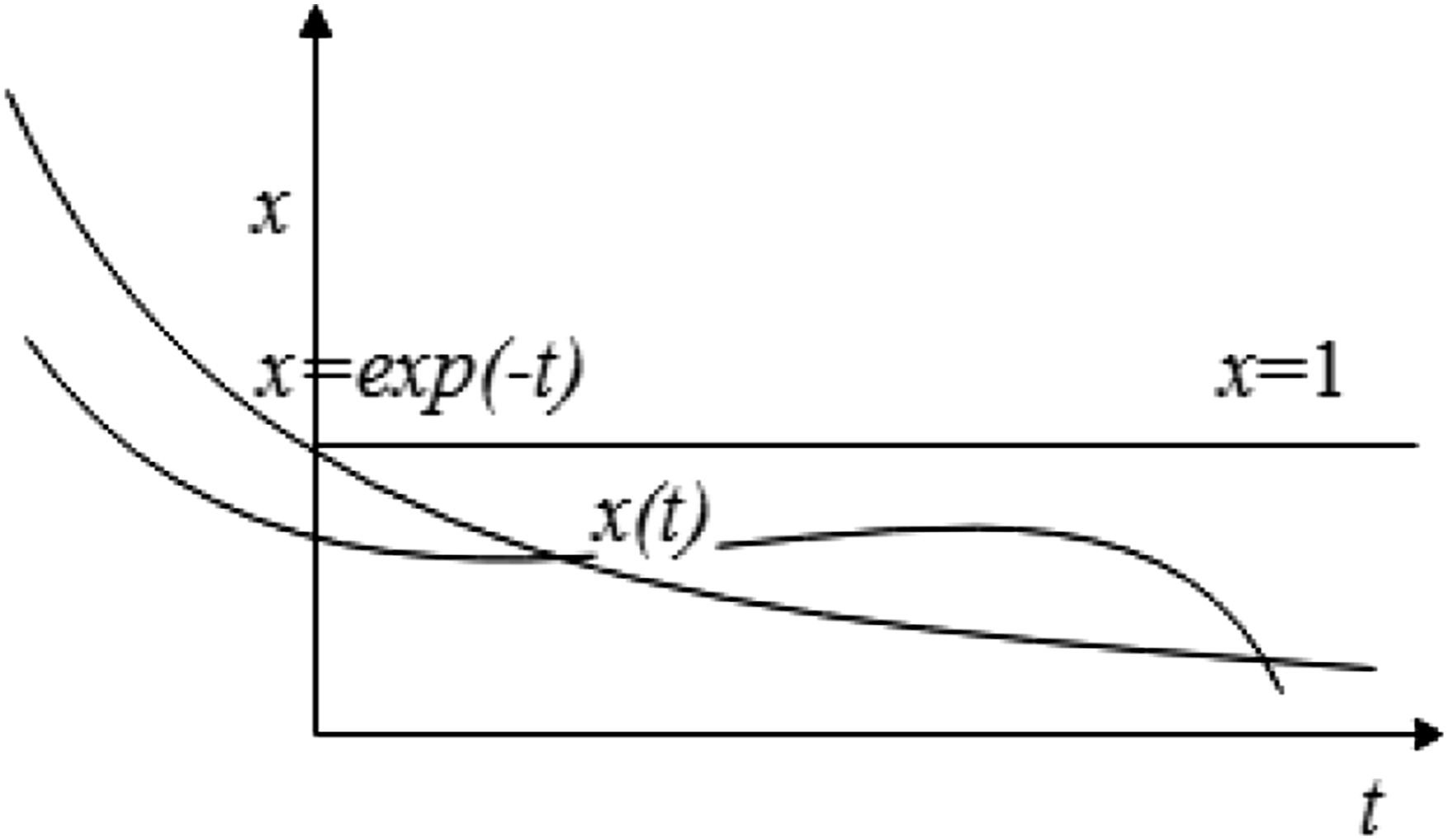

For any given
Sufficiency criterion of alliance’s stability and instability
Given the stochastic differential equation: Let there be a smooth function The omitted proof can be derived from the general theory of stochastic differential equations.
108
To determine the stability of the interaction of players in a collaborative innovation alliance, we used the above lemma to draw the following conclusions for equations (19) and (20). If The stability of the equilibrium solutions 
Numerical simulation
Matlab 2012 a software was used to carry out the numerical simulation of our model. We analyzed the factors that affect the U-I alliance’s evolutionary path over time and those that impact alliance stability. The purpose was to examine game conclusions and the trends of considered variables.
The impact of innovation efficiency
on collaborative innovation alliances
Firms and universities possess different innovation resources, capabilities, knowledge, and innovation inputs.
We choose as the parameters for the initial setting of the model: (1) the efficiency of the firm
Subsequently, we increase the firm’s innovation efficiency to Innovation Efficiency and Firm’s Evolutionary Path. Innovation Efficiency and University’s Evolutionary Path.

In Figure 3, the blue dotted curve is the evolutionary path of the firm’s strategy when innovation efficiency
Figure 4 confirms that these results are the same for universities: when innovation efficiency increases, strategies evolve toward open innovation; by contrast, when innovation efficiency is low, the preferred choice is a closed innovation strategy. Even in this case, the random interference factors do not change the direction of evolution. For both firms and universities, the transition speed toward an open strategy is significantly higher than toward a closed strategy. Firms tend to reach the equilibrium point faster than universities due to a higher knowledge input (3 instead of 2). Therefore, when higher initial levels of knowledge exist, collaborative innovation alliances tend to form more quickly.
The impact of the degree of complementarity of knowledge
on collaborative innovation alliances
Maintaining most of the simulation parameters of the previous section, we examined the effects of changing the degree of knowledge complementarity from Complementarity of Knowledge on Enterprise’s Evolutionary Path. Complementarity of Knowledge on University’s Evolutionary Path.
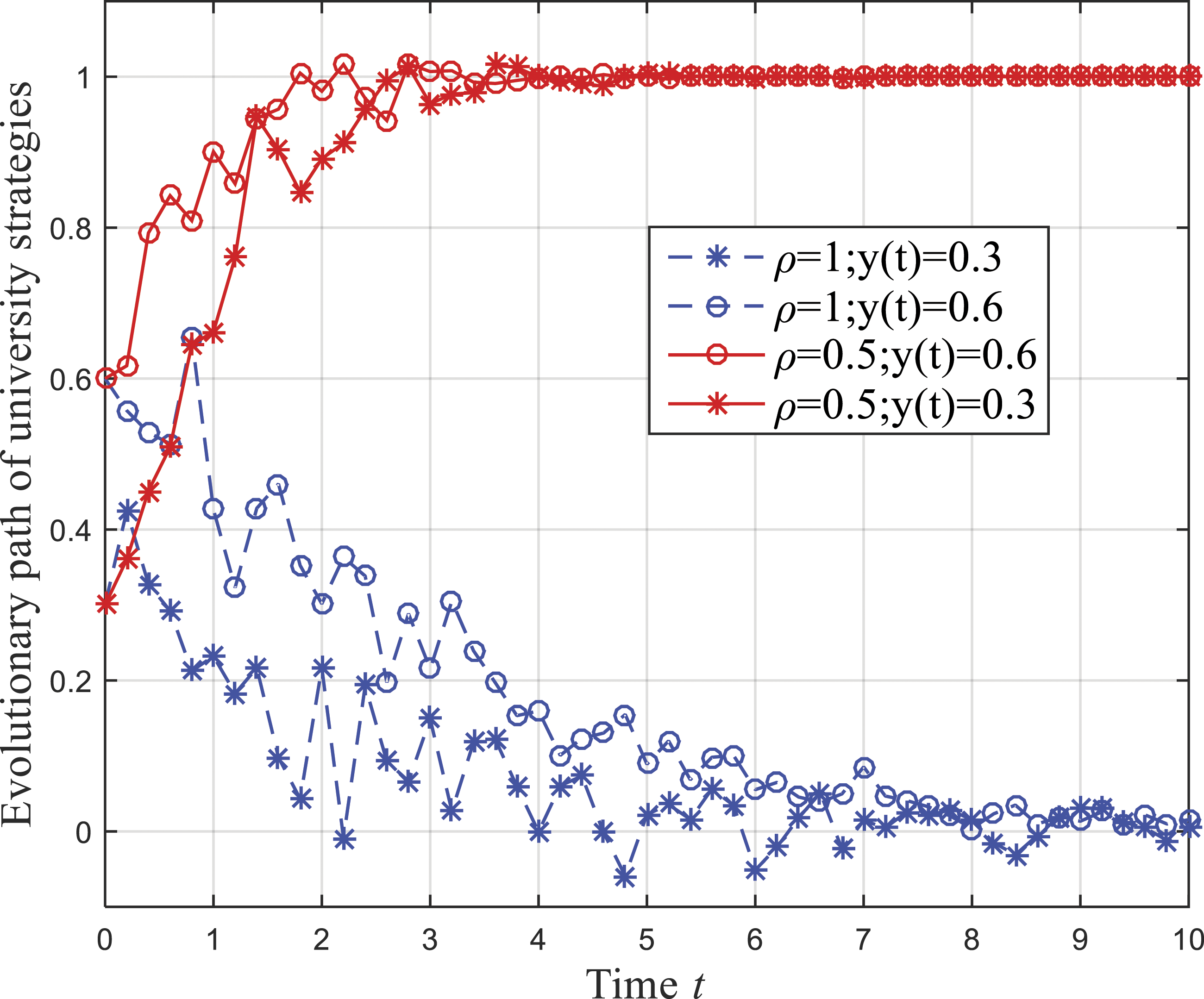
The blue dotted curve represents the evolution path of the firm when the degree of knowledge complementarity is
As shown in Figure 6, the results are identical for universities: when the degree of knowledge complementarity is lower, both firms and universities tend to choose an open innovation strategy. Moreover, the evolution speed toward an open innovation strategy is significantly more rapid than a closed innovation strategy. Firms reach the equilibrium point faster than universities. This is because we set a higher knowledge input for firms. In this scenario, a higher knowledge input, signaling the need to invest in greater levels of knowledge, supports the faster formation of sharing-based alliances. Lastly, looking at the convergence speed in Figures 3, 4, 5 and 6, we note that a low knowledge complementarity is more effective than a high innovation efficiency in pushing collaborative innovation alliances.
The impact of knowledge spillover coefficient
on collaborative innovation alliances
Here, we set Knowledge Spillover on Enterprise’s Evolutionary Path. Knowledge Spillover on University’s Evolutionary Path.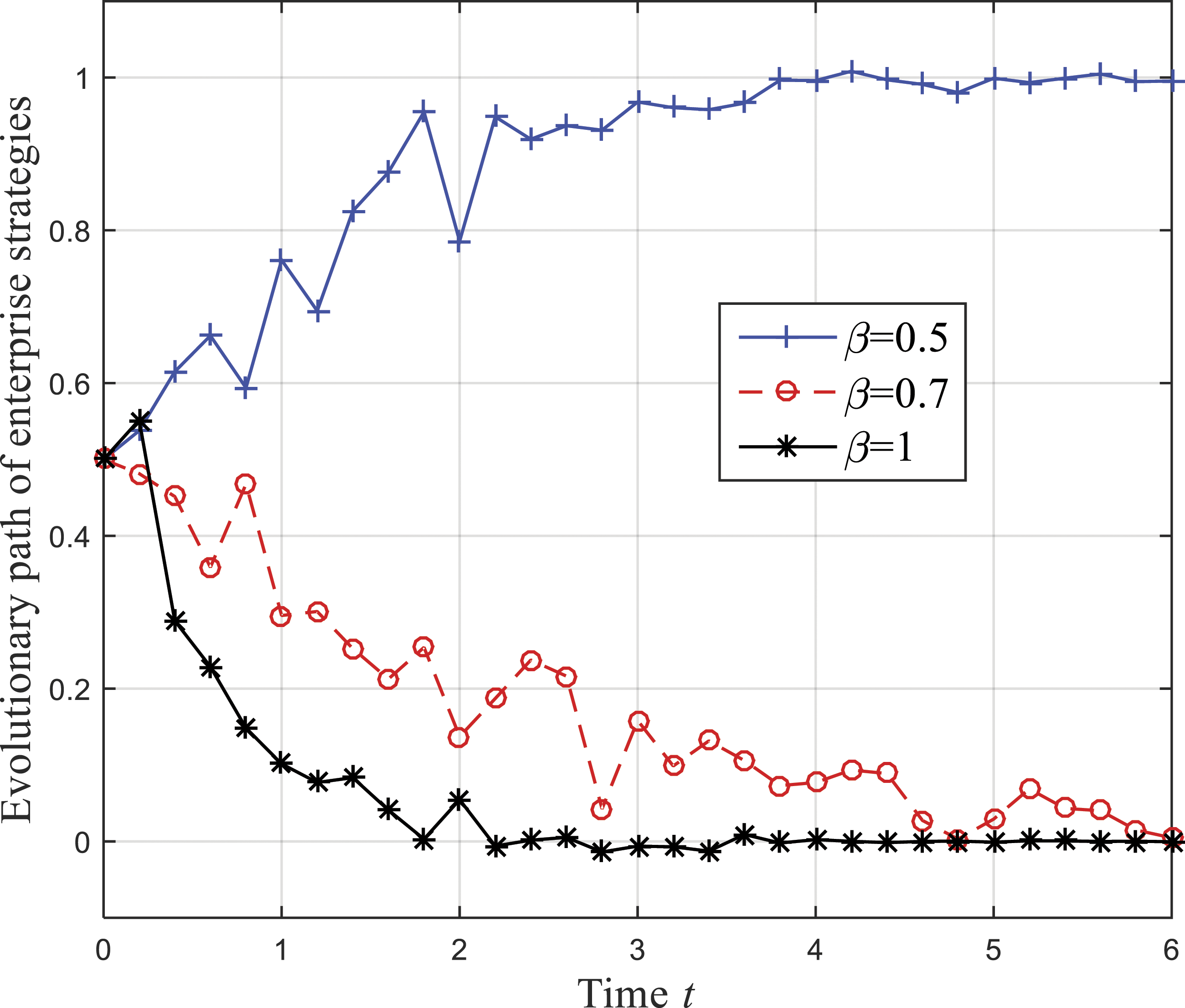

In both figures, the blue curve represents the evolutionary path in the case of
Discussion
U-I collaborations face many challenges due to high uncertainty and risks, significant pressure in terms of creativity and innovativeness, individually oriented employees, and project members resident at different locations. 110 Little systematic research has been conducted on how U-I barriers can be overcome as these relationships evolve. 60 Even more pronounced is the dearth of attempts in the literature to explain the mechanisms by which firms are better able to realize innovation-driven alliances. 111
The present study aims at enhancing our understanding of how U-I alliances. Our findings explain how partners of these alliances can absorb knowledge and learn from each other. Using a game-based approach, we obtained three main results. Firstly, firms and universities tend to choose an open innovation strategy when there is high innovation efficiency. The more productive a firm is, the stronger its tendency to collaborate through an open innovation strategy. Secondly, the lower the degree of knowledge complementarity between U-I partners, the higher the probability that both firms and universities will successfully form an innovation alliance. Third, when the level of knowledge spillovers is high, a closed innovation strategy tends to be chosen to obtain higher individual returns. Consequently, the actors require a method for assessing the efficiency of their potential partners. 112
University-industry R&D projects have grown considerably in recent years due to the search for new knowledge. 72 Policymakers increasingly stress U-I collaborations’ importance and long-term impact on the industry. 113 Previous research in Spain, France, and Portugal showed that, out of 375 entrepreneurs interested in cooperating with universities, only 10% ended up teaming with them 114 . 115 claimed that the main problems in U-I alliances are a lack of structured communication with industry and between structures that implement collaboration and a lack of a unified system for such cooperation. Accordingly, the authors have developed a model for enhancing collaboration and relationship building. In many developed economies, governments offer substantial funding for R&D that incentivizes U-I collaboration and knowledge exchange. 72 The aim is to create innovative solutions that will result in economic growth. “Knowledge and technology transfer between academia and industry is expected to spur innovation, as this kind of collaboration combines not only heterogeneous partners but, more importantly, heterogeneous knowledge”, 12 p. 42).
Our model offers insights into different factors influencing the formation of collaborative U-I. Results are aligned with previous studies (e.g., 116 that suggested that firms possessing greater capabilities to turn innovation inputs into revenues are more oriented toward an open innovation approach. This also sheds light on why sub-optimal levels of open innovation have been found among firms. 117
Universities should develop in parallel with industry and focus more on U-I collaboration activities. 23 U-I collaborations can benefit all their participants, enhancing their reputation, prestige, and responsiveness to government initiatives. 64 The Triple Helix model illustrates the importance of university-industry-government interaction in facilitating the conditions that lead to innovation in a knowledge-based society. In the future, effective management of “knowledge” will be a primary concern for both universities and firms. 25 The essential facets of knowledge management are the systematic collection, storage, sharing, diffusion, and reuse of information and knowledge. 118 Harmonized organizational culture and rewards are required to increase knowledge sharing in U-I teams. These teams need to manage the processes related to creating knowledge resources and identify the value of their intellectual capital for a sustained role in society and the global business arena. 119
Universities and business companies have different organizational and knowledge-production structures, 26 leading to a high chance of conflict or misunderstandings in U-I collaborations. 72
Producers, users, companies, and external actors can collaborate to create new value and knowledge, 22 also supported by public incentives. Through co-creation, actors expand their knowledge integration and innovation opportunities. In this view, our results contribute to practice, emphasizing the need to move beyond the triple constraints of time, cost, and quality and consider more strategic measures related to knowledge creation and sharing. Further insights derive from our analysis regarding the role of knowledge complementarity and its spillover effects. Our model suggests that these factors are more effective in forming collaborative innovation alliances in a U-I context than innovation efficiency. Therefore, as the model suggests, the lower the level of knowledge complementarity between U-I players, the greater the propensity to engage in open and collaborative partnerships. However, high levels of technological proximity between U-I players may be counter-productive. 58 This suggests an in-depth analysis of knowledge complementarities before setting up an alliance. Accordingly, there is an increasing debate on the closeness of partners’ technological capabilities and how to promote partnerships.43,54 By contrast, our model suggests that a certain distance between the U-I partners’ knowledge base is required to promote a successful alliance. Thus, technological proximity is not necessarily the key, which could be the ability to absorb partners’ knowledge. 87 Therefore, our findings extend the work of Bruneel et al., 28 which suggests that universities appear to be more inclined to cooperate when knowledge is less aligned with their existing skills. This seems to contrast with the idea that greater knowledge complementarity between U-I partners reduces uncertainty and promotes collaboration.57,120 Therefore, effective collaborations seem to require heterogeneous knowledge bases. Our model also suggests that the most effective way to promote collaborative innovation alliances between firms and universities is to reduce the likelihood of knowledge spillovers. Accordingly, a lack of informal knowledge exchange may encourage the creation of new alliances. Indeed, when knowledge is ‘in the air’ or freely available, there is less incentive to engage in formal partnerships, and actors usually proceed through an informal strategy.18,121
Conclusions
By collaborating with external partners, companies can gather diverse information and rapidly respond to market demands, using their limited innovation resources in the most fruitful way. 47 Collaboration between universities and industry has been recognized as an essential driver of technological innovation 2 and a critical component of the national innovation system. 20 As such, it appears to be indispensable to the survival of firms in the contemporary world. 122 Firms today utilize considerably more knowledge than they can create alone. 65
The present study wants to enhance our understanding of U-I alliances, using a stochastic evolutionary game model and simulating the interactions of firms and universities, which operate in conditions of uncertainty and bounded rationality. The need for such research emerged from the realization that we do not have a thorough understanding of why some U-I innovation collaborations thrive while others fail.
Our study presents three main findings. First, a higher level of firms’ innovation efficiency encourages collaboration and promotes U-I innovation alliances. Second, the lower the knowledge complementary of U-I actors, the higher the probability that they will collaborate. The potential gains from accessing heterogeneous knowledge seem to push U-I actors toward an open innovation strategy. Third, higher knowledge spillovers tend to enhance the probability of a closed innovation strategy and make U-I innovation alliances less likely.
Our study has practical implications as it highlights the conditions under which firms are likely to increase collaboration with universities. Firms that are not merely innovators but still have high efficiency appear to be best suited for such alliances. Consequently, policymakers must identify not only innovators but also companies capable of commercializing innovation outputs. Furthermore, when promoting U-I alliances, policymakers should consider the knowledge complementarity of partners, ensuring that they are not too homogenous. Finally, policymakers should also consider the fluidity of knowledge within an innovation system to assess the level of spillovers. We found that firms and universities are less likely to engage in formal U-I alliances when such fluidity abounds.
The assumptions we made pose certain limitations to our research. Therefore, results must be interpreted within the framework of our assumptions and should be tested in real-world settings as a suggestion for further research. One limitation is our study only considers the impact of knowledge input on U-I innovation returns without incorporating other measures of impact (e.g.,. 123 There may be more factors influencing innovation output, which, if brought into play, would lead to a more complex game theory model, thus expanding the present research. Future studies might also explore the behaviors of academics in diverse contexts (e.g., different scientific fields or countries) or intertemporal transitions. Cooperation based on bilateral rewards and abstention from collaboration would be of both theoretical and practical interest. 124 Accordingly, future research might investigate other determinants and conditions of forming and maintaining U-I cooperation, such as firm size or the possibility of multiple alliances with heterogeneous partners. For example, our model was aspatial and did not consider the physical distance between U-I partners, a factor that results relevant for U-I innovation alliances.35,125 Lastly, future studies could consider additional causes of external disturbance or changes in government policies.
Footnotes
Declaration of conflicting interests
The author(s) declared no potential conflicts of interest with respect to the research, authorship, and/or publication of this article.
Funding
The author(s) disclosed receipt of the following financial support for the research, authorship, and/or publication of this article: This paper is supported by China’s National Natural Science Foundation (No.71874068).
