




Abstract
This study aims to analyze crowdfunding’s economic success in the Gulf region as the Crowdfunding (CF) experience and practice in this part of the world tend to be unexplored in terms of research. In particular, the study examines whether the adoption of entrepreneurial finance (EF) principles in crowdfunding platforms affects the economic success of funding and entrepreneurs’ ability in the Gulf Cooperation Council (GCC) to access financial resources. The study uses an online questionnaire survey on Crowdfunding economic success in the GCC to collect information from the participants. Participants are investors, entrepreneurs, and startups from five Gulf countries (i.e., Saudi Arabia, Bahrain, Kuwait, Oman and UAE) in addition to several Crowdfunding platforms commonly used by crowdfunders in this region (such as Indiegogo, Kickstarter, Eureeca, Beehive and GoFundMe) with total members (102964). Signaling theory and principle-agent theory combine to make a theoretical foundation that explains the relationship between funders and fundraisers. The pilot sample consisting of 10 units was used to validate and verify the research instrument of the study. The research sample consists of 1145 respondents (sample size n = 1145) selected randomly from the five Gulf countries included in the study. The findings reveal that CF’s presence positively impacts economic fundraising success and that crowdfunding platforms are an effective financial technology (Fintech) tool for financing entrepreneurs in the GCC. We conclude with recommendations for future EF and CF research. The findings of this study will have implications for improvements in practices of economic and finance. They may be used as a guide towards advancing the management and performance of the crowdfunding platforms in the Gulf region. Presently, a very few number of published research on crowdfunding exist in this region. Moreover, to the best of our knowledge, there is no single study investigating crowdfunding as an alternative financing source in the GCC.
Keywords
Introduction
Diversification of income sources in a country is one of the basic premises for creating an economy that enjoys sustainable growth in normal conditions. A substantial literature has also emerged examining the link between diversification and stability. Various recent studies find a positive relationship where diversification strategies aid economic stability. 1 Nowadays, it is not easy to finance a novel idea or project. Therefore, the crowdfunding (CF) is expected to fund emerging projects. Furthermore, the advance of information and communication technologies allows access to unlimited and immediate sources of information, multiplying the impact of any activity simply by disseminating it across the appropriate forums, social networks, or specific platforms. 2
Crowdfunding is one of the new financing approaches that entrepreneurial finance (EF) has included in the previous decade and has developed significantly to turn into an alternative source of fundraising and helping entrepreneurs and business ventures in the Gulf Cooperation Council (GCC). However, regardless of the turn of events and spread of debt-based crowdfunding remarkably, donation-based crowdfunding is likewise advancing, particularly with the developing connection among crowdfunding and entrepreneurial finance and through which it is conceivable to set out open doors to raise funds by crowdfunding platforms 3
As a business entity, entrepreneurs invest their own resources and attract capital (in debt, shares, etc.) from investors and capital owners to push the national economies into structural transformations. These same funds contribute to the economic success of entrepreneurs on the one hand and thus serve the community on the other. The entrepreneurs collected money, whether their own money or the money of other investors and put it in this project, which are the same projects that provide services to society in general. The success of new startups venture they embarked on business from a garage and small avenue inspires millions of young people to start their business journey and create jobs.
In the GCC, the fundraising challenge is much more prominent. Entrepreneurs have not many wellsprings of financing, most relying on close-to-home assets, family, and friends. As a result, they face enormous trouble acquiring bank financing, notwithstanding bearing the weight of obligation reimbursement in the underlying phases of improvement. This is clear from how bank loaning to entrepreneurs in the Middle East and North Africa (MENA) district is normal, just 8%–10% of the absolute bank loaning. The restricted wellsprings of financing offers ascend to an expected financing gap of more than US$400 billion in the Middle East region. When analyzing the GCC and Middle Eastern financial markets, entrepreneurs can be viewed as the Middle Eastern economy’s foundation. The structure 45.2% of all endeavors in a non-financial business area in the MENA, producing more than US$ 1.1 trillion of significant worth added (23% of the area’s complete worth added) and utilizing right around 15 million individuals in this manner giving 25% of the region’s all-out work.
Moreover, while dissecting Gulf entrepreneurs’ construction, it ought to be noticed that more than 90% of those are microenterprises.4,5 Since admittance to fund is still among the top five issues entrepreneurs face in the GCC, it is fascinating to recognize crowdfunding’s genuine pertinence to quicken the admittance to back. The purpose of this paper is to acquire the complete comprehension of crowdfunding ventures and assess their wellness to address the genuine requirements of entrepreneurs in the GCC. This study’s fundamental target is to test the hypothesis that “crowdfunding can be viewed as an optimal alternative to build the admittance to finance for the Gulf and Middle Eastern entrepreneurs.”
This study aims to analyze crowdfunding economic success and the principles of EF in the Gulf region. The main question of this research effort is: “would we be able to assume that Crowdfunding impacts the success of fundraising and that the crowdfunding platforms are an effective EF tool for financing entrepreneurs in the GCC?” In this study, the central hypothesis can be stated in the null form as follows: “Crowdfunding models does not impact the economic success of fundraising and that the crowdfunding platforms are not effective EF tools for financing entrepreneurs in the GCC.” Figure 1 is summarizing the theoretical framework of this study. Theoretical framework of the research.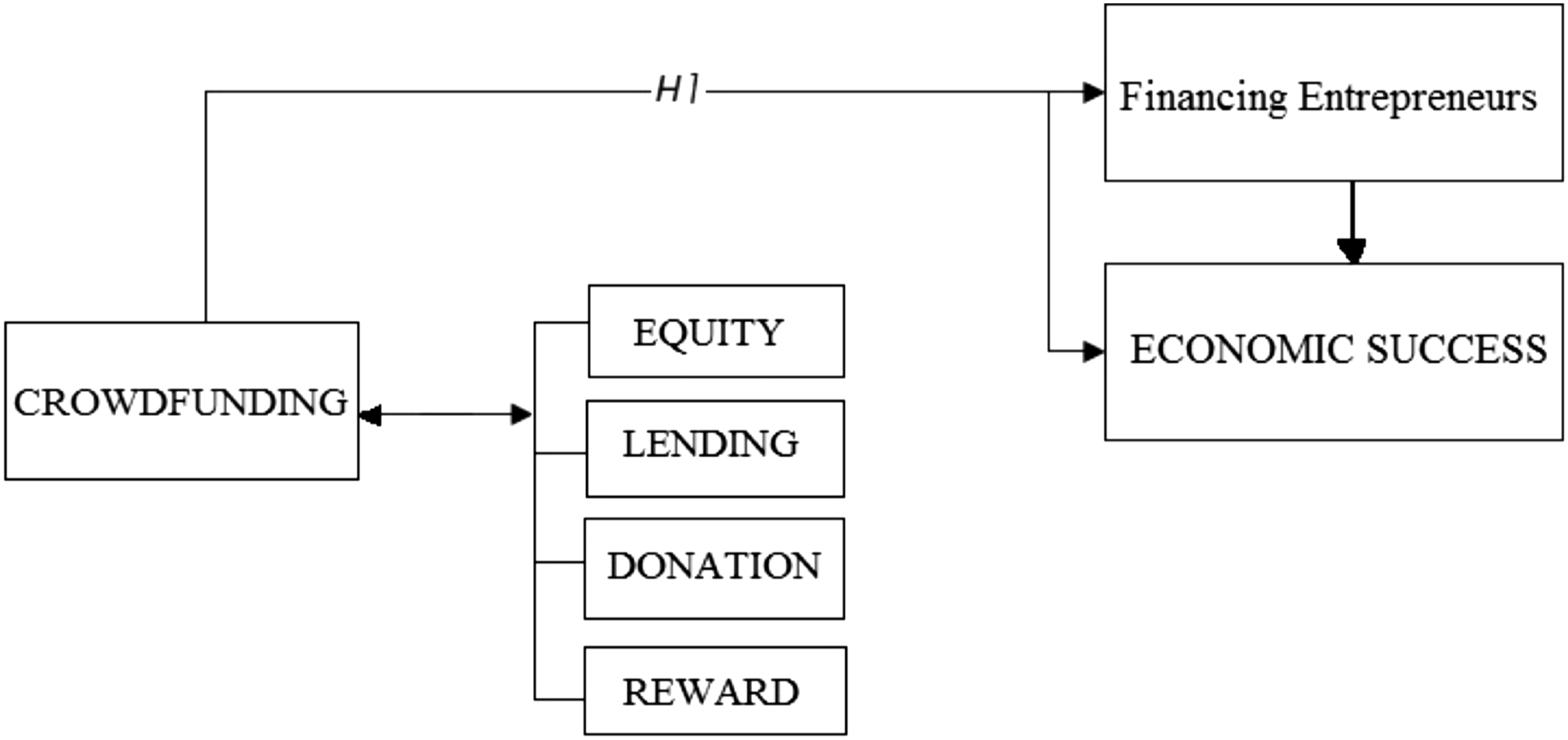
This study will make an essential contribution to the literature at both the theoretical and practical levels. Presently, a very few number of published research on crowdfunding exist. Moreover, to the best of our knowledge, there is no single study investigating crowdfunding as an alternative financing source in the GCC. At the theoretical level, this study’s findings will provide empirically-based results on the impact of Crowdfunding on the economic success of fundraising for financing entrepreneurs in the GCC. This study also contributes to the larger area of economic and behavioral finance theories by highlighting the effect of Crowdfunding on financial fundraising success for financing entrepreneurs in the GCC.
To give the full investigation of the circumstance and demonstrate the theory, two assignments will be performed. In the first place, the examination and fundamental attributes of crowdfunding will be introduced. At that point, establishing the measurable information, the monetary necessities of entrepreneurs will be featured. To upgrade the examination, the study will utilize the accompanying exploration techniques: 1. Monographic technique. 2. The strategy for financial examination. 3. The technique for graphical perception.
To achieve the objectives of this study, the accompanying assignments will be done: 1. Assess and evaluate crowdfunding in the GCC. 2. Analyze the monetary requirements and the most well-known ways Gulf entrepreneurs use to draw in fundraising. 3. Evaluate if crowdfunding can be viewed as an essential method to fulfill the necessities of entrepreneurs in the GCC for fundraising.
This paper adds to the international body of literature review that sees entrepreneurship as experimentation. In this regard, 6 contend that business venture or entrepreneurship is about experimentation on the grounds that the probabilities of accomplishment are low and mysterious. Experimentation settles vulnerability and makes genuine alternative worth. The expenses and limitations on the capacity test in this way impact entry into entrepreneurship just as related returns are justified.7–9 This paper recommends that, by expanding the criticism estimation of experimentation, crowdfunding can empower entrepreneurs in the GCC through a channel other than diminishing financing requirements. However, little attention has been paid to the community that exists within the crowdfunding ecosystem.
Literature review
Predicting the success of new projects depends on the ability of project owners to convince financiers of the feasibility of their projects, the low risk, and their ability to succeed. Previous studies proved that high money collection at the start of the funding campaign is linked to the success of the projects, which underlines the importance of promoting the project from its inception. 10 Using crowdfunding platforms has become a modern method to collect funds from external sources via social networks such as Kickstarter and Zoomaal.
Crowdfunding refers to the practice of funding a project by drawing on small contributions from many individuals. 11 The success of crowdfunding projects is complex. A few studies investigate crowdfunding campaigns’ success factors on different aspects.12,13 This study is related to three streams of the literature: social capital, human capital, and processing theory. Nonetheless, there has been no comprehensive discussion of the mechanisms that make prediction models for the success of crowdfunding projects. Thus, prediction remains a big challenge. These include platform-specific determinants, project-specific determinants, and individual-level determinants. Even with individual-level determinants, research has focused on the attributes of the project creator, such as geographical location 14 and crowdfunding experience. 15 However, researchers have generally not looked at backer characteristics as a possible determinant, focusing on platform determinants, project characteristics, and project creator attributes. One intuition for this is the findings from crowdfunding research by Lin, Boh, and Goh on different clustering archetypes of crowdfunding users. Their research supports the idea that confident backers may seek out more influential backers for information on what projects they should back. With this, if we can show that there is a method to identify influential backers, we believe that the combined effect of the influ-enters and the influenced will not be trivial and will have a significant impact over how well a crowdfunding project performs. Belleflamme, Lambert, and Schwienbacher defined Crowdfunding as “Crowdfunding involves an open call, mainly through the Internet, for the provision of financial resources either in the form of donation or in exchange for the future product or some form of reward and/or voting rights.
Previous research has identified several sources of motivation for supporters contributing to a campaign: collecting rewards, supporting a cause, helping others, and affiliating with a community.18,19 Building a conceptual paper on the literature on different sources of finance available for the startups makes a case for the crowdfunding platforms in Saudi Arabia. Abu Amuna et al. addressed obstacles and possibilities for campaigners on Crowdfunding platforms in developing countries. Several studies studied Equity Crowdfunding as an alternative source of financing small and newly established ventures in the Shariah-compliant Middle Eastern nations.21,22,9 The crowdfunding market is growing rapidly, both in terms of capital volume and number of campaigns.23–25
Figure 2 below shows the mechanism of crowdfunding and how it works along with its relationship with the environment as an open system. Information gathered by Cambridge Center for Alternative Finance uncovers that crowdfunding brought US$304.53bn worldwide up in 2020, with the normal subsidizing per crusade in the crowdfunding section adding up to US$5270. This improvement is considerably more critical for Small and medium enterprises (SME). As indicated by the World Economic Forum, they are ineffectively addressed with only 7% of absolute bank credits (least on the planet), even though they establish around 96% of enrolled organizations in the GCC and Middle East districts. Hence, crowdfunding can help connect this stunning knowledge hole as presently, the more significant part of the pie of crowdfunding is involved by business organizations and business people, with social causes, movies, and performing craftsmanship coming in second.
26
Crowdfunding mechanism.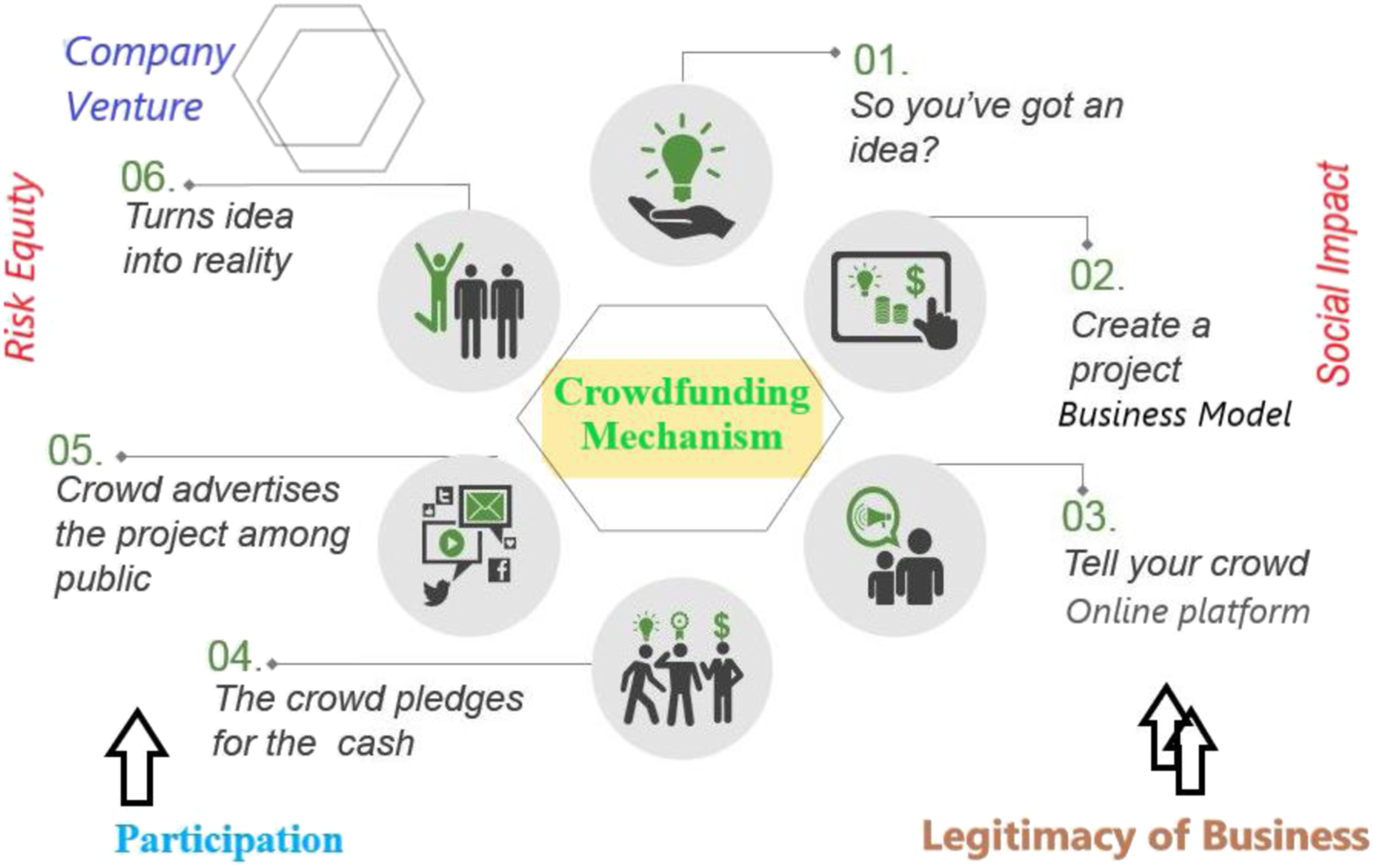
Consequently, this study aims to fill this gap by examining supporters’ engagement and the impact of creators-supporter communication. We further investigate how supporter engagement impacts supporters to actively promote campaigns and affect their support intentions for future campaigns. Research should continue in this direction by expanding the current findings to incorporate the creators’ perspective. A supplementary study can examine how creators use different communication channels to enhance supporters’ engagement. Finally, while crowdfunding represents a novel phenomenon, it shares many characteristics of traditional marketing endeavors. Thus, crowdfunding should be measured against central marketing theories to explore further drivers and motivators of the various stakeholders relevant to crowdfunding. 27
Figure 3 below summarizes the different models of crowdfunding in the GCC and Middle East in 2020. It can be seen that the four different models of crowdfunding are commonly used in this area of the world. The most common model of CF is the equity model, followed by the lending model. Crowdfunding models in the Gulf Cooperation Council and Middle East in 2020. Source: Crowdfunding Marketing Report (2020).
The idea of crowdfunding is established in the more extensive view of publicly supporting, which alludes to utilizing the group (the crowd) to get thoughts, input, and answers for creating corporate exercises. 28 On account of crowdfunding, the goal is to gather cash for investment, for the most part by utilizing online social media and platforms. Therefore, crowdfunding is professed to assist entrepreneurs with getting cash from huge crowds, in which every individual may give a minimal quantity. It is noticed that such a venture can appear as “equity purchase, loan, donation, or preordering of the product” proposing various types of crowdfunding. 29 Another clarification states crowdfunding to be another technique for financing, in light of a mediator (platform), which joins sponsor/financial backers, who are conventional individuals able to put limited quantities into great undertakings, to entrepreneurs, which normally address valiant groundbreaking thoughts and have issues with pulling in account utilizing different channels. 30
Methodology
In order to fulfill the purpose of this study, two main theories were utilized as a theoretical foundation, that is, the principal-agent theory and signaling theory. The principal-agent theory describes the agency relationship in which one party (the principal) delegates work to another (the agent) who conducts the work in line with a mutually agreed-on contract. 31 This theory assumes that both parties are self-interested with integrated goals to perform investment. Furthermore, information-based power includes the volume of trust can found between funders and borrowers.
Signaling theory provides an adequate theoretical framework for studying borrower-funder relationships. 32 The signaling theory being a logical development of asymmetric information theory is based on the fact that the capital market sends appropriate signals to funders and borrowers about the prospects for developing a project based on the behavior of managers in this market. With favorable development prospects, managers will try to satisfy the additional need for capital by attracting borrowed funds (in this case, the expected additional income will be allocated exclusively to the previous owners and will create conditions for a significant increase in the market value organization). In the event of unfavorable prospects for development, signaling theory and principle-agent theory combine to make a theoretical foundation that explains the relationship between funders and fundraisers. Hence, these two theories were utilized to develop the questionnaire survey of this study. In addition, signaling theory were surveyed according to the type of signals which classified into positive signals, negative signal, and neutral signals that explain the strength of relationship between fundraisers and funders in the GCC. Managers will try to satisfy the additional need for financial resources by attracting capital from external sources, that is, by expanding the circle of investors, which will allow them to share with them the number of upcoming losses. The theory of signaling in the context of asymmetric information will enable investors and lenders to justify their decisions on the provision of capital to an organization which is accordingly reflected in its structure.
Research Sample description.

Validity and reliability
Cronbach’s alpha was determined to evaluate the reliability of the research instrument for the questionnaire survey in general and each subscale. Cronbach’s alpha value of 0.86 for the whole dimensions of the questionnaire was considered acceptable.
Data collection procedures
The target population is the investors, entrepreneurs, and startups in the GCC. The participants received electronic version of the questionnaire using google doc. online format. Several emails were sent to participants, including the invitation to participate and a link to the web page to guide them to the questionnaire survey. Participants were reached using “snowball sampling”, whereby participants suggest other participants. This technique facilitated the selection of participants across the five different countries in the GCC included in this research effort (i.e., Saudi Arabia, Bahrain, Kuwait, Oman, and UAE). As a result, 1145 questionnaires were usable out of 1500 received due to incomplete or unrealistic responses.
To test the significance of the attributes and qualities of crowdfunding distinguished in the literature review empirically, a quantitative study design was selected. This methodology considers contrasting the outcomes and prior examination of crowdfunding efforts that attention on Europe and USA30,32 compared with the GCC and Middle East experience crowdfunding. Thus, an online questionnaire survey was utilized. The survey tended to various, explicitly chose gatherings of respondents. Initially, 500 people illustrative of the five unique nations in the GCC included in this research effort (i.e., Bahrain, Saudi Arabia, Kuwait, Oman, and UAE) concerning age, gender, and education were surveyed.
Notwithstanding, as it tends typically that few segments of these populaces are dynamic in crowdfunding projects, the subsequent objective gathering contained dynamic crowdfunders on the most well-known crowdfunding platforms in the GCC. Hence, these crowdfunders can measure up to the normal of the populace. For this reason, a joint effort with three crowdfunding platforms was set up (i.e., Indiegogo, Kickstarter, and Beehive). These three platforms were provided with a link to our online survey in the confirmation email that crowdfunders typically received after their funding action and added their newsletter. Overall, 1176 responses were collected from the users of these platforms. However, out of this number, 31 respondents expressed that the aggregate sums put resources into crowdfunding were negative, which were assessed as incorrect responses. Thus, these respondents were barred from the analysis. Hence, the final sample contained 1145 responses.
Data and analysis
As mentioned earlier, this study conducted at five Gulf countries (i.e., Saudi Arabia, Bahrain, Kuwait, Oman, and UAE) and five Crowdfunding platforms that are commonly used by crowdfunders in the GCC (i.e., Kickstarter, GoFundMe, Beehive, Indiegogo, and Eureeca) with total members (102964). A pilot sample consists of 10 units to validate and verify the research instrument of the study. The research sample consists of 1145 respondents from the five Gulf countries included in the study. The participants’ demographics of the study are illustrated in Figures 4 and 5 below. To accomplish the set objective and assess if crowdfunding has the wellness to address the genuine requirements of entrepreneurs in the GCC, the issue of the client profile ought to be featured (see Figure 4). Entrepreneurs and fundraising in the Gulf Cooperation Council. Data analysis results.

It can be seen from Figure 4 that 46% of the participants are aging between 20 and 39 years old, which indicates that young entrepreneurs in the Gulf region are the highest groups utilizing crowdfunding as an alternative source of funds for their new projects. 51.4% of participants (583 entrepreneurs) are males, while 48.8% (562) are females. The vast majority of participants (65%) are receiving average annual income ranging from 20000 to 60000 US$. More than half of the participants (53%) are self-employed. In addition, 44% of participants have invested in startup projects before and 30% of participants (573 individuals) have been involved in crowdfunding.
Over the recent years, crowdfunding in the GCC has developed significantly and now brags a few neighborhood players, each with broad sponsorship and backing. A portion of these organizations dispatched in the UAE, specifically, which have acquired momentum, incorporate “Smart Crowd”, a real estate crowdfunding platform permitting crowds to buy land and properties in the UAE market; “Beehive”, a managed peer-to-peer lending platform empowering entrepreneurs to get to credits from general society; and “Eureeca”, an equity-based crowdfunding platform permitting entrepreneurs and startups to raise fund from financial backers (investors). Thus, the crowdfunding business will assume a critical part in boosting the SME area. In any case, we need to see a more extensive administrative structure that is adaptable enough for crowdfunding to create and prosper. Therefore, the GCC is gradually inviting the possibility of crowdfunding to empower promising entrepreneurs and energizing undertakings see the light of the day. Crowdfunding is drawing in extensive premium considering the vital part of entrepreneurs and SMEs in this area of the world. Entrepreneurs and SMEs are estimated to represent more than 45% of the business and labor force in the region. As per the UAE’s Ministry of Economic, SMEs represent nearly 60% of the UAE’s GDP.
When respondents were asked about investing in a startup, 56% have invested in a startup before, out of this more than half of respondents (56%) have not heard of crowdfunding as shown in Figure 4. Hence, despite these new turns of events, crowdfunding is as yet not explicitly regulated in the GCC and Middle East. This could represent an obstacle for new companies keen on setting up a crowdfunding platform, as no one needs to risk falling foul of the law. Like this, if the Central Banks or the Securities and Commodities Authorities controlled it, at that point, there would be a bigger system inside which to work. There are only two separate controllers that screen crowdfunding exercises: the UAE Central Bank manages lending-based crowdfunding. At the same time, the Emirates Securities and Commodities Authority directs equity crowdfunding platforms. Other countries in the GCC are following after accordingly, especially Bahrain, as the Central Bank of Bahrain has given crowdfunding guidelines to help the Fintech space in the country. Figure 4 also indicates that only 30% of respondents have crowdfunding financing for their projects. Out of this, 36% have donated to a crowdfunding campaign before.
When respondents were asked about their preferred crowdfunding platforms (see Figure 5), 28% reveal that Kickstarter is the most commonly used platform in the GCC, followed by Eureeca (18%), and then GofundMe (15%). As far as types of crowdfunding in the GCC are concerned, donation-based crowdfunding is the highest (43%), followed by equity-based crowdfunding (31%), then peer-to-peer crowdfunding (24%) and finally reward-based crowdfunding (17%). Kickstarter is the world’s biggest reward-based crowdfunding platform. It was established in April 2009 and has since developed quickly. As of January 2021, Kickstarter is available to entrepreneurs from all nations and backers (investors) from 224 countries. More than 500,000 projects have been dispatched on this platform, getting more than US$5.5 billion promised funds from 19.2 million investors. Noticeable ventures financed on Kickstarter incorporate Pebble Watch (a smartwatch), Oculus (a computer-generated experience gaming goggle), the film Veronica Mars, and Coolest Cooler (a multi-work cooler). On Kickstarter, an entrepreneur posts an undertaking pitch that usually remembers data for item, group, foothold, utilization of assets, applicable dangers, and guaranteed rewards. Entrepreneurs usually set a financing objective just as a subsidizing time window (normally 30 days). After the venture is dispatched, investors begin to vow cash in modest quantities as a trade-off for the guarantees of rewards and remunerations. Rewards fluctuate across projects, going from blessings, early examples, and item parts to the result ultimately created by the project. Rewards are likewise organized into levels, with various levels relating to various contributing sums. Funding keeps a win or bust principle: a project is supported if, before the end of the financing window, the absolute promised sum comes to or surpasses the funding objective, wherein case the entrepreneur gets all the swore cash; else it is unfunded and no cash is transferred to the entrepreneur.
Platforms and their design assume a significant part in the crowdfunding market portion. 32 The platforms are the commercial centers that match demand (entrepreneurs) with supply (investors) of fund and give offices to trading data among financial backers and entrepreneurs. A portion of the platforms expects to guarantee a specific degree of the crowdfunding projects’ nature and decrease data imbalances. 32 To avoid suspect speculations and to ensure a particular nature of the publicized undertakings, a few platforms power the task initiators to be straightforward about their endeavor and the innovative group. Besides, a few platforms present an application interaction where project initiators need to meet certain measures and give specific data to be qualified and to be recorded on the platform. The particular prerequisites vary among platforms and rely upon the particular CF type. For instance, equity crowdfunding platforms require a more thorough portrayal of the plan of action, the endeavor group, and the monetary qualities, and they now and again lead individual verifications. Notwithstanding flagging and confirmation work, the platforms offer clearing administrations. These administrations help reduce exchange costs and stay away from ethical issues with entrepreneurs.
The worldwide evolution of the number of platforms and crowdfunding.
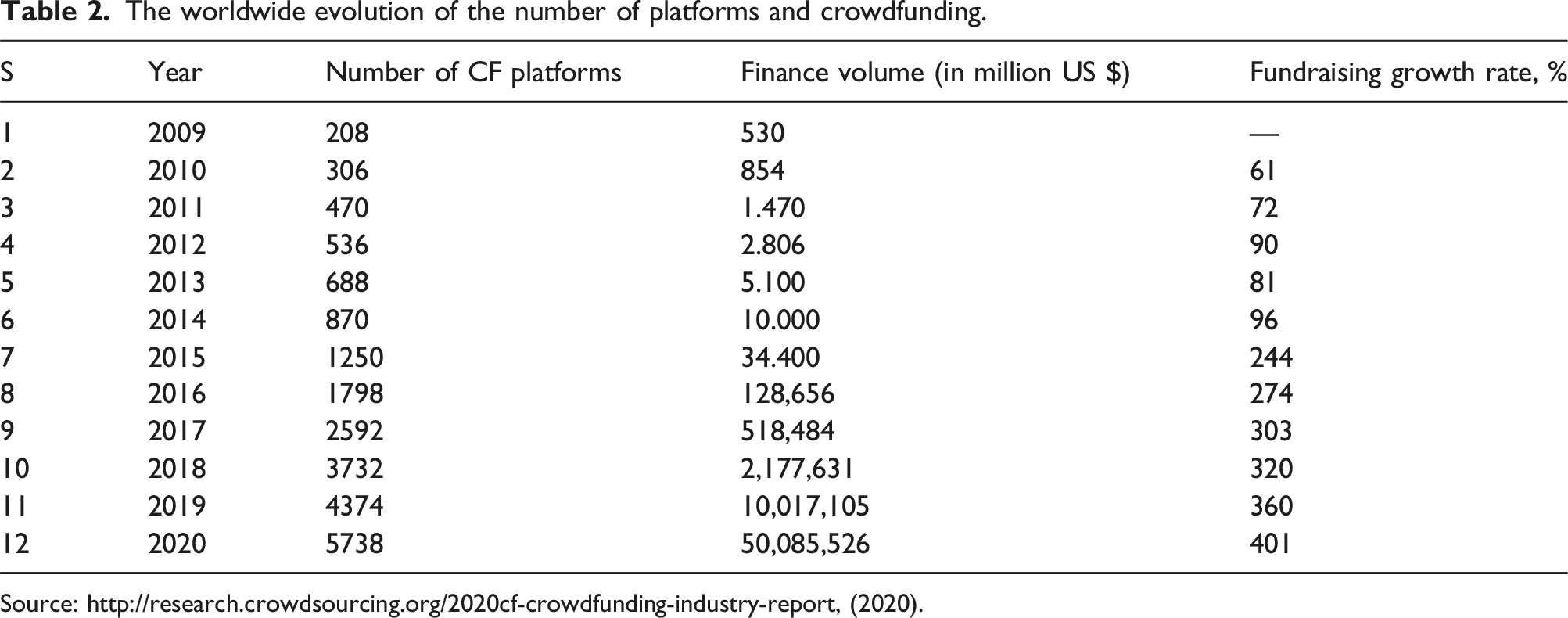
In addition, Figure 5 shows the different types of rewards that investors in the GCC would like to see in the crowdfunding platforms. Proffered rewards include accessories, personalized services, and reading materials. Moreover, when respondents were asked about the types of business they would support through crowdfunding, 41% (783 individuals) from the different countries in the GCC stated that startups is the first option, followed by the food industry and educational projects (21% each). This implies that many startup projects in the GCC are using crowdfunding as a primary fundraising method.
Regression Analysis.

According to the results presented in Table 3, the researchers reject the null hypothesis and accept the alternative hypothesis that Crowdfunding positively impacts fundraising success and that some crowdfunding platforms (i.e., Indiegogo, Kickstarter, Eureeca, Beehive, and GoFundMe) are effective EF tools for financing entrepreneurs in the GCC.
Therefore, in light of the data analysis mentioned above, the researchers reject the null hypothesis and accept the alternative hypothesis that Crowdfunding positively impacts fundraising success and that some crowdfunding platforms (i.e., Indiegogo, Kickstarter, Eureeca, Beehive, and GoFundMe) are effective EF tools for financing entrepreneurs in the GCC. These findings are in line with several previous studies on crowdfunding that were conducted in different countries such as USA, Europe, Australia, and Canada. These studies include: Ref. 33 – 35.
Since this study aims to analyze crowdfunding economic success and EF principles in the Gulf region, the Crowdfunding experience and practice in this part of the world tend to be unexplored in research. Presently, a very few number of published research on crowdfunding exist. Moreover, to the best of our knowledge, there is no single study investigating crowdfunding as an alternative financing source in the GCC. Therefore, this study will contribute to the literature at both the theoretical and practical levels. At the theoretical level, this study’s findings will provide empirically-based results on the impact of Crowdfunding on the success of fundraising for financing entrepreneurs in the GCC. This study also contributes to the larger area of economic and behavioral finance theories by highlighting the effect of Crowdfunding on fundraising success for financing entrepreneurs in the GCC. At a practical level, this research may also contribute to the policy makers in the GCC and Middle East in the assessment and evaluation of the effectiveness of the different models of crowdfunding (equity-based crowdfunding, donation-based crowdfunding, lending-based crowdfunding, and reward-based crowdfunding), as well as contributing to the advancement of management and corporate governance practices. After all, the findings and results of this study will have implications for improvements in practices of economic and finance and may be used as a guide towards advancing the management and performance of the crowdfunding platforms in the Gulf region.
Results and discussion
After data collection and analysis of data, the researchers reject the null hypothesis and accept the alternative hypothesis that Crowdfunding positively impacts fundraising success and that the crowdfunding platforms are an effective EF tool for financing entrepreneurs in the GCC.
Presently a very few number of published research on crowdfunding exist in this region. Moreover, to the best of our knowledge, there is no single study investigating crowdfunding as an alternative financing source in the GCC. Hence, this study will make an important contribution to the literature on both the theoretical and practical levels. Currently a few empirical studies on crowdfunding exist. Moreover, to the best of our knowledge, there is no single study investigating crowdfunding as an alternative financing source in the GCC At the theoretical level, this study’s findings will provide empirically-based results on the impact of Crowdfunding on the success of fundraising for financing entrepreneurs in the GCC. This study also contributes to the larger area of economic and behavioral finance theories by highlighting the effect of Crowdfunding on fundraising success for financing entrepreneurs in the GCC. At a practical level, this research may also contribute to the policy makers in the GCC and Middle East in the assessment and evaluation of the effectiveness of the different models of crowdfunding (equity-based crowdfunding, donation-based crowdfunding, lending-based crowdfunding and reward-based crowdfunding), as well as contributing to the advancement of management and corporate governance practices. After all, the findings and results of this study will have implications for improvements in economic and finance practices and may be used as a guide towards advancing the management and performance of the crowdfunding platforms in the Gulf region.
The thriving of crowdfunding projects increases the visibility of diverse economy. Countries that enjoy a diversified economy and diversified sources of income, their economic performance is better than in countries that enjoy non-diversified sources of income, such as the Gulf Cooperation Council countries whose economies depend on a single source of income such as oil. Their recovery from the consequences takes longer than it is in other countries with diversified economies. These countries still have not benefited from the oil revenues they earned over the five decades since the discovery of oil and employ them in diversifying their economies. The Central Banks in GCC have issued new crowdfunding regulations intending to create a legal framework for financing conventional and Shariah-compliant syndications. At the same time, the governance of fintech projects protects their clients. Moreover, regulations will help startups and SMEs access alternative financing models if the traditional financing option is unavailable.
In general, GCC governments introduced the crowdfunding option because they realized it can close the financing gap. Providing customized opportunities for investors and lenders develop innovative solutions. Among the essential things that can be achieved through crowdfunding are empowering startups and small and medium enterprises, supporting the FinTech ecosystem, and pioneering Islamic finance offerings.
Moreover, in the same way as past research, our information is cross-sectional and we recognize that there is the chance of converse causation for our hypothesis. In any case, that is an issue which can be raised at essentially all investigations on crowdfunding. A longitudinal study could be acted later on. Additionally, a point by point qualitative analysis of associations among funders and pledge drives in the GCC might have shared all the more light on the network elements. It was recognized that numerous crowdfunded projects in the GCC use web online media to disperse their thoughts and relate with their networks. What such interactions are meaning for refreshes on the crowdfunded tasks could be an intriguing road for future exploration.
Conclusion and implications
Nowadays, the globe we live in offered many opportunities with just a few quick taps of the keyboard. Those many opportunities opened their doors for diligence and creativity. Crowdfunding provides an alternative option for entrepreneurs to raise funds externally. Over the past few years, crowdfunding has raised many business observers’ eyebrows and how it has transformed from a fundraising tool into a successful funding mechanism for various entrepreneurs, startups, and small businesses.
This study aimed to analyze crowdfunding economic success and the principles of EF in the Gulf region. In particular, the study examines whether the adoption of EF principles in crowdfunding platforms affects the economic success of funding and the ability of entrepreneurs in the GCC to access financial resources. This study was conducted at five Gulf countries (i.e., Saudi Arabia, Bahrain, Kuwait, Oman, and UAE) in addition to several Crowdfunding platforms that are commonly used by crowdfunders in this region (such as Indiegogo, Kickstarter, Eureeca, Beehive, and GoFundMe) with total members (102964). The research sample consists of 1145 respondents from the five Gulf countries included in the study. The study emphasizes the partners, microstructures, administrative conditions, and crowdfunding advancement in the GCC. The findings reveal that the presence of CF positively impacts fundraising economic success and that the crowdfunding platforms are an effective EF tool for financing entrepreneurs in the GCC. This study, therefore, seeks to add to our knowledge of the crowdfunding as an alternative way for entrepreneurs to fundraising in developing countries in general and the Gulf region in particular.
Practitioners acknowledge the potential effects of these influencers, with third-party platforms such as Backer Club, Krowdster, and Backer camp promising to connect project creators to backers that have influence. Kickstarter has also encouraged project creators to leverage on the “network effects of Kickstarter”, encouraging creators to reach out to influential backers. 31 However, industry players often use the activity as an indicator of influence. For example, BackerClub identifies influential backers as backers who have backed an average of 106 crowdfunding projects (BackerClub, 2017).
Many studies by organizations such as World Bank have revealed that Crowdfunding has got untapped potentials in the markets of Shariah-compliant nations particularly in the GCC and Middle East. It reaches out to reduce the credit gap in the region despite having some of the largest Islamic banks. Although there has been an upsurge regarding debates and discussions over Crowdfunding and its potentials to expand the scope of finance for Startups and SMEs facing funding crisis, the growth and progress has been relatively slow-paced compared to various developed economies of the world. But over the years, the Middle East’s underdeveloped markets are now aware of a powerful financing tool that would enable profitable businesses and entrepreneurial talent to become some of the most successful business projects. Therefore, it is up to the regional governments to accelerate Crowdfunding into their capital markets to reap the most benefits from its early development and surge.
Regarding the practical implications of this study, it is apparent that supporters express diverse motives for involving themselves in crowdfunding by segmenting the right crowd for each campaign, based on the motivation embedded in the campaign, creators can enhance the engagement of their supporters and thus improve their campaigns’ success outcomes. Moreover, this study confirms that young people need support to embark on their innovative projects. Therefore, identifying and legalizing the crowdfunding platform is a crucial task for the governmental economic institutions.
So, this is the argument of this paper that by using different crowdfunding models (Donation, Reward, lending, and equity), the development of social enterprises can be accelerated in the GCC societies; consequently, the unemployment rate problem can easily be solved. Promoting Crowdfunding for local communities should be enhanced by encouraging entrepreneurs to participate in local and global Crowdfunding platforms.
Furthermore, the study indicates that entrepreneurial finance markets are in a powerful state in the GCC New market specialties and players have created and keep on arising. The standards of the game and the strategies for accepting monetary sponsorship have changed from various perspectives. This study focused on crowdfunding, a significant entrepreneurial finance market portion of things to come in the Gulf region. Our study emphasizes the partners, microstructures, administrative conditions, and advancement of the business sectors in the GCC. The study concludes that crowdfunding positively impacts fundraising success and that the crowdfunding platforms are an effective EF tool for financing entrepreneurs in the GCC.
Further research is encouraged to investigate if the GCC, crowdfunding platforms give investors a setting to recognize promising new entrepreneurs and assemble crowd’s audits about the business’s future possibilities.10,27 Finally, this study suggests that further research should be conducted to investigate the actual performance of those social enterprises which are using the different models of crowdfunding platforms intending to understand the true benefits as well as to identify the problems of social enterprise so that necessary policies can be devised to ensure the smooth development of social enterprise in the GCC. Further, this study used descriptive statistics and a simple method of data analysis and visualization as it serves the abstract purpose. Still, future studies can use more statistical techniques that can generate mixed results and measure more complex relationships. Furthermore, we know that Gulf societies are socially and culturally interconnected, and the tribal and ethnic bond represents the vital link. Therefore, we find it necessary for future studies to focus on investigating the ability of social and cultural ties to support and fund emerging and entrepreneurial projects.
Footnotes
Declaration of conflicting interests
The author(s) declared no potential conflicts of interest with respect to the research, authorship, and/or publication of this article.
Funding
The author(s) received no financial support for the research, authorship, and/or publication of this article.
