




Abstract
Entrepreneurship is an important part of any economy today regardless of its level of development. However, not in all contexts do entrepreneurs operate in the same way, nor are they motivated by the same factors. This research seeks to identify possible coincidence factors and differences between entrepreneurs that operate in different contexts from the point of view of their historical evolution, the duration of these and the economic and social model applied in the countries. Specifically, a comparative study is carried out between entrepreneurs from the republics of Ecuador and Cuba considering various variables such as: personality characteristics (attitude to failure, risk, perseverance and innovation), use of the available time fund for work in entrepreneurship; Impact of the environment in relation to: government regulations, taxes, level of competition and availability of suppliers, as well as the structure of personal expenses projected in the short and long term that entrepreneurs assume as a stimulus for their actions. For the development of the study, a description of the behavior of the variables was initially made and later, by hypothesis testing, to verify differences and similarities between both populations. The study allowed us to identify common and divergent aspects between both populations analyzed. Similarly, it showed how differences in the administrative and financial environment in which entrepreneurs operate generate changes in their priorities and projections.
Keywords
Introduction
Entrepreneurship as variables under study are not something new, multiple investigations are reported each year aimed at understanding the particularities of their operation. Just to give a reference, a total of 41,940 publications are reported in the Scopus database, with an increasing trend per year. The investigations are developed from multiple visions, depending on the science that analyzes them.
Although the object of study is multidisciplinary, in general, some fundamental issues stand out on which multiple investigations revolve. Among the most addressed topics are: the influences of the personality of the entrepreneurs, 1 their attitude towards risk, failure, perseverance, and the incidence of family ties or gender focus. 2 In addition, other variables that affect entrepreneurs are analyzed, such as: the environment in which they work, public administration policies, 3 –5 financial facilities, 4,5 the social culture in which they operate and the values that characterize it, 6 among others.
According to the Global Entrepreneurship Monitor report, 7 about 70% of the adult population, in 52 economies, believe that entrepreneurs are well considered and enjoy a high status within of their societies. The level of recognition by entrepreneurs of society varies depending on the geographical region where they are developed. In Africa, 74.5% perceive entrepreneurs with admiration and 76.2% consider entrepreneurship as a good career choice. The numbers tend to be lower in Latin America and the Caribbean (60.7%), falling in Europe to 58.5%.
Likewise, the causes that condition or motivate entrepreneurs to start their career are explored. In general, 43% of the world population surveyed consider that there are opportunities to start a business. These numbers vary between continents: in Latin America it reaches 61.9% and in Africa the opportunity is only perceived by 37.2%. In general, between 43% and 53% consider having the capacity to undertake, but this perception is limited by the fear of failure, which is reported by about 40% of the respondents, so the intention to undertake only reaches 30%.
In the literature, multiple comparative studies are reported, which seek to understand the changes existing between the levels of entrepreneurship. These studies are developed from various angles, for example, Pejić-Bach et al. 8 guide their studies to analyze the incidence of internal variables to the entrepreneur such as: personal attitudes, subjective norms and perceived behavior, control can affect the intentions to convert in entrepreneur. For its part, Ropega 9 carries out a comparative study between the similarities and differences between experienced entrepreneurs and a novice entrepreneur and how this manifests itself through other variables such as the use of external networks, financing management and management internal organization.
Reyes-Fong et al. 10 analyzes the motivations, success factors and obstacles to entrepreneurship, in environments as different from each other as they can be: Mexico, the United States and Turkey. Similarly, Peraza-Castaneda et al. 11 estimate the entrepreneurial capacity of some Latin American and Caribbean countries through productivity indices and seek to establish the determining factors in entrepreneurship. Quevedo-Monjarás et al. 12 carry out a comparative study of entrepreneurs from the Andalusian region in Spain and the South West Texas Border in the United States, considering the influence of variables external to the organization such as: government policies, educational training actions, and the offer of financial support, among others. For her part, Sánchez-García 13 analyzes the differences in entrepreneurial activity in countries such as: Mexico, Spain and Portugal, based on social learning mechanisms. Several of these investigations also analyze the variation of their dependent variables under study as a function of independent variables such as sex, age or level of training.
Although the aforementioned studies address common variables, which are considered in this research such as: demographic variables (sex, age and basic education); personal variables (attitude towards risk, failure, perseverance and entrepreneurial spirit; knowledge of previous undertakings) and variables of the administrative and financial environment (public policies and funding sources), the researchers consider that there are others that should be explored, fundamentally related to the needs that stimulate people to undertake, among which could be considered: the number of dependents, the fundamental destinations assigned to income in the short and long term, as well as the use of the available time fund that the researchers consider could be considered as an expression of the level of perception of the need for work in entrepreneurship.
The previously analyzed constituted the stimulus for the present investigation that aims to evaluate the differences in the perceptions and behaviors of entrepreneurs and how these may be in correspondence with the influence of variables external to the enterprises. The introduction of variables related to the need to undertake and the use of the time fund, as well as their relationship or conditioning by the socio-economic environment should be of interest to researchers seeking to understand the behavior of entrepreneurs and the relationship of this behavior with these variables.
Referential framework
Currently, there are multiple definitions of entrepreneurship. De Massis et al. 14 define it as the activities oriented to the identification, evaluation and exploitation of opportunities, in order to focus research attention on the processes through which the individuals prospect, develop and exploit opportunities by creating new organizations. While Sørensen and Sharkey, 15 , p.82 state it as: “the most basic act of entrepreneurship is the decision of an individual to resign from a paid job and assume the responsibility and risk of operating a new company”.
In literature there are multiple scientometric studies that seek to characterize the trends that are manifested in entrepreneurial research. According to these analyzes, entrepreneurship studies generally revolve around groups of variables that are typified in Table 1.
Summary of the groups of variables analyzed in the investigation.

In the same way, several investigations are available that seek to identify or characterize existing differences between entrepreneurs who operate in different contexts.
The variables most addressed in the literature are those related to individual characteristics of entrepreneurs, and as part of these, but to a lesser extent treated, the analyzes of family incidence and demographic variables such as gender, age, or race. In addition to the variables related to the influence of the environment and perhaps, as part of it: public administration. Also, management methods and the risks associated with them are addressed, as well as financing mechanisms and, to a much lesser extent, the results obtained in the entrepreneurships. In the opinion of the authors, the investigations that are recorded in the literature do not target one of these groups separately, but rather evaluate them interconnectedly, some or their generality. In accordance with the objectives of this research, the analysis will focus on the groups related to individual characteristics and those oriented to the analysis of the environment, considering as part of this, the mechanisms of public administration.
Personality characteristics are perhaps the most analyzed variables, from different points of view. It deepens in personality traits such as: self-confidence and trust, risk tolerance, proactivity, persistence, the emotions that are experienced before the choice of working for another or for oneself, among other aspects. 23 –25
The research orientations are diverse; Burton et al. 26 delve into variables that condition the stimulus of being an entrepreneur: sources of income, generation of independence or the development of a process of creativity and innovation. On the other hand, Block et al. 20 recognize two groups of variables that influence the start of entrepreneurship: The first group refers to individual characteristics such as attitude towards risk, initiative of the individual; and in the other group, variables of a social nature typical of the environment or social culture where it is located, such as the level of risk tolerance, level of production and innovation in the country.
In the same way, the incidence of variables that characterize individuals is valued, such as: race, age and gender, with the latter emphasizing more. 27 –30 In general, both the individual and her personality are influenced by her family environment, which is why aspects such as: the influence of the spouse, the parents and the family in general are evaluated; In addition, the power relationships that are manifested in this and how they influence entrepreneurship and its evolution are studied. 31 –33
The availability of financing sources in the environment is another variable that is regularly analyzed in research. Within this, variables such as: the decision to invest, investors, financial debt, the availability of mechanisms to obtain microcredits, the sources of initial capital and risk capital associated with investments. 34 –36 Likewise, the influence of public administration and how the regulations it establishes related to entrepreneurship are analyzed: registration procedures, taxes, controls system; in summary, the opportunities and limitations that arise from these for entrepreneurship. 37,38
Research that focuses on the comparative study of variables related to entrepreneurs considering different socio-economic contexts generally repeats the analysis of these variables. 8 –13,39 However, it is the researchers’ criterion to incorporate into the analysis of these comparative studies variables that are considered an expression of the degree of need that encourages entrepreneurs to assume the risk and effort involved in undertaking. Among these variables are: Number of people dependent on the entrepreneur, age at which the work activity begins, destinations of short-term personal expenses, destinations of long-term expenses; In addition, the use of the time available for work is considered. In accordance with the foregoing, it is decided to analyze whether the behavior of the commented variables varies in two socio-economic environments with different characteristics.
Methodology
The development of the methodology sought to evaluate the fulfillment of the following hypotheses:
To verify the validity of the hypotheses formulated, the following steps were followed:
Definition of the variables to study
The variables object of analysis were established according to: the research objectives, the references of previous research and the inclusion of another group of variables selected by the researchers. Table 2 summarizes the variables under analysis.
Variables under analysis.

Design of the measurement methods
The research was carried out through a field study in the selected territories during the first 6 months of 2019. The variables were characterized by means of a direct interview with the entrepreneur or with the use of a designed survey, in correspondence with the defined objectives. The design of the instrument alternates the use of various scales, including: Dichotomous, Likert, open-ended or multiple-choice. The face and content validity was evaluated through consultation with seven experts, characterized by having previous research in the field of administration, in the teaching of administrative sciences and in the provision of consulting services related to business administration and ventures. The reliability of the instrument was evaluated through Cronbach’s alpha coefficient, which reached a value of 0.82.
Characterization of the population and the sample
For the development of the research, two countries with different economic partner contexts were chosen. To characterize the populations under study, a succinct description of the socio-economic environment of both countries under study is presented.
The Republic of Ecuador is a country with a population of over 16 million inhabitants, with a developing economy, characterized by the export of products such as: bananas, cocoa, flowers and oil. During the period from 2007 to 2017, the government opted for a model of economic and social management different from the predecessors and was part of what several countries in the region defined as a socialism of the XXI century. Although this model proposed and applied multiple actions of a social nature, aimed at improving the social welfare of the population, it did not make significant changes in the relations of production and forms of property.
In the statistical report of the National Institute of Statistics and Census (INEC) of 2018, it is reported that the country has 6,089,518 companies. Of this total, micro and small companies occupy 90.4%. These companies are distributed in different sectors of the economy: agriculture 98.5%; extraction 94.4%; Industry and manufacturing 97.4%; construction 97.1%; commerce 97.8% and services 98.3%. These companies in their entirety are private and emerging ventures, where 90% are renewed every year, or what is the same: they are born and die in the same year. In Ecuador, more than 34% of the economically active population works independently in micro-enterprises with a maximum of up to nine workers.
The Republic of Cuba, in the same way, has an economy that exports raw materials, historically linked to the export of cane sugar, tobacco and rums. With a population of more than 11 million inhabitants, with a high level of aging and various social indicators characteristic of a developed society. This country in 1959 assumed a social change, and in the 60’s of the last century declared its socialist character, gradually implementing changes in its production relations until establishing an absolute predominance of state ownership over the means of production and the almost null the existence of private property, being relegated only to peasants for their own consumption. These forms of production relations remained that way for decades, until in July 1993 the start of changes in these organizational forms was announced, which have been gradually implemented and full of advances and setbacks.
The almost absolute predominance of state property, together with communication mechanisms that stimulated and reinforced the role of this type of property, while discouraging any other different option, modified the population’s attitudes towards entrepreneurship as a form of business management. In such a way that, although throughout the first two decades of the 21st century, entrepreneurship has increased significantly, even the effects of the years of its non-existence are noticeable in the attitudes and perceptions of entrepreneurs and managers. consumers of your service. In Cuba, self-employed workers, the name under which small companies made up of workers who own or not the means and objects of work are registered, are not subject to an employment contract with legal entities, they are only registered for payment of your taxes. These only represent 11% of the economically active population. Peasants are excluded from this classification.
Table 3 summarizes some of the differences in the socio-economic environment that characterize both populations and that are considered differences that affect the perception of the entrepreneurial needs of their members. The table was prepared considering the recommendations of Green and Keegan 40 and Hollensen. 41
Distinctive characteristics of socio-economic environments.

For the selection of the sample, it was initially decided to apply a conglomerate sampling, choosing for both cases a province of strategic importance for economic development. In the Republic of Ecuador, Santo Domingo de los Tsáchilas was chosen, a relatively young province with rapid economic and population growth and of high strategic importance, serving as a logistical link between the coastal and mountain regions. Currently, it has a total of 69,623 micro-enterprises (with nine workers or less). In the Republic of Cuba, the province of Holguín was selected, also of high strategic importance due to its productive capacity and its contribution to the national Gross Domestic Product (GDP) and the great diversity of sectors that are represented in it. The province has a total of 43,208 self-employed workers.
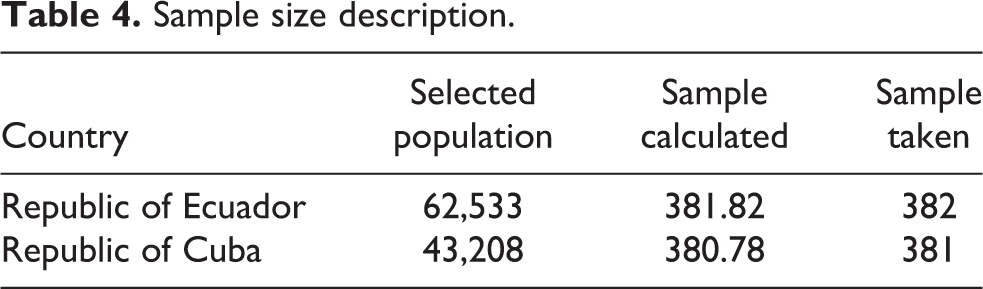
For the selection of the sample size, conceptual equivalents were considered: the registration of self-employed workers and of micro-enterprises. Likewise, micro-enterprises in the agricultural sector in Ecuador were not considered, as they are not considered equivalent in Cuba. Therefore, the number of Ecuadorian micro-enterprises that was assumed as population was 62,533. Based on the sizes of both populations, and by applying mathematical expression 1, the sample size for the study was determined (see Table 4).
Sample size description.

Where:
n: sample size
p: probability of success = 0.5 and
q: probability of failure = 0.5
z: Confidence level = 1.96
N: Population size
e: investigator error was set at 5%
Figure 1 presents a general characterization of the sample. As can be seen, already in the characterization of the sample, different behaviors of the variables of the studied diversity are observed.

Characterization of the sample.
Regarding gender, in Ecuador there is a relative balance between both; while in Cuba, the male sex is more represented. Regarding ages, no significant differences were observed between both populations studied. However, regarding educational level, the behaviors by levels are different between both populations: in the Republic of Ecuador a predominance of the second level was found and a greater representativeness of the first, while for the Republic of Cuba the prevalence is distributed between levels II and III and the first level is much less represented.
Figure 2 shows the representation of the productive sectors that were considered in the survey. As can be seen, in Ecuador the most representative sectors were commerce and gastronomic services, while in Cuba the sample had a greater predominance of technical and personal services, which corresponds to the general composition of the population for this type of company in both countries.

Composition of the sample by sectors.
Application of the instruments. The instruments were applied to 100% of the selected entities. With the results obtained, a matrix of 763 rows and 61 columns was formed.
Processing and analysis of results. Processing began with the characterization of the variables studied, through a descriptive analysis of the variables under study. Subsequently, a cluster analysis of K means was applied, 42 to check the possible conformation of groups, as well as to identify the variables that affect this and their verification by means of an ANOVA test. 43 To achieve a comprehensive assessment of the results, a correspondence analysis 44 was developed that allowed the behavior of the variables in both populations to be represented on a two-dimensional map, which facilitates the graphic analysis of the coincidences and differences. This analysis was carried out determining the percentage that the value reached by each variable in analysis occupies with respect to the maximum possible to reach. The analysis was developed considering the classification by country and by sector only for those variables that showed significant differences according to the result of the cluster analysis.
Results
The results of the application of the different research instruments are described below. The study began with the characterization of the entrepreneurs. For this objective, variables such as the age at which they started as workers, the number of people who depend on them and the personal characteristics under study were characterized.
Regarding the age at which they started working (see Figure 3), it can be seen that, in general, the age of starting work in Cuba is, on average, several years later than in Ecuador.

Age of labor onset by country.
Taking into account the number of dependent people, in charge of the entrepreneurs (see Figure 4), there are no significant differences between the two populations, unless in Ecuador 7% of the subjects under study have seven or more dependent people.
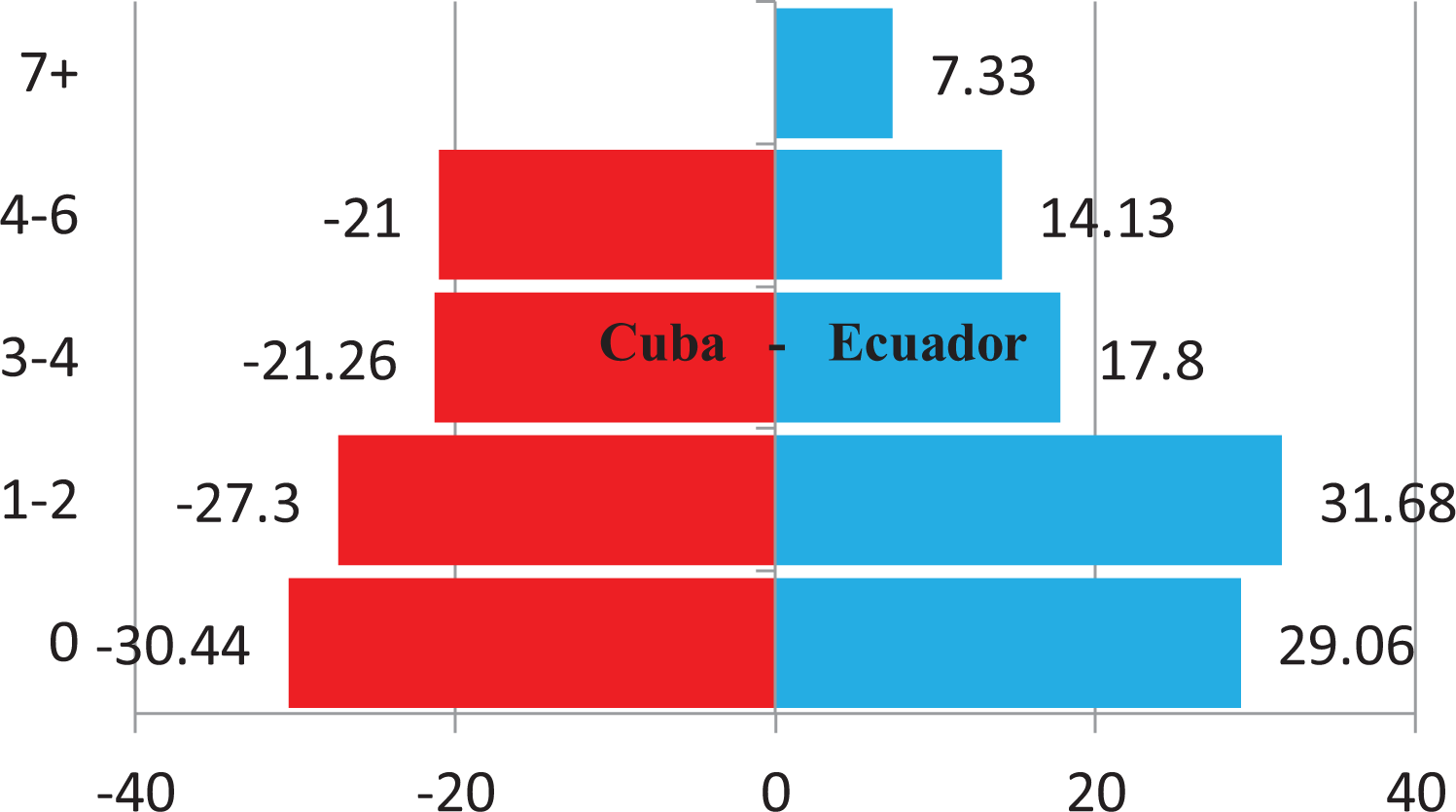
Number of dependent people.
A situation similar to the previous one is observed in relation to the individual characteristics among the entrepreneurs (see Figure 5), where in both populations the four evaluated characteristics showed similar behaviors among themselves.

Individual characteristics of entrepreneurs.
Characterized these variables, we proceeded to analyze other characteristics of entrepreneurs aimed at identifying how they structure the living expenses they produce, according to their income, as well as what spending projections they have in the long term. Both variables are considered expressions of the degree to which their needs determine their behavioral priorities. Regarding short-term expenses (see Figure 6), there are differences.

Structure of short-term expenses.
Both populations evaluate food as high consumption, which is not surprising as this is one of the highest priority basic needs. However, other types of expenses do show significant differences. For example, in medical services few expenses are reported in Cuba, since the charge for the provision of medical services is not legal, although in some cases expenses are incurred to receive this type of services that are paid to professionals generally through gifts of products to meet the needs of health personnel. For similar reasons, the population in Cuba does not have a culture of paying for health insurance, although the sale of insurance and taxes for social security do exist. The former are paid by an unrepresentative part of the population and the latter are perceived as a further tax, but not as a need for spending, since the supply of medical services is not conditioned by whether or not this insurance is paid. Expenditures on education in Cuba are relatively low, and in no case occur for the payment of tuition, but for food, transportation and other expenses indirectly associated with education. On the other hand, in Ecuador, even when there is free education, many opt for private education, assuming that it is of higher quality; and those who are in public schools must assume operating expenses generated by the schools during their operation.
Regarding the structure of long-term expenses (see Figure 7), similarities and differences are also observed. Among the coincidences, the purchase of furniture and equipment for homes and cars as means of transportation stand out. Among the differences are the projected expenses for the Universities, which in the case of Cuba are low because there is no access to private Universities and it is only possible to access them through government actions. Meanwhile, in Ecuador many families prioritize this type of expense to try to guarantee for their descendants or for themselves a better future.

Projected structure of long-term expenses.
The tendency of some Cuban entrepreneurs to prioritize in expenses of less social importance such as tourist trips is observed, this in the criteria of the researchers responds to several factors, among them: not having to allocate resources to basic services such as education and health, so which are assumed as guaranteed, the promotion of an egalitarian culture for the whole of society, by which everyone pretends to live under the same conditions and have access to the same resources, regardless of their real purchasing power.
Other variables object of analysis are related to the operation of the organizations, regarding the use of the time fund. This was measured through three variables: number of daily hours worked, number of days worked per week, number of holidays worked by entrepreneurs. Figure 8 shows the behavior of these variables. As can be seen, in general, the Ecuadorian entrepreneur tends to show a better use of time, both in the number of hours per day and the days of work per week or the work of holidays. The above, according to the researchers’ criteria, responds to the habit created in the entire population of availing themselves of the working hours of state organizations as the only available alternative, the perception of security existing in relation to health and education services without having a life insurance.

Use of the bottom time for the entrepreneurship.
In addition, it was assessed how the influence of the environment is perceived in the enterprises (see Figure 9), in which it was established that there are similarities in the levels of influence of the regulations of public administration, taxes and sources of financing.

Perceptions of influence of environment variables.
Differences in access to suppliers and levels of competition are observed. The first responds to the non-existence in Cuba of wholesale markets and the existence of high levels of resistance and regulations for non-state imports. While the lack of competition is typical of the representation of self-employed workers within the total number of workers, where in Cuba it does not exceed 30%, in Ecuador the value is close to 90% of all existing companies.
The differences in the behavior of the variables between both populations were verified by means of a cluster analysis of K means and, as part of this, an analysis of variance (ANOVA) of the groups formed. As a result, the formation of two groups was obtained. Table 5 shows the significance of the incidence of the variables in the conformation of the groups.
Classification results of the k mean cluster.a

aValues in bold mean that there are significant differences between the groups analyzed in the variables with a significance value less than 0.05.
The table shows two groups that show the differences and similarities found in the behavior of the variables analyzed for both populations. In the first group, a predominance of variables with highly significant significance is observed, reflecting different perceptions of the need to undertake; although differences were also observed in two variables of the administrative and financial environment: the level of competition and the availability of suppliers. In the second group there are fundamentally variables that do not show significant differences between the two populations, fundamentally in relation to the personal characteristics of the entrepreneurs and the associated administrative and financial environment variables, although two items of variables were located that express the perception of the need to undertake.
The results of the correspondence analysis (see Figure 10) corroborated those obtained by the cluster analysis, also allowing its graphic representation and consequently a better understanding. As can be seen, the four sectors of the Ecuadorian population under study tend to be concentrated on the left of the map; There is a small distinctive trend in the commerce sector, which separates a little from the rest in fundamental terms regarding the number of hours of work per day, which are generally the longest, reaching up to 15 hours. In the same way, in the case of Cuba, business ventures show a somewhat different behavior from the rest, fundamentally with regard to showing as long-term prospects spending on jewelry, and expansion of the house.

Correspondence analysis.
Discussion
A comprehensive understanding of the results achieved allows us to state that despite living in different socio-economic environments, entrepreneurs show similar personal characteristics to undertake ventures, which denies hypothesis 1. On the other hand, it was observed that the existence of differences in the socio-economic environments do condition the existence of differences in the ways of perceiving the needs that motivate the undertakings, which corroborates hypothesis 2.
The results obtained showed that, in general, the representative variables of the characteristics of the entrepreneurs do not show significant changes between the two populations studied, therefore the first research hypothesis formulated is not fulfilled. Similar analyzes for the study of the characteristics of entrepreneurs and their comparison based on various conditioning characteristics have been carried out by previous research. 22,45 –49
Specifically, the research by Pejić-Bach et al. 8 was oriented to the analysis of personal characteristics such as: personal attitudes towards entrepreneurship, subjective norms and behavioral control and the degree to which these influence business intentions, in this case it differs with the personal characteristics that are analyzed in this research.
Instead, the investigation of Partida-Puente et al. 39 delves into very specific personal qualities such as the degree of presence of personal values such as: honesty and personal reputation. Variables that showed coincidence in their behavior in environments as different as: USA, Mexico and Turkey. Specifically, the variable fear of failure was investigated by Reyes-Fong et al. 10 in ten Latin American countries, observing little variation in nine of them where the rate of fear of failure oscillates in values between 26.75% and 30.87%, with the exception of Panama (20.51%) and Brazil (36.34%), which showed greater dispersion and were the extreme behaviors of both variables. Similarly, the research carried out by Quevedo-Monjarás et al. 12 where a comparative study is carried out between different environments such as Andalusia and Texas, similar behaviors were observed between personal characteristics such as: risk and innovation, among others.
Compliance with the second research hypothesis, which assumed the existence of differences between the needs that drove the entrepreneurs, was verified, observing that when the socio-economic environment changes, the expressed behaviors of consumers are modified in terms of variables that are considered expression of the need to undertake.
Differences were found between variables such as the number of people who depend on the entrepreneur and the age they started working. Similarly, differences were found between the projected structure of short-term and long-term personal expenses for both populations of entrepreneurs, as well as the level of use of the time available to work.
The age of beginning work in entrepreneurship is addressed by other investigations in comparative studies 10,11 as a source of differences, but they do not make explicit in the results if they were able to verify the presumed difference.
In the investigation of Partida-Puente et al. 39 address, as the main motivator of entrepreneurship and in turn expressions of entrepreneurial needs, the level of income, observing important differences between the three environments analyzed (Mexico, Turkey and USA), and how additional variable: intention to be your own boss. This variable was also considered by Quevedo-Monjarás et al., 12 showing differences between the two environments approached by the researchers. In this research, these variables are not considered directly, but rather delve into the use that is assigned to income, as an expression of the need that motivates the search for this income and based on which differences were observed and recorded.
Likewise, it was evident how the influence of the administrative and financial environment generates changes in the perceptions and behaviors of entrepreneurs, based on variables such as regulations and taxes derived from public administration, the availability of financing sources and suppliers, as well as the levels of competencies that entrepreneurs must face. Aspects also highlighted by previous research. 34 –37
Limitations and future investigations
The present investigation did not study in depth the possible differences between the two populations under study in relation to diversity variables such as age, gender and school level; those that were only used as characterization of the sample. Likewise, other productive sectors such as agriculture, construction, intellectual work, among others, were not considered.
The investigation was carried out from the comparison of two populations with some similarity conditions and others with greater differences. It would be appropriate to carry out this type of comparison considering other countries in the region.
Managerial implications
The implications of this research, from a managerial point of view, are associated with the recognition of the influence of the environment on the behavior of entrepreneurs and their projections of expenses; as well as the identification of differences regarding the potential use of the available working time funds, which implies a possible productivity reserve. In the same way, the idea that characteristics necessary for business success such as perseverance, innovation and the willingness to take risks can emerge and be strong, regardless of the social context in which the organization operates, is reinforced.
Conclusions
The development of this research allowed corroborating the ideas raised by previous research, which has shown that the qualities that characterize or distinguish entrepreneurs can be similar even in different socio-economic environments. Similarly, a coincidence was observed with previous investigations that have shown the existence of differences in the behavior of variables that drive individuals to undertake, among these variables the following stand out: the age of beginning of the work activity of entrepreneurs and income searches.
This research, rather than analyzing the search for income as a distinctive variable, delves into the existing differences in the purpose of use of income, expressed in the structure of short and long-term project expenses. In this variable, differences were also found between the two populations studied.
The differences observed in the structure of projected expenses in the short and long term, as well as in the use of the funds of time available for work in the enterprises, as a reflection of the incidence of the socio-economic environment, are considered the main contribution of this research.
Footnotes
Declaration of conflicting interests
The author(s) declared no potential conflicts of interest with respect to the research, authorship, and/or publication of this article.
Funding
The author(s) received no financial support for the research, authorship, and/or publication of this article.
