



Abstract
Leadership is considered to be a viable solution to avoid persistent project failures in an increasingly volatile and uncertain competitive business environment; however, practitioners and researchers have yet to reach a consensus on the best leadership style to prevent project failure. Although past studies have examined different leadership models in the project environment, they have overlooked the importance of emerging leadership styles in managing new business realities. This article thus attempts to determine whether two leadership styles, that is, contingent reward and empowering, directly and indirectly achieve project success. Data were collected from 289 project team members in the IT sector and analysed using partial least squares structural equation modelling. The results demonstrate the positive impact of empowering leadership on employee self-leadership, which leads to project success. Further, employee self-leadership positively mediates the link between empowering leadership and project success, while goal clarity moderates the influence of self-leadership on project success. However, contingent reward leadership neither directly nor indirectly (through self-leadership) showed any significant relationship with project success.
Keywords
Introduction
In the increasingly volatile and uncertain business environment, both dominant and emerging companies need to be able to quickly propose innovative changes to cope with intensifying competition. 1 The new era, especially the post-COVID-19 one, is also driving companies towards radical change in their hierarchies and operations. 1 In the IT sector, project-based business firms are following suit by adopting up-to-date project management practices to enhance their performance. 2 A project management framework that enhances the efficiency and effectiveness of human efforts, in particular, can offer these firms competitive advantages. 3 Unfortunately, many projects still fail to be completed within their scope, schedule and budget constraints. 4 Already understudied IT sector 5 is experiencing a higher rate of project failures both in developing and advanced countries. 6 The investigation to unearth the reasons behind the high rate of IT project failure has prevailed in the IT project management literature for quite some time, revealing numerous elements that influence IT project success, including multifaceted hard and soft skills. 7
Among the different typologies of soft skills, leadership is essential in managing projects. 6 In fact, Muller et al. 8 explained that the most crucial soft-skill factor in project success is the project manager’s role as a leader instead of a manager. Project leadership seeks to influence other individuals within organisations, such as subordinates and peers, to achieve a project’s objectives and goals. 9 However, to date, the various dimensions and styles of leadership that impact project performance have yet to be fully explored. 10 Past studies have primarily focused on conventional leadership styles, which are mostly leader-centric.11,4,12 The IT projects are open and flexible in nature compared to other projects. 13 Current IT projects demonstrate less control 14 and uncertainty leading to change in standard processes and adjustment in organisational structures. 15 The increasing formation of empowered teams, coined with the flattening of organisational structures, resulted in a shift from conventional leadership models. 16 The individual-based traditional heroic-models11,4,12 of leadership may no longer be viable in the IT context due to the prevailing empowering environment. 17 In this context, among other leadership theories, leader-member exchange theory18,19,20 emerged as an alternative, which focuses more on the leader and follower relationship. 19 Although high-quality leader-member exchange influence becomes reciprocal between leader and follower. 21 Still, researchers criticise it due to its detrimental outcomes such as conflict and jealousy 22 and consider it as an extended form of transformational leadership (i.e. leader-centric). 19
Therefore, project management researchers have called for the examination of new leadership styles that facilitate project success in turbulent times. 23 For example, though the corporate sector witnessed a significant increase in directive leadership behaviour during the 2008 financial crisis, 24 researchers now recommend leaders’ to delegate during the COVID-19 crisis. 25 In this context, empowering leadership has emerged as an essential way to proactively advance organisational change by drawing constructive ideas from subordinates. 26 Empowering leadership depicts leaders’ conscious behaviours to share their power with employees and give employees additional responsibility to control their own work.27,28 Unfortunately, most studies on empowering leadership have been conducted in individualistic Western cultures. 26 A detailed review of the empirical literature also shows that the findings on empowering leadership have been mixed and incongruent, which calls for the examination of moderators and mediators that underlie its effects. 29
Nonetheless, empowering leadership alone cannot ensure project success. 30 Taking project-based organisations into account, Tyssen et al. 31 noted the importance of contingent rewards in project success. Moreover, contrary to traditional leadership views, supervisors typically employ both leadership and supervision techniques within their units. 18 In fact, Gupta and Singh 32 suggested that task-oriented leadership, which applies contingent rewards, be jointly practised with empowering leadership in the Indian context.25,33 Contingent reward leadership also positively related to leader-member exchange leadership concept. 34 A recent study in the project environment further evidences the positive congruence between empowering leadership and directive leadership like contingent reward leadership. 35 Contingent reward leadership is a common style of leadership which is present in all types of organisations. 36 It involves leaders explicitly identifying and providing rewards for self-leadership behaviours in a work environment, which makes followers more inclined to lead themselves. 37 While empowering leaders create a work environment that supports followers’ autonomy and work meaningfulness, 38 contingent reward leaders motivate followers to be more self-determined by supporting and rewarding their self-leadership behaviours. 37 Leaders who combine both styles reap good results when they enable subordinates to challenge the status quo and reward subordinates’ risk-taking, which in turn enhances the latter’s autonomy.39,40 However, despite numerous studies demonstrating the benefits of contingent reward leadership,41,42 its role in project performance has not received sufficient attention.43,44
Moreover, as an outcome of managers’ leadership, the self-leadership of employees plays a central role in crises times. 45 Today, the practice of directing and controlling employees under traditional hierarchical structures has become obsolete; rather, it is time to empower and enable employees. 46 Munshi et al. 36 agreed with this and stressed the importance for leadership at all levels in an organisation, such as when top management empowers a horizontal leader.47,48 Employees’ self-leadership at all levels is the key solution to achieve optimal performance in 21st century organisations, 49 since self-leaders exert strong efforts, face challenges, pursue self-motivation and continuously update their thinking styles. 50 Therefore, given scarce empirical testing of the direct and indirect influences of leadership styles on project success,29,51 we propose self-leadership as a possible intervening factor in the effects of empowering leadership and contingent reward leadership on project success.
Although self-leadership is a useful tool to tackle temporal urgency, unstructured tasks and a fast-developing work environment, 52 it should be noted that IT projects are more volatile and fluid in a dynamic setting. 53 As such, uncertainty is an inherent issue in IT projects that may cause frustration about project goals. 54 Adding to this, empowering leadership heightens ambiguity. 55 In this scenario, goal clarification and rewards at the supervisory level may facilitate empowered employees’ self-leadership in achieving project goals. 56 This is in line with Bendell et al.’s 57 recommendation that researchers should account for the organisational context in self-leadership studies to avoid incorrect conclusions. However, the outcomes and boundary conditions pertaining to self-leadership are inconclusive and ambiguous. Additionally, although goal clarity as a crucial organisational context has been studied in relation to transformational leadership and transactional leadership,58,41 its moderating role in the consequences of employees’ self-leadership has yet not been explored.
To fill the literature gaps highlighted above, this study set out to answer the following research questions: (1) Do project managers’ contingent reward leadership and empowering leadership influence project success? (2) Does employee self-leadership mediate the influence of project managers’ contingent reward leadership and empowering leadership on project success? and (3) Does goal clarity moderate the influence of self-leadership on project success?
Theoretical background and hypothesis
Contingent reward leadership
This leadership type is positively viewed as an exchange where the leader validates employees’ performance. 59 Contingent reward leaders also give just clear guidance related to followers’ work roles and, in turn, fulfil followers’ needs and wants against their effort. 60 This motivates subordinates to pursue the promised praise and rewards and work independently. 61 Therefore, in a typical project, a project manager who practises contingent reward leadership would first clarify the roles and expected outputs of the team members, then outline the rewards or incentives to be received, secure the appropriate resources and finally monitor and control the members’ activities to grant rewards accordingly. 43 Thus, the leaders support self-initiatives by offering rewards to their followers, which ultimately leads to higher performance.
Moreover, contingent reward leadership is recognised as an essential determinant of followers’ performance-related behaviours and attitudes in the workplace. 62 In adopting a contingent reward strategy, leaders attract the involvement of followers in a given task 31 by setting goals for employees or allowing employees to set their own goals. When leaders explicitly identify and provide rewards for autonomous behaviours in the work environment, followers are more inclined to lead themselves. 37 On the other hand, poject success generally refers to a team’s completion of a project’s goals. 63 Because subordinates’ rewards are contingent on results, the performance-outcome expectancy of the team is strengthened under contingent reward leadership. 64 A recent meta-analysis explained that contingent reward leadership benefits performance through significant positive contributions to the leader–follower social exchange. 51 This study aims to extend the current literature by examining the association of contingent reward leadership and project success in project environment. Thus, we hypothesised that:
Contingent reward leadership is positively related to self-leadership
Contingent reward leadership is positively related to project success
Empowering leadership
The intense competitive market is shifting the prerogative of authority and power from top management to lower-level employees through the delegation of responsibilities and decision-making power. 65 Self-directed decision-making allows employees to solve problems and take actions autonomously, which requires extensive information sharing, coaching and training support. 66 To this end, empowering leadership enables and encourages subordinates to take the initiative to manage and control their own behaviours. 67 Empowering leadership focuses on sharing power and autonomy 68 with followers while affirming the significance of followers' work by showing confidence in their abilities. Empowering leaders also deliberately remove behaviour controls enforced on their subordinates and grant them greater independence for self-expression. 27 A primary objective of empowering leadership is therefore to develop self-leadership among employees, both internally and externally. 69 Bandura 70 presented social cognitive theory, which describes that empowered individuals have strong feelings of confidence that their hard work will achieve success.
The significant aim of all empowering behaviours is to enhance self-efficiency and higher self-efficacy in their followers, leading to better performance. Self-leading employees thus exhibit self-efficacy and responsibility for tasks and actions because of their self-confidence, thereby forming the basis of effective ways to fulfil their tasks. Kerzner 71 commented that success mainly depends on the project stakeholders’ satisfaction, because they continually struggle for a well-executed project.4,9 Empowering leadership has been associated with positive outcomes such as enhanced performance, organisational citizenship behaviours and managerial effectiveness.68,72 A study on 223 supervisor–employee dyads found that managers’ empowerment behaviours stimulate subordinates to express their ideas, which improves team and organisational results. 73 Ultimately, leaders play an essential role in empowering and motivating individuals to take initiative and contribute proactively towards a project’s success. 74 This study aims to extend the current literature by examining the association of empowering leadership and project success in project environment. Therefore, we hypothesised that:
Empowering leadership is positively related to self-leadership
Empowering leadership is positively related to project success
Self-leadership
An individual’s self-perception of his/her capabilities, also known as self-efficacy, has a positive influence on their beliefs that they can fulfil their role outcomes. 75 Self-efficacy gives people the confidence to overcome self-doubt by imparting the understanding that risk-taking can lead to successful goal achievement. 76 This is the fundamental idea behind self-leadership, which refers to the behaviours of an initiative-taking and self-motivated individual. 69 At the individual level, self-leadership has been found to improve career success, 77 self-efficacy, 78 employee productivity, 79 effective self-regulatory processes, 80 and innovative work behaviour. 81 Moreover, employees with higher self-leadership levels show better adaptation and adjustment in organisations seeking innovative solutions. 82 Prior research has found positive associations between self-leadership and a variety of individual and organisational outcomes. 82 As contingent reward leaders offer feedback about followers’ tasks and roles, the latter tend to demonstrate enhanced work-related self-efficacy. 83
Additionally, contingent reward leadership behaviours eradicate obstacles in the way of performance, thus creating a conducive environment for employees' independent task performance. 84 In reciprocity, the follower senses an inherent liability and responsibility to fulfil the leader’s efficiency and performance objectives by engaging in self-initiated and proactive performance behaviours. 84 Amundsen and Martinsen 85 have further proved that empowering leadership has indirect effects on employee empowerment by way of employee self-leadership. As a result of empowering leaders, self-leading employees are inclined to perceive themselves as capable enough to perform at a greater level. 86 Thus, self-leadership is a self-influencing process that enhances an individual’s productivity and efficiency. 87 This study aims to extend the current literature by examining the mediation of self-leadership between contingent reward leadership and project success and empowering leadership and project success in project environment. Thus, it was hypothesised that:
Self-leadership is positively related to project success
Self-leadership mediates the relationship between contingent reward leadership and project success
Self-leadership mediates the relationship between empowering leadership and project success
Goal clarity
One of the first steps in project management involves clarifying the project’s goals, objectives and organisation.41,58 The clarity of project targets pertains to followers’ extent of understanding, communication and acceptance of the project’s mission and aims. 88 Goal clarity also refers to the clarity that an employee perceives about his/her roles and responsibilities, 89 which is a significant element of good project management. 41 As per Hu and Liden, 90 goal clarity increases employees’ recognition of their paths and task goals, as well as their connections with peers and their organisation. Goal-driven leaders should communicate with employees so the latter can self-regulate themselves at work to achieve organisational goals. 91 Such information access increases employees’ creativity because they better understand their workflow and strategy. 92 The goals are then successfully interpreted by employees, consequently fostering proactive behaviour. 91 Moreover, well-informed employees tend to put forth novel ideas that align with organisational goals and potentially grant competitive advantages for the company’s future development. 93 Therefore, team members’ goal clarification, in tandem with their self-managing behaviour and information access, tend to engender enhanced outcomes. 94 A team can rarely take a project to success on its own without clear and up-to-date goals at all stages of the project. 43 This study aims to extend the current literature by examining the moderation role of goal clarity for self-leadership and project success in project environment. Thus, we hypothesised that:
Goal clarity moderates the relationship between self-leadership and project success Based on the hypotheses justified above, Figure 1 presents the conceptual model of this study

Research model.
Instrument
The Multi-Factor Leadership Questionnaire (MLQ) is a popular and well-validated instrument in measuring leadership styles. 11 Four items from the MLQ were adopted to measure contingent reward leadership, an example of which was ‘My project manager expressed satisfaction when I met expectations’. To measure empowering leadership, a seven-item scale was adopted from Tekleab et al. 95 A sample item was ‘My project manager urged me to assume responsibilities on my own’. A six-item scale was adapted from Yun et al. 67 to measure self-leadership. A sample item was ‘I assumed responsibilities on my own’.
Three items adopted from Aga et al. 58 were employed to measure project goal clarity, where a sample item included ‘There were clear and comprehensible goals for this project’. The 10 items to measure project success were derived from the widely used scale of Turner and Muller.96,97 A sample item was ‘The project met its overall performance objectives’. All items were rated on a five-point Likert scale ranging from one (strongly disagree) to five (strongly agree).
Research methodology
Sampling
The present study investigated the impact of project managers’ leadership style on project success in Pakistan’s IT sector. In line with similar previous studies, the unit of analysis in this study was a single project. 2 In the past, various techniques have been used to select a project for research purposes. For instance, respondents have been asked to give feedback on a project that is current, active, more than halfway through, near completion or completed within a specific number of years prior.58,98,99,100 In this study, respondents were requested to answer about a project that was completed not more than 2 years ago.
From the sampling frame of 875 Pakistani IT firms registered with the Pakistan software house authority (P@SHA), 56 were chosen to take part in a pilot test while 500 were selected using the systematic sampling technique for the main study. Data was collected online by emailing each firm’s representative a link to a Google Form survey. Prominent researchers have adopted a cross-sectional method in exploring project success 101 and typically prefer subordinates’ rating of their managers' and their own leadership. Aga et al. 58 further recommended studying project team members in assessing project leadership behaviours. Based on these guidelines, in this study, departmental heads and senior project team members were chosen from each firm to respond to the survey. Out of the 500 distributed questionnaires, 289 usable questionnaires were returned. This yielded a response rate of 59%, which is 20% lower than previous studies, most likely due to the COVID-19 pandemic at the time. However, the sample size of 289 exceeded the required size of 265 as per Krejcie and Morgan’s 102 formula.
Data analysis
The latest version of SMART-PLS v3.3.1 was used to perform partial least squares structural equation modelling (PLS-SEM) analysis. PLS-SEM is pervasive in social science and management studies for its cause-and-effect examination of constructs. 103 Upon first checking for multicollinearity among the variables, the variance inflation factor (VIF) values less than 5.0 confirmed the non-existence of multicollinearity. 103 Next, SPSS v26 was used to perform Harman’s single factor test to detect common method bias, as suggested by Podsakoff and Organ. 104 The highest variance explained value (43.199%) proved that the data was free of common method bias. 105 The results also indicated no abnormality in the data, as values ranged within ±3.29, thus establishing data normality.
Respondent profile
Descriptive statistics of the respondents.

Reliability and convergent validity.

Note. *SD = standard deviation; **OL = outer loadings; ***CA = Cronbach’s alpha; ****CR = composite reliability: *****AVE = average variance extracted
Discriminant validity.

Structural model
Next, the structural model was analysed to test the linkage between the constructs as hypothesised in the research framework. 107 It was assessed by determining path coefficients among the variables under study, 107 followed by additional analyses of moderating and mediating effects. 110
Hypothesis testing results.

Note. CRL = contingent reward leadership; EL = empowering leadership; GC = goal clarity; SL = self-leadership; PS = project success.
Nevertheless, H3 was supported as empowering leadership revealed a significant positive effect on self-leadership (β = 0.677, p = .00). However, the results rejected H4 as empowering leadership did not have a significant relationship with project success (β = 0.106, p = .159). The relationship between self-leadership and project success was found to be positive and significant (β = 0.478, p = .00), supporting H5.
Moving on to the mediation analysis, the results in Table 4 indicate that self-leadership failed to mediate the relationship between contingent reward leadership and project success (β = 0.–0.013, p = .0.650); thus, H6 was not supported. In contrast, self-leadership showed a significant mediating effect on the relationship between empowering leadership and project success (β = 0.324, p = .000); therefore, H7 was supported.
With regard to the moderator, H8 was validated as goal clarity was revealed to positively moderate the relationship between self-leadership and project success (β = −0.160, p = .000). Interestingly, the moderation graph in Figure 2 illustrates that, contrary to expectations, lower levels of goal clarity strengthen the impact of self-leadership on project success. Moderation effect graph.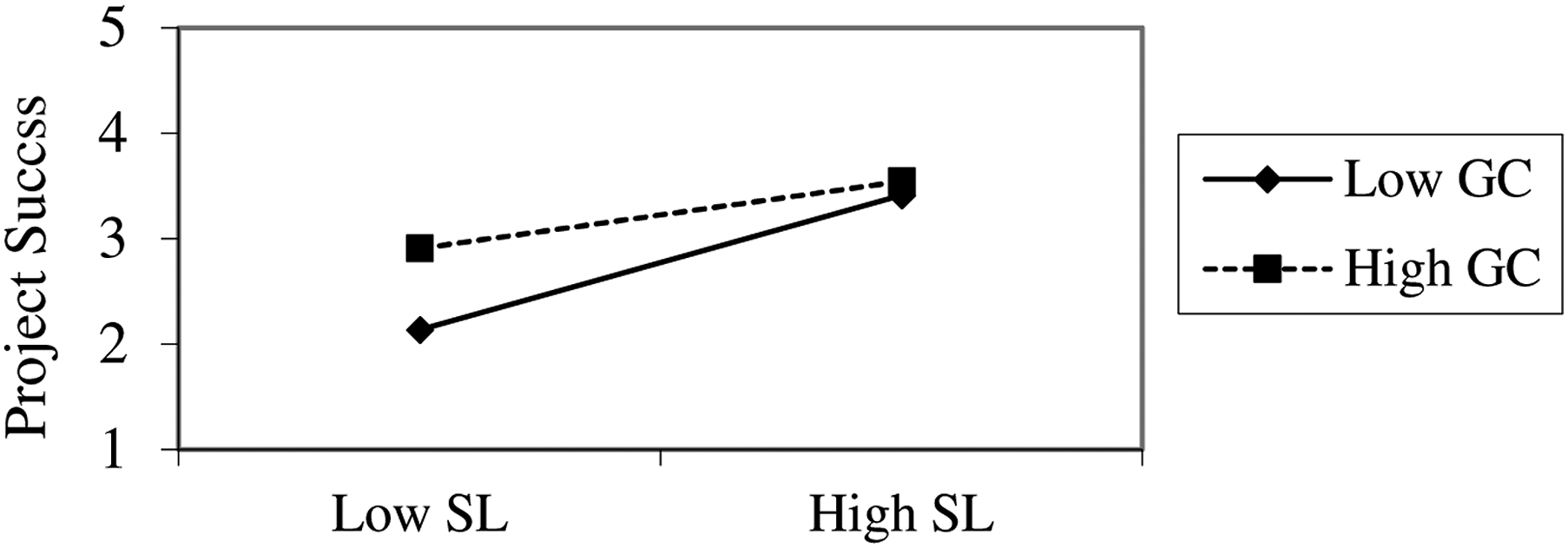
R2 and Q2 values table.

Discussion
The current research was carried out to determine the direct and indirect effects of contingent reward leadership and empowering leadership on project success via the mediating role of self-leadership and the moderating role of goal clarity. The analysis of data collected from Pakistani IT industry employees has revealed that contingent reward leadership has no positive implications for project success. The results contradict earlier studies that reported the favourable performance outcomes of contingent rewards.41,58 Moreover, only a handful of studies have explored the negative side of contingent rewards, such as its ability to undermine followers’ autonomy and empowerment. 59 This phenomenon clearly demonstrates that contingent reward leadership behaviour is context-specific and is a double-edge sword. 51 Consequently, to increase project success, project managers should avoid adopting this strategy in the IT context.
Contingent reward leadership also demonstrated a negative beta value and insignificant relationship with self-leadership. This implies that contingent rewards do not motivate followers’ self-leadership and may even discourage it. The results are in line with past findings stating that contingent reward leadership dampens followers’ intrinsic motivation and leads to less empowerment.51,112 Pieterse et al. 40 highlighted that reward-based leadership seems to be influential only in a highly psychologically empowered environment. By drawing employees’ focus solely to the aspects of their jobs that offer rewards, contingent rewards may weaken motivation by reducing followers’ perceived autonomy and shifting their attention away from non-incentivised duties and responsibilities. 113
Further, self-leadership does not mediate the relationship between contingent reward leadership and project success. This is plausible as by nature, contingent reward leaders address the self-interests of those under their influence, 67 which has an indirect negative effect on task performance via diminished competence and autonomy. 51 Contingent reward behaviours also vary between individuals. 114 As such, though contingent reward leadership is a managerial behaviour present is all organisations, today’s employees, especially in IT sector, are not influenced or motivated by this leadership behaviour to increase their self-leadership or performance. However, instead of Bass’s 11 material transactional, if LXM social transaction 19 strategy is applied in IT projects, it may give better results.
Moreover, the results demonstrate an insignificant relationship between empowering leadership and project success, despite prior scholars’ agreement on the positive outcomes of empowering leadership across different contexts. 115 This insignificance is possibly due to the existence of a full mediator (i.e. self-leadership) between this relationship. In fact, researchers have warned about a reduction in core performance due to its adverse effects. 18 Thus, other aspects like U-shaped or curvilinear effects must be carefully considered. In this regard, given that the relationship between empowerment and project success is fully mediated by self-leadership, the direct effect of empowering leadership on project success becomes insignificant. In other words, empowering leadership cannot entail project success without followers’ self-leadership behaviours. This result is in line with a study conducted in the banking sector that revealed a similar full self-leadership mediation. 81 Past studies have also indicated that employees’ personality and characteristics play a vital role in determining the effects of empowering leadership. 55 Thus, this study’s finding puts forth that self-leadership is a core mechanism through which empowering leadership impacts project success. In particular, the empowering leadership behaviour of project managers is more beneficial for employees in terms of their self-leadership. When leaders let employees coordinate with their peers independently, employees jointly search for better solutions and solve problems on their own. They also assume responsibilities of tasks on their own and take initiative without leaders ‘direct input, which is imperative for project success. Moreover, the descriptive analysis depicts that experienced employees are more inclined towards self-leadership. Empowerment is a fluid phenomenon that changes over time. With time, as people gain experience and expertise, they become more independent. 116 Additionally, a longer duration of cooperation with a leader meant a higher degree of autonomy on the followers' part. 117
Notably, a low level of goal clarity appears to strengthen the association between self-leadership and project success, meaning that self-leaders are more likely to achieve project success with unclear goals. Though these results align with the previous results where goal clarity has been found to have moderating 58 and mediating 41 effects in different contexts, the direction of the moderation is surprising. Nonetheless, it can be explained as a phenomenon where followers’ creativity increases under conditions of either high or low goal clarity, which enables them to be more independent in improving performance. In contrast, mid-range goal clarity is related to fewer novel ideas. 118 Overall, the magnitude of goal clarity’s effects differs from study to study. 118
This research adds to the body of knowledge in several ways. First, given the limited research on the direct and indirect influences of various leadership styles on project success, this study has presented a novel research framework on leadership to cope with rapidly changing business realities. 15 Apart from conventional leader-centric styles like transformational leadership, authentic leadership and servant leadership, this research examined the effect of an emergent leadership style (i.e. empowering leadership) in the project environment. In doing so, this study has answered calls for more empirical work on empowering leadership and contingent reward leadership due to inclusive findings and insufficient coverage in the Asian context.1,19,43,44 Next, this study contributes to the literature by addressing researchers’ recommendations to consider the organisational contexts surrounding self-leadership.81,119 In particular, the present paper incorporated goal clarity as an organisational boundary condition that moderates the relationship between self-leadership and project success. Lastly, this study adds to the literature by introducing and testing self-leadership as an underlying mechanism that explains the influence of contingent reward leadership and empowering leadership on project success.51,69,19
The findings also have practical implications for practitioners and project management professionals. Based on the results, one strategy for project managers seeking project success is to avoid contingent reward behaviour, 119 as its effectiveness depends singularly upon reward administration. 120 The findings thus provide a cautionary note to those who would wholeheartedly advocate using certain contingent reward leadership behaviours to improve performance. Instead, future developers could design leadership development programmes that target mechanisms to reduce the potential adverse effects of reward-based leadership. 51 For example, leaders could administer rewards in a manner that is less likely to be perceived as controlling and, if possible, that provides autonomy to followers in performing their job tasks. 51 Organisations should also search for alternate strategies to contingent reward leadership and be meticulous in choosing the best-suited design after a thorough validation of its compatibility with the empowering environment and industry.
Moreover, the current study serves as a guideline for existing project managers to practice empowering leadership. As Srivastava et al. 106 advocated, organisations must hire leaders who believe in sharing power with subordinates rather than retaining it for themselves. Organisations will likely only succeed at facilitating self-leadership when they consciously plan to replace hierarchies and share power among organisational members. However, empowering and shared forms of leadership may not a natural response for many leaders because of fear of losing power and authority. 7 If managers do not want or know how to delegate authority and power, extensive brainstorming and training programmes can be designed. 121 For instance, Kim and Beehr 122 suggested that the project organisations can motivate supervisors to exercise empowering behaviours by assigning rewards and incentives to their subordinates that increase their work meaningfulness and autonomy. More importantly, management needs to be extra careful in implementing empowerment efforts in Asian culture because employees habitually follow management’s rules. 123
Due to a direct and robust association between self-leadership and project success, the current study suggests that managers should be mindful of employees’ self-leadership. Thus, leaders must provide ample authority and resources to enable individuals to be self-leaders. 37 Senior management should also play its part in allocating resources to facilitate self-decision-making and greater responsibility at all organisational levels. 124 Unfortunately, the focus of training funds for project professionals is typically driven by the developmental need for technical capabilities instead of soft skills. 46 If employees are to act as leaders, management should prioritise training programmes promoting self-leadership among employees.
Though the effects of project goal clarity are more complicated, it still has practical implications for project success. 117 Namely, management should exploit goal clarity to increase self-leadership and mould a culture where employees have enough information for decision-making, leading to improved project performance. The IT sector is adopting agile methodologies; consequently, the goal clarity concept needs a fundamental shift. Management should set goals in a way that assists the project team’s trade-off decisions. 88 For example, for complicated or innovative tasks, a do-your-best goal strategy might be the best strategy to enhance task performance. 125
This study’s data was collected from the IT sector during the peak of COVID-19, when countless people and organisations were forced to work from home. This crisis has increased the pace of prevailing changes, forced many organisations to undergo significant transformation and altered basic organisational structures. Researchers observed an increase in task-oriented behaviour during the 2008 financial crises 14 but expect more delegation behaviour following the COVID-19 crisis period. 15 Thus, organisations must be ready for the post-COVID-19 scenario and prepare their managers and team members to embrace emergent leadership behaviours, such as empowering leadership and employee self-leadership.
Limitations and future research
As the main methodological limitation in this study is its cross-sectional design, future research can adopt a longitudinal research design to study changes in leadership effects throughout the project life cycle. The generalisability of the results is also a concern, given that data was gathered from the IT sector in Pakistan, which falls in the South Asian developing nation. Upcoming studies can replicate this model in other countries and industries to enhance generalisability. Another limitation of the model is that it did not include all empowering leadership dimensions, which can be considered in future studies. Interested researchers can also replace or add other emergent leadership styles to the model. Next, single source data may be a limitation in this study; thus, prospective research may employ several sources of data to adequately test the mediating effect (self-leadership), moderating effect (goal clarity) and project success. It is further possible that the peak COVID-19 pandemic at the time of data collection might have affected the results. The present model may behave differently when tested in a normal working environment once COVID-19 is over. Future researchers can also use the present model to examine its impact on projects executed during crisis times.
Conclusion
The present study’s outcomes demonstrate that empowering leadership behaviour can induce self-leadership in employees and thereby lead to project success. With regard to project-based IT organisations, the findings recommend that project managers adopt non-conventional and emerging leadership styles to cope with complex and rapidly changing business challenges. In this context, goal clarity, at low and high levels, plays a catalyst role and assists self-leaders in achieving project success. Management and project leaders should emphasise proper information flow for self-leaders to ensure the clarity of project goals in an empowered project environment.
Footnotes
Declaration of conflicting interests
The author(s) declared no potential conflicts of interest with respect to the research, authorship, and/or publication of this article.
Funding
The author(s) received no financial support for the research, authorship, and/or publication of this article.
