



Abstract
The study is to propose a theoretical framework for a value co-creation process based on Service Dominant logic and to explore the effect of value co-creation on student benefits in a higher education environment. We applied value co-creation in an online education platform during the COVID-19 pandemic and conducted an empirical analysis on the value co-creation theory in higher education. We found the following results. First, co-production not only directly affects the value-in-use, but also affects student benefits, consisting of satisfaction and loyalty. Second, value-in-use also has a direct effect on student benefits and is more important than co-production in increasing student benefits in an online education platform. This study extends the Service Dominant logic theory by applying the Service Dominant logic, which has been widely studied in service marketing, to the higher education environment. This study also helps university stakeholders to understand the value of online education platform, understand the diversification of online education modalities, and understand the perspective of students as co-creator.
Introduction
According to the Educational Statistical Yearbook of the Korea Educational Development Institute, the school-age population over 18-year old in Korea has continued to decline from 670,000 in 2012 to 473,000 in 2022 and the number of high-school graduates has been below the admission quota of universities since 2019. In addition, the enrollment rate at higher education institutions continued to decrease from 75.4% in 2010 to 72.5% in 2020. 1 The decline in the number of high-school graduates and the decrease in university enrollment rates will intensify the shortage of its admissions, and accordingly, will have the greatest effect on the finances of universities. The financial crisis of universities will lead to a reduction in direct education expenses, such as for research, machine purchases, laboratory equipment, and book purchases, which will lead to a decrease in the quality of teaching and national competitiveness, which will further increase its severity. Because of these turbulent environments, institutions of higher education are strongly emphasizing competitive advantage among institutions, with active attraction and retention of students, and their satisfaction.
In addition, the coronavirus (COVID-19) has had a tremendous effect on higher education around the world. With the spread of COVID-19, schools and universities in 61 countries including Asia, Europe, the Middle East, North America, and South America have closed.
2
In China, universities provided online education to 180,000 international students, but universities relying on international students have faced serious financial difficulties.
3
Many faculty members have spent much time adapting and developing curricula for online education. Because of the spread of the COVID-19, universities in Korea also switched to non-face-to-face classes during many periods of higher education (see Figure 1). .Daily new coronavirus cases in South Korea.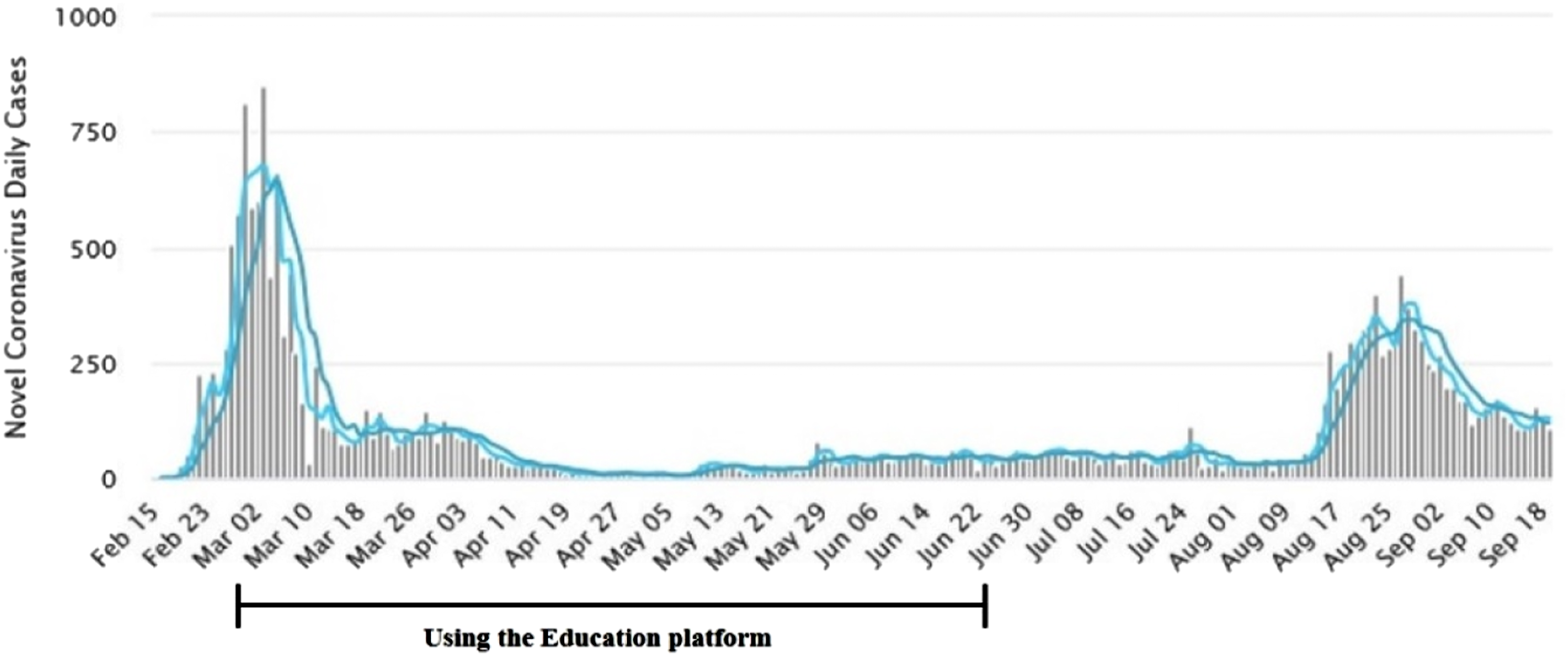
McKinsey and colleagues said that students can postpone enrollment or choose a different school, and over 80% of students would want a tuition discount if they take classes that are completely remote. 4 With the spread of the COVID-19, countries are implementing emergency plans to withhold the spread of the virus and to prepare for a possible longer-term disruption of university attendance. Although this is a strong stress for education systems, it is also an opportunity to develop alternative education opportunities. 5 As the university’s business environment deteriorates, most universities are adopting online education platforms such as CANVAS. The sudden outbreak and spread of COVID-19 facilitates the integration of various learning tools (e.g., Zoom software) into online education platforms and allows faculty, students, and teaching-learning staffs to share different resources, co-create their own value, and help to overcome the COVID-19 crisis. 6
In order to overcome this difficult situation, universities should offer unique and memorable student experience by encouraging interaction between the university and students. This concept has its root in the Service Dominant (S-D) logic, which generates extra values in the two-way delivery of the service. 7 Therefore, engaging students in creating educational value can help tailor education services to the student’s particular needs and assist the creation of a unique experience throughout their higher education years. Therefore, we presented the following research questions: (1) Can the higher education institutions apply S-D logic from a marketing perspective? (2) How can the higher education institutions measure value co-creation? (3) Does the value co-creation of higher education affect student benefits during COVID-19?
Our purpose in this study is to apply S-D logic to a higher education setting in order to help universities survive in a fiercely competitive environment during the COVID-19 pandemic. Details on this are as follows. First, we present how to apply the 10 foundation premises proposed by S-D logic to the higher education setting. Second, based on these foundation premises, we propose the theoretical framework for the value co-creation process in higher education. Third, based on the theoretical framework, we investigate the causal relationship between the dimensions of value co-creation and student benefit by applying the value co-creation measurement proposed by Ranjan and Read 8 to the higher education. This study contributed practically and academically as follows. In practice, this study suggests ways for universities to co-create value and increase resilience in times such as pandemics such as COVID-19. Academically, this study extends the S-D logic theory, which has been widely studied in service marketing, to the higher education environment. This study also developed and applied the value co-creation measurement items that can be applied to the higher education from them generally applied to the service industry.
To this end, we proceed as follows. First, we review the literature on value co-creation, resource integration, and value propositions, and then develop research hypotheses. Next, we offer a research method to prove the hypotheses. In section 5, we test the hypotheses empirically. We then conclude by delineating contributions to research and practice on value co-creation in higher education and discuss areas requiring further research.
Theoretical background
S-D logic in higher education
The COVID-19 pandemic has upended the world of higher education. The pandemic has forced universities into a precarious balancing act between student health and financial survival. Universities face an impossible choice: allow students to return to campus and risk their health, or switch to remote instruction and risk having them not return at all. 9 The direction of education after the COVID-19 needs a plan for value co-creation using the educational platform base. In other words, universities should create a space for overcoming the crisis by means of resource integration between universities, professors, and students. Given necessary closures of universities, they should mobilize different forms of online education and education resources. In addition, in order to increase the resilience of university stakeholders in the COVID-19 situation, it is necessary for university to create a place where stakeholders can interact and collaborate to co-create value, centering on the online education platform.
Value co-creation has changed in recent years from a producer’s point of view to create exchange value to a service provider’s perspective of co-creating value-in cooperation with customers. Vargo and Lusch 7 called the former Goods-Dominant (G-D) Logic and the latter S-D logic. They argued that the four core and fundamental elements of S-D logic are actors, resources, services, and value. Actors are entities that can act purposefully. Services is the application of resources for the benefit of another actor or oneself. Resources are anything that an actor can draw on for value. Finally, value is benefit, an increase in well-being. 7
S-D logic Foundational Premise (FP)a.

aThis is an excerpt from Vargo and Lush 11 .
Second, service providers can make value propositions by means of operant resources integration. 12 In foundation premise seven in Table 1, Vargo and Lusch 7 said that service providers cannot deliver value, but can only provide value propositions. According to Vargo and Lusch, 7 a value proposition is an invitation to participate with companies for benefits. In other words, a value proposition is a set of promised benefits related to expected costs. Value propositions under S-D logic are how service providers co-propose to positively affect their customers. In other words, value is co-created when a customer participates by means of a value proposition. Therefore, customers can co-create value with the company by actively participating in the value proposition provided by the company.
Third, in axiom 2 and foundation premise six (see Table 1) of Vargo and Lusch,
7
customers are always co-creators of value. S-D logic makes it clear that value is customer-centric and co-created by both companies and customers.
13
Co-creation of values consists of the co-production of values generated by value propositions and the concept of value-in-use.
8
According to Vargo and Lusch,
11
co-production is a set of activities carried out by actors. Three underlying elements of co-production consist of knowledge sharing, equity, and interaction. The value-in-use is the customer’s experiential evaluation of the product or service proposition beyond its functional attributes. Three elements that make up value-in-use are experience, relationship, and personalization.
8
We apply the three core concepts of S-D logic to higher education environments, as shown in Figure 2, which presents a theoretical framework for the value co-creation process in the relationship between resources, resource integration, value propositions, and value co-creation in higher education. Value co-creation process in higher education.
Value co-creation
Education is not a standalone product. Education is always a co-created interaction between students and professors. Thus, education always has a foundation based on this relationship. Moreover, higher education involves stakeholders such as students, faculty, and university institutions to produce a variety of outcomes. However, higher education differs from other services in that it is not until years or decades later that the value can be predicted when the experience is used for knowledge applications or career purposes. 14
In S-D logic, value is co-created during the interaction between service providers and customers; as shown in Figure 2, the only result is value co-creation. 15 If the service provider and customer are satisfied with the result of the service provided, value is co-created. However, if there is some misunderstanding of operant resources between the service provider and the customer over the provided value proposition, the value may co-destructed. 16 Thus, operant resources are the most important resources for co-creation of values during interactions between service providers and customers.
In the higher education, actors, who are the basic elements of S-D logic, consist of university institutions, professors, and students as shown in Figure 2. The institution’s resource is CANVAS as the operand. The faculty resources as the operant are professional knowledge, the ability to teach, and the ability to use CANVAS. The student resources as the operant also are the learning ability and ability to use CANVAS. Service is an educational service, and the value is satisfied with all the actors participating in CANVAS. These basic elements form resource integration, value proposition, and value co-creation by means of interaction between the actors described in the previous section. In this study, the value proposition of universities is CANVAS, an online educational platform.
Research on co-creation of value-in higher education has recently begun to receive attention.14,17,18 Dziewanowska 17 proposed three multidimensional factors (co-production, experience, and relations) for value co-creation of higher education institutions using exploratory and confirmatory factor analysis. Dziewanowska 17 revealed factors for value co-creation based on Polish universities, but did not link them to the benefits of actors. Dollinger and Lodge 14 first presented a conceptual model of value co-creation in higher education based on business and marketing literature. According to their study, they suggested that value co-creation can be composed of co-production and value-in-use, but they did not show generalization through empirical analysis. Cho et al. 18 suggested that student-faculty partnerships and support from educational institutions can provide opportunities for value co-creation, and suggested the roles of faculty, students, and institutions for partnership through field studies. They did not show the effect on student benefits through empirical analysis.
Co-production
Dziewanowska 17 defines co-production in higher education as the participation of students and faculty during the service process and their cooperation directly or indirectly, and suggests that it can consist of information access, dialogue, and control. According to Ranjan and Read, 8 co-production with customers is a system that can integrate customer resources, such as knowledge, experience, and opinions, to produce services or products. In other words, the co-production process is to integrate the customer’s knowledge and experience based on the active participation and communication of the customer. Dollinger and Lodge 14 proposed a formative-indicator of knowledge sharing, equity, and interaction to measure this co-production in a higher education. Therefore, since the concept of co-production proposed by Dziewanowska 17 is consistent with the concept of Dollinger and Lodge 14 based on the study of Ranjan and Read, 8 this study is based on the concept of co-production proposed by Dollinger and Lodge 14
Knowledge sharing, the first important element of co-production, is a way to achieve greater innovation by collecting and analyzing consumer knowledge and opinions related to value proposition to find and converge the intersections between organizations and consumers. Ramirez 19 found that when organizations shared consumer knowledge, they had more innovative results than when they did not. Dollinger and Lodge 14 argued that as competition in the higher education market became fierce, user resource integration could help innovate higher education institutions. Spohrer and Maglio 20 also pointed out that the universities providing an environment where students can share knowledge more freely can help innovate services while avoiding future risks. Therefore, knowledge sharing at the university is defined as the extent to which students can integrate knowledge, experience, and other resources with the value propositions offered by the university.
Although knowledge sharing is key to fostering co-production, it is impossible to co-produce without access to the value proposition provided by organizations that allow users to share knowledge and resources. This is equity, the second element of co-production. Equity means the organization’s ability to provide consumers with an equal approach to value propositions. Therefore, in order to improve the co-creation of values, it is necessary to enable all users to participate in the value proposition provided by the organization. 21 Ramaswamy and Ozcan 22 argued that if all consumers have access to value propositions, such as the platform provided by the organization, consumers provide resources such as innovative feedback and ideas. Likewise, in a higher education environment, equity refers to the degree to which students have equal access to value propositions such as the educational platform.
Finally, the interaction between consumers and companies is another important component of co-production and value co-creation, along with knowledge sharing and equity. Interaction is a key service encounter between actors in the value co-creation process. 8 Knowledge sharing, a key element of learning and teaching, stems from this interaction. In a higher education environment such as a university, interaction refers to the degree of integration of resources between the university and students in the value propositions provided.
Value-in-use
Vargo and Lusch 15 used the term “value-in-use” for the first time, insisting that no products or services had value until the consumer added value. Fisher and Smith 23 and Vargo and Lusch 15 linked value-in-use with how to consume or use value propositions provided by consumers’ time, place, and experience. Thus, co-creation of value can be a way to use what is co-produced by organizations and consumers. 24 The value-in-use relies heavily on consumer use to derive value. Ranjan and Read 8 proposed constructing value-in-use as experience, personalization, and relationships. In addition, Dollinger and Lodge 14 suggested that these three components of value-in-use can be applied in a higher education environment.
In general, if a consumer has a positive experience with a product or service, the consumer is likely to have a positive relationship with the service or product, even with the organization. Therefore, with value proposition, user experience is important not only to the organization but also to the consumer. This consumer experience not only repurchases, but also influences brand advertising and future product development. Therefore, experience is an enabler of value-in-use. In a higher education setting, most researchers link this consumer experience to a student 25 or learning experience. 26 Dollinger and Lodge 14 refer to the degree to which the value is given by accessing the value proposition in the higher education environment.
Ranjan and Read 8 include not only the user experience of value propositions, but also personalization to tailor value propositions to user needs, as a component of value-in-use. Therefore, it should be possible for the consumer to change the value proposition to add use, meaning, or value. According to Ramaswamy and Ozcan, 22 more and more organizations are allowing consumers to purchase products or services and change or reconfigure them to suit their needs. Today, this is an example of Samsung Electronics’ refrigerator personalized according to the consumer’s lifestyle. Therefore, in order to maximize the value-in-use, the value proposition must be customized according to the personal and unique needs of the consumer, not by a predetermined method. 27 The personalization of value-in-use in higher education allows students to organize value propositions, such as curricula, to fit their own needs within the learning experience. 14 Today, an example of this is a dual major designing a value proposition to fit a student’s needs. Therefore, in higher education, personalization is defined as the extent to which students customize the value proposition to meet their needs.
The last construct of value-in-use is relationship, which complements the two components of value-in-use, experience and personalization, by forming the overall relationship between the organization and the consumer. This relationship is often based on a collaborative experience that can be created by means of the co-production of organizations and consumers. In a higher education, positive relationships between university and students can influence collaborative behavior. Therefore, the formation of relationships by means of continuous dialogue and a balanced role is the basis of value co-creation. 21 Thus, in higher education, this relationship is defined as the extent to which students experience collaboration with universities.
Student benefit
To date, few studies have explored the outcomes of students and universities by means of a value co-creation framework.8,14,17 Dollinger and Lodge 14 separated these outcomes into university and student benefits. However, according to axiom 4 and fundamental premise 10 (see Table 1) of S-D logic, value is always uniquely as perceived by the beneficiary. 7 Therefore, the outcome of value co-creation should consider only student benefits arising from value propositions. These student benefits are measured by student immersion, satisfaction, loyalty, academic image, etc. It was argued that satisfaction can be an emotional response to a service or product. However, in the marketing literature, consumer satisfaction is defined as the probability that a consumer will repurchase a service or product. The co-participation of consumers in a value proposition can increase customer satisfaction. 8 In higher education, student satisfaction is also be influenced by the degree of participation in the value proposition. 28 Student loyalty, which is increasingly attracting attention in the field of higher education, is measured by the intention to recommend or repurchase a product or service. 29 Finally, in addition to student satisfaction and loyalty to the value proposition, it is a major image. This is influenced by the degree of participation of professors and students in the value proposition. In the highly competitive marketplace for higher education, the images of both a major and of a university are becoming more and more important.
Hypotheses development
Co-production and value-in-use
In general, services are produced and consumed simultaneously. However, Pine and Gilmore 30 categorized them into service and experience economies and suggested differences. Although services are intangible and consumed at the same time as they are delivered, experiences are seen as being memorable and created as experiences for a certain period. The service is co-produced and customized for the customer, but the experience is viewed as highly personalized. Even in higher education, the co-production of educational services by means of the co-participation of professors and students can lead to the creation of personalized value-in-use that can be remembered for a long time by students as experiences.
S-D logic suggests that such co-production activities provide value for consumers. Students can act as value co-creators by interacting during a service encounter by presenting their likes, dislikes, preferences, and expectations. 31 Etgar 32 argued that co-production is directly linked to customization (personalization). The online education platform that becomes a service encounter provides a collaborative environment in which students can participate and interact to acquire and share knowledge. Therefore, interaction between professors and students creates learning experiences, and knowledge sharing between students or between professors and students results in personalization, which meets student needs. In addition, both actors form a high relationship with each other by participating in the equal access to the online education platform. Therefore, the co-production composed of knowledge sharing, equity, and interaction will positively influence the students’ overall experience based on the value propositions provided by the university. Based on this discussion, we set up the following hypothesis:
Co-production (CoP) has a positive effect on value-in-use (ViU).
Value co-creation and student benefit
S-D logic argues that the concept of co-production is only one component of value co-creation. The second component of co-creation of value is a more encompassing concept, determined by the consumer in consumption and use. Value co-creation can increase revisits as well as benefits for students using the online education platform. Ranjan and Read 8 revealed that the independent variable of value co-creation composed of formative-indicators had a strong and significant statistical effect on customer satisfaction. Recently, Jin and Chen 33 also revealed the relationship between value co-creation and user satisfaction on the car online platform. Dollinger et al. 34 suggested also that the formative-indicator measurement of value co-creation would be suitable for a higher education setting, and that it would be related to the student benefits. Despite the fact that co-production can be a prerequisite for value-in-use in the educational environment, the relationship between the elements of value co-creation and the performance or benefit have not been known. Therefore, we will prove this relationship based on the theory of co-production and experience-economy.
The theory of co-production has been defined in various fields from the public sector 35 to manufacturing. This study is based on the theory of co-production based on S-D logic presented by Lusch and Vargo. 23 They defined the concept of co-production as an activity occurring within a production process that precedes use or consumption. In other words, co-production refers to the participation of consumers in one or more activities in a service process. In the service industry, many studies have demonstrated that this co-production affects customer satisfaction and loyalty. 36
Previous studies have shown that knowledge sharing affects productivity and performance of companies based on social-exchange theory, in which the maximum mutual benefit is obtained by sharing knowledge through social relationships and interactions. 37 Malik and Kanwal 38 argued that the knowledge sharing practices of banking, finance, and telecommunication service organizations promote learning commitment, job satisfaction, and interpersonal relationships. Rafique and Mahmood 39 also revealed that knowledge sharing by faculty members has a positive effect on job satisfaction. Chen et al. 40 argued that the availability, interaction quality, and service quality of online education platforms had a strong influence on user (student) satisfaction during COVID-19. Therefore, given this discussion, we set up a hypothesis that co-production consisting of students’ knowledge sharing, equity, and interaction on the online education platform in a higher education environment affect student benefits.
Co-production (CoP) has a positive effect on student benefits (StB). According to the experience-economy theory, service experience can be expressed in terms of value-in-use, such as physical value, social value, economic value, emotional value, and learning value.
41
Until now, studies of the relationship between this experience and customer satisfaction or loyalty under the experience-economy as presented by Pine and Gilmore
30
have received much attention.41–43 In addition, personalization of services also has a significant influence on customer satisfaction and loyalty.44,45 Berg
45
suggested a way to improve customer satisfaction by improving service personalization. In addition, it has also been widely found that the formation of a relationship between service providers and customers affects corporate performance or satisfaction and loyalty as social capital34,46 Therefore, value-in-use, which is composed of experience, personalization, and relationship, also affects the benefits described by satisfaction and loyalty in higher education setting. Therefore, we set up the following hypothesis in the higher education environment.
Value-in-use (ViU) has a positive effect on student benefits (StB).
Methodology
Measures
We developed the survey measures with items validated in prior research (see Appendix A) to measure each construct for our conceptual research model using a 5-point Likert scale, ranging from “(1) strongly disagree” to “(5) strongly agree.” The study used three constructs—co-production, value-in-use, and student benefits—to measure students’ value co-creation in higher education. Co-production was adopted and modified from validated questionnaires created by Ranjan and Read 8 measuring the degree which integrates the students’ knowledge and experience based on their active participation in class. Co-production consisted of knowledge sharing, equity, and interaction, and each consisted of second-order reflective measurement items. In this study, measurement items that were applied to the service industry by previous researchers8,17,47 and verified their validity, were adopted and modified to fit the higher education environment.
Value-in-use was adopted and modified from validated questionnaires created by Ranjan and Read 8 measuring the degree to which students use the education platform that the university provided. 23 Value-in-use consisted of experience, personalization, and relationships, and each consisted of second-order reflective measurement items. In this study, measurement items that were applied to the service industry by previous researchers.8,17,47 and verified their validity, were adopted and modified to fit the higher education environment.
The measurement for student benefits (student immersion, satisfaction, loyalty, and class image) was extracted from Dollinger et al. 34 Each item was partially modified from previous studies related to student loyalty and student benefits.47,48 Since all questions were originally in English, they were translated to Korean for this study. The questionnaire was pre-tested on a student group that was taking courses by means of the education platform of Busan University of Foreign Studies (BUFS) during the spring semester of 2020. We used the information gathered from this pre-test to fix the readability and quality of the items. A list of measurement items was generated to ensure face validity and minimize overlap between constructs. 49
Data collection
Descriptive statistics.

Analysis and model test
We used partial least-squares structural equation modeling (PLS-SEM) to test the conceptual research model using Smart PLS 3.2. According to Hair et al. 50 PLS-SEM has a few advantages over more-often used covariance-based SEM, such as small sample size or a complex model with many indicators. Considering the number of items in this research model, together with the sample size, we believe PLS-SEM is a better alternative for this particular research because it avoids the constraints of LISREL and AMOS. 51 The analysis involves separate assessments of the measurement model and structural model.
Empirical analysis and results
Measurement model
Reliability and validity test.

Discriminant validity test.

Structural model assessment
After confirming the construct measures, we assessed the structural model. First, we examined the collinearity between the constructs before conducting the path coefficient estimation. We examined each set of predictors in the structural model for collinearity; each predictor had a variance inflation factor (VIF) value lower than 5. Following this initial step, we then assessed the significance of path coefficients to investigate the hypothesized relationships proposed by the conceptual research model.
The individual path coefficients of the PLS structural model can be interpreted as standardized beta coefficients of ordinary least-squares regressions. To estimate the significance of the path coefficients, we used bootstrapping with a sample size of 1000, as recommended by Chin.
55
The results of the structural model analysis are presented in Figure 3 and Table 5. Result of hypothesis testing. Path coefficients. *p < 0.01, **p < 0.05, ***p < 0.001.

Looking at the direct paths between CoP and ViU, we confirmed the relationships between CoP and ViU (H1). The standardized beta (β) for the relationship was H1 (β = 0.71, p < 0.001). Thus, CoP has a positive effect on ViU. Second, the direct paths between CoP and StB (H2: β = 0.57, p < 0.001) was supported. Thus, CoP has a positive effect on StB. Finally, the direct paths between ViU and StB (H2: β = 0.57, p < 0.001) also was supported. Thus, ViU has a positive effect on StB.
Finally, the structural model was evaluated by R 2 values of the endogenous variables in the path model. The variance explained by the model in terms of R 2 is 0.49 for value-in-use, and 0.65 for student benefit. Chin 55 describes R 2 values of 0.67, 0.33, and 0.19 in PLS path models as substantial, moderate, and weak, respectively. Hence, the R 2 can be classified as more than moderate.
Findings and discussions
Figure 3 and Table 5 outlines the structural model of this study. The model shows an estimate of all constructs as indicated by the path coefficients. It was noted that the structural paths between constructs were all significant, which means that our research hypotheses were all supported by the current data.
Influence of CoP on ViU
Our results support hypothesis 1: CoP has a positive effect on ViU. The results show that for value co-creation of actors on an online education platform, the co-production turns out to have significant influence on value-in-use. In other words, co-production can be a predictor of value-in-use in a higher education environment. The S-D logic emphasizes that the integration of intangible resources among actors such as knowledge, skills, and capabilities creates value, breaking away from the concept that the product itself creates value. In other words, service dominant logic can maximize service value when customers accumulate experiences using services provided on the platform. Therefore, in order to increase the value co-production of university stakeholders, it is important to first define and integrate resources. In addition, an online education platform should be built as a value proposition that enables knowledge sharing, fair access to the platform regardless of time, place, or device, and interaction between them. For example, video lectures and lecture notes created by professors are provided to students, and the student’s experience of use is reinforced through interactions by means of message boxes of online platform, e-mails, or social media messenger.
One of the key contributions in the S-D logic is that “the customer is always a co-creator of value” (see Table 1, FP6). The service encounter, which is the core of value co-creation, represents knowledge sharing through a series of interactions in the relationship between professors and students. This interaction means that it can be one of the sources of value co-creation. 21 Therefore, students should be viewed as value co-producers or value co-creators, not just consumers. The concept of seeing students only as consumers does not provide a desirable environment for the learning experience, whereas the concept of seeing students as co-producers represents the best learning experience (outcome). In summary, the S-D logic can also be applied in higher education settings, presenting many potential activities for co-creating value with students through online education platforms. Therefore, hypothesis 1 gives answers to research questions 1 and 2.
Influence of CoP on StB
Our results support hypothesis 2: CoP has a positive effect on StB. The results show that co-production not only directly affects the value-in-use, but also affects student benefits consisting of satisfaction and loyalty. So far, student union, 56 learning environment design, 57 and university-related content creation through social media have provided examples of value co-creation using student resources. However, it does not show examples of co-creation of value within the field of teaching and learning. Hence, this study suggests how activities that can co-create values in the teaching-learning domain of higher education affect students’ benefits.
On the online education platform of higher education, interaction, knowledge sharing, and fairness of information access based on the relationship between students and professors co-create values and ultimately improve student satisfaction and loyalty. Existing studies that active participation in students’ learning activities improve learning satisfaction are a concept that views students as consumers.38–40 However, this study expanded the concept of students as co-producers. Viewing students as consumers creates value-in-exchange, while the concept as co-producers creates value-in-use. It is the primary focus of S-D logic. 23 Therefore, co-production through interaction between students and professors not only creates social capital but also increases trust. 44 This high trust not only co-creates value,58,59 but also increases learning satisfaction and major loyalty. The value co-creation process by means of online education platform is where professors and students work together to improve the student experience and strengthen the student’s role as a partner. 18 This can be explained as the process of integrating student and professor resources to promote better activities and experiences. 21
Influence of ViU on StB
Our results support hypothesis 3: ViU has a positive effect on StB. The results show that value-in-use also has a direct effect on student benefits and is more important than co-production in increasing student benefits in an online education platform. These value-sharing activities, such as individual feedback and exchange of individual messages, between professors and students, and learning environments not restricted by time, places, or devices, were found to reinforce student’s memorable and unique experiences. It was found that the core service experience formed during service consumption in the tourism industry directly affects customer satisfaction. 60 Therefore, as in the tourism service industry, students’ learning experiences in online education platform enhance student satisfaction.
Value-in-use introduced by Vargo and Lusch 11 mentioned the importance of intangible relationships in the process of value creation. This led students to perceive educational services provided by the online education platform as benefits in various aspects, such as time, location, and experience. As such, by forming intangible and intimate relationships with students’ major by means of the online education platform, students build satisfaction and loyalty to their professor and major.
There are two core values of a product. One is value-in-exchange and the other is value-in-use. The S-D logic perspective focuses on value-in-use. Value-in-use appears customized and personalized to each actor’s experience by integrating the actors’ operant resources. This maximization of the value-in-use improves customer satisfaction as well as loyalty.41–45 In the higher education environment, as in the general service industry environment, the experience and personalization of educational services acquired through student-faculty relationships based on online education platforms improve student loyalty and satisfaction.
Conclusions and implications
Theoretical implications
In this study, we attempted to examine the effect of value co-creation on the benefits for students with S-D logic theory in the COVID-19 pandemic of Korean university context. First, we tested two higher-order constructs to check their validities representing the relevant variables in the conceptual framework. Second, we confirmed the positive links between value co-creation (co-production and value-in-use) and student benefits. Finally, we extended the current literature by exploring the research context in a higher education setting and used students’ value co-creation as an antecedent for student benefits.
So far, studies on what factors affect student satisfaction and loyalty have been conducted considering students as consumers. 61 Such research only creates value-in-exchange between students and universities, but it is far from creating value-in-use that emphasizes experience and customization. As S-D logic theory was introduced to service marketing, researches on value co-creation have been actively conducted. 62 From this point on, researchers began to view customers as value co-producers or partners. However, research based on the theory of S-D logic has only recently begun in the higher education environment.17,34 Therefore, in this respect this study is a leading research that empirically reveals the factors of value co-creation to improve student satisfaction and loyalty from the perspective of value co-creators based on S-D logic.
Theoretically, this study extends the S-D logic theory by applying the S-D logic, which has been widely studied in service marketing, to the higher education. This study developed and applied value co-creation measurement items suitable for the higher education environment from the value co-creation measurement applied so far in the general service industry. In particular, in times of crisis such as COVID-19, we not only presented a method of measuring value co-creation on the online education platform, but also presented a method of co-creating value through operant resource integration of actors. Lastly, this study was differentiated from previous studies by exploring factors affecting student benefits, such as student satisfaction and loyalty, in value co-creation.
Practical implications
Practically, the findings indicate that, in order to co-create value between students, professors, and universities, it is necessary to have an online education platform that enables the customization of students as well as knowledge sharing with students through relationship formation and interaction between these actors. Essentially, this study helps university stakeholders to (1) understand the value of online education platform, (2) understand the diversification of online education modalities, and (3) understand the perspective of students as co-creator. First, universities should be able to provide an educational platform as a value proposition of value co-creation. Depending on which online education platform is used, the degree of engagement, interaction, experience and personalization of university stakeholders can be different significantly. Therefore, universities should provide an open education platform that allows stakeholders to create personalized learning experiences through knowledge sharing through co-participation with easy access anytime, anywhere, on any device. Second, in times of crisis such as COVID-19, universities should be able to offer a variety of educational modality, from full face-to-face education to full online education, depending on the severity of the crisis to increase stakeholders’ engagement. Cho 6 presents synchronous and asynchronous remote video lectures during the stay at home stage of the COVID-19 crisis, and blended and hybrid learning methods, which are a mixture of face-to-face and non-face-to-face lectures during the intermediate stage. This can increase stakeholders’ engagement and interaction to co-create value-in co-production and value-in-use, which in turn can increase student benefits. Therefore, universities must provide tools that can implement various educational methods by crisis levels and deliver efficiently educational services on the online education platform. Third, university staff and professors must recognize students as value co-creators and at the same time provide personalized education services to students to enhance student benefits. In other words, the G-D logic approach based on student demographic market segmentation is no longer sufficient today. University staff and faculty must explore detailed background information about each individual student, as well as tailor interactive educational services based on individual student characteristics. This can improve the quality of teaching services, improving student satisfaction and loyalty, as well as increasing students’ resilience in times of crisis such as COVID-19.
Limitations and future works
Despite these implications, this study has several limitations that need to be addressed in future studies. First, we focused on local university with a high percentage of female students in Korea. Future work will require a study that selects several universities nationwide. In addition, it is judged that it is necessary to establish a gender-differentiated education policy by comparing the differences between male and female students regarding the degree of co-creation of values, the degree of participation in education, and the degree of benefits in the online education environment. Second, this study was based on Ranjan and Read’s research 8 on the value-in-use of value co-creation at the time of consumption. However, this value-in-use can be formed before, after or during consumption depending on the object of value co-creation. 63 For example, university brand value can be formed during, before or after students’ experience on educational services. Therefore, it is judged that future research on the co-creation of university brand value will be meaningful in deriving directions for university brand improvement. Third, this study relied on surveys to draw conclusions based on quantitative analysis. However, in reality, active participation of staff, professors, and students around the educational platform creates a large amount of big data. From the perspective of big data analytics, it is judged that the quality of online education can be improved by analyzing traffics, learning and educational behaviors of participants from the data generated through the integration of operant and operand resources. 64 Finally, although university faculty and staff should pay attention to the emotional changes of students and to physical and mental health during a crisis such as COVID-19, we did not consider the emotional factors based on social support theory. 64 Value co-creation may also differ in the quality of a university’s stakeholder relationships. Therefore, it may be interesting to study the value co-creation of universities based on social support theory and relationship quality theory.
Supplemental Material
sj-xls-1-enb-10.1177_18479790211058320 – Supplemental Material for An effect of value co-creation on student benefits in COVID-19 pandemic
Supplemental Material, sj-xls-1-enb-10.1177_18479790211058320 for An effect of value co-creation on student benefits in COVID-19 pandemic by Byung–Hak Leem in International Journal of Engineering Business Management
Footnotes
Acknowledgments
This work was supported by the research grant of Busan University of Foreign Studies in 2021.
Declaration of conflicting interests
The author(s) declared no potential conflicts of interest with respect to the research, authorship, and/or publication of this article.
Funding
The author(s) received no financial support for the research, authorship, and/or publication of this article.

Supplemental Material
Supplemental material for this article is available online.
Questionnaires: List of items by construct and measurement
Construct
Measurement
Measurement items
Related papers
Co-production (CoP)
Knowledge sharing
K1
The professor was open to my ideas and suggestions for existing or new learning content
Ranjan and Read (2016)
8
, Dollinger et al. (2018)
34
, Dziewanowska (2018)
17
K2
The professor provided enough explanation and information for me to learn
K3
I was willing to spend my time and effort to share my ideas and suggestions for learning with the professor
K4
The professor provided an appropriate environment and opportunity to provide my suggestions and ideas
Equity
E1
I could easily access the learning content in e-class (including Zoom) according to my interest level
Ranjan and Read (2016)
8
, Dollinger et al. (2018)
34
, Dziewanowska (2018)
17
E2
The learning content provided by the e-class (including Zoom) was consistent with my learning needs
E3
I thought my role was important in the learning process through e-class (including Zoom)
E4
The professor and I used the best communication channels to share learning results
Interaction
I1
I was able to express my needs conveniently during the e-class (including Zoom) learning process
Ranjan and Read (2016)
8
, Dollinger et al. (2018)
34
, Dziewanowska (2018)
17
I2
The professor gave me enough information related to learning through e-class (including Zoom)
I3
Me and the professor interacted sufficiently during the learning process through e-class (including Zoom)
I4
During the course of learning through e-class (including Zoom), I played an active role in interacting with professors to get the most out of knowledge
Value-in-use (ViU)
Experience
X1
Learning through e-class (including Zoom) was a fresh and memorable experience for me
Ranjan and Read (2016)
8
, Dollinger et al. (2018)
34
, Dziewanowska (2018)
17
X2
I felt that learning through e-class (including Zoom) differed depending on my participation
X3
During the learning process through e-class (including Zoom), I was able to do something useful for me by challenging new things
Personalization
P1
I felt that the benefits, values, or enjoyment of learning through e-class (including Zoom) depends on my role and environment
Ranjan and Read (2016)
8
, Dollinger et al. (2018)
34
, Dziewanowska (2018)
17
P2
During learning through e-class (including Zoom), the professor tried to meet the individual needs of each student
P3
During learning through e-class (including Zoom), I felt that participation in learning activities varied depending on my taste and knowledge
P4
The e-class (including Zoom) provided a good overall learning experience beyond functional benefits
Relationship
R1
I felt that the university needed e-class related promotional activities in order for students to be completely immersed in learning activities through e-class (including Zoom)
Ranjan and Read (2016)
8
, Dollinger et al. (2018)
34
, Dziewanowska (2018)
17
R2
During my learning activities through e-class (including Zoom), I felt an intimate relationship with my major
R3
I participated in study groups, clubs, or networks that can become fans during learning activities through e-class (including Zoom)
R4
During the learning activities through e-class (including Zoom), I felt that my relationship with my major or professor could be improved depending on the word of mouth of social media (including everytime) that students use a lot
Student benefit (StB)
B1
I was able to immerse myself in learning activities through e-class (including Zoom)
B2
I have improved overall learning satisfaction through e-class (including Zoom) learning activities
B3
I would recommend e-class (including Zoom) learning activities to colleagues, seniors, and juniors
B4
I felt that my major image was enhanced through e-class (including Zoom) learning activities
References
Supplementary Material
Please find the following supplemental material available below.
For Open Access articles published under a Creative Commons License, all supplemental material carries the same license as the article it is associated with.
For non-Open Access articles published, all supplemental material carries a non-exclusive license, and permission requests for re-use of supplemental material or any part of supplemental material shall be sent directly to the copyright owner as specified in the copyright notice associated with the article.
