



Abstract
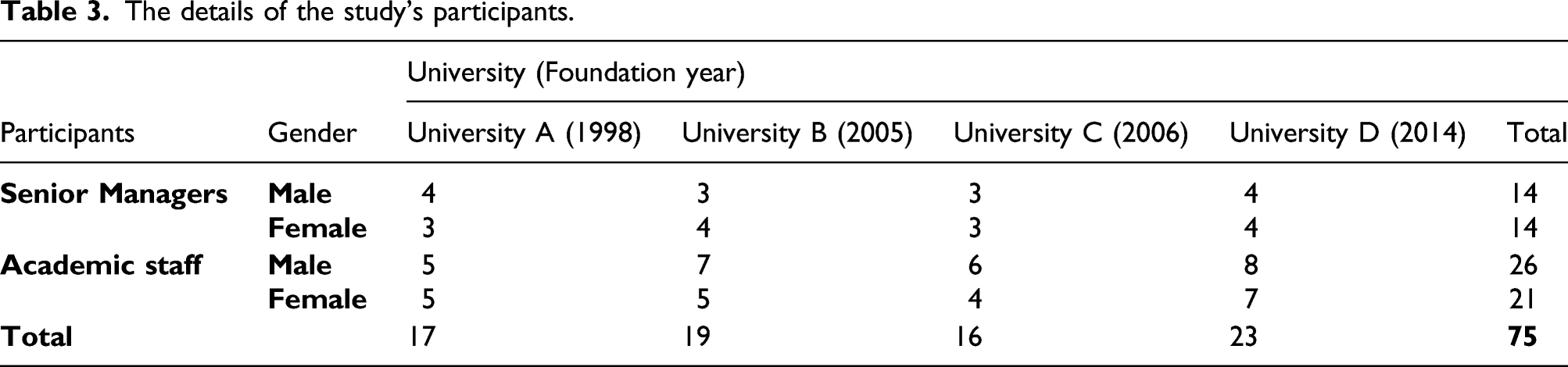
This research examines the problems encountered by the Training Needs Assessment (TNA) system from the perspective of faculty members and Human Resources (HR) managers in emerging public universities in the Saudi Arabian Higher Education sector. It aims to understand how problems with this will affect the success rate of Training and Development (T&D) curriculums. The research comprises an analytical study using a case study method of analysis. Qualitative data collection was carried out using semi-structured interviews with 75 senior managers and faculty members of four selected universities, selected using purposive non-random sampling. The data was analysed using Thematic Analysis (TA). The results highlight the insufficiency of the TNA techniques applied to ascertain training requirements. The primary obstacles to successful TNA were inadequate HR processes, insufficiently experienced HR directors, poor engagement, and favouritism concerning the selection of candidates for T&D. These issues affect the enthusiasm of those in the department. Additionally, resources required for T&D, particularly time and money, are misused, which could influence the growth potential of the universities against the country’s Vision 2030 plan. The findings indicate procedural differences in selecting and approving staff requests for Human Resource Development (HRD) support, managerial discretion in selecting participants for HRD programmes, and selective or restricted access to HRD programmes for foreign-born employees, which raises significant questions about equality policies. This study is unique as a contribution to the literature in exploring the challenges faced by the TNA process in Saudi Arabian Higher Education, therefore broadening understanding in the field as a whole, especially concerning the developing countries and Gulf Cooperation Council of Nations. The study concludes that there is currently unsatisfactory commitment in determining the staff training needs by the HR departments of Saudi Arabian public universities, which damages morale and leads to a lack of faith between HR directors and departmental staff. Finally, this study contributes to the area of policy decision-making by reporting the present situation surrounding the issues related to the application of TNA in T&D.
Keywords
Introduction
Training and Development (T&D) is among the most critical activities to improve productivity in an organisation and give it a competitive advantage. 1 Training is necessary for the workforce to acquire the knowledge, skills and attitudes needed to effectively carry out their jobs as greater knowledge and practice in tasks increases competency. 2 According to Gómez-Mejia et al., 3 our behaviour changes in the process of learning new knowledge and skills, thereby bringing about greater competence in accomplishing results.
Training can help overcome the performance issues triggered by a lack of adequate job knowledge on the part of the staff. In many organisations in Arab countries such as Saudi Arabia, T&D is not considered essential or a major contributor to success. According to Abdalla, Maghrabi and Raggad 4 found that while Arab countries engage in certain aspects of T&D management, significant deficiencies remain in Training Needs Assessment (TNA), which is a primary element to determine who needs to be trained, where training is needed and what training needs to be conducted. 5 According to Mayombe 6 maintains that the TNA process is one of the most important factors in the success of a training programme, stressing that it can improve the accuracy of the identified needs and their fulfilment. It is therefore considered imperative in the implementation of T&D as its advantages when appropriately implemented include more efficiency in the cost of training and inspiring staff to improve their performance. 7 TNA resources are particularly crucial for public universities in Saudi Arabia to enhance employee performance and stimulate growth in the institution.
Although there is considerable literature on TNA for different institutions and organisations, there is little surrounding its application and challenges in public universities, especially in Saudi Arabia. To address this, the current empirical study aims to identify the key challenges of TNA programmes in Saudi Arabian public universities alongside a critical review of the relevant T&D literature, to understand its challenges, theory and practice and the factors which influence the effectiveness of T&D in public organisations. This should fill the gap in the literature brought about by the lack of research on the challenges of TNA in public universities in the Middle East (particularly Saudi Arabia).
Research is making it increasingly clear that numerous issues in HR operations such as poor wages and the absence of performance assessment benchmarks are prevalent in developing nations,8–10 as well as issues with poor Human Resource Development (HRD) analyses in the Gulf Cooperation Council (GCC) of Nations, especially Saudi Arabia.9,11 Thus, the present study aims to evaluate the challenges being faced by TNA programmes in public sector universities in Saudi Arabia from the management and academic staff perspective.
Review and theoretical framework
Training and development (T&D)
Definitions of T&D from different scholarly sources.

Training Needs Assessment (TNA)
Overview of TNA
TNA is defined as an in-depth study by an establishment to assess staff performance and identify problems to determine why they exist and what remedial approaches can be carried out through training. 25 Goldstein 26 also defined TNA as the stage of the teaching system that supplies the relevant data for creating a comprehensive T&D curriculum. T&D functions can be understood at this phase regarding its complete progression and objective, with training deficiency regarded as the variation between present performance and the mandatory benchmark concerning the work.
As TNA forms the initial feature in any function of T&D, the research begins with a ‘necessity’ that can be ascertained via multiple methods but is mostly denoted as a harbour between what is instantly accessible, what is required in the present and what is required thereafter. Hence, it is not a standard operation and must be implemented with care through a diagnostic approach. TNA simply means an ongoing data reservation procedure to determine current training requirements so training can be improved to help the establishment accomplish its objectives.27,28 It is also a ‘system of storing data regarding a conveyed or a company’s suggested requirement that could be fulfilled by organising training’. 20 Put simply, TNA is a system through which a trainer outlines training guidelines following the storage and evaluation of the accessible data.
Mayombe, Burke and Cocoman Hussain and Taylor and O’Driscoll6,29–31 noted that developing and developed countries face several serious challenges with TNA and employee development including inadequate funding, insufficient literate instructors, poor remuneration of facilitators, a dearth of skilled manpower and favouritism. Training requirements can be discovered and evaluation of the range and class of essential resources to fund the training carried out through the TNA procedure, 32 but as environmental aspects can affect the T&D system in terms of its complete effectiveness, 33 training must never be examined during the original phase. The T&D method should be sufficiently flexible to re-examine T&D requirements at every phase to handle any critical requirements. TNA aims to bridge the gulf between the present output and the desired one. T&D comprises identifying requirements by creating a sequence of investigations in and out of the company to outline guidelines matching these requirements. To meet the goals and requirements of the company, the interrelated needs of the enterprise, groups and individuals are highly significant elements in estimating T&D requirements. 32 The training must match the corporate plan and values to accomplish the company’s objectives.
Armstrong 34 suggested a ‘Deficiency Model’ as a crucial technique to determine training requirements as analyses the gap between people’s ability and knowledge, allowing a judgement to be made on what they should learn and can implement. The model illustrates the elements of training in terms of ‘given’ expertise and skills and ‘sought-after’ expertise and skills. Similarly, Roger 35 noted that the objective of implementing TNA is to gain knowledge about ‘preferred’ expertise or performance and ‘present verified’ expertise or performance. It also incorporates the reasons for learning issues, resolutions and the beliefs of various stakeholders and trainees. Training can be an effective way to address poor results if it is implemented following a successful analysis. For example, training is not always the answer to problems occurring due to a bad system design, too few employees or insufficient resources. 36
In these sorts of situations, upskilling staff may not rectify the issues, so training may be a waste of time and resources. As Goldstein and Ford
21
pointed out, the four diagnostic phases, including company backup, are essential to discovering efficient training requirements (Figure 1). Deficiency model. Source armstrong.
34

Challenges facing TNA
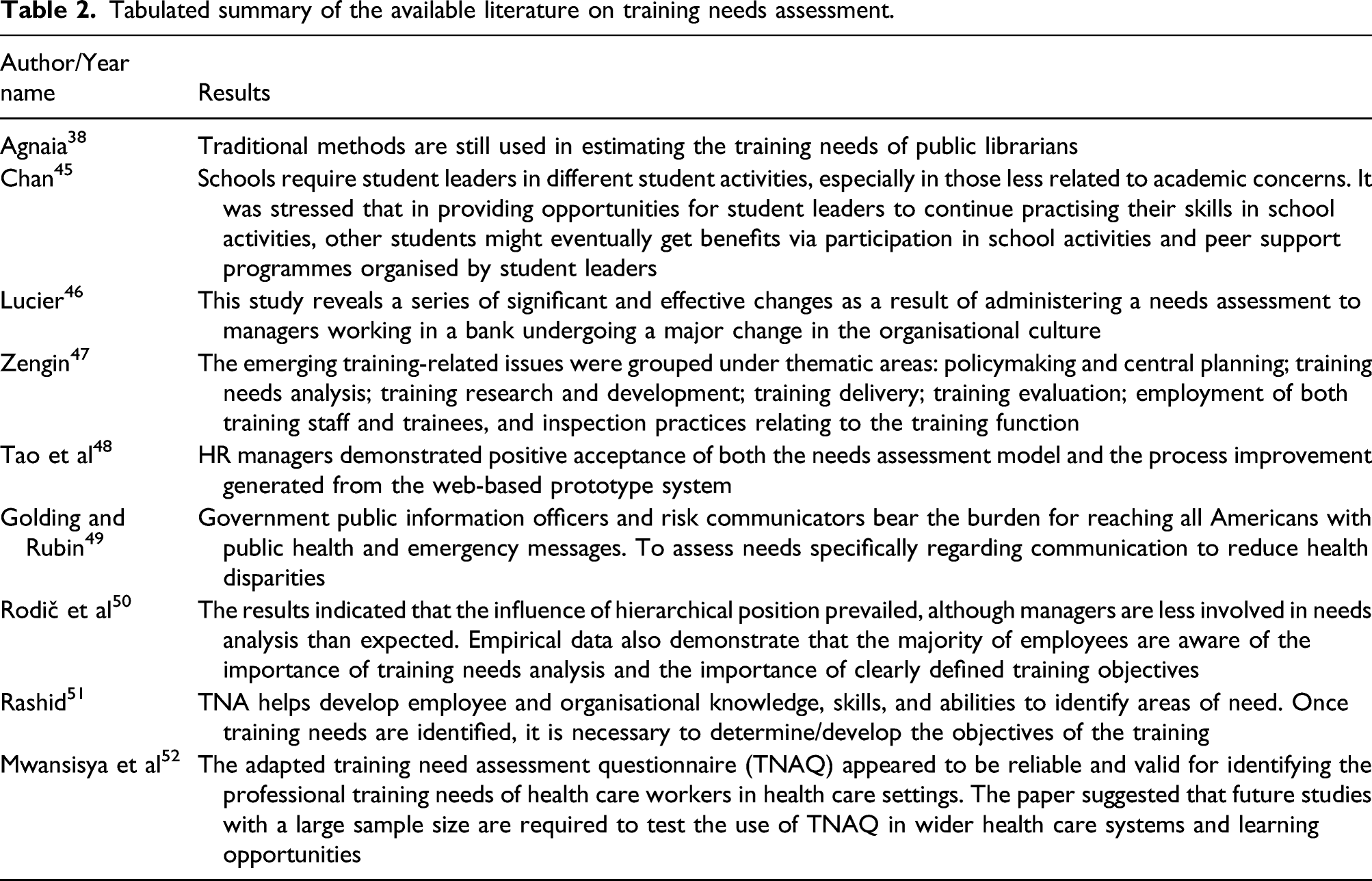
There is significant debate surrounding the importance of TNA with some sources implying that many companies do not regard TNA as a priority. 10 According to Turwelis, 37 one cause of insufficient TNA practices in organisations is a lack of clarity on who is responsible for what. Agnaia 38 found that managers who are in charge of assessing training needs are not usually specialists and lack the necessary skills and knowledge to perform their tasks. The same research argues that bosses assessing training needs by performance records may not reflect reality because this is subject to family, nepotism, kinship and personal relationships between the supervisors and employees. Abdullah 39 also stated that the absence of needs assessment and analysis is due to a lack of expertise. Earlier, Abdalla and Al-Homoud 40 found that there are no specific procedures for determining training and educational needs due to a lack of reliable information, and turbulent political, economic and social environments. Other Arab researchers add to these the lack of job descriptions and clear performance appraisal and maintain that the approaches used to assess employees’ development needs tend to be impressionistic and generalised rather than systematic. 41
These problems should be addressed appropriately. According to Ludwikowska, 7 many training programmes, instead of identifying needs, are based on tests and errors and not conducted fairly. Nankervis et al. 42 argued that a large number of organisations do not implement TNA properly and sufficiently as they see the analysis of training needs as expensive and time-consuming. Anderson et al. 43 previously noted that TNA is rare, and stated that most organisations follow traditional, office-based procedures, which are unsystematic, in line with various internal and external pressures. Mayombe, Burke and Cocoman, Hussain and Taylor and O’Driscoll6,29–31 are some researchers who have studied the challenges of TNA and the development of staff.
Tabulated summary of the available literature on training needs assessment.
Methodology
Study design
The research is based on the qualitative research approach; therefore, it can be regarded as an exploratory type. It was aimed at analysing and exploring the challenges that are faced by the T&D. The research was conducted in four public universities in the Kingdom of Saudi Arabia and had the choice of selecting between an inductive approach or a case study design approach. The inductive approach was considered suitable since a significant research was unavailable in the context of Saudi Arabia53,54. The data of this study was collected by using in-depth, face-to-face interviews. The interviews were semi-structured, and the interview guide provided a broad scope and much flexibility to discuss in detail several T&D issues within Saudi’s public universities.
Sampling
The details of the study’s participants.
Data colocation
The choice of a qualitative research approach for this study was driven by the need to draw from a dataset consisting of rigorous interviews conducted in Arabic, as this is the official language of Saudi Arabian Higher Education institutions. While the interviews were conducted in Arabic, they were transcribed and translated into the English language for thematic analysis. The translations were reviewed by an independent party to ensure accuracy. To ensure consistency in interpretation during the interview between the interviewer and the interviewees, ‘community of interpretation’ 57 was considered to ensure that all participants understood the purpose of the study before the commencement of the interviews. Thirty-one participants were interviewed face-to-face (interview time 65–70 min), and all were audio recorded, and transcribed verbatim. As a result of the COVID-19 pandemic, 44 interviews were conducted online using Skype and Zoom. These video conferencing technologies have been reported to provide leverage to qualitative research. 56 Findings of the on-site reviews were supported by documented records and literature sources obtained from HR research publications, websites and reports from the Saudi Ministry of Education
Data analysis
For analysing the collected data, the present study used a framework analysis. This method has become more popular within the public sector. 56 In the present study, the primary role of the framework analysis technique was to deliver an in-depth comprehension of the public universities. This function is well matched to this study’s purpose, whose aim is to explore the challenges met by Saudi public universities in TNA. The framework analysis technique is primarily employed when analysing semi-structured interviews and other kinds of textual data. 57 An advantage of this technique is that it is flexible and can be applied to a number of studies with varying epistemological assumptions. 57
Findings
The thematic analysis carried out on the data collected for the present study led to the formulation of one key theme and two subthemes.
Senior management perspective
This is a key point concerned with exploring the challenges encountered when determining T&D needs within public universities. It implies the investigation of these challenges, and the assessment of T&D needs is based on the view of academic staff and the experiences of senior managers. This key theme includes the subthemes given below.
The senior university managers were asked how they determine faculty members’ training needs and explore the defects. Thirty-four participants reported that they used no specific method for this, as Participant A003 noted:
There was no method for determining the training needs for either the faculty members or staff in the college, only the Deanship of Development and Quality was the one who proposed the courses, and the training needs were randomly selected.
Another participant pointed out:
Faculty members were nominated based on their availability to attend a course rather than their actual needs. Hence, there was no scientific or particular method for determining the training needs of faculty members.
On the other hand, some participants reported that the universities used questionnaires to determine training needs:
The method used to determine the training needs involves distributing a questionnaire to faculty members that include courses that the university intends to offer. The faculty member arranges those courses according to their importance, but often we cannot find the T&D we need, which makes me believe this method cannot assess our real needs. The training administration also announces the training programmes that it will provide hereafter, and the faculty members are randomly nominated to participate in those programmes.
Figure 2 summarises the methods used to determine T&D needs in the emerging public universities used in this study in Saudi Arabia. Methods used to determine T&D needs.
Lack of proper communication and coordination
The majority of the participants identified a lack of proper communication and coordination as a challenge in determining faculty members’ training needs. A communication barrier was identified between colleges and the deanship that designed the course with some senior directors noting that university policy is the reason for this barrier. Furthermore, several interviewees reported no communication of any kind with the HR department at any stage of the training programme because there is no policy in place to encourage and organise communication. Concerning this, an HR director with 13 years of experience gives the reason stated:
The number of faculty members is huge and is distributed among the university branches in various regions of the Kingdom; this hinders communication with the faculty members to determine their training needs because there is a lack of direct contact with the trainees, which I believe affects determining the training needs and that becomes a challenge faced in the HR department.
An overlap between the colleges in terms of their T&D needs makes this process even more difficult and generates unnecessary delays as was supported by another HR manager:
We in the HR division cannot manage a large number of employees, especially in the university, because every college has different training needs; for example, the academic staff in the medicine department need other T&D programmes than the school’s management staff. Can you see how this makes it challenging to build training programmes for every college? (A008)
Concerning the key theme about the challenges encountered in determining T&D needs, several senior managers noted the lack of cooperation and willingness to participate in determining training needs as another challenge that they face as decision makers. Participant A013 noted:
The targeted faculty members are not convinced of the importance of determining training needs, so we cannot get accurate data from them, making this a real challenge for the HR department. So, for us, it is hard to create T&D programmes without exact data.
A number of senior managers complained about university policies which do not oblige a faculty member to participate in the training needs process, making it challenging to manage them and accurately determine their T&D needs. A senior director supported this by stating:
There was no policy that would oblige a faculty member to participate in the training process, making it difficult to control them. For example, last year, we sent about 100 surveys to the management staff to determine the training needs, especially in research methods. Nevertheless, we received only eight surveys in the department. That means there is no cooperation between the employees of the training department and the workers of other departments, which affected us in making decisions. (A013)
Although many deanships and units design and execute some Human Resource Management (HRM) functions, they often fail to coordinate. Consequently, various HRM procedures and practices have been established in different departments, resulting in distress among staff who have to work across contrasting procedures. This directly violates the principle of procedural justice and fairness. For example, the immediate supervisor of academic employees is usually responsible for assessing employee performance and determining their training needs, but the deanship responsible for T&D ignores the input of these school and departmental heads when determining and selecting the employees for it. This implies that the T&D programmes identified by the deanship may not match the real training needs of the staff. Therefore, it can be argued that the training programmes are not based on a proper evaluation of staff training needs, which are often determined by examining employees’ performance, the details of which should be documented in performance evaluation reports. One participant said:
Even though the university conducts training and development, the training is not based on a strategic plan. This means that the universities’ training programmes are not based on actual need. They are done in a manner that is disorganised. (A008)
Academic staff perspective
Lack of competency to determine needs
Several participants highlighted the importance of the perception that it was the people responsible for determining T&D needs in the university who were not competent, as they do not correctly identify these needs. Many participants believed that these people lack experience in this aspect of the job, such as participant B017:
The people working in the administration who are responsible for training are not specialised and do not have sufficient experience to determine the faculty’s actual needs.
Another participant supported this:
The people responsible for training are not specialists and do not have sufficient experience to determine the training needs or manage the training process. This leads to poor T&D outcomes in Saudi universities. (B017)
Some of the participants showed dissatisfaction with the level of experience of HR staff and doubted their ability to select staff for T&D programmes. Another significant challenge noted is duplication of roles when it comes to T&D management. This results from an overlap in the determination of T&D needs and supervision between several deans within the university and the Deanship of Faculty and Personnel Affairs. Participant B012 noted that:
In my view and after 15 years of experience in the university, the challenges we face to determine T&D needs of staff programme can be appropriately ascertained, which is due to the lack of professional people with experience in the HR department to determine T&D needs. They cannot develop training programmes that can be adopted to increase the skills of faculty members while at the same time linking them with the university goals. However, what I see are just the same training every year and mere repetition. There seems to be a lack of concern and responsibility of the HR division to develop the modern techniques in determining training programmes for academic staff.
Adding to the idea of the duplication of roles, some participants suggested that employees’ needs are not always considered when determining T&D needs. They believe that this is a defect within the HR system. There is further evidence pointing to the restricted role of HR departments and how other departments often overlook them, implying a lack of recognition and credibility in HR departments. Participant B006 reported:
The training programmes are not designed according to the needs of the trainees. There is a gap between the design of the training and what we need as faculty members. The universities also depend on commercial entities to design training programmes, which often made training packages suitable for all parties and did not consider the needs related to specific beneficiaries.
Partiality when selecting participants
A number of participants expressed discontent as a result of perceived bias in the selection of candidates for T&D programmes, stating that training needs were determined based on personal relationships. Participant B006 said:
Channelled and interpersonal relationships are the challenges that the administration faces in determining the need for training. Also, we can see the same person attending the T&D programmes many times. Also, these people who have a good relationship with the HR managers get a chance to apply for many development programmes, so this makes me unhappy, to be honest.
This was echoed by Participant B008:
Participation in training courses was limited to individuals whom the administration had previously nominated. This nomination was often based on the personal relationship and not on the actual need. For example, we can see the same group of academic staff selected for T&D courses every year. Some of them have attended the same programmes twice, which, to be honest, affects our career growth and the overall atmosphere in the department.
The data also shows that Saudi nationals are treated better than foreign nationals when it comes to distributing T&D opportunities. In principle, T&D programmes are designed to support employees without regard for their nationality, but it is evident from the data that employees born outside Saudi Arabia were only offered in-house (internal) opportunities, while external opportunities seemed to be reserved for Saudi national employees. Although the non-Saudi participants stated their belief that T&D programmes could help them improve their teaching and research skills, they are unable to access these programmes. Article 27 of the Charter for Employment of Foreign-Born Workers stipulates that ‘the University President may, on the recommendation of the Departmental Faculty Board and then the College Faculty Board, allow a faculty member to attend a conference or symposium, without the university bearing any expense’. Notwithstanding the reality that this law is not by itself discriminatory, it provides deans with an excuse to be involved in unequal treatment of foreign-born employees when it comes to dispensing T&D. One non-Saudi employee said:
It appears the university policy does not provide us, non-Saudi citizens, the opportunity to participate in development programmes because the focus tends to be more on Saudi faculty than the non-Saudi faculty with regards to training and development. Because of this, we can feel that there is a gap between us. I hope that the university will allow us to attend training and development programmes in the same way it does for citizens of Saudi Arabia.
It is clear that even though both Saudi and non-Saudi employees feel that they need greater access to T&D opportunities, foreign-born workers feel they are not provided with the same opportunities as those born in Saudi Arabia, as they are mainly offered in-house training. Participants noted that this leads to differentiation and inequality between Saudis and people from other countries working in the Kingdom, despite the fact that employment contracts require all staff members to contribute to the advancement of teaching and research and support the institutions that employ them to become world-renowned places of learning. Foreign-born Participant B012 stated:
The targeted participants of training courses are the Saudi faculty members instead of the non-Saudis; therefore, the need is determined based on specific faculty members' situation. This makes us disappointed as non-Saudi staff, and this affects our performance. Also, there is no support for non-Saudi faculty members to attend and participate in conferences. The motivation that makes me publish research work is to get a promotion to associate professor.
Discussion
Building robust human capital is essential for any organisation to achieve a competitive advantage. As part of its Vision 2030 plan, the Saudi Arabian government aims to develop its human capital, which has afforded the opportunity for this study. The findings highlight several tensions and challenges which affect the implementation of TNA for faculty members in public universities in Saudi Arabia and it illuminates the real situation regarding HRM processes and practices in Higher Education institutions.
The first problem identified is the lack of any method for determining training needs, so there can be no clear programme goals. This finding was consistent with Braun and Clarke
58
and Armstrong
34
who argued that if clear objectives are not set in a training programme, it is less likely to succeed. The findings of this study have shown that the majority of T&D programmes seem to be based on the programme creator’s own desires and beliefs rather than actual employee training needs. This was also consistent with Ludwikowska,
7
who found that a large number of training programmes are based on personal wants rather than identified needs, and that TNA is based on trial and error and conducted unfairly. Further, it was found that some managers believe that determining training needs represents too great a cost for the university, just as Nankervis et Al.
42
reported when they stated that most organisations either do not properly implement TNA or do not perform the process at all due to a belief that it is costly and time-consuming. In fact, most of the senior managers interviewed agreed that they failed to determine training needs. Figure 3 shows the most common challenges for top management in this process. Senior management perspective on the top management challenges.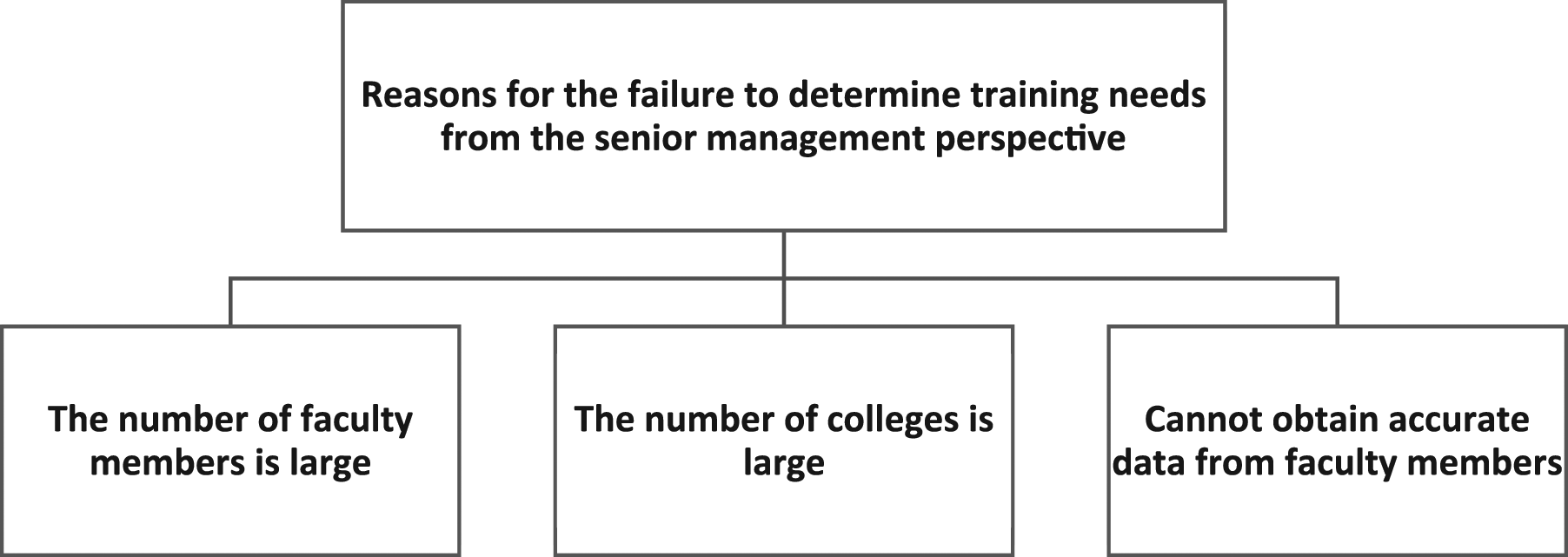
All of these reasons indicate the weakness of HRM in Saudi Higher Education institutions and provide evidence that those responsible for determining training needs are not specialists and lack the necessary skills and knowledge to perform the task. Most of the academic staff interviewed voiced this view, such as Participant B017:
The people working in the administration who are responsible for training are not specialised and do not have sufficient experience to determine the faculty’s actual needs.
This finding agreed with the work of Agnaia 38 who found that the managers in charge of assessing training needs very often lack the necessary skills and knowledge to do this, and Abdullah, 39 who stated that the absence of TNA and analysis is the result of a lack of expertise.
Secondly, this research study found the existence of discrimination between foreign-born and Saudi national employees regarding how T&D opportunities are assigned. The concept of justice is interpreted as a positive link between an individual’s contribution and the returns they receive, so inequality is perceived when an individual is made to believe that their contribution is worth less than the contributions of others. 59 The findings suggest procedural differences in the compilation and approval of staff requests for T&D support, management control in selecting participants for T&D programmes and selective or restricted access to such programmes for foreign-born employees compared to their Saudi counterparts. The differences in job contracts between Saudi and foreign-born staff explicitly demonstrate institutionalised inequality patterns between the two cohorts. Saudi academic staff enjoy greater job security via tenure or permanent contracts while foreign-born staff are offered temporary contracts with renewal opportunities based upon discretionary performance standards. 60 The evidence also refers to Saudi universities focussing on the career development of Saudi academic staff by preferentially promoting and offering external T&D opportunities such as conferences, workshops and seminars abroad. While this may be justified by the argument that investment in the national workforce is likely to build human capital for the region, 61 the real-term effects of this perceived inequality include reduced morale, and therefore productivity, among foreign-born workers, and they may directly limit their research output and choose not to share knowledge or collaborate with Saudi nationals to pursue research.62,63 Perceived inequality undermines motivation by eroding the underlying role of fairness in the system of input–output ratios. 64 Some Saudi universities defend the practice of reserving external training opportunities, particularly those which take place abroad, for Saudi nationals by referring to the fact that foreign-born employees are on renewable contracts which they can terminate at any time, therefore representing a more risky training investment. Although this assumption appears reasonable, it typically reduces the university’s ability to develop sufficient human capital given that the majority of Saudi academics are foreign-born. Indeed, the real benefits of T&D lie in enhancing the capacity for Saudi universities to gain global recognition by increasing the abilities of individual academic staff regardless of nationality distinctions.
Perceived inequality can impact foreign-born workers’ organisational commitment and contribute significantly to adverse outcomes such as reduced productivity.64,65 Organisational psychology research has shown that perceptions of managerial discrimination are related to stress, which leads to psychological pressure, decreased organisational commitment and reduced job performance. According to Ybema et al. 66 , as a result of the perceived lack of procedural and administrative justice required to support their career growth. 66 This similarity suggests widespread inequality throughout the sample which explicitly undermines the knowledge-sharing capabilities of foreign-born workers, creating long-term implications for building Saudi universities’ institutional and human capacity. Drawing from the literature around the transfer of knowledge, Cabrera and Cabrera 67 argued that knowledge-sharing among key staff is an essential component of a knowledge-flow mechanism driven by knowledge creation and integration. The psychological aspect of employee knowledge-sharing behaviour recognises HRM activities as a necessary prerequisite for promoting knowledge-sharing in organisations. 68 HRM practices which encourage knowledge-sharing include HRD (or T&D), work culture, work implementation and quality evaluation. 69 The perceived inequality in Saudi universities is likely to contribute to the psychological burden on foreign-born workers, which decreases their efforts to change and consequently affect the government’s ability to build globally recognised academic establishments and improve the country’s human capabilities. 59 Recruiting international employees has significant advantages, such as the availability of expertise to enhance university performance, filling skills’ gaps, growing university diversity, networking opportunities and strengthening the skills and capabilities of local staff through information-sharing with foreign-born academics. 68
Thirdly, several HR directors described the challenge presented by faculty members who lack cooperation and involvement, which could be a result of poor HR practices. Indeed, research suggests a link between a lack of HRM and employee motivation. The wage hypothesis
70
states that staff decide to continue in an organisation when HR operations enhance their value but resign when their perceived usefulness declines.24,71,72 This was made clear by Participant A014, an HR manager, who said:
I still remember last year when we sent about 100 surveys to the management staff of the school to determine the Training Needs Assessment, especially in research methods. We only received eight surveys.
This is an example of a lack of interest and enthusiasm for cooperation with the HR department, which might affect the TNA process in these universities. Al-Eisa and Smith 73 stressed that Saudi Higher Education is at risk due to the absence of a solid structure to uplift staff, poor perks and bonus structures, lack of benefits as an incentive for research and method of instruction and poor relationships between managerial positions and academic departments. Much research has found the overall motivation of the staff influences a firm’s output, 74 so there are multiple reasons why educational institutions should focus on improving the morale of their personnel. Primary among these is that if staff feel welcomed, they perform at their optimum level and even try to surpass expectations. Another reason is that it reduces turnover as fewer employees resign if the workforce is motivated to deliver strong results which assist the universities in accomplishing their objectives. 74
Conclusion
This research explores current obstacles in Training and Development implementation in the Saudi Higher Education sector. The major challenge is the mediocre expertise of HR managers in universities. These should represent the backbone of the Kingdom’s education system, but in reality, are not specialists in their field. HR managers must therefore upskill through HR training programmes or appoint and train under highly qualified people either from within the Kingdom or from overseas. If these managers fail to accept that it is their responsibility to take the initiative to develop themselves and transform the Higher Education system, true educational reform will remain only a dream. However, if the managers equip themselves with the appropriate tools, they can provide and organise training for the university faculty to develop their skills, resulting in the production of world-class graduates.
The expertise, experience, career prospects and wisdom of foreign faculty members should no longer be undermined as these individuals can represent extraordinary assets for Saudi Arabia. They must be provided with a pay scale commensurate with their skills and experience and be offered additional perks and benefits such as generous leave, bonuses and extended contracts so they do not feel alienated, as this would lead to their underperformance and reluctance to share knowledge with Saudi faculty members. Treating foreign employees in this way is a ‘win-win’ situation, benefitting the careers of the individuals and the Saudi Higher Education system alike.
Therefore, fulfilling the needs of foreign employees and revamping the training system to benefit HR managers and faculty will eventually benefit the students who are the future of Saudi Arabia so the dream of making Saudi Arabia a global education hub in line with the Vision 2030 plan can become a reality.
Study implications
The results of this study show the insufficiency of techniques applied in ascertaining training requirements in Saudi Arabian public universities. Inadequate HR processes such as insufficient experience of HR directors, favouritism or nepotism during candidate selection for T&D and poor engagement with departments are the main impediments experienced by TNA in this context. Resources such as money and time are misused, which could damage the growth of Saudi universities contrary to the Saudi Vision 2030. It is hoped that the results of the current study can be used by training practitioners for better understanding of the factors which contribute to the effectiveness of TNA. The findings can assist organisations, who may use it to appraise their existing TNA practices and make necessary changes for continuous improvement in managing their training approaches. The study could also help corporate organisations in other sectors to employ the most effective TNA approach and handle the challenge of training HR managers. Finally, this study contributes theoretically and provides further illumination of the key factors to consider when carrying out TNA in universities and other organisations.
Study limitations
This study has several limitations. The data was collected through semi-structured interviews, which are less flexible than unstructured interviews. To obtain more important information, unstructured interviews could be employed in future studies. This study also used self-reported data with regard to the importance and proficiency in skills, which is not necessarily indicative of job performance. Bogaert et al. (2019) 75 indicated that in some cases of self-assessment of skills, proficiency is often overestimated by those with limited ability, so there may, in fact, be even more widespread training needs than identified in the results.
The generalisability and transferability of the research outcomes are also limited. The findings of this study cannot be generalised to other private universities in Saudi Arabia. Additionally, the same research carried out in private universities may yield different results. Future research should consider a quantitative or mixed-methods methodology to achieve more refined results.
Footnotes
Declaration of conflicting interests
The author(s) declared no potential conflicts of interest with respect to the research, authorship, and/or publication of this article.
Funding
The author(s) received no financial support for the research, authorship, and/or publication of this article.
