



Abstract
E-commerce growth enforces the courier business to focus on developing a new business model decision. This paper aims to explore a suitable new business idea for courier business if the Data Analytics (DA) can be advantageous, using small courier company as a case study. The study investigates Logistics Service Provider (LSP) activities and the Gap Analysis and SWOT analysis were conducted to explore Data Analytics (DA) opportunity. Then, the alternative business models were pre-screened by the requirements of company, i.e. reasonable investment cost and the opportunity in using Data Analytics (DA). Ansoff Matrix is used to classify the alternative of new service idea into two segments; 1) offer development, i.e. Market development, and 2) New business development, i.e. Service development and Diversification. Fuzzy Analytic Hierarchy Process (FAHP) is used to select suitable business idea by weighted summation on five of Data Analytics (DA) accommodation criteria, i.e. company capability; the ability performs of demand; vision, strategy, and desire of executive, investment strategy and customer data opportunity. The business models that are mostly desirable are 1) Suppliers-Consignees recommendation, 2) Fulfillment service model and 3) Sourcing model. These three models were elaborated and discussed in the perspectives of company and customer. Additionally, this research proposes several challenges in Data Analytics (DA) related in logistics activity, key decision criteria and methods of idea selection implemented guidelines for logistics business practice.
Keywords
Introduction
E-commerce sales trend has continuously grown especially in the first-half of 2020. It is highly increased due to the global pandemic and the new normal life. Consequently, traditional merchandise has turned to online channel in spite of everyday items. Many retailers have changed their sales platforms to website or mobile application and established the logistics system to distribute their products. The impact of this new form of e-commerce has ushered new opportunities as well as challenges for many Logistics Service Providers (LSP), especially courier service companies.
Nowadays, LSP market has been highly growing in Asia Pacific, North America and Europe. 1 The market size was expected to be expanded up to 1.7 trillion USD in 2027. Major international players are DHL, DB Schenker, Yusen Logistics, Kuehne+Nagel, trying to capture significant market shares. So, LSP was forced with various internal and external environments such as the new entrants, innovations, challenging incumbents, substitutes, niche offers, trade war and deglobalization. 2 Competition is thus influenced by many factors, including price, quality, and cost. Thus, logistics business ecosystem must address the more complicated, more demanding, more competitive, and intensive. Otherwise, they will be dying in the red ocean. This leads to small LSPs to adjust themselves to still be competitive in the world market.
In courier businesses, there are data generated in every basically service activity of customers and goods which are infinite of transactions generally. The customer information, i.e. name, addresses, contacts etc. and sale transaction details, i.e. time, date, weight, number of pieces, service charges etc. were recorded and real-time processed for the networks analyzing. 3 Some profiles are useful to analyze customer behavior-based characteristics such as shipment preferences. Courier businesses needs Data Analytics in order to make decision, identify target customers, determine client demand, and define specific products for individual customers. However, it is important to ask if this information is used effectively. In fact, this information may have potential for business improvement by learning customers’ insight and developing new business models. This enhancement may help improving new service position and lead to the desired competitive advantage.
Idea generating and screening concepts to explore new service businesses are important in the “design” processes of New Service Development (NSD). 4,5 The careful selection of potentially successful new business ideas must be considered with many factors according to risks and uncertainties associated with new business. There are several studies concerns on idea generation process and factors of new business idea selection which are for example, business performance, technological capabilities, marketing, financial, competitive and strategy. 6 –8 However, the research addressing the business ideas generation with Data Analytics (DA) for logistic business are still lacking. 9 Therefore, this paper introduces the investigation of suitable new business idea for couriers business considering DA opportunities in every stage of idea selection as Business Investigation, Idea Classification and Idea Selection. The new ideas of service were used to criticizing the pros and cons and thus the implementation guidelines for logistics business practice are discussed.
The study is organized as follows. Second section describes the review of logistics service activity and the opportunity of DA for the courier business. Third section is dedicated to the description of research methodology. Fourth section presents idea selection of new service in the case study company. Fifth section discussed of new idea selection in the perspectives of company and customer and future research implications. Finally, sixth section concluded the study and the examination is presented.
Literature review
Logistics service activity for courier business
Courier service is a business that plays an important role in industrialized economies. Courier service has high-growth rate across the world due to the trend of e-commerce and globalization. Global E-commerce market is expected to be valued at more than USD 400 billion by 2024, with a CAGR of 8–10%. 10
Couriers are responsible for the delivery of packages, documents, parcel and mail as the exchange of items between two or more parties. 11 These businesses are in a field of LSP, who provide transportation service. 12,13 Horzela 14 said that there are many of logistics providers. While 1PL and 2PL usually use their own resource and provide logistic services in transport and warehousing, 3PL performs logistics functions to improve services for their client. The functions performed by the 3PL can encompass the entire logistics process or selected activities within that process, 15 4PL is defined as LSP without resources. 16 The 4PL manage a value creating business solution through control of time and place and possession within the client organization. 17 5PL is the realization of full-scale operation of e-procurement 18 as an e-logistics agent or a provider of e-solutions. 7PL is the amalgamation of a well-established 3PL domain with the concept of 4PL, rendering various services to respond customer demands more with no own assets. From the above, several activities of LSP was argued in several types of levels. In this study, we tried to collect and classify the activity of all LSP levels in to nine key logistics activity, referred to Grant 19 to make a depiction of LSP positioning and role in client supply chain (see Table 1).
Summary service function on LSP.

There are also others services in beyond 3PL categories, e.g. Accounting, Financial engineering, Management of payments, Billing function, 31 Customs formalities, Customs clearing, Import/Export management, Multi-shipper container consolidation, Global airfreight, Freight forwarding, International shipment, 32 –34 Omni-channel fulfillment, 35 Support technology and infrastructure to test new markets, Supply chain modeling and simulation, Advanced robotics, Big data analytics, Drone technology Warehouse inspections, Labor recruitment and management, 36 Supply chain/logistics consulting, General consulting, 12 IT consultancy, Application hosting, Software development, Service system and information integration, Information systems management, ERP system, Decision support system, 29 Cold chain logistics and management, 37 Spare parts logistics and maintenance activity, 28 Organizational change management, project management, network management, project logistics, logistics planning, modeling, and analysis, 21,23 Supply chain reengineering, Process redesign. 38 Collateral management, Insurance brokering, 20 Rate negotiation. 22
Data Analytics (DA) in logistics sector
The trend of LSP business has been growing in last 3 years. 39,40 The coming trends of LSP are technology related with IOT, AI, cloud computing, Big Data and Data Analytics. Whilst, every company already owns a lot of information, most of their data are not refined. In fact, they can be transformed into business value. Among the top 10 drivers for organization to implement Data Analytics, more than 70% of organizations have used Big Data Analytics to understand customers and to improve product and services. More than 40% use DA to improve management of existing data and to create new revenue streams for business model operational. 41
The application of Big Data and Data Analytics (DA) in the domain of logistics and supply chains has become challenging. The amount of data in supply chains is rising. The competition is becoming fiercer and the customers often expect integrated services. LSP who manages the flow of goods in millions of transactions yearly get data of time of delivery, origin and destination, size, weight, types of goods, and the delivery location around the world. Data set are available for the analysis in different purpose such as the vehicle/driver’s ID, latitude, longitude, speed, date, time etc. acquired by GPS device, mobile, sensor on difference package, e.g. door sensor, fuel sensor, tracking sensor, etc. Additionally, the data of, product, price, place, people and promotion are used to establish marketing intelligence. 42 The shipment records, such as sender/consignee address, type of parcel, volume/pieces, and value can justify existing market. DA can gain information in a shipment database and can crucially increase the clarity of conventional demand and supply estimate. 43
This information leads to the analysis of valuable insights for the business. 44 Opportunity to apply DA exists in every part of supply chain 45 including logistics. 3 Several researches tries to adapt DA tools; association rule; clustering technique; decision tree; forecasting; discrete event; statistics optimization; simulation; data mining; applied probability; etc. 46 to solve in several objectives and problems. The open source tools are readily available. Any enterprise can adopt such as Hadoop, MapReduce, RapidMiner, Weka, R, Knime, and Python. 47 –49
However, it is important to ask if this information is used effectively or offer operational improvement by developing customer insights and analyzing new business models. In this opportunity, the companies can modify their new business models and rethink their role and position in value chain as for the possibilities given by the utilization of big data to add value for their customers and suppliers. This requires changes from logistic companies in supply chain redesign and management, while in their information technology view to support the collaborative decision-making. 50
As the review above, this research integrates these tools to develop a framework for ideas generation of new business model for logistics business including three main stages. Firstly, state of Business Investigation to study the characteristics of logistics service activities and understand existing business, in term of strength and weakness opportunity and treat to select the possible alternative of new business. Secondly, Idea Classification stage as the possibility of logistics activities considering DA opportunity under the term of market and service. Finally, Idea Selection to select the suitable new business model with the multiple criteria decision-making with DA opportunity. The research framework is shown in Figure 1.

Research framework.
Research methodology
From the stages of research framework, this section magnifies the research methodology of new service idea identification (Figure 2). Firstly, Business Investigation, LSP activities was studied to propose the alternative identification for new idea generation for the case study company. Then, existing logistics characteristics business of the case study was diagnosed using Gap Analysis to for investigate database architecture compare with the practice by interview and assessment. SWOT is used to analysis core business and identifies company opportunity and readiness of new service development. DA was included in business analysis according to strength, weakness, opportunity and threats.
Research methodology.
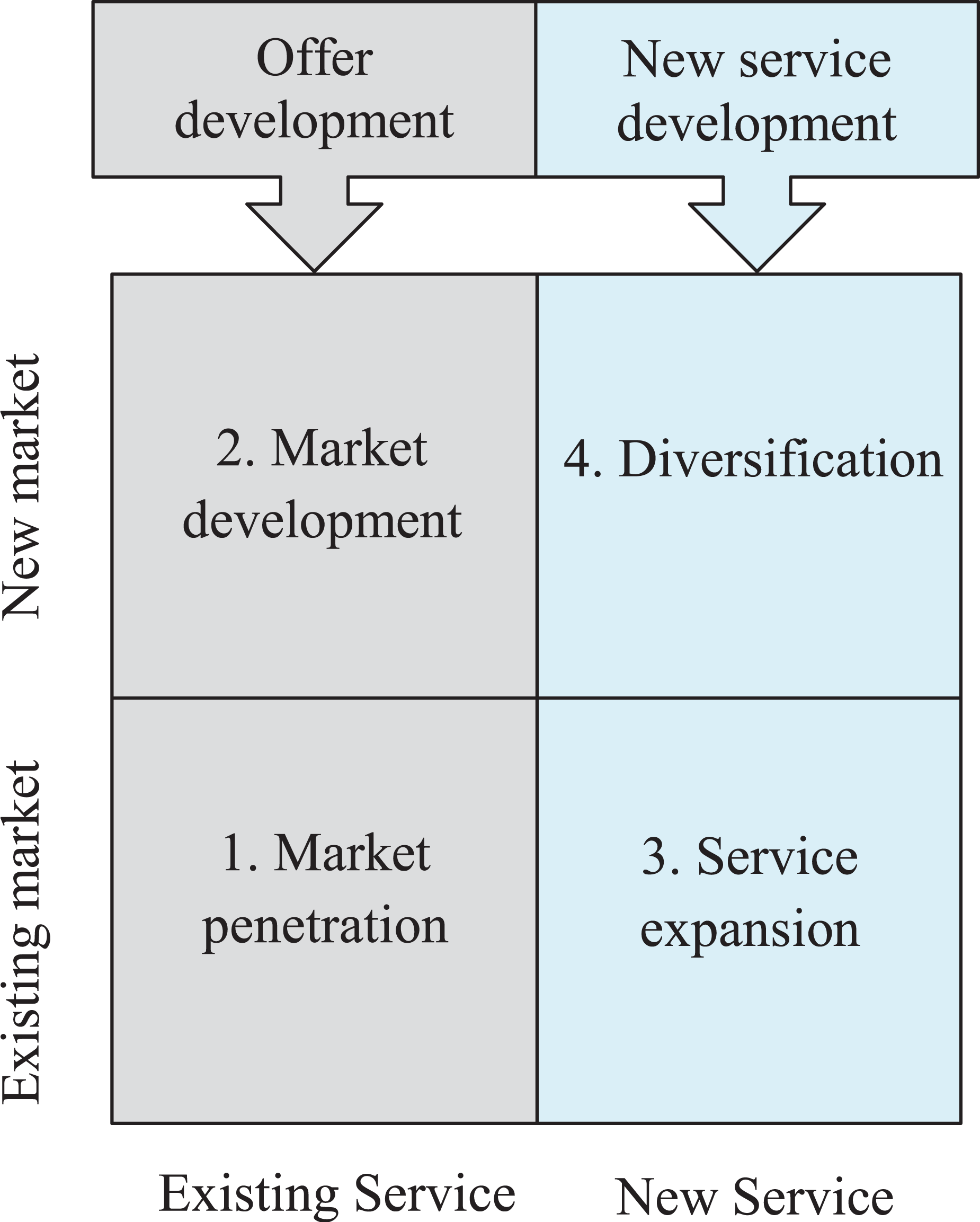
Secondly, Idea Classification, this stage classifies the possibility of logistics activities considering DA opportunity under the term of market and service development that can match with the company strategy. In general, there are many tools to generate idea, i.e. BCG matrix, Canvas, SWOT, Porter matrix and Ansoff Matrix. 51,52 Ansoff Matrix 53 is one of the most well-known tools in strategic planning in order to screen diversified choice of idea-generating. Ansoff Matrix 53 suggested that planning business field can be classified as to whether use new or existing products/service and whether position on new or existing markets. 54 In other words, Ansoff Matrix, which consists of continuous grow and change vectors, is a planning technique used for deliberating judgment about firm growth through product/service and market extension networks. The growth vectors are market penetration, market development, product/service development and diversification. 55 For these objectives accomplishment, marketers have adopted Ansoff Matrix in order to provide strategic alternatives for market growth observation and competitive advantage creation (see Figure 3).

Ansoff Matrix. 53
Market penetration is a strategy to penetrate the existing product/service market in original market. To boost sales, the company can use marketing techniques to communicate and build relationship with customers for example, promotions, discounts, etc. The market penetration strategy can be done in a number of ways; reducing prices; offering introductory prices and increasing their promotion and distribution efforts; acquiring a competitor in the same marketplace; Customer Relationship Management (CRM); Improve of product/service quality and etc. 56
Market development is a strategy to increase sales by positioning existing product/services in potential markets. In other words, market development expands products/services to new geographies, customer segments, regions, etc. The successful market developments are as follows: (1) the advantages of their proprietary technology into new market, (2) profitable products for consumers in the new market (for example, consumers earn income and need the products), and (3) consumer behavior adaption to the new market. Many market development strategies are to (1) cater to a different customer segment, (2) enter into a new domestic market (regional expansion); (3) invade into a foreign market (international extension). For instance, recently Nike and Adidas, sporting companies, have expanded into Chinese market in order to offer the same products to a new demographic. 56
Service expansion is a strategy for new services creation to fulfill the needs for existing customer base and build brand loyalty. The firms have to understand their current market in order to suggest alternative innovative solutions to suit the existing market requirements. The strategies for the product development are as follows: (1) R&D investment for catering the existing market, (2) competitor product acquirements including resource combination for designing a new product which is better than those in the existing market, (3) strategic partnerships with other firms for expanding access to each partner’s distribution channels or brand. 56
Diversification is a strategy to develop new services for new markets. In spite of the riskiest strategy, market and product development is mandatory. For diversification that a firm can carry out, the two types are related and unrelated diversification. The related diversification is to observe the potential synergies between the existing business and the new product/market. For example, the restaurant expands to be a supplier of food ingredients to another similarly restaurant. Unrelated diversification, there are no potential synergies to be realized between the existing business and the new product/market. Such as, the restaurant that starts the hotel business. 57
This concept continuously perceives as one of the most important tools for business development and penetration. Ansoff’s matrix has been used in business development in numerous studies, so it is one of the effective variants that entrepreneurs can successfully apply. In the development of new products on emerging markets, Loredana 57 reported that Ansoff Matrix is a way in order to lower the risks. Amount studies demonstrate that Ansoff Matrix allows an extension of theoretical and practical knowledge. Yin 9 used the Analytic Hierarchy Process (AHP) technique with Ansoff Matrix to analyze the possible strategy to diversify business in the case study Evergrande group. The application of these techniques let the enterprise know the diversified strategy to choose and conduct further analysis. Hanif and Fafurida 58 used Ansoff Matrix to identify the strategic direction of the small industry in food supporting tourism sector to expand market share and to create the brand image to the tourists. Prasetyo and Rahman 59 analyzing the strategy and the level of effectiveness of developing the new products on the creative mat industry. Ansoff Matrix was used to explain the intensive growth strategy for assisting to determine the best product/service and market strategy for enables various business opportunities into existing value.
Idea Classification starts from using conjunctive method 60 to screen the undefined alternative using specific criteria of the company. DA opportunity was used as one issue for screening. After that, Ansoff Matrix is used as the alignment framework for classify alternatives into two segments; (1) Offer development i.e. market development strategy and (2) New business development i.e. service development and diversification.
Finally, Idea Selection, decision criteria of new idea selection was used to summarize DA opportunity concern in the decision-making criteria. Among of uncertainty in the subjective judgments to be made in multi-criteria decision-making, Fuzzy Analytic Hierarchy Process (FAHP) is well-known Multiple Criteria Decision Making (MCDM) tool can be handled to solve the hierarchical fuzzy problems. 61 FAHP extended from AHP 62 which is cannot reflect the human thinking style yet. 63 Güngör 63 applied FAHP to evaluate the personal selection problem. The results founded, FAHP can deal with the best of adequate personnel rating of both qualitative and quantitative criteria. Junior 64 showed the comparisons between FAHP and Fuzzy TOSIS in supplier selection application. The results have shown that FAHP perform better than Fuzzy TOSIS in term of time complexity while nearly the same in term of prioritization ranking. The most empirical studies have applied FAHP techniques to investigate indistinctly qualitative problem in several study, i.e. land/warehouse selection, supplier/employee selection, investment/project selection and prioritization/ranking of alternative/indicator. 64 –69 In this paper, proposed a FAHP to make a decision in uncertainty existing in the importance attributed to judgment of the decision-makers, due to crisp pairwise comparison in the conventional AHP seems to insufficient and imprecise to capture the degree of importance of decision-makers on new service idea selection in courier business.
Chang 70 introduced FAHP with the use of triangular fuzzy numbers for the pairwise comparison scale of FAHP, and the use of the extent analysis method for the synthetic extent values of the pairwise comparisons. The triangular fuzzy numbers, 1–9 are used to represent subjective pairwise comparisons of selection process in order to capture the vagueness. 71 Therefore, FAHP is used to select suitable alternatives of new service by weighted summation on all criteria. 72 This study used three experts who can make decision, i.e. The CEO, Courier Manager and General Manager. Then, the chosen new businesses were elaborated and discussed in the perspective of company and customer.
Results
Business analysis and gap analysis for investigate logistics-base characteristics
The case study in this research is the biggest bus company in northern Thailand, Green Bus Company (GB). The company provides a passenger service between provinces and between regions of Thailand. It has 31 fixed routes passing north, south, central and north-eastern of Thailand. There are 432 buses traveling more than 50,000 routes/year. The company serves more than 2,000,000 customers/year and employs over 645 workers. There are more than 140 ticket sales points and agencies. The company has used IT extensively to facilitate the sharing of information in the organization, such as Global Positioning System (GPS), Enterprise Resource Planning (ERP), Transportation Operation System (TOS), and mobile application “Green Bus” for ticket booking.
Over the past 5 years, the company has faced intense competition among other transportation modes such as a personal car, train, and low-cost airline. The booming of low-cost airlines overlaps a huge number of market segments with competitive prices and promotions that affects number of customers and revenue. To face this crisis, the company has tried to develop new business units as a courier service by using available space under the routed bus. Since 2016, they have officially provided a port-to-port courier service within the northern areas and expanded to southern routes. Now, there are 115 service ports covering 22 provinces. The service is not only carrying but also a packing service, short-term warehouse and door-to-door service (only in some area).
The company recorded annual revenue of 387 million THB in 2018, with 80.5% from a bus service, 17.7% from courier service and 1.8% from others. Bus service growth rate is relatively stable for the last 5 years with the average growth rate of 4.14%. On the other hand, courier service average grows at 13.8%. Courier service has become an important business unit due to high demand and the growing demand of customers, i.e. B2C, B2B, and C2C. The strength of this business is high frequency in with an hourly bus schedule and low asset investing because they use the existing area under a passenger service bus. However, the courier service can create value in several functions, such as door-to-door, packing service, etc. So, the fare can be flexible according to the value. Additionally, there are opportunities in doing business since the company has developed a customer database collection system. Every carrying activity is recorded in a transaction, such as shippers/consignees name, date, time, product category, start/destination station, quantity, weight, fees of charges, etc. However, it is yet to be analyzed and exploited. Therefore, the CEO aims to look for a new idea for developing a new business that is feasible within the challenging circumstances and new competitive advantages.
Looking at the delivery history of the case study company, there are many types of products distributed from/to southern and northern. One of the most promising products is seafood. Foods, fruit, ceramic and bedding are also in high volume. The distribution network in the case of seafood is that the consignee (for example from Chiang Rai, the north of Thailand) directly makes a purchase order to the sender (or shipper). The sender than delivers the goods at a GB port, e.g. Phuket in the south of Thailand. Lead time from when the consignee makes an order until they receive the products takes 1–2 days. Normally, it takes 1 day for a first-mile and then to distribute from port-to-port and 1 day to keep in storage room before the consignee picks up. Product and information flow is shown in Figure 4.

Existing service model.
The company has used a database system since 2013. It collects all data related to service. When a customer uses a service, a staff member will register a member ID for each customer. Each service activity from each customer is recorded in a sale transaction as a basic selling spreadsheet data. This is an opportunity to create a value from the database by mining knowledge that possibly supports a new idea for market development and service expansion. As regard attributes in the parcel profile, the database includes shippers/consignees name, date, time, product group name, product category name, start/destination station, quantity, weight, freight charges, membership application date, and payment type (see Table 2).
An example of customer transaction dataset.

There are more than half a million records yearly. Then, the research uses gap analysis for interviews for assessment in the database architecture in terms of what is the utilization of data and how data are collected and used by comparing with the practice; in this case, it uses bus service data as the role model for data utilizations (Figure 5). In bus service data, data were collected, analyzed and used to conduct in the Management Information System (MIS) and Decision Support System (DSS) to create a strategy planning. As a result, a gap can be identified in difference of data structure and utilization. For data structure, the courier service has a layer of data classification as with the bus service; however, there are no processes in the Decision Support System (DSS) due to strategy cannot be planned. SWOT is used to analyze the existing business with DA engagements and shown in Table 3. The weakness of company in DA engagement is that DA has never been used for any business improvement.
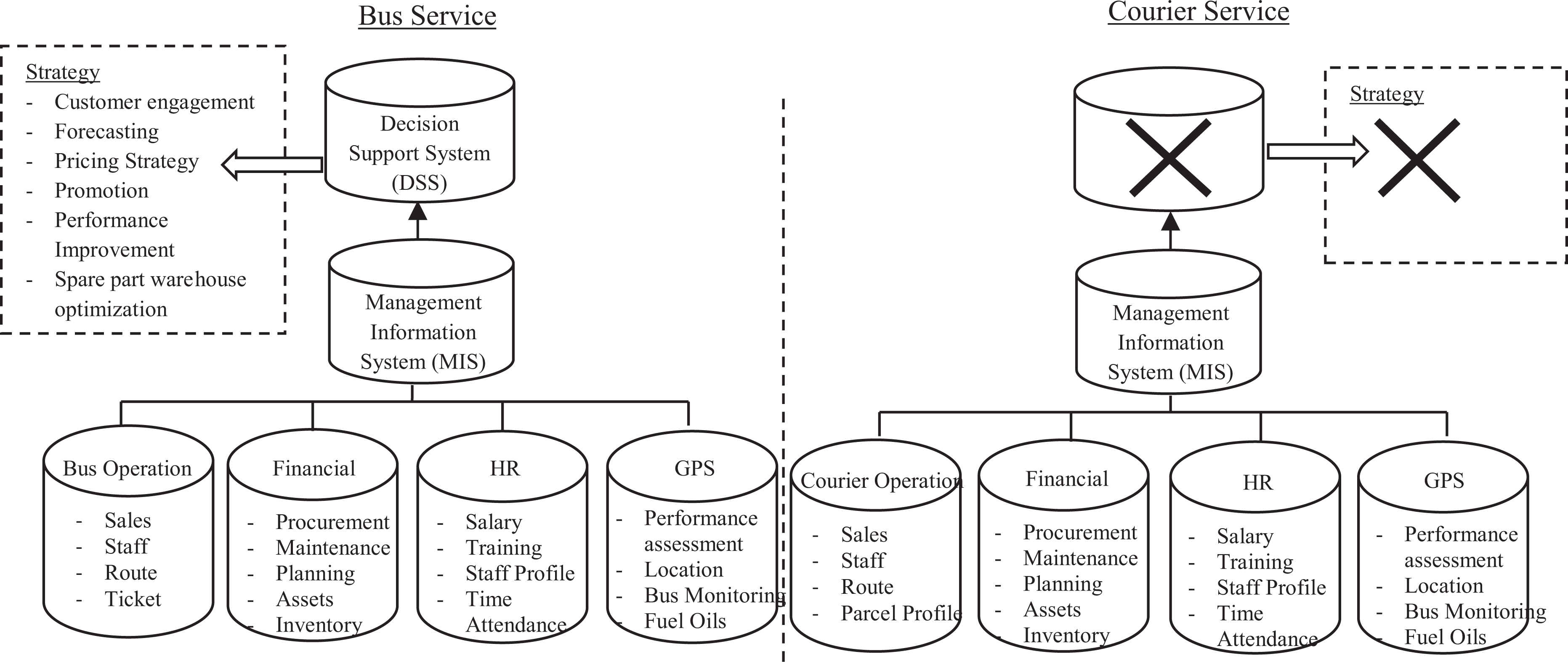
Utilization of data in bus and courier service-gap analysis.
Strengths, weakness, opportunities and threats with DA engagement of GB company existing service analysis.

Classify possible alternatives of logistics activities
The current service case study is a port-to-port courier service. From the literature review, there are possible different options for developing new markets and new services functions for GB, for example, cross-border logistics/international freight forwarder, warehouse automation, drone delivery, sourcing/trading and so on. But first, the company must consider the elimination of the least feasible alternative as much as possible. Here, the important conditions of the organization include investment cost. GB sees that, to begin a new business, it also faces significant risk and uncertainty. So they prefer new business ideas with low investment and profitable. Another important factor is the opportunity to use the existing database, e.g. customer database. The database is stored, but never analyzed in order to be useful at all. Therefore, these two conditions are used to screen the undefined alternative using a conjunctive method. The study explores possible logistics solutions that get advantages from the high connectedness 73,74 as if the data is used intensively in understanding, analyzing, predicting and mining, of relation, pattern and principle to transform data to wisdom, using the specifics tools and techniques. In summary, the possible alternative for new market development and new service expansion according to the framework of Ansoff Matrix from market penetration (As is) to market development strategy, service expansion and diversification service (To be) are shown in Figure 6.

The possible alternative to create new market development and new service for GB company.
Market penetration strategy is the ways that led the company keeping customers satisfied. Delighting existing customers do buy again but also spread the word through referrals. The example of improvements activity are e.g. increase efficiency in service while reduce cost, customer database improvement, customer relationship management, reports and data analysis sent to every customer on daily base. 56 For idea of market development strategy, the choices of the company are shipper-consignees recommendation (M1), advertising/public relations/digital marketing (M2), and pricing strategy/promotion (M3). These activities are low-medium investment activities and able to increase customer base from database analysis. DA techniques can help to accomplish such a goal by extracting or detecting patterns or forecasting customer behavior from large databases. Marketing intelligence refers to developing insights from data for marketing decision-making. 42 According to the DA literature, Recommender Systems (RS) have been widely used in the e-commerce context. 75 An RS suggests products that customers will likely prefer by considering the relationship between a customer’s purchase history and the product’s review rating. 76,77 This database can gain information for business decisions by identify target customers, ascertain the needs of these customers, and then specify how the product satisfies these needs. Therefore, RS (M1) recommend a suitable new shipper to new consignee to expand customer base and increase the delivery volume in couriers business. 78 Advertising/public relations/digital marketing (M2) are the business model that connect potential customers through service and experiences. There are using traditionally methods or modern media, such as, blogs, social media, e-mail, Search Engine Optimization (SEO), viral videos, web-based seminars (Webinars), etc. 79 Company must try to inform viewers with content they seek with different levels of marketing. Location-based advertising provides a new tool for companies to attract more customers with the located and profile database of shippers and consignees who has direct/indirect experienced use service. 80,81 For pricing strategy/promotion (M3), there has been several research on business analytics to support strategy formulation by forecasting market demand and analyzing competitive environments. 42 Regression methods are widely used for price prediction. 82,83 Association technique is applied to competitor analysis. 84 Promotion marketing analysis has attracted a lot of attention by analyzing how customers respond to promotional strategies or how categories of service affect the effectiveness of promotional strategies. 85 Clustering technique can be used to understand customer behavior and identifying market segments. 86 A regression method is used to study promotions in different contexts. 87 Moreover, companies can use customers’ location to improve promotion strategy and select targeted customers. 88
For service expansion, four choices of interest are fulfillment service (S1), real-time tracking and tracing (S2), fleet management/distribution management (S3), and management and negotiations with LSPs/Rate negotiation (S4). Several LSPs provide fulfillment services (S1) including warehousing, shared, multi-client distribution center, warehouse management system (WMS), order fulfillment, pick up and drop off, picking, and packing. 89 In this case, the customer database is available and can be analyzed to identify potential customers, forecast demand, locate suitable warehouses, etc. to support this business model. For real-time tracking and tracing (S2), this service provides a platform where customers can check the status of a parcel and it will be transparent to the participant in the logistics flow. In practice, there are several tracking systems available through GPS, GTIN, RFID, Barcode, etc. 90,91 However, technologies or tools need to be invested for the service. Fleet management (S3) focuses on managing assets through control of the different variables included: assets (vehicles, equipment, tyres etc.), distribution management, maintenance planning, drivers, service performance, part and inventory, and cost. The technology needed to support real-time logistics requires mobile communication, GPS (Global Positioning System), GIS (Geographical Information Systems), TMS (Transportation Management System), and ERP (Enterprise Resource Planning). 92 Asset and non-asset base are the business model that the company needs to consider, e.g. vehicle rentals, own vehicle, 3LP, etc. The last interesting choice is management and negotiations with LSPs (S4). Here, the company begins to interact with various intermediate coordinating LSPs to implement supply chain management on behalf of the client. 26 This service is non-asset and information-based. The company may be responsible for a greater set of activities because of the complexity of the client’s operations. The company may occasionally take over employees with expertise in the product/customer knowledge toward rapidly developing expertise on that end and build on focusing the supply chain processes. 93
For diversification strategy, the new business model is completely different from the existing service, for example, McDonald’s developing new products to sell in new markets such as McCafe, a coffee shop and The Golden Arch, a hotel which includes brand extensions. 57 Farm business can be diversified as farm shops, tourism landmarks, renting of machinery, and buildings. 94 GE Company diversified the multinational company by providing technology and services, involved in household appliances, consumer electronics, aviation, power distribution products, energy, finance, medical, lighting, media and entertainment, oil and gas, rail transportation, security, water treatment and other industries. 95 In this regard, GB company has many ideas for diversifying service development. However, the extent of a boost in diversification resulting in enhanced effectiveness depends significantly on the asset utilization 96 in comparison to single-segment firms and also on the type of industries, whether related or unrelated with the present activities. 97 The GB company business interests are sourcing/trading (D1), rest area/mall/stop/commercial area (D2), delivery service (D3) and hotel/restaurant (D4). So, integrating DA opportunity and Ansoff Matrix can generate decision support information for new business idea selection effectively. This information can classify and guide for scope in more than 20 possible alternatives of logistics activities. For GB, 11 possible alternatives will be used to the select the most suitable in the next section. It shall be noted that the alternatives can be varied if different input are considered, e.g. other companies or other requirements.
Select suitable alternatives of new service
In order to select the suitable business idea for the case study company, there are criteria that are specific by the company. The following section discusses these issues.
Criteria for idea selection
The readiness of the organization transformations can impact in new business decision. This will be a joint effort between corporate staff, lines of business, and IT ability. Five data accommodation criteria are conducted to get a deeper understanding of the challenges and opportunities that could be selected for new marketing development and new service function expansion in the case study company including, Data accommodation on company capability (C1), Data accommodation on demand (C2), Data accommodation on vision, strategy, and desire of executive/CEO (C3), Data accommodation on investment strategy (C4) and Data accommodation on customer database (C5). For example, Data accommodation on demand criteria, identifying the level of data that can accommodate in demand of customers clearly and used for decision support of new business selection according to availability, usability, reliability, relevance, and presentation quality 98 of the company. The criteria are shown in Table 4.
Criteria of data accommodation for idea selection in new marketing development and new service functions expansion of GB company.

Idea selection of the new market development and new service expansion
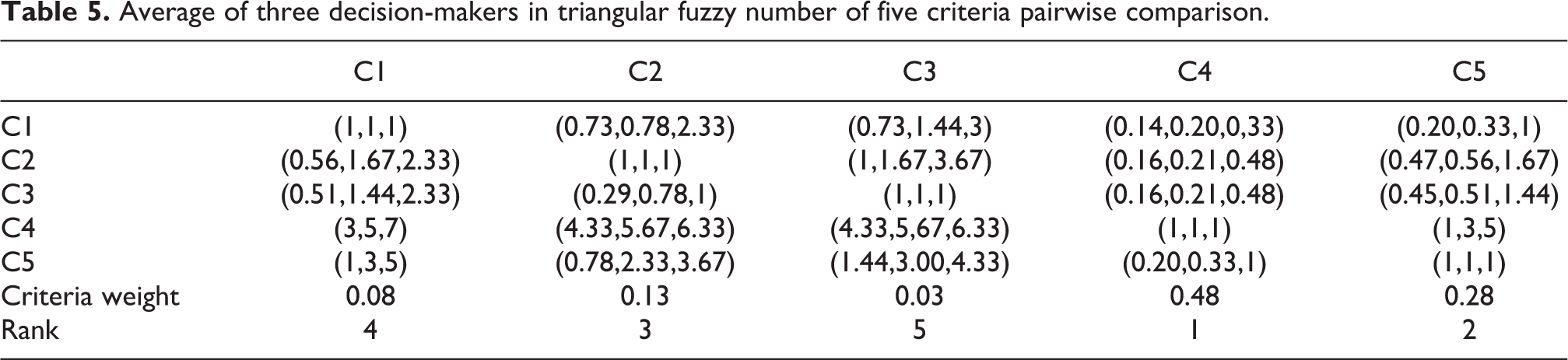
Questionnaires are designed and carried out to relevant experts, who are the first-line of decision-makers, i.e. CEO, General Manager and Courier Manager. According to the criteria for idea selection in Table 4, the paper applied FAHP for pairwise comparison between criteria to criteria and criteria to alternative 104 by linguistic number. Then, the linguistic terms were transformed into triangle fuzzy numbers. For example, 9 ? were transformed to (7,9,9). Then, the steps of the FAHP based were used. By the way, all the pairwise comparison process must pass the consistency check. 62 Table 5 shows the average of three decision-makers in triangular fuzzy numbers of pairwise comparison. 105 Pairwise comparison between five criteria and alternative according to three segments of Ansoff Matrix are shown in Table 6.
Average of three decision-makers in triangular fuzzy number of five criteria pairwise comparison.
Pairwise comparison between five criteria and alternative according to three segments of ansoff matrix.

For idea selection, new business idea was effectively summarized according to DA opportunity concern in the decision-making criteria. Then, FAHP is used to select suitable alternatives of new service by weighted summation on all criteria. This section evidence practically integrate DA accommodate in criteria decision and DA opportunity impact on decision-making for new ideas selection. The results show that the criteria weighting observed that maximum priority weight is for data accommodation on investment strategy (C4) (0.48) followed by data accommodation on customer database (C5) (0.28), data accommodation on demand (C2) (0.13), C1 (0.08) and C3 (0.03), respectively. It implies that, for new service idea selection in the courier business, the company needs to determine about DA opportunity can help in investment strategy very carefully. From Table 6, the best alternatives in each strategy are Shippers-Consignees recommendation (M1), Fulfillment service (S1) and Sourcing/trading (D1) (see Figure 7).

New ideas selection in ansoff matrix framework.
Shippers-Consignee recommendation business model (M1) is the business model that matches consignee and shipper who have similar patterns in receiving/sending and whether there is hidden supply and demand. This model is possible to be successful due to there are existing customer databases whereby there is the possibility of new business matching between their existing customers, shippers and consignees by DA application that can be explored. Moreover, the model can increase volume of delivery by there being no need to invest in main infrastructure. Similarly, the Fulfillment Service business model (S1) provides the delivery service of moving products from the point of sale to the end customers with several value-added logistics functions, such as multi-client distribution center, warehouse management system (WMS), order fulfillment, pick up and drop off, picking, and packing, until door-to-door service. This model is also possible to be developed using existing customer database and DA to classify the priority of customer segmentation. The company can earn more revenue from an additional channel, while retaining existing customers and attracting new ones. Further, Sourcing/trading (D1) is most likely to be the diversified business model. The model can utilize the opportunity of DA with minimal investment and optimal diversification from the company’s core competency, compared to rest area/mall/stop/commercial area, and Hotel/Restaurant business. The discussions of the selected new businesses are elaborated in the next section.
New business development
The following section discusses the new business selected previously.
Shipper-consignee recommendation
This model is the most preferable in market development strategy. The idea focuses on expanding the customer base in existing service, a port-to-port courier service. The model can use DA to explore the possibility of new business partnership. The opportunity is the recommendation of matching new shippers with new consignees. For example, if there are shippers of cotton fabrics, cartons and plastic beads, in which normally cotton fabric will be frequently sent to a weaving factory, the cartons will be sent to a souvenir/handicraft consignee, the plastic bead shipper will frequently send to button manufacturers. It is possible for the weaving factory to require cartons or souvenir/handicraft consignees to require plastic beads. Also, the business partner is probably between consignees e.g. it is possible for the weaving factory to require buttons or souvenir/handicraft. The opportunity is by exploring the association between product, characteristics of shippers and consignees that can be used to formulate the recommendation system. Therefore, it is important to ask: how to know who are the shippers and consignees, which consignee and shipper are likely to relate to each other, how to know what kind of products are in need of shipper/consignee, and which kind of product is likely to be potential and suitable for recommending. This is possible with DA
Figure 8 shows the product and information flow between GB and their customer (shippers and consignee). GB position as the operator who gives a recommendation of other suitable suppliers to their consignees while retaining an existing product and information flow. GB could create a new business partnership and increase volume of delivery by there being no need to invest in main infrastructure but a need to improve more data collection structure, DA and data management system. However, it is important to use DA for provide a suggestion as to the most likely requirement to ensure new business partnerships.

Shipper-consignee recommendation model.
Fulfillment service model
For the existing service, the consignee places an order directly to the shipper. Then, shipper delivers the goods at GB port for outsource transport. Lead time from consignee placing the order until receiving products normally takes 1–2 days. For the fulfillment service model, GB provides a logistics service for shippers by managing order fulfillment as storing, warehouse management, distribution, picking, packaging, and delivering the product to the end customer. As first, the company provides first mile delivery for pick up of products to distribution port. Products are then transported from port to the designated warehouse. When the purchase order is received, the online ordering system will link the order to the Warehouse Management System (WMS) for pick and pack. Then, consignees can decide to pick up products at the warehouse or receive last-mile delivery preference. This model provides consignees a very short lead time (<1 h) to receive products, as shown in Figure 9.

Fulfillment service model.
The customer data, for example, quantity, frequency, weight, number of receivers, number of product type, represent business diversity and reflect the previous history of shippers or consignees and can forecast and estimate the need of the product and see if it is feasible to offer the fulfillment service. DA can forecast hidden requirements, for example, predicting the shipper who delivers products to many customers with high frequency, low quantity and variety of products; it can be assumed as a retailing, wholesaling, or online shopping/e-commerce. Therefore, this customer segment should be offered with a fulfillment service. Besides, this business model will help the customer to reduce overall logistics cost, enhance operational flexibility, and focus on core business. This model provides a new service while retaining existing customers and being an additional channel to acquire new customers. Whereas, GB is needed to invest in infrastructure of the warehouse, information system, other equipment including rendering the service to support different requirements of the customer’s business, such as; the service of the sales, conclusion report, returning and claims, high value and special care or perishable product, etc.
Sourcing model
For this model, GB will be the product provider for the customer. Being a trader, the business model is called “Sourcing”. The idea is, for example, GB has transported a considerable volume of seafood products from the southern area to a restaurant in the north with a high frequency (every 2 days). Frequent delivery results in high logistics cost and, therefore, total cost. If the products are consolidated, the total cost will be much lower. These ideas lead to an opportunity to create a sourcing model.; GB can start to be the seafood provider for the seafood shop, restaurant and other market segmentation in the northern area by collecting seafood products from known suppliers. The data set of customer (consignees) and supplier (shippers) can compel service as the trader. To serve a broad range of potential customers, the generated forecasts are segmented by volume, region, and product category. The sourcing model can provide value-added service, as shown in Figures 10 to 12. First, is the sourcing drop-shipping model, whereby the customer can place the purchasing order to GB. Then GB purchased items’ management and Port-to-Port delivery are shown in Figure 10. This model has no storing process and no warehouse activity. The lead time can be long. But the cost can be low due to no investment. The second model is sourcing with warehouse ownership. This is the model with warehousing and related activity such as picking, packing, cross docking, etc. as shown in Figure 11. The lead time can be short due to postponement. But the cost can be higher. The last model will provide sourcing with warehouse and door-to-door service. The model needs to invest for both warehouse and transportation as shown in Figure 12. GB will have to analyze the customer behavior to identify such demand.

Sourcing with drop-shipping model.

Sourcing with warehouse ownership.

Sourcing with warehouse and door-to-door service ownership.
Discussion
This paper involves DA opportunity to help idea generation and selection of a new business model effectively; accordingly DA was included in every stage, as decision support and concerns, in business analysis, alternative classification, and ideas selection, DA opportunity concerned was blended in the decision-making criteria. As a result, this paper shows new business/services that impact the company. The solution can be a new service, a new market, or a diversified new business under the dominance criteria decision as low investment and data utilization.
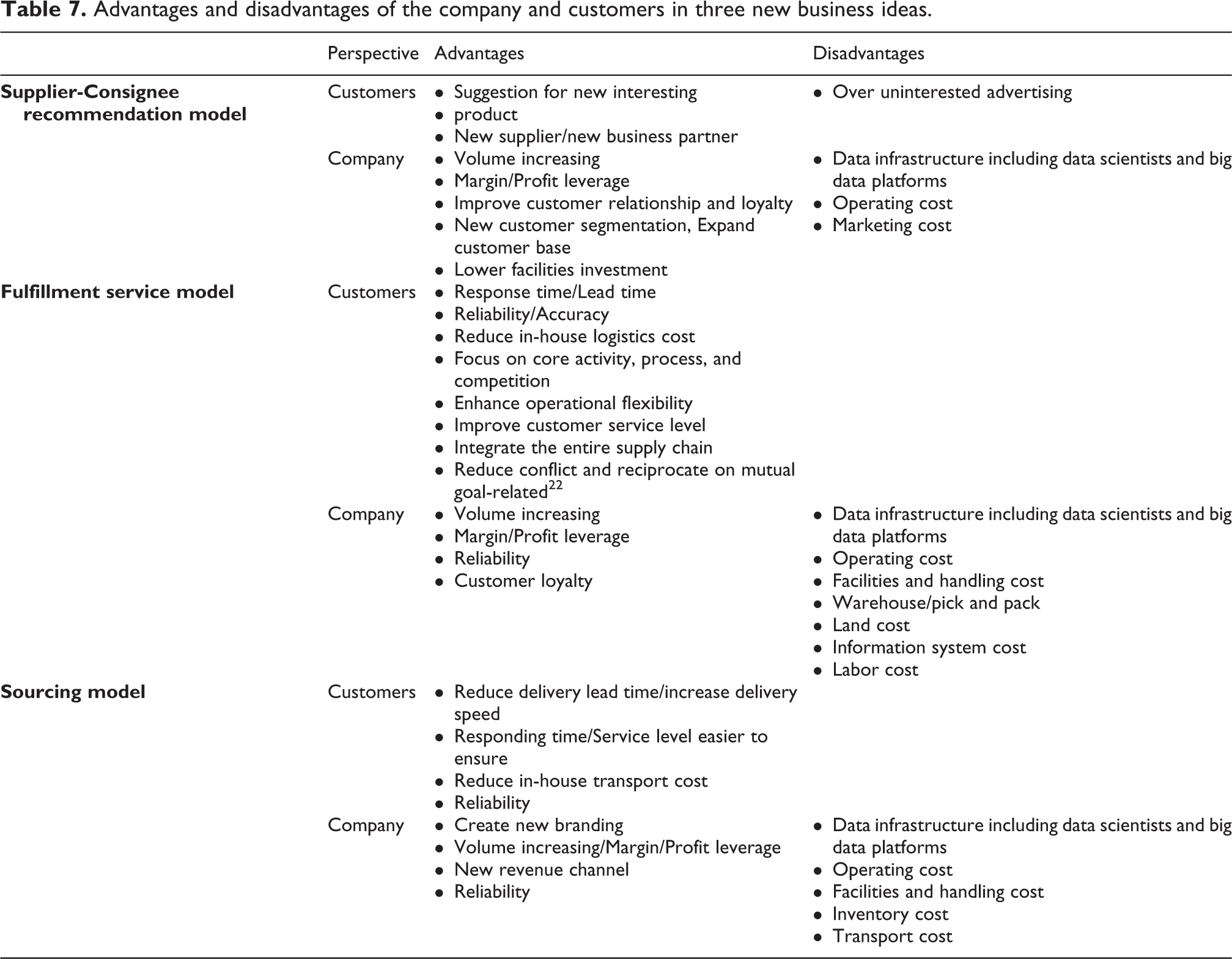
Data-enabled marketing intelligence will become a competitive source for business idea selection. However, the company must invest in data infrastructure, including data scientists and big data platforms. The company must be aware of internal environmental and external threats such as risk and uncertainty. Table 7 shows the summarized advantages and disadvantages of the company and customers in three new business ideas. For the company, the volume and revenue can be generated while there is a need to invest in the operating facility. For customers, they are offered a valuable service, e.g. suggestions for new interesting product, enhanced flexibility operation, reduced delivery lead time, reduced total logistics cost, etc. This creates a win-win scenario for all players in the business model. 106 Otherwise, if the company wins but the customer loses, the customer will not participate in the business model. However, this proposal is the first step of New Service Development (NSD). For the future, the process of business analysis, development, test marketing, and launch needs to be part of the NSD process. 107
Advantages and disadvantages of the company and customers in three new business ideas.
Conclusion
This research presents the investigation of a suitable new business idea for courier businesses considering DA opportunities using Thai Courier Company as a case study. This research contribution is the use of DA opportunity, incorporated into the process of ideas selection for new business development in logistics businesses, and proposes several challenges in DA related to logistics activity, key decision criteria for development in new service, and methods of idea selection and implementing guidelines for logistics companies and similar services business. The study investigates LSP activities and the Gap Analysis and SWOT Analysis were conducted to explore in DA opportunity that can be aligned to create the alternative of new service ideas. All logistics activities were considered and pre-screened by the critical element of company criteria, i.e. investment cost and the opportunity to use DA. Ansoff Matrix is used to classify the alternative of new service ideas into two segments; 1) offer development, i.e. market development, and 2) new business development, i.e. service development and diversification. Five of DA accommodation criteria, i.e. company capability, demand, vision, strategy, and desire of executive, investment strategy, and customer data opportunity, were used in FAHP for selecting suitable alternatives. As a result, DA opportunities are the dominant factor for new business development decision. The results from the decision-makers are illustrated along with the Ansoff Matrix framework in three new service ideas as 1) Suppliers-Consignees recommendation, 2) fulfillment service model, and 3) sourcing model. These three models were elaborated and discussed in the perspective of both company and customer. This idea selection will lead to the process of new service development for further study.
Footnotes
Declaration of conflicting interests
The author(s) declared no potential conflicts of interest with respect to the research, authorship, and/or publication of this article.
Funding
The author(s) disclosed receipt of the following financial support for the research, authorship, and/or publication of this article: This work was supported by the Thailand Research Fund (TRF) under Grant No. PHD58I0068 and Excellence Center in Logistics and Supply Chain Management (E-LSCM), Chiang Mai University.
