




Abstract
The main purpose of this study is identifying the various factors affecting change management success, as well as examine their relevance in the case of a Moroccan construction company. A combination of a literature review and research action was employed to this end. Specifically, an in-depth review of 37 organizational change management models was conducted to identify the factors that affect change management success. Additionally, a research action approach validated the identified factors. Several factors that affect organizational change management success were identified and categorized into 12 categories relevant to the successful implementation of organizational change initiatives within the case company. While further research is needed to explore the relevance of the identified factors in other organizations and sectors, this study provides an integrated understanding of change management success based on the analysis of various organizational change models. Understanding success factors can help managers implement change initiatives in their organizations effectively.
Introduction
In an increasingly complex and dynamic business environment, organizations are continually striving to change and adapt their operations to circumstances as they evolve. 1,2 Organizations are, therefore, required to make significant investments for implementing various changes to adapt to the changing context. However, managing change is a complex process and risky endeavour. 3 Hence, many companies struggle with organizational change projects and fail to realize expected outcomes. 4
Several studies have highlighted that most organizational change initiatives fail, with an estimated failure rate of 60–70%. 1,5,6 High failure rate raises the sustained concern and interest about the factors that can decrease failure and increase the success of organizational change. 7 Researchers and consultancy firms have developed several change management models that can improve the success rate of change projects. Despite many models, there is still a need to identify these factors comprehensively and to bridge the gaps in understanding how to succeed in organizational change management. 1,6 Indeed, existing models do not fully explore or display all factors that influence the success of organizational change. 6 Some models place emphasis on specific factors that are not major success factors as demonstrated in other models, while some models incorporate factors not included in others.
Therefore, the use of a single model or few models is not sufficient to cover various change situations 8 and certain factors may be omitted or neglected, which could result in failure if the model is inappropriate to the change context. 9 Consequently, integrating existing models may lead to an integrated understanding of how to ensure successful organizational change and help develop a comprehensive approach for managing change.
This study is conducted within this framework, with the aim of investigating various organizational change management models and to identify the most important factors influencing change management success, which is tested in a selected Moroccan construction company that recently implemented several organizational changes.
Construction companies have frequent organizational changes at the project and business levels. 10,11 These firms need to continually implement changes initiatives to adopt new methods and technologies to improve performance and ensure operational excellence. Some initiatives include implementing lean construction, 12 increasing digitalization and implementing building information modeling (BIM), 13 integrating supply chains, 14 and improving project management practices. 15
Due to the multidisciplinary nature, the geographical dispersion of organizational structures, the complexity of processes 10,16 and the nature of projects, 17,18 construction companies have difficulty implementing change management processes. However, these factors make the construction sector an interesting industry for analyzing organizational issues. 11 Specifically, the industry is of particular interest for organizational change management, which is a developing and emerging research topic in this sector. 19
The paper is divided into four main sections. First, a literature review on organizational change models, including commonly used models, is presented. Second, an in-depth analysis of 37 organizational change models is conducted, providing an integrated understanding of factors affecting organizational change success. Third, the study examines an empirical case study within a Moroccan construction company to outline critical factors for success of two change initiatives. Finally, the conclusion details the limitations of the study and areas for future research.
Literature review
Organizational change models
A change management model serves as a compass that can facilitate or lead change efforts 20 by determining the specific processes and steps to follow, by illustrating the various factors influencing change, or by determining the levers used to succeed in the change management process. 21 –23 Several change management models have been developed over the years using various theories and principles from different disciplines. 24,25
Parry et al. 21 distinguish between two categories of change management models: processual and descriptive models. A processual model determines the steps for conducting and managing change: for example, Lewin’s 26 3-stage model of change, Kotter’s 27 8-step model, Kanter’s 28 change wheel, IMA’s 29 10 steps, and Luecke’s 30 7-step model. A descriptive model specifies the main variables and factors that affect organizational performance and organizational change success: for example, Parry et al.’s 21 change tracking model, Cummings and Worley’s 31 change management model, Burke and Litwin’s 32 model of organizational change, and Nadler and Tushman’s 33 congruence model.
Processual models
Lewin’s 26 three-stage model is considered the theoretical foundation of planned change management. 34,35 This model involves three main steps for managing planned change: unfreezing, transition, and refreezing. “Unfreezing” consists of destabilizing the status quo by creating the need and buy-in for change and preparing for the upcoming change. “Transition” involves moving to the desired future state. “Refreezing” takes place after the implementation of the change, resulting in a new culture, behaviors, and practices. The second notable change management processual model is the one proposed by Kotter, 27 consisting of eight steps to ensure a successful change process: (1) establish a sense of urgency about the need to achieve change, (2) create a guiding coalition, (3) develop a vision and strategy, (4) communicate the change vision, (5) empower broad-based action, (6) generate short-term wins, (7) consolidate gains and produce more change, and (8) anchor new approaches in the corporate culture.
While other processual models exist, many of these models are extensions of Lewin’s 26 model by dividing its three stages into more steps. For example, “unfreezing” corresponds to the first four steps in the Kotter’s 27 model, “moving” corresponds to the following three steps and “refreezing” to the eighth step, as presented in the Table 1.

Similar to Kotter’s 27 model, Jick 37 developed a tactical change model involving 10 steps: (1) analyze the need for change, (2) create a shared vision, (3) separate from the past, (4) create a sense of urgency, (5) support a strong leader role, (6) line up political sponsorship, (7) establish an implementation plan, (8) develop enabling structures, (9) communicate and involve people, and (10) reinforce and institutionalize change.
The seven-step change acceleration process model developed by the General Electric Company (GE) and reported by Garvin 38 aligns with Lewin’s 26 model and follows its three steps. In essence, this model focuses on the role of the change leader in creating a shared need for change, developing a vision for change, mobilizing the commitment, making change lasts by developing longer-term plans, monitoring and measuring the progress of change including the use of appropriate metrics and milestones, and reinforcing and integrating change into the organization’s culture.
By combining Jick’s 37 model with GE’s change model 38 and Kotter’s 27 model, Mento et al. 36 proposed a 12-phase approach to implement and manage change efforts successfully: (1) determine the idea and its context, (2) define the change initiative, (3) evaluate the climate for change, (4) develop a change plan, (5) identify a sponsor, (6) prepare the recipients of change, (7) create cultural fit, (8) develop and choose a change leader team, (9) create small wins for motivation, (10) constantly and strategically communicate the change, (11) measure progress of the change effort, and (12) integrate lessons learned.
Whelan-Berry and Somerville 39 proposed a summarized approach consisting of five steps, starting with establishing the vision, moving change to the entire organization, enabling individuals to adopt change, sustaining the momentum, and institutionalizing change.
A few models provide a more detailed process list for these three steps. For example, the ACMP 40 model determines 33 processes, organized into five process groups: (1) evaluate change impact and organizational readiness, (2) formulate the change management strategy, (3) develop the change management plan, (4) execute the change management plan, and (5) close the change management effort.
Descriptive models
There are several descriptive models that explain and identify the various determinants of the outcomes of organizational change initiatives. These models have different emphases and view change from various angles.
The 7-S Model was developed by former McKinsey consultants Thomas Peters and Robert Waterman in the late of 1970s and serves as a framework to assess changes necessary to ensure organizational effectiveness by analyzing seven interrelated elements: strategy, structure, systems, staff, style, skills, and shared values. These seven elements interact to create different organizational patterns but does not explain how these factors are affected by the external environment or how each factor affects others.
The model of Burke and Litwin 32 is a framework that hypothesizes how organizational performance and effectiveness can be influenced and identifies the factors influencing organizational change and explains how they are interrelated. This framework establishes cause and effect relationships between 12 dimensions that determine organizational change within an organization: external environment, leaderships, mission and strategy, organizational culture, management practices, structure, systems (policies and procedures), work unit climate, motivation, task requirements and individual skills/abilities, individual needs and values, and individual and organizational performance. In this model, change is represented in terms of both process and content, with a comparison between transactional and transformational factors. Transformational change occurs in response to the external environment and directly impacts the mission, strategy, leadership, and culture of the organization. Similarly, transactional factors (management practices, structure, systems and work climate) are directly affected. Both factors together affect motivation, which in turn impacts individual and organizational performance. 32
Based on the open systems paradigm, Nadler and Tushman 33 designed the congruence model, which focuses on the transformation process and emphasizes the role of congruence between organizational components in producing effective behavior patterns. This model seeks to explain how congruence and fit among the four components of the transformation process of an organization (i.e., work and tasks, individuals, formal organizational arrangements, and informal organization) affect and produce organizational behaviors and impact change and performance.
The Beckhard and Harris 41 change model describes the conditions necessary for overcoming resistance to change within an organization, by indicating that for change to occur, the product of three variables (dissatisfaction with the current state, vision, and first steps) must be higher than the resistance to change.
Carnall 42 highlighted the importance of competencies and skills during change and stated that effective change management depends on three managerial skill areas: managing transitions, dealing with organizational culture, and establishing the politics of organizational change.
The critical factors of change management success are important. The Change First methodology 43 has identified six critical factors to ensure successful organizational implementation of change: shared change purpose, effective change leadership, powerful engagement processes, committed local sponsors, strong personal connection, and sustained personal performance. Similarly, Knoster 44 identified five elements that must be in place for successful implementation: vision for change, availability of resources, skills, change plans, and incentives for motivation.
Further, Kanter 28 conceptualized an approach through “the change wheel model,” incorporating 10 key factors to ensure successful change: (1) common theme and shared vision; (2) rewards and recognition; (3) measures milestones and feedback; (4) guidance, management structure, and process; (5) communication and best practice; (6) quick wins; (7) champions and sponsors; (8) training; (9) approach of change; and (10) symbols and signals.
Necessity for a holistic analysis
There are many similarities and differences between change management models. Although there is an abundant literature on organizational change models, there are still few studies that compare the various existing models. For instance, Galli 24 compares five models: Lewin’s, Kotter’s, Prosci, ADKAR, McKinsey 7-S, and GE’s change model and concludes that, although these models share many similarities, they have differences and various advantages, disadvantages, and perspectives. Previously, Brisson-Banks 45 compared five models (Lewin, Beckhard, Thurley, Bridges, and Kotter) and found significant commonalities between them. Additionally, Mento et al. compared Kotter’s, Jick’s, and GE’s models.
Furthermore, some models focus more on certain aspects. For example, ADKAR places particular emphasis on team members and employee change adaptation, 24 Carnall’s 42 model focuses on the managerial skills and abilities required for change, the Beckhard and Harris 41 change model comprises a formula that may help overcome resistance to change, and Lewin’s 26 change model focuses on the reduction of the resisting force. 46
Some processual models provide substantial details concerning the steps to be followed for initiating, managing, and sustaining change, while others do not separate the steps enough (e.g., Cummings and Worley’s, 31 Lewin’s, 26 Whelan-Berry and Somerville’s 39 models). Additionally, some steps are incorporated in some models but do not appear in others, while some descriptive models place more emphasis on specific factors that may not be considered as major success factors in other models.
Furthermore, there is a disagreement concerning the choice of the most appropriate model to guide change within an organization. 24,47 It is argued that one or even two change models cannot be appropriate tools to cover the different change situations. 8 Indeed, a change model would not be suitable for all change situations, as change and its context vary significantly from one organization to another. 2,48
Using only one model may not provide a full description of the change management process, may neglect or omit certain important success factors, or may be inappropriate to the particularity of a change. Therefore, several change models could be combined to best fit the particular situation of change or the circumstances of an organization. 24,45,49
Therefore, considering the complex nature of organizational change, understanding and controlling change requires a holistic approach that includes all relevant factors and steps.
Categorization and descriptions of success factors
This study conducted an extensive literature review, including a review of books, journals, databases, and several publications from world-renowned consulting firms specializing in change management. This review yielded the list of models of organizational change management shown in Table 2.
List of organizational change management models.

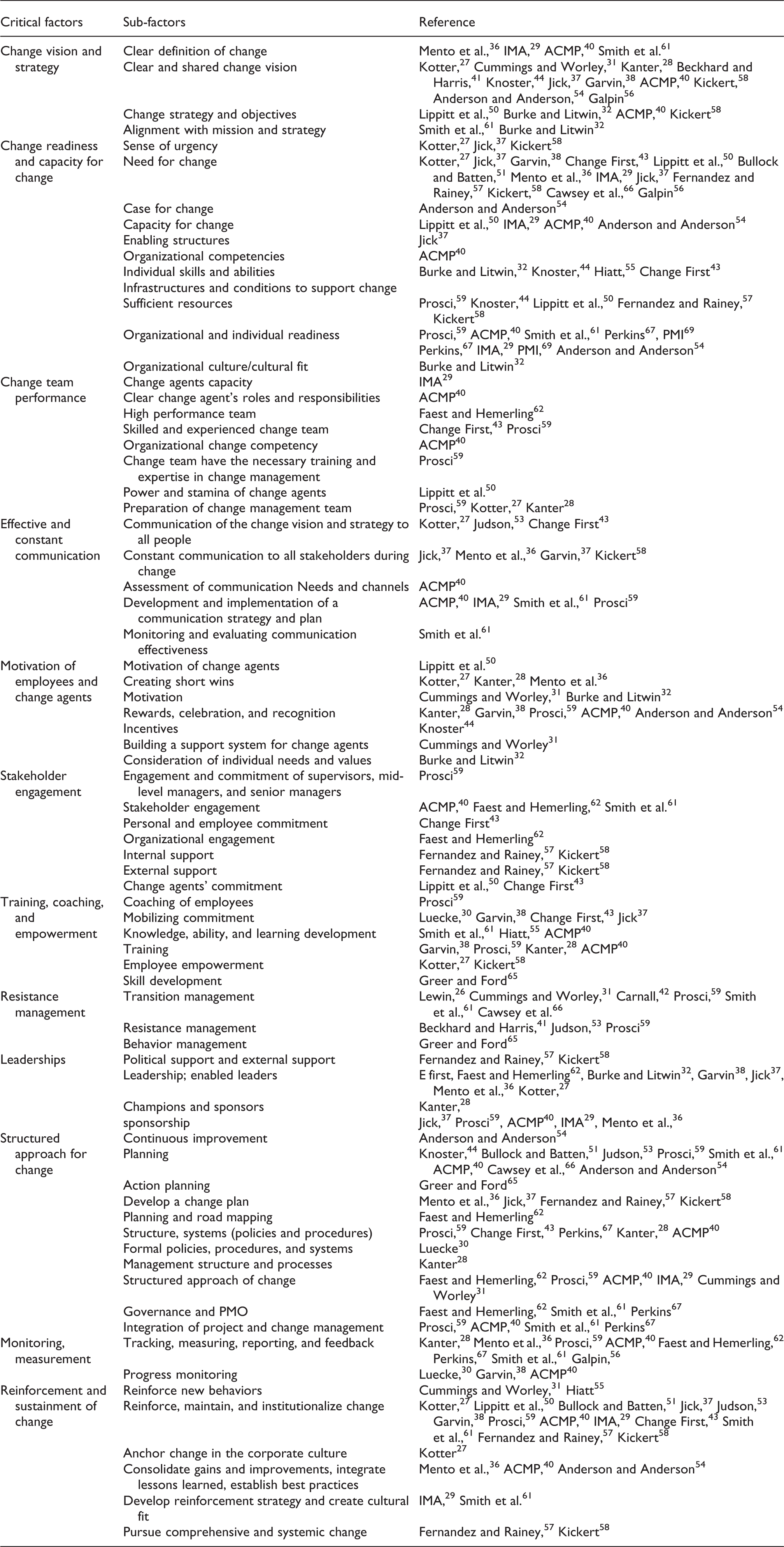
An in-depth analysis of the selected models was conducted to identify the factors influencing change management success. All models were independently examined and intensively studied. Following this analysis, 77 sub-factors were identified (Appendix 1).
For example, the first sub-factor, “clear definition of change,” was suggested by four models. In its framework for managing organizational changes, “Accelerating Implementation Methodology,” IMA 29 considers the definition of change as the necessary first step. Likewise, in their 12-step model, Mento et al. 36 dedicated the second step to the definition of change. ACMP 40 considers “the definition of change” as a key process for managing change and stated that a clearly defined change is needed to determine the approach necessary to implement change successfully. The change management body of knowledge 61 considers the full definition of change as a key factor of change management success.
The models analyzed include many similarities. Some factors are suggested by several models while others are mentioned by only one or few models. Considering these similarities and redundancies of meaning, sub-factors that seemed to be related to the same phenomenon were categorized into 12 categories as presented below. For example, the four sub-factors (clear definition of change, clear and shared change vision, change strategy and objectives, alignment with mission and strategy) were grouped into the same category “Clear and shared vision and strategy of change”.
Several of the reviewed change models have stressed the importance of clearly defining change 29,36,40,61 and establishing a vision and strategy for change. 27,28,31,38,41,44,40 The vision should be aligned with the organizational strategy 61 and describe the characteristics of the future state, the reasons the change is needed, and the expected outcomes of the change. According to several processual models, creating a clear and shared vision is considered a critical early step of a change process. Moreover, the acceptance of the vision by all employees and stakeholders is a prerequisite for change success. 39 Indeed, successful changes require leaders to develop an appropriate and accepted vision, with measurable objectives and a strategy that guide the organization to the realization of expected benefits. 40
The AIM roadmap change management methodology 29 identifies readiness to change as one of the 10 stages of any successful change process. Organizational change readiness represents an organization’s willingness and preparedness to adapt to change. 68 Change readiness needs to be prepared at two levels: organizational and individual readiness. 69 Individual readiness focuses on employees’ skills and abilities, in addition to their motivation, perceptions, and behaviors toward change projects. 69,70 Organizational readiness focuses on the readiness of the organizational environment, in which change is to be implemented and can be seen in three aspects: cultural, commitment, and capacity readiness. 70
Furthermore, some models 44,59,65,67 emphasized the importance of the availability of change resources as a precursor to change readiness. Moreover, Prosci 59 reveals that change management is likely to be more effective in change projects with dedicated resources than in those without them. To sustain change, it is not sufficient for organizations to be ready for implementing single change initiatives, but they must also have the capacity to maintain daily operations and manage and implement multiple changes. 71 In this respect, organizations need to develop and build sustainable capacity for change. According to Klarner et al. 72 and Judge and Douglas, 73 organizational change capacity is a combination of managerial and organizational capabilities that allows an organization to develop and implement appropriate changes to constantly adapt to environmental and organizational evolutions. However, one of the most important capabilities required for coping with change is resilience. 74 It helps people and organizations to increase their abilities to execute a greater number of changes more efficiently and effectively. In this context, some authors 75,76 have highlighted the role of the governance reflexive as a tool that can enable a successful path towards resilience and sustainability.
One of the first steps to successfully manage change is to create a guiding coalition, by putting together a group of selected individuals with enough expertise, position power, credibility, and leadership skills. 27 These individuals are generally called change agents and are responsible for the formulation and implementation of change. Many models 27,28,29,59 have outlined the importance of building and preparing a change management team by identifying its members, clarifying their roles and responsibilities, 40 developing their capacity to change 29,50 and equipping them with the skills, knowledge and competencies needed for managing change. 59
Various change management models have highlighted the necessity of using a set of tools to support individuals through all phases of the change process. 28,38,40,59 The training, coaching, and empowerment of employees have been broadly cited among these tools. It is argued that training facilitates change efforts by developing technical capabilities and influencing the mind-set of employees, thus improving their readiness and involvement in change. Similarly, the coaching of employees aims to liberate their full potential by helping them develop intrapersonal skills such as self-awareness and self-motivation. 71 The coaching process must be part of an integrated approach for empowering employees by preparing them, understanding what they do and do not know, working with them, watching their performance, giving them feedback, and creating an ongoing dialogue with them. 77 This environment allows employees to explain their beliefs and specific worries and concerns about change. It can also be an opportunity to gather feedback about the change progress and to be aware of the obstacles and difficulties encountered when implementing a new methodology. 78
Judson 53 considers people’s resistance as the biggest barrier that can make change difficult, if not impossible. Therefore, change management is traditionally used to identify the sources and causes of resistance and provide tools and ways to overcome them. 31 Therefore, failing to overcome resistance is a big failure for change management teams and successfully managing resistance is a key factor for effective change management. 59
Effective and constant communication is a key factor for change success and plays a major role in creating change readiness, reducing resistance to change, and in obtaining the buy-in of individuals. 79 Among the objectives of the communication process is communicating the strategy, the desired future state, the vision, and the scope of the change project to all relevant stakeholders. Effective communication starts with an assessment of the communication needs of all stakeholders 40 and continues with the development of a communication strategy and detailed plan. 29,59,61 To achieve the goals in this plan, it is highly recommended to ensure regular monitoring and evaluation of the communication process. 61
The majority of the studied models emphasize the importance of the motivation process in mobilizing employees to be an active part of change. To this end, Kotter, 27 Kanter, 28 and Mento et al. 36 recommended creating short-term wins during change process by advertising short-term visible improvements and anything that demonstrates progress toward the future desired state of change. The employees involved in those improvements should be recognized and appropriately rewarded. 28,40 Their needs and values must be considered during change. 32 Additionally, change agents must be highly motivated, 40,50 as they must motivate in turn individuals and stakeholders to render their change projects successful.
Change initiatives require the significant engagement and commitment of all relevant stakeholders, including employees, supervisors, and managers. Moreover, stakeholder participation in organizational change initiatives is considered an important success factor. 61 In accordance with Peltokorpi et al. 80 a change project stakeholder is any group or individual who can affect or is affected by the implementation of the change project. To ensure that all stakeholders are engaged in the change effort, it is recommended to establish a “stakeholder engagement strategy” that will identify the required engagement of the various stakeholders and the necessary activities to achieve the required engagement. 40 Several studies emphasize the role of the middle managers in ensuring change success. 1,59,81,82,97 In this respect, Prosci’s 2017 report of best practices in change management cited the middle management engagement among the seven factors contributing to change success. In regard to executives and senior managers, their active and visible engagement gives more credibility to change initiatives and leads to a greater degree of stakeholder acceptance of these initiatives. 69 However, the lack of employee commitment and engagement may be a source of resistance and a serious barrier to the successful implementation of change. Numerous studies have shown that the success of any change project depends primarily on employee commitment because the implementation of change is mainly carried out by the employees. 83 Therefore, to increase the likelihood of success, middle and senior managers should get their employees to commit to change by targeting individuals or groups whose commitment to the change is required. 36
Several models have underlined the importance of a powerful leadership and strong sponsorship in ensuring successful change initiatives. 59,40 As defined by Northouse, 84 leaderships may be considered the process whereby an individual influences a group of individuals to achieve a common goal. Gill 85 proposed an integrative model that identifies six elements of effective leadership in change management: clear and effective vision, strategy, values, empowerment, motivation, and inspiration. The role that leaders play evolves throughout the change project, from defining the vision and strategy to preparing the organization, empowering the employees, and sustaining the results of change. 62 Moreover, leaders must be able to play a sponsorship role, with the aim of aligning stakeholders to support and own the change. 40 The importance of this role was confirmed by consultancy firm Prosci in all its change management benchmarking studies over the past two decades, by placing effective sponsorship at the top of the list of the key contributors to change success. 59
As confirmed by the majority of the change models examined in this study, there is a broad consensus that we cannot achieve a successful change without implementing a process for sustaining the gains and benefits of this change over the long term. Sustaining change is accomplished by embedding new work processes and methods, integrating lessons learned, reinforcing the new behaviors, assessing change outcomes against organizational objectives, and developing actions for continuous improvement and reinforcement. 31,36,40 ACMP 40 highlighted the importance of developing a sustainability strategy that provides a clear roadmap, including all the mechanisms and activities to be used for sustaining and reinforcing the change.
Some models (especially those developed by consulting firms) cited the use of a structured methodology for managing change as a contributor to success. However, choosing a ready-made methodology requires tailoring processes and tools to a specific organization and particular change initiative. 86 Whether choosing a tailored approach or an in-house developed method, three elements must be carefully considered: design of process and procedures, planning and integration of project management, and change management.
Design of processes/procedures
As previously seen, all processual models are based on the assumption that change process can be successfully managed by following a series of pre-planned steps. Additionally, using appropriate procedures and processes contributes to the improvement of organizational readiness and change management maturity. 43,59,67 Moreover, formal procedures and policies are also useful to consolidate the gains of change, as they are intended to explain how new behaviors and practices will be sustainably conducted. 30
Planning
The majority of the reviewed models have cited planning as a fundamental step or an important factor in the success of change initiatives. Moreover, poor planning is considered a main reason for organizational change failure. Additionally, Faest and Hemerling 62 considered the lack of milestones to gauge progress as a leading cause of failed change projects, while Prosci 59 suggests establishing five plans that define the short-term activities needed to support individuals during change: communication, training, coaching, resistance management, and sponsorship roadmap plans.
Integration of project management
Some models have highlighted the importance of integrating change management and project management for delivering successful change. 40,59,87 Additionally, managing change in organizations nowadays requires project-based management and excellent practice of project management principles and tools. Furthermore, PMI 69 stressed the importance of project management portfolio in managing multiple change. Change management and project/portfolio/program management offices are also cited in some models as organizational structures providing guidance and ensuring compliance with project management processes/methodology and change management approaches. 61
Organizational change initiatives almost never proceed according to the initial plan. 30 Accordingly, change progress must be continuously monitored, tracked, and measured. 36 Proper measurement and monitoring are critical to keeping the change project on track. The measurement system requires creating and establishing metrics, using milestones and tools for tracking change progress, 30,38 assessing, and measuring change benefits and outcomes. 40,61
For this purpose, the triple layered business model canvas 88 can be a useful tool for assessing the benefits of changes and appraising how they create value for organizations in a more holistic manner with economic, environmental and social perspectives.
Method
To validate the findings from the literature review, an action research study involving a series of semi-structured interviews 89 was conducted within a Moroccan construction company to investigate the factors that affected the success of two organizational change initiatives over 2 years. This company specializes in the construction of industrial and commercial buildings, with an annual revenue of around 35 M$, approximately 300 employees and many tens of clients.
Personal observation has been also employed for data collection, as one of the authors is working at this company as a senior manager. The research action methodology is inspired from the constructivist epistemology and promotes an understanding of complex processes from a learning or organizational change perspective. 90 It is based on the hypothesis that, on the one hand, actors in organizations have practical knowledge and experience and, on the other hand, researchers have theoretical knowledge about organizational change processes. 91 A difference between action research and other types of case studies is that the researcher is involved in the case as an active participant. Therefore, their knowledge can be immediately applied to address the problem at hand, which constitutes an ideal application of research action. 92
Concern about subjectivity and bias in action research and in qualitative research is inevitable but can be reduced in several ways. Shah 93 underlines that researchers must consider all the data collected, analyze it with a clear and unbiased mind, and maintain full neutrality to not influence the research outcome or support pre-established beliefs. Additionally, the use of triangulation is widely recommended to improve validity and minimize bias. 98 This includes collecting data from different sources, participation of two or more researchers, using different theories, and implementing multiple data collection methods. 94
Interviews were conducted and were followed by several focus group discussions involving participants of change to analyze the identified issues more deeply. For the change initiatives examined in this study, the participants are composed of 43 men and 7 women, which included senior project managers, junior project managers, site managers, and employees in support functions (purchasing and supply chain, quality, and finance and accounting). The Table 3 presents detailed data about the participants.
Interviewee profiles.

Case study
The case company was in the process of implementing four organizational change initiatives, which made the project to identify the factors that increase change management success appealing to the management.
The four initiatives are:
CI1) Implementation of BIM to respond to an increasing demand of this approach from customers. The objective of BIM implementation is to create a digital representation of the components of a facility and share knowledge related design and operational information about a project. 95
CI2) Implementation of lean construction best practices: This change project aimed to implement processes to eliminate waste across the construction value chain, as well as to improve productivity and quality. It focuses on six practices: just-in-time, 5S method, value stream mapping, standard operating procedures, waste elimination, and continuous improvement.
CI3) Implementation of a project management methodology (PMM): This change project includes:
✓ Definition and formalization of project management processes in accordance with the models proposed by the Project Management Book of Knowledge (PMBOK) 96 ;
✓Standardization of documents by creating templates and artefacts (e.g., work control sheet template, project cost estimation template, task and change trackers);
✓ Implementation of good practices associated with the processes (e.g., use of project planning software, use of risk analysis tools, use of documents to track changes).
CI4) Implementation of an ERP system to support finance, accounting, and project management departments in their daily operations.
For 2 years, the progress of the four initiatives was tracked across the company. The first two initiatives (CI1, CI2) were perceived as unsuccessful changes by the interviewees while the last two (CI3, CI4) were rated as successful. At the time of data collection, CI3 had been achieved and the methodology had been implemented for more than one year. CI2 and CI4 were in the execution phase and CI1 was in the initiation phase.
For reasons related to the lack or insufficiency of data, only two cases were analyzed in this study: (CI3) and (CI2). The other two initiatives were declined, as (CI1) was still in its early steps and CI4 had started more than 5 years prior and most of the interviewees had not participated in all phases of its implementation.
To determine which factors are considered by the employees as the most important determinants of change management success when implementing the two changes CI3 and CI2, we have established a semi-structured questionnaire rated using a five-point Likert scale ranging from 1 = strongly disagree to 5 = strongly agree. The results are presented in Table 4.
Results of survey.

Case 1: Implementation of a project management methodology
The analysis of the information delivered by the respondents through focus groups and interviews has confirmed the importance of all factors identified in the reviewed models. The five factors that have obtained the highest scores are: leadership and sponsorship, effective and constant communication, stakeholder engagement, activities for managing change, and motivation of employees and change agents.
Leadership and executive sponsorship
The leadership of the change manager had a visible impact on the successful implementation of the PMM. Indeed, all interviewees agreed that the change manager has established a clear vision and a roadmap on how to implement the PMM. Through effective communication, regular meetings, personalized coaching, empowerment and motivation, he succeeded in convincing the supervisors and project managers to become effective actors of change.
Although there were low levels of both commitment and change readiness of employees at the preparation phase of the PMM implementation, the majority of the interviewed individuals thought that the strong commitment observed in the execution phase was primarily due to the role of the change manager. Therefore, leadership proved to be a success factor of change management when implementing a PMM.
The designated change manager has a set of skills and competencies that enabled him to effectively fulfill his role as a leader. Additionally, he relied on knowledge from both project and change management, which allowed him to ensure the proper use of project management tools and principles, notably planning and stakeholder management based on an intelligent use of change management principles, such as resistance management and employee empowerment.
Effective and constant communication
Regular communication has proved helpful in mobilizing employees and increasing their commitment level. With a clearly defined plan of communication executed by change agents, the belief that implementing the new methodology will be beneficial was created among employees and managers, which has contributed to overcoming the reluctance and resistance to change observed in the early phases. Therefore, communication had an important role in creating the awareness of the need for implementing the new PMM, thus contributing to employee commitment.
The fact that the company is an SME with limited geographical coverage enabled the change manager to have a perspective of the entire company, leading to better communication between all relevant stakeholders. Additionally, the adoption of an open communication and “no blame” attitude had encouraged all change agents and employees to actively participate in meetings throughout all phases of the change process.
Learning, coaching, and empowerment
During implementation, various training sessions covering the principles, processes, and tools of the new methodology, were carried out for the individuals involved in projects. Additionally, some individual coaching sessions were conducted. The respondents revealed that training and one-on-one coaching sessions helped them overcome their fears and misconceptions and made them aware of the advantages of the new methodology. They also accepted that learning, coaching, and empowerment are key factors for their motivation and full commitment.
Stakeholder engagement
The company’s executives were convinced that their way of managing projects was inadequate and caused considerable financial losses. They were aware that the implementation of a new PMM was necessary for the company to improve its overall performance. Therefore, the executives demonstrated active support for the change team, by providing it with all the necessary resources for successful implementation (e.g., funding for training, consultancy and certification, acquisition of a project management software). All respondents stated that executive support has greatly facilitated the change process by making resources available, thus engendering the sentiments supporting change readiness.
Similarly, the other stakeholders (e.g., change agents, employees, support functions, project management staff) demonstrated their commitment to change management activities and made every effort to respect the milestones specified in the change management plan. Moreover, all respondents agreed that the PMBOK implementation would not have been successful without the commitment of all stakeholders.
Motivation
As reported by most respondents, employee motivation was perceived as a key factor for the successful PMM implementation. They also stated that their level of motivation has improved for several reasons, namely the crucial contribution of the change leader who has succeeded consider the needs of change agents and employees by preparing them, tracking their progress in adopting the PMM, and creating an ongoing dialogue with them through regular meetings. It was also observed that the change motivation of change agents helped create a spirit of initiative and developed a willingness to learn, which maintained a sustained rhythm to managing day-to-day activities according to the new methodology.
Case 2: Lean construction
The interviews revealed that the lack of a clear change vision, lack of leadership skills, poor communication, low commitment of stakeholders, and lack of monitoring system were the main barriers to successful change management in the case of lean implementation.
Lack of clear vision
There is considerable ambiguity related to the change content and vision was not specific enough. The operational objectives of change remained unclear and those related to employees’ transition management were missing. According to some interviewees, the lack of a detailed vision and the first steps required to get started (assessment, vision establishment) constituted the first major cause of failure.
Lack of leadership skills
As explained by most interviewers, the designated change manager was not able to correctly manage the lean construction implementation because of his lack of leadership traits for mobilizing and involving stakeholders. Indeed, the change lacked a leader who could make sense of the change and was able to effectively communicate, motivate the change team, empower people, and develop change management plans (communication, resistance management, training, and coaching).
Low stakeholder engagement
As reported by the interviewees, there was little conviction and commitment from the executive committee. The lean implementation was not considered a priority, which explains why the change team had not received enough support from this committee. Additionally, the change agents selected by the change manager have not shown much enthusiasm for the implementation process. According to them, a roadmap, as well as the motivation and encouragement for the change agents to get involved, were lacking. The insufficient commitment of the change agents had negatively affected the awareness of employees and their involvement, thus constituting a real obstacle to change within different services and sites.
Poor communication
Contrary to the first case, where effective communication was a success factor, the lack of communication was considered as a barrier to success here. The respondents stated that this change project suffered from poor communication, information meetings being rare, which suggested no urgency for change. Furthermore, neither the company executives nor the designated change manager were concerned about the lack of communication. The employees were not informed about the expected benefits that lean implementation would bring to them and the company. Some project managers complained they were not aware of the progress of the lean construction implementation. Moreover, as explained by several interviewees, the absence of a communication plan that would normally maintain the commitment of employees and stakeholders has created a climate of disinterest and low buy-in.
Conclusions
This study comprehensively examined the factors affecting change management success by reviewing 37 change models. While most existing literature concerning success factors for implementing organizational change initiatives has focused on one or a few models and factors, this study aimed to comprehensively identify these factors. Consequently, 74 sub-factors were identified and categorized into 12 categories.
Additionally, by adopting an action research approach within a Moroccan construction company, the relevant factors for effective change management of two change initiatives were investigated. A survey and focus groups with change agents revealed that the leadership of the change manager, effective and constant communication during change, engagement of stakeholders, and motivation of employees and change agents are the most relevant factors for change management success when implementing a PMM. Conversely, for lean construction, the lack of a clear vision, lack of leadership skills, low engagement of stakeholders, and poor communication are the main causes of change management failure. In the case study, the factors were scored differently by the interviewees, which explains why some factors may be more critical while others are less critical for successful management of change. Furthermore, the case study revealed that some factors may influence others. This was illustrated in the first case by the contribution of the change manager’s leadership in developing other factors, such as stakeholder engagement, motivation, and communication.
The findings of this study may provide useful insights for improving activities and decisions needed for the successful implementation of organizational change initiatives. Additionally, the results can allow managers to focus efforts and resources on essential issues necessary to ensure the success of organizational change management. Therefore, managers can increase the success of organizational change initiatives and can use the study findings to develop better strategies to improve change management maturity within their organizations.
This study has some limitations that should be addressed in future studies. Although we have executed an extensive literature review that focused principally on change models, some practical success factors may have been overlooked. Thus, to complete the theoretical analysis, future studies could identify the key factors contributing to change success from the published case studies dealing with organizational change initiatives success. These findings could be compared with results issued from the models and those of this study.
A case study is useful to address managerial issues despite any disadvantages associated with generalization problems. Thus, we advise future studies to combine a case study and a large-scale study by broadening the methodology employed here to a larger number of companies in the construction sector. Additionally, researchers are encouraged to conduct this study in different countries to determine specific aspects that may affect the outcomes.
Furthermore, a quantitative approach should be performed to rank factors by type of change and to identify factor correlations or inter-relationships.
Finally, the findings of this study may provide the foundation for developing a change management measurement model and a new change management maturity model.
Footnotes
Declaration of conflicting interests
The author(s) declared no potential conflicts of interest with respect to the research, authorship, and/or publication of this article.
Funding
The author(s) received no financial support for the research, authorship, and/or publication of this article.

Appendix 1
| Critical factors | Sub-factors | Reference |
|---|---|---|
| Change vision and strategy | Clear definition of change | Mento et al., 36 IMA, 29 ACMP, 40 Smith et al. 61 |
| Clear and shared change vision | Kotter, 27 Cummings and Worley, 31 Kanter, 28 Beckhard and Harris, 41 Knoster, 44 Jick, 37 Garvin, 38 ACMP, 40 Kickert, 58 Anderson and Anderson, 54 Galpin 56 | |
| Change strategy and objectives | Lippitt et al., 50 Burke and Litwin, 32 ACMP, 40 Kickert 58 | |
| Alignment with mission and strategy | Smith et al., 61 Burke and Litwin 32 | |
| Change readiness and capacity for change | Sense of urgency | Kotter, 27 Jick, 37 Kickert 58 |
| Need for change | Kotter, 27 Jick, 37 Garvin, 38 Change First, 43 Lippitt et al., 50 Bullock and Batten, 51 Mento et al., 36 IMA, 29 Jick, 37 Fernandez and Rainey, 57 Kickert, 58 Cawsey et al., 66 Galpin 56 | |
| Case for change | Anderson and Anderson 54 | |
| Capacity for change | Lippitt et al., 50 IMA, 29 ACMP, 40 Anderson and Anderson 54 | |
| Enabling structures | Jick 37 | |
| Organizational competencies | ACMP 40 | |
| Individual skills and abilities | Burke and Litwin, 32 Knoster, 44 Hiatt, 55 Change First 43 | |
| Infrastructures and conditions to support change | ||
| Sufficient resources | Prosci, 59 Knoster, 44 Lippitt et al., 50 Fernandez and Rainey, 57 Kickert 58 | |
| Organizational and individual readiness | Prosci, 59 ACMP, 40 Smith et al., 61 Perkins 67 , PMI 69 | |
| Perkins, 67 IMA, 29 PMI, 69 Anderson and Anderson 54 | ||
| Organizational culture/cultural fit | Burke and Litwin 32 | |
| Change team performance | Change agents capacity | IMA 29 |
| Clear change agent’s roles and responsibilities | ACMP 40 | |
| High performance team | Faest and Hemerling 62 | |
| Skilled and experienced change team | Change First, 43 Prosci 59 | |
| Organizational change competency | ACMP 40 | |
| Change team have the necessary training and expertise in change management | Prosci 59 | |
| Power and stamina of change agents | Lippitt et al. 50 | |
| Preparation of change management team | Prosci, 59 Kotter, 27 Kanter 28 | |
| Effective and constant communication | Communication of the change vision and strategy to all people | Kotter, 27 Judson, 53 Change First 43 |
| Constant communication to all stakeholders during change | Jick, 37 Mento et al., 36 Garvin, 37 Kickert 58 | |
| Assessment of communication Needs and channels | ACMP 40 | |
| Development and implementation of a communication strategy and plan | ACMP, 40 IMA, 29 Smith et al., 61 Prosci 59 | |
| Monitoring and evaluating communication effectiveness | Smith et al. 61 | |
| Motivation of employees and change agents | Motivation of change agents | Lippitt et al. 50 |
| Creating short wins | Kotter, 27 Kanter, 28 Mento et al. 36 | |
| Motivation | Cummings and Worley, 31 Burke and Litwin 32 | |
| Rewards, celebration, and recognition | Kanter, 28 Garvin, 38 Prosci, 59 ACMP, 40 Anderson and Anderson 54 | |
| Incentives | Knoster 44 | |
| Building a support system for change agents | Cummings and Worley 31 | |
| Consideration of individual needs and values | Burke and Litwin 32 | |
| Stakeholder engagement | Engagement and commitment of supervisors, mid-level managers, and senior managers | Prosci 59 |
| Stakeholder engagement | ACMP, 40 Faest and Hemerling, 62 Smith et al. 61 | |
| Personal and employee commitment | Change First 43 | |
| Organizational engagement | Faest and Hemerling 62 | |
| Internal support | Fernandez and Rainey, 57 Kickert 58 | |
| External support | Fernandez and Rainey, 57 Kickert 58 | |
| Change agents’ commitment | Lippitt et al., 50 Change First 43 | |
| Training, coaching, and empowerment | Coaching of employees | Prosci 59 |
| Mobilizing commitment | Luecke, 30 Garvin, 38 Change First, 43 Jick 37 | |
| Knowledge, ability, and learning development | Smith et al., 61 Hiatt, 55 ACMP 40 | |
| Training | Garvin, 38 Prosci, 59 Kanter, 28 ACMP 40 | |
| Employee empowerment | Kotter, 27 Kickert 58 | |
| Skill development | Greer and Ford 65 | |
| Resistance management | Transition management | Lewin, 26 Cummings and Worley, 31 Carnall, 42 Prosci, 59 Smith et al., 61 Cawsey et al. 66 |
| Resistance management | Beckhard and Harris, 41 Judson, 53 Prosci 59 | |
| Behavior management | Greer and Ford 65 | |
| Leaderships | Political support and external support | Fernandez and Rainey, 57 Kickert 58 |
| Leadership; enabled leaders | E first, Faest and Hemerling 62 , Burke and Litwin 32 , Garvin 38 , Jick 37 , Mento et al., 36 Kotter, 27 | |
| Champions and sponsors | Kanter, 28 | |
| sponsorship | Jick, 37 Prosci 59 , ACMP 40 , IMA 29 , Mento et al., 36 | |
| Structured approach for change | Continuous improvement | Anderson and Anderson 54 |
| Planning | Knoster, 44 Bullock and Batten, 51 Judson, 53 Prosci, 59 Smith et al., 61 ACMP, 40 Cawsey et al., 66 Anderson and Anderson 54 | |
| Action planning | Greer and Ford 65 | |
| Develop a change plan | Mento et al., 36 Jick, 37 Fernandez and Rainey, 57 Kickert 58 | |
| Planning and road mapping | Faest and Hemerling 62 | |
| Structure, systems (policies and procedures) | Prosci, 59 Change First, 43 Perkins, 67 Kanter, 28 ACMP 40 | |
| Formal policies, procedures, and systems | Luecke 30 | |
| Management structure and processes | Kanter 28 | |
| Structured approach of change | Faest and Hemerling, 62 Prosci, 59 ACMP, 40 IMA, 29 Cummings and Worley 31 | |
| Governance and PMO | Faest and Hemerling, 62 Smith et al., 61 Perkins 67 | |
| Integration of project and change management | Prosci, 59 ACMP, 40 Smith et al., 61 Perkins 67 | |
| Monitoring, measurement | Tracking, measuring, reporting, and feedback | Kanter, 28 Mento et al., 36 Prosci, 59 ACMP, 40 Faest and Hemerling, 62 Perkins, 67 Smith et al., 61 Galpin, 56 |
| Progress monitoring | Luecke, 30 Garvin, 38 ACMP 40 | |
| Reinforcement and sustainment of change | Reinforce new behaviors | Cummings and Worley, 31 Hiatt 55 |
| Reinforce, maintain, and institutionalize change | Kotter, 27 Lippitt et al., 50 Bullock and Batten, 51 Jick, 37 Judson, 53 Garvin, 38 Prosci, 59 ACMP, 40 IMA, 29 Change First, 43 Smith et al., 61 Fernandez and Rainey, 57 Kickert 58 | |
| Anchor change in the corporate culture | Kotter 27 | |
| Consolidate gains and improvements, integrate lessons learned, establish best practices | Mento et al., 36 ACMP, 40 Anderson and Anderson 54 | |
| Develop reinforcement strategy and create cultural fit | IMA, 29 Smith et al. 61 | |
| Pursue comprehensive and systemic change | Fernandez and Rainey, 57 Kickert 58 |