




Abstract
Large organisations use both internal and external methods to educate their workforce. Workforce approaches in Defence were usually of a closed nature, characterised by entry at recruitment and sequential and hierarchical rank progression. More recently, emerging technology and the associated pace of societal change has required Defence to recruit more laterally and to outsource more education, both ab initio and development. The growing complexity of workforce problems, therefore, challenges military educational decision making to increase its focus on organisational resilience. Modelling and Simulation (M&S) can take messy, ill-defined problems and build models for decision support and problem-solving. M&S is being explored in Defence workforce employability planning to deliver education that is more resilient to perturbations and can more confidently predict graduate demand for educational support partnering. However, the effective use of M&S can be compromised if it is not cognitively useful for the problem owner. A new transformational approach between the modeller and the managers of Defence educational workforce is proposed and illustrated by two conceptual case studies. The method uses the module-based translation between Business Process Model Notation (BPMN) design patterns and systems dynamics building blocks to reduce the problem owner’s reliance on specialist modellers. This approach increases the cognitive effectiveness of proposed workforce education solutions and the sharing and reuse of workforce M&S applications. Any large organisation with sufficient human resource and systems engineering support could adopt this new approach to model and simulate their workforce education and examine their resilience to fluctuations.
Keywords
Introduction
Military recruitment, education and training in Australia are challenged by growing complexity of workforce problems that feature requirements for unique skill sets, competing priorities and uncertainties associated with new technologies and capabilities. 1,2 This complexity increases even further with the division of military workforce into the Sailor/Soldier/Aircrewman and Officer cohorts that work harmoniously in the same workplaces, but often have very different entry points and education and training requirements. 3 Historically, the military recruited its lower ranks without prior qualifications, while the officer class required tertiary education. 4 Technological and societal changes in Australia, especially more competition for school leavers, 5 have led the military to offer more initial entry education and qualifications. Further, the military has had to increasingly use targeted retention strategies, lateral recruiting and cross-training, to meet perturbations in employability requirements. 1,6 None of the Defence employability pipelines has its education and training requirements fully addressed by their selected degrees. These pipelines need to be supplemented to various degrees by either internal Defence training packages or external education providers as personnel progress through the ranks, or as new technologies emerge. 7 Changes in Australia’s tertiary education 8 and society 9 has meant that degrees are no longer the exclusive domain of the officer class. There are now well-established tertiary pathways from ‘other ranks’ to officer. 4 These complexities often result in ‘messy’ workforce education and training problems where different Defence stakeholders have different focus points and competing priorities impact the problem definition and solution.
Modelling and Simulation (M&S) take messy, ill-defined problems and build models that are clear and supportable for multiple potential audiences. 10 Modelling software has progressed to a point where decision makers can leverage such techniques in their everyday problem-solving to provide objective quality evidence and to link decision options to possible costs and benefits under different scenarios. M&S are increasingly being used in the management of complex systems and system-of-systems (SOS), especially in military and related contexts. 11 In their comparative analysis of United States (U.S.) and Australian Departments of Defence (DoDs) practices of acquisition and through-life programme management, Joiner and Tutty 12 examine significant benefits to the US DoD gained from systematically pursuing M&S for all their systems.
Defence workforce constructs are perhaps more adaptable for various modelling practices because of their still relatively closed nature compared to large civilian organisations, whereby military recruitment is generally followed by a sequential and hierarchical rank progression pyramid. 13 Turan et al. 3 reviewed the literature on M&S in military workforce contexts finding early promise of the benefits in Australian studies by Linard et al. 14 and Wang, 15 as well as similar research approaches in Italy, United States, New Zealand and Canada. Turan et al. 3 note ‘existing SD [systems dynamics] models in the military workforce planning address mostly the issues related to supply-side such as training, recruitment and career advancements of military personal and their implications on cost’, before then adapting such approaches to cater for capability demand and movement across trade and category boundaries.
Workforce problem owners are, unfortunately, rarely capable of independent development and use of M&S applications due to their expertise being in other domains. In such instances, modelling practices like those of Turan et al. 3 commonly rely on a close collaboration between the modeller and the problem owner. The modellers’ decision about what to include or omit in the model from the real system it represents depends on the quality of contribution from the problem owners who often do not fully understand the modelling process. This constraint could potentially decrease the ability of the problem to be modelled. In the context of this paper, the term ‘modelability’ is introduced to describe the ‘usability’ of a workforce employability problem to be modelled and how well, where usability comes from human factors 16 and ICT governance. 17
Even when the M&S development is successful, the M&S application’s effective use can be compromised if it is not cognitively useful for the problem owner. The term ‘cognitive effectiveness’ is formulated by Vessey and Galletta 18 as ‘a matching representation to the problem situation conceptualisation tasks via the use of similar problem-solving processes, and hence the formulation of a consistent mental representation’. Suppose the model’s cognitive effectiveness is lacking for the problem owners. In that case, this could potentially lead to a high M&S development cost and reliance on modelling expertise external to the problem owner organisation and ultimately limit the M&S uptake, sharing and reuse across the Defence organisation. Indeed, there is the research gap in the M&S enabled decision support domain, with insufficient reporting of the M&S development process and practical benefits from M&S applications in actual military workplaces. 19
This paper reports a M&S building approach based on a modular translation between common conceptual models and systems dynamic constructs to improve modelability of the military education and training problems and cognitive effects of the M&S applications. In this method, Business Process Model Notation (BPMN) problem design patterns identified by the problem owners are translated into pre-made, reusable and validated systems dynamics building blocks (mini-models). These translations are reciprocal BPMN to systems dynamics pairs, named as ‘module pairs’. Each module pair has an allocated title and a module code. The module pairs developed for the same problem context are stored as module-based translation maps that could be used by the M&S developers to guide their translation effort between the reciprocal BPMN and systems dynamics components. On completion of the translation, the systems dynamics building blocks are assembled to form modules that retain their structural integrity and are easily added or removed from the model. After adding the model’s logic and variables, the resulting M&S applications can be used to simulate the system’s dynamic behaviour, such as resilience to changing educational requirements, graduate demand, or outflows to other industries. Two original case studies illustrate the approach. The developed artefacts will be collected in information repositories for future sharing and reuse.
The paper is traditionally structured, beginning with an academic literature review on the combined use of conceptual modelling and systems dynamics methodologies to inform the research direction and to identify the research gaps. The decision context is then outlined, followed by a brief description of the research methodologies used in the proposed approach. A Seven-Step Approach to Modular systems dynamics development is then reported along with the projected benefits from its implementation. Two military education and career progression case studies are presented to illustrate the approach implementation – one is set in the context of the Sailor cohort, while the other tackles the Officer cohort problem. The paper concludes by discussing the key findings of the research, its broader implications and proposed future directions.
Combined use of conceptual process modelling and system dynamics
Jnitova et al. 19 conducted a literature review of M&S practical applications for decision support in the military workforce planning and management context. One of the findings was that the academic literature had reported primarily technical parameters of the M&S applications, while details of a modelling process and M&S use in actual workplaces had been lacking. This paper presents a further literature review with its focus on a modelling process, in particular, the use of conceptual modelling methodologies to support the systems dynamics aspects of M&S development. In the workforce education context, systems dynamics models change over time in response to perturbation, thus giving a simulation of the resilience of an organisation’s workforce to differing levels of graduate inflows and workforce separations. The papers for this review were selected from many scientific databases including Scopus and Web of Science, using combinations of keywords such as: military training, training pipelines, workforce planning, workforce requirements, modelling and simulation, system dynamics, conceptual modelling, modelling process, translation maps, business process modelling notations and others. Further, references in the obtained papers were used to gather additional publications. The review was constrained to publicly available documents with 26 papers selected for more in-depth study from 1997 to 2017 (Figure 1).

Number of reviewed papers per year of publication.
Twenty conceptual modelling methodologies associated with the systems dynamics modelling process were identified from the literature (Figure 2).

Conceptualisation methodologies commonly associated with systems dynamics modelling process.
The approaches to combining conceptual modelling and systems dynamics methodologies in the modelling process grouped into three category themes, namely: (1) Mixing; (2) Integration and (3) Translation, as follows:
One last point on modelling approaches is that ontology-based modelling approaches are also excellent facilitators in support of above approaches such as those described in Nadarajan and Chen-Burger 24 , Evermann and Wand 25 , Manzoor et al. 26 and Tu et al. 27 Ontology-based modelling provides a structure for all the semantics used in the models. The ontology models can therefore be a medium between translations in support of translation maps or facilitate mixing and integration approaches.
Examples of rationales for the combined use of conceptual modelling and systems dynamics are as follows: to enrich systems dynamics with end user problem representations and research methodologies
10,21,28
; to combine dynamic (behavioural, event thinking; process) and static (structural thinking, content) constructs
28
–31
; to visualise emergent properties not available with static display
29,33
; to evaluate the model design process and validate the resulting models
21,34
; and to provide a structured approach to the model development process.
10,32,34
The review reinforced the Jnitova et al. 19 finding that the model development projects often result in one-off M&S applications, that are not reused, not shared and not supported by reports of their actual workplace implementation. While some reviewed papers focus on problem owners’ improved comprehension of modelling results 35 and facilitate problem owner’ active participation in M&S modelling, 33 the majority of the reviewed papers are written only from the expert modeller perspective. The problem owners’ participation in the M&S processes development is often overlooked or is heavily reliant on the modelling experts’ guidance, potentially resulting in M&S applications that are not fully understood by the end users. The opportunities to increase modelability of the decision problems and cognitive effectiveness of M&S applications for the end user community are consequently lost or diminished. Jnitova et al. 19 also highlight several other issues associated with M&S development for decision support.
This research uses the developed BPMN and systems dynamics modelling approach to address the gaps identified. In this approach, the artefacts expressed in the common language are converted behind the user interface into problem-specific simulation models. The process aims to reduce the boundaries between the modeller and problem owner perspectives by using original module-based translation maps between the problem owner and modeller system representations. The aim in the case studies is to provide military workforce education specialists with a modelling toolset that enables independent development of M&S that is more intuitive to use, generic, adaptable to new technologies, cost-effective and comparatively easy to share and reuse. Potentially, this transformational process can be extended to include other business and workforce management factors, as envisioned by some researchers in capability systems engineering 36 and soft systems methodology. 37
Military education and training problems
The Defence Learning Manual (DLM) is the top-level Australian Defence Force (ADF) training policy that mandates the use of the Systems Approach to Defence Learning (SADL) to plan, develop and manage education and training across the ADF organisation. The SADL aims to ‘ensure that all Defence workforce performance requirements are correctly specified and supported by the most cost-effective learning strategies and clear lines of responsibility for the associated processes and decisions’. The SADL implementation, however, often relies on subjective analysis rather than objective consideration of the learner needs and ADF capability requirements. Such subjectivity is likely because the selection of solution options in Defence is often based on the problem owners’ experience, previous decisions, and lessons learnt. Some of the cause-effect relationships and second-order effects are potentially not being appreciated, mitigated or exploited, limiting problem-solving.
38,39
For example, McConachy
39
states: The RAN schools and instructors have no alternative but to base their decisions on informed guesses when dealing with challenges of meeting expectations and learning styles of new generations of trainees, as well as leveraging the technologies to improve training safety, flexibility, cost, throughput, and outcomes. The rapid development of cyber operations, hypersonics, human-machine teaming and novel weapon systems will significantly challenge the nature of war and how we prepare our people to exploit emerging technology. Preparing to operate within environments that are complex, congested, contested and ambiguous will require great thought and foresight, and careful consideration and planning. Only an intellectually prepared Joint Force will be able to achieve the strategic objectives…and remain adaptive to evolving geopolitics, technological disruptions and demographic shifts. (p. 9)
System resilience
Resilience emerges as a desirable system attribute demanded at all levels within many large organisations, public or private. Resilience is particularly important to Defence Forces due to strategic and mission uncertainties and the continuous need to change and adapt quickly in turbulent periods, while retaining a desired level of performance to consistently satisfy stakeholder needs and requirements. 12,41 We propose that the modelling methodology reported in this paper would be beneficial in supporting any large organisation’s decision making in workforce employability pipelines, including the education service aspects, by improving the organisation’s resilience in its greatest resource.
Despite organisations striving to increase the resilience of their capabilities, business frameworks and the underpinning research often falls short of a clear and standardised resilience definitions. Unfortunately, there is little overall consensus regarding what resilience is, what it means for organisations and, more importantly, how to achieve greater resilience in the face of increasing threats. Resilience is discussed in various disciplines such as engineering manufacture 42 and supply chain management, 43 but a plethora of the concept interpretations presents a challenge for defining resilience for any given sociotechnical system. 44 It is not intended for this paper to provide an in-depth review of such diverse literature to define resilience. Instead, we briefly outline the findings of our multidisciplinary literature review of resilience concept to support our study of resilience in a Defence Training System (DTS). 19 Like Said et al., 44 the review by Jnitova et al. 19 emphasised the multidisciplinary nature and role of resilience and provided examples of definitions from the disciplines of ecology, psychology, engineering, organisational or enterprise supply chain management, economics, systems engineering, computer science, material science, disaster management; organisational theory, risk management, sociology, and defence, just to name a few. For the purpose of this paper, we selected five generic definitions of resilience that are applicable irrespective of the system context (Table 1).
Four resilience definitions from academic literature.

Despite an acute interest in the academic literature in the resilience concept, focus on measuring resilience for decision support is still lacking. 43 Raj et al. 43 found studies of this subject are limited, and quantitative studies are scarce and insufficient to provide an accurate theoretical basis for practical applications. To address this, they proposed a detailed mathematical simulation model to measure supply chain resilience and a simulation model of the supply chain developed to estimate the recovery time of a supply chain after disruption. In particular, their work considered 12 different sources of disruptions.
Said et al. 44 also propose a simulation modelling approach to measuring resilience using combined business process and SD modelling, for the purpose of conceptualising and measuring a sociotechnical system’s resilience. The authors propose to use a structural conceptual meta-model of sociotechnical systems expressed in Unified Modelling Language (UML) (another process modelling methodology), using a block definition diagram. This meta-model originality is in involving a novel process category involving resilience processes. Said et al. 44 then explored the utility of integrating resilience into the structure of sociotechnical system processes and the way in which resilience processes can ensure system’s functioning in crisis periods. The authors conclude that ‘every [sociotechnical system] process must be associated with a resilience process set up in such a way as to continuously develop the resistance of the relevant process to operational disturbances that can be sources of major failures’.
The proposed approaches to working with the system’s resilience give decision makers and practitioners a clear way forward in their attempt to address resilience requirements in their systems’ design, and continuous monitoring and improvement of the system’s resilience performance. These examples, however, are still limited to their application areas and focus on a limited number of resilience measures.
The modelling approach presented in this paper contributes to a wider resilience research project aiming to develop a comprehensive resilience framework to model employability pipelines in large organisations, where resilience to graduate or training disruptions is anecdotally a point of concern. The research team is using Australian Defence training system problems to improve decision support, resilience measures and mechanisms. The primary research questions are as follows, where this research paper addresses the first and the others are in work: Can employability pipelines for large organisations be usefully modelled and with what methodology? What are the main attributes or scales of resilience in organisational training systems? Can the resilience attributes of the training systems in large organisations be measured by instrumented survey? Can resilience surveys then be used to focus modelling and simulation interventions into employability pipelines to improve the overall organisational resilience?
Other products proposed by the research team is an original resilience architecture, soon to be published. A collaboration programme with Defence is also under way to develop tools to measuring Defence Training System resilience again using an original resilience framework. Combined with the modelling approach proposed in this paper, the project aims to apply the evolving academic theory of resilience to contribute to further developments that promote innovation in large organisations, Defence in particular. The original case studies of this project are developed in collaboration with the Defence Co-Sponsors as a proof of concept and target a regular Defence user with limited or no expertise in model-based system resilience design.
Combining business process and system dynamics modelling to study resilience
Jnitova et al. 19 propose an approach for developing a simulation model of a system from an assembly of modules based on common design patterns, where a modeller identifies ‘design patterns’ in a system data model; then designs building blocks based on those patterns; and finally construct a simulation model tailored to a system or problem under consideration. Similar to Said et al., 44 the authors combine Business Process and System Dynamics methodologies. Business Process Model Notation (BPMN) is a popular defence process mapping approach that is proposed to be used to initially formulate design patterns that can be further converted in System Dynamics representations from which complex simulation models can be assembled.
This paper presents a combined modelling methodology that should enable development of systems’ simulation models targeting decision support and problem-solving, in particular system’s resilience problems. It proposes a model development process based on the three research methodologies supported by translation maps and Defence case studies. The three foundation research methodologies selected for the proposed approach are BPMN, systems dynamics and Module-based Translation Maps.
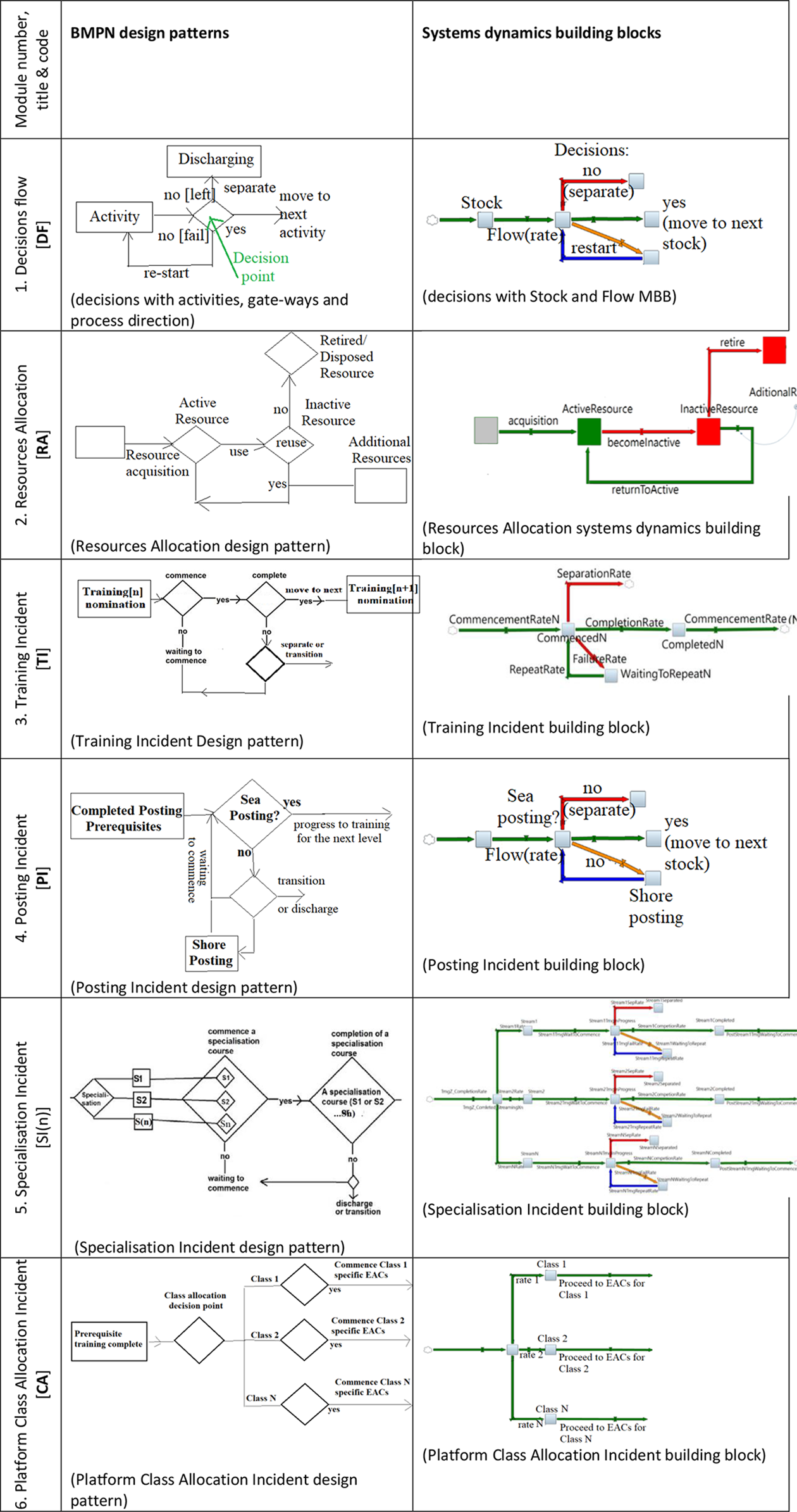
BPMN and systems dynamics share a common logic (sequential progression of the activities from start to finish). Also, BPMN’s flow and gate-based notations are conceptually similar to systems dynamics stocks and flows. Furthermore, both BPMN and systems dynamics methodologies focus on the ‘big picture view’ enabling stakeholders to see the entire problem space in a compact format at different levels of aggregation. Both methods can utilise modular designs for repetitive processes. There are, however, no elements between the BPMN and systems dynamics methodologies that have the same purpose and function; therefore, a direct BPMN to systems dynamics translation on the elements’ level is unavailable. As such, the module-based translation approach has been proposed, where BPMN to systems dynamics module pairs had been developed for the original case studies. Each module pair consists of one BPMN pattern and its reciprocal systems dynamics building block, that have been constructed from more than one element and represent artefacts of equivalent value. Each module pair has an allocated title and a module code as depicted in the translation map prototype in Table 1. In the future, the module-based translation maps will be available for sharing and reuse in the problem-specific information repositories. It is acknowledged that the proposed module-based translation approach is agnostic to the modelling methodologies and the problem contexts, potentially opening the approach implementation to use with other methods and in a wide variety of problem contexts.
A brief description of the module pairs from Table 2 is as follows:
Case studies specific BPMN – systems dynamics translation map.

Modular systems dynamics building: process and benefits
A seven-step process was created to develop the modular systems dynamics for a military education context using a module-based translation approach (Figure 3): Step 1: Represent the problem diagrammatically using BPMN symbology Step 2: Express BPMN diagram from Step 1 in the problem design patterns and module codes Step 3: Translate BPMN design patterns from Step 2 into the systems dynamics building blocks Step 4: Assemble systems dynamics building blocks from Step 3 to form problem-specific conceptual modular systems dynamics Step 5: Add model logic and variables to the conceptual model from Step 4 to enable its execution Step 6: Execute the systems dynamics M&S application from Step 5 Step 7: Validate the model execution results from Step 6

Seven-step modular systems dynamics development approach.
Each of the seven steps prepared for the case studies is illustrated in the two case studies. Only the Step One BPMN diagram development warrants careful decomposition as it consists of a) brainstorming, b) capturing business rules, c) reconciling individual contributions, and d) developing a BPMN problem diagram. Table 3 illustrates the decision context review conducted in brainstorming (Step 1a). The table is a form of a check list for the model developers’ consideration, to ensure a comprehensive data set and a model structure have been achieved during the modelling process. The brainstorming focuses on three aspects of a case study under consideration namely: (1) system’s structural elements; (2) system’s processes; and (3) system’s variables. These are supported by a system/case study title and a problem statement which helps to formulate a system’s boundary and a scope of the future model.
Systems dynamics information requirement guide for military training problems.


A proposed set of business rules (Step 1b) for military training problem modelling is provided below: Rule 1) Changes in policy are impacting critical parameters and potentially lead to a step-change; Rule 2) The pipeline flow is regulated by the recruitment policy, with the recruitment numbers adjusted routinely (i.e., every 6 months) based upon: i) capability needs (platforms commissioning and de-commissioning including transition provisions; ii) new skills required to use new technologies; iii) pipeline production capacity; and iv) separation/ transition numbers; Rule 3) Phasing out of the consolidation training on operational platforms can impact personnel confidence levels when operating equipment for the first time. Rule 4) Failure/separation (or transition) from the training pipelines occurs at a limited number of points that remain the same at different trainee intakes.
For Step 1c, reconciling individual contributions, Mathieu et al. 57 suggest comparing problem representations of individual stakeholders to the respective ‘expert models’ to assist with identification and addressing of any deficiencies in the unique models. An example of such an expert model has been presented by Drach-Zahavy et al., 58 where 34 concepts relevant to nursing tasks have been selected by the domain experts and presented to the problem owners to guide their modelling activities. Ideally, the owner’s original problem representations are sufficiently guided and structured, at the same time a due consideration is given to the contributions from the individual stakeholders. The final part of Step 1 is to develop the BPMN problem diagram (Step 1d) and these are illustrated in the two case studies later based on the information collected in Steps 1a to 1c and stakeholder consultations.
The seven-step progressive approach offers at least five potential benefits to model designers, system engineers, workforce planners and education specialists within and outside Defence that are interested in M&S applications’ development for workforce problem-solving. First, the approach standardises the workforce education problem representation with a fixed number of variables and constructs, enabling identification of generic problem design patterns and modular building blocks from which problem-specific modular M&S applications can be assembled. There should be a significantly reduced burden for the M&S user with limited or no M&S expertise to repeat all steps of the proposed M&S building process. Adopters of the approach should be able to use the pre-made, standardised and validated expert modules developed to suit their specific requirements. Second, the approach likely improves the cognitive effectiveness of M&S applications and thus, problems’ modelability. Equipping the workforce education stakeholders with a modelling process that does not require a detailed understanding of modelling logic and language should improve cognitive effectiveness amongst the M&S non-specialists. The module-based translation maps between the common BPMN problem representations and systems dynamics building blocks should enable workforce specialists to operate within a familiar user interface and reduce the instances of developing challenging M&S applications from beginning. Third, organisations will likely benefit from the modularity as relatively time-consuming systems dynamics process development should be mitigated with pre-made, reusable and validated systems dynamics building blocks. The cognitive effectiveness of M&S will likely improve amongst non-technical specialists from the ‘hands-on’ practice of model building and experimentation. Fourth, the approach should enable ready translation from BPMN to systems dynamics using systematic modularity where multi-element BPMN workforce education problem patterns are mapped against the pre-built systems dynamics building blocks targeting the same goal. Fifth and finally, the proposed approach provides a ‘one-stop-shop’ for objective and systematic M&S development. There should be more independent and unassisted use by problem owners with limited M&S expertise that should be intuitive to use, flexible to tailor to a specific problem and easier to share, reuse and to work collaboratively. The repetitive and reoccurring design patterns could be identified and modelled within any organisation. Individual (or group) M&S applications could be used for everyday tasks, as well as in a higher-level decision making for a wide range of problem-solving activities, including but not limited to investigations, risk assessments, maintenance forecasting, resource allocation, business case development, workforce management and planning, training pipelines modelling and so forth.
Case studies
An application of the proposed seven-step M&S development approach is illustrated by two original military education and career progression case studies, namely: Royal Australian Navy (RAN) Electronic Technician-Basic Employability Pipeline and Maritime Warfare Officer (Submarine) Employability and Career Progression. The paper reports progression through the conceptualisation phase of the process and illustrates Steps 1, 2, 3 and 4. Completion of the Steps 5–7 is proposed for future research.
Case study 1: RAN Electronic Technician-Basic employability pipeline
Case study 1 Step 1: Represent the problem diagrammatically using BPMN symbology
The RAN Electronic Technician-Basic Employability Pipeline case study has been reported initially in a conference paper by Jnitova et al.
59
The authors identified three variations of the pipeline as it went through reform, namely (1) Pre-2015, (2) 2015-2016 and (3) Post-2016. Each of these variations leads to different outcomes in terms of the training cost, duration and approach to consolidation training. The variation (1) delivers the Electronic Technician Certificate III via two phases: the ashore Initial Technical Training (ET ITT) course and the ‘at sea’ Competency Task Journal (CTJ); followed by the Advanced Skills Training Course (ASTC) and platform class allocation. Variation (2) was a reinvestment that moves the training consolidation from operational platforms at sea to shore, resulting in removing the journal component from the programme and extending the duration of the initial course to cover some of the journal content. The variation (3) introduces specialisation courses and moves the advanced course from the programme to the next training level. Figures 4(a) and (b) BPMN diagrams depict variations, (1) and (3). The variation (2) diagram is similar to the variation (1), minus the journal component. The following abbreviations are used in both Figures 4(a) and 4(b): ET ITT – Electronic Technician Initial Technical Training CTJ – Competency Task Journal S1, S2 and S3 – ET sub-specialisations ASTC – Advanced Skills Training Course EAC – Equipment Application Course AB ET – Able Seaman Electronic Technician

(a). BPMN diagram of pre-2015 RAN ET BTP training pipeline variation. (b) BPMN diagram of post-2016 RAN ET BTP training pipeline variation.
Case study 1 Step 2: Express BPMN diagram from Step 1 in the problem design patterns and module codes
The BPMN diagrams in Figures 4(a) and (b) were reviewed against the module-based translation map in Table 2, with the identified problem design patterns and their corresponding module codes given in Figures 5(a) and (b).
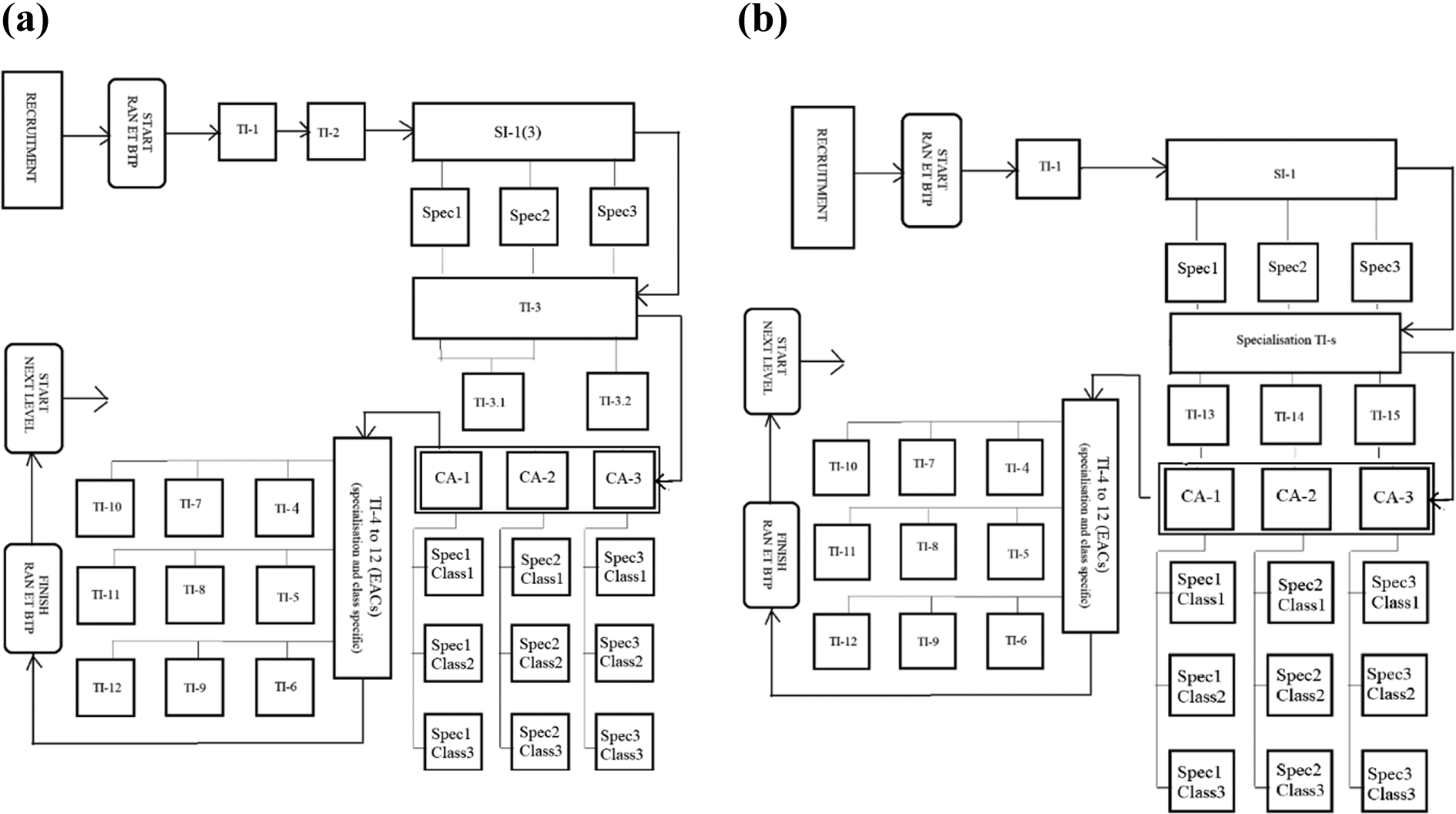
(a) Module code diagram of variation (1). (b) Module code diagram of variation (3)
The modules in Figures 5(a) and (b) are generally then numbered per their module codes in Table 2 and the order of appearance in the RAN Electronic Technician programme (i.e., Step 2 in the method). Note that the review led to three new specialisation courses added to the variation (3), numbered TI-13, TI-14 and TI-15. Also, the TI-4 to TI-12 modules have been created earlier for the variations (1) and represent equipment application courses (EACs). EAC modules are the same across the three pipeline variations and therefore retain their module codes. EACs are platform class-specific whereby each of the three platform classes requires these specialists, resulting in nine EAC variations. Such mixes of competence between general and on-type equipment are common in technician training, and the M&S enables organisational resilience to change in equipment or general technology to flow through the workforce education permutations.
Case study 1 Step 3: Translate BPMN design patterns from Step 2 into the systems dynamics building blocks and Case study 1 Step 4: Assemble systems dynamics building blocks from Step 3 to form problem-specific conceptual modular systems dynamics
Systems dynamics building blocks are then selected by module codes in Figures 5(a) and (b) and Table 2, followed by their assembly into conceptual systems dynamics applications specific to the electronic technician variations (i.e., Steps 3 and 4 in the method). A conceptual systems dynamics model for the variation (3) has been developed in Figure 6 to illustrate the outcome.

Conceptual systems dynamics diagram of post-2016 ran electronic technician employability variation.
Although the first case study modelling process has not resulted in an executable decision support application, it did derive some of the benefits predicted earlier. The diagrammatic representation of the problem improved the problem models’ cognitive effectiveness for the problem owners. With the transition to variation (3) complete, objective evidence towards historical and superseded pipeline variations (1) and (2) was not collected; instead, workforce managers focused on further analysis of the current variation (3) structure and dynamic behaviour for continuous improvement. Such future focus is common in organisations at a project-level, and it, unfortunately, limits the objective case for broader use of methods at programme or portfolio-levels.
Case study 2: Maritime Warfare Officer (Submarine) employability pipeline
Case study 2 Step 1: Represent the problem diagrammatically using BPMN symbology
The paper reports a small selection of activities from the Maritime Warfare Officer (Submarine) – MWO (SM) employability pipeline that has not been discussed in the earlier case study to illustrate additional considerations. With this goal in mind, only Steps 1 and 2 of our model development process have been reported for the Case Study 2. This second graduate employability pipeline has seven levels (Figure 7) compared to the one-level pipeline earlier. The Submarine Officer career commences with MWO (SM) transition from a Designate to a Qualified status with the award of RAN SM Qualification (

Maritime Warfare Officer (Submarine) employability pipeline.
Brainstorming and development of the BPMN representation were challenging. Despite considerable a priori analyses of this graduate progression, problem representations were not developed for systems dynamics modelling support and lacked detail, currency and version control. Stakeholders also lacked systems dynamics expertise and therefore, often did not fully comprehend the systems dynamics information requirements. There were also significant variations in the problem interpretation and decision options in reports and stakeholder feedback, with the access to specialists sporadic and often one-off encounters. Finally, the small sample numbers and pulsed nature of training pipelines were not conducive to modelling with some security and privacy limitations from the low population samples. Many organisations have highly specialised employability pipelines, where staffing is critical to success. Persevering to robust M&S often identifies pressure points and options to relieve criticality and improve resilience to graduate availability. Figure 8 illustrates the BPMN representation of the MWO(Submarine) employability pipeline.

BPMN model of Maritime Warfare Officer (Submarine) career progression.
Case study 2 Step 2: Express BPMN diagram from Step 1 in the problem design patterns and module codes
The module codes diagram with the corresponding levels is in Figure 9.
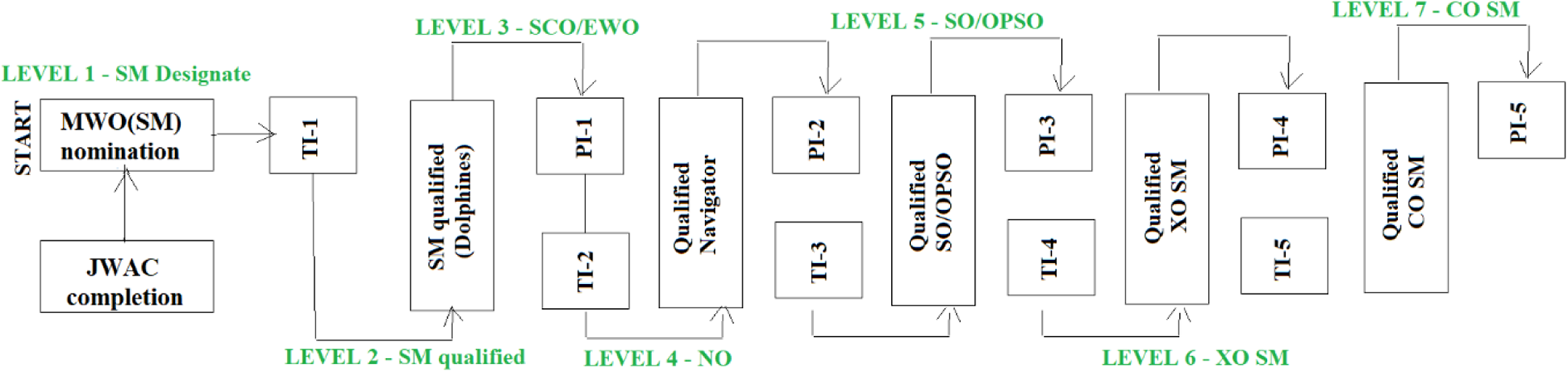
Maritime Warfare Officer (Submarine) module codes and pipeline levels diagram.
The first two benefits posited earlier from method development were evident in this case study. The generic problem design patterns and modular building blocks were identified and modelled as shown. The submariner workforce education stakeholders were equipped with a modelling approach that did not require a detailed understanding of modelling logic and language. This provision improved the cognitive effectiveness by the non-specialists in M&S. Stakeholder engagement was mutually beneficial with some of the findings from the case study informing the progression of the submariner workforce review. Further, there are some promising developments with Elsawah et al. 60 reporting assessments of submarine support systems using the M&S approach, as well as used in a comprehensive submarine workforce analysis project. The documented modelling approach would benefit from more automation to increase its efficiency and facilitate more independent conduct by problem owners.
Discussion
Workforce modelling has promised greater optimisation and efficiency for decades 3 but has generally not been sufficiently elegant for widespread use without dependence on specialist M&S support. 19 Such M&S support is commonly only sought when significant organisational difficulties have occurred in particular professions and thus is pathologically dependent (i.e., a band-aid). While M&S offers considerable efficiency benefits, anecdotally workforce managers are sceptical of lean management practices likely because such efficiencies can reduce an organisation’s resilience to complexities like competition, technological and societal changes, of which there are many. 61 There is promising research that organisational resilience broadly may be sought with M&S, distinct from purely lean objectives, 62 –64 where this appears more advanced for supply chain elements. 65,66
This research has sought to model workforce education to achieve more organisational resilience, offering a unique translation of BPMN approaches with systems dynamics to lower barriers to achieving M&S use in workforce management. Such M&S allows organisations to partner more sustainably with education providers where they do provide competencies that can be outsourced while optimising personnel flows through in-house education where external providers cannot. The research team has recently focused on the measurement of training system resilience 67 similar to the instrumented survey approach by Morales et al. 62 but concentrated on just workforce education. The aim is to make it easier to identify when training and education management may be sub-optimal or fragile to perturbations well before problems occur (i.e., avoiding band-aid approach) by surveying the milieu inhabitants of employability clusters. A framework for examining training systems resilience has been piloted at a large Australian defence site and the results used to refine the survey instrument for quicker assessment and management direction. This recent work provides the training systems resilience metrics and early management focus, however, the M&S of employability pipelines as researched here is the wherewithal to derive substantial organisational optimisation. Defence is a major outsourcer of education and training, and as outlined earlier 40 is publicly seeking greater resilience to disruptors and emerging technologies through workforce education. A logical next step from this research is to survey the resilience of the many employability streams and then progressively model those areas identified as fragile to optimise the education and training solutions.
Conclusion
Research has identified that modelling and simulation in workforce employability pipelines offer significant benefits, especially to modern complexities in technology and societal changes. However, M&S is impeded by the complexity of systems dynamics and a dependency on specialists to construct and use. The literature review by Jnitova et al. 19 found conceptual modelling, like Business Process Model Notation, needs to be used with systems dynamics and a translation approach to improve what we term the modelability for users. A new translation approach was developed and used to model two different critical employability pipelines within the Royal Australian Navy. Five benefits of such an approach exist in the literature. These benefits were all realised to some extent in both the case studies documented. Many large organisations would likely benefit from such M&S of their employability pipelines; however, often, organisations do not resort to such deep support until significant problems emerge. There is also the spectre that such M&S is only for efficiencies and not to build resilience where it is needed. Further research is focused on instruments to measures training system resilience to improve early detection of resilience concerns and to promote greater M&S in critical employability pipelines.
Footnotes
Declaration of conflicting interests
The author(s) declared no potential conflicts of interest with respect to the research, authorship, and/or publication of this article.
Funding
The author(s) received no financial support for the research, authorship, and/or publication of this article.
