




Abstract
Textile and apparel manufacturing industry of India is second highest employment generator sector and largest contributor to India’s GDP. Unfortunately, it lacks behind in innovations and adoption of technology to meet the challenges. The basic problem remains as how to bring varied designs to market quickly with less efforts and cost. The adoption of CAD technology offering enormous benefits to apparel manufacturers in India. It makes quick and efficient revisions in apparel design changes including colour adjustments on fabric pattern and resizing garments. CAD system enable designers to produce more accurate designs with less chance of mistakes by saving cost and time. Its integration with CAM offers many advantages during manufacturing process and makes the apparel production faster with consistent and accurate results every time. As all information related to design and production are stored in file format, it makes very easy to produce the same design again without repetition of previous activities. The introduction of CAD technology in the industry resulted to improved efficiency of the design process due to automation of routine design tasks, increased employee productivity and shortened lead time in the product development process. This study highlights on adoption of CAD technology, limitations and its impact on business.
Keywords
Introduction
The Indian textile and apparel industry accounts for about 14% of the country’s total industrial production and 4% of GDP, it is the second most important sector in terms of employment after agriculture. To be competitive and to survive in the global market, Indian apparel manufacturers require to create value to the customers by offering high quality products and services in less lead time with minimum manufacturing cost and maximum operational efficiencies. To achieve these objectives there is need to employ computer-based technology, undoubtedly, in recent years, there has been technology shift in designing and production of apparels to meet the customer demand of rapid changes in fashion clothes. Designing is the first step of garment production; Computer Aided Design has brought a revolution in the textile and apparel industry.
For smooth manufacturing and designing process, most of the apparel manufacturing firms have adopted CAD software, with the help of CAD software, a garment designer easily creates a virtual representation of the artefacts they are planning to design, Aldrich, W. 1 Now a days CAD software is used in many areas of garment production to increase the quality of designs and productivity of the designers, this not only increase productivity but also reduce the manual and thus time-consuming process of apparel designing. Designers can produce all possible outputs within few seconds to weave exquisite piece of apparel, they can have clear idea about the designs to fit into various fashionable patterns and variety of fabrics. Now a days with the help of varied CAD programs, two-dimensional and three-dimensional models can be created and viewed in different directions, the most popular programs for Computer Aided designing are Adobe Illustrator, Poincare, Adobe photoshop, Gerber, Lectra etc. all of which are used by designers for experiment with pattern, colour and textures for producing quality and perfect designs along with availability of sketch background in broad concepts. However, in developing countries such as in India, the adoption of such technology is limited in Textile and Apparel industries. To know the level of adoption of such technology, the empirical evidences for this study were taken from National Capital Region that includes Delhi, Noida, Gurgaon, the region has emerged as the hub for production and export of ready-made garments since the period of 2000–2003. Firms located in this region either relocated from Delhi, new start-ups or multiple plant of an existing unit. In the region different firms hold different opinions with regard to the adoption of CAD technology, Gong et al., 2 believed that Computer aided design system reduces the lead times compared to the manual work of designing and thus enhanced business performance of firm, on the other hand, few firms were in opinion that it is more costly to install the software and then hire CAD professionals as compared to manual designing task. Author found the gap in firm’s perceptions of increasing business performance before CAD adoption and actual increased business performance after CAD adoption. The study revealed that the benefits of CAD adoption are more than the cost occurred in its implementation and in hiring of CAD professionals. These firms can achieve quality of work and efficiencies in production by adopting CAD system and transforming themselves from traditional methods of manual designing to automated computer designing methods.
Lifestyle, Stopper, Rituwear, H&M, Pantaloons, Shapes, GAP, TNG, Diesel, Adidas and many more are big brands which purchase garments produced by NCR based apparel manufacturers. These Firms have cut throat competition with apparel manufacturers located in low wage countries such as Cambodia, Bangladesh, Vietnam, Sri Lanka, Indonesia and Pakistan and Most of the firms also sell their products whether to European countries or USA markets. It has been found through the literature review that many of the firms lack of technological adoption and face challenges from ineffective management structure, low employee’s productivity, less innovativeness, less awareness of benefits of technology adoption, poor quality of designs and product development, and limitations of skilled professionals and training institutes. To overcome these challenges and to meet international demands, the adoption of CAD technology and automation in product development process is important and its application in different capacities of garment production should be recognized by each apparel manufacturing firm in India, stated by Kasik DJ, et al. 3 Textile and Apparel industry in India is the biggest employment generator after agriculture sector, it is also claimed to bring the highest foreign exchange among all other industrial sector on India, hence adoption of technology and its importance for the growth of industry cannot be ignored stated by Jerrard R, 4 keeping in view the requirement of CAD technology adoption and its impact on business performance of firms the present study was planned to conduct in NCR region of India.
Different types of cad system
Apparel manufacturing firms use CAD systems mainly for garment designing, pattern grading, pattern preparation and marker grading. During the end of 1980s, apparel CAD technology as creative designing tool received a lot of attention by textile experts, although, lot of research has been conducted on its application and uses and benefits in textile industry, major portion of the industry still use basic CAD design software such as Adobe photoshop, Adobe Illustrator, Corel Draw etc. rather advanced CAD software as Gerber, Lectra, Design Dobby, Tukatech, Optitex and many more.
Research objectives
Three major objectives of this study are: ⇆ To determine the CAD adoption rate by apparel manufacturing units. ⇆ To assess the impact of CAD usage on business performance of apparel manufacturing units. ⇆ To examine the hindrances in the way of CAD adoption.
Impact of cad technology on business performance
This section will specifically focus on the discussion of various performance indicators that are linked with the impact of CAD adoption on business performance of the firm followed by supporting literature review and hypothesis respectively. The constructs which are taken into consideration in this study and being impacted by adoption of CAD technology are employee’s productivity, cost effectiveness, quality and innovative designing, increased sales, customer responsiveness, lead time, competitive capability and production efficiency, the statement was also supported by Kedia BL and Chhokar J. 6
CAD technology has been achieving rapid growth since early eighties of twentieth century in major industrial sectors of country, it impact firm’s business performance as a whole, and help firm’s streamline business operations in the areas designing, pattern making, pattern grading, digitizing of pattern, plotting and marker making reach out to maximum number of customers and to compete more effectively with rivals, by Hands et al. 7
According to Technology adoption model (TAM) which was first developed by Davis et al. 8 ‘perceived ease of use and perceived usefulness determine an individual’s intention to use a system or technology’. The model proposed that behavioural intentions and usefulness of system determine the adoption of technology. Government policies and procedures of technology innovations, adoption, research institutions, requirement of technological up gradation, financial support system, all are determinants of technology penetration of a Nation.
CAD adoption is determined by the extent of the degree to which firm believe that using a particular technology would benefit the company with less effort and cost of adoption leading perceived ease of use which would enhance production efficiency. 9 Adoption of new technology also increase competitive capability of the firm, and affordable cost would create intention of use of new technology. 10,11,12 This is also supported by Grover 13 and Premkumar and Ramamurthy, 14 firms are most likely to adopt new technology, if they perceive that gaining competitive advantage from using the technologies is feasible, Thus, an apparel manufacturing firms using integrated CAD tools are likely to meet their goals more efficiently by reducing time of product development, manufacturing cost and increasing product quality and productivity of employees to gain competitive advantage, hence CAD technology integration with other business operations and the extent to which technology has been adopted influence the global competitive capability of a firm. 15
To achieve quality and innovative apparel designs CAD technology allows design team to test designed garment in the virtual world before it is produced as real product, it also enable designers to investigate an error at early stage of designing and solve it before any prototypes are made, this not only minimize wastage of fabric but also save money and time. With advancement of 3D CAD software, it is becoming sophisticated in terms of visualization and realism. 16,17 Managers suggests that utilization is antecedent to the achievement of impact, there are several levels of impact and the achievement of impact across these levels is progressive. Previous studies, 18,19 evaluate the effectiveness of CAD technology in terms of achievement of pre-set goals. The goals included: reduced cost, improved quality, less lead time, quality and innovative product designs, customer responsiveness and production management, the statement also supported by studies of CAD 20 software ensures that CAD drawings are easily read and converted correctly into the necessary formats and that the integrity of data is preserved and no issue in reading and sharing of drawings. According to Agrawal Bikash and Datta DB 21 CAD software produce impressive models that can be demonstrated by marketing and sales departments without spending money on prototype to impress investors and customers. Such data can then be easily stored and further it can be integrated with CAM systems in order to facilitate production process efficiently in shorter period of time.
According to Harmit Kaur Saini and Harpreet Kaur 22 quality of design, production capacity, efficiency in production and communication speed increased with the adoption of automation and CAD technologies, whereas operating cost, manpower and lead time decreased. Aldrich, W 1 revealed that with the adoption of automation and CAD/CAM systems, there was considerable demand for quick delivery of the order with shorter lead time which can be fulfilled through automation and CAD/CAM adoption and enhance customer satisfaction. CAD frees up designer’s innovative thinking and encourage creativity in different ways to produce unique and superior quality designs that manual designing is not able to create. Manual pen-and-paper design is not only time taking, more chances of errors, cumbersome and laborious, but also not able to entirely capture details down to the minutes level.
Fashion design software (CAD) greatly aid the work of a fashion designer and help in increasing designer’s performance. 23 They help the designer in experimenting with a number of textures, colours and patterns for producing superior quality of designs. During the design and production phase, CAD system indirectly improve the productivity and efficiency of companies by contributing to the integration and automation processes. 24 With the use of CAD technology cost effectiveness can be realized at each stage of work in different aspects with increment in Profit margins and less expenses on labour, rework, and even wasted or underutilized raw materials. Customer satisfaction and experienced also improved with excellent and accurate apparel quality, leading to higher sale volumes. 25
The research of Okay 26 and Oppong et al. 27 stated that productivity effectiveness and efficiency of garment manufacturing industry increased by the adoption of CAD technology as it integrates many garment manufacturing processes starting from cutting of different garments parts, integration of multiple machines, and then sewing of these parts. CAD is uniquely fast and easy to use software, it makes garment production faster with accurate results in minimum required times.
In short, CAD system improve the quality of design, eliminates redrawing of designs with each small change and then, designs can be transferred digitally into CAM system. Other benefits of CAD identified 28 includes increased customer satisfaction, product performance, cost reduction and timely deliveries. Studies carried out by Okay, 26 Oppong et al. 27 and Tan and Vonderembse 29 reveal that using textile firms can yield more productivity by making conceptualization of designs easier and thus, has a positive impact on operational and cost performance of manufacturing firms.
The research of Vincent WC Fung and Kam Chuen Yung 30 stated that adoption of computer technology increase the engineering decision-making functionalities available in the manufacturing industry, their study specifically focused on automated PCBA which is an essential process during the manufacture of electronic products.
Problem statement
The information presented above in literature review highlights the important aspects of the CAD technology that define its importance to the apparel industry. CAD application in the apparel manufacturing industry has boosted apparel design quality and production, allowing apparel producers to increase operational efficiency and profitability. There are numerous benefits of CAD technology adoption; provide clear advantages over traditional methods of manual designing textile products. Few studies evaluate the effectiveness of CAD technology in terms of achievement of organizational goals through survey methods. While there are challenges in adopting CAD software, the extent to which apparel manufacturers can be benefited from this technology is worthy of exploration. There remains a gap in the literature to measure the adoption rate of CAD technology in apparel manufacturing units and the impact of this has on business performance in terms of benefits after implementation and the obstacles in the path of adoption of CAD technology. India is the world’s second largest exporter of textiles and clothing. To compete the globally it has become necessary for Indian textile and clothing industry to be more technological advance with the adoption of new technological tools. CAD is one of the technological tools which adoption in industry could contribute to create more jobs, alleviate poverty and improve India’s competitiveness globally.
Hypothesis formulation
Based on theoretical framework and related literature review, this study proposed eight hypotheses with regard to the impact of CAD technology adoption on the performance of apparel manufacturing firms in NCR region of India. H1: Use of CAD technology significantly impact the cost effectiveness of apparel manufacturing firm. H2: Use of CAD technology has significant impact on production efficiency of apparel manufacturing firm. H3: Use of CAD technology leads to an increase in customer responsiveness of apparel manufacturing firm. H4: Use of CAD technology is positively related to the competitive capability of apparel manufacturing firm. H5: Use of CAD technology has significant impact on the firm to produce quality an innovative apparel design. H6: Use of CAD technology has a significant impact on the enhancement the employee’s productivity. H7: Use of CAD technology positively facilitate the firm in reducing lead time from receiving of orders to delivery of orders to the customers. H8: Use of CAD technology positively impact an increase in the sale of apparels.
Significance of the study
The significance of the study is to provide knowledge about the adoption of CAD technology by apparel manufacturing units and how this has impacted the performance of the industry after implementation. There is abundance of literature covering CAD adoption and performance, but does not focus on the survey of the adoption of CAD usage and the corresponding impact on firm’s performance in NCR. It is hoped that the research will provide insight into CAD adoption and how this has positively or negatively improved firm’s performance. The study will also provide insight for existing and emerging entrepreneurs, students doing fashion designing course and the firms who are still relying on manual apparel designing methods on the adoption impact of CAD technology on business performance in terms of benefits and losses, types of most preferred CAD software, its application in different areas of garment manufacturing process and the barriers in the path of adoption of CAD technology. The study data can also serve as base for further study in the field of emotion-based apparel design system as now a days the customer’s increased demand for apparel products not only in the aspect of quality and function but also of emotion, affection (aesthetics), with the use of Neural Network technology a mapping from affective words to design parameters can be developed, Yu Zhao et al. 31
As the development of technology and science has transformed people’s lifestyle from choice of food to clothing, firms now a days are facing a great challenge to explore customer demand. Therefore, apparel manufactures need to constantly carry out technological innovations, development of CAD technology to invent and develop new designs and styles of garments, to produce and sell goods to meet customer’s changing preferences of designs of apparels. The study will be helpful in construction of a functional model of the manufacturer’s optimal garment supply strategies for group customers, Zhiyi Zhuo et al. 32
Research methodology
The study was carried out in National Capital Region of India that includes Delhi, Faridabad, Gurugram, Noida, Greater Noida. The region has emerged as the major site for production and export of ready-made garments. This study used quantitative approach of research methodology in order to examine the adoption rate of CAD technology and its impact on the business performance of apparel manufacturing firms situated in NCR, India.
A survey was conducted to be the most suitable research method in order to meet the objectives. The primary instrument was standardized questionnaire which constitutes open ended and close ended questions under each construct. Questionnaire was divided into four sections, section A consists general information related to firm and its employees, section B include the usage of CAD technology consist of open ended and close ended questions, section C consists measurement of impact of CAD technology adoption on firm’s performance in which 24 questions under eight constructs on five-Likert scale were framed to achieve the objective. Section D focused on exploring various hindrances in the path of CAD technology adoption and then close ended questions were framed to seek the statements of respondents. The data was analysed using SPSS statistical software.
Snow ball technique was used to select the apparel industry from the directory Apparel Export Promotion Council of India, for NCR based units. The designers and Managing Directors and Garment managers were requested to give information being asked in questionnaire and data was collected personally.
The sample population in this research was 90 employees of apparel manufacturing units in NCR, 75 responses were collected among which 15 responses were incomplete and excluded from the study.
Data analysis and interpretation
The study sough to collect data from 90 respondents, among which 75 respondents furnished all details of questionnaire and their responses were considered for analysis. Table 1 below exhibits all demographic information of respondents and size of the firms. At the same time Table 2 demonstrates various Designing methods adopted by Apparel Manufacturing companies in NCR.
Demographic profile of respondents.

Designing methods adopted by Apparel Manufacturing companies in NCR.

From the Figure 1, it is revealed that 48 respondents out of 75 respondents viewed on using CAD technology in the firms they were working, and 27 respondents viewed on using manual methods of apparel designing.

Designing methods adopted by Apparel Manufacturing Companies in NCR.
Figure 2 Represents the respondents opinion on preference of companies for CAD software, 18 respondents out of 75 respondents replied that the company in which they work use Corel Draw, 13 respondents replied for Adobe Illustrator, 10 respondents replied for Adobe photoshop, and 5 respondents replied for Lectra, No one replied for Gerber, only 2 respondent replied for others (Tukatech, Telestia), It is believed that CorelDraw, Adobe Illustrator and Adobe photoshop is the most appropriate and available software for apparel manufacturing firms in NCR.

Types of CAD software used by apparel manufacturing units in NCR.
Figure 3 shows that out of 48 respondents, 18 respondents said ‘Yes’ and agreed that CAD implementation is costlier and not easy to install by all firms in the category, 11 respondent accepted that lack of skilled professional is an obstacle in CAD adoption, 10 respondents agreed that traditional and manual designers became reluctant for the adoption of CAD due to fear of their job loss, 5 respondents viewed that lack of Government financial assistance to the companies become an obstacle in the path of technology (CAD) adoption, 4 respondents were not aware with the benefits can be sort by the adoption of CAD so their company least interested to adopt new technology.

Respondents statements on the hindrances of adoption of CAD technology.

Testing of research hypothesis
Reliability of scales
Cronbach Alpha reliability test was used to measure internal consistency among the sub-set of surveyed items which the researcher believed would all measure the same construct, and were therefore correlated with each other.

The reliability of the constructs used to measure impact of CAD adoption scale has a Cronbach’s Alpha value of 0.899, according to Nunnaly 33 the acceptable Cronbach Alpha value has to exceed 0.7. The result of this study shows that all the constructs had Alpha value more than 0.8 which is acceptable and strong and shows good reliability of the survey. There was no individual item that was higher than the total Alpha, hence all items were retained.
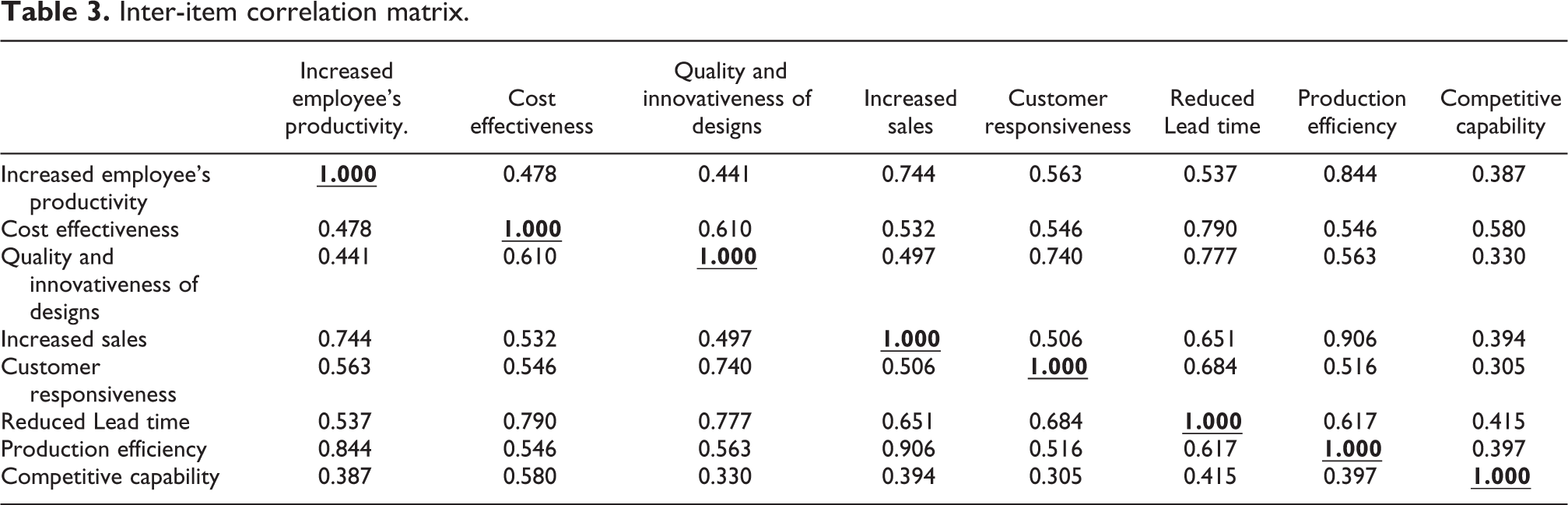
Table 3 represents Inter-item correlation matrix, quantifies how much consistency there is between the items measured on scale to know the impact of CAD adoption on business performance. A list of 1.000 across the diagonal (top left to bottom right) can be noticed from Table 3 represents instance that the item has been correlated with itself. Thee scores are identical; the correlation is perfect (r = 1). If correlations are less that r = .30 it indicates that the item may not belong on the scale and need to be removed, in the table above no item is less than .30, hence all are perfectly correlated and no need to remove any item from questionnaire.
Inter-item correlation matrix.
Correlation testing of hypothesis
Pearson product-moment correlation coefficient was used to test the relationship between variables that were hypothesized in this study.
From Table 4, it can be observed that the correlation coefficient between two variables for H1 r = 0.896 and p < 0, hence hypothesis H1 is accepted. For H2 correlation coefficient r = 0.882 and p < 0.01, hence hypothesis H2 is supported, for H3 r = 0.771 and p < 0.01, hence hypothesis 3 is accepted, for H4 r = 0.895 and p < 0.01, hence hypothesis 4 is accepted, for H5 r = 0.713 and p < 0.01, hence hypothesis 5 is supported, for H6 r = 0.743 and p < 0.01, hence hypothesis 6 is accepted, for H7 r = 0.786 and p < 0.01, hence hypothesis 7 is accepted, for H8 r = 0.899 and p < 0.01, hence hypothesis 8 is accepted.
Correlation testing.
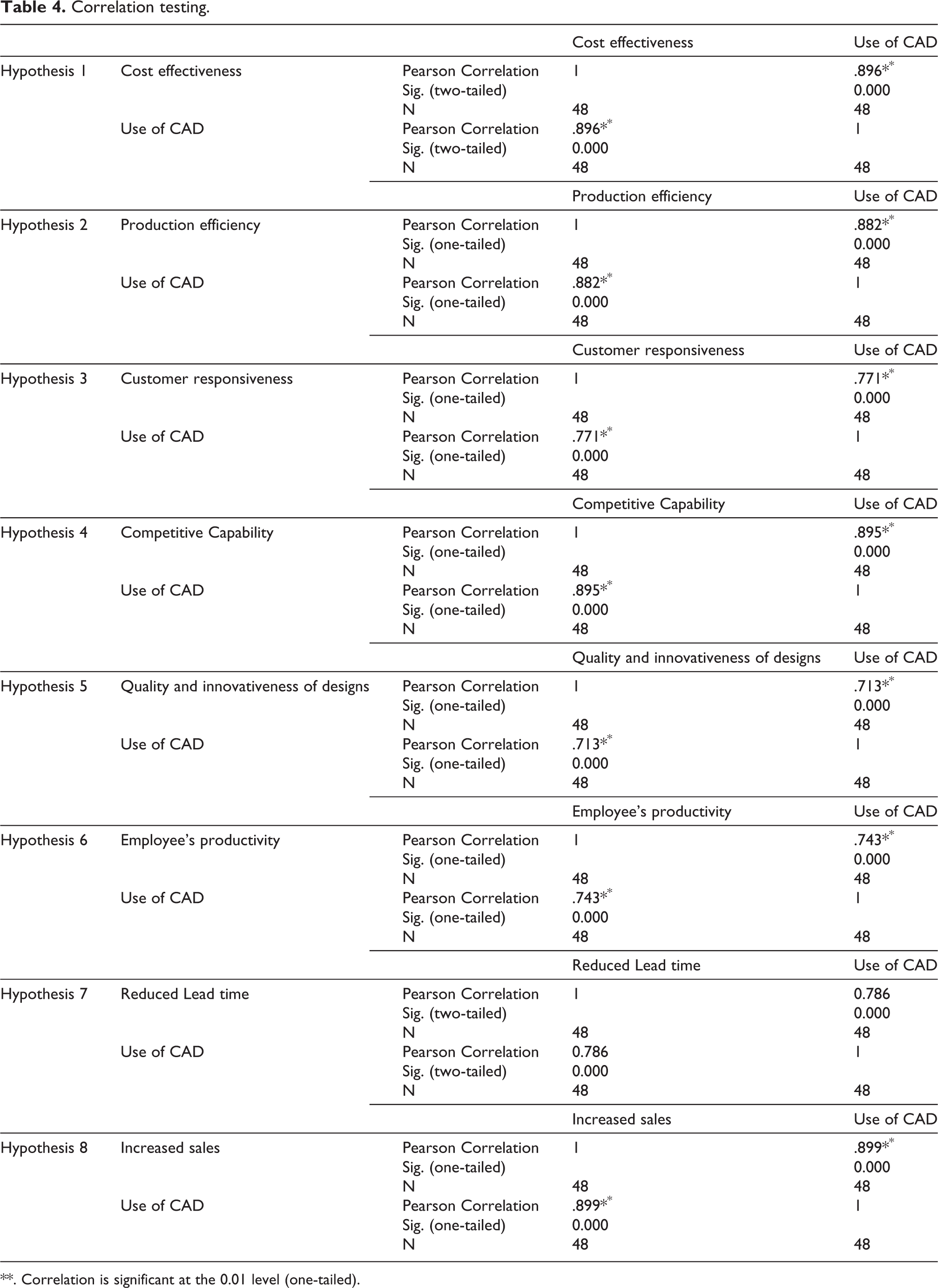
**. Correlation is significant at the 0.01 level (one-tailed).
Regression analysis
To analyse the relationship between independent variables and one dependent variable multiple regression analysis (MRA) was applied, CAD adoption was a dependent variable and Increased sales, Quality and innovative designs, Employee’s productivity, Cost effectiveness, Customer responsiveness, Production efficiency, Reduced lead time, Competitive capability were taken as independent variables.
The measurement of the proportion of the variance between dependent variable and independent variables are determined by the coefficient of R2. Higher coefficient of determination indicates higher explanatory power of the regression model. Table 5, represents the value of R2 for the use of CAD technology is .862, which denotes that 86.2% of the variance in Use of CAD technology is explained by the model. This high value of R2 denotes that the regression model is very good. The model is statistically significant at F = 16.29, confidence interval =95%, and p < 0.001. Regression coefficients of Increased sales, Quality and innovative designs, Employee’s productivity, Cost effectiveness, Customer responsiveness, Production efficiency, Reduced lead time, Competitive capability are statistically significant.
Results of multiple regression.

a. Predictors: (Constant), Increased sales, Quality and innovative designs, Employee’s productivity, Cost effectiveness, Customer responsiveness, Production efficiency, Reduced lead time, Competitive capability.
Respondent statements of CAD adoption impact on business performance (Likert scale data)
From the chart above it has been revealed that majority of the respondents out of 48 respondents agreed the statement that CAD adoption has positive impact on apparel manufacturing firm’s business performance in terms of cost effectiveness, production efficiency, customer responsiveness, employee’s productivity, competitive capability, quality and innovative designs and increased sales.
Hindrances in the path of cad adoption
The hindrances involved in the adoption and use of CAD technology in various companies surveyed are as follows: Sudden break down of computers can damage the whole work, work is also prone to viruses and can be hacked easily in lack of security licenses. CAD is only a technological tool for designer, innovative and best designing on CAD depends on the skills of designer, it can tell only what a design looks like, hence adoption of CAD require skilled professionals. CAD hardware and Lack of Government Industrial institute for CAD training with minimum fees for students and Garment industry workers. Sometimes, it’s too tough to find There is lack of financial support from government to small-scale apparel units, in the era of stiff competition it is essential to give financial assistance to the small-scale apparel manufacturing industries to purchase CAD software and hardware components. Penetration of technology is also low in NCR and most of the companies are not aware with the benefits of technology adoption, hence in the case of CAD adoption, few companies are still not aware with usage and benefits of CAD in garment manufacturing and designing process (Ostad-Ahmad-Ghorabi and Collado-Ruiz)
34
. Many different CAD tools may be used by a collaborative design team, due to the often-distributed nature of modern, internet based collaborative design processes. When design teams use different CAD tools, problem often arise because different CAD tools still use different native file formats. For example, Autodesk inventor generates part files in .ipt file format and Pro/E generates part files in prt file formats. If design team members want to share data stored in both file formats among firms connected with supply chain networks, a problem in data consistency might exist. Data communication problem due to using the Internet as a communication channel may also exist.
35,36
Conclusion
This research was investigated to identify the status of CAD technology adoption, its impact on business performance on apparel industry and factors affecting CAD adoption. Research revealed that in the fast-changing era of technology development 36% of the surveyed garment manufacturing companies still rely on manual work and not aware with the usage of CAD technology. Though majority 64% of the surveyed companies use CAD technology but they are lacking behind in use of advanced CAD systems as Lectra, Gerber, Tukatech etc., they are still relying on basic CAD software. The research question concerned with factors that affect CAD adoption in apparel manufacturing units in NCR was answered by formulating hypotheses, Pearson product-moment correlation coefficient was used to confirm the relationship between variables. Correlation analysis supported all hypothesis formulated on the model. All correlation test was found significant supporting all hypothesis stated in this study. Accordingly, it can be concluding that adoption of CAD technology is positively related with increased sales, Quality and innovative designs, Employee’s productivity, Cost effectiveness, Customer responsiveness, Production efficiency, Reduced lead time, Competitive capability of apparel manufacturing firms. Regression analysis further depicted that Quality and innovative designs, Employee’s productivity, Cost effectiveness, Customer responsiveness, Production efficiency, Reduced lead time, Competitive capability were significant predictor of the firm’s business performance and influenced positively with the use of CAD technology. The research depicted main challenges of using CAD technology as cost of CAD implementation, lack of skilled professionals in the area, and resentment of manual desginers to work with CAD technology. Few respondents were also stated that lack of financial support from Government is also an obstacle in technology adoption as in the era of stiff competition and for sustainable growth of small and medium apparel manufacturing companies in the market it is essential for them to get financial assistance from government for technology adoption and upgradation. The hindrances which are explored in this research can be used as instruments for the development of CAD technology and future research and also to find out the reasons for inefficiencies and suggesting solutions. The study will be helpful for the other researchers, fashion designing students to explore the influencing variables of business performance of apparel manufacturing firms and impact of CAD technology implementation on the variables. Study further enable other researchers to explore the status of adoption of CAD technology and key performance indicators of apparel manufacturing firms influenced by the usage of technology.
Limitations
The study was limited to selected apparel manufacturing units in textile industry from NCR, region, India. It would be better for generalization if data included from other states of the country. Therefore, implications and generalizations of results obtained at other industries should be done with caution since adoption, impact and hindrances in adoption of CAD technology might be dissimilar at different times and in different zones.
The research only investigates the adoption and impact of CAD technology and the hindrances associated with adoption, it fails measuring how much it contributes to the profit maximization and growth of the industry in country. The researcher also realizes what the limitations of this study would have in terms of apparel CAD analysis in the whole apparel supply chain and in training. The study also fails to explore also fails to explore the application of 3D CAD in the industry, it would be better if longitudinal data gathering method is applied in future research to see the long-term effect of CAD adoption in textile and apparel industries.
Suggestion for further research
Other researchers could expand the research by expanding sample size to textile and clothing industry across India and not limit to specific zone as NCR as this study did. The main focus of current research was limited to application of CAD in apparel designing and its impact on business performance of surveyed firms. Study of CAD technology can be further combined with CAM technology to explore more application and impact in garment manufacturing process. In the current study only nine constructs as performance indicator was used, hence there are many more constructs related to human resource, managerial capabilities, financial strength etc. can be taken by other researcher to expand the impact of CAD technology in other functional areas of firm. The Apparel firm’s perspective on gaining a deeper understanding to adopt CAD technology and to combine with CAM and other technological tools in the manufacturing process and the perceived impact on firm performance within other textile manufacturing industry as knitting industry, yarn manufacturing industry etc. is still open to be explored. Furthermore, there is one more opportunity to explore the adoption of advanced 3D CAD technology and its impact on performance was not explored in this research.
Research can also be expanded to Environmental Assessment that can be done by integration of LCA software with CAD technology. For environmental evaluation of product concepts in early design stages, implementation of LCA (Life cycle Assessment) is a promising approach. Merging these two processes by adding the right theory will lead to a successful integration of LCA into early product design stages, Yu Zhao et al. 31 (2016)
Future growth of cad in apparel industry
The way technology innovations and adoptions are taking places in country like India, the future of machines with little human presence can be forecasted wherein all the process of garment manufacturing would be done by automation. Now, variety of CAD systems have been commonly used in the field of clothing, to be competitive in global market and sustain, the future of garment industry rely on the shift from old technology to advanced technology, the advancement in CAD technology from two dimensional to three dimensional has changed the ways of designing and simulation practices. Due to the push forward of fashion industry and changing customer’s preferences of fashion clothes, no one can think of turning back to the methods of manual designing, the growing demand of fashionable and customized clothing with high quality designs would trigger the development and adoption of CAD technology, transitional shift from 2D CAD technology to 3D CAD technology enable designers to view all three dimensions of an object. 3D view of an object not only help in determining the colours and design printing of the fabric but also the thickness of the textile, and then, appeal and durability of textile and design of texture of the textile can be determined easily in less time. Textile industry is very old and labour intensive, it lags behind the corresponding hardware required for the development of CAD technology from two-dimensional shift to three-dimensional shift. Three-dimensional CAD technology provide a system of visualization and simulation start from textile designing to the production of virtual ready-to-wear clothes. It represents the new generation textile and clothing CAD. Recent developments in technology propose more humane oriented approach with intelligent artificial neural network garment CAD technology which focus on measurement of three-dimensional body measurement, turn 2D pieces into 3D ready to wear, design clothing pieces based on data measured, and finally making it aesthetic and stimulate the motion as human being. At present, Indian textile and apparel industry lagging behind in the application and development of three-dimensional CAD technology. For the development of CAD technology from two dimensional to three dimensional there is need of hour to improve and resolve fabric compositions and performances, flexible and vivid surface modelling and also conversion from three-dimensional models to two-dimensional models of garment designs and many more technicalities. Resolution of issues and fulfilment of hardware requirements by industry would result to the future direction of the growth of three-dimensional CAD software in Indian textile and apparel industry. CAD technology is also being utilized now a days to rationalize the affective property and design for apparel, as in in the apparel industry, emotions or effects of both wearers and audiences are very important, Y Zhao, Song et al. (2017). 36 Now a days a potential enrichment of integrated CAD/CAM technologies support in the areas of integrated design and operation management system of garment industry and facilitate in designing the models and collections, patterns, marking, laying out and cutting in production of garments, further, the integrated approach to design and production and other life cycle activities will be studied in the future according to the work, Zhang et al., 37 which further integrates the cloud computing and big data technique, Breivold 38 and operates in the context of a holistic supply chain network system, Wang JW et al. 39
Footnotes
Declaration of conflicting interests
The author(s) declared no potential conflicts of interest with respect to the research, authorship, and/or publication of this article.
Funding
The author(s) received no financial support for the research, authorship, and/or publication of this article.
