




Abstract
The number of international students applying to universities in Taiwan is increasing annually. Moreover, universities’ choice for international students is also increasing with support from the Ministry of Education of Taiwan. Therefore, it is crucial to understand the factors that influence student choice. This study investigates the effects of Taiwan’s higher education service quality on international student satisfaction and institutional reputation. We collected data from 197 international students studying at 33 national and private universities in Taiwan to test the study’s proposed model. This study uses a quantitative approach to examine the proposed hypotheses, and causal research design is used to elucidate the cause-and-effect relationship between constructs. The non-academic aspect of service quality is the most influential variable in student satisfaction, and student satisfaction strongly affects institutional reputation. Student satisfaction mediates the relationship between the academic and non-academic aspects of service quality and institutional reputation. This study’s findings could help higher education institutions in Taiwan assess and improve their service quality, which would help them attract international students.
Introduction
In this era of globalization, nations worldwide need to enhance their citizens’ skills, knowledge, and capability to compete globally. Higher education institutions (HEIs) are becoming more aware of the effects of globalization. In reality, the need for international work experience and partially or fully acquired education abroad is increasing. 1
The educational system and cultural values of Taiwan are similar to those of other East Asian countries. The internationalization of Taiwan’s educational system has transformed the educational system of Taiwan significantly over the last two decades. 2 The number of international students choosing Taiwan for their higher studies has continuously risen. The number of international students in Taiwan has continuously increased from 111,000 in 2015 to 132,000 in 2019. 3
International students often struggle with choosing a suitable university, especially during the application process’s early stages. The process of selecting a university that matches the desired major is time-consuming and challenging. However, this critical decision affects the next few years of their life. Why do international students invest so much time in university selection? What influences their choice? These concerns are closely related to the students, and they affect university policymaking and management, which are ultimately related to economic benefits. Therefore, colleges and universities attracting international students is a vital issue for local governments and university administrators. Among other concerns, students focus on world-ranking, recognition, and employment opportunities after graduation. Other factors related to study and campus life are decisive factors for students in their choice of universities. For example, factors such as the school’s geographical location, environment, tuition fees, and living expenses are non-academic factors.
The number of international students in Taiwanese HEIs is increasing. 4 The increasing mobility of international students toward Taiwan’s higher education provides opportunities for both students and universities. Students have a pervasive range of choices, and institutions face increased competition. 5 Competition among universities to recruit international students leads to a focus on student satisfaction. 6 Since universities compete to attract the best and brightest students, they should assess service quality and student satisfaction. 7
Taiwanese educational institutions are facing student shortage due to low birthrate. 8 One in three Taiwanese colleges is expected to cease operations by 2021 because of the shortage of local students, 9 leading to intense competition to attract international students. However, Taiwan has recently started being favored by international students due to its cost-effective price, the popularity of doctoral teaching degrees in universities, and the relatively international education mode. Therefore, many universities focus on enhancing student satisfaction and reputation to attract the best international students. 6 The number of international students registering at Taiwanese universities or colleges has increased annually, and it accounted for 10% of the total number of university and college students in 2018. 10 This study endeavors to build a framework empirically to investigate the effect of Taiwan’s higher education service quality on student satisfaction and institutional reputation.
The study aims to explore the extent to which service quality dimensions (academic and non-academic) influence student satisfaction and general reputation, examine whether student satisfaction mediates the relationship between service quality (academic and non-academic aspects) and reputation, and analyze whether student satisfaction influences the reputation of an institution or university. By studying the widespread impact of service quality on Taiwanese universities, empirical data will be provided for practitioners to plan for enrollment in universities better and improve the competitiveness of institutions and the domestic higher education system.
Literature review
Service quality, student satisfaction, and reputation
In the past two decades, service quality has been extensively researched. Willms et al. proposed that the nature of service quality refers to performance and opportunity quality, which is mainly controlled by the provider. 11 Quality can also refer to and is measured as belief statements or attribute performance. 12 Parasuraman et al. noted the different dimensions of service quality and proposed the SERVQUAL framework. 13 SERVQUAL is a service quality gap model, which has been used to assess service quality in different domains such as internet marketing, 14 hospitality, 15 restaurants, 16 banking, 17,18 commercial hospitals, 19 insurance, 20 and higher education. 21,22
Some studies have investigated the relationship between service quality and customer satisfaction. They indicated that the multidimensional service quality scale is positively and significantly associated with customer satisfaction in banking, 23 telecommunication, 24 the auto repair service industry, 25 etc. Although the industries’ nature varied, the conclusions corroborated that service quality and customer satisfaction are crucial components of the service industry. HEIs have been emphasizing service quality to gain a competitive advantage. 26 Higher education focuses on what society values in the graduates’ skills and competencies, as well as graduates’ educational experience. 27 Moreover, since higher education lies in the service industry field, universities and other related HEIs need to do their best to meet students’ service quality standards. 27 Govender et al. stated that service quality in higher education measures how well HEIs conform to their customers’ needs and expectations. 28
Maintaining satisfied customers is the key to developing competitive advantages in the current market. A deeper understanding of how to attain a certain level of customer satisfaction and awareness of the vital roles that measurement issues play is essential for a competitive advantage. 29 Some marketing researchers propose that satisfaction results from the high-quality performance. 30 –32 Spreng and Chiou indicate that the interdependent relationship between service quality and customer loyalty, which is essential for any enterprise, is one of the most critical and frequently-tested ideas in terms of the concept and practice of marketing. 33 The perception of service quality is an important variable affecting consumer evaluation on satisfaction. 34 –36 For example, in the tourism industry, causality can be found between suppliers’ performance, customer satisfaction, and one specific institution or enterprise’s success. In the early years, Oliver defined satisfaction as “a function of an initial standard and some perceived discrepancy from the initial reference point.” 37 He also quoted, “customer’s purchasing intention depends on his/her level of satisfaction.” Oliver further identified satisfaction, “the consumer’s fulfillment response, the degree to which the level of fulfillment is pleasant or unpleasant” (p.28) as an “advanced conceptualization.” 37 Satisfaction is an emotional state of mind after an immediate connection. Satisfaction may relate to customers’ socio-psychological status, such as tourists’ emotional attachment toward a destination. It could also relate to environmental impacts (for example, climate change, mobility of social network) beyond the host’s constraints, and all the providers and suppliers involved. Moreover, customer satisfaction has been recognized as a key element of success and survival for an organization by Athanassopoulos et al. 38 However, few studies discuss the relationship between service quality and customer satisfaction in the context of HEIs, where students play the role of customers.
Abdullah presented Higher Education PERFormance (HEdPERF), a performance-based measuring scale that attempts to determine service quality factors in the higher education sector. 39 HEdPERF uses a five-dimensional scale to measure service quality, including academic aspects (AA), non-academic aspects (NA), program issues, access, and reputation. Ali et al. stated that HEdPERF is a broad scale in which a broad range of service attributes is covered in the context of universities, and that academic and non-academic aspects are the essential dimensions that influence international student satisfaction. 40
Academic aspects (AA) are described as academic responsibilities, which include teaching, conducting examinations, and assessing. 41 Academic staff is evaluated for professionalism, competence, performance, and willingness to assist students. Greimel and Geyer observed that students need teachers to clearly and comprehensibly explain new learning content and provide answers. 42
Non-academic aspects (NA) include social life quality (i.e., student and psychological health counseling), admissions, financial services, cafeterias, library services, and other services not directly related to teaching and learning activities. 41 Non-academic staff provides these services. The capability and willingness of the administrative staff and other service providers regarding respect for the other party (customer/student), equal treatment, and protection of the confidentiality of information are emphasized. 39
Student satisfaction (SS) is a cognitive or affective reaction to a single or prolonged set of services that students encounter. 40 Service quality also produces customer satisfaction. 43 According to Helgesen and Nesset, student satisfaction is an attitude resulting from assessing student experience regarding service quality. 44 Students who feel satisfied tend to commit to a brand and repurchase products or services. Accordingly, customer (student) loyalty has rapidly become the marketplace currency of the 21st century and, consequently, a marker of an educational institution’s value. 5
Reputation (RP) refers to the positivity or negativity of an institution’s image, which comes to the consumer’s mind when viewing a brand. 45 Verčič et al. proposed that initial image-formation is a continuous, gradual process, in which the image becomes meaningful to the client based on their thoughts, emotions, and previous experiences regarding an object or institution. 46 Organizational reputation is a type of belief, namely, the public’s emotional evaluation of an organization. 47 Generally speaking, reputation is an overall expression of general evaluations made over time, to the extent that stakeholders perceive trustworthiness, value, and respect when mentioning an organization. 48 This kind of shared perception of feelings by the public toward a particular organization may bring practical components, including high/favorable and low/unfavorable ones. Researchers state that social complexity and causal ambiguity are involved in reputation formation and provide the appearance of value and imitability, which are ultimately considered intangible assets. 49,50 Accordingly, a high reputation can offer certain advantages to an organization, such as obtaining better resources and hiring more competent staff, ultimately resulting in greater profitability opportunities. 51 –53 Favorable reputations motivate organizational achievements, 53,54 and various factors affect an organization’s reputation, including implementation, competition, affiliation, and industry. 53,55 However, some scholars argue that a high reputation could have adverse effects, which may be a burden under specific circumstances, including severe automobile recalls 56 and low financial performance. 57 The commonly discussed reputation is the corporate one. A corporate reputation is primarily associated with identity and image. 58 According to Pruzan, it represents a comprehensive view of a company’s different stakeholders. 59 In this study, the focus is on institutional reputation (generally referring to HEIs). Since students choose colleges after assessing them, they must choose based on expectations, which are affected by institutional reputation.
Furthermore, a university’s image is a perception of services, both communicative and cognitive. 40 It is considered a variable that has a strong relationship with satisfaction. 58
Interrelationship between service quality (SQ) and student satisfaction (SS)
Lai 60 and Subrahmanyam 61 found a strong relationship between service quality and customer (student) satisfaction. Ali et al. stated that student satisfaction is significantly affected by effective communication between students and faculty. 40 Additionally, the academic staff’s quality of service and their interaction with students are related to retention rates and student satisfaction. 62 Fernandes et al. demonstrated that students who are satisfied with university facilities and services are more likely to be loyal to the university. 63
Interrelationship between service quality and reputation
Research has proven a direct correlation between service quality and reputation. 64 Lestari et al. showed that students who receive better service quality from an institution tend to build positive images and perceptions of that institution. 65
Interrelationship between student satisfaction (SS) and reputation (RP)
Brand image is essential in the educational sector as it is in other categories of service organizations. 26 Kunanusorn and Puttawong proposed that institutional image might be derived from consumer satisfaction. 66 Hence, a favorable institutional image may lead to substantial student satisfaction. 40
Mediating effects between student satisfaction (SS), service quality (SQ), and reputation (RP)
Better service quality yields higher customer satisfaction, which leads to the formation of a good reputation. 60 Ali et al. revealed that student satisfaction is influenced by many aspects, including academic and non-academic aspects and effective communication between students and faculty. 40 Luo et al. stressed that student satisfaction is essential because it is the only performance indicator of service quality for service providers in higher education. 67 In other words, the service quality of HEIs in terms of faculty performance, advisory staff performance, learning activities, and library services determine student satisfaction. Similarly, some researchers have shown that service quality also affects a company’s image or reputation. 65,66 In this vein, Ali et al. found that student satisfaction affects university image significantly, and that satisfied students perceive the institutional image positively. 40
Methodology
This study uses a quantitative method to examine the hypotheses because the data are observable and measurable. We distributed questionnaires (in English) to collect data from 197 international students at 33 national and private universities in Taiwan to measure and explain the relationship between constructs (independent, mediating, and dependent variables). To choose the international students, we first contacted the International Affairs Office or the primary office to recruit international students by email or phone. Each Taiwanese university has an international student president or chief officer, the central point of communication for events and activities. We distributed the questionnaires through the chief officers of each university.
Figure 1 shows the research framework for this study. It is one dependent variable (Reputation—RP), two independent variables (Academic Aspect service—AA and Non-academic Aspect service—NA), and one mediating variable (Student Satisfaction—SS). Based on the discussion presented in the literature, five main hypotheses and two mediating hypotheses were developed for testing (Figure 1): H1: Academic Aspects (AA) of Service Quality (SQ) influence Reputation (RP) significantly. H2: Academic Aspects (AA) of Service Quality (SQ) influence Student Satisfaction (SS) significantly. H3: Non-Academic Aspects (NA) of Service Quality (SQ) influence Student Satisfaction (SS) significantly. H4: Non-Academic Aspects (NA) of Service Quality (SQ) influence Reputation (RP) significantly. H5: Student Satisfaction (SS) influences Reputation (RP) significantly. H6a: Student Satisfaction (SS) mediates the relationship between Academic Aspects (AA) of Service Quality (SQ) and Reputation (RP) significantly. H6b: Student Satisfaction (SS) mediates the relationship between Non-Academic Aspects (NA) of Service Quality (SQ) and Reputation (RP) significantly.

Research framework.
The interrelationship between service quality, customer satisfaction, and corporate image has been investigated by several scholars mentioned in the previous section. We chose Ali et al. 40 Furthermore, Nguyen and LeBlanc 68 to model our framework and construct our research model. The questionnaire consisted of two sections. The first described demographics and the general information of respondents. The second included the instrument of the constructs adopted by Ali et al. 40 and Nguyen and LeBlanc. 68 Four items measured the academic aspects, and four items measured the non-academic aspects. Four items measured reputation, and eight items measured student satisfaction. The satisfaction measure corroborates the works of Teas 35 and Hunt, 36 which are related to customer satisfaction and service quality. We used a 5-point Likert scale ranging from strongly disagree (1) to strongly agree (5). For the questionnaire, see the Appendix 1. The study population is comprised of international students studying in Taiwan.
Research findings
The sample consisted of 197 international students, of which 51.8% were female, and 48.2% were male. They were from 33 universities in Taiwan. As shown in Table 1, almost all were single (89.8%). 83.3% of the sample was aged between 20 and 30. 58.4% were pursuing a master’s degree, 23.4% were studying for a bachelor’s degree, and 18.2% worked on their Ph.D. The students were funded by universities and organizations (53.3%), parents (30.5%) or their government (16.2%). The majority of students were enrolled in the first, second, or third semester (58.9%), and the respondents were from 23 different countries.
Demographic of respondents.

Exploratory Factor Analysis (EFA) was used to reduce unnecessary items and increase the data’s validity. Satisfactory Kaiser-Meyer-Olkin (KMO) and Bartlett’s Test of sphericity scores were required before proceeding to EFA (Table 2). The factor loading should be 0.50 or greater. 69 SS2 and SS6 for student satisfaction and RP5 for reputation had low factor loading values (less than 0.50). With these three variables deleted, the other factor loadings were higher than 0.50, indicating the reliability of the study’s instrumentation (Table 2). The KMO score was good (0.935). The p-value was 0.000, and the total variance extracted was 73.07%. Table 3 shows the EFA results (component, mean, SD, variance extracted explained, and KMO) for each item, as well as the total KMO and variance extracted (Table 3).
Deleted questionnaire items and reason.

Exploratory factor analysis.

Extraction Method: Principal Component Analysis
Rotation Method: Varimax with Kaiser Normalization
The reliability test was used to ensure the consistency of the measurement items over time. Cronbach’s alpha coefficient was used to measure the study’s reliability. If Cronbach’s alpha is between 0.60 and 0.80, the instrument is reliable; if it is higher than 0.80, the instrument is highly reliable. 70 For this study, since Cronbach’s alpha was 0.947 for all questionnaire items (18 items), the instrument was highly reliable (Table 4). The reliability test was also conducted separately for each variable. Cronbach’s alpha for each variable ranged from 0.798 to 0.935, which indicates that each variable was highly reliable and acceptable (Table 4).
Reliability of each variable (N = 197).

Confirmatory factor analysis (CFA) is used to study the relationship between observed variables and a set of continuous latent variables when the observed variables are categorical. 71 The factor structure was explored to improve the overall fit of the model. This procedure involves ensuring unnecessary items are rejected due to their lack of correlation with other similar items. In this study, CFA was performed to examine the relationship between the items and their respective latent variables using the Analysis of Moment Structures 22 software (Figure 2).
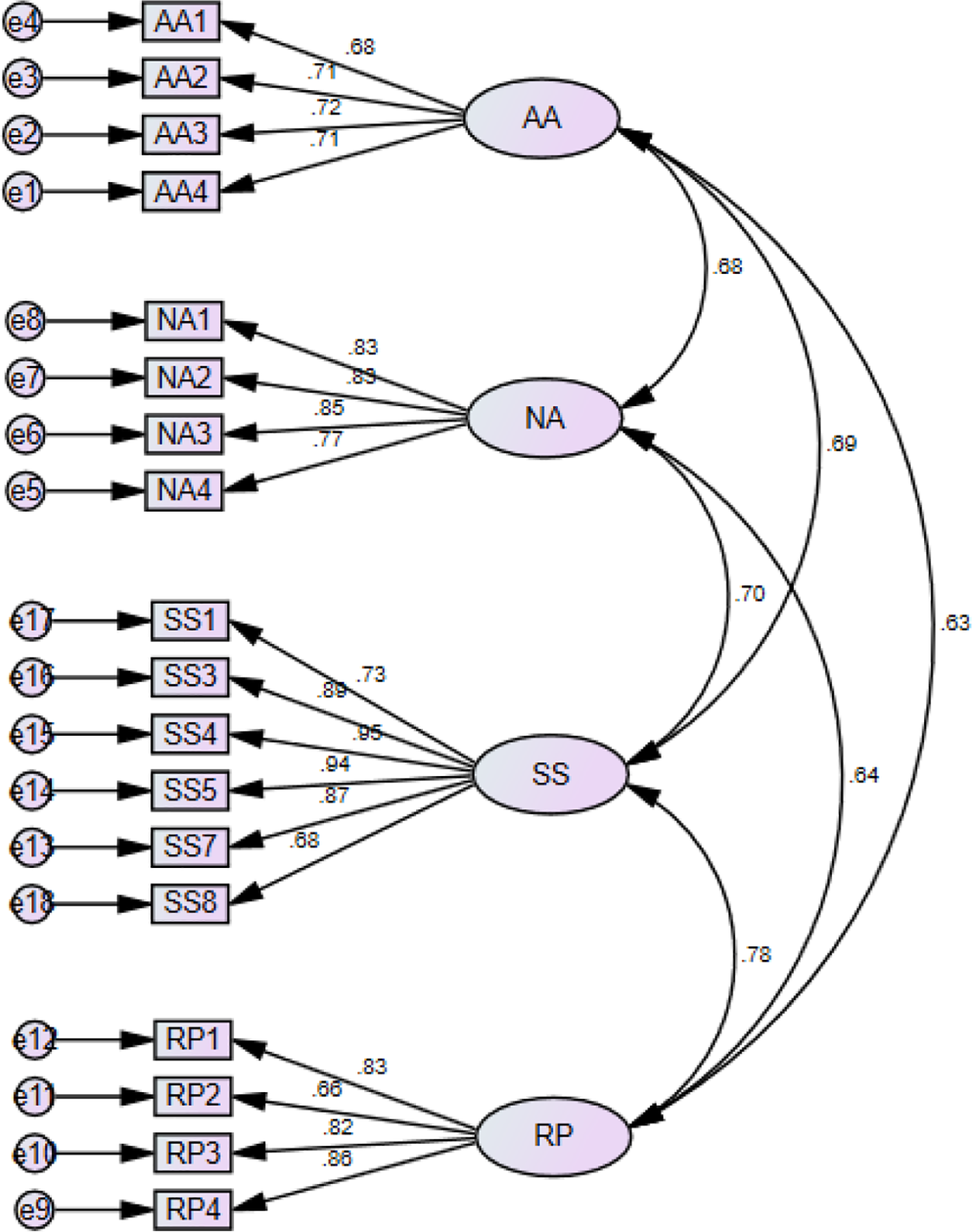
Confirmatory factor analysis (CFA) framework.
Table 5 presents the CFA results. All the values met the required criteria, indicating that the model has a good level of fit: X2/df = 1.91, Goodness of Fit Index (GFI) = 0.884, Comparative Fit Index (CFI) = 0.955, Tucker-Lewis Index (TLI) = 0.95, and Root Mean Square Error of Approximation (RMSEA) = 0.06.
CFA goodness of fit test (N = 197).

Calculating CFA as part of the Structural Equation Model (SEM) requires establishing convergent and discriminant validity and the instrument’s reliability. Anderson and Gerbing suggest using three standard indices to deal with convergent validity, including individual item reliability, composite reliability (CR), and the average variance extracted (AVE). 77 AVE is a measure of the error-free variance of a set of items; CR is a measure of reliability and internal consistency based on the square of the total of factor loadings for a construct; other measures used to establish validity and reliability include maximum shared variance (MSV) and maximum inter-construct correlation (Max r). 69
In this study, all the AVE values were ≤ 0.50, and the MSV value was more significant than the AVE, which meant that the four variables indicated strong discriminant validity (Table 6). Discriminant validity is tested to identify the extent to which the construct does not correlate with other measures. These are objective tests and are based on numerical scores indicating how well the construct conforms to theoretical expectations. The CR values of each latent variable were between 0.800 and 0.936, indicating strong composite reliability (Table 6). 78 Hence, the variables AA, NA, SS, and RP have strong reliability and convergent validity.
Test of discriminant validity, convergent validity, and composite reliability.

Note: CR > 0.7; AVE > 0.5; MSV < AVE; √AVE > Max r, is
Table 7 presents a comprehensive summary of all the reliability and validity results from EFA loading, CFA loading, SEM loading, Mean, SD, Cronbach’s alpha, KMO, CR, and AVE. All the measures used in this study indicated an excellent and high variance, which means the instruments used in this study were valid and reliable.
Summary of reliability and validity.

* Items details for each construct:
AA1. Professors have the knowledge to answer my questions relating to the course content
AA2. Professors deal in a courteous manner
AA3. Professors show a sincere interest to solve my problem
AA4. Professors show positive attitude toward students
NA1. Academic staff show sincere positive work attitude toward students
NA2. Academic staff is willing to respond to my request for assistance
NA3. Academic staff is knowledgeable to respond to my request
NA4. Students are treated equally by academic staff
SS1. The university offers quality programs
SS3. I am satisfied with my decision to attend this university
SS4. My choice to enrol in this university is a wise one
SS5. I am happy with my decision to enrol in this university
SS7. I will recommend this university to my friends and family
SS8. I will keep in touch with my advisor or university after I graduate
RP1. This university has a prestigious image
RP2. This university’s graduates are easily employable
RP3. This university has a good image
RP4. I have heard positive things about this university
According to Guh et al., SEM is used to analyze the measurement model, estimate the structural model, and test the proposed research hypotheses. 79 Figure 3 shows the SEM testing result.

The result of structural equation model (SEM) testing.
Table 8 presents the results of the fit indices of the proposed model. X2/df = 1.92, and as it is a value between 2 and 1, it is an acceptable fit with p-value = 0.00. Goodness of Fit Index (GFI) = 0.884, Comparative Fit Index (CFI) = 0.955, Adjusted Goodness of Fit Index (AGFI) = 0.846, and Root Mean Square Error of Approximation (RMSEA) = 0.06. Table 8 shows that each point met the minimum acceptable value requirement.
SEM goodness-of-fit statistic.

Table 9 and Figure 4 present the result of the proposed hypotheses. They show that H1 and H3 were rejected. H1 was rejected because the path from AA to RP was not significant (p-value = 0.253) with β = 0.11. Nevertheless, the path from AA to SS showed strong influence with β = 0.40***, and NA positively influenced SS (β = 0.43***). H4 was rejected because β = 0.15 with p-value = 0.104. Finally, the path from SS to RP was supported because β = 0.59*** Therefore, H5 was supported.
Result of the hypotheses based on standardized estimates.

* P < 0.05, **P < 0.01, ***P < 0.00
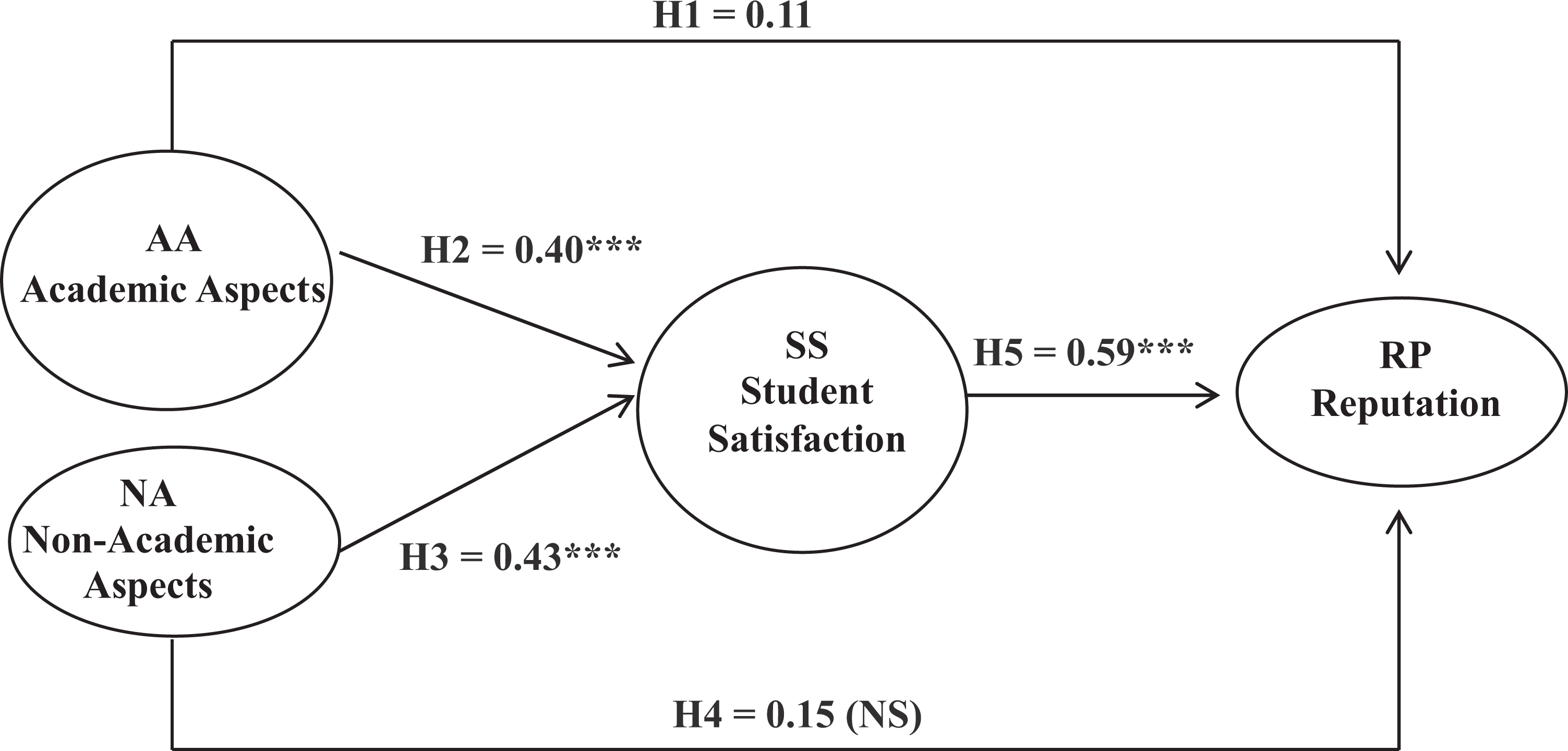
Standardized results (β) of structural equation model (SEM).
To address this paper’s research questions, we examined the level of the mediating effect of each proposed mediator and checked whether it was a partial or complete mediator. Bootstrapping was conducted using Amos 22. When bootstrapping, the direct, indirect, and total effects were tested. This study’s bootstrap samples were set to 5000, and the bias-corrected bootstrap was set to 95% confidence interval (CI). Figure 5 and Table 10 present the result of the mediation analysis.

SEM with mediation and without mediation.
Summary of mediation for the model using bootstrapping.

*P < 0.05, **P < 0.01, ***P < 0.00, NS = NOT Significant.
Table 11 shows that the first three steps are supported. The results shown in this table indicate a difference between total effect (β = 0.63***) and direct effect (β = 0.17NS).
Testing the mediating effect of SS on predictor AA and outcome RP.

* P < 0.05; **P < 0.01; ***P < .001; Std β = standardized beta coefficient
Figure 6 shows the graphic representation of mediation. Table 12 shows in detail the effect size of SS on AA and RP. The indirect mediation effect is significant (β = 45***). This table also indicates that the indirect to total effect ratio is β = 0.73, and the ratio of R2 indirect/R2 total = 0.925. This indicates that 92.5% of the explained variance in the relationship between AA and RP (with SS as the mediator) is due to SS’s mediating effect and is thus statistically significant. Moreover, R2 indirect/R2 total = 0.925 indicates that SS is a mediator between AA and RP. Additionally, it indicates complete mediation.

Mediation analysis for AA, SS, and RP.
The effect size measure of SS on AA and RP.

* P < 0.05, **P < 0.01, ***P < 0.001; NS = Not Significant
Table 13 shows that the first three steps are supported. The results from Table 13 indicate a difference between total effect (β = 0.644***) and direct effect. (β = 0.195*).
Testing the mediating effect of SS on predictor NA and outcome RP.

* P < 0.05, **P < 0.01, ***P < .001; Stdβ = standardized beta coefficient
Figure 7 shows the graphic representation of mediation. Table 14 shows in detail the effect size of SS on NA and RP. The result indicates that the indirect effect is β = 0.45*** and that the ratio of indirect to total effect is β = 0.83. Moreover, the ratio of R2 indirect/R2 total = 0.90, indicating that 90% of the explained variance in the relationship between NA and RP (with SS as mediator) is due to SS’s mediating effect and is thus statistically significant. Further, R2 indirect/R2 total = 0.90 indicates that SS is a mediator between NA and RP. Therefore, there is partial mediation.

Mediation analysis for NA, SS, and RP.
The effect size measure of the whole model.

* P < 0.05, **P < 0.01, ***P < 0.001
The mediating test of SS indicates complete and partial mediation. Table 15 shows that H6a is supported. The mediation is complete because AA is no longer significant when SS is controlled. The total effect between AA and RP is 0.63***, and after mediation, the direct effect becomes 0.17. Meanwhile, the total effect between NA and RP is 0.64***. After mediation, the direct effect becomes 0.195*. Hence, H6b is supported and indicated as partial mediation because NA, albeit weak, is still significant.
Summary results of post hoc mediation analysis.

*P < 0.05, **P < 0.01, ***P < 0.00, NS = NOT Significant.
To sum up, the following are the summaries of all the results of the hypotheses. They are shown in Table 16.
Summary table of all hypotheses result.
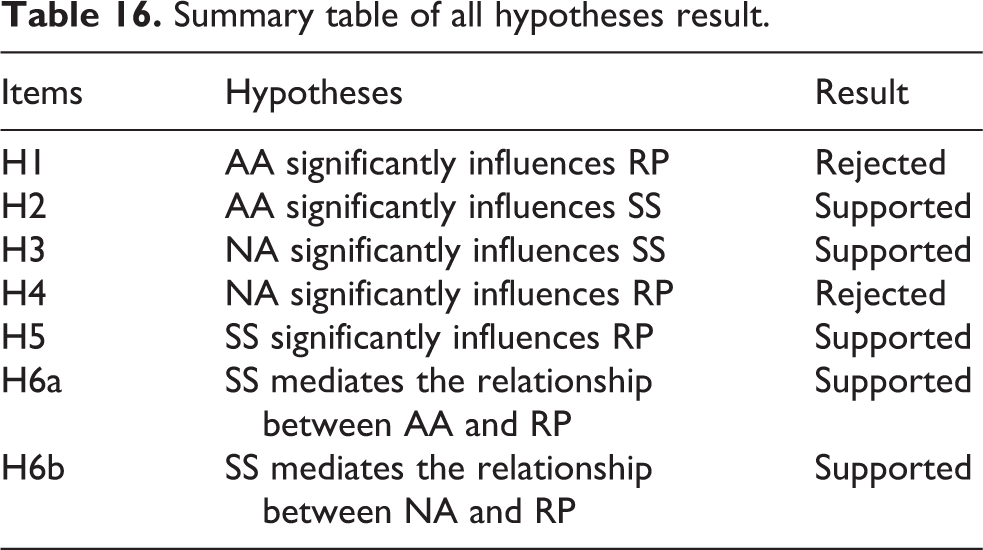
H1 is rejected
Academic Aspects positively and insignificantly affect Reputation (β = 0.11, p < 0.253).
H2 is supported
Academic Aspects positively and significantly affect Student Satisfaction (β = 0.40, p < 0.000).
H3 is supported
Non-Academic Aspects positively and significantly affect Student Satisfaction (β = 0.43, p < 0.000).
H4 is rejected
Non-Academic Aspects positively and less significantly affect Reputation (β = 0.15, p < 0.104).
H5 is supported
Student Satisfaction positively and significantly affects Reputation (β = 0.59, p < 0.000).
H6a is supported
Student Satisfaction mediates the relationship between Academic Aspects and Reputation (Figure 5 and Table 10).
H6b is supported
Student Satisfaction mediates the relationship between Non-Academic Aspects and Reputation (Figure 5 and Table 10).
Discussion
The purpose of this study was to analyze Taiwan’s higher education service quality in terms of student satisfaction and institutional reputation. As discussed in the literature review, all the hypotheses were developed using prior studies, none of which were conducted in Taiwan.
This study surveyed 197 international students studying in Taiwan. As mentioned in the literature review, several studies have revealed that academic aspects significantly influence reputation. 69,80 However, this study showed that different academic aspects do not significantly influence reputation. This is because of the significant and robust mediation of student satisfaction (SA). Therefore, academic aspects do not play a primary role in building a university or HEI’s reputation.
This study showed that academic aspects significantly affect student satisfaction (β = 0.40, p < 0.001). This finding confirms that students report satisfaction when universities provide suitable academic activities. 58,80,81 Students feel satisfied when universities provide high-quality academic service. Academic aspects of service quality refer to the way of teaching, and academic services refer to professors or instructors showing a positive attitude and sincere interest, behaving courteously with students, and possessing the knowledge to answer student questions. Student satisfaction results from the fulfillment of their needs in students’ minds.
This study revealed that non-academic aspects significantly affect student satisfaction (β = 0.43, p < 0.001). Alves and Raposo, 80 Hu et al., 81 Lai 60 and Subrahmanyam 61 also reported the same result. The non-academic aspects of service quality play a critical role in student satisfaction. Non-academic aspects refer to office staff, administration staff, librarians, or heads of departments. International students need to adapt and adjust to a new environment and educational services. Administrative staff plays an essential role during this period of adjustment. Therefore, non-academic service quality certainly plays a role in increasing student satisfaction.
Previous studies have indicated that service quality significantly influences reputation. 65,66 However, the results of this study showed that non-academic aspects (i.e., the staff’s willingness to respond to student requests or problems, their effectiveness, their fair treatment toward students, their manner of responding toward students, and their fulfillment of student expectations) do not directly and significantly influence reputation. The insignificance of this relationship, as we will see later, is due to student satisfaction.
The literature review showed that several researchers agree that student satisfaction significantly influences reputation. 40,44 This study corroborated that student satisfaction (SS) significantly influences reputation (RP) (β = 0.59, p < 0.001). This study showed that AA significantly influences the reputation of an HEI only when mediated by SS. For international students studying in a Taiwanese HEI, SS is the most influential and essential contributor to institutional reputation. Student satisfaction significantly mediates the relationship between non-academic aspects and reputation. Therefore, student satisfaction plays an essential role as a mediator in enhancing the reputation of a university.
Conclusion and implications
This study explored the influence of both academic and non-academic aspects of service quality on international student satisfaction and institutional reputation. The results revealed that the effects of academic and non-academic aspects on reputation are insignificant. However, both academic and non-academic aspects of service quality affect student satisfaction significantly. Furthermore, the outcome revealed that student satisfaction significantly influences the reputation of HEIs. Among the three variables that affect reputation, only student satisfaction directly and significantly affects reputation. Notably, HEIs must seek to maintain or increase student satisfaction as it significantly mediates the relationship between service quality dimensions, namely, its academic and non-academic aspects, and the institution’s reputation.
Therefore, this study’s findings offer directions for HEIs in Taiwan to enhance their reputation by realizing and improving the influencing factors.
Footnotes
Appendix 1
Acknowledgments

Declaration of conflicting interests
The author(s) declared no potential conflicts of interest with respect to the research, authorship, and/or publication of this article.
Funding
The author(s) received no financial support for the research, authorship, and/or publication of this article.