




Abstract
Small and medium-sized enterprises (SMEs) have to face the time post COVID-19. The pandemic impacted the SMEs with great force worsening the well-known situation of lack of resources and its tendency to disappear in the very early years of existence. This systemic crisis jeopardizes SMEs in many ways and it is necessary to find ways to emerge and survive from this crisis. This manuscript conducts a literature study on more than 100 manuscripts that present recommendations from McKinsey & Company for SMEs to face post-pandemic time. Through the application of the entropy-weight coefficient method this paper finds priorities from Ecuadorian SMEs out of essential elements proposed at the literature review, to introducing at the managing process to face post COVID-19 era.
Keywords
Introduction
Small and medium-sized enterprises (SMEs) are the pillar of many economies. 1 –4 Systemic shocks such as the COVID-19 pandemic affects performance and even the existence of SMEs. 2,5 The COVID-19 crisis have had a devastating effect on the global economy, 5 –8 and Ecuador is not an exception.
Ecuador is a highly entrepreneurial country, the emerging entrepreneurship rate and early entrepreneurial activity reach values of 21.2% and 29.6%, well above other countries in the region. Nevertheless, statistics reflects that 80% of Ecuadorian SMEs are paralyzed, which means that they do not receive income and it is estimated that the losses generated are close to 500 million dollars. 9,10 This situation is worrying since there is evidence that confirms the hypothesis that early entrepreneurship and established ventures have driven Ecuador’s economic growth in recent decades. 1,3
Survivors and new entrepreneurs, face the challenge of adapting to the new normal and its demands. The COVID-19 crisis will impose on SMEs the resolution, in the best possible way, of the dilemma between reducing their expenses to the maximum and transforming their business models. There is no right solution for the particular reality of each company, but discovering some priorities can pave the way for rethinking the administrative processes of SMEs and overcome the current COVID-19 crisis.
This paper makes an important contribution to the entrepreneurship literature by examining what are the priorities of Ecuadorian SMEs in order to face post COVID-19 era. To the best of our knowledge this is the first paper to empirically examine the future way of behave of SMEs in Ecuador, thereby making a contribution to the growing volume of literature on SMEs and COVID-19.
The remainder of the paper is structured as follows. First, a brief literature review of business priorities based on the recommendations of McKinsey & Company, one of the most famous consulting firms in the US, is conducted to address the post-Covid-19 era. Second, the findings of the empirical analysis are highlighted; presenting the priorities of Ecuadorian SMEs from their point of view. Finally, in the discussion the main results and limitations of the research are analyzed.
Literature review
COVID-19 has battered the global economy causing a very heavy recession. 6,7,11 In the months of March to June, there has been an unprecedented shutdown in the global economy. 6,12 It was never thought that a virus could threaten the entire world economy, which is an example of the complexity of the environment in which different regions live and as a risk, in a remote part of the world, it can compromise the vast majority of known systems. This means a catastrophe for many countries where SMEs represent an important generator for employment, innovation and economic growth. SMEs are particularly vulnerable to external shocks, 2,5 –7 so this closure is probably one of the greatest challenges that this type of businesses have had to face. Shutting down the economy is tough on SMEs.
SMEs bear the worst economic brunt of COVID-19, they are under an existential crisis and heavy distress trying to understand the impact of the COVID-19 crisis, not knowing what the future holds and what to do to face it. 5,6,12 The devastating effects this outbreak is having on SMEs can already be seen, many of them are even on the verge of collapsing, others are struggling to survive navigating as best they can (a) some are temporarily closing hoping to get to the other side of this in one piece and (b) some are changing and investing to best deal with the rapidly changing environment.
SMEs have very low cash buffers. Even if they are prepared, if suddenly they have to shut doors and their revenue stream goes to zero, or just to a fraction of what it used to be, they will run out of money in no time. 2,5,13 And run out of cash means that SMEs is dead. This is a real crisis that is in the hands of everyone: governments, academics, researchers and the entrepreneurs themselves. Other disadvantages that SMEs face are not related to internal factors, but to external factors that will prevent them from developing their production and/or service provision processes; that is why it is so important to find priorities to manage this type of business and be able to get ahead. Nevertheless, given the smaller size of SMEs, they tend to be rather flexible when opportunities or threats arise in their environment. 2,14 The smaller the organization, the closer the decision-makers are to their customers and other stakeholders facilitating helpful market information to a better focus. 2,12,14
In the wake of COVID-19, Ecuadorian government have issued a mandatory lockdown. SMEs, a critical part of the Ecuador economy, are scrambling to stay afloat, but also are under extreme duress feeling the economic strain amid COVID-19; a lot of them are folding up. In Ecuador the National Institute of Statistics and Census (INEC), accounts for a total of 6.089.518 companies. SMEs represent 90.4%. The contribution of this type of companies to the Ecuadorian GDP exceeds 25% and employs 70% of the economically active population. 15 Ecuadorian SMEs owners-managers are left with unprecedented decisions to make that is why is important to talk about what is necessary do to manage through this crisis truly unprecedented. During a crisis, not only the performance of the business is at stake, but its survival and the findings verified that a good management and a market orientation have positive impact on SMEs’ performance in times of crisis. 12
Labeled as a black swan event, COVID -19 present the fears of disappearance of many SMEs, times like these call for clarify priorities that will allow return to a new normal with less possible harm. In such environments, SMEs have to re-adjust and improve their strategies and behaviors fit to the environment in order to ensure business survival. 2,5,14 Based on recent studies SMEs adopting innovative and proactive behavior can overcome the crisis and improve their performance. 12,14,16
In order to clarify the priorities of the SMEs during and after the pandemic, an analysis of several documents published by the McKinsey & Company was carried out. McKinsey & Company is an American prestigious management consulting firm that provides advice on strategic management to corporations, governments and other organizations, and regularly publish books, research and articles about business and management. It has become the biggest consulting firm in the world. 17 The analyzed documents include the period between May and June of this year. More than 100 documents were reviewed. Figure 1 is a synthesis of the most frequently repeated priorities and the authors who mention them in their writings.

Network of authors and priorities.
From Figure 1 it is possible to summarize that the most frequent recommendations are associated with: investment in technology 18 –22 ; decentralize decision making 20,23,24 ; teamwork; 19 –21,23 –28 ; communication across all channels 18,23,27,29 ; agile and flexible operations 19,22,28,29 ; resilience, 21,22,24,26 crisis management, 21,24 –26 stakeholder management 18,21,22,26,28 ; and use of scenarios and contingency plans. 21,25,28,29 Those criteria will be a highly valued during crisis and in the new normal so that SMEs can reorganize and start again.
With the purpose to clarify the priorities among the identified criteria, various applications of the entropy-weight coefficient method were found in the literature that might allow this objective. The entropy-weight method, based on Shannon entropy, is proposed as a measure of uncertainty in information well suited to measuring the relative intensities of contrast criteria in order to represent the average intrinsic information transmitted for decision making. 30,31
In the business field, the uses of the method are diverse, suppliers´ selection, 32,33 investment decision making, 34 performance analysis, 35,36 transport and logistics evaluation, 37 innovative enterprise competitiveness, 38 Customer Relationship Management (CRM) 39 and environmental conflicts. 30 All the aforementioned applications are related to the analysis, prioritization and selection of the final solution, which implies the best possible alternative. The entropy-weight coefficient method provides a way to determine the priority among the analyzed criteria. This allows knowing the opinions of Ecuadorian entrepreneurs regarding how to face the current pandemic situation and the future in the new normal, all of which provides an effective and objective guide for future behavior. The reasons discussed make the entropy method an appropriate and convenient choice for our purpose.
Method
A combination of snowball sampling and judgment sampling was used for the present investigation. 40 –42
An initial group of three entrepreneurs was selected, who, after being asked to prioritize the recommendations identified in the literature review, were asked to identify other entrepreneurs who could participate in the study. Subsequent entrepreneurs were selected based on references. 65 entrepreneurs were identified and the search process was stopped because the entrepreneurs began recommending others who were already involved in the study and the sample did not grow any further. Figure 2 shows the final network of entrepreneurs.

Final entrepreneur network.
Figure 2 visualizes the density (0.609) of the relationships between the individuals that make up the study sample. Network density is a measure of the number of effective relationships divided by the number of possible relationships excluding self-relationships. Density is defined between 0 and 1, where 0 is a totally disconnected graph and 1 is a totally connected graph. 43,44
The graph shows the high degree of interconnectedness between the participants in the study. This shows that the participants began to select one another, which indicates that the sampling method used would no longer allow many more entrepreneurs to be included in the sample. The characterization of the sample is shown in Table 1.
Sample characterization.

For the analysis of the importance and prioritization of the criteria found in the bibliographic review, the entropy-weight coefficient method was used. The selection of the entropy-weight coefficient method is based on the strength of the treatment rather than the inconsistencies among the experts, as well as the ease and simplicity at the time of its application. Working with experts involves the subjectivity of their opinions. This problem, called probability distribution function aggregation (DFA), requires to aggregate a set of expert opinions with the individual subjectivity modeled with probability theory. 32,45
The entropy-weight coefficient method can be used to objectively calculate the relative weight of a specific attribute or aspect, this allows knowing the relative importance of the people who made the evaluation of these aspects. 32,35,46,47 In the current investigation, the significance coefficient of the elements is determined through Shannon’s entropy. 48
Several advantages of the method were taken into account for its selection, (1) there are no previous assumptions for the data before weight determination in the entropy method, 47 (2) can be used not only to quantitatively estimate data quantity, but also to calculate objectively the relative weight of information, 32 (3) allow calculate objective weights of criteria avoiding subjective factors, 30 (4) increasing the accuracy of the results, 46 (5) allow to determine the extent of influence each criterion without affecting the preferences of decision-makers 49 and (6) allow to know the relative intensities of criteria importance and the divergence among them. 31
The following steps are recommended to prioritize the parameters: a) Definition of the criteria to evaluate (parameters); b) Selection of alternatives (expert opinion); c) Priority setting (entropy method). The application of the three previous steps is detailed below.
Definition of the criteria to evaluate (parameters)
The parameters or criteria to be evaluated were identified in the literature review presented in the previous section. These criteria are stated as follows: C1: Decentralize decision making C2: Communication across all channels C3: Use of scenarios and contingency plans C4: Agile and flexible operations C5: Stakeholder management C6: Teamwork C7: Resilience C8: Crisis management C9: Investment in technology
Selection of alternatives (expert opinion)
The alternatives, in this case, will be given by the opinion of the experts (owner-managers of SMEs), that is, the score that each expert gives to each of the established criteria, when it is desired to determine their priority for the ventures during and after COVID-19. In this sense, the number of experts who will participate in the research has already been determined and characterized.
Priority setting (entropy method)
Once the two steps necessary to apply the entropy method “parameters and alternatives” have been defined, it is put into practice, which also has three fundamental stages: Analyze the evaluations of the alternatives. Standardize evaluations. Calculate entropy.
Analyze the evaluations of the alternatives
The evaluations were the weighted scores to be given by the experts using a scale of the different criteria identified in the literature. A constant sum scaling was used where experts distribute 100 points among the set of established criteria. The above allows the construction of the following matrix (see Table 2):
Expert vs. criteria matrix.

Standardize evaluations
In this phase it is necessary the normalization of eij to determine pij which is the total outcome, obtained by Eq. (1):

Calculate entropy
Shannon entropy measure (Ej) is calculated using the total outcome pij computed by Eq. (2):

Where:
k: is a constant that is adjusted by the expression
m: total of alternatives.
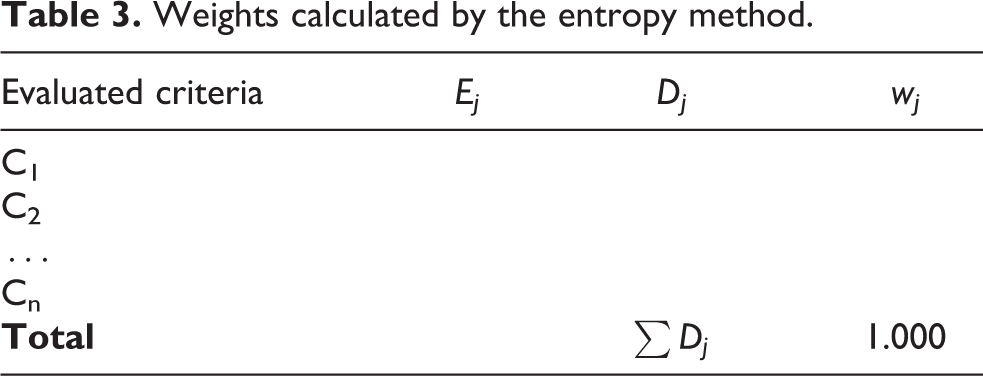
It is important to note that the entropy (Ej) of a parameter is the greater the more equal its evaluations, precisely the opposite of what is desired if (Ej) is to be an approximate value of the weight (wj) of the parameter. Therefore, an opposite measure can be used that can be denominated as the diversity of the criteria (Dj), calculated through by Eq. (3):

Finally, the required weights are obtained, by Eq. (4):

All of the above can be summarized in Table 3:
Weights calculated by the entropy method.
As a final assessment of this method, its undisputed objectivity in decision-making contexts should be emphasized. 31,32
Results
The constant sum data collected from the entrepreneurs of the SMEs allowed to form a 64 per 9 matrix. The results of applying the entropy-weight coefficient method are shown in Table 4.
Weights calculated by the entropy method.

A reorganization of the previous table based on the weight obtained allows us to say that the priorities of the owner-manager of the SMEs studied to face the COVID-19, now and in the future, are as follows (see Table 5):
Priority of studied criteria.

Taking into account the obtained results is possible to say that Ecuadorian entrepreneurs recognize in the following order that: Owner-managers of SMEs have to face challenges, such as digital technology, automation, and artificial intelligence (all of which still loom). This is perceived as the first of the priorities within the studied. The greatest challenge involve empowering owner-managers and employees with the skills to manage data, and technology they needed to engage with customers in new ways. Those skills will be the defining competitive differentiator of their performance.
8,24
A hands-on approach is needed to act on key scenarios and strategies that allow a differentiation in the environment. It is vital setting multiple business scenarios and building flexibility into planning to fit them. Having a varied range of scenarios can allow for more agility and flexibility in both the planning process itself and the SMEs responses to the changes that may emerge. The scenarios must focused on the most important opportunities and threats for the future of the SME, where the company expects to see significant value leakage or a potential way to succeed. It is also important to identify key factors of success to overcome competition and better serve the costumers at each scenario.
14,25,28
Now and future behave of SMEs should incorporate crisis management as a way to deals with major events that threatens to harm the performance as business and its stakeholders. Crisis, as the one SMEs are actually living, could appear in three forms threats, surprises and fast changes. It is not desirable new events that might hit again in the way COVID-19 is doing. For that reason, SMEs need to dealing with crisis before, during, and after they have occurred, and crisis management provide with the skills and techniques required to identify, assess, understand, and cope with a crisis situation, especially from the moment it first occurs.
2,21,5
Maintaining an ongoing, open dialog with stakeholders should be a key responsibility of owner-managers of every SMEs as business conditions change. Managing interactions with customers, suppliers, financial institutions governments, investors, activists and many others, may be particularly vital during and after the pandemic. All of them may offer key ideas that owner-managers should consider for channel the future of the SMEs for the post-pandemic era.
22,27
Because of the pandemic, teams inside of SMEs are called to reinventing core processes of services and manufacturing and adopting new collaboration ways in many cases where work is now teleworking. Teams are at the heart of the new operating model for SMEs in order to create an effective post-pandemic organization. Owner-manager should empower teams must to solve problems and obtain the best possible outcome discovering powerful ideas and innovating to satisfy the customer, while generating excitement and loyalty among the employee base.
20,21,27
Successful SMEs should redesign their operations and supply chains to protect itself against potential crisis and to bounce back from present one. Building resilience is all about maintaining a positive mindset, a willingness to grow and an ability to learn from setbacks. Owner-managers and employees of SMEs should employ the ability of resilience and rise to the challenges of pandemic and the times to come that may bring another kind of crisis.
21,50,51
Owner-managers will have to embed agile practices in their businesses models to manage the impact of the COVID-19 crisis better than their peers. Those agile practices will make easy to cope shifts in the environment in order to adapting more quickly to them. Agile organizations are designed to be fast, resilient, and adaptable which are desirable characteristics to respond shocks such as the COVID-19 pandemic. That is way it is time for SMEs to adopting new business models that should not set aside at new normality. Agile practices will help SMEs to navigate the downturn and survive post-pandemic. It is time to give up traditional processes to face the faster pace of decision making during COVID-19 pandemic evolved.
19,25,51
Decentralize decision making is something that owner-managers should implement to make smart decisions quickly during the pandemic. Making good y fast decisions is challenging under actual circumstances. It is time to reject the hierarchical model and instead involve employees to get smarter decisions as fast as possible. During crisis-response efforts, owner-managers recognize that is necessary to empowered frontline employees with decision-making authority min order to improving their engagement with customers in a turbulent environment.
20,24,52
The fundamental tools of effective communication are essential in current circumstances when, in some cases, employees are working at home. It is important that owner-managers of SMEs define and point to long-term goals, listen to and understand your stakeholders, and create openings for dialogue. Owner-managers should be a good communicator because people’s information needs are very changing and evolve during a crisis. Varity of channels, different forms of information and communicate clearly, simply, frequently can help to keep employees with a sense of purpose to get the vision of future for how the organization and its members will reemerge.
24,27
Conclusions
Ecuadorian entrepreneurs are facing the worst economic crisis in decades with COVID-19 complicating their subsistence, but it is perfect time to create opportunities to rethink entrepreneurship´s priorities in the face of crisis and in the dawn of a new normal. 5,6,13,16 The priorities put to the consideration of Ecuadorian entrepreneurs in this study were the result of the analysis of several documents published by the McKinsey & Company, but the review of other references allowed to confirm that these criteria tend to be important at present to face the pandemic and for a post-pandemic future. 5,6,11,13
The prime finding of the research is related to the determination of the criteria that are considered essential in the context of Ecuadorian SMEs to get out of the crisis caused by the COVID-19 pandemic and survive in the new normal. The entropy-weight coefficient method, used for other purposes according to the reviewed literature, 32,34,36,53 allowed establishing the priorities of Ecuadorian entrepreneurs to guide daily action through the current crisis situation. In the same way, they are established as future ways of behave to follow when accessing the new normality. 54
The paper has limitations. Field research is restricted to the province of Santo Domingo de los Tsáchilas, which has a high percentage of entrepreneurs in Ecuador. 31 The authors are aware that the achieved results do not represent all Ecuadorian entrepreneurs, therefore, it is not possible the generalizability of the results. The difficulties imposed by the quarantine prevented the investigation of a larger sample (high percentage of closed businesses, prohibition of free movement), as well as using a different sampling method than the one used. Despite the limitations stated, it is considered that the results obtained contributing to the study of entrepreneurship in pandemic conditions, and opens spaces to delve into related issues such as the resilience addressed by other authors in the context of SMEs. 51,55
The future scope of this research should be oriented to follow up the priorities between these criteria and others that can begin to be taken into account. To the extent that epidemiological circumstances allow, address the limitations of current research in future research. What is interesting about the current situation is the possibility of changing priorities between criteria depending on how the situation of the economy, the markets and the needs and desires of customers is presented. All of the above requires continuing research in order to adjust the administrative behavior of entrepreneurs to the requirements of the environment and thus avoid their disappearance as a business.
Footnotes
Acknowledgment
We thank the UTE University authorities for the facilities provided to carry out this research, in terms of the use of their databases and the time required for the collection of information. No funding funds were received for this investigation.
Declaration of conflicting interests
The author(s) declared no potential conflicts of interest with respect to the research, authorship, and/or publication of this article.
Funding
The author(s) received no financial support for the research, authorship, and/or publication of this article.
