




Abstract
The aim of this study is to examine the impact of AMO-HR Systems (i.e., ability-enhancing HR practices, motivation-enhancing HR practices and opportunity-enhancing HR practices) on proactive employee behavior through the effect of leader-member and team-member exchange. A questionnaire was developed based on prior related works to collect the required data from a sample of 230 employees from 13 small companies in the service industry in the Jordanian capital, Amman. The results showed that nine HR practices are significant predictors of employee proactivity behavior. The impact was significantly mediated by leader-member and team-member exchange. On the ground of the results, the study concluded that proactivity is a function of three categories of HR practices. First, an employee should be supported to enhance his or her ability. Second, an employee should be motivated and granted the opportunity to share knowledge. Third, employees should be encouraged to participate in problem solving, in the presence of leader-member coordination, to improve relationship quality and team-member recognition, support, and effective communications. Accordingly, recommendations, social and managerial implications were reported.
Keywords
Introduction
Employee proactiveness gained great attention from researchers and practitioners due to numerous factors related to organizations’ needs for innovative employees to deal with the uncertain organizational environment, 1 workforce globalization and international competition, 2 and lack of knowledge on public employee proactivity. 3 Generally, the role played by proactive employees in organizations has not yet received sufficient attention from scholars. Proactivity as a change-oriented term 4 was described in terms of work-related new enhancement problem-solving ideas. 5 The term, for numerous authors, represents three types of behaviors: employee taking-charge, employee voice and employee innovativeness. 1,6 Some authors added personal initiative 7,8 to the list.
For firms to assist employee proactivity, human resource (HR) practices were the most common systems used to achieve this end. 9 –17 HR practices are very pivotal for organizations due to their constructive effects. Some examples of these effects include enhancing employee performance, increasing employee engagement, improving employee creativity, engendering employee motivation, and enriching employee proactivity. 1,14,15,18 –21 One of the most significant HR systems studied by researchers is AMO-HR practices, which refer to ability, motivation, and opportunity-enhancing HR practices. 18,19,22 –25 An AMO model was selected for the purpose of the current study due to its comprehensiveness in terms of HR practices that contribute to employee abilities, motivation and opportunities. 16,18,19,21,26
Another view of the literature considered the effect of in-site relationships like employee relationships with his or her leader or team members. A good-quality employee-leader or team relationship has been cited in the literature as a significant predictor of employee satisfaction, engagement, commitment, performance, and proactivity. 27 –31
The importance of the current study is based on providing an appropriate model that explains the role of AMO practices in enhancing employee proactivity in small service companies. These practices involve helping employees to improve performance, increasing engagement, improving creativity, engendering motivation, and enriching proactivity. On the other hand, the contribution of this study focuses on the mediating role of employee-leader and team relationships to the possible impact of AMO practices to employee proactivity, especially in the presence of a few previous studies. Concurrently, employee-leader and team relationships were explored in the current study as mediators between AMO practices and employee proactivity based on cross-sectional designs. Clearly, future research needs to use longitudinal designs is the best alternative.
Accordingly, the main research question of the current study could be: “Is there an impact of AMO-HR Systems on proactive employee behavior through the meditation of leader-member and team-member exchange?” So, the purpose of this study is to examine the impact of AMO-HR Systems (e.g., ability-enhancing HR practices, motivation-enhancing HR practices and opportunity-enhancing HR practices) on proactive employee behavior through the effect of leader-member and team-member exchanges. Data collected by using instrument from a sample of small service companies has been used to examine the possible impact according to hypothesis study.
This paper consists of five sections. After the introductory section, the literature review and hypothesis development section are developed. In the next section, methodology is provided, including sampling, instrument, research model and validity and reliability. Results and discussion are presented in section four. Finally, conclusion, implications, limitations, and future research are provided.
Literature review and hypotheses development
Proactive employee behavior
Proactivity, in the organizational context, is a behavior that the employee does in order to bring change to his or her work environment, whether by improving its conditions or replacing those conditions with new ones. 4 Reviewing the literature on proactive employee behavior, Chia-Huei 5 described the proactive employee as the one who introduces or applies new ideas related to the work, makes suggestions that lead to improving the work environment, and identifies problems that affect the performance of the work and provide appropriate solutions. The advantage of such an employee is that he benefits himself in terms of career development and benefits the organization in terms of improving organizational effectiveness. Huynh et al. 1 added that the the proactive employee contributes to the achievement of the organizational goals through his work-related experience, ability to brainstorm ideas that improve work processes and enhance work efficiency, and suggestions of new ideas to carry out work tasks and commitment to save the resources of the organization.
Proactive employee behavior has been operationalized based on three key dimensions linked to personal employee characteristics that distinguish the proactive employee, one who is self-initiated, focused on the future and oriented toward organizational change, from the non-proactive employee. 5 As well, Huynh et al. 1 conceptualized proactive employee behavior in terms of three dimensions: employee taking charge behavior, employee voice behavior and employee innovative work. Fritz and Sonnentag 6 used taking charge as a principal dimension of proactive employee behavior. Thomas et al. 8 identified four constructs of proactive employee behavior: personal initiative, employee voice, proactive personality and taking charge. Sonnentag 7 used two dimensions of employee proactivity: personal initiative and learning pursuit.
Research on proactive employee behavior cited numerous antecedents of this construct, e.g. development-oriented performance appraisal, 17 supportive supervision, 11,15 organizational support, learning goal orientation, and job autonomy, 13 psychological empowerment and self-efficacy, 9 high-commitment HR practices, 12 high-involvement HR practices, 16 employee engagement, 32 high-performance work systems, 10 job environment, job autonomy and training culture. 14 The most common variables in this regard were HR practices.
Human resource practices
Human resource (HR) practices are functions carried out by HR department in an organization to recruit, select, attract, develop, and retain its human resources. 33 Several labels of HR practices were depicted in the literature. For instant, HR practices, 34 socially-responsible HR practices, 35 HRM practices, 33 change-oriented HR practices, 18 high-performance HR practices, 36 high-commitment HR practices 15,37 and high-involvement HR practices. 38,39 The last three labels have the same meaning in the literature. Table 1 arrays examples of HR practices investigated by scholars.
Examples of HR practices labels and sub-practices in the literature.

Source: authors’ own preparation.
Although there are different labels of human resources management practices in the literature, these practices are linked to the achievement of organizational objectives. Of course, the reason for this difference is the nature of the variables studied with these practices, or the intended goal of using such practices. For example, some HR practices, e.g. supportive supervision, result in positive innovative work behavior, 15 while other practices, e.g. employee training and development, and enhance employee performance, 43 did not.
According to Appelbaum et al., 44 the idea behind high-performance HR practices is that the organization allows frontline workers to participate in decision-making process upon which the organizational routines can be altered. The authors reported some examples of these practices like quality-improvement teams and problem-solving participation. High-performance HR practices framework was used in several prior works. 36,45 –50 Tian et al. 22 added that high-performance HR practices comprised three key practices: ability-enhancing HR practices, motivation-enhancing HR practices and opportunity-enhancing HR practices, which refer to the AMO HR framework.
The researchers were interested in studying the role of implementing technology in human resource functions and its contribution to improving the organizational performance. Barišić et al. 51 study aimed to explain the better use of human resources information systems (HRIS) in improving the organizational performance. Providing this information can inform quality HR strategic decisions that contribute to maximize its impact on organizational performance. According to Hunday et al., 52 it is necessary to employ technology in human resources to achieve efficient performance of human resource functions and its relation to organizational performance. On the other hand, Turulja and Bajgorić 53 explained the importance of implementing the technologies to support all business processes, including HRM functions.
Adapting the AMO model for the current study can be justified in line with the features embedded in this model. According to Rajiani et al., 20 the model enables the organization to elevate employees to a high-performance class by improving their abilities, as well as motivation by offering rewards, good performance management, and providing opportunities for knowledge-sharing and problem-solving participation. The model encompasses three key dimensions: ability-enhancing HR practices, motivation-enhancing HR practices, and opportunity-enhancing HR practices. 18,19 Sub-practices included in AMO can be adapted to the dependent variable under study.
The AMO model was used by researchers in different subjects like green HRM and environmental cooperation, 21 HR practices and organizational performance, 26 employee motivation, HR practices, organizational performance and knowledge management, 33,54 HRM practices and employee proactivity, 18 employee creativity, 19 high-involvement HR practices, employee motivation and creativity. 16,54
The current study is concerned with the effect of AMO-HR practices on employee proactivity. Consequently, nine HR practices were used as shown in Table 1. They were adopted from studies explored the relationship between HR practices and employee creativity 19 and employee proactivity. 18 The authors have shown that employee proactivity is a major stimulus for workplace innovation, which in turn is influenced by HRM practices, such as recruitment and selection, employee training and development, performance appraisal and rewards. The first practice leads to the selection of individuals with skills, innovation, and communication skills. Training can improve employees’ skills and attitudes toward innovative ideas, while evaluating employee performance and rewards encourages the employee to put forward proactive ideas and initiatives, because these practices increase the employee’s sense of personal achievement and his or her desire to achieve organizational goals.
Similarly, in their study on HRM practices and firm innovative performance, Li et al. 55 used four HR practices: employee compensation, employee participation, training and development, and employee performance appraisal. Collecting data from a large sample contained 3,316 employees selected from 240 manufacturing firms in South Korea, Shin et al. 16 pointed out a significant effect of high-involvement HR practices on employee motivation and creativity. Tummers et al. 40 investigated the effect of five practices of high-performance work systems: training and development, teamwork, feedback, job autonomy, and participation. It was shown that three practices: job autonomy, teamwork and decision-making participation had significant effects on employee proactivity and vitality.
Furthermore, Maden
32
found a positive link between employee engagement and employee proactivity. High-performance work systems as assessed by employee selection, training, performance management, employee compensation, flexible work design, and decision-making participation were revealed as significant and positive predictors of proactive employee behavior.
10
Beltrán-Martín et al.
56
confirmed the significant impact of HR practices on employee proactivity. Diamantidis and Chatzoglou
14
examined the impact of organizational factors, e.g. management support and organizational climate, as well as job factors, e.g. job autonomy, on employee performance through employee factors, e.g. employee proactivity and adaptability, as a mediating variable. Basically, the authors highlighted significant effects of organizational factors and job factors on employee performance as mediated by employee factors. More specifically, their results showed that job environment, job autonomy and training culture are positively related to employee proactivity. In light of the above-mentioned literature, this study seeks to test the following hypotheses: H1: AMO-HR practices trigger proactive employee behavior. H2: Employee staffing triggers proactive employee behavior. H3: Employee extensive training triggers proactive employee behavior. H4: Employee participation triggers proactive employee behavior. H5: Performance appraisal triggers proactive employee behavior. H6: Information sharing triggers proactive employee behavior. H7: Employee compensation incentives triggers proactive employee behavior. H8: Employee engagement triggers proactive employee behavior. H9: Employee empowerment triggers proactive employee behavior. H10: Flexible work design triggers proactive employee behavior.
Leader-member exchange
The relationship between a team member and his or her leader is called leader-member exchange (LMX). According LMX theory, employee performance and leader performance are based on the quality of employee-leader relationship. Such a relationship depends on three aspects: employee-leader mutual trust, mutual respect and obligation. 27 Buch et al. 29 identified two types of LMX: high-quality LMX (i.e., social relationships) and low-quality LMX (i.e., economic leadership).
A number of LMX-related employee and positive work behavior attitudes were found in the literature like employee engagement, satisfaction, commitment, organizational citizenship behavior, performance. 27,29 Sanders et al. 28 found a positive association between LMX and employee satisfaction with HR practices and innovative behavior. Investigating the impact of one dimension of employee proactivity (i.e., proactive personality) on another dimension of the same construct (i.e., employee voice) through LMX, Wijaya et al. 31 found a partial mediating effect of LMX between proactive personality and employee voice. In order to achieve the second goal of this study, the LMX role was examined using the following hypothesis:
H11: LMX mediates the effect of AMO-HR practices on proactive employee behavior.
Team-member exchange
Team-member exchange (TMX) refers to an exchange relationship between the employee and his or her peers in a team. The term can be described in terms of employee perception of the effectiveness of work interactions, communication and coordination with team members. 1 Chaurasia and Shukla 57 added that the effectiveness of communication, the assistance of the member by the team members as well as his suggestion or development of new ways to improve the work are key aspects of TMX.
In fact, the relationship between HR practices and TMX has not been well documented in the literature. However, HR practices like work design flexibility significantly affected team outcomes such as team effectiveness, performance and innovation. 58 In a study on high-performance HR practices and team creativity, Ma et al. 41 indicated that there is a significant effect of AMO-HR practices on team creativity through team efficacy and knowledge sharing. On the other hand, researchers mentioned several positives of the relationship between the employee and the team members—the most important of these positives are improving employee performance and proactive employee behavior. 1 In a study on business school alumni in Indonesia, Shih and Wijaya 30 showed that TMX is positively linked to employee voice behavior and creative work involvement.
H12: TMX mediates the effect of AMO-HR practices on proactive employee behavior.
Methodology
Research instrument
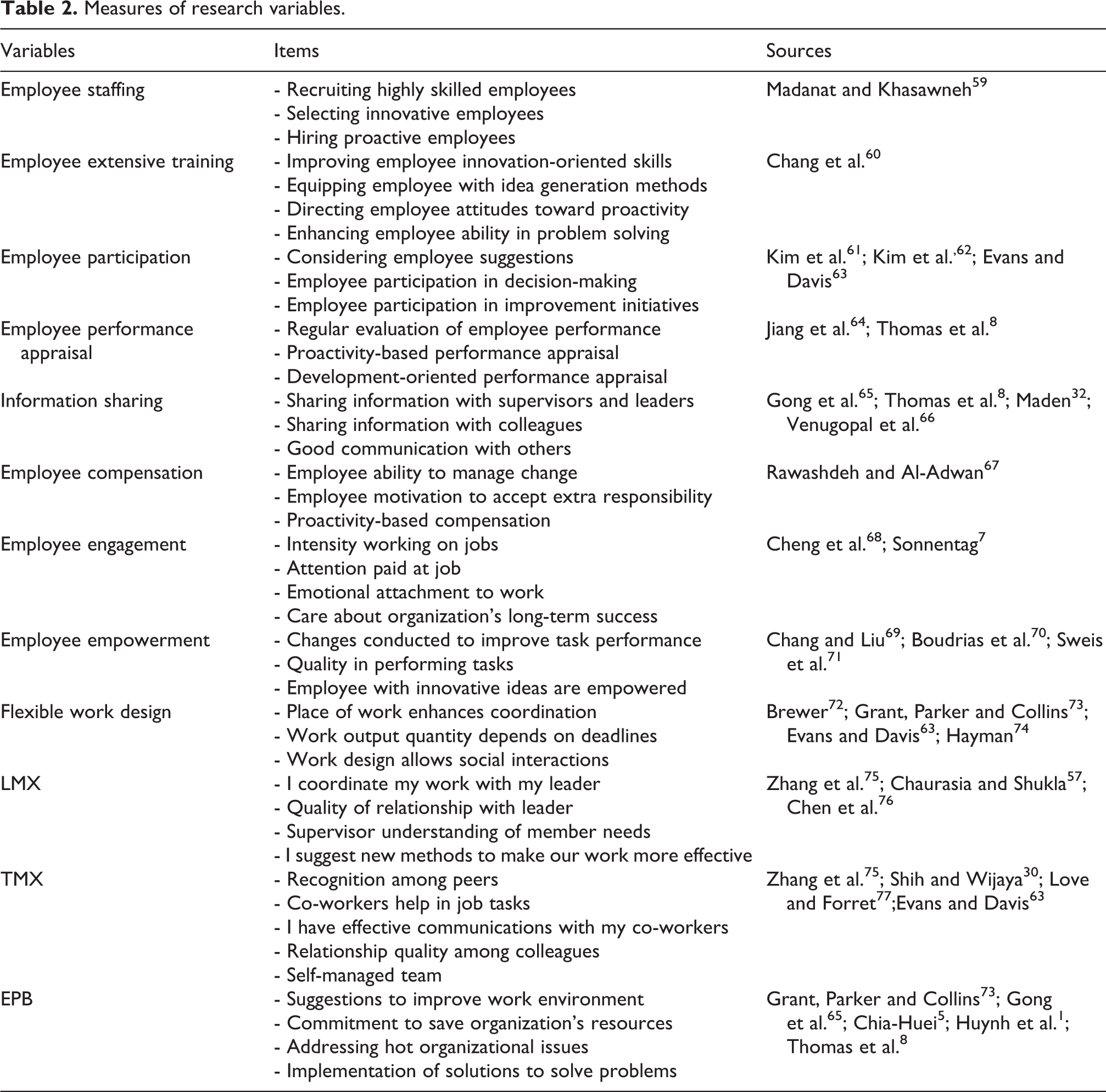
A questionnaire survey was developed to measure research variables to collect data by the researcher, based on the review of instruments used in previous relevant studies as well as the studies explain in Table 2. The questionnaire consisted of two parts. The first part was used to collect the data about the characteristics of the sample individuals, such as their gender, marital status, educational qualification, and nationality. The second part aimed to measure research variables and consisted of 42 items distributed among 12 variables. Table 2 shows indicators used to measure research constructs: AMO-HR practices, LMX, TMX and EPB. Indicators were adopted from prior related works. The total number of the indicators used to assess HR practices is 30 items. As can be noted, eight items were used to measure LMX and TMX and four items to evaluate EPB. Participants’ responses were coded using a five-point Likert scale, i.e. 1 (strongly agree) to 5 (strongly disagree).
Measures of research variables.
Data collection
The population of this study incorporates all employees of small service companies in the Jordanian capital, Amman. 13 small companies were singled out for the purpose of the study due to accessibility of those companies and their agreement to participate in the study. Due to the possibility of distributing the study instrument to those employees, a comprehensive survey method was conducted to collect data. A total of 230 questionnaires were handed and 196 questionnaires returned usable for data analysis, which represents a response rate of 85.2%.
Sample data on small service companies showed the characteristics of the sample individuals, the respondents were from the gender male (58.6%), and female (41.4%). In terms of the participants’ marital status, it was shown that most of them were married (63.2%), whereas some were single (26.8%). About two-thirds of the sample (67.6%) had a Bachelor qualification, and the rest (22.4%) had a high education qualification. Regarding nationality, the sample was distributed across two groups: Jordanian (71.3%) and non-Jordanian (28.7%).
Research model
In light of research hypotheses, the model of the current study was divided into three sub-models. Figure 1 shows an H1-related model, in which AMO-HR practices as a whole construct was assumed to exert a significant effect on EPB.

Impact of AMO-HR practices on EPB.
Figure 2 displays impacts of AMO-HR practices: staffing, employee training, employee participation, performance appraisal, information sharing, employee compensation, employee engagement, employee empowerment and flexible work design, on EPB as stated in H2–H10.

Impacts of AMO-HR practices on EPB.
Mediating effects of both LMX and TMX in the relationship between AMO-HR practices and EPB, as postulated in H11 and H12, can be seen in Figure 3.

Impacts of AMO-HR practices on EPB through LMX and TMX.
Statistical methods
The face validity of the instrument was verified by presenting the questionnaire items to raters to verify the suitability of the questionnaire instrument to measure what was set to measure it, in addition to making sure of the linguistic formulation of these items. The construct validity was also verified by the Pearson Correlation Matrix, standardized factor loadings (SFL) and the average variance extracted (AVE). As for the second step, reliability analysis, it aimed to verify the questionnaire consistency by checking the internal consistency instrument for the responses of the sample individuals to the questionnaire items by using composite reliability (CR) and Cronbach’s alpha. 71,78 –80 The final step, research hypotheses, was tested by using the path analyses.
Validity and reliability
Face validity was assessed by showing the initial version of the questionnaire to raters, who specialized in human resource information system (HRIS) to assess the appropriateness of the instrument to measure the research variables. In addition to checking the linguistic of these items, the raters’ notes were modified and there are no items were removed or added to the instrument. Construct validity and reliability of the questionnaire was assessed based on the values of standardized factor loadings (SFL > 0.50), average variance extracted (AVE > 0.50), composite reliability (CR > 0.70) and Cronbach’s alpha (α > 0.70) were found to be acceptable, as shown in Table 3. 71,78 –80
Results of construct validity and reliability.

1: Employee staffing; 2: Employee extensive training, 3: Employee participation; 4: Employee performance appraisal; 5: Information sharing; 6: Employee compensation; 7: Employee engagement; 8: Employee empowerment; 9: Flexible work design; 10: LMX; 11: TMX; 12: Proactive employee behavior.
Results
Hypothesis 1, which presumed that AMO-HR practices significantly trigger EPB, was tested in the first level of the analysis using both AMO-HR practices and EPB as whole constructs. The results are portrayed in Figure 4.

Impact of AMO-HR practices on EPB.
In the second level of the analysis, AMO-HR practices were separately examined in terms of their relationship to EPB, i.e. H2–H10. The results are portrayed in Figure 5.

Impacts of AMO-HR practices on EPB.
On the other hand, the effect of LMX on the relationship between AMO-HR practices and EPB as well as the effect of TMX on the relationship between the same exogenous and endogenous constructs as initialed in H11 and H12, were investigated, as shown in Figure 6.

Impacts of AMO-HR practices on EPB through LMX and TMX.
The results of hypotheses testing, as shown in Table 4, indicated that AMO-HR practices significantly trigger proactive employee behavior (ß = 0.63, P < 0.05), which supports H1. The effect of employee staffing on EPB was also supported (ß = 0.11, P < 0.05). Similarly, employee training (ß = 0.11, P < 0.05), employee participation (ß = 0.41, P < 0.05), performance appraisal (ß = 0.18, P < 0.05), information sharing (ß = 0.32, P < 0.05), employee compensation (ß = 0.36, P < 0.05), employee engagement (ß = 0.51, P < 0.05) and employee empowerment (ß = 0.54, P < 0.05) along with flexible work design (ß = 0.27, P < 0.05) had significant effects on EPB. These findings confirmed that H2–H10 were accepted. Moreover, the results indicate that AMO-HR practices significantly predicted EPB through LMX (ßdirect = 0.38, P < 0.05, ßindirect = 0.07, P < 0.05) and TMX (ßdirect = 0.36, P < 0.05, ßindirect = 0.16, P < 0.05), which assured that H11 and H12 were supported.
Results of hypotheses testing.
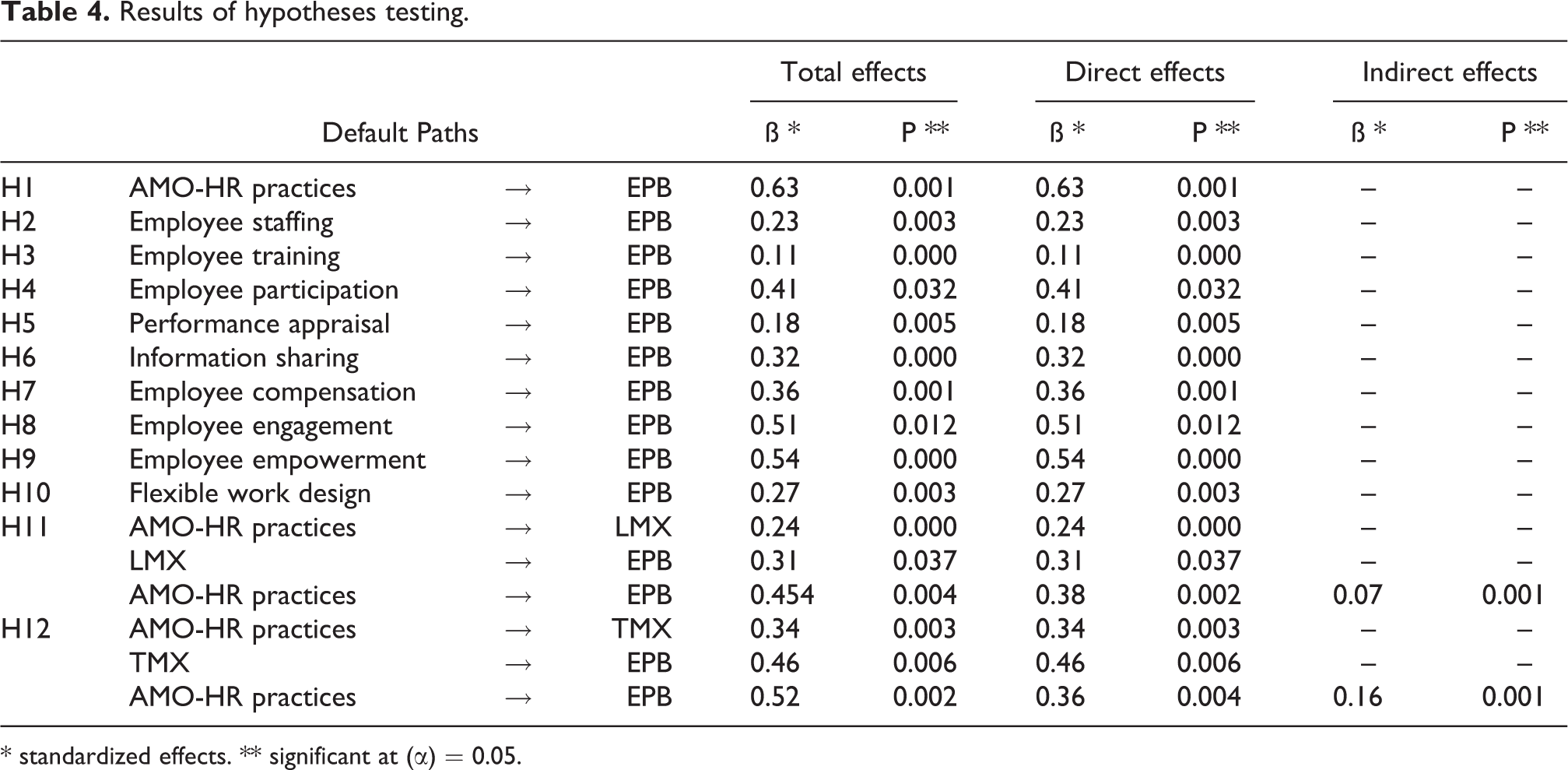
* standardized effects. ** significant at (α) = 0.05.
Discussion, conclusion, and implication
Discussion
The aim of this study was to investigate the effect of nine AMO-HR practices on employee proactivity. This was based on the review of previous relevant studies that showed a relationship between HR practices and employee creativity and employee proactivity. The current study is distinguished from these previous studies as it focuses on assessing human resource practices by using technology and trying to reveal its relationship with proactive employee behavior. In other words, the extent to which the proactive employee behavior can be controlled through the implementation of AMO-HR practices, and discovering the mediating role of the leader-member and team-member exchange to effect on this relationship.
In a few words, AMO-HR practices as a whole construct and each dimension of AMO-HR practices (Employee staffing, Employee training, Employee participation, Performance appraisal, Information sharing, Employee compensation, Employee engagement, Employee empowerment, and Flexible work design) had a significant effect on proactive employee behavior. The effect of AMO-HR practices on EPB was significantly mediated by leader-member exchange and team-member exchange. In fact, no previous studies tackled the same constructs or revealed the same results, i.e. the effect of AMO-HR practices on EPB in the presence of LMX and TMX. However, Lee et al, 18 Li et al. 55 and Shin et al. 16 regarded HR practices as a main source of employee proactivity. Training and development, teamwork, feedback, job autonomy, and participation were positively associated with EPB. 40 Employee engagement also had a similar effect on employee proactivity. 32 Performance management, employee compensation, flexible work design, and decision-making participation are examples on HR practices that trigger employee proactivity. 10 In a similar line, Beltrán-Martín et al. 56 detected a positive link between HR practices and employee proactivity. According to Diamantidis and Chatzoglou, 14 employee proactivity mediated the relationship between organizational and job factors on employee performance.
Regarding leader-member exchange and team-member exchange impact on the relationship between AMO-HR practices and EPB, which confirmed in this study, de Oliveira and da Silva 27 argued that the quality of LMX depends on mutual trust and respect and results in an increased level of employee performance. Sanders et al. 28 highlighted a significant effect of LMX on employee innovative behavior. Wijaya 31 found a significant mediating role of LMX in the relationship between proactive personality and employee voice. On the other hand, the effectiveness of work interactions, communication and coordination with team members 1 as well as assistance provided by a team member through the introduction of enhanced work methods, 57 as referred to TMX, were critical for workplace innovation. 58 These dimensions are influenced by AMO-HR practices. 41 More importantly, the effectiveness of member-team relationship engenders employee proactivity. 1 Furthermore, employee voice, as a key dimension of employee proactivity, 28 was positively linked to TMX. 30
Conclusion
This study aimed at contributing to the human resource management literature through examining the impact of ability-enhancing HR practices, motivation-enhancing HR practices and opportunity-enhancing HR practices as suggested in AMO HR practices model. 18,19,22,36,45–50
Our results underlined a significant impact of AMO-HR practices on proactive employee behavior, when analyzed based on an integrated construct of AMO-HR practices. Explanation of such an effect can be understood via representing the specific findings related to each HR practices within AMO model. It was revealed that employee staffing, employee training, employee participation, performance appraisal, information sharing, employee compensation, employee engagement, employee empowerment and flexible work design were significant predictors of employee proactivity behavior. These results were regarded logical because of how these practices conceptualized.
Managerial and social implications
Three managerial insights were emerged in light of the current research findings. First, innovation-directed human resource practices and organizational relationships, at the team or the organizational levels, are key drivers of proactive employee behavior. Managers are assumed to ensure effective management of HR practices that encourage employee innovation and to maintain high-quality relationships with and between employees. Second, the availability of employee proactivity alone is not enough—hence, an appropriate environment that supports the proactive behavior of the employee should be created. One of the most important things to focus on here is to maintain a high-quality of the relationship between the employee and the leader, as well as between the employee and the team. Third, management of human resources and relationships within the organization has short-term outcomes, like employee proactivity enhancement, and long-term outcomes, like organizational performance magnification. For this reason, organizations are required to adopt proactivity enhancing HR practices like recruiting and selecting, developing and rewarding talented individuals in order to achieve positive outcomes.
In line with exchange social theory, the current paper suggests that the rule of social exchange should be respected and social resources, which makes up the content of this exchange such as love and trust, should be protected. Such resources contribute to the exchange of other resources such as information. Of course, enriching a healthy working environment improves and activates employee outcomes such as creative ideas initiation. Moreover, from the perspective of social identity theory, the results of the current study emphasize the need to maintain the cohesion of the social group, a group whose members belong to the same group, and have a common social identity. In other words, how an individual views him- or herself as a member of the group and what role he or she plays. This applies to a group that represents a small group, which includes relationships between the member and the team, and the organization that forms a large group, which describes the relationship between the leader and the member. These positive social impacts overlap with managerial effects and ultimately support the implementation of the organizational strategies and innovative approaches to achieve organizational goals. Positive social outcomes include improved job engagement, organizational trust, and organizational cooperation, which alleviates work stress, conflict at work, and helps the employee to develop and promote him- or herself. This is reflected in his or her social life outside the organization.
Limitations
There are limitations in the literature dealing with the relationship between AMO-HR systems on proactive employee behavior is still rather scarce, especially, if there are leader-member and team-member exchange as a mediating variable. The current study is, therefore, a good starting point for future research about AMO-HR systems on proactive employee behavior and the mediating contribution of leader-member and team-member exchange.
Research design, which is cross-sectional, used in the current research, represents the first limitation of the research. As a result, using longitudinal designs is the best alternative. Shih and Wijaya 30 suggested that conducting a study on leader-member exchange and employee voice behavior using longitudinal data results in more accurate results.
One of the most important limits of the current study is that it was applied to the service industry, and therefore, the generalization of the results of this study is limited to this sector, in addition to that the study sample was approved by XXX, where the study could not be applied to other regions of Jordan.
Future studies and recommendations
Researchers are called for carrying out future research using longitudinal designs. Some studies, (e.g., Joo et al. 81 ), have shown that culture has an impact on the proactivity of the employee, consequently, the proactive employee is not necessarily encouraged by the leader because the prevailing culture in some countries like south Korea focuses on collectivism. Accordingly, researchers should consider culture as a key factor when tackling proactive employee behavior.
Future studies can be directed to other sectors, especially that the current study has been applied to the service sector. In addition, the current study recommends applying it to other regions in Jordan and comparing its results with the results of the current study to discover if there are differences in the implementation of AMO-HR between different regions of Jordan.
Footnotes
Declaration of conflicting interests
The author(s) declared no potential conflicts of interest with respect to the research, authorship, and/or publication of this article.
Funding
The author(s) received no financial support for the research, authorship, and/or publication of this article.
