




Abstract
Customer demand is the core of the vendor’s implementation of product supply strategies. There are three different patterns of demand: real demand, false demand, and semi-real demand. For this article, we study the product supply strategy formulated for manufacturer-to-group customers based on a semi-real demand pattern. Firstly, we construct two mathematical models in which the manufacturer obtains the best profit based on the two supply modes in the semi-real demand pattern. Secondly, we solve the optimal production volume and optimal pricing. Finally, numerical examples are used to verify the validity of the model. In accordance with the optimization principle, results of the analysis are extended to the range of optimal value of product profit in the demand model, so as to explore the mechanism of manufacturers for maximizing group customers’ product profits under the semi-real demand model.
Introduction
Since the beginning of the 21st century, innovations in industrial technology, information technology, and management systems have brought about great developments in social productivity. The Internet+, IoT+, cloud computing, and artificial intelligence have promoted a new scientific and technological revolution and industrial transformation. The progress of science and technology has not only transformed people’s styles of life and work but has also brought about changes in people’s needs, from solving the problem of food and clothing to meeting today’s intangible and spiritual needs. Therefore, it is a great challenge for enterprises to explore customer demand at this time. Enterprises need to constantly carry out scientific and technological innovation, develop new products, and produce and sell goods that meet customers’ needs. At the same time, enterprises need to adjust production and sales volumes according to changes in customer demand and strive to achieve the optimal product profit by finding the equilibrium point between oversupply and undersupply. Facing these opportunities and challenges, it is very important for manufacturers and retailers to design and plan product supply strategies for individual and group customers according to different patterns of customer needs.
In product supply chains, customer demand is a fundamental driver of customer buying behavior. Manufacturers ascertain market dynamics and customer preferences through customer demand, and produce and sell products that meet customer needs, thereby achieving substantial economic benefits. However, when manufacturers are formulating product supply strategies, they must consider the market equilibrium problem. If the quantity of products produced by a manufacturer exceeds the demand for that product, surplus products will be manufactured and will occupy valuable inventory space. This oversupply will prevent the company from maximizing profits. Conversely, if the quantity produced is insufficient to meet the consumers’ demand, there will be a supply shortage; with some consumers being unable to satisfy their demand due to the lack of supply, the company cannot maximize profits.
In terms of management practice, this article identifies an interesting phenomenon in the process of product marketing. People must eat if they want to live, and from this point of view, food is the most important material product to meet the needs of human survival. However, with the continuous progress of social productivity, the problem of obtaining food and clothing has changed throughout history. At this time what to eat has become a difficult choice, with people facing a wide variety of foods. We find that the customers’ needs in this simple example are no longer just to meet the basic survival needs, but are sublimated into the field of ideology, and this interesting phenomenon holds true for the vast majority of products. However, from analyzing the research findings of the application of demand theory in the product supply chain field, 1 we find that this interesting phenomenon has not systematically studied. Studying product supply strategies while taking this phenomenon into account can therefore be said to be groundbreaking, with the results likely to have a great impact on demand theory in the field of marketing and supply chain strategies.
In the relevant literature on the subject, Monden et al. 2 stated revenue-sharing contracts in shopping centers based on retailers’ demand uncertainty. Chuang et al. 3 stated the relationship between retailer inventory leanness and operational efficiency under uncertain demand. Alvarado-Vargas and Kelley 4 stated the bullwhip effect of regional and global supply chains under uncertain demand. Sun et al. 5 established a price-based demand response (DR) model based on consumer psychology, by studying the variation of the range of deviation caused by customer response uncertainty. Zheng et al. 6 stated housing demand in the Hong Kong rental market under the uncertainty of demand. Alonso-Ayuso et al. 7 constructed a stochastic model of forestry planning risk management under uncertainty in demand and price. Avila-Torres et al. 8 constructed a mathematical model of urban transport planning under uncertainty in demand and travel time. Esmat et al. 9 stated a decentralized local flexibility market under uncertainty of demand. Butters 10 stated the news vendor model under the uncertainty of demand. Kim et al. 11 stated the robust optimization model of closed-loop supply chain planning under reverse logistics and uncertainty of demand. Mohamed et al. 12 stated a stochastic multistage two-echelon distribution network design problem under demand uncertainty. Chien et al. 13 stated the decision-making model of strategic capacity planning for intelligent production under demand uncertainty.
However, when scrutinizing this existing research, we find that the current studies are focused only on the results of uncertainty of demand, ignoring the three different demand patterns that exist in customer demand in management practice: real demand, false demand, and semi-real demand. Therefore, we first determine how these three demand patterns are defined in management practice.
Since the beginning of the 21st century, the rapid development of science and technology has brought about progress in social productivity and changed people’s consumption habits. At this time, the well-developed material life of people has led to make their consumption habits shifting from the original need to solve the food and clothing problem (we call this real demand), to improving satisfaction in the intangible and spiritual needs (we call this false demand). Here, we give a simple example to verify our theory. As can be seen from the simple case of drinking tea, customer demand can be divided into three dimensions. The first dimension of demand is the essential need, that is, the function of quenching thirst; therefore, we call this real demand. But does drinking tea satisfy only the primary purpose of quenching thirst? No, there is a second dimension of functionality, which is the function of sociability. Drinking tea with friends has become a daily habit of modern city dwellers; in our time, drinking tea has become a means for social interaction. Also, in many parts of China, such as Fujian, Guangdong, Hong Kong, Macau, and Taiwan, drinking tea is a means of talking about work. Therefore, drinking tea has the function of work etiquette; this is the third dimension of tea drinking. The latter two kinds of requirements are nonessential, for which we use the label of false demand. Besides this, there is an intermediate point between the essential and the nonessential, which we call semi-real demand. Still using the case of drinking tea to illustrate this intermediate demand, consumers may wish to drink tea because of thirst, but they suddenly remember that they have not met their friends for a long time, so they call them to meet at the tea house. These kinds of consumers arrive at the tea house with “really demanding needs,” facing sets of information influenced by external factors; ultimately, with increasing external influences, consumers are forced to divide demand into smaller and smaller elements. This is neither a false demand nor an objectively determined “real” need, but rather the material and symbolic aspects of consumers forming “needs” in a state of uncertainty; it is thus a semi-real demand.
By extending from the case of drinking tea to various other real-life products, we find that there are more than two patterns of customer demand. It can be said that the ideological factor has gradually become the main factor affecting consumers’ purchasing behavior; the main factor is now false demand. 14 By reviewing the relevant literature, we have found that customer needs for products are not divided into multiple dimensions, such as essential and nonessential needs, nor are the results of subcategory research on these dimensions (i.e. different demand patterns) as reflected in this literature. Therefore, how product manufacturers and retailers design and plan different product supply strategies according to different demand patterns and various types of customers represents a crucial theoretical gap in the existing research. Agustina et al. 15 believed that at the operational decision-making level of an enterprise, mathematical models can effectively solve various macro and micro problems at the operational, tactical, and strategic levels of the enterprise, including but not limited to product production, transportation, inventory, and sales.
Our intention is to provide valuable insights for enterprises, so as to solve the enterprise’s decision-making problems in the production and operation of various products, and ultimately obtain maximum profits of the enterprise by developing mathematical models.
In addressing the research gap, the present study provides a theoretical basis and practical support for manufacturers to formulate product supply strategies based on different demand patterns from the perspective of mathematical modeling, with particular theoretical research significance.
Variable function
Semi-real demand function
Petruzzi and Dada
16
considered that demand is a stochastic function of price and then defined the price function of general demand, believing that this can model the demand function in the addition or multiplication. The addition form represents a phenomenon demand curve, and the multiplication form represents an elastic demand curve. Mills
17
uses the addition form to define the demand function as a function model of

where d 0 donates the minimum weighted product utilization efficiency.
In theory, the normal distribution is a convenient model for quantitative phenomena in the natural sciences and behavioral sciences. Under certain conditions, the delivery of the average of a large number of statistically independent random variables tends to be normally distributed, which is the central limit theorem.
21
The uniform distribution is also called the rectangular distribution, which is a symmetric probability distribution, and the distribution probability at the same length interval is equally possible.
22
We believe that the normal distribution and the uniform distribution show distinct differences in the results, but the functional model idea is consistent. For the purposes of the study, we set ε to be a function that is uniformly distributed over the interval
Then,

Manufacturer profit function
In the product supply chain, the central role of the manufacturer is to produce products according to market demand and then wholesale the products to retailers or make direct sales to individual customers or groups of customers. There are two outcomes in this process. One is that the demand is higher than the supply, and the other is that the demand is less than the supply. We assume that the marginal cost of producing a specific product by a manufacturer is c, and if it is the product of a production unit q, the total cost of producing a product is
If the supply is less than the demand, the products can be sold out, and the corresponding total sales revenue is

If the supply is higher than the demand, we find that the manufacturer’s sales revenue for the product is only

Notations
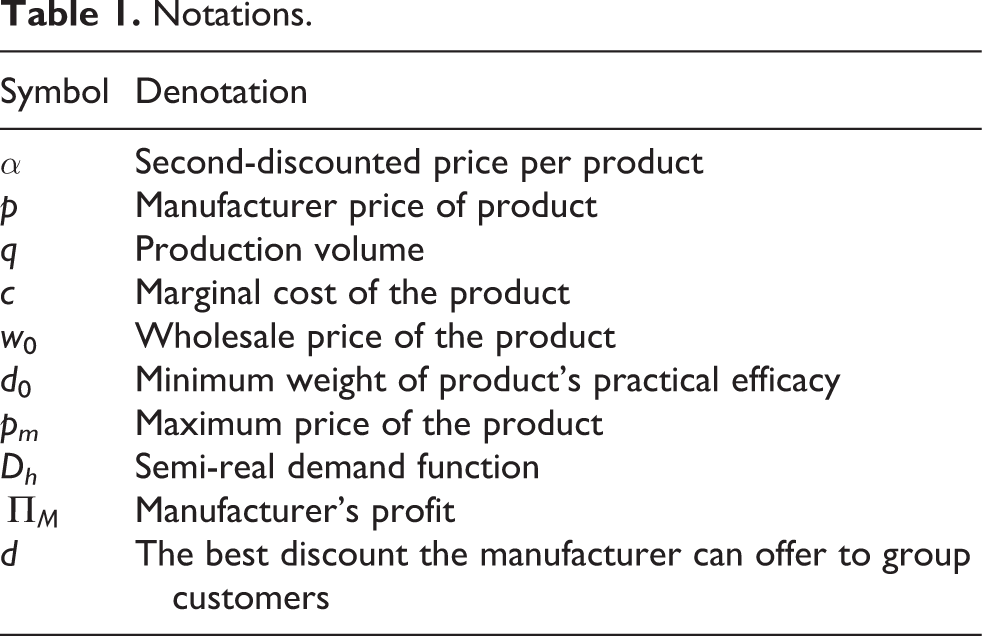
We construct the mathematical model of the product supply strategies for the manufacturer-to-group customer based on the semi-real demand pattern. We define the relevant notations used for modeling (see Table 1).
Notations.
Mathematical model construction
Compared with individual customers, the advantage of group customers lies in the large number of purchases made by group customers and the relatively stable demand. From the perspective of management practice, an essential prerequisite for manufacturers is to cooperate with group customers, who must be targeted with special measures such as volume discounts, scale customization, and so on.
Based on the notations given in the “Notation” section, we construct two profit function models to describe the manufacturer’s design and planning product supply strategies for group customers based on the semi-real demand pattern. We solve the problem of maximizing the profit of the products by solving the corresponding optimal production volume, optimal pricing, and optimal discount.
Off-invoice mode
We assume that the retail price by the manufacturer for an individual customer is p, with d discount for the group customer; therefore, the sales price for group customers is

Using the expectation formula theorem of probability theory, we substitute equation (1) into the above profit function model and get the following equation:

Using the optimal method, we make a first-order derivation of the above formula and equate to 0, so we have,

The value of q solved by equation (6) is the optimum production quantity of the manufacturer.
Then,

The value of p solved by equation (7) is the optimum price of the manufacturer.
Then,
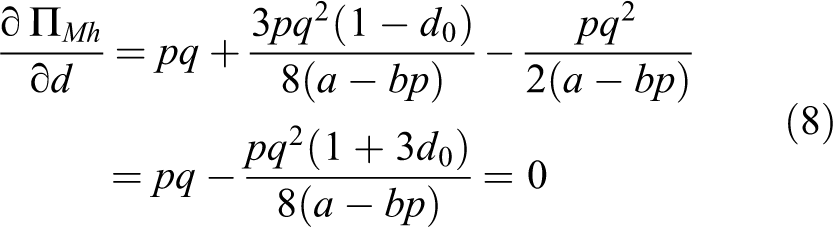
The value of d solved by equation (8) is the optimum discount of the manufacturer.
Then,

The value of α solved by equation (9) is the optimum second-discount of the manufacturer.
Unsold-item processing mode
In this mode of supply, if the manufacturer’s production volume is higher than the demand, it can only be recycled

Using the expectation formula theorem of probability theory, we substitute equation (1) into the above profit function model, and we get the following equation:

Using the optimal method, we make a first-order derivation of the above formula and equate to 0, so we have,

The value of q solved by equation (12) is the optimum production quantity of the manufacturer.
Then,

The value of p solved by equation (13) is the optimum price of the manufacturer.
Then,

The value of d solved by equation (14) is the optimum discount of the manufacturer.
Verification of the numerical example
The theoretical contribution of this article is to construct a functional model of the manufacturer’s optimal product supply strategies for group customers based on the semi-real demand pattern. Compared with existing research, this model theoretically constructs the semi-real demand in the application in a realistic scenario. However, according to equation (14), we find that the mathematical relationship between the manufacturer and the product model of the product supply strategy of the individual customer in the semi-real demand model is very complicated. There are no specific solutions to the optimal production volume
We assume that a manufacturer (S company) produces a product with a marginal cost of 50 and a market having a maximum retail price of 100. At this time, the retail price of the product sold by the manufacturer to the customer must meet the constraint condition of
Off-invoice mode
We used Mathematica 8.0 to substitute the set parameters into equations (6)–(8) and obtained the results shown below.
At the same time, in order to examine the influence mechanism of manufacturer’s rediscount to individual customers on optimal production and optimal price, we conduct numerical calculations with increment of 0.5 within the range (0.5, 3).
Numerical calculation shows that under the off-invoice sales mode, there is only one optimal solution satisfying the constraint conditions
Optimal price, optimal production, and optimal discount under off-invoice mode.
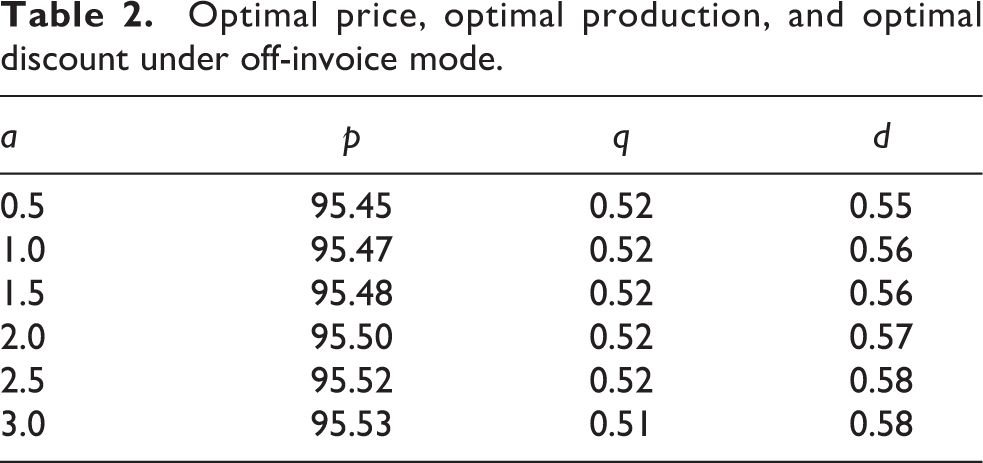
In order to more intuitively analyze the changes between the preferential value and the best production volume, best pricing, and best discount, we extend Table 2 to Figures 1 and 2 through the mapping function of Mathematica 8.0. In Figure 1, the horizontal axis represents the optimal pricing p and the vertical axis represents the production volume q. Figure 2 shows the discount d on the horizontal axis and the production q on the vertical axis. Under the direct discount mode, the relationship between optimal pricing and optimal yield is parabolic (see Figure 1). The highest point of the upward trend of the parabola is the manufacturer’s optimal pricing. According to the three sigma principle theorem of Pukelsheim, 23 the product sold by the manufacturer is priced within the range of (95, 96), and the manufacturer’s profit can be maximized in a realistic state. According to the theory of optimization, the manufacturer’s profit is optimal. At the same time, Figure 2 shows that the manufacturer’s discount to group customers is within the range (0, 0.6), and the output value is negative, which is not consistent with the commodity operation law. It can thus be inferred that the manufacturer’s sales at this time are loss-making. Therefore, according to the profit optimization principle, the manufacturer’s discount to group customers should be within the range (0.6, 1). The closer the discount value is to 1, the greater the profit will be.

Variation trend of manufacturer’s optimal pricing with optimal order quantity under off-invoice mode.

Variation trend of manufacturer’s optimal discount with optimal order quantity under off-invoice mode.
Unsold-item processing mode
We used Mathematica 8.0 to substitute the set parameters into equations (12)–(14) and obtained the following results.
Meanwhile, in order to examine the mechanism of the effect of manufacturers’ discount processing fees on the optimal yield and the optimal price, we numerically calculate γ within the range of (44, 49) and increasing by 1.
Numerical calculation shows that in the unsold-item processing distribution mode, there is only one optimal solution satisfying the constraint conditions
Unsold-item processing mode of the optimal price, the most healthy birth yield, and the best discount.
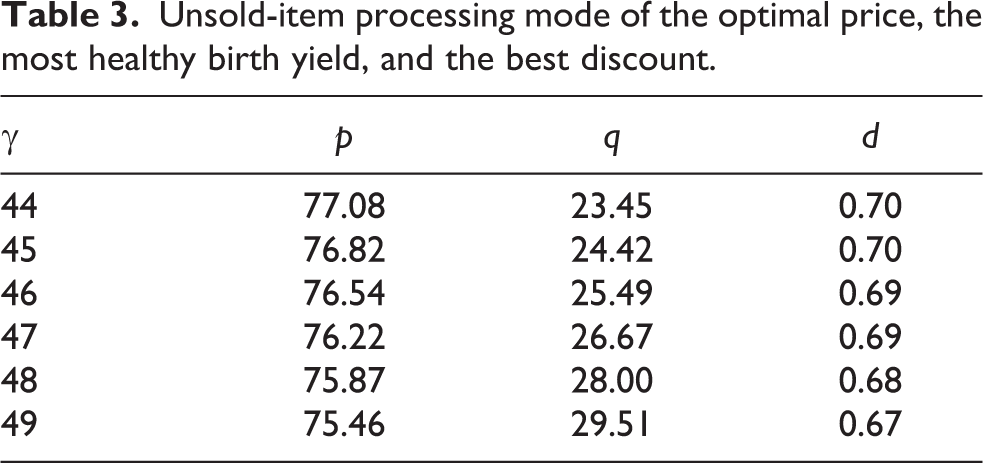
This article extends Table 3 to Figures 3 and 4 through the mapping capabilities of Mathematica 8.0. In Figure 3, the horizontal axis represents the optimal pricing p and the vertical axis represents the production volume d. In Figure 4, the horizontal axis shows the discount d and the vertical axis shows the production volume q. As shown in Figures 3 and 4, under the unsold treatment mode, the relationship between optimal pricing and optimal production presents an inverted parabolic relationship (see Figure 3). The highest point of the upward trend of the parabola is the optimal pricing of the retailer. According to the three-sigma rule theorem of Pukelsheim, 23 a product sold by the manufacturer to individual customers is priced in the range (60, 64), with the parabola at the highest position. According to the theory of optimization, the manufacturer’s profit is optimal. At the same time, Figure 4 shows that the manufacturer’s discount to group customers is within the range (0, 0.65), and the output value q is negative, which is not consistent with the commodity operation law. It can thus be inferred that the manufacturer’s sales at this time are at a loss. Therefore, according to the profit optimization principle, the manufacturer’s discount to group customers should be within the range (0.65, 1). The closer the discount value is to 1, the greater the profit will be.

Unsold-item processing mode manufacturer's optimal discount with the optimal order quantity change trend chart.

Unsold-item processing mode optimal pricing with the optimal order quantity change trend chart.
Conclusion
Based on the supply model of direct selling to group customers by manufacturers, we construct a product supply strategy model for manufacturer-to-group customers based on a half-true and half-false demand model. By using mathematical expectation formula of probability theory and optimization methods, the optimal yield, optimal pricing, and optimal discount of the model are respectively discussed in the off-invoice and unsold-item processing distribution modes. Finally, the effectiveness of the model is verified by example analysis, the results of which are generalized to the optimal value of the product profit under the demand model.
There are two primary research contributions made by this article. First, our research finds that there are three different patterns of customer demand in the consumer goods supply chain, but that existing research has not reflected the results of these three different demand patterns. Therefore, our research has a particular theoretical effect on the application of customer demand in the consumer goods supply chain field. Second, current research has certain flaws in considering product or supply strategies for manufacturers or retailers based on different types of supply models. Thus, we construct product supply strategies for the manufacturer in the two different supply modes, off-invoice mode and unsold-item processing mode, based on the semi-real demand pattern, which has specific practical significance in management practice. In the future, we will consider the multiplication model of the demand function to construct a product supply strategies model based on the semi-real demand pattern, and carry out comparative analysis.
Footnotes
Declaration of conflicting interests
The author(s) declared no potential conflicts of interest with respect to the research, authorship, and/or publication of this article.
Funding
The author(s) received no financial support for the research, authorship, and/or publication of this article.
