




Abstract
We investigated the probabilities of acquisition of requisite human capital by new entrants in the institutional network. Graph theories applied in complex social networks using multi-attribute decision models were employed for our study. We coupled the dynamical and complexities of social network analysis with BASS-SIR epidemiological model to ascertain sustainability in the light of internal and external forces in the human capital acquisition. The results show that a new entrant’s ability to acquire human capital within the network increases rapidly and reaches a steady state by the third month. The fractional analysis indicated that a combined effect of internal and external injection of knowledge into the network sees entrants acquiring the required knowledge and work world skills in a relatively shorter time. Finally, the discrete and continuous analyses revealed that relatively even and continuous patterns of information flow reduce the time of reaching a steady state in the industry. We recommend a strong policy on continuous and even rates of training, a high rate of information flow such as internal and external training with the emphasis on internal training systems to gain competitive advantage.
Keywords
Introduction
Studies in strategic management have had a long history of adapting the resource-based view (RBV) of the firm to explain differential firm performance. 1 The uniqueness of human resources among all other resources available in explaining differential performance has been emphasized in many studies. The core of this stress lies in the difficulty involved in the imitation of this particular unique resource and the relative time involved in attempts to acquire competitively advantageous portions of this resource in a competitive industrial space. 2 –5 In more recent times, researchers have drawn on network literature to highlight the importance of both internal and external resources available to the firm through its networks. 6 –8 In the view of Gulati et al., 9 the strategic network perspective professes that the embeddedness of industries in networks of external and internal relationships with other organizations and individuals holds significant implications for firm performance. Explicitly, strategic decision-making that draws from existing structures such as knowledge diversity pools, the world of work skill sets, interinstitutional cooperation, and third-party endorsements are often acquired through networks. 10,11 Clandestinely, access to such resources and capabilities influences performance. Again, since human resources and capabilities are differentially available to a firm depending on its network structure and ties, the importance of the complexity of social networking and its impact on human capital development coupled with its subsequent impact on performance is worth exploring.
The accessibility to a wider range of human capital has an impact on the retention or probability of a worker to remain affiliated with an employer for a longer period. One of the major considerations of human resource managers in the processes of employment is to select the best-fit personnel into an organization. 3,12 The acquisition and diffusion channels of human capital, therefore, become critical to the attainment of competitive advantage of any institution. Management, therefore, is baffled with the pertinent issue of newly employed workers acquiring the requisite organizational fit knowledge during the probation period. This article assesses among other considerations the probability of survival of newly recruited personnel taking into consideration the internal and external influencers of adaption and diffusion of human capital.
Human capital diffusion model description and parameter setting
Firms in competitive spaces engage new and critical human resources with desired skills to boost, sustain, or attain desired competitive advantage levels, signaled by the innovation that competent workers infuse into their operations. One major purpose of this article is to provide a hypothetically general model for analyzing human capital diffusion and acquisition in highly competitive networks. We adopt and adapt a simple BASS-SIR differential spread model to present our analytical model. This model considers the spread of any medium through a population of diverse interactive connections as being a signal of diffusion and fractional impact of the medium. Further, it holds that the population is made up of major categories but separate groups with intra- and intergroup interactions among the populations. The first group is considered already in direct contact with the medium under review and considered as the infected population. The second group is considered as the population who are yet to contact the medium but can contact and retain or reject the medium; this group is considered as the susceptible population. The interaction between the two groups and the subsequent retention or rejection of the medium yields a third quasi-group known as the recovered group. The dynamic movement of the medium within and among these three populations helps to analyze the impact of the medium on the population with possible extrapolations in desired numerical analogies. In some instances, some of the populations who contact the medium exit the system. In such instances, the analysis considers such exits as attrition or death.
In this article, we, therefore, consider the susceptible population as the average of employee closeness to ideal (CI) below the infectious population (I), the infected population as the population average of the Technique for Order of Preference by Similarity to Ideal Solution (TOPSIS) determined CI, and the average of the employee CI below the susceptible population (S) as the recovery (R) to potentially represent all individuals who fail to acquire or retain diffused human capital within the network in the study as elaborated in our earlier article. 13 Further, we assume the population that do not meet the desired performance benchmarks as having attained attrition status.
The viability of employing the epidemic model in forecasting the acquisition of human capital and retention of new employees over a long period lies in the similarities of their operations. In the first instance, both diseases and disruptive human capital emerge in a similar context. In both cases, a small number of infectious individuals or pathogens emerged in a region. Secondly, human capital is possessed and diffused in the form of information flow which can be infectious. 14 Again, both thrive on direct and indirect channels of diffusion. Direct infections (in-service training and development) are purposefully channeled by management members to new employees on probation for organizational competitive advantage and sustainability while the indirect channels (coexistence) are the human capital adopted by actors on probation in the organizational environment unconsciously. 15 –17 We will adopt the Susceptible - Infectious - Recovery - Susceptible (SIRS) model proposed by Bani-Yaghoub et al. 18 to establish an analogy between human capital diffusion and SIRS taking into consideration the key components of susceptible agents, infectious agents, and recovered agents in Figure 1.

Disruptive human capital diffusion model.
Modeling argument
Argument 1: Discrete analysis of industrial human capital network
Competitive industrial spaces require high human capital influx as a means of attaining a competitive advantage through the diversity of skills such influx provides. The presence of international participants in such spaces exponentially influences the human capital value as well as influence diversity. Invariably, any economic space seeking to maintain and or attain a competitive advantage must appreciate the complexities of knowledge acquisition, transfer, and innovation generation as a result of improved human capital. This capital in such instances becomes comparable to technology linked innovation.
Thus, our analogy is premised on the critical notion that all new employees to any competitive space has at least a human capital index that satisfies the minimum desired index within the competitive space. Further, new employees also can adopt dispersed or diffused knowledge that prevails within the competitive space through their direct and indirect dyadic relations with other human and institutional actors within the space. This premise allows for the numerical analysis of the complexities that surround human capital acquisition, growth, retention, and attrition in any competitive space.
Again, we hold the belief that retention and sustainable growth of human capital are strongly linked to in-service training and development, programs, and employee interactions with marginally high human capital indexed actors within the competitive space. Research has proved that in developed nations industries invest a considerable amount of funds in training their staff to attain high and unique human capital. In sharp variance is the case of emerging economies where scarcity of resources influence investment in in-service training and development programs. 19 We hypothesize a critical benchmark for this study as there is a correlation between retention of unique human capital and an employee’s connections with a highly skilled cluster of actors. Finally, there is a correlation between patterns, thus the frequency and time intervals of training and the rate of absorption of disruptive human capital.
In our analysis of how training and development and one’s connections influence retention and organizational growth and sustainability, it is viable to assess the organizational growth and sustainability models. The RBV model of organizational growth and sustainability posits that the uniqueness of human resources is hinged on human capital that lies in one’s unique knowledge and skills that have been attained as a result of investment in ones’ training. 20 This view is based on one of the most central pillars of human resources that postulates the assumption of employees being the most valuable asset of an organization for economic growth. Deducing from this model lies one’s connectedness to a pool of knowledge and skill set (network) as an advantage for growth and sustainability and one’s motivation to be employed.
Again, we adopt a BASS-SIR approach to highlight our discrete analysis. We, therefore, consider a situation where a new employee (actor) is recruited on probation by a particular institution. This means that the new actor (j) at time t joins an institution’s network M with permanent employees who were retained by management after exhibiting skills acquired through interactions with actors in the competitive space and considered as a set of unique knowledge and skills for the institution’s growth and sustainability. Further, we consider our institutional human capital network as undirected as both direct and indirect channels of human capital development are considered. In the view of Bass, 21 if a new employee i is on probation for employment by management by time t, his probability to attain full employee status is a signal of retention

Thus, as
Again, we argue that the magnitude of internal influences increases linearly with the number of ij of contagious actors connected to j and normalized by ej such that irrespective of the structure of an employing institutions network, the maximal internal influence that author j can experience when all his/her connections are with management members in the network is q.
For our analogy to hold, we do not hold that author j still exhibits the required human capital (knowledge and skill set) post the probation period. In actuality, this assumption helps because not all employees on probation get retained as employees. Some exit to other industries while others do not attain the required human capital index deemed necessary for retention. Our assumption, therefore, helps in factoring in the actualities of the labor market and employment probabilities. Thus, we assume that the probability of author j being infected (employed) at time t to being released back into the unemployed pool (unemployed after probation = not exhibiting required human capital index = recovery = returns to prior entry status = intern) at

Customarily, as
Concluding our argument, we revert to the SIR approach by denoting

Thus, for an institutional network where all employees are new and have not attained management levels, then
Argument 2: Structural analysis—diffusion of human capital in the banking network
The structure of a network, its connectedness, and distance between actors influence the strength of bonds and the probabilities of diffusion of human capital (information) within the network. Having conducted a discrete analysis of employee knowledge acquisition probabilities within the institutional network, we seek to understand the nature of human capital flow within institutional networks. We commence by considering that a typical employee network of an institution will be complete. Referencing initial parameters in Argument 1, when all employees in an institutions network M have a connection with at least one management member (directly or indirectly), thus being connected to everyone and anyone directly or indirectly, then

where q 1 represents “Internal drive” influenced by connections with management member(s) and other employees who has a human capital index higher than the actor under consideration; p represents external influence from country’s/region/industry’s unemployment index; and rI represents attrition condition hinged to the decision of management to retain an employee at his/her current human capital index.
In the absence of employee attrition, and regarding to equation (3), and by applying reduction, equation (4) reverts to original BASS 23 which when solved provides

Reverting to our initial argument, if we consider that no external factors are driving the interns to acquire the requisite human capital index necessary for employment in an institution, such that only intrinsic conditions serve as a driving force for human capital index acquisition, that is,

In the same vein, if we consider that human capital acquisition index is not influenced by external drives, such that

And bounded by initial conditions that factor in the fraction of contagious actors I
0 at time

If we consider our institutional network M of having a D-dimensional nature where each actor is connected to his/her 2D nearest neighbors, then we can write equation (1) as

In such an incidence, for example, when
To test these arguments, we applied our argument to an institutional network based on human capital diffusion in an emerging economy in Africa and reported results. The focal area was a competitive financial market space (banking sector).
The symbols and notations of the equations are listed in Table 1.
Symbols and notation table.

CI: closeness to ideal.
Developing the network
The financial network of listed banks in Ghana from which data were collected was found to have an aggregated management number of 64. The weighted-TOPSIS approach was used to divide the management team to susceptible, infected, and recovered entities 25,26




where X = individual CI scores.
The population average of the TOPSIS determined CI was used as the infectious population (I), the average of employee CI below the infectious population (I) were employed as susceptible population (S), and the average of the employee CI below the susceptible population (S) as the recovery (R) in the study by Kong et al. 13
Collected data were extrapolated from the curriculum vitae of actors as well as from industrial and government reports. The UCINET 6 for Windows version 6.658 was used as the analytical tool for the network. The condition for interaction between actors in a network has always been contingent on proximity (closeness, distance), accessibility (centrality), and similarities (clusters). The argument is that all things being equal, proximity, accessibility, and similarities are catalysts for establishing relationships between actors within a network. Referencing our earlier article, 13 the appropriate weight determination was done in Table 2.
Weight determination.

The aggregated value of an individual based on the variables of assessment as determined in Table 1 is
Network visualization
We adopted a social network analysis to describe the human capital network of the financial institutions of the developing economies. Using UCINET 6.658 and NetDraw 2.163 graphics visualizer, the network measures based on importance and closeness were obtained. For the study, the following specific measures will be adopted: degree centrality, information centrality, and clustering. Figure 2 represents the human capital network of listed banks in Ghana.
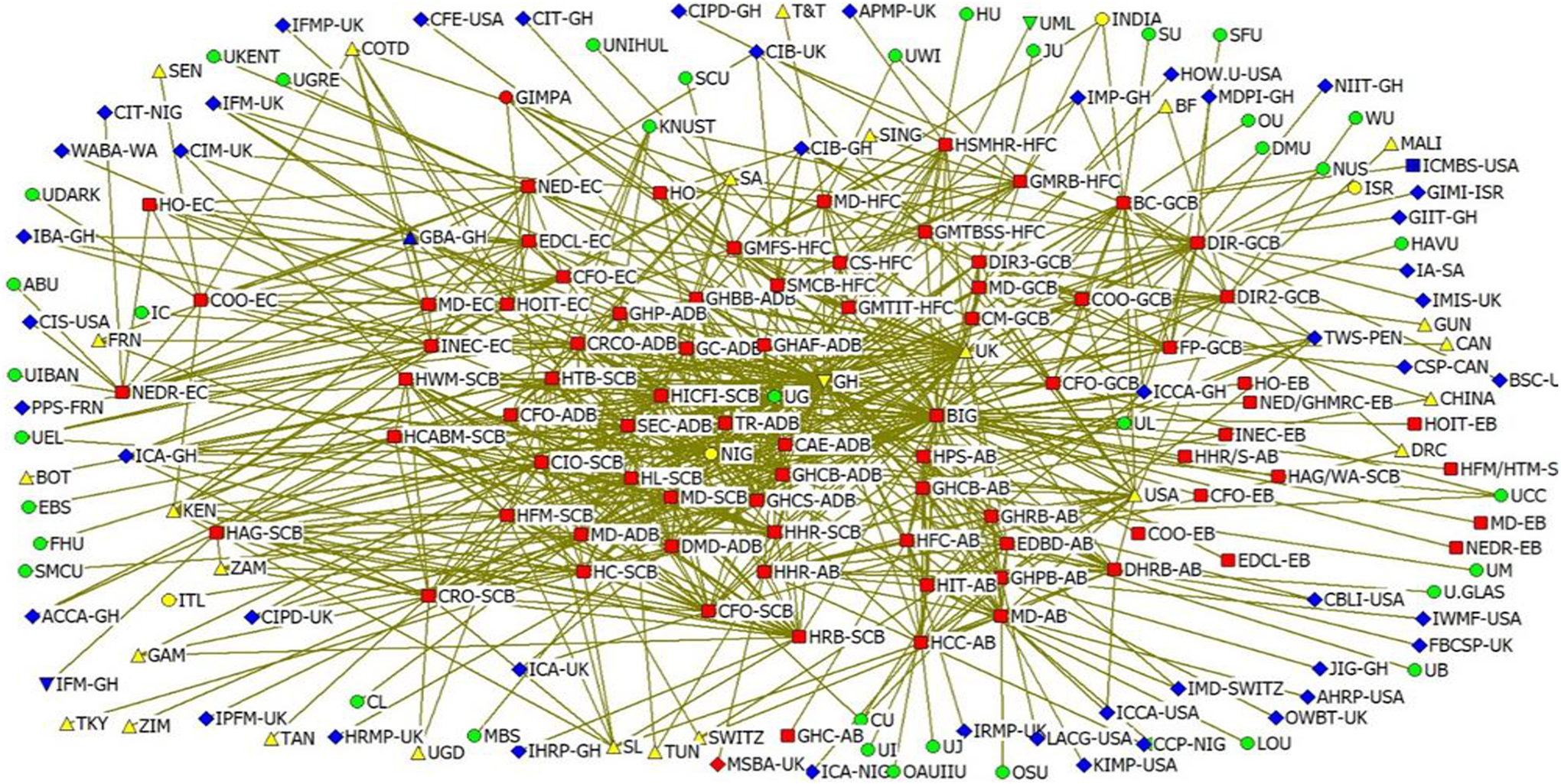
Human capital network. Red nodes are management team members, blue nodes are professional bodies, yellow nodes are countries, and green nodes are universities. Source: Field data by authors.
TOPSIS score as attributes
The weighted-TOPSIS approach for determining influential nodes that take into consideration a multi-attribute approach for decision-making was applied to the management team members to ascertain their human capital influence capacity within the network. Figure 3 represents the human capital network based on how influential management members are to the best possible ideal point in the network.

TOPSIS-weighted HC network. Red nodes are infectious nodes, blue are susceptible nodes, green is recovery approaching nodes, and purple is indirect sources of human capital inflow. Source: Field data by authors. TOPSIS: Technique for Order of Preference by Similarity to Ideal Solution; HC: human capital.
Results of analysis
Demographic
Figure 4 represents the listed banks and their management team size. At a glance, there are 6 banks involved in the network with varying management sizes ranging from at least 7 to a maximum of 13. This conforms with international standards in the banking industry.
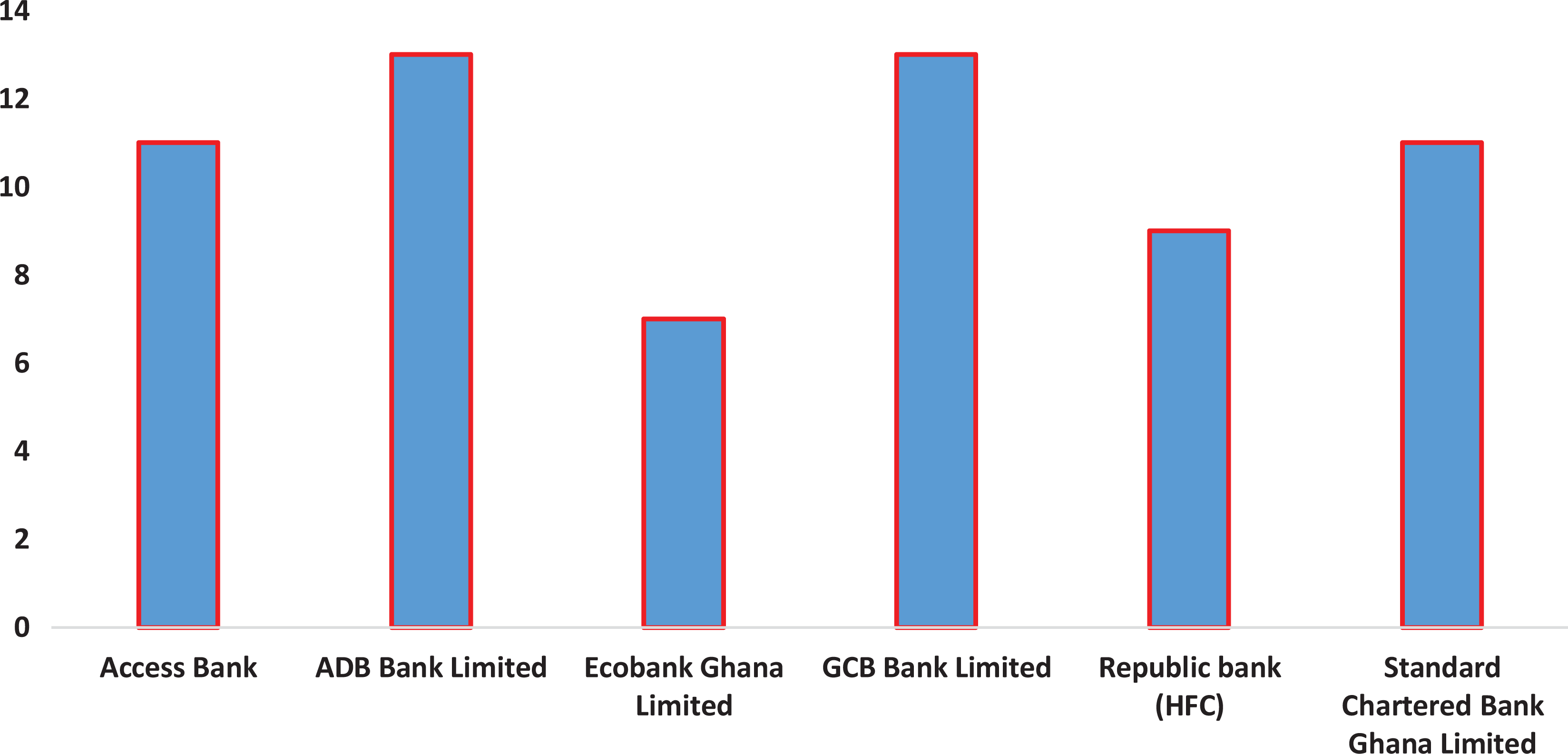
Listed banks and management size.
Degree centrality
The degree of centrality is a simple centrality measure that counts how many neighbors a node has. 27 An actor is deemed important if the actor has many neighbors or in the directed case, if many other actors link to it, or if the actor has links to many other actors. Figure 5 presents the degree centrality of the “infectious population” and the general financial network. On average, the general network had connectivity of 31.657.

Degree centrality.
Information centrality
We measured the information centrality of the current financial network in terms of human capital diffusion. Information centrality measures the rate at which information flows from actor A to actor B. 28,29 The information centrality of the network is presented in Figure 6. All the actors in the network performed above the threshold of greater than 1 in our study. On average, however, the rate of information centrality within the existing financial network was 2.59, with the least information centrality of 2.4 and a maximum of 2.8. Relatively, the information centrality of the actors in this network does not have outliers. They are all concentrated around the average.

Information centrality.
Clustering coefficient
The weighted clustering analysis conducted on the financial network and its results are presented in Figure 7. The normalized weighted overall clustering coefficient was 0.555 with a small world index of 30.987. Our study adopted a proximity-based algorithm for the clustering. In the view of Rizman Žalik 30 in a proximity-based cluster analysis, the cluster with the largest population has a higher level of interaction while the cluster with fewer population have less interaction. Three clusters were created as determined by the TOPSIS adopted from Kong et al. 13

Management team clustering. CI: closeness to ideal.
Observably from Figure 7, cluster 1 signaled as the most isolated subclique as only one management team member was found in the cluster. Cluster 2 had 59 management team members in the subclique while cluster 3 had five management team members. This indicates that the information flow within the network is very efficient as the majority (90.76%) of the actors were found in the same cluster. 2 Cellerino and Sanguanini 31 expresses that the higher the concentration of actors in a particular cluster, the higher the interactive activities and the more efficient the network.
Empirical test of equations
The survival of a new employee in a competitive industrial space, given the internal and external influences and time factor, is critical to an organization’s competitive advantage and sustainability. We argued that as training and development rates in additions to the connectivity of new entrants to influential actors increase so does their probabilities of retention in the organization increases. From Figure 8, as infectious actors increase, susceptibility increases and recovery decreases. Implicitly, as training and development increases in the organization, the more new employees acquire the required human capital for retention and the least the decay processes thus recovery occurs. Thus, new entrant’s survival probabilities (susceptible and recovery) are inversely related.

Probabilities of survival.
The organizational human resource practices concerning training and development and policies in relation to networking for competitive advantage are critical to enhance and provide a high and constant rate of information, knowledge, and skill flow to new entrants which increases their probability of retention within the organization by retaining the required human capital for organizational growth and sustainability. The existing professional network within the banking sector of Ghana is infused with a knowledge index reflected by the average information centrality index of 2.59. The probability that a new entrant attains the ability to transmit or transfer knowledge on joining any financial institution within the network is represented by the infectious prediction and his or her subsequent ability to acquire knowledge or professional know-how or world of work skills for the sector is represented by the susceptibility prediction. It is interesting to note that knowledge acquisition and knowledge transfer are highly correlated within the network as observed by the proximity between the susceptible and infectious predictions. However, the loss of any acquired by any actor having entered the network is reflected by the recovery prediction.
Consequently, the results show that joining the network new entrants’ ability to acquire and or transfer knowledge within the network increases rapidly and reaches a steady state by the third month. This is typical of professional networks like finance networks where initial entry is supplemented by vigorous and frequent entry-level training exercises. The decaying state of the knowledge loss (recovery) shows that the system has a strong probability of providing the requisite conditions for new entrants to retain knowledge. This is reflected in the gap between the recovery and infectious predictions. This further confirms knowledge acquisition and retention in closed and highly interacting networks.
Further, the diagram shows that if a new entrant is employed by any banking institution within the network, all diffused knowledge reaches a peak or maximal acquisition and retention level of 60% by the fifth month. However, if after initial training sessions, there are no further supplementary training programs, the probability that a new employee or entrant will lose his or her system acquired knowledge decays at a rapid state and reaches a steady state of 60% loss of all and any acquired knowledge by the fourth month.
Categorically, this graph provides evidence that informs managerial training decisions for newly employed workers within the network. Thus, for workers to retain at least 60% of all acquired knowledge, management must ensure periodic training periods not less than 5 months apart. This is reminiscent of strongly innovative and competitively driven networks. In developing countries where financial institutions compete strongly within and among themselves to obtain a competitive advantage in resource-strapped populations, frequent training ensures or assures innovation and knowledge retention among workers. This is a critical factor in attaining competitive advantage in such competitive networks.
We proceeded to conduct a decomposition analysis of knowledge within the network. Technically, this is a systematic decomposition analysis of varying rates of decay of knowledge loss as observed in Figure 9.

Recovery probability in human capital acquisitions (low rate).
The decomposition analysis shows that in general without any training all and any actor within the network will obtain initial entry-level knowledge within and by the 20th month if they receive no training. Thus, for any institution, the optimal training gap for new entrants as observed in Figure 7 is a 5 month apart sequence. However, every actor within the network must participate in at least one training program at least once in every 20-month period if an institution is to avoid total loss of competitive advantage through the loss of actor knowledge as observed on the different rates in Figures 9 and 10.

Recovery probability in human capital acquisitions (high rate).
Having assessed the decomposition rate of decay (recovery) in the financial network in Figures 9 and 10 at differential rates with respect to time, Figure 11 accounts for the fractional analysis of factors that influences acquisition in terms of external and internalities within time rates in months. The fractional acquisition of required knowledge for competitive advantage holding internal and external influence constant at relative times is assessed in months.
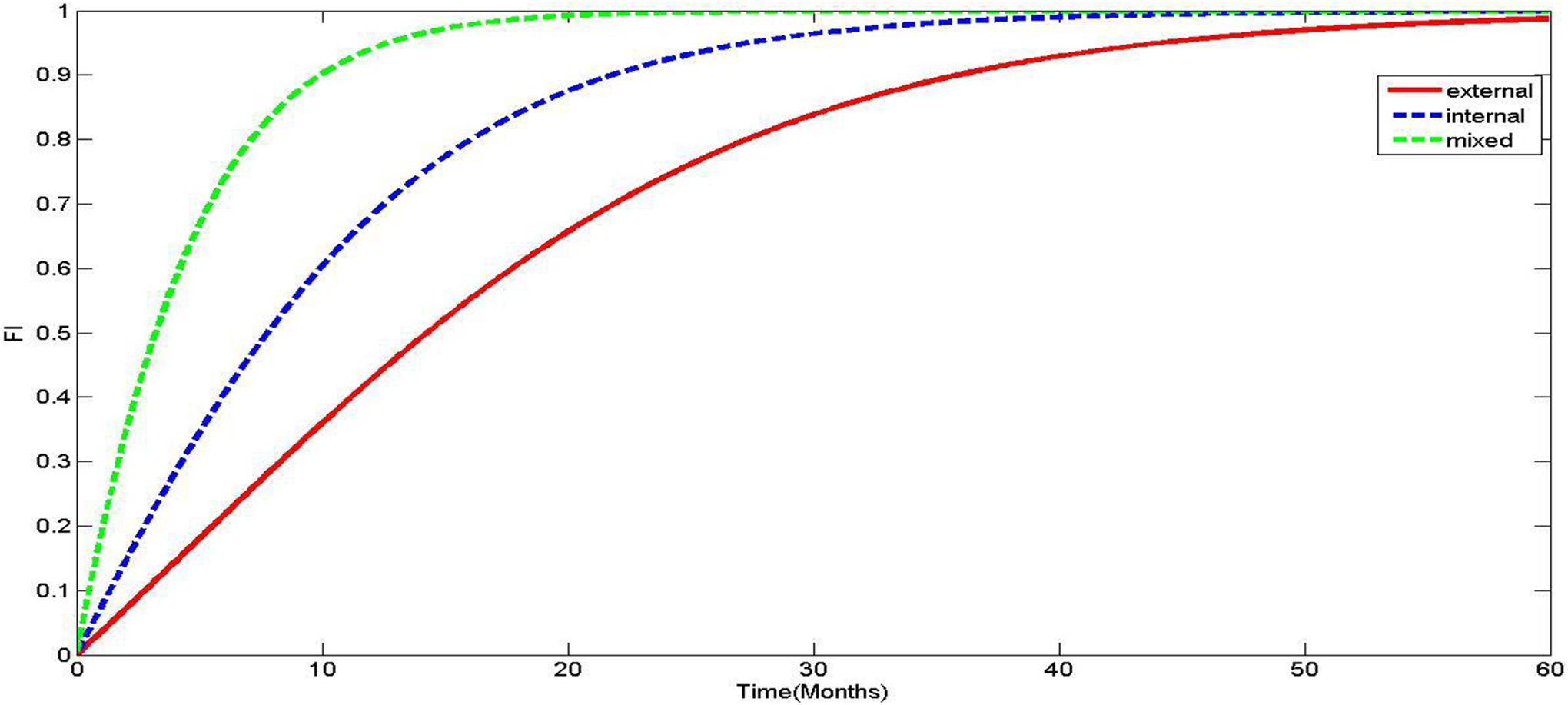
Fractional analysis of human capital acquisition.
The fractional analysis indicates that a combined effect of internal and external injection of knowledge into the network sees entrants acquiring the required knowledge and work world skills in a relatively shorter time (18 months—thus 1.5 years) than in the two cases of internal and external only.
Given the typical situations of financial constraints in developing countries, where choices are inevitable between the internal and external forces, the study continued to assess among these factors the relative impact of each and the duration of time needed under each condition to optimize knowledge acquisition. Figure 11 revealed that between the internal and external influences, the internal dynamics of an organizations in terms of training and development programs, rate of training, internal networking policies, organizational work culture, and collaborative work practices, among others have relatively faster rate of aiding new employees to acquire and retain requisite work world skills and knowledge. Within a relatively shorter period of 36 months thus 3 years, the new entrants acquire a steady state where they are now in the position to infect others in the network holding all external forces constant. However, in the case of holding all internal influences at zero (0), it takes a relatively longer period (60 months thus 5 years) for a new entrant to acquire a steady state in the institution in relations to work world skill and knowledge where he or she can influence other employees for a competitive advantage within the network. Obviously, strengthening the internal dynamics of influence on human capital acquisition is an option where constraints limit the implementation of both forces for competitive advantage.
We again looked at the patterns of injection of forces both internal and external and its relative impact on human capital acquisition. A comparative analysis of the continuous and discrete conditions of injection of knowledge into the new employees is presented in Figure 12. It is clear from Figure 12 that new employees acquire human capital faster on continuous conditions than on discrete conditions. From Figure 12, both discrete injection and continuous injection of human capital through training, development, and social network channels have an impact on the acquisition of human capital at different rates with the continuous rate increasing the probabilities of fast acquisition. Supportably, a continuous pattern of information flow (constant training and development programs) sees new entrants achieving full status (acquired susceptibility and infectious status) within 36 months of engagement within the institution while it takes a longer period, 72 months thus 6 years in a discrete situation where training and development programs come intermittently. Deductively, even and continuous impact of knowledge and skills through both on the job and off the job training schemes of institutions commensurate institutional quest of gaining competitive advantage within the network space. A note has to be made of the relatively slow pace of acquiring the same steady state in discrete situations where institutions do not organize both on the job and off the job training on a timely basis for their workers. The role of institutions in acquiring competitive advantage lies in raising an innovatively stable and influential staff that is equipped and innovative enough to ensure the sustainability of the current niche of the organization in the competitive industrial space.

Discrete and continuous HC. HC: human capital.
Conclusion
Human capital acquisition in the current knowledge-based economy is inevitably and unarguably the most stable and relatively secured source of competitive advantage among institutions. The relative time of imitation of this particular resource requires organizations to invest their competitive advantage in it. We investigated the probabilities of acquisition of requisite human capital by new entrants in an institutional network. Graph theories applied in complex social networks using multi-attribute decision models were employed for our study. We coupled the dynamical and complexities of social network analysis with the BASS-SIR epidemiological model to ascertain sustainability in the light of internal and external forces in the human capital acquisition. We assessed the probabilities of acquiring infectious, susceptible, and recovery statuses. Again, our study investigated the impact of the injection rate of information on the three states by decomposing the SIR state at relatively different rates. Further, we run a fractional analysis to ascertain the decomposed effect of internal and external influence on human capital acquisition and finally a discrete and continuous analysis of the pattern of training influence on human capital acquisition in a competitive network.
Our study revealed that the existing professional network within the banking sector of Ghana is infused with a knowledge index reflected by the average information centrality index of 2.59. The results show that upon joining the network, the new entrant’s ability to acquire and or transfer knowledge within the network increases rapidly and reaches a steady state by the third month. The decaying state of the knowledge loss (recovery) shows that the system has a strong probability of providing the requisite conditions for the new entrants to retain knowledge. However, if the rate of information flow is low, the “decaying state” is hit within a relatively shorter time. The fractional analysis indicated that a combined effect of internal and external injection of knowledge into the network sees new entrants acquiring the required knowledge and work world skills in a relatively shorter time. With the internal forces only, a steady state is achieved in a relatively shorter period than that of external forces only. Finally, the discrete and continuous analyses revealed that relatively even and continuous patterns of information flow reduces the time of reaching a stable state of human capital.
Implication for policies
Our study makes the following recommendations for policies in the light of the findings.
Institutions should ensure managerial training is done in relatively even and continuous patterns to attain a relatively fast and stable competitive advantage. Thus, the patterns of training are as important as the training itself. The relative time of catching up with innovative ideas is important in maintaining and improving upon competitive advantage. This is reminiscent of strongly innovative and competitively driven networks. In developing countries where financial institutions compete strongly with both indigenous and multinationals to obtain a competitive advantage in resource-strapped populations, frequent training ensures or assures early innovation and knowledge retention among workers. This is a critical factor in attaining competitive advantage in such competitive networks. We again recommend that a higher rate of information flow (unimpeded exchange of know-how) into the network is a sure sign of acquiring the requisite human capital for an innovative and sustainable competitive advantage. Based on the findings, in-service training, on-and-off-the-job training systems, and collaborative work practices should be promoted and enforced by policies for the institution’s growth and development within the competitively relevant time frame. Again, we recommend institutions adapt total training policies thus both internal and external training systems. However, organizations should be encouraged to increase their internal human capital transformation drives. Internal training and development programs give organizations the unique skills that offer them a competitive advantage that is normally not attained in the external training systems as well as networks. Real-time experiences that lead to innovations are normally acquired through internal training mechanisms. Training systems like coaching, job rotation, apprenticeship, and internships should be emphasized for organizational competitive advantage.
Footnotes
Acknowledgment
The authors are very grateful to the National Science Foundation of China for the financial support.
Declaration of conflicting interests
The author(s) declared no potential conflicts of interest with respect to the research, authorship, and/or publication of this article.
Funding
The author(s) disclosed receipt of the following financial support for the research, authorship, and/or publication of this article: This work was supported by the National Science Foundation of China under Grant Number 71371087.
