



Abstract
The concept of corporate social responsibility (CSR) has been embedded across psychological and physical frontiers of organizations building up on philanthropy, ethics, regulation, and economy. However, there is a lack of empirical evidence that how CSR gears up various aspects of an organization. The major objective of the present study is to explain the multidimensional catalytic role of CSR in transforming brand equity from brand reputation in the fast-food industry. The study has been designed to get responses through a structured questionnaire to analyze the data through descriptive and inferential statistical techniques. Sample size of 420 consumers and employees of international fast-food chains, located in Pakistan, with diverse demographical profiles have been involved for the survey. Three models were developed to understand the aforementioned phenomenon; the first model examines the impact of brand reputation on brand equity, and the second model reassesses the same relationship with moderating role of CSR, while the third model evaluates the associations with each dimension of CSR. The results indicate that brand reputation is a significant predictor of brand equity, and its predictive power boosts up in the presence of CSR activities. It was also ascertained that CSR initiatives related to ethics, economy, and philanthropy expedite the process of conversion from brand reputation to brand equity. The legal aspect of CSR in developing economies could not prove to be fruitful in this particular context. The research would provide great insight to the managers of fast-food retail chains to evaluate investments for CSR activities in raising equity of their organizations.
Keywords
Introduction
The world has become a global village, and every renowned global brand has marked its existence at almost every frontier of states in diverse domains such as manufacturing, logistics, selling, and consumption. Therefore, stakeholders of each global brand are affected by the management of their competitors. 1 –3 Corporate social responsibility (CSR) can be used as a competitive advantage for any brand. This social responsibility of an organization starts where law of the land ends. 4 Companies spend billions in social responsibility initiatives such as cause-related marketing (CRM), philanthropic minority aid initiatives, in a move to build good corporate reputation. 5 This happens because consumer purchase intention is influenced 60% by perception of the company as against 40% perception about products. 6 Moreover, the same study shows that interestingly 42% image of a company is stemmed from its CSR activities. Now, if this is the case, some questions arise, for example, how CSR activities are linked up with corporation reputation? How can it be transformed into equity of that company? And which aspect of CSR is dominant in transforming reputation into equity? However, so far most of the studies have investigated the overall impact of CSR on the performance of organizations without considering its specific elements. 7 How each of the four aspects affect corporation is still scarce. 8 Therefore, future studies need to link the influence of each dimension of CSR (economic, legal, ethical, and philanthropic) on corporate brand outcomes to analyze their comparative effects. 7
Carroll 9 emphasized that corporation should progress on both economic and social frontiers. He divided the social responsibilities into four categories: economic, legal, ethical, and philanthropic. Legal aspect of CSR is to comply with the laws and regulations of the land including environmental, consumer protection, and safety laws to demonstrate responsible behavior. Ethical element of CSR is related to actions that are permissible or forbidden in the organization without any binding by the law. Philanthropic dimension of CSR calls for companies to donate to the society in uplifting the quality of life. Economic attribute of CSR refers to the fair distribution of scarce resources to produce goods and services.
CSR, as a strategy, influences the performance of a firm in general perspective, and particularly it is expected to jack up equity of a brand. In the past, it was considered a measure of improving the quality of life of a society by being socially responsible about different aspects of society like hunger, poverty, environment, and work life of employees. But now it has gained a vital importance and become a competitive advantage for the companies. It helps build equity of a brand by creating positive image in the mind of consumers. 10 CSR has also been observed as an added strategy to enhance the profitability and boost the development of companies. This phenomenon is understandable thanks to increased customers’ awareness regarding products and practices beneficial to the environment and society. Therefore, CSR has been considered as an important pillar in shaping behavior, strategies, and objectives of corporations. According to a research by McWilliams et al., 11 the relationship between companies and society is based on a social contract that evolves with social changes and resulting expectations of the society. In this way, a company legitimizes its existence, recognizes its activities and obligations, as well as establishes legal limits for its performance. With changes taking place in the 21st century, transformation into the social and business context has become necessary where organizations have come to realize that it is necessary to assume responsibilities in order to meet new requirements. McWilliams et al. 11 determine that corporate responsibility, as a strategy of differentiation, is used to generate new demands and obtain premium price for a product or service. Some consumers want products they buy to show certain attributes of responsibility (product innovation) while others value products that are created in a responsible way (process innovation). This strategy consists of creating activities for a company and striving to add value to its products and services. 12 In this manner, the company builds unique offer throughout the market by offering products and services with distinct features valued by their customers. It is important to note that this difference might be created in various ways such as through design of a product, brand image, application of technology, after-sales service and system distribution.
The literature also identifies brand reputation as one of the most influential resources of a firm with respect to value creation. 13 Collectively, major issue for stakeholders is whether a certain brand will meet the desired expectations or not. 14 Feedback from particular market and industry is vital information for the key stakeholders to determine the core reputation of a brand. 15,16 Social media has helped in providing information to the 21st century’s consumers, thus allowing the customer to find out everything about a product or service. Another organizational asset called as brand equity is increasingly becoming associated with the reputation of a company. 17 The study of brands and equity for corporations is gaining relevance because strengthening brand equity could represent an increase in the productivity of marketing investment. 18 People would understand brands by observing their manifestations, that is, the more coherent and consistent they are with their initial proposal, the more they would enable the consumer to understand brand design. 15 Thus, reputation of a brand is extremely important to build brand equity but still this relationship requires a moderator that can influence this relationship positively, and here comes CSR. 19 CSR activities and actions result in increased reputation and image of a company to finally transform into brand equity. 20 Therefore, both CSR and brand equity are very much aligned in the contemporary organizational setting. Large multinational organizations have now recognized the fact that without being socially responsible, and without addressing the social needs of a society, it is difficult to build customers’ brand. But it is also of great importance here that companies only behave socially responsible where they find some potential market for their businesses to grow. 21
Pakistani organizations, particularly multinational corporations, are providing social services to the society. Fast-food industry tycoons McDonald’s and Kentucky Fried Chicken (KFC) are the globally leading fast-food retailers with thousands of locations and millions of daily customers. Their retail chain managers are continuously striving to establish socially responsible corporations. They extraordinarily focus on CSR activities formulating their policies and management strategy in view of global movements for green environment. This study would contextualize CSR effects of two big fast-food retail chains in building brand equity in Pakistan where CSR phenomenon is progressing in its nascent phase. In this context, the present study has focused on the relationship between brand reputation and brand equity by exploring the moderating effect of CSR with respect to economical, ethical, legal, and philanthropic aspects on fast-food retail chains of Pakistan. The study would provide great insight to the managers of fast-food retail chains to evaluate investments for CSR activities in raising equity of their organizations.
Literature review and hypotheses development
CSR has attracted a growing interest from business research scholars over the past couple of decades. The term CSR became important when the stakeholders were given more rights and importance in the business world. Extensive research studies argue that CSR has been used previously as an afterthought, when in the 1980s the business plus social areas of interests became parallel to each other to serve the stakeholders. Later, the concept of CSR evolved, and after two decades it was considered to be instrumental in all strategic decision-makings in a business. 22 Jones et al. 23 have summarized the work of previous studies to describe the relationships of CSR practices with different corporate performance indicators. A study by Garberg and Fombrun 24 shows that CSR activities are stimulants for increasing brand reputation in the minds of customers, thus making it an investment of strategic nature that can be viewed as a form of reputation building. The existing literature also points out that companies which are accountable in the social context can easily gain competitive benefit and, thus, enhance their financial performance. Stanwick and Stanwick 25 noted that there is an optimal level of CSR where managers in the organizations control an economic view of benefits versus costs.
CSR phenomenon connected to benefits can be supported through resource-based perspectives (RBPs). 11 RBP explains the association between internal characteristics and performance of organization and provides a reference point to describe the reason for being involved in CSR activities. Organizations preserve those resources which are vital to convert inputs to outputs in manufacturing and services. 26 Thus, according to RBP, an organization reaps sustainable competitive advantage by regulating and maneuvering the resources. 27 The scarce intangible resources such as corporate reputation and culture bring about economic performance. In this regard, moral capital as an intangible resource is the product of an organization’s philanthropic or ethical activities, constituting the notion of CSR based on RBP. 28 If CSR is based upon moral capital, the consumers’ skepticism can be avoided because they are keener to know why a company is involved in these activities rather than what it is doing. 29 Thus, based upon RBP, moral values of a company can enable it to create and transform good reputation into equity (monetary value).
Corporate reputation and corporate equity
A corporation’s reputation as a socially responsible entity is a favorable component in establishing brand equity. 30 A company’s good reputation is a valuable strategic asset that helps differentiate it from the competitors. 31 A company may charge premium if it possesses competitive advantage in terms of superior brand reputation. 32 A well-reputed company attracts more qualified personnel and that, in turn, brings about valuable transactions from customers. 31 Corporate reputation plays a vital role in the success and in being a profitable brand in almost every industry and business. On the other hand, McWilliams et al. 11 explain that social engagement activities can enhance the cooperative culture that would increase its know-hows and contribute to its reputation. In this way, firms can develop true and sustainable presence including the sustainable bionetwork for the organization. 32 However, the image of a company is consolidated only if the identity is well founded. Moreover, it is not easy to build image of a brand in the market. This happens little by little, and when done rightly, results in reputation or you can say positive reputation. Being remembered as a trusted brand is the best achievement a business can have. The path between “who we are” and “how we are viewed” will always be loaded with reinterpretations, and it is up to us as professionals to seek alternatives to make the process of meaning clearer and more understandable. 33 Academic and managerial schools of thought jointly agree on the aspect that positive reputation results in a profitable brand, and it serves as a competitive advantage in the industry. 34 When it comes to building reputation, one must understand that it is a long process that takes decades to complete, and all stakeholders contribute equally in developing long-term reputation of a brand. Brand reputation can also be created as a result of certain activities including being philanthropic or producing best quality whether in case of products or services. The literature highlights brand reputation to be linked with the organization’s integrity, or in other words, corporate reputation is a reaction of stakeholders to organization’s strong, weak, or poor actions. 5,15
Similarly, brand equity is the worth of a brand in the market, and therefore, a high equity brand has high value in the market. This seems to be a subjective concept with several definitions such as by Sarstedt, 35 which states that it is overall estimation in which a company is held by its constituents. However, this concept is not fully or clearly understood. 36 A brand is not just a name or symbol 37 but it also has a capability to produce value, which is called as brand equity in the business world. 10,38 Brand equity is, in fact, a collection of brand assets, liabilities, its name and symbol that is added or deducted from the value provided by a product or service to its customers. 10 It can also be defined as the differential effect of brand knowledge on consumer reaction to the promotion of the brand. In the marketing industry, brand equity is a phrase which explains about value of having brand name based on the idea that owner of a brand can generate revenue from brand recognition. Brand equity refers to the brand value that has two different perspectives related to economics and cognitive psychology. 39 Brand loyalty is a part of the overall brand equity where the extent of the brand power is determined by positive or negative knowledge of consumers, which includes their experiences and perceptions with the brand. 34 In the views of Buil 40 and Cho, 41 brand equity constitutes brand image of the companies and loyalty for their customers. On the other hand, according to marketing researchers, brands are the most valuable assets for an organization that can enhance the brand financial value to the brand owner. 42 Hence, brand equity is generated through strategic investments, economic growth in market share, critical association, and prestige value. 43,44 It is important to emphasize that the customer buys the product for quality and the brand for empathy. The company, in turn, is in charge of providing a set of values that add value to the product while selling its image. Therefore, the ideal image of a brand must follow a composite view, that is, convey trust, quality, responsibility, and ethics. 38 Thus, the differentiation can take place in the positioning strategy in a socially responsible manner.
Thus, the following hypothesis can be proposed:
CSR as moderator between brand reputation and equity
According to daisy-wheel model of brand equities by Jones, 21 the brand equity is linked with its stakeholders’ fulfilled expectations. One of the most important expectations is socially responsible behavior. Companies have used CSR as a strategic tool to meet the expectations of various stakeholders such as NGOs, consumers, and media. 45 Hence, CSR and corporate reputation of a company help build affective perception of a higher brand leading to develop equity. 5
The consumers pay more value to the company’s identity if it is aligned with their own belief system. 46 According to Bhattacharya and Sen, 47 consumers tend to associate themselves with a brand’s CSR initiatives toward broader community in addition to their consumption experience. The perception about CSR activities of a company has a positive impact on consumers who are sensitive to social concerns. 48 CSR activities also imply that the particular company possesses enhanced competencies to produce superior quality products. 49 A study by Hur et al. 50 provided evidence that CSR is directly influencing the brand equity of a company positively. Thus, CSR’s positive aura has become even more prominent for all kinds of companies. Furthermore, abiding by the rules of CSR, especially in the world connected through the Internet 24/7, is crucial in competing and sustaining a good reputation. Equity of a brand today is no longer constant, and can decline or increase within a short span of time, thus making CSR even more important to the businesses and their shareholders than ever. 29 The power of destroying or building a business now relies on the stakeholders including customers and employees. Among the prominent stakeholders, customers are given priority today by all companies. Customers build the brand equity of a socially responsible company by enhancing its future profits and goodwill. Therefore, CSR activities are modes for companies to increase their reputation, and thus affecting the brand equity as a result. 21 This is because CSR activities are the ones which “go beyond the legal obligations,” thus showing that the company cares more than just profits. CSR activities which act as a moderator in this study cover different aspects of CSR in general such as “sponsorship, CRM, and philanthropy.” 51 CRM includes an organization’s guarantee to give a specific amount of cash to a philanthropic association or to a social agenda when shoppers buy the organization’s items/services. In one study, almost half of the respondents claimed that they will happily move to another brand because of a “cause.” 52
The different aspects of CSR (legal, ethical, philanthropic, and economic) affect customer evaluations in the restaurant industry. 53 Since paying back to the society in the form of philanthropic activities such as donations and community’s well-being creates corporation’s positive image, therefore, restaurant managers should support CSR activities to contribute to the enduring success. 54
Based upon the foregoing discussion, the following hypotheses are being proposed:
The above discussion highlights the importance of CSR activities as a survival strategy for corporate giants in the current business era as well as its impact on a firm’s perception, image, and identity. Although brand reputation has been seen to influence brand equity directly, however, this research tends to find whether CSR can act as a moderator to enhance the influence of brand reputation on brand equity. So far, much research considered the organizational behavior and business’ profit maximization relation with the CSR in the management domain. 17 Here the research is trying to extend the literature by focusing on CSR in terms of economic, philanthropic, ethical, and legal perspectives in marketing domain in general and consumer behavior in particular as shown in Figures 1 and 2.

Conceptual framework.
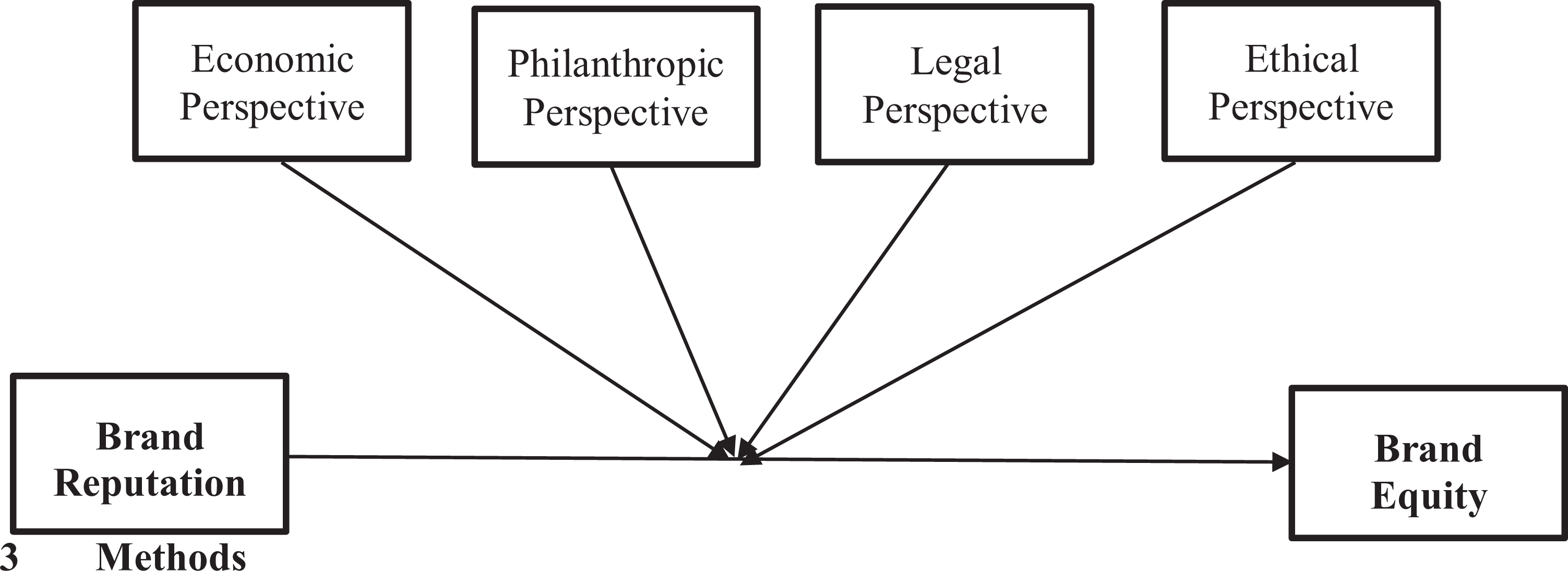
Extended research framework.
Methods
Participants and procedure
This research study employed quantitative deductive approach to test the moderating effect of CSR on the brand reputation and brand equity by using hypotheses development process. The study is empirical and non-contrived where the data have been collected through structured questionnaire without changing the environment. A reliable sample is one which concretely represents its population. As this research is specifically about the fast-food industry, the sample must be among those cities where most fast-food companies are operating. The participants belonged to the biggest fast-food chains, McDonald’s and KFC. A screening question was asked to the respondents, “Which fast-food restaurant have you visited in last 3 months?” If they marked the checkbox of either McDonald’s or KFC, then they answered rest of the questionnaire. Twenty-four questionnaires out of 454 received were excluded due to missing information. Hence, the sample size selected was 420 comprising fast-food restaurants’ stakeholders including customers and employees with equal proportion particularly from Lahore region on convenient basis. If we look at the demographic statistics of the respondent as shown in Table 1, it is evident that maximum representation is from the age group of 18–30 years in the sample, which is 82.4% of the entire sample. So, we can say that younger generation in Pakistan is more inclined toward fast-food restaurants. Moreover, according to bureau of statistics of Pakistan, youth comprises almost 58% of entire population of the country, therefore their opinion matters a lot.
Demographics of the respondents.

Measures
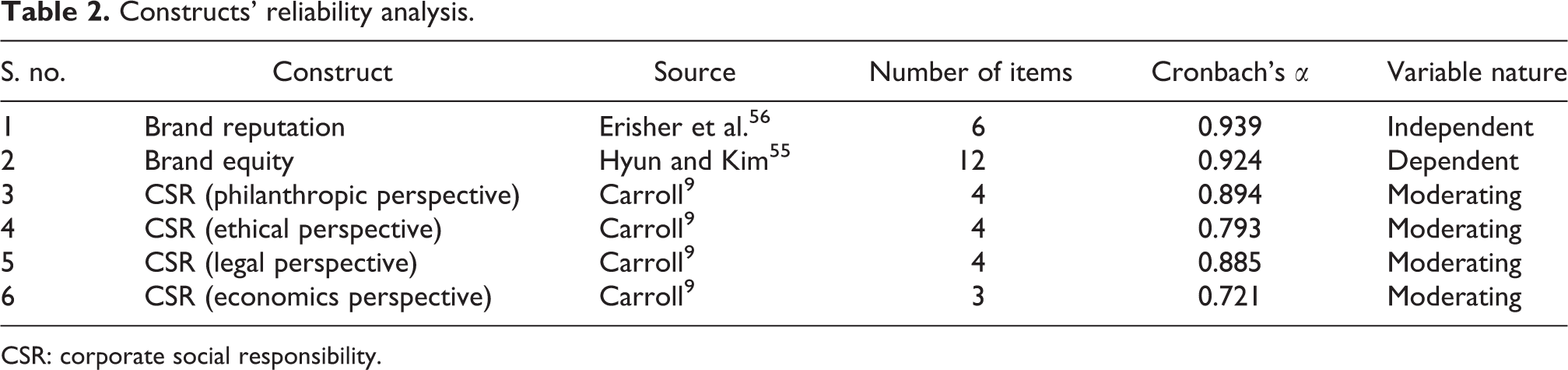
Established scales were used to measure constructs on a five-point Likert-type scale. The constructs in the study include brand reputation, brand equity, and CSR with its perspectives on philanthropic, ethics, legal, and economical as shown with their sources in Table 2. Fifteen items based on Carroll’s 9 four dimensions were taken to measure CSR perception of the customer. Twelve items were adopted from Hyun and Kim 55 to measure brand equity. Six items from Erisher et al. 56 were used to measure brand reputation.
Constructs’ reliability analysis.
CSR: corporate social responsibility.
Results
Reliability test
The reliability test is employed with the intention to measure scale reliability. In reliability analysis, coefficient α measures internal consistency and demonstrates how closely is the set of items are.
Reliability in the form of Cronbach’s α for all the constructs was checked through SPSS (version 26) as shown in Table 2. By looking at the values, we can say that compiled data are reliable enough to perform statistical tests. The reliability coefficient for brand reputation is 0.939, which is reliable enough to be pursued for statistical tests. Brand equity coefficient has reliability test value of 0.939 demonstrating that the variable is reliable enough to proceed the analysis. CSR is being used as a moderating variable and its four dimensions have been analyzed. All four of its dimensions such as philanthropic perspective, ethical perspective, legal perspective, and economic perspective are reliable enough as per the statistical values of 0.894, 0.793, 0.885, and 0.721, respectively.
Descriptive statistics
Table 3 reveals that mean values of all variables under study range from 3.3 to 3.9, which show that maximum number of respondents agree from the scale being used. Skewness and kurtosis values indicate the normality of data and they have a certain range for data to be claimed as normally distributed. The values of skewness and kurtosis must fall between −1.96 and +1.96, so if we look at Table 3, the values lie exactly within this boundary limits. Therefore, we can assume that our data are normally distributed and can be used further for statistical testing.
Descriptive statistics.

CSR: corporate social responsibility.
Confirmatory factor analysis
In order to analyze the characteristics of the instrument employed, confirmatory factor analysis (CFA) was performed with the help of AMOS 22. Furthermore, convergent and discriminant validities were calculated based upon outputs received from the CFA analysis. The measurement model specified has shown better fit to the data of all loading items (i.e. chi-square per degree of freedom ratio (χ 2/df) = 1.982, incremental fit index = 0.951, Tucker–Lewis index = 0.945, comparative fit index = 0.95, and root mean square error of approximation (RMSEA) = 0.048). The convergent validity was established because all factor loadings crossed the threshold value of 0.7, and average variance extracted (AVE) was found to be >0.5 as shown in Table 4 and Figure 3. The discriminant validity is set up if square root of AVE of each construct is greater than its correlations with other constructs. The results of Table 4 confirm discriminant validity because they meet the set criteria.
Square root of AVE and correlations between constructs.a

AVE: average variance extracted; CSR: corporate social responsibility.
a Diagonal elements (in bold) are the square roots of AVE whereas off-diagonal elements are the correlations between constructs.
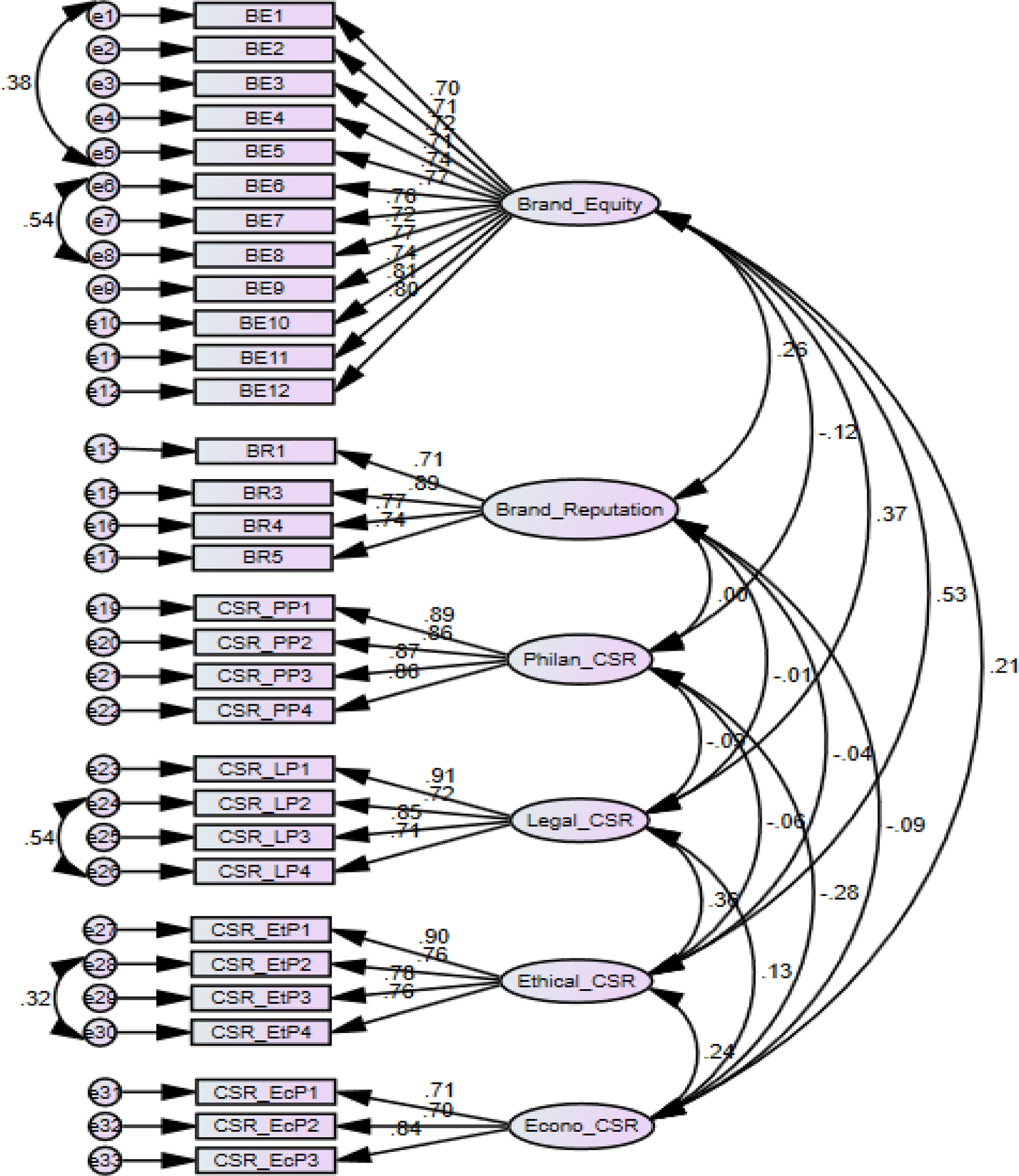
Confirmatory factor analysis.
Regression analysis
The regression analysis employed in this research study predicted the value of a variable based on another variable value as described below.
Table 5 shows regression analysis for the selected variables of this particular study in which independent variable is brand reputation and dependent variable is brand equity. There is a positive and significant impact of brand reputation on brand equity. The predictive power (R 2) of the model is 39% which is not very high, but as per p value, this prediction is significant. Low R 2 value is fairly justified if the relationship is significant. It means that there are some other variables (other than brand reputation) which also predict the dependent variable (brand equity). The magnitude (β) of our model, or in other words, change in brand equity due to brand reputation, is around 37%. This relationship can also be explained in an equation as given below for further understanding of the current relationship

Model (I): Impact of brand reputation on brand equity.a

a Dependent variable: BE. R 2 = 0.39. F = 29.508, SE = 0.596.
b Significant at p < 0.05.
Moderation analysis
In this particular setting, CSR has been taken as a moderator between brand reputation and brand equity. In order to proceed moderator analysis, an interaction term was formed after centering of variables. Then regression analysis, consisting of both centered variables and the interaction term, was carried out, and resulted in significant moderation (p = 0.049) as shown in Table 6. It implies that CSR significantly and positively moderates the relationship between brand reputation and brand equity.One of the important dimensions of CSR is what company thinks about its employees and how it treats them at workplace. Work–life balance, educational opportunities, counseling, and career growth are some of the aspects that need to be considered by the company about its employees. This particular dimension of CSR talks about employees’ perspective and data were collected from the employees as well because they are the internal customers of a company. It is evident from Table 7 that philanthropic perspective of CSR significantly and positively moderates the relationship between brand reputation and brand equity in the fast-food industry of Pakistan.
Model (II): Impact of brand reputation on brand equity—moderating role of CSR.a

CSR: corporate social responsibility.
a R 2 = 0.51. F = 27.04.
b Significant at p < 0.05.
Model (III): Impact of brand reputation on brand equity—moderating role of dimensions of CSR.a

CSR: corporate social responsibility.
a R 2 = 0.30. F = 11.452.
b Significant at p < 0.05.
Ethical perspective relates to the customers of fast-food restaurants with regard to providing authentic piece of information about its company and products. It also means to provide hygienic food, consider customers’ opinion as the most important part of feedback. A company tries to satisfy customers with its actions and traditions to prove itself a socially responsible entity. The results from Table 7 show that ethical perspective of CSR significantly and positively moderates the relationship between brand reputation and brand equity.
Legal perspective of CSR relates to legal bindings of a company operating in a specific country with respect to its prevailing laws and regulations to run business legally and in a legitimate way. In other words, it talks about whether a particular fast-food company is performing its business operations including financial matters according to law of the land. Moreover, being a socially responsible company, whether the company is providing enough employment opportunities in accordance with its expansion and business model. So, data were collected for this dimension as well, and it surprisingly did not reflect in a usual way. It did not statistically enhance the relationship between brand reputation and brand equity due to localized conditions.
Lastly, economic perspective of CSR relates with environment-friendly investments for the betterment of future generations of a particular society where the company is operating. Conducting special campaigns regarding environment protection, sponsoring events in which general public participates in achieving plantation targets, investing in programs and institutions which positively influence the growth of future generations, provoking a healthy competition among different fast-food restaurants, and so on. As is evident from Table 7, economic perspective of CSR significantly moderated the relationship of brand reputation and brand equity as per collected data from customers.
If we assemble all this information in an equation, it becomes as

where BE is brand equity, BR is brand reputation, CSRPP indicates CSR (philanthropic perspective), CSREP indicates CSR (ethical perspective), CSRLP indicates CSR (legal perspective), and CSRECP indicates CSR (economics perspective).
Discussion
Past studies indicated CSR as the determinant of building equity. 10,21,33 This empirical study is the extension of work to examine the specific role of each dimension of CSR. The study revealed that CSR initiatives have positive catalytic effect between brand reputation and brand equity. According to the outcomes, it has also been identified that brand reputation has significant impact on brand equity in the fast-food industry. The predictor and moderator in this relationship managed to predict about 39% of the dependent variable (brand equity), and the relationship is significant according to p value of regression analysis. In other words, outcomes of regression analysis indicated that 39% of the variance in brand equity can be explained by brand reputation, and social responsibilities such as philanthropic, ethical, and economic.
Hypothesis 1 of the study states that brand reputation positively influences the brand equity of fast-food companies. This hypothesis has been supported (β = 0.369, p = 0.000) in the local context. It means a well-reputed company brings about valuable transactions from customers. 31 In this way, firms can develop true and sustainable presence including the sustainable bionetwork for the organization. 25 Academic and managerial schools of thought jointly agree on the aspect that positive reputation results in a profitable brand, and it serves as a competitive advantage in the industry. 34 The literature highlights that brand reputation is linked with the organization’s integrity. 5,15
The literature also suggests that CSR is directly associated with brand equity and is considered as one of the important aspects to transform brand reputation into brand equity. 55 This is in line with hypothesis 2 that predicts that CSR activities positively moderate the relationship between brand reputation and brand equity in the fast-food industry. This hypothesis has been supported as well (β = 0.151, p = 0.049). Furthermore, CSR and corporate reputation of a company help build affective perception of a higher brand leading to develop equity. 44 The perception about CSR activities of a company has a positive impact on consumers who are sensitive to social concerns. 38 CSR activities also imply that the particular company possesses enhanced competencies to produce superior quality products. 49 A study by Hur et al. 50 provided evidence that CSR is directly influencing the brand equity of a company positively. Thus, CSR activities are modes for companies to increase their reputation, and thus affecting the brand equity as a result. 42 This is because CSR activities are the ones which “go beyond the legal obligations,” thus showing that the company cares more than just profits. 51
The study’s hypotheses 3–6 predict that four CSR perspectives positively moderate the relationship between brand reputation and brand equity in the fast-food industry. Among the four dimensions of CSR, three significantly moderated the relationship between brand reputation and brand equity. These three dimensions with significant results are ethical, economic, and philanthropic perspectives. Their β values are 0.150, 0.141, and 0.156 (p < 0.05, for all), respectively, implying that the most important aspect of CSR in building brand equity from brand reputation is philanthropic followed by economic and ethical as stated by the respondents. These findings are consistent with the previous studies (e.g. Esen, 5 Azham and Ahmad, 31 and Hur et al. 50 ) that have emphasized the importance of these aspects for equity building. The different aspects of CSR affect customer evaluations in the restaurant industry. 53 The philanthropic CSR has the highest impact to strengthen the brand equity, perhaps because it reflects what the society expects. 52 Since paying back to the society in the form of philanthropic activities such as donations and community’s well-being creates corporation’s positive image, therefore, restaurant managers should support CSR activities to contribute to the enduring success. 54 The consumers also closely watch organization’s economic and production activities and expect it to share profits with the society. The stakeholders use this obligation as a measure to assess a brand. 14
The legal aspect of CSR in a country like Pakistan did not show a constructive role to translate brand reputation into brand equity. The customers of McDonald’s and KFC did not show their concerns about this aspect, because these are judged against the set food standards, regulations, and laws considering them as compulsion rather than a choice. 16 This could also be attributed to the localized perception of the respondents in particular, and the overall weak legal structures of developing economies in general. It could also mean that social and interpersonal facets of CSR appear to be important cues than the legal aspect to transform brand reputation into brand equity. However, ethical responsibilities, depending upon the acceptance of customers, are difficult to define and measure, but once established, consumers may associate themselves with a particular brand. 21
Contribution to theory
In an attempt to investigate the moderating effect of CSR between brand reputation and brand equity, the empirical results and theoretical concepts contribute to the literature. The study considered the effects of dimensions instead of the current approach that mostly regard CSR at aggregate level in an effort of equity formation in food service organizations. Applying a thorough perspective of CSR makes a contribution to the body of knowledge of marketing.
The research study creates a link between brand reputation and its equity with moderating dimension role of CSR. The study contributes to the marketing psychology literature in a number of ways. Even though CSR is acknowledged as an effective method in marketing campaigns, there are limited studies that explore the individual effect of each dimension of CSR. Chen et al. 8 have suggested to further explore the role of each dimension in different cultures. Since RBP provides better understanding about the effect of corporate’s CSR activities on financial performance, 27 this study extended this approach to add to the body of knowledge by exploring the impact of all aspects of CSR (philanthropic, economic, legal, and ethical) in creating corporate reputation for equity in food service industry. The contribution of the subject in multinational fast-food companies operating in local context of Pakistan is itself a unique feature. The respondents partially perceived CSR to foster brand equity from brand reputation. All dimensions of CSR except legal perspective are significantly moderating the relationship. The legal aspect of CSR activities is considered to be corporation’s duty instead of voluntary action. 51
Legal CSR activities are regarded as a company’s obligation rather than optional. The philanthropic perspective has the highest effect on the relationship according to the attitudinal responses. This study also corroborates with the previous studies 8 in nonsignificant finding of legal aspect of CSR in respondents’ perspectives. The reason for economic aspect being significantly moderating the relation could be attributed to the local economic deteriorating conditions of the masses. The respondents expect these multinational organizations to show corporate citizenship behavior by contributing in job creation, improving quality of life, and investing in other economic developments.
Implications for practice
The research has raised some important issues concerning the significance of results. The majority of Pakistani respondents have affirmative viewpoint toward CSR expecting it essential for fast-food companies to help CSR initiatives. The results of the present study have implications for CSR managers to enhance their performance by investing marketing resources in CSR initiatives. The study revealed that consumers perceive those organizations auspicious in terms of long-term success which are involved to solve certain social issues. The organizations that involve in social causes would achieve a positive word of mouth, more trustworthy with reference to brand reputation and equity, and acceptability to function in local markets as compared to socially irresponsible companies.
According to the outcomes, it has also been identified that brand reputation has significant impact on brand equity in the fast-food industry implying that marketing managers would continue to provide great role for promoting brand image. It is identified that majority of customers tend to visit fast-food restaurants with high brand reputation, and when the aspect of CSR is added in their experience with that particular brand, it enhances brand equity in the mind of the customers. Therefore, it is self-evident from the research that customers tend to become more loyal and habitual about brands with high involvement with CSR.
CSR dimensions are distinct and need diverse kind of skills and resources to implement them.
According to the response of participants on attitudinal scale, the brand equity has been fostered partly. According to these findings, the most effective dimensions are philanthropic, ethical, economic, and legal, respectively. All dimensions of CSR except legal aspect positively moderated the relationship to form brand equity. It could be construed that customers of McDonald’s and KFC are not abreast of their legal activities related to CSR. So, it is essential to channelize fast-food’s marketing programs to publicize legal aspects through in-store bulletin and websites. On the other hand, marketers should devise plans and formulate strategies by considering all significant dimensions of CSR. The brand managers and practitioners would be able to adjust worth of the companies by considering only the most efficient dimensions.
The findings of this study would help managers devise an optimal CSR strategy to develop superior corporate strategy. The market managers should be aware of the benefits of a socially responsible company. They should also engage other employees in social activities so that they may become associated with the objectives and make the efforts consistent and reliable over time. They should then devise publicity program to let customers aware of their CSR activities. As a result, it would create a better perception of products and services in the customers’ view.
Conclusion
Firms can no longer see their performance as a simple act of marketing products or services. In the highly competitive contemporary market, brands must exceed customer expectations to make shopping experience memorable. The motive of this particular research was to find out the relationship between brand reputation and brand equity in the fast-food industry of Pakistan. Further, the study was designed to investigate whether CSR plays a moderating role followed by dimensions-wise effects between them. Data were collected from customers of fast-food restaurants particularly from international chains working in Pakistan.
In this article, CSR has been administered as a composite and four-dimensional construct instead of aggregated single measure. The major objective of the study was to get an insight of how various dimensions of CSR affect the relationship of brand reputation and brand equity. A total of 454 questionnaires were distributed on convenient basis to the consumers of McDonald’s and KFC fast-food restaurants’ stakeholders including customers and employees with equal proportion particularly from Lahore region of Pakistan. A sample size of 420 was finalized for further analysis due to incomplete information in rest of the questionnaires. Both descriptive and inferential statistics were performed, and the results confirmed three out of four causal hypotheses of the study. The hypotheses related to ethical, economic, and philanthropic perspectives of CSR were accepted, while legal perspective could not be accepted based upon the results.
The results are consistent with the previous studies that have found positive relationship between brand reputation and brand equity. 25,31 The past studies are also in line with the current findings that CSR plays a greater role in enhancing the brand equity of an organization by developing good reputation. 38,49,51
The managers of the region should line up their efforts toward CSR activities directed at improving corporate social performance for the overall betterment of the organization as well as the society. The brand managers of fast-food restaurants may obtain direct benefits of enhanced brand equity by initiating CSR activities. The study has several limitations with reference to sampling technique, sample size, and geography. Future studies may be conducted to overcome these constraints, as well as add more useful variables to further enhance the predictability of the model.
Limitations and future research directions
Despite several contributions, the study has few limitations that may act as opportunities to conduct future research in this sought-after area.
The explanatory power of the model was 39%, implying that there are other variables that may be included in the model to enhance the predictability of brand equity in future models. Further research can be extended to incorporate few more variables into the model to enhance its predictive power.
The results should be interpreted with caution because this study has employed convenient sampling, thereby overestimating some demographic groups. Another limitation of the study that may have affected the results is related to sample size and location of the respondents. The future studies should be conducted utilizing some probabilistic sampling technique with large sample across different cities of the country as well as across geographical regions for the generalizability against social, cultural, political, and economic diversities in application of CSR dimensions. Similarly, the similar research model may be checked for its reliability in other related sectors, as well as to further extend the model downward for customer behavior outcomes such as purchase intention and word of mouth. Future studies may also consider the effects of religion, education, and gender on the relationships under discussion. Moreover, since CSR and brand equity are hard to grasp concepts, qualitative studies may help understand them in a better way. Another interesting aspect to study could be to investigate what happens if corporations show socially irresponsible behavior to the society.
Footnotes
Ethics statement
Ethical review and approval were not required for this study on human participants because the opinion was gathered and analyzed anonymously. Moreover, the results do not discuss exclusive opinion of a certain respondent.
Declaration of conflicting interests
The author(s) declared no potential conflicts of interest with respect to the research, authorship, and/or publication of this article.
Funding
The author(s) received no financial support for the research, authorship, and/or publication of this article.
