




Abstract
Recently, the company’s overall performance (OP) has become a major concern of our modern society, as a key factor that can potentially increase firm’s competitive advantage and ensure its sustainable development. However, OP is increasingly being considered as highly complex because of the complex interrelationships within industrial systems. This article presents a contribution to modeling of OP in order to apprehend its complexity and take into account the interactions between all its aspects. The proposed model is based on a combination of the value chain concept and System Modeling Language modeling. The main study established an OP indicators system to better present the firm sustainability behavior, and thus provide a comprehensive view that facilitates an in-depth understanding of its complexity. Besides, a case study from the dairy industry is presented to illustrate the model. This model can identify different activities’ interactions in the firm and understand interrelationships between OP dimensions and firm’s activities. Moreover, the proposed indicators system helps to define OP problems in the firm. Such knowledge enables managers to identify OP problems’ drivers, the related activities and set up the optimal solutions to improve the most critical activities whose performance affect the whole value chain.
Introduction
Over the next three decades, humanity is expected to consume about 140 billion tons of minerals, fossil fuels, and biomass per year, three times its current annual consumption. 1 Not only environmental concerns are in question, but social and human well-being is threatened by the scarcity of natural resources. Nations and their societies face a great risk because of these shortages and inequalities in access. 2 Manufacturing companies play a crucial role in this alarming trend, to be the largest contributor to environmental pollution and the responsible of more than one-third of global energy consumption, and dioxide emissions of carbon (CO2), as shown by the International Energy Agency studies. 3 Garetti and Taisch 4 argue that the commitment of industrial enterprises in the context of sustainable development is the most important challenge to face this major and important global issue.
Sustainable development was first defined by the United Nations in 1987 (UN World Commission on Environment and Development, 1987): “…development which meets the needs of current generations without compromising the ability of future generations to meet their own needs….” 5 In general, sustainable development means that economic growth must be done with respect for nature and people. Thus, sustainability is achieved just when economic goals, social responsibility, and environmental preservation come together.
Regulations have forced companies to take up the challenge of reconciling the economy with environmental and social aspects, which has prompted manufacturers to consider environmental and social impact in production, 6 through an overall performance (OP). At the same time, consumers, increasingly aware of sustainability in general, are demanding more sustainable products, encouraging companies to develop their own sustainability indices and targets in order to reduce market risks and improve their competitiveness. 7
The idea of OP has emerged over the last 20 years and is mobilized to assess the implementation by companies of the sustainable development concept. 8 Integrating this approach into business activities seems to have a significant impact on company’s competitivity. 9
However, OP is a multidimensional and a complex strategy. Its complexity results from the difficulty to describe and manage the interrelationships between its economic, social, and environmental dimensions, which creates major challenges for implementing this strategy and causes a lack of transparency for decision makers. 10
The objective of this article is to propose a modeling approach of OP, based on the integration of value chain approach and the System Modeling Language (refers to SysML). The aim is to facilitate the presentation, the description, and the management of interactions within OP dimensions to help decision makers deal with its complex character and opt for the best decisions on the way of sustainability implementation.
The remaining of this article is organized as follows. The second section discusses OP complexity feature and presents its different dimensions. We have thereby proposed a comprehensive indicators system to support the modeling. The third section defines the methodology used in this work. The fourth section describes the proposed model based on the value chain method and the SysML language. In the fifth section, a dairy industry case study is performed, and results are reported to demonstrate the system model. The sixth section discusses the results of the case study and highlights the main contribution of the model. Finally, the seventh section presents the conclusion and emphasizes possible future perspectives of this work.
OP complexity
OP notion
Since the 1980s, the performance was an ambiguous notion that many researchers tried to approach. 11 One of the recent definitions of performance was presented by Bourguignon as “the achievement of organizational objectives, regardless of the nature and the variety of these objectives. This realization can be understood in the strict sense (result, outcome) or in the broad sense of the process that leads to the result (action)…..” 12 Yet, in a sustainable project, the apprehension of performance can no longer be limited to minimizing costs and increasing the volume of production. It requires, today, a continuous and global improvement approach, which translated by addressing all the economic, social, and environmental dimensions of the company.
Many theoretical works have attempted to conceptualize these so-called OP themes. Reynaud defined this OP as “the aggregation of economic, social and environmental performances.” 13 Such an aggregation is, however, very difficult to perform, given the presence of many factors, particularly heterogeneous, and there is no overall indicator to measure, in a synthetic way, the economic, social, and environmental performances of the company.
Many researchers confirmed that this initiative can be triggered by several concrete and potential benefits such as cost reduction, 14,15 increased customer satisfaction, 14,15 enhanced profit realization, 14 improved market position, and corporate image. 14,16 The company can also consider this sustainable strategy as one of the main drivers of innovation and competitiveness. 9
Tools for OP decision-making
Numerous methods have been deployed to develop decision-making tools addressing the modeling and the management of OP and promising to meet the challenges of the sustainable manufacturing systems of the future. 17 However, currently, there is no method generally accepted and applied by industrial companies. 7
Analysis of most existing tools of OP assessment indicates that these tools are used to address just one or two of OP aspects. Examples include: Optimization models such as game theoretic-based approach used by Wei et al. 18 to explore optimal strategies on price and warranty periods to increase market demand by reducing risks for consumers; Bayesian belief network approach for managing salinity issues associated with the use of recycled water 19 ; Taguchi optimization approach employed, in the energy saving context, to identify the optimal factors for a microwave heating process 20 ; discrete-event simulation approach combined with life cycle analysis method to analyze and assess the economic and environmental performance interrelations in production systems. 21
Relatedly with this problem, major efforts have been made to develop OP assessment tools addressing all its three dimensions of sustainability. However, most of the tools are developed for specific products, processes, or parts of manufacturing system. For instance, AHP and multi-criteria decision-making method used for integrating sustainable manufacturing assessment for a production work cell 7 ; intuitionist fuzzy-based DEMATEL method for developing green practices and performances in a green supply chain 22 ; and LCA integration for sustainable product design. 23
The Balanced Scorecard and the Triple Bottom Line, among other methods, are some of the most popular piloting tools, those that make the most explicit reference to the issue of measuring OP with its all dimensions and addressing the company’s global context. The Balanced Scorecard approach seeks to achieve, on the one hand, the balance between financial and nonfinancial indicators to assess a true performance of the enterprise and, on the other hand, to find causes of the differences between actual results and the objectives displayed. 10 However, the Balanced Scorecard model is criticized to broad the company’s economic performance management to social and environmental dimensions relative to stakeholders and exclude all other factors of environmental or social performance which do not participate in improving the economic performance of the company. 24 In some cases, social and environmental performance remains clearly subordinated to financial performance. 25 The Triple Bottom Line captures the essence of sustainable performance by measuring the impact of a company’s global operations in terms of profitability and shareholder value as well as social, human, and environmental capital. 26 Such an approach allows the company to minimize any damage from its business while considering the needs of its stakeholders. However, the Triple Bottom Line, like the Balanced Scorecard, does not escape a segmented view of OP. In practice, it draws an independent assessment of the economic, social, and environmental performances, without taking into account the correlations between these areas. It lacks a very important notion of integration and transversality that facilitate describing the relationships between the company performance dimensions. 27
From these limitations of existing methods described, it is clear that no method that addresses all the aspects of the complexity of OP has been previously presented. It is imperative to have a clear perception of OP complexity and interrelationships between its dimensions to select the critical indicators allowing a strategic implementation of OP. In this context, this article provides a model focused on the complexity challenges to address the need of decision-making tools for enterprises on the path of incorporating OP as a strategic consideration.
Complex aspect of OP
The industrial systems are increasingly being considered as “social-ecological systems” that are complex systems whose “…properties are not fully explained by an understanding of their component parts.” 28 In fact, a “complex system” is defined as a system that consists of a large number of heterogeneous entities and interactions creating a collective structure and organization. 29 These interactions and interdependencies are difficult to describe, understand, predict, manage, develop, and/or change. 30 Thus, a complete understanding of complex system components does not allow a full description of it. Moreover, the constituent parts of a complex system can change according to their interactions with each other and with the environment. 31 Therefore, the dynamic and structure of the system are characterized often by an unexpected appearance of spatial and temporal configurations. 32 Another key feature of complex systems is the unpredictability of its overall behavior. The relationships between system entities are often nonlinear. In other words, they cannot be expressed by simple proportionality factors. The evolution of the system is very sensitive to the initial conditions and a slight disturbance in the initial state of the system may cause it to deviate from its usual path. 33
Industrial systems (ISs) are, thus, very complex systems, which typically include multiple subsystems, many operations, dynamically changing objects, and processes, which contain variables that are often difficult to measure and calibrate. Dealing with these systems through an OP as company’s governance strategy is considered highly complex. 34 Actually, in the context of persistent sustainability problems in ISs and the related uncertainties, OP is characterized by, diversity of dimensions, heterogeneity of objectives and indicators, as different actors and perspectives need to be dealt with, and complexity of interactions, between its different dimensions as well as with ISs components, which makes it a complex concept to assess and manage, especially when clear mechanisms and tools of implementation are still lacking. 7,34 Figure 1 summarizes the key factors causing the OP complexity.
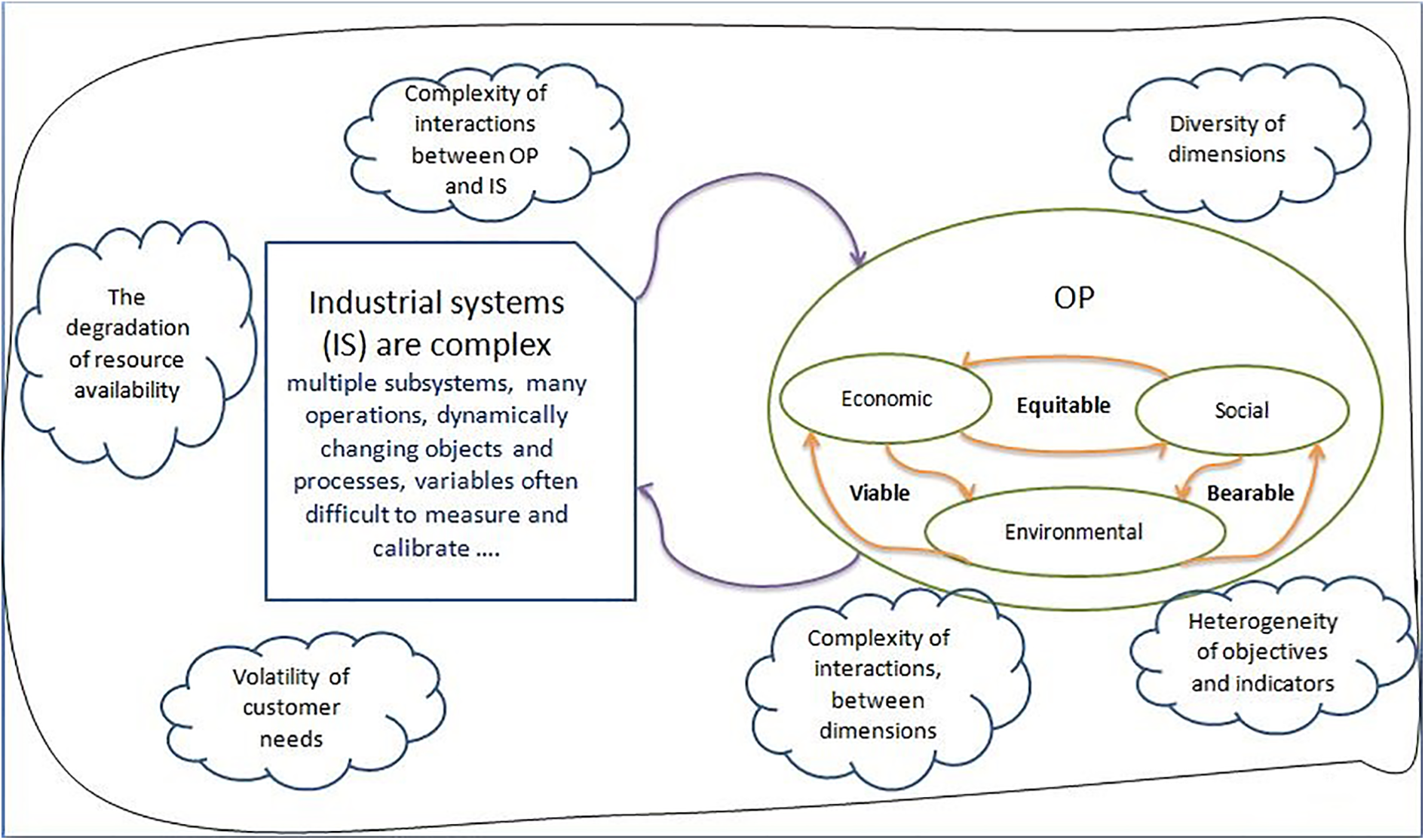
Key factors causing the OP complexity. OP: overall performance.
OP dimensions and intersections
In order to better apprehend the company’s OP complexity, it is useful to understand its different dimensions and aspects with which sustainability performance assessment and management are necessarily performed. 35 The company’s environmental performance issues consist, among others, in using the natural resources in an optimal and efficient way, limiting waste, favoring the use of renewable resources and recyclable materials, limiting production to the necessary quantities, and so on. Social performance that aims to ensure employees well-being focuses on establishing an advanced social policy based on different practices such as guaranteeing good working conditions, promoting training, motivating employees, and so on. The economic performance still being the priority concern of all managers, it aims to reduce the costs of water, energy, and materials consumption; to hunt for waste; to implement new long-term production strategies; and to carry out all other practices that ensure a higher profit for the enterprise and a competitive advantage.
To these three OP dimensions are added the bearable, viable, and equitable aspects, namely the zones of intersections or interdependencies between the previous performances. The bearable aspect refers to the simultaneous consideration of environmental and social factors, to ensure an acceptable living environment. For companies, the issues associated with this aspect concern hygiene, safety, health, and occupational risks, but also working with local actors (communities, associations, suppliers) and therefore promoting products and local know-how. Viable aspect relates to the environmental/economic interface, to allow long-term industrial ecology and eco-efficiency. The stakes relating to this development consists on several practices. For instance, optimizing transport, promoting the use of seasonal products, promoting the sorting and recycling and recovery of waste. Finally, the equitable aspect consists on combining economic growth while respecting human rights, to achieve greater equity. Companies should, for example, set up a policy to help reintegrate professionals, develop targeted projects to limit disparities (gender equality, salary leveling, accessibility for all, etc.), select fair trade products, and so on.
Indicators to apprehend the complexity of OP
The measurement of indicators is an effective way to convey essential performance information for the management and the piloting of this strategy and therefore the implementation of progress plans, the construction of reporting mechanisms, and the capitalization of experience in the company. Thus, Joung et al. defined an indicator as “a measure or an aggregation of measures from which conclusions on the phenomenon of interest can be inferred.” 36
In the literature, significant numerous research studies have proposed extensive collections of indicators to meet the overall concept of sustainable performance. In order to make the OP indicators comprehensive to deal with OP complexity, we propose a three-level hierarchical structure for these indicators in the sequence of aspects, criteria, and metrics. Hence, this study presents 21 criteria from the standpoint of the different OP aspects as defined in Figure 2.

Structure of criteria within OP aspects. OP: overall performance.
The established indicators system were evaluated and selected, to better reflect the context of OP management, from a review of the literature, based on the OP aspects and criteria proposed above.
The Table 1 provides the three-level hierarchical structure of the indicators system, identifying literature sources that consider the respective aspects and criteria of OP. We find that some criteria have received a lot of attention from researchers while other criteria have received considerably less attention.
Compilation of measurement criteria of OP.

OP: overall performance.
The social dimension is still the less presented in OP tools and methods, despite its important effect on OP implementation and management. This aspect shows three principal criteria (Figure 2), namely work conditions, costumer relationship, and social communication to better ensure social well-being in the organization. Work conditions are associated with the improvement of overall health and safety and the evaluation of impacts of practices on work conditions and social welfare to develop the standards of living of employees in the company. 37 Costumer relationship relates to the health and safety of costumers from product-use, customer satisfaction and the increase the channels of product information to customers. 36 Cao and Zhang 42 explain that social communication means the information conveying process in the company in terms of frequency, mode, and strategy.
Bearable aspect criteria are related to the firm’s well-being through a healthy relationship with its environment. Thus, local partnership covers the proportion of local market and the share of projects in the company involving local partners. 10 Community impact includes organization’s actions and programs for community development such as supporting community development plans and improving local communication. 37 Hence, nuisance focuses on the number of actions in terms of nuisance control (sound, olfactory etc.), measures taken in response to incidents of corruption and justice practices for anticompetitive behavior. 36
For the environmental aspect, resource consumption criteria are related to water, energy, and land use and reuse in the company process. 53 Pollution criteria refer to all emissions and wastes that enhance the amount of air, water or land toxicity and pollution, and actions related to reducing these effects. 38 Waste covers waste treatment practices aiming to minimize waste generated from organization’s processes. 54
Meanwhile, environmental policy reflects the involvement and commitment of company to environmental conformity through relevant environmental certifications and environmental protection actions. 39
Green logistics is categorized by logistics uses and mode of transportation and practices that aim to minimize environmental effects and enhance organization’s logistic efficiency. 45
According to Chardine-Baumann and Botta-Genoulaz, 37 energy saving is associated with actions to reduce energy consumption as development of products that consume less energy or preventive machines maintenance to minimize energy waste during production operations. Recycling is based on the amount of waste recovered and reintroduced in the process and the investment put to improve the company recycling strategies. 55
In economic aspect, quality improvement relates to firm plans and efforts to enhance quality of products and services to create high value for customers and enhance their satisfaction. 56 Cost reduction refers to minimize cost of different production stages including procurement, manufacturing, and distribution costs, it aims also to eliminate expensive processes to ensure production feasibility and provide cost rating. 53
Profit covers measurement of profit received from the organization activities. 36 Reactivity and flexibility is the capacity of the company to manage and cope market uncertainties and changes, and to effectively transmit information through firm processes to meet this unpredictability challenge. 51 In addition, economic potential focuses on the improvement of the degree of firm innovation and the introduction of technological changes in the manufacturing operations. 40
The last three criteria, in this study, specifically transparency, career development, and suppliers development depend to the equitable aspect of OP. Transparency presents the set of actions related to the justice aspect of social responsibility, including fairness, equity, and human rights respect in the company. 51 Career development is related to firm strategy to assist employee career evolution through personnel promotions and internal qualifications, continuous training of employees, and the amelioration of staff costs (earnings, bonuses, etc.). Thus, suppliers development covers the fair trading practices with suppliers, the amount of local sourcing, and the percentage of sustainability-oriented suppliers. 10
Working methodology
This section presents the value chain approach and the SysML model used in the proposed modeling methodology.
Value chain approach
The value chain, as the name implies, refers to a related set of value-added activities, whose sequence creates a value that can be identifiable and, if possible, measurable. 57 It therefore integrates all the stages of process that bring a product from its initial conception to final consumption. These activities are interdependent and can be splitted into two groups: (1) primary activities and (2) support activities (Figure 3).

Value chain adapted from Porter 58.
Primary activities directly contribute to the physical creation, the sale, the marketing, and the distribution of the product. Specifically, this includes product-related activities, namely inbound logistic and operations and market-related activities, that are outbound logistic, marketing, sales, and after-sales service. Support activities sustain the primary activities and form the infrastructure of the firm. In detail, this includes procurement, technology development, human resource management, and firm’s infrastructure. They are integrated in every function of the value chain. 58
The value chain approach is a relevant tool for OP assessment and management within manufacturing companies. 17 It is a flexible and a descriptive tool that forces analysts to consider all interconnections and interactions within the company system activities and components. By systematically understanding these firm system interactions, one can better describe OP complex interrelationships, related to company process and linkages, and prescribe the best practices and recommendations to enhance capabilities in the value chain and raise value added in the sector. 59
The value chain concept was first presented by Michael Porter, as a decision support tool to help companies to gain a competitive advantage over competitors. 60 Currently, the utilization of value chain has been extended to help manage the firm’s sustainability. Several tools have been proposed based on the value chain perspective: Value chain analysis applied to the scrap tire reverse logistics chain 61 ; Sustainable Manufacturing Mapping. 62 In one case study, 57 the authors used the value chain analysis to compare the value added by certain activities, in costumer perception, with the greenhouse gas emissions associated with these activities, in an Australian wine chain, to provide a clear diagnostic of misalignment between the allocation of resources and consumer preferences in this type of industry. 63 However, most of these models focus only on the environmental dimension of sustainability.
SysML Model
SysML is an object-oriented language developed by the Object Management Group (OMG), as “a general-purpose graphical modeling language,” 64 that supports the engineering of complex systems. 65 Object-oriented language is based on the concept of treating a system as a set of interdependent and interrelated objects that can be used and reused independently. 66 This feature makes this modeling not only “effectively support the establishment of large and complex systems by decomposing the problem into its natural entities…it can also model the interrelationships between [these entities].” 67 SysML is generally considered as an improved extension of Unified Modeling Language, which primarily treats software engineering systems. 68 SysML tends to include different types of systems and clearly define their constituents and interactions through describing their structure, requirements, parametrics (mathematical relationships), and behavior. This language includes nine diagrams to serve its use and objectives. 66
The applications of SysML modeling in the field of industrial sustainability and OP are multiple. Romaniw 68 uses SysML to develop a model-based approach in order to quantify the manufacturing environmental impact for a better environmental management. Matar et al. 65 proposed a SysML systems-based model aiming to facilitate the realization of sustainable construction, by identifying the environmental impact of each production activity. In Azavedo et al., 69 a multi-scale framework was developed to model sustainability of complex systems. This study proved that the use of formal modeling by SysML makes it possible to address problem emerging from complexity management within a large, multi-layered system. However, like several SysML sustainability modeling, this study still confined in economical and environmental aspects of OP in the company.
In this article, we propose a new decision-support tool using SysML modeling combined with a value chain perspective to support OP assessment and management, within manufacturing systems. This method allows specifying and modeling the approach dimensions and interactions, and therefore, helps understanding the global firm’s behavior, for a better decision-making.
Proposed model
The proposed model aims to analyze the firm’s OP problems to help providing the optimal opportunities of improvement. It involves the modeling of the different interactions in firm’s system using a SysML model. The analysis reveals which activities are responsible of firm’s inefficiency and which ones could be improved to ameliorate firm’s OP. The methodical steps of this model are organized as follows: Firm’s value chain activities and interactions definition, establishment of OP main problems through system interactions modeling, determination of performance problems drivers for each activity, and finally, identification of performance improvement opportunities. Figure 4 presents the sequence of these steps.

Steps sequence of firm’s OP modeling. OP: overall performance.
Step 1: Firm’s value chain definition
This step is based on the transformation of the firm’s value chain into block definition diagram in SysML. This modeling allows a better vision of the company’s key activities that are undertaken to produce goods or services and makes it easy to separate them from each other. Step 2: Activities interactions definition
This step is formalized as an internal block definition diagram which establishes the different relationships among value chain activities. It aims to identify the link between activities to better understand how one activity’s performance improvements would impact the whole firm’s OP. Step 3: System interactions definition
The interactions between the OP criteria and the firm’s value chain activities are modeled in this stage, through an internal block definition. It enables, therefore, the identification of OP problems in the firm and the activities that are the major sources of these problems. Step 4: Performance drivers for firm’s activities
After the identification of the OP main problems and the responsible activities, this step consists on determining these OP problems drivers for each activity. It aims to understand what factors drive the firm’s inefficiency to better define the optimal solutions. Step 5: Identification of performance improvement opportunities
Identifying OP problems drivers and the responsible activities (step 4), allows the establishment of improvement opportunities, in this step, and the major activities that should be improved, basing on the activities interactions diagram defined in step 2.
Case study and results
A case study for application and validation of the proposed model is illustrated through a multinational dairy industry firm in Morocco. It’s a large-sized company with €470+ million turnover, an annual production of 620,000+ tons of ultra-fresh milk and dairy products and a distribution in more than 65,000 sales points all over Morocco. As a result, it holds a 65% market share.
This company is committed to a sustainable policy since 2008. Thus, in 2016, it achieved a 50% reduction in emissions intensity on its value chain, including operations, packaging, and logistics.
In this case study, data collection was conducted through semi-structured interviews to define value chain main activities and establish their different relationships and linkages (step 1 and step 2). Successive questionnaires, were then, developed and used to establish performance problems’ drivers in each activity (step 3 and step 4) and to identify possible and optimal improvement opportunities in the firm (step5). Further details of these semi-structured interviews and questionnaires and there results are discussed below. Step 1: Firm’s value chain definition
The definition of value chain elements requires the collection of qualitative data at each stage from the raw material procurement to final product distribution. Hence, our research team conducted semi-structured interviews with various peoples responsible for different functional activities (e.g. quality control, storage, and sales), at different levels (e.g. operations, services, and procurement) to establish the nature of relationships within and between the firm’s activities. Semi-structured interviews are defined as being “based on a checklist of general questions which can be revised at any time, leaving a degree of flexibility, so that other issues raised during the interview can be explored.” 70 The research team conducted these semi-structured interviews and managed the qualitative data by strictly pursuing a previously defined research protocol that illustrates and explains the procedures to be followed. 71
Generally, the current value chain of the case study is presented in Figure 5. Figure 6 shows the block definition diagram of the value chain activities, using SysML notation.

Value chain from the dairy industry firm.
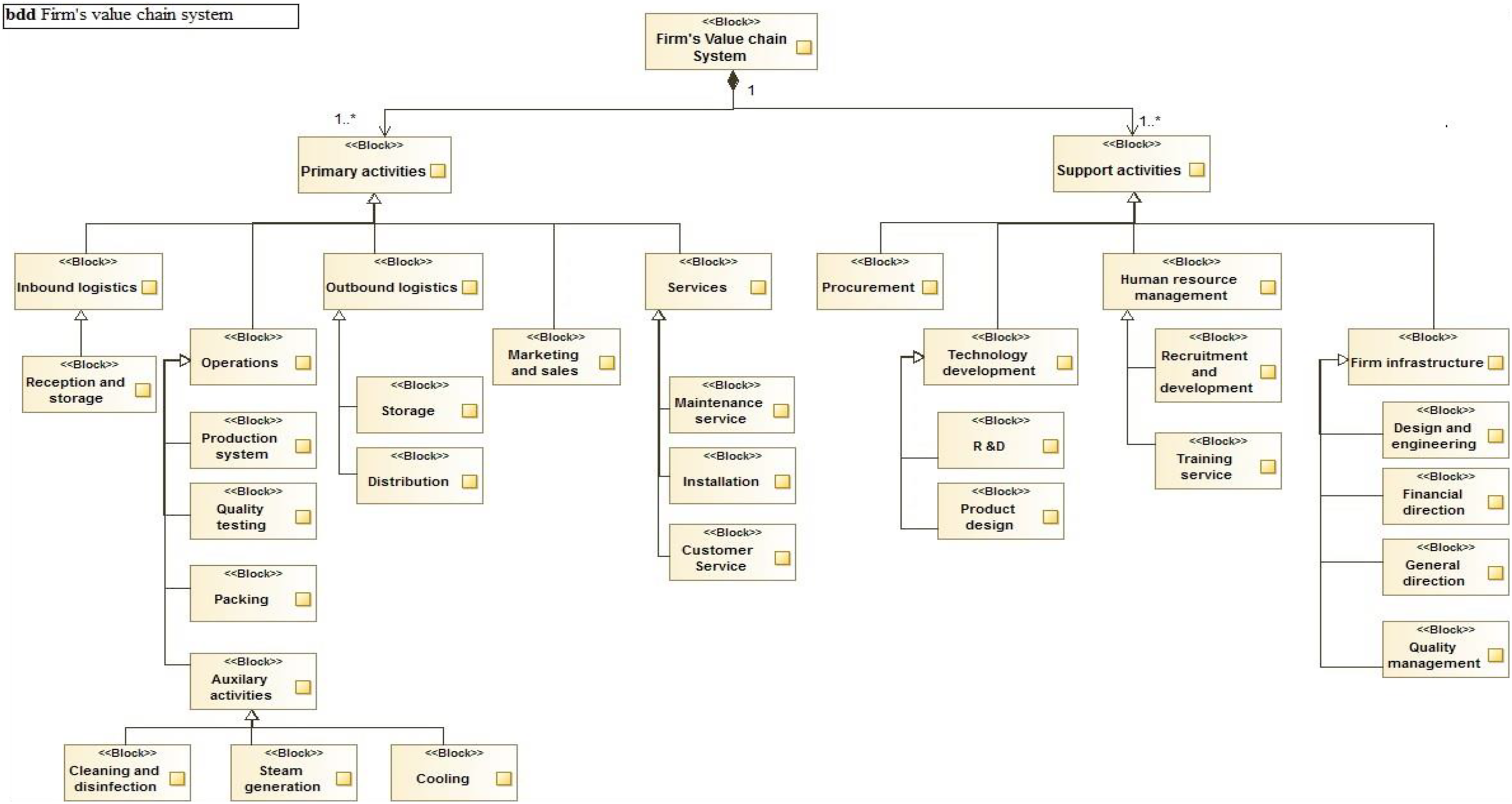
Value chain system of the firm.
Step 2: Activities interactions definition
The material flow and the information flow within and between each value chain activity were assessed through the semi-structured interviews. The material flow describes the transportation of the different stages of the product, among the activities, from the reception of raw material until the distribution of finished product. Information flow allows the value chain activities to connect and coordinate their actions according to clients’ needs and demands, in order to maximize value chain profitability. Results show that the activities are also related by another type of links, which represent an operation or service that can provide one activity to another. For example, the general direction is linked, by a general management operation, to all other activities; also, the maintenance department is responsible for the maintenance of machineries used in the inbound logistics, operations, and outbound logistics. Figure 7 represents the internal block definition diagram that models these different interrelationships between the key activities of the studied firm.

Essential interactions between value chain activities of the case study.
Step 3: System interactions definition
In order to identify key OP challenges and problems in this example, a questionnaire was developed by the research team. The questionnaire regrouped two main sections: (i) value chain activity information and (ii) perception of OP. The first section aims to collect information about the value chain activity such as type (primary or support activity) and role and experience of respondent in the concerned activity. The second section presents the OP problems in each activity, drivers of these problems and proposed prevention actions on which respondents were asked to give their opinions and propositions.
The questionnaire was addressed to 19 different managers in functional activities at different levels of primary and support activities.
In this step, the proposed model is designed to capture the identified problems from the questionnaire in the form of flows between the two interacting systems namely, the firm’s value chain activities system and the OP system. Thus, we focus, in this stage, on the part of the questionnaire that investigates OP problems within each activity. For this, the metrics of indicators system, previously established in the “Indicators to apprehend the complexity of OP” section, are used in this part of questionnaire as Likert-style rating questions or items, using a four-point scale, in order to obtain respondents’ opinions about the frequency of each OP problem in each activity. Generally, the scale intervals are interpreted as follows: (1) can be ignored or not at all frequent; (2) rare; (3) frequent; and (4) very frequent.
Reliability of questionnaire data
A reliability analysis was conducted to test the internal consistency of this part of questionnaire data. Reliability is measured in this study using Cronbach’s α coefficients. The measures are considered to have sufficient reliability when Cronbach’s α values are equal to or higher than 0.70. 72 Table 2 reflects Cronbach’s α scores for all the criteria considered from the system indicators in this study. It is clear that the values of Cronbach’s α vary between 0.786 and 0.905. These values well surpass the 0.70 recommended. It can be concluded, thereby, that the measures have acceptable level of reliability.
Cronbach’s α scores for all the criteria.

Validity of the construct
Construct validity evaluation consists in verifying that the questions of a test are related to the construct that is supposed to be measured, it is directly related to the question of what the instrument is in fact measuring. 73 A confirmatory factor analysis (CFA) was used in this study to test construct validity. The CFA models are generally evaluated based on a number of goodness-of-fit indices (GFIs). That is, a CFA is said to indicate a good fit of the model to the data if the ratio of chi-square (χ 2) to df is less than or equal to 2, comparative fit index (CFI) higher than 0.95, the root mean square error of approximation (RMSEA) and standardized root mean square residual (SRMR) values are less than 0.06 and 0.08, respectively. 74 The data sets of our model were tested using R program. The model results are summarized in Table 3. Overall, the results indicated good model-data fit in terms of all the fit indices.
Model fit.

CFI: comparative fit index; RMSEA: root mean square error of approximation; SRMR: standardized root mean square residual.
System interactions modeling
The identified problems from this part of questionnaire were used to model the interactions between the firm’s value chain activities system and the OP system, in the internal bloc definition of the SysML model. Figure 8 highlights the essential system flows in such a way that each defined problem generated by a specific activity is assigned to a type of OP criteria. For example, for “reception and storage” activity, the most frequent performance problem is “injury rates” which is related to “work condition” criteria in “social” aspect as defined in Table 1.

OP essential problems and responsible activities for the case study. OP: overall performance.
Step 4: Performance drivers for firm’s activities
Once the OP problems were determined and modeled, researchers used, in this step, the results of the questionnaire to establish the drivers of each problem (Table 4). Then, by referring to the diagram of interactions of value chain activities (Figure 7) and the results of the previous semi-structured interviews, they established the responsible activities of each proposed improvement (Table 4).
Performance drivers and improvement opportunities for system activities.

Step 5: Identification of performance improvement opportunities
The improvement actions proposed in the previous step were grouped and formulated in the form of a second questionnaire for the 19 managers to choose the most optimal actions for each activity that may lead to performance improvement in other subsequent activities. For example, “periodic and preventive maintenance of machines” in “maintenance” activity will contribute to “cost reduction” in “operations” activities and “energy saving” and “pollution prevention” in “auxiliary activities.” The results were validated by the key top managers at the firm.
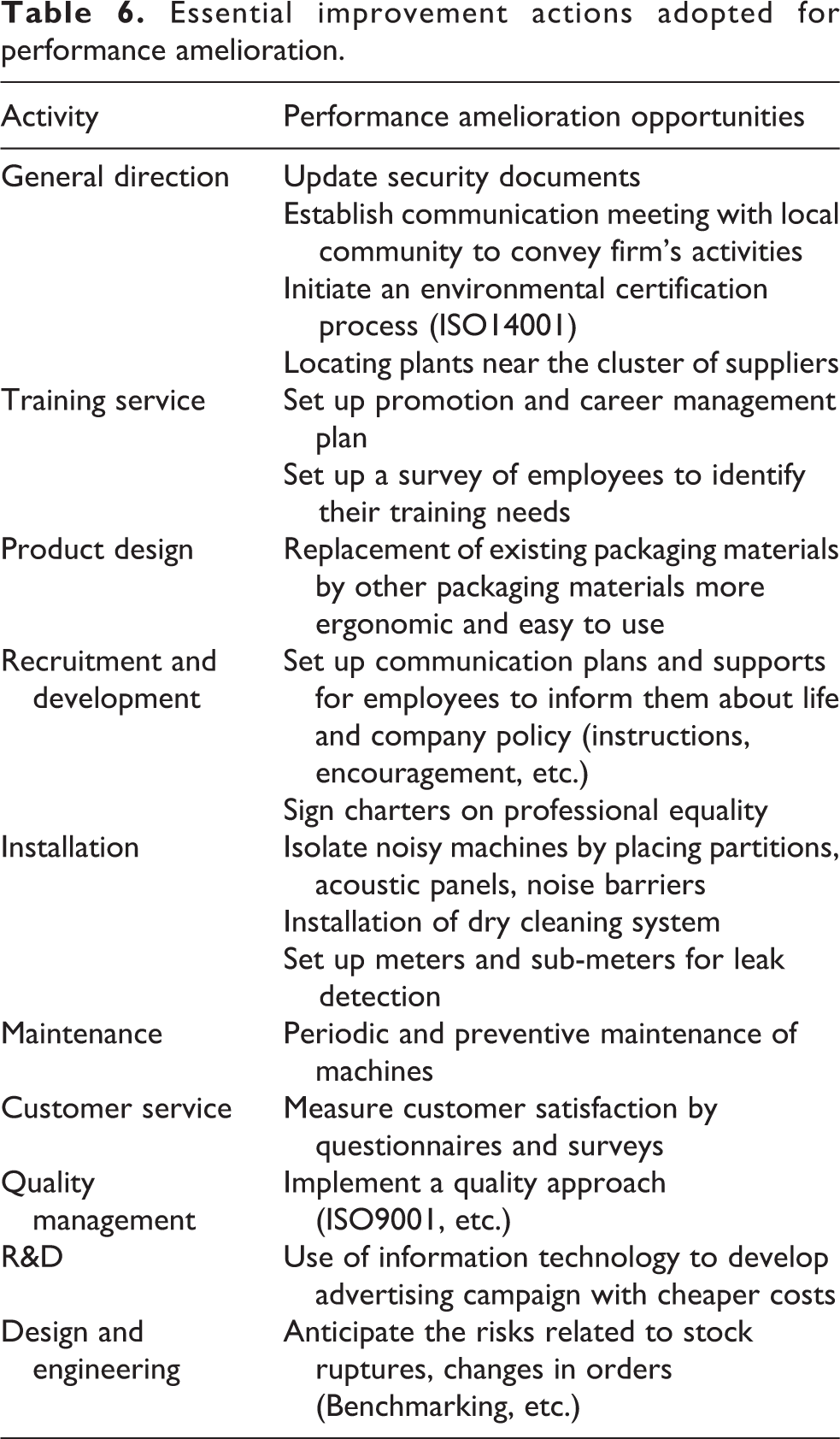
Due to space limitations, we cannot present all the parts of the questionnaire in this article. However, Table 5 shows, as an example, the part of the improvement actions related to the “General direction” activity in the questionnaire. Thus, the results, presented in Figure 9, show that the actions (A), (C), (G), and (I) are the most optimal for “General direction” activity according to managers opinions. Table 6 summarizes the improvement actions selected for each activity in firm’s value chain.
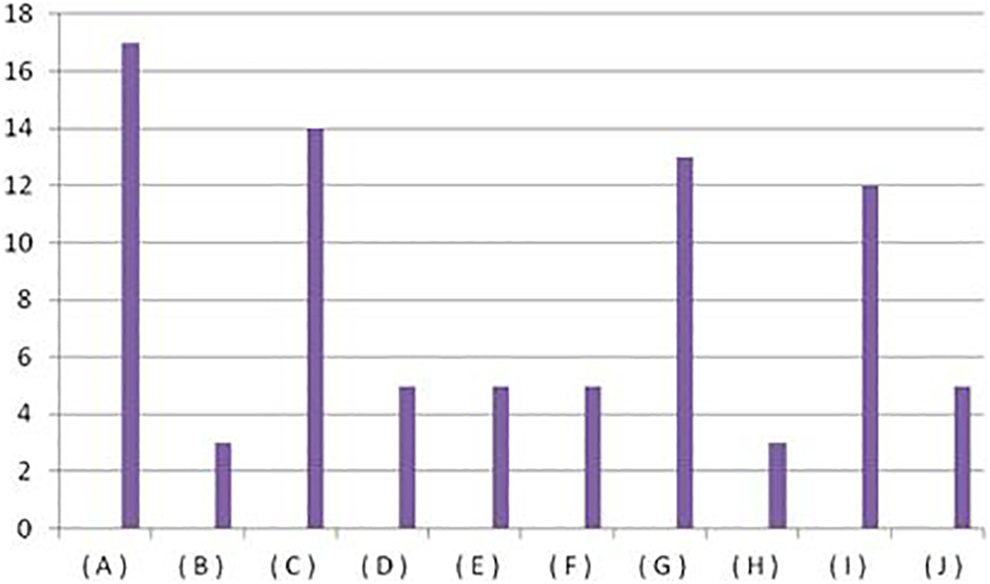
Managers opinions about improvement actions in “General direction” activity.
An example of the part of improvement actions related to the “General direction” activity in the questionnaire.

Essential improvement actions adopted for performance amelioration.
Discussion
The application of the proposed model based on the combination of value chain approach and SysML modeling on a real case has proved its usefulness to support OP management. It is important to point out that this model is still under development, despite that, it has already proved its feasibility dealing with OP complexity components previously described in the “Complex aspect of overall performance” section. This complexity that comes essentially from the firm’s and OP different interactions. Actually, the value chain perspective enables to determine the important value-added activities in the firm, then the SysML notation allows the identification of internal activities’ interactions, which gives a clear vision on firm’s system and makes it easy dealing with it. Besides, the proposed system indicators helps to determine OP problems in the firm and the related activities and establish, therefore, the relationships between OP components and firm’s activities. By systematically understanding these system (firm and OP) interactions, we can better describe OP problems’ drivers, related to company activities, and prescribe the best practices and recommendations to enhance capabilities in the most critical activities whose improvement would affect the whole value chain. It can be concluded that the present model contribute largely to apprehend the complexity of OP in this case study. However, this model is still under development and will carry its real results once finished. Efforts should be pursued in that direction, including the dynamic part of modeling through other SysML diagrams, in order to directly determine the final state of the OP of the company based on the performance indicators in each activity in the firm. The results will bring new information in order to identify its applicability on different manufacturing industries and the potential drawbacks that need rectification.
Conclusion and future work
In this article, a system model, based on the integration of value chain concept and the SysML modeling, has been developed to apprehend the complexity of OP in the enterprise. This complexity that results of OP dimensions’ interactions dealing with firm’s heterogeneous and diverse components makes it a difficult strategy to manage and implement in the firm.
The proposed model provides the methodological benefits of value chain and SysML modeling for description of system constituents and specification of its various interconnections. It is guided by the definition of a measurement indicators system that allows judicious implementation of OP in firm, whatever its production activity and its performance status. It is, effectively, based on the definition of key activities that create value for the company, through a value chain approach, and the modeling of the different interactions using a SysML notation. This facilitates the description and the pursuit of OP in the firm, in terms of its main problems and the activities that are the major sources of these problems, to finally identify the optimal amelioration opportunities that should be taken to improve firm’s sustainability.
The proposal has been successfully used in a case study of dairy industry to unfold the complexity of OP management in industry systems. This validation case demonstrated the versatility and the usefulness of the model as a decision support for system engineers, to better perceive firm’s OP challenges and choose the best practices and opportunities of improvement. Hence, this methodology provides a tool that allows formalizing the complexity of OP and therefore supports firms in the implementation of their strategy toward sustainable development.
Future work should integrate, foremost, a dynamic modeling through parametric SysML diagrams in order to directly read and analyze activities performance data and quantify its problems for each key activity. It would be interesting, then, to achieve a multi-agent simulation and implement it on a well-chosen platform to facilitate the choices of decision makers, through simulation and monitoring of results of the various improvement strategies adopted and provide the best possible amelioration scenarios. The final model should be, then, tested on various case studies in the manufacturing field to prove it’s applicability on manufacturing firms and its role in optimization and supporting OP management.
Footnotes
Author’s Note
Maryam Gallab is now affiliated with ENSMR, National School of Mines of Rabat, Rabat, Morocco.
Declaration of conflicting interests
The authors declared no potential conflicts of interest with respect to the research, authorship, and/or publication of this article.
Funding
The author(s) disclosed receipt of the following financial support for the research, authorship, and/or publication of this article: This work was supported by the National Centre for Scientific and Technical Research of Morocco (CNRST) (grant number: 14UIZ2017).
