




Abstract
This study investigates the driving factors of the social commerce intention of online communities in Saudi Arabia by building a model that comprises two exogenous variables (social support and social commerce constructs (SCCs)), a mediating variable (trust), and one endogenous variable (social commerce intention). The study population comprises Facebook and Twitter users in the kingdom. A convenience sample of 500 social media users was chosen. Data were gathered via a questionnaire-based online survey. Our findings indicate that social support had a significant relationship with trust and social commerce intention. This relationship was significantly mediated by trust. SCCs also had a significant relationship with emotional as well as informational support and social commerce intention. Unexpectedly, the relationship between SCCs and social support dimensions was significantly mediated by trust. Consequently, it was concluded that social support, trust, and SCCs are key drivers of social commerce intention. These results invite social media retailers to consider such factors to increase social media users’ intention to purchase.
Introduction
Three major pillars supported the introduction of social commerce, namely, electronic commerce, social media application, and Web 2.0 constructs. Predominantly, works on social commerce introduced the term, describing it as a new platform that emerged from electronic commerce in the wake of social media networks, such as Facebook, Twitter, and LinkedIn, 1,2 or a combination of social media applications that were built using features of Web 2.0, such as user-generated and shared content, and e-commerce. 3 The first goal of using social networking sites is to construct an online environment, where participants can share and pursue common activities, experiences, and interests. 4
The widespread use of social media applications paves the way for social commerce to gain the attention of both researchers and social retailers. Researchers dedicated a large part of their efforts to explore factors that affect the purchase intention of customers. Their work identified drivers of such an intention, including social support, 1,5,6 trust, 1,6 –10 and social commerce constructs (SCCs). 8,11 Despite the great interest in examining the factors that enhance social commerce intentions, little research studies have been conducted to examine the impact of online consumer behavior on the social commerce intention in developing economies such as that of Saudi Arabia, where an important consumer concern is a lack of trust in the accuracy of information about products and services before purchase. In addition, very few attentions have been paid to having online social support, relationship quality with social networking sites, and SCCs in enhancing social commerce intentions.
For instance, in a study on the explored antecedents and consequences of customer satisfaction in a social commerce context, Beyari and Abareshi 12 found the impact of trust and social influence on consumer satisfaction in Australia and Saudi Arabia. Abed et al. 13 carried out a study to identify social media elements used by small- and medium-sized enterprises in Saudi Arabia to connect with their customers and explored the influence of these elements on customer usage of social commerce. The results explained that innovative businesses are being developed; online business strategies influence consumers’ perceptions of uncertainty; online trust when using social media implies that the quality of online information affects consumers’ adoption; and that consumers are becoming more innovative.
Similarly, Eid 14 studied the determinants of customer satisfaction, trust, and loyalty in an e-commerce environment. He concluded that B2C e-commerce customer loyalty has an influence on customer satisfaction but simultaneously has a weak influence on customer trust. On the other hand, Makki and Chang 15 found that social media and mobile usage influence e-commerce. Furthermore, the focus of Alqahtani et al. 16 was on mobile transactions and factors that affect the intention and usage of these transaction types. He found that 11 factors influence the acceptance and adoption of m-transactions, including navigational structure, ease of use, usefulness, visual appeal, security, information communication technology (ICT) infrastructure, culture, trust, government m-readiness, cost, and social influence. On the basis of data collected from social media users, Di Gangi and Wasko 17 found that the experience of social media as assessed by social interactions and technical features had significant effects on user engagement.
By addressing the abovementioned gaps, our study contributes to the existing literature in the following ways. First, we build a mediational model, which demonstrates how trust mediates the relationship between social support and social commerce intentions. Second, this study is the first to examine the impact of online consumer behavior on the social commerce intention in developing economies, such as Saudi Arabia, where an important consumer concern is a lack of trust in the accuracy of information about products and services before purchase. Overall, this research provides a basis for new theoretical models in the context of social commerce based on the online social interaction of the consumer.
The remainder of the article is structured as follows. The next section reviews the existing literature on the determinants of social commerce intentions. This is followed by the research methodology section, after which the results are presented and discussed. Finally, a summary and conclusions are presented.
Literature review and hypotheses development
Social support, trust, and social commerce intention
Social support has been divided into two dimensions: emotional support and informational support. 6 Referring to Crocker and Canevello, 18 Bai et al. 5 defined social support as individual perceptions of physical and psychological help, responsiveness, and care received from others in the same group. The authors highlighted the existence of three types of social support, which are emotional, informational, and tangible support. For them, emotional support contributes to an individual’s feelings, informational support describes giving helpful information and recommendations to others, while tangible support relates to direct assistance to use functions of social media applications. Liang et al. 1 indicated that emotional support includes features, such as friends’ encouragement, empathy, and understanding, while informational support is related to information shared with others on social sites to assist them to face the difficulties they encountered during their purchasing decision-making.
Trust in social commerce describes the extent to which users of social media have positive expectations about electronic retailers as well as their behavioral intention to resort to those retailers in critical situations. 10 Trust was regarded as a key driver of the social commerce intention of Chinese social buyers. 6 Three major motives of trust were identified by Awad and Ragowsky 7 : user belief in a social retailer; an outcome of integrated trustworthiness, integrity, competency, and benevolence of a social retailer; and specific beliefs of ability, integrity, and benevolence of a social retailer. Mainly, trust can be measured by benevolence and credibility in social networks, 8 and benevolence, integrity, and ability/competence. 9 Therefore, social trust is related to positive expectations of users about social commerce sites. 1
Social support, either personally or technically, engenders trust among social commerce users.
19
In the context of social commerce, trust was found to predict social purchase behavior.
20
Using a sample of social commerce users in Korea, Kim and Park21 pointed out a positive relationship between trust and social commerce success. Despite these results, Sheikh et al.,
2
whose research sample encompassed users of social networking sites in Pakistan, indicated that there was no significant relationship between social support and relationship quality, as measured by commitment, satisfaction, and trust. For Kim,
22
social networking services were a key predictor of employee job satisfaction. On the understanding that the results on the relationship between social support and trust are mixed, and to examine such a relationship using estimations of social users in Saudi Arabia, the following hypotheses were defined:
Commerce intention refers to customer animus to buy goods or services. Given that the commerce transaction is effected online through social networks, it signifies social commerce intention, 23 which might be influenced by numerous factors, such as customers’ perceptions of the value they received and their social awareness, 24 social support, and website quality. 1 Based on these definitions, social commerce intention was measured on the basis of users’ intention to buy via social networks and their willingness to pay using these networks. 8
Trust, on the other hand, has been significantly related to social commerce intention.
8
According to Sharma et al.,
25
the positive effect of trust on social commerce intention can be understood by two major drivers of customers’ trust, namely, his or her trust in the organization itself and trust in the Internet. Trust plays an additional role in social commerce of enhancing the relationship between social support and social commerce intention.
6
Kim and Park
21
identified several factors that have an influence on social customer trust in social commerce, such as reputation, size, information quality, communication, safety of transactions, and referrals. Abed et al.
13
found that small- and medium-sized enterprises in Saudi Arabia use social media to build online trustworthy relationships with their customers. Trust, on the above-mentioned findings, was expected to be significantly related to social commerce intention. Therefore, the following hypothesis was presupposed:
Concerning the relationship between social support and social commerce intention, together with the unrealized role of trust as a mediating variable in this relationship, Sheikh et al.
2
found a positive relationship between social support and social commerce intention. In their study on customer engagement in social commerce, Lin et al.
6
indicated that emotional and informational support, which can be enhanced through relationship quality, had a significant influence on the behaviors of social users. Virtual experiences of social customers, such as social support, social presence, and flow, are key drivers of social commerce intention.
26
The results of Liang et al.
1
suggest that the relationship between social support (emotional and informational support) and users’ intention to do social commerce was mediated by relationship quality, as measured by trust, satisfaction, and commitment. Moreover, Li and Wang
27
identified emotional support and informational support as significant predictors of social media users’ intentions. Accordingly, we formulated the following hypotheses:
SCCs, social support, and social commerce intention
SCCs have been defined as Web 2.0-based platforms used in social media, by which users (i.e. social customers) are enabled to generate their own contents and share their experiences.
8
SCCs were adjudged as best practices in social commerce.
28
These practices include forums and communities, ratings, and reviews, in addition to referrals and recommendations.
8,11
SCCs have been regarded as a major source of social support.
8
Shanmugam et al.
29
studied the applications of SCCs using data from online communities in Malaysia and found that these constructs had significant effects on social support, as measured by emotional and informational support, as well as on trust building. SCCs also had a significant effect on social commerce intention.
2
Thus, we formulated the following hypotheses:
Methodology
Sampling
The study’s population of interest includes users of Facebook and Twitter in the kingdom. A convenience sample of 500 social users was chosen. Data were gathered via a questionnaire-based online survey. Out of the questionnaires posted to users, a total of 500 questionnaires were filled out. Of these, 389 questionnaires were usable with a response rate of 77.8%.
Conceptual model
Figure 1 shows the conceptual model. It portrays four latent constructs that are linked via 10 hypotheses. The dimension of social support (emotional and informational support) is linked to trust (hypotheses 1a and 2b), which in return connects to social commerce intention (hypothesis 2). Emotional and informational support are associated with social commerce intention (hypotheses 3a and b). The mediating role of trust in the relationship between emotional and informational support was also examined (hypotheses 4a and b). Then, relationships between SCCs and social support dimensions (hypotheses 5a and b), as well as social commerce intention (hypothesis 6), were investigated.
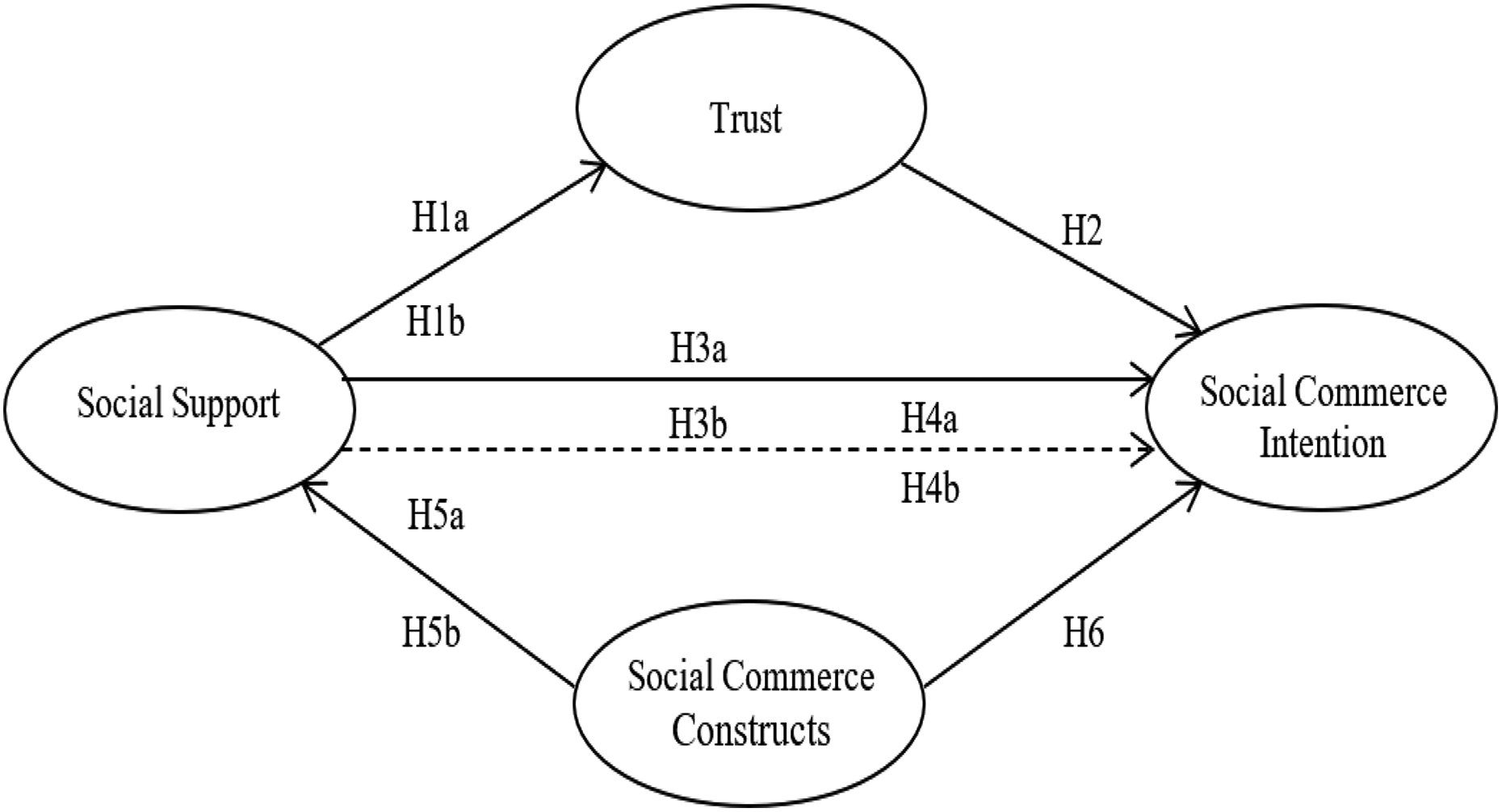
Research conceptual model.
Measures
Dimensions and items used to measure research constructs are presented in Table 1. Social support was measured using two dimensions: emotional support and informational support. Emotional support was measured by items that evaluate the degree of encouragement, sympathy, and caring, while informational support was rated based on items that concern the degree of assistance received from others on social sites. 1 Trust was assessed by items about social commerce site responsiveness, reliability, and safety. 1,12 SCCs were measured by items concerned with the social recommendation, forums, and communities as well as ratings and reviews. 8 Social commerce intention was estimated by items referring to user’s willingness to share experience and ask for information from others on social media. 1
Construct and items.

Reliability and validity
Reliability was measured by composite reliability (CR) as well as Cronbach’s α coefficient, while validity was assessed by discriminant and convergent validity. Constructs with acceptable values of CR and Cronbach’s α are those that reached or exceeded the cut-off value, which is 0.70. 8,30 Convergent validity was appraised by the average variance extracted (AVE), which should be >0.50. 1 Discriminant validity was determined using the square root of AVE values, 12 which should be greater than correlations between constructs. 31 The results in Table 2 pointed out that reliability and validity statistics were acceptable.
Results of reliability and validity.

FL: factors loading; CR: composite reliability; AVE: average variance extracted.
Goodness-of-fit indices
The results of the model fit statistics can be seen in Table 3. These results confirm that our measurement model fitted the data well, since all indices met the required criteria. 5,32 The χ 2/degree of freedom was less than 3; the goodness-of-fit-index (GFI) and adjusted GFI were greater than 0.90; the comparative fit index was higher than 0.90; and the root mean square error of approximation was below 0.08. 22
Results of measurement model goodness-of-fit indices.

GFI: goodness-of-fit-index; AGFI: adjusted goodness-of-fit-index; CFI: comparative fit index; RMSEA: root mean square error of approximation; df: degrees of freedom.
Results and discussion
Figure 2 outlines the structural model of this research. The model shows the estimates of all constructs, as represented by regression weights. It was noted that the structural paths between constructs were significant, which means that our hypotheses were supported by the current data. That is, emotional support (β = 0.41, p = 0.000) and informational support (β = 0.34, p = 0.000) were positively related to trust, as suggested by hypotheses 1a and b. Trust was significantly associated to social commerce intention, as presumed in hypothesis 2 (β = 0.27, p = 0.001). Furthermore, the model confirmed that emotional support (β = 0.39, p = 0.003) and informational support (β = 0.31, p = 0.000) were significantly and positively connected to social commerce intention, as postulated in hypotheses 3a and b. SCCs, as in hypotheses 5a, b, and 6, were found to be positively linked to emotional support (β = 0.29, p = 0.000), informational support (β = 0.35, p = 0.004), and social commerce intention (β = 0.25, p = 0.016).

Research structural model.
Regarding hypotheses 4a and b, which were proposed to investigate the mediating role of trust in the relationship between emotional support (besides informational support and social commerce intention), the results in Table 4 reveal that the relationship between emotional support and social commerce intention was mediated by trust, as clarified by the standardized direct effect (β = 0.202, p = 0.000) and the standardized indirect effect (β = 0.057, p = 0.002). Significance values of the indirect effects were tested via bootstrapping. The same procedure was conducted. 22
Total, direct, and indirect effects between constructs.
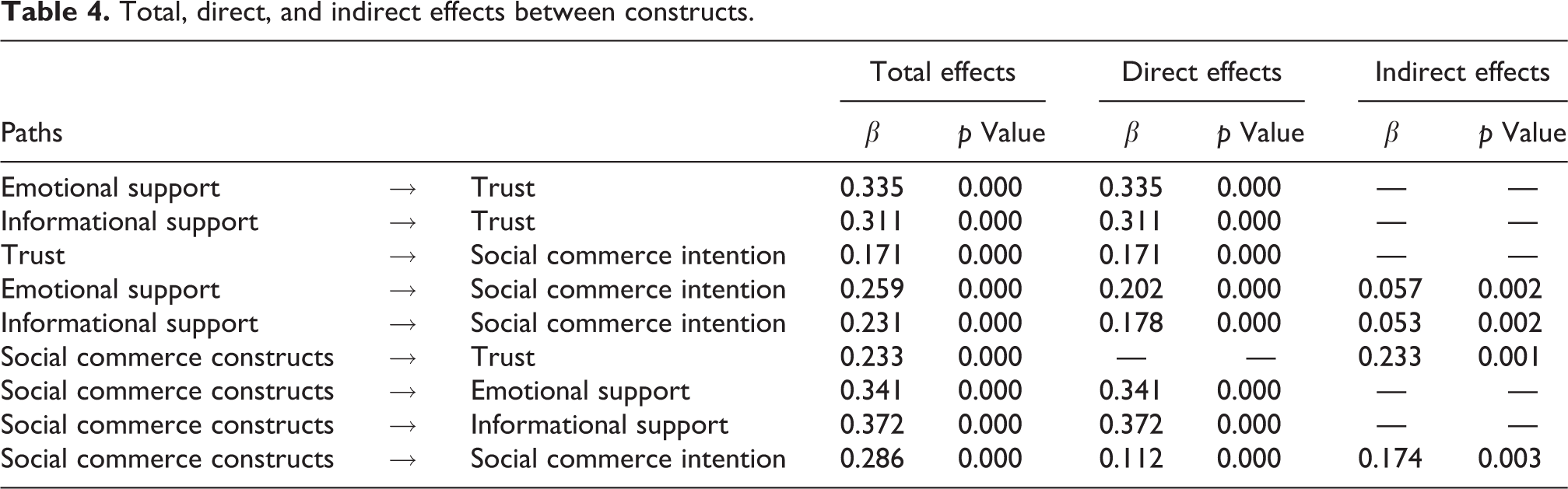
Further, the relationship between informational support and social commerce intention was mediated by trust, as is demonstrated by the standardized direct effect (β = 0.178, p = 0.000) and the standardized indirect effect (β = 0.053, p = 0.002). Interestingly, the results illustrated a tacit mediating role of social support, as measured by emotional support and informational support in the relationship between SCCs and social commerce intention, as emphasized by the standardized direct effect (β = 0.112, p = 0.000) and the standardized indirect effect (β = 0.174, p = 0.003).
Our results were echoed, either directly or indirectly, in prior research. Social support (i.e., emotional and informational support) was a key driver of trust in social commerce sites, 19 –21,27 in contrast to the findings of Sheikh et al. 2 Trust was the second driver of social commerce due to its positive relationship with social commerce intention. 6,13,25 Further, emotional and informational support was significantly joined to social commerce intention. 2,6,26 In agreement with Liang et al., 1 the results show that the relationship between both emotional and informational support was mediated by trust. Finally, our results are similar to those found by authors in which SCCs positively predicted social support 8,29 and social commerce intention. 2 Our results added that the relationship between SCCs and social commerce intention is mediated by the dimensions of social support. Finally, despite the fact that our model had no direct relationship between SCCs and trust, the results show a significant indirect relationship between these variables. In other words, our results identified social support, trust, and SCCs as driving factors of social commerce in Saudi Arabia.
Conclusion and practical implications
This study was designed to explore the driving factors of the social commerce intention of online communities in Saudi Arabia by proposing a model consisting of social support, trust, and SCCs, linked to social commerce intention. The results underline significant relationships between emotional support and informational support with trust and social commerce intention. Trust also has a significant relationship with social commerce intention. Additionally, SCCs have a significant relationship with emotional and informational support and social commerce intention.
These results have a number of implications. First, both dimensions of social support can be used to strengthen the social commerce intention. Social retailers who buy their goods and services through social networks should be aware of this type of support to enhance customers’ intention. They are invited to encourage the idea of sales and marketing for groups, in which friends meet socially and exchange their perceptions, experiences, and suggestions. Through these recommendations, social retailers can solve problems and enhance products or services to increase customers’ trust in social commerce sites. Second, SCCs, such as social forums, communities, ratings, and referrals, complement the role played by trust in improving customers’ intention. Therefore, social retailers and service providers on social media should consider these dimensions, particularly in the design and functioning of their websites. Third, social retailers are requested to pay attention to both social support and SCCs, due to the fact that the former drives social customers to trust social commerce sites and the latter is an effective factor in promoting social support.
Generalizability of the results of this research might be limited to the factors studied in this research and to its cross-sectional design. Therefore, researchers could extend this study by exploring additional drivers of social commerce intention using longitudinal research. In addition, our proposed model was only estimated in the case of social networking site users in Saudi Arabia. Future research could test our proposed conceptual model in other geographical areas to confirm our findings.
Footnotes
Acknowledgments
The authors would like to thank the respondents who participated in this research. They would also like to thank the Deanship of Scientific Research in Qassim University, Buraidah, Saudi Arabia.
Declaration of conflicting interests
The author(s) declared no potential conflicts of interest with respect to the research, authorship, and/or publication of this article.
Funding
The author(s) disclosed receipt of the following financial support for the research, authorship, and/or publication of this article: This research was funded by the Deanship of Scientific Research in Qassim University, Al Malida, Buraidah 15452, Qassim, Saudi Arabia.
