




Abstract
In this study, a hybrid model based on ANFIS (Adaptive Neuro-Fuzzy Inference Systems), a predictive intelligent-based technique, and TOPSIS (Technique for Order Performance by Similarity to Ideal Solution) was implemented for sustainable supplier selection. Selection of supplier is a crucial task for companies to achieve the objectives of inbound and outbound supply chain system. This selection process may be complex due to the inclusion of diverse subjective and objective factors. There is, therefore, the need for a reliable methodology to provide higher accuracy in predictions of anticipated supplier performance, and this article makes contributions in that direction. The model was applied in the retail end of a fast-moving consumer goods (FMCG) industry to select the best possible suppliers using the sustainability criteria of the triple-bottom-line. Available data from the FMCG retail sector was fed into the TOPSIS and ANFIS model to rank the suppliers. Results indicated that the most dominant sustainability factors in the Nigerian FMCG retail sector are advanced technology, cost, reliability, on-time delivery, and environmental competencies. The finding should encourage companies in the retail sector to explore sustainability opportunities in order to improve their competitiveness for selection during bidding processes. The novelty of this study is the application of ANFIS to sustainable supplier selection problem in the context of a developing economy like Nigeria. It should also assist managers in the FMCG retail sector to highlight areas of possible sustainability improvements.
Keywords
Introduction
The retail industry serves as the intersection between production and consumption of goods and is subject to particular attention among academic and stakeholder audiences. 1 To increase competitive advantage, retail firms must endeavor to align their business strategies, activities, and operations along their supply chains. The supply chain has to do with the selection of best possible supplier ensuring an effective network of product interaction. Brun and Castelli 2 proposed a segmentation tree model for supply chain strategy segmentation based on three drivers: brand, product, and retail channel. Managing supply chains emphasizes the importance of buyer–supplier relationships, thereby strategizing the purchasing function which is considered a primary driver of the profitability of the firm, since it represents a 50–60% of a particular firm’s total turnover. 3 Previous studies available in extant literature affirm to supplier selection being an extremely important operation within the purchasing function. 4 –7 There exist several approaches to the supplier selection problem, most of which are based on multi-criteria decision-making (MCDM) model methods and are incapable of detecting the nonlinear and linear relationship between variables and alternatives to predict higher accuracy. To address this limitation, many researchers have strongly recommended the application of soft computing/predictive intelligent-based techniques. 8 –10 Soft computing techniques are innovative approaches to build intelligent systems that mimic human-like expertise within a specific domain, adjust themselves to the changing conditions, and provide traceability and reasoning capability in its decision processes. 11 Currently, the application of soft computing techniques in supplier selection is largely limited. 12 Moreover, there is an emerging consensus among researchers and practitioners that supply chains need to shift focus from merely considering economic factors to include broader, social, and environmental dimensions of sustainability. 13 The consideration of the economic factors simultaneously with environmental and social factors defines the triple-bottom-line (TBL) approach to sustainability. Most studies on sustainable supplier selection highlight mainly economic and environmental factors without much consideration for the social factors. 14 Hence, this study pioneers the application of a hybrid decision model comprising of an MCDM model and a soft computing/predictive intelligent-based technique to solve the supplier selection problem under TBL sustainability factors in the retail industry in Nigeria. The MCDM model that was considered in this study is the technique for order performance by similarity to ideal solution (TOPSIS) 15 while adaptive neuro-fuzzy inference systems (ANFIS) 16,17 is the predictive intelligent-based technique applied in this work. TOPSIS is applied in this study to evaluate different supplier alternatives with regards to relevant supplier selection criteria in the Nigerian retail sector. Then, the results of the TOPSIS process were used as inputs for the ANFIS analysis to find the importance level of each supplier alternative toward selecting the most sustainable supplier in the retail industry. TOPSIS is a very popular MCDM model to solve the supplier selection which enables the use of linguistic terms to judge the importance of criteria and rank the alternatives. 18 On the other hand, ANFIS is an extensively applied soft computing technique that can successfully enhance the performance of predictions. 19 The ANFIS modeling process involves a much more complicated mathematical foundation which enables it to present a well-structured output representation and reveals complex linear and nonlinear relationships between inputs and outputs. 20
The main purpose of this work is to develop a reliable research methodology based on TOPSIS and ANFIS for the sustainable supplier selection problem in the Nigerian fast-moving consumer goods (FMCG) retail industry. The Nigerian FMCG retail industry is characterized by intense competitive pressure, so many different products, uncertain customer demands, volatility of product portfolio, and a mass market due to the huge population. 21 Additionally, the dynamism and work in combination with the competitiveness of this retail industry is one of a rare combination which necessitates working together with suppliers so as to increase competitive edge. The novelty of this study is the introduction of supplier alternatives in combination with subjective and objective sustainability factors as input parameters to the ANFIS framework, to find the fuzzy relation with the performance of supplier alternatives which is the output parameter from the system. This will ensure that the best possible sustainable supplier is selected from a pool of suppliers and assist managers to highlight areas of possible improvements and increase competitive advantage.
The remainder of this article is structured as follows. The second section presents a literature review of the supplier selection problem and relevant criteria for supplier selection in the Nigerian FMCG retail industry. The third section explains the proposed evaluating methodology. The application of the proposed research methodology in the retail industry is provided in the fourth section with the research implications. The fifth section provides the conclusion of the research and future research directions.
Literature review
Maintaining a good and long-lasting relationship with suppliers is a strategic problem in every organization. Supplier selection is considered pivotal to managing and developing an effective and efficient supply chain since a firms’ competitiveness highly depends on its suppliers increasing the strategic role they play in the supply chain. 13 Besides the common challenges of increased customer requirements, the globalization of procurement markets, the demands and opportunities of e-procurement, shortened product life cycles, and the expansion of just-in-time environments, purchasing firms are confronted with increasing market and legal pressures related to sustainability. 22 Due to an increased awareness and significant environmental pressures from various stakeholders, companies have begun to realize the significance of incorporating green practices into their daily activities. 23 In fact, supplier selection is one of the paths to reach sustainability objectives not only for the focal firm but also for the entire supply chain. 13 This is because suppliers as the basic components of the supply chain play a significant role in creating a sustainable supply chain. 24 Industries are increasingly deemed to be responsible not only for embedding the sustainability concept within their own production process but also for ensuring the commitment of their suppliers. 25 The level of sustainable performance actualized by a particular industry may be aided or impeded by the perceived behaviors of their suppliers with respect to relevant sustainability factors. The sustainability awareness has become an important issue in supply chain management and companies prefer to work with other companies focusing on this subject. 26 In fact, supplier selection is strategically important as it can determine the industry’s success in achieving goals of adopting green practices. 27 Hence, sustainable supplier selection involves synthesizing the economic, environmental, and social development factors of sustainability that are relevant to a firm during selecting the best possible supplier from a pool of suppliers.
Past studies exist in the available literature on the sustainable supplier selection problem. A consistent pattern in most of the studies is the application of hybrid MCDM models which do not involve temporal or spatial considerations and assume that criteria and alternatives are fixed a priori, thus, reducing the accuracy of predictions. Several studies exist on the application of TOPSIS in the sustainable supplier selection problem. 24,28 –31 Determining and applying the most efficient method of evaluating suppliers is a challenge for purchasing managers, since they seek to select the best suppliers or to identify any deviations from predefined standards among suppliers. 25
Thus, researchers advocate for predictive intelligent-based techniques so as to accurately predict results to various real-world supplier selection problems. 9,10 ANFIS is one of the well-known predictive intelligent-based techniques which is capable of revealing complex linear and nonlinear relationships between system variables and sufficiently involve spatial or temporal considerations. 20 ANFIS has been applied to the supplier selection problem without consideration of TBL sustainability criteria or integrating TOPSIS computations. 11,32,33 The evaluating methodology in this study focuses on employing TOPIS and ANFIS in evaluating various supplier alternatives in the Nigerian retail industry based on TBL sustainability criteria and ranking the supplier alternatives. The retail industry is faced with risks from supply side including uncertainties in supplier responsibility, lead time, and supply quality, hence the selection of a qualified and reliable supplier remains a challenge for the retail sector. 34 Moreover, it is highly recommended for retail companies to have sustainable suppliers that are able to contribute to economic development and maintain business ethics. The evaluating methodology provides an accurately predicting process of selecting the best possible sustainable supplier in the retail sector and provides management with the in-depth insights so as to effectively achieve sustainability objectives and increase competitiveness.
Identification of sustainability factors for supplier selection
The identification of sustainability factors plays a vital role in the supplier selection process because the identified factors will directly determine the estimated value of supplier efficiency. 25 In this study, the sustainability factors that are relevant for supplier selection in the retail industry have been collated from previous studies by various researchers coupled with the perspectives of the retail industry experts. The list of dimensions and respective factors are given in Table 1.
Sustainability factors relevant to the retail industry.

Social factors
These are factors that are focused on working place and employee’ progresses with supportive activities. Local community influence is a key social factor of sustainability that is relevant to the retail sector. 38 A positive local community influence can be cultivated by providing entitlements and rights of stakeholders by the retail industry within its external environment to increase efficiency and profitability. The rights of employees include wages and other employment benefit packages which can aid in increasing workers’ satisfaction. 24 Providing rights of employees can be a certain incentive to improve workers’ productivity and increase competitiveness. Social image/responsibility has significant effects on customer attitude and satisfaction 40 and includes responsibility integrated in the industry encompassing legal, ethic, economic, and philanthropic expectations that the industry owes the society. Safety concerns providing safer working places by managing health and safety risks. 28 Customer service ensures that buyers/consumers are afforded the necessary services to increase satisfaction and improve the relationship.
Environmental factors
Certain factors that are related to the environment of the retail industry were identified as waste management system, pollution control, and environmental competencies. Waste management systems concern the means and strategies for collecting and disposing wastes including reuse and recycling activities to ensure sustainable outcomes. Pollution control encompasses measures to avoid and minimize the effect of pollution occurrences. Through trainings to acquire knowledge and skills required for effective environmental management, environmental competencies can be actualized thereby increasing sustainable performance. 12
Economic factors
Cost, advanced technology, on-time delivery, reliability, quality, and product availability are the factors that are identified as relating to the economic issues of the industry. The cost can be defined as the price of industry’s product which includes the necessary costs to maximize profit and maintain competitiveness. 25 Quality encompasses maximizing productivity and efficiency at minimized defects in conformance with standard specifications to improve customer acceptability. 12 On-time delivery ensures that products are available to customers at the expected due date to avoid penalty cost and increase profitability. Access to advanced technology entails the provision of advanced technological tools to implement sustainability strategies and improve organizational performance. Product availability can contribute to increased profitability by ensuring that customer preferences and requirements are satisfied. 41 Reliability is the ability of an industry to manage risk and uncertainty due to increased lead time, production disruption caused by strikes and natural disasters, and instability of procurement due to poor quality. 42 Atsalakis and Valavanis 43 demonstrated the application of TOPSIS in compound linguistic ordinal scale. The effective strength of Fuzzy was equally demonstrated by Yuen 44 in the grouping of product alternatives into different consumer preference grades.
Application of ANFIS modeling technique
This study applies the ANFIS modeling technique to the supplier selection problem to actualize sustainability goals in the Nigerian retail sector. ANFIS is a predictive intelligent-based technique that has a hybrid learning rule algorithm integrating the gradient descent method and the least square methods to train parameters. 11 Although, ANFIS has been applied extensively to the field of supply chain management due to the precision and accuracy of its results, it has not been employed to solve the sustainable supplier selection problem. Table 2 shows the application of the concept of ANFIS technique by different authors in various research domains.
Application of ANFIS modeling technique in supply chain management.

ANFIS: adaptive neuro-fuzzy inference systems.
Methodology
The detailed research evaluating framework that is employed in the current study to select the best possible sustainable supplier in the retail industry is shown in Figure 1. The proposed research evaluating methodology consists of TOPSIS and ANFIS.
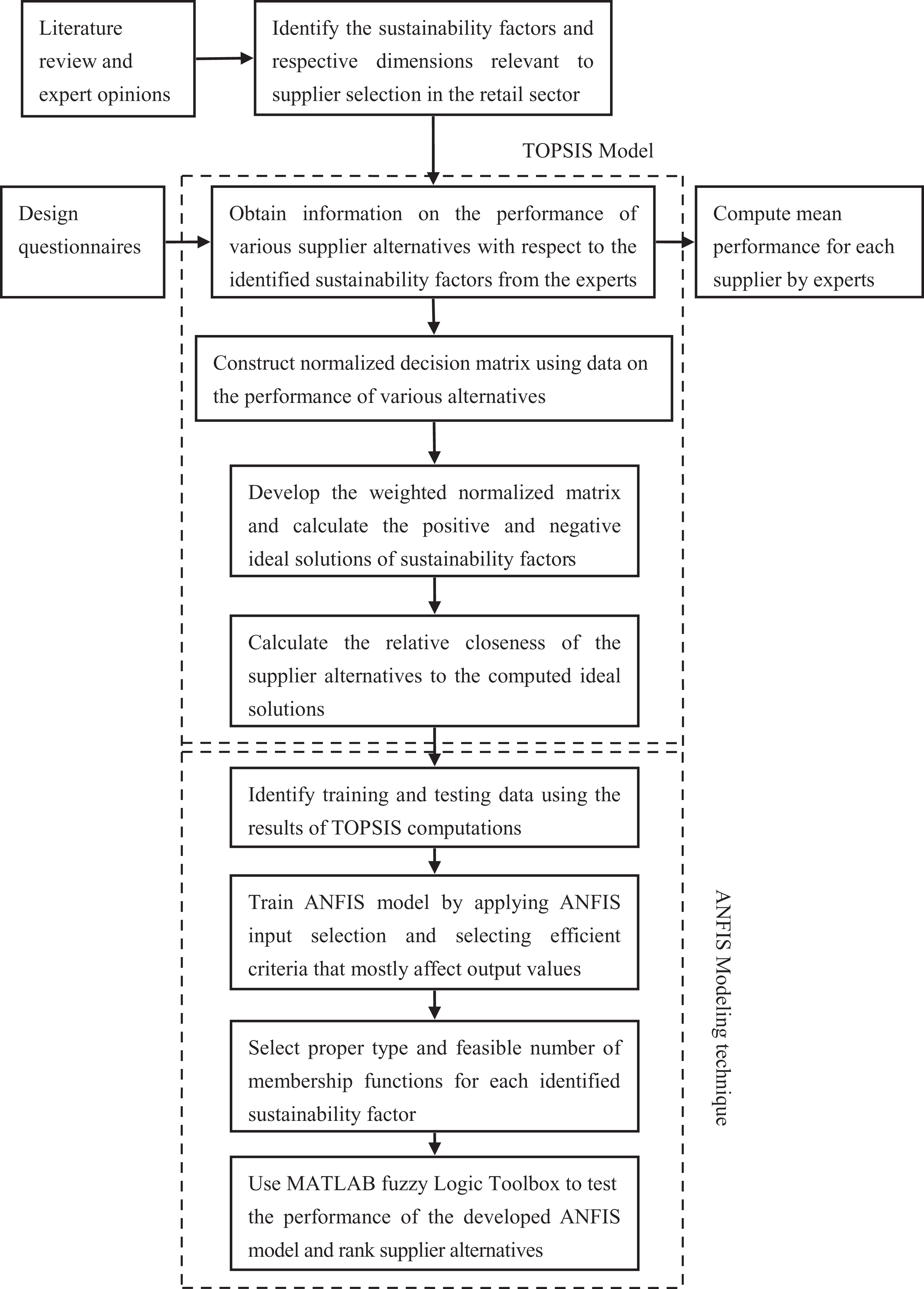
Research methodology.
The data for this article were sourced through the survey of three rapidly growing and competing FMCG retail suppliers located in the Southern part of Nigeria. Questionnaires were issued to the respondents in the selected major retail suppliers through personal visits who were assured that their responses would be treated as confidential. The target group of respondents for this study was mainly operations managers with more than 5 years of experience in the FMCG retail industry in Nigeria. This target group was regarded as having sufficient experience and knowledge thereby ensuring the accuracy of responses to the questionnaires.
TOPSIS model
The TOPSIS model is a method that can assist in decision-making by ranking several alternatives based on their similarity or proximity to an ideal solution and has been widely applied to various research domains during the past few decades.
25
In this study, the TOPSIS model is applied to preliminarily determine the performances of the supplier alternatives with respect to the sustainability factors relevant to the retail sector and thereafter rank the suppliers. The TOPSIS model is formulated in the following steps:
Step 1: Determine the supplier performances with regards to sustainability factors.
This is done using the questionnaires designed for this study. The performances of the suppliers were depicted on the questionnaires by the respondents using the linguistics scale in Table 3.
Linguistic scale for the TOPSIS model.

TOPSIS: technique for order performance by similarity to ideal solution.
Step 2: Design of the normalized decision matrix.
The normalized decision matrix can be computed as

where D is the normalized decision matrix with m rows and n columns.
The sustainability criteria are categorized into two types namely “benefit criteria” which signifies that the increase in magnitude is favorable and “cost criteria” which signifies that the decrease in magnitude is favorable.
Benefit criteria
Cost criteria
Step 3: Compute weighted normalized decision matrix.


The weighted normalized decision matrix is calculated as follows:


where vij
is the weight of the ith criterion for the jth supplier alternative
Step 4: Calculate the positive ideal solution (P+
) and the negative ideal solution (P−
).
Benefit criteria
Cost criteria


Step 5: Determine the separation measures of each supplier alternative from positive and negative ideal solution.


where bt
is the distance between two corresponding numbers on the linguistic scale.
Step 6: Computation of the closeness coefficient (A) for each supplier alternative.
Step 7: Prioritization of the supplier alternatives.

The supplier alternatives are ranked with respect to the closeness coefficient with the best alternative being closest to the positive ideal solution and the worst alternative being farthest from the negative ideal solution.
Results
The supplier performances with respect to sustainability factors relevant to the retail industry as completed on the questionnaire in this study are presented in Table 4 as the results of the first step of the TOPSIS process.
Performances of supplier alternatives with regards to sustainability factors.

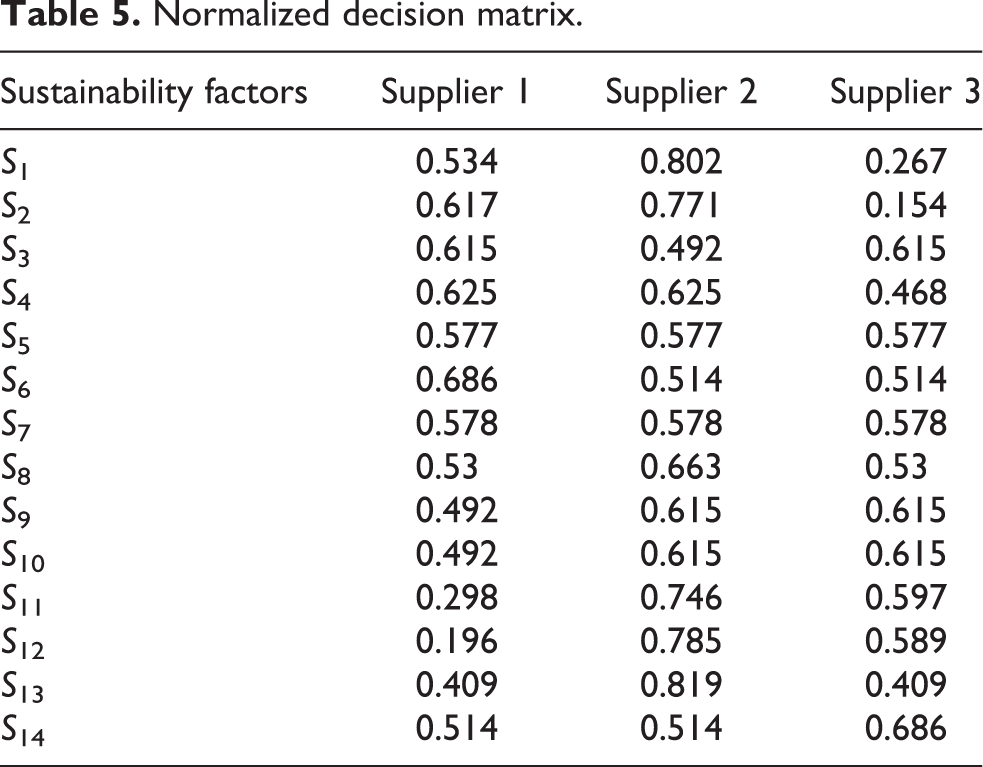
The normalized decision matrix shown in Table 5 was determined by applying supplier performances with respect to the sustainability in equations (1) to (3) as the second step of the TOPSIS process. The third step of TOPSIS process was done by computing the weighted normalized decision matrix given in Table 6 using equation (4) Then, the positive ideal solution and the negative ideal solution for the benefit criteria were determined using equations (5)and (6) while the positive ideal solution and the negative ideal solution for the cost criteria were determined using equations (7) and (8). The separation measures from the positive ideal solution and the negative ideal solution of the benefit criteria and the cost criteria were computed using equations (9) and (10) as the fifth step of the TOPSIS model.
Normalized decision matrix.
Weighted normalized decision matrix.

The closeness coefficient for each of the supplier alternatives was calculated using equation (11) as given in Table 7.
Closeness coefficients for supplier alternatives.

According to the results of the TOPSIS analysis implemented in the current study, the best possible sustainable supplier in the Nigerian FMCG retail sector is supplier 2. This is followed by supplier 1 and lastly supplier 3. The results of the TOPSIS computations will be applied in the developed ANFIS model to predict the performance of the suppliers with regards to the sustainability factors in the retail sector.
ANFIS model
In this study, ANFIS was employed to predict the best possible sustainable supplier with regards to confirmed sustainability factor. The main aim of applying the ANFIS technique was to investigate the relationships between the input variables and three supplier alternatives. Several membership functions (MFs) are considered for each input variable. In this work, triangular MFs were applied in the ANFIS to fuzzify the input variables. For each variable and factors, five linguistic terms given in Table 8 were chosen to demonstrate the level of each input. Additionally, the degree of membership is defined in this study as being between the range of 0 and 1. Several rules (“IF conditions–THEN conclusions”) are employed to depict the relationships between fuzzy parameters which can be effectively generated by the ANFIS technique using the responses from the questionnaires.
Linguistic scale for ANFIS analysis.

ANFIS: adaptive neuro-fuzzy inference systems.
A structure of the entire sustainable supplier selection problem was developed as shown in Figure 3 so as to effectively demonstrate the strength of the predictive intelligent-based technique, ANFIS, and implemented in the MATLAB 2016a environment.
The training was performed several times where the sigmoid function serves as the controller for effective decision-making using the triangular MFs for available input/output dataset. 51 (See Figure 2 for the triangular MFs for the 14 input variables employed in this study which were plotted based on the available data set.) The ANFIS architecture was plotted by applying a hybrid creative algorithm to perfect the model as shown in Figure 4. The training data set is trained for 50 epochs with minimum checking error occurring by about epoch 5.

MF plot for sustainability factors. MF: membership function.

ANFIS structure for sustainable supplier selection with sigmoid function for effective sensitivity rule. ANFIS: adaptive neuro-fuzzy inference systems.

The architecture of the proposed ANFIS model for sustainable supplier selection. ANFIS: adaptive neuro-fuzzy inference systems.
During the training process, the alpha cut was taken shown in yellow colors and the system automatically generate the best output value displayed in blue lines as shown in Figure 5.

Three-dimensional surface plot.
The three-dimensional plot shows the changes in the output of ANFIS after the training process. According to the three-dimensional surface plot depicted in Figure 5, the most influential sustainability factors during supplier selection in the retail sector are S 1, S 2, S 3, S 4, and S 14. After the training, the rule structure of the ANFIS model is obtained and displayed to help make an effective decision by varying the input value to obtain output values as depicted in Figures 6 to 8. As shown in Figures 6 to 8, each rule indicates a row of plots while each variable indicates an input variable. The system produces output values automatically as seen in the last column of Figures 6 to 8 by varying the red lines for the 14 input variables in the current study. The model established 14 × 7 different fuzzy rules according to the linguistic terms and assigned value for each variable to predict the best possible sustainable supplier. To determine the supplier performance with regards to the relevant sustainability factors (input variables), the solution response is obtained with the available dataset by taking an alpha cut and refining the weights using the rule viewer platform demonstrated in Figures 6 to 8.

ANFIS solution rule viewer for supplier 1. ANFIS: adaptive neuro-fuzzy inference systems.

ANFIS solution rule viewer for supplier 2. ANFIS: adaptive neuro-fuzzy inference systems.

ANFIS solution rule viewer for supplier 3. ANFIS: adaptive neuro-fuzzy inference systems.
The choice (or preference) categories for the prediction of the performance of the alternative supplier with regards to the sustainability factors in the Nigerian retail sector were determined by decision makers. After the analysis of the rule structure, a choice category is assigned to indicate the level of preference. The ANFIS model has been analyzed using the ANFIS solution rule viewer developed in Figures 6 to 8. The very low preference choice group was assigned value 0–19, the low preference choice was assigned value 20–39, the preferred choice group was assigned value 40–59, the highly preferred choice group was assigned value 60–79, and the most preferred group was assigned value 80–100 as shown in Table 8. Based on the information provided, the ANFIS solution rule viewer was tuned and adjusted using the red line. According to Figure 6, the solution rule viewer indicates that supplier 1 has a ranking value of 40 which falls within the assigned values for “Preferred” choice category. Likewise through adjusting the red lines of input parameters, Figure 7 indicates that that supplier 2 has a ranking value of 30 which falls within the “Low preference” choice category while Figure 8 shows that supplier 3 has a ranking value of 60 which falls within the “Highly preferred” choice category. According to the results of the ANFIS analysis in this study, the best possible sustainable supplier in the Nigerian FMCG retail sector is predicted as supplier 3. Ultimately, the most dominant sustainability factors to be considered during implementing sustainable supplier selection in the FMCG retail sector include advanced technology, cost, reliability, on-time delivery, and environmental competencies.
Research implications
The current study makes contributions to the theory and practice of selecting the best possible sustainable supplier in the retail supply chain. From a theoretical standpoint, the fuzzy set theory aids in eliminating uncertainty and ambiguity in experts’ judgments. This article makes a contribution to the fuzzy set theory by defining the MFs of sustainability factors applied in generated fuzzy rules and applying a reasoning mechanism that performs the inference procedure.
Our research findings are in line with Rashidi and Cullinane 25 regarding the huge influence of cost and reliability during implementing sustainable supplier selection in the retail industry. To ensure the improved sustainable performance of the retail industry, advanced technology was noted as a significant sustainability factor. Undeniably, the sustainable retail business is often driven by advanced technology. Retail firms should be provided with access to advanced technological facilities that eventually results in productivity and improved sustainable performance. 41 Our research complements published literature 42 that reliability is essential for suppliers to improve sustainable performance and increase competitive advantage. In addition, Orji and Wei 12 also support the huge influence of environmental competencies during the sustainable supplier selection process. Our work contradicts Park et al. 38 on the importance of local community influence during implementing sustainable supplier selection to improve sustainable performance. Contrary to Fallapour et al. 28 and Azimifard et al., 24 our results indicate that the safety and rights of employees do not necessarily exert a huge influence on improving sustainable performance in the FMCG retail sector. This can be attributed to the retail industry being more inclined to issues dealing with increasing customer satisfaction through ensuring reliability and on-time delivery of products.
Although, our research findings corroborate studies on implementing sustainable supplier selection in the supply chain management field, our approach and context differ from past published works because we applied a predictive intelligent-based technique, ANFIS to predict the sustainable performances of suppliers in the Nigerian FMCG retail sector. Based on the findings of this study, retail managers are provided with recommendations to focus on the most important sustainability factors to achieve better sustainable performance and development. This work is also expected to provide an in-depth insight for academia, policy makers, and retail industry practitioners.
Conclusion
To increase competitiveness, the FMCG retail sector, just like other industrial sectors, should build an effective supplier base and ensure adequate supplier relationships by applying predictive intelligent-based techniques. In this study, we propose a predictive intelligent-based technique, ANFIS, for sustainable supplier selection in the Nigerian FMCG retail sector. The research findings of this article have indicated the most dominant sustainability factors in the FMCG retail sector based on the ANFIS analysis with regards to improving sustainable performance in the Nigerian retail sector. Thus, this study will serve as an incentive to inspire policy makers and industry practitioners to gain perspectives on how to improve sustainable performance in the retail sector.
Based on the opinions of experts in the Nigerian FMCG retail industry, this study may be regarded as being one-dimensional. To provide a broader perspective, future studies may consider other industrial sectors, for example, manufacturing, construction, and so on by applying the evaluating methodology developed in this study. Additionally, other evaluating methodologies based on various multi-criteria decision models such as Decision Making Trial and Evaluation Laboratory, Technique for Order of Preference by Similarity to Ideal Solution, Adaptive Neuro-fuzzy Inference System and Analytic Hierarchy Process may be developed and utilized to solve the sustainable supplier selection problem in the retail sector. Also, the same evaluating methodology may be applied to a larger pool of experts from other countries to provide a broader view of the dominant sustainability factors in the retail sector. Furthermore, a comparative analysis of the present study can be carried out by comparing other evaluating methodologies for the sustainable supplier selection problem or comparing results from the developed evaluating methodologies from various retail firms.
Footnotes
Acknowledgement
Authors acknowledge Dr. I.J. Orji of Soochow University (PRC), Suzhou China, for her useful and valuable contributions in the course of this research.
Declaration of conflicting interests
The author(s) declared no potential conflicts of interest with respect to the research, authorship, and/or publication of this article.
Funding
The author(s) disclosed receipt of the following financial support for the research, authorship, and/or publication of this article: The authors received financial support for publication of this article from the University of Johannesburg, South Africa.
