




Abstract
Although various studies have been conducted to examine the role of human capital, role models, and fear of failure in the entrepreneurial process, the results reveal inconsistencies. Moreover, the relationship between them and their role in explaining the perceived feasibility of starting a new business still has no clear answer. Based on the adult survey data of the Global Entrepreneurship Monitor in Vietnam 2017/2018, the study find that having entrepreneurial knowledge, skills, and experience and knowing an entrepreneur are positively associated with the individual’s perception of feasibility to start a new business; whereas, the fear of failure do not have a direct significant effect on it. However, the influence of fear of failure on perception of starting a firm is strongly negative effect as moderating by educational attainment. Individuals with personal entrepreneurial connection and gaining entrepreneurship knowledge, skill, and experience have reduced the fear of business failure. The contribution of this study is twofold. First, it provides empirical evidence on the relationship between human capital, role models, fear of failure, and entrepreneurial feasibility. Second, it contributes to the understanding of entrepreneurship environment in Vietnam, a communist country still existing today.
Introduction
Studies on entrepreneurship have gained much attention since policies and measures cannot be formulated and implemented effectively without fully understanding the factors affecting entrepreneurship. 1 Entrepreneurship research may be conducted on different groups, including real entrepreneurs (individuals who have their own business and still living), nascent entrepreneurs (people engaged in the process of starting new ventures), or the general population of non-entrepreneur. Each group fit a different stage of the entrepreneurial process. For the general population, their perceptions about starting a new business may play an important role on the path to becoming a future entrepreneur, because entrepreneurial perception might contribute to forming the intention 2 –4 or affect entrepreneurial behavior and decision. 5
Prior studies have emphasized entrepreneurship as a career choice 6 and demographic and economic factors such as education, age, wealth, and work situation are important drivers of entrepreneurial behavior. Additionally, a set of variables describing personal perceptions including role models, confidence in one’s skills and ability, risk propensity, and alertness to unexploited opportunities were proposed to explain the entrepreneurial behavior. 5 It was found that these perceptual variables are highly correlated with the decision to start a new business, but the causal direction of the relationship is not clearly established. Continuing this line of research, this study investigates the relationship between the main subjective perception, including human capital (knowledge, skills, and experiences), role models, and fear of failure. We also address the impact of these above factors in the perceived feasibility of starting a new business.
Numerous studies have investigated this question and tended to support the existence of a positive relationship between human capital and entrepreneurial activity. However, studies examining this relationship have not yielded consistently strong results, and conflicting findings are easily found. 7 It was indicated that overinvestment in human capital leading to high levels of certification may discourage risk-taking, while underinvestment may encourage it. According to Unger et al., 8 human capital has long been argued to be a critical resource for entrepreneurial success, but the magnitude of this relationship, however, remains unknown. Another important variable in the start-up process is the perception of feasibility. 9 Jiménez et al. 10 indicated that tertiary education increases formal entrepreneurship as a result of the higher self-confidence, lower perceived risk, and enhanced human capital. Meanwhile, tertiary education has a negative effect on informal entrepreneurship when it increases awareness of and sensitivity to the possible negative repercussions. In addition, for the general population, fear of failure plays an important role in their process of starting new ventures. 11 Fear of failure prevents individual with ideas not to explore them and venture into a competitive stage. Therefore, to be successful and reduce the level of fear of failure, new entrepreneurs must gain knowledge on their tolerance of risk. 12
Prior research has provided literature for understanding the role of fear of failure in entrepreneurship; however, important questions remain regarding the nature of this concept and its relationship with the entrepreneurial process. 13 For many researchers, fear of failure has a negative relationship with entrepreneurial entry, 14,15 but for others, fear of failure motivates entrepreneurial behavior. 16 In addition to the relationship between human capital and fear of failure, the relationship between fear of failure and role model needs also to be clarified.
In fact, role models have been a familiar variable in entrepreneurship research; however, their occurrence, function, and characteristics have been studied only to a limited extent by academics. 17 Anttila 18 confirmed that emotions derived from observing entrepreneurs in the local and social environment influence a number of entrepreneurial activities, such as recognition of opportunities, acquisition of resources, decision-making, and coping with stress. However, the link between the role model and human capital has not been clearly confirmed in the entrepreneurship literature. It was suggested that there are two opposing views about this relationship. 17 The first view is based on the notion of absorptive capacity. Therefore, the likelihood of role model presence may be higher for entrepreneurs with higher levels of human capital. More highly educated people may also in greater need of successful examples. The second view is that an entrepreneur’s human capital can serve as a substitute for the support of a role model. Individuals with higher levels of human capital may be less likely to have entrepreneurial role models.
The objective of this research is to help close a research gap regarding the relationship between human capital, role models, and fear of failure and also to analyze the influence of these variables on the perception of feasibility to start a new business. We draw our analyses on a sample of the general adult population from Vietnam based on the Global Entrepreneurship Monitor (GEM). The article is organized as follows: in the second section, we review the theory and previous research on human capital, role models, and fear of failure. The third section is devoted to research methodology. The results are presented in the fourth section. The final section provides discussion and conclusions.
Literature review and hypotheses development
This section presents several key concepts, including human capital, role models, and fear of failure. Relevant studies on the relationship between human capital, role models, and fear of failure and the effect of these variables on the feasibility of starting a business are also included. Accordingly, research hypotheses are proposed.
The role of human capital
Human capital attributes have long been considered to be a critical resource for success in entrepreneurial firms. 8,19 The human capital is defined as education, experience, knowledge, and skills that individuals gain through their schooling, on-the-job training, and other kinds of experience. 20 Similarly, human capital is the result of formal education, such as university education, informal education, including work experience and nonformal education, that is, specific training courses that do not belong to traditional formal educational structures. 7 It was suggested that differentiating human capital along with two distinct conceptualizations of human capital attributes: (i) human capital investments versus outcomes of human capital investments and (ii) task-related human capital versus human capital not related to a task. 20 Human capital investments consist of experiences such as education and work experience that may (or not) lead to knowledge and skills. The outcomes of human capital investments are obtained through knowledge and skills. Task-related human capital addresses whether human capital investments and outcomes are related to a specific task, such as starting and running a business. In this study, we use the concept of human capital as outcomes of human capital investments—knowledge, skills, and experiences that a person actually possesses to start a new business.
The human capital is an important source of competitive advantages to individuals, organizations, and societies. 21 The individuals’ existing knowledge and skills may be important drivers for their behavior and play an important role in explaining economic activities. Campisi et al. 22 mentioned that human capital is a key determinant in the capacity of a nation to innovate new technologies suited to domestic production. The knowledge provides individuals the cognitive abilities and leads to more productivity and efficiency. 23
The skills and knowledge on entrepreneurship are needed in the entrepreneurial process though to varying degrees. 24 In the field of entrepreneurship, research has attempted to support the existence of a positive relationship between human capital and entrepreneurial activity or entrepreneurial success. 7 It was stated to have a positive effect of one’s education level and the likelihood to perceive entrepreneurial opportunities. 25 It was also suggested that a positive relationship between entrepreneurial competencies and the success and survival of entrepreneurs exists. 26 Furthermore, through an extensive literature review, it was found that there is a significant and small overall relationship between human capital and entrepreneurial success, and the magnitude of this relationship depends on conceptualizations of human capital, the context of the firm, and the choice of success measures. 8
Prior research has suggested a number of arguments. Human capital increases the ability of owners to conduct the generic entrepreneurial tasks of discovering and taking advantage of business opportunities. Human capital helps owners to acquire other utilitarian resources such as financial and physical capital, and it assists in the accumulation of new knowledge and skills. In all, owners with higher human capital should be more effective and efficient in establishing and operating an enterprise successfully than owners with lower human capital. 8,27 In this study, we focus on the relationship between human capital and the perception to start a business. The individuals with higher quality human capital should be better at perceiving the profitable opportunities. Clercq and Arenius 28 suggested that knowledge-based factors of human capital have a strong impact on the decision to engage in business start-up activity. Once engaged in the entrepreneurial process, such individuals should also have superior ability in successfully exploiting opportunities. 7
The entrepreneurship studies indicate that cognitive factors such as perception play a critical role in the new venture creation process.
29
The perceived feasibility of starting a new venture is defined as the degree to which individual believes that he/she has the required resources (or abilities, skills) to carry out the new business.
30
Krueger
3
identified that perceived feasibility, perceived desirability, and the propensity to act can explain more than half of the variance in self-employment intentions; noticeably, feasibility perceptions have the higher explanatory power over the variance. Therefore, the impact of perceived feasibility and desirability on self-employment intentions should be tested. Thus, we hypothesize:
Role models and entrepreneurial perception
According to Bosma et al., 17 relying on the opinions of the entrepreneurs, role models matter for pursuing an entrepreneurial career. An entrepreneurial role model has been defined as a common reference to individuals who set examples to be followed by others and who may motivate other people to make career decisions and obtain certain objectives. 17 It has long been confirmed that role models may have a great influence on career decisions. The presence of successful entrepreneurial role models in a community delivers a message to the potential entrepreneurs that business is an attractive career option. Meanwhile, negative public attitude toward entrepreneurs along with the lack of role models may discourage individuals from going into business. 31 Therefore, role models may gain the individual’s desire to become an entrepreneur and the entrepreneurial self-efficacy. This may, in turn, positively influence entrepreneurial intentions and entrepreneurial activities. The role model reflects (i) the concept of roles and the tendency of individuals to identify with other people and (ii) the concept of modeling, the psychological matching of cognitive skills, and patterns of behavior between a person and an observing individual. 32 This suggests that individuals are attracted to role models who are perceived to be similar in terms of their characteristics, behavior, or goals (the role aspect), and from whom they are able to learn certain abilities or skills (the model aspect).
The exposure to knowledgeable others may be especially meaningful for would-be entrepreneurs. Since individuals are limited in their ability to assemble and absorb information and to determine the results of their decision alternatives, they often have to rely on external contacts to obtain information necessary for making decisions. It was argued that the networking may support new business activities through membership in various organizations because the membership increases one’s exposure to beneficial sources of information. 28
The previous studies have suggested that contact with other entrepreneurs may have two effects. Entrepreneurs furnish opportunities to learn about entrepreneurial tasks and capabilities. In particular, the existence of entrepreneurial role models reduces the ambiguity about starting a business that potential entrepreneurs may have and may help them obtain necessary information and entrepreneurial skills. Other than that, knowing and watching successful entrepreneurs demonstrates to potential entrepreneurs how to locate the resources and activities needed for starting and operating a venture more easily and increases individual’s self-confidence. 33 Based on a sample of 82 students from two Midwestern universities, Van Auken et al. 34 also indicated that direct interactions between role model and respondent through positive discussions and involvement in a business have a significant impact on interest in starting a business; whereas, negative interactions seem to prevent respondents from being interested in starting a business.
Demonstration and legitimation effects related to social and economic interaction with entrepreneurs lead to the following: (i) a reduction of ambiguity and (ii) an increase in the perceived attractiveness of entrepreneurship as a career choice. The same mechanisms should also contribute to a reduction of the fear of suffering from entrepreneurial failure since observing entrepreneurs allow learning from them, which should decrease the observer’s perceived risk of engaging in entrepreneurship. Perceivers can gain knowledge about entrepreneurial tasks and have the opportunity to acquire entrepreneurial capabilities. This should enhance the perceived ability to launch and run an entrepreneurial venture which is almost by definition accompanied by a lower fear of failure. Likewise, fear of failure should be decreased by perceiving entrepreneurship as an attractive career choice due to the peer effect. Fundamentally, the fact that friends and acquaintances can manage to be an entrepreneur causes the perception that an individual can also be an entrepreneur.
33
Therefore, the following hypotheses are proposed:
Fear of failure and entrepreneurial perception
According to the GEM, fear of failure is the biggest reason given worldwide by aspiring the majority of people for not going into businesses. 35 Hindle 36 has highlighted importance of studying fear of failure as a possible cause for decision to start a business. In the context of entrepreneurship, fear of failure has been examined in the three theoretical perspectives. 16 Firstly, fear of failure perceptions have a negative influence on entrepreneurship as an occupational choice (the economics-based view). Other studies suggest that a reduction of the perceptions will increase the probability of starting a business. According to this perspective, almost all researchers relied on the GEM data in which fear of failure is assessed by the statement, “fear of failure would prevent me from starting a business.” The phrasing of this item supposes a static relationship in the nature of the behaviors associated with the fear of failure, specifically that avoidance is the only behavioral result.
Secondly, according to the social psychological view of fear of failure in entrepreneurship, fear of failure can be considered as a sociocultural trait that influences attention to rewards in the social environment. It was suggested that people’s attitude toward failure is influenced by the presence of social norms that see failing as a shameful experience. It was also assumed that fear of failure is equivalent to risk aversion. As such, fear of failure reduces the likelihood that individuals expose themselves to situations characterized by the risk of failure (e.g. entrepreneurship). A lot of studies relied on the GEM data and single-item measure. Given the format of the fear of failure measure, the results unsurprisingly show a negative influence of fear of failure on entrepreneurial behavior. Lastly, the psychological view of fear of failure in entrepreneurship is that fear of failure is a negative feeling that derives from the anticipation of the possibility of failure and is associated with psychological and behavioral outcomes.
The abovementioned studies have viewed fear of failure as a form of risk aversion. However, this concept may also represent a form of loss aversion 37 and no entry in the debate of the nature of this concept. Therefore, we view fear of failure as the perceived risk of failure and its consequences when engaging in entrepreneurship.
It was found that individuals who demonstrate their fear of failure are much less likely to be engaged in entrepreneurship. It was indicated that fear of failure has a negative influence on individual’s transitions through the entrepreneurial process and the level of start-up activity. Fear of failure can also motivate people to work harder to avoid the failure occurrence. Although, it was illustrated that a motivating impact of fear has only existed in individuals who are already engaged in entrepreneurship or had earlier entrepreneurial experience. On the contrary, most non-entrepreneurs seemed to have a negative impact of fear among.
33
Based on the abovementioned points, we propose the following hypotheses in this study.
Research methodology
Data collection
Our study utilized GEM Vietnam 2017/2018 data. In Vietnam, Vietnam Chamber of Commerce and Industry (VCCI) conducted the survey under the permission of GEM to gather information about the entrepreneurship characteristics in Vietnam in different stages, from intending to start, to just starting, to running a new or established enterprise, and even to discontinuing a business. Based on Adult Population Survey (APS) and National Expert Survey (NES), GEM Vietnam 2017/2018 data have provided information on components of the entrepreneurship ecosystem using a Likert-type scale.
The NES was administered to 36 experts and collected data on the context in which entrepreneurship takes place in Vietnam. It provides information about the nine aspects of a country’s socioeconomic milieu that are believed to have a significant impact on national entrepreneurship.
Meanwhile, the APS was a comprehensive questionnaire, administered to 2118 adults, designed to collect detailed information on the entrepreneurial activity, attitudes, and aspirations of respondents. The survey provides data on 123 variables, the authors selected those variables that are coherent to the objectives of this study.
Individual-level variables
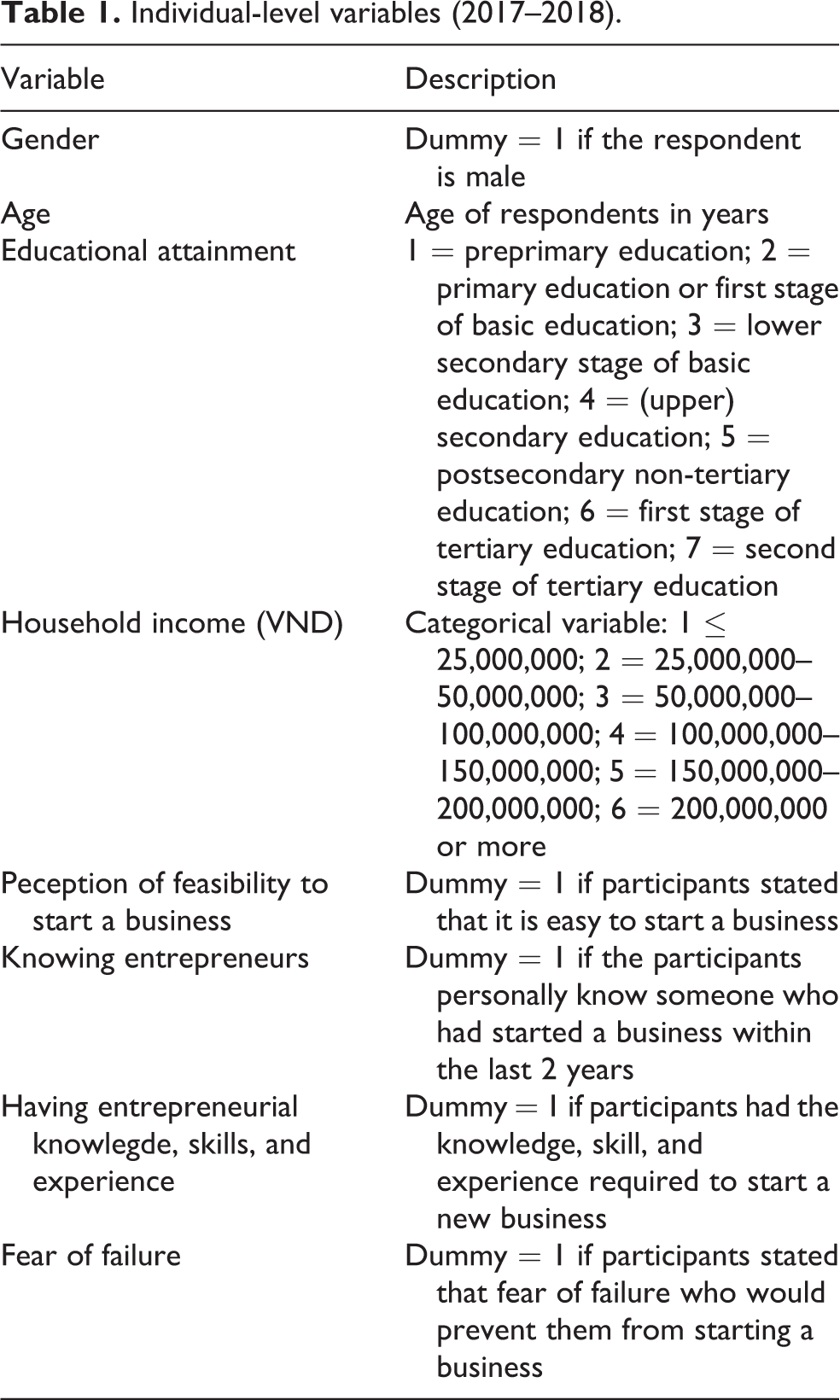
To test our hypotheses, we use dummy variables at the individual level for perception of starting a new venture (1 = yes, 0 = no); respondents know an entrepreneur (1 = yes, 0 = no); individuals have entrepreneurial knowledge, skills, and experience (1 = yes, 0 = no); and whether people indicate they are fear of business failure (1 = yes, 0 = no). We also argue that educational attainment moderates the relationship of fear of failure to entrepreneurial feasibility. So we treat educational attainment as dependent variable and use dummy variables for the lowest educational level as an indicator for human capital. 7 Furthermore, individual control variables are gender (1 = male, 0 = female), age of participants (in years), and household income as measured by six different categories. The definitions of all variables are listed in Table 1.
Individual-level variables (2017–2018).
Data analysis
The proposed regression model in this study is logistic regression because of the following: (i) all the independent variables are dichotomous or categorical and (ii) the dependent variable is dichotomous. The statistical program STATA v15.0 (Stata, College Station, Texas, USA) is used to analyze the data and test the research hypotheses.
As mentioned, logistic regression is used to describe data and to understand the relationship between one dependent binary variable and one or more nominal, ordinal, interval, or ratio-level independent variables. In many cases, that dependent binary variable (outcome event) can be easily categorized into classes of having occurred, or not having occurred, that is, the occurrence of a stroke, or of going bankrupt, is relatively easily discerned and coded as either having happened, or not having happened. Once this categorization has been obtained, the independent variables (predictors of that outcome) can be studied. 38,39 A concern in developing of a logistic regression model is that which variables are selected to analyze as potential predictors of the outcome.
Results
Entrepreneurial feasibility: Regression analysis results
We use logistic regression model as a statistic method for analyzing data and confirming hypotheses H1–H3.
In Table 2, perception of feasibility to start a business is treated as a dependent variable for testing hypotheses H1–H3. The independent variables consist of knowing entrepreneurs; having entrepreneurial knowledge, skills, and experience; fear of failure; and educational attainment. The control variables are gender, age, and household income.
Perception of feasibility to start a business (logit regression).a

a Binary variale is 1 if respondent’s perception of starting a business is easy.
***p < 0.01: significant level.
**p < 0.05: significant level.
*p < 0.1: significant level.
The baseline model (Table 2, column II) indicates that respondents with knowing entrepreneurs have strongly positive effect on perception of feasibility on starting a new venture compared to people without this opportunity (p < 0.001), that is in line with our first hypothesis (H1). Moreover, Table 2 (column II) shows the logistic regression coefficients. The predicted logit model was established by the use of following variables, including gender; age group 25–34 and 45–54; educational attainment at lower secondary level, at upper secondary education, at postsecondary non-tertiary education, and at the first stage of tertiary education; and household income between 150.1–200 and more than 200 million VND. The other variables were dropped because they did not contribute significantly to the model. The hypothesis H2 is supported by result in the model (Table 2, column III). The positive coefficient in this case indicates that, on average, the perception of Vietnamese adults who have entrepreneurship knowledge, skill, and experience about start-up capabilities is more positive than those without these capabilities. The odds ratio reveals that individuals with having the entrepreneurial human capital (e.g. knowledge, skills, and experience) are, on average, 1.63 times more likely to start a new business than people lacking of business skill, knowledge, and experience. Additionally, Table 2 (column III) provides the coefficients. The following variables, including gender; age group 25–34, 35–44, and 45–54; educational attainment at lower secondary level, at upper secondary education, at postsecondary non-tertiary education; and household income between 101–150, 150.1–200, and more than 200 million VND. The other variables were excluded because they did not contribute significantly to the model.
With respect to the relationship between fear of business failure and the perception of feasibility of starting a new firm, the statistical result is insignificant (see Table 2, columns IV and V). In other words, Vietnamese adults’ fear of entrepreneurship failure does not have direct impact on their opinion on starting a new business. However, when dummy variable fear of business failure is interacted with the continuous educational attainment variable (Table 2, column VI), the finding is interesting insights. Fear of entrepreneurial failure becomes strongly significant and has a negative impact on perceived feasibility. That means the negative effect of fear of failure on the perception of starting a business is stronger among individuals who are more likely to fear of entrepreneurship failure. Furthermore, the higher the individuals’ educational level, the weaker is the negative effect of fear of failure perceived feasibility of starting a business. Other than that, Table 2 (column IV) shows that age group 25–34 and 45–54; educational attainment at lower secondary level, at upper secondary education, and at postsecondary non-tertiary education; and household income between 100.1–150, 150.1–200, and more than 200 million VND should be included in the model.
Table 2 also shows that gender is strongly significant associated with perception of feasibility to start a new business and male perceive entrepreneurship capabilities more positive than female. The link between age groups and entrepreneurship perception is presented in Table 2, younger people have a less positive opinion on entrepreneurship than older people. It should be noted that the influence of age on the perceived feasibility of starting a business is different in age cohorts. People in the age group from 25 to 34 have a more negative perception of start-up feasibility than age group 45–54. Whereas individuals in age groups (35–44 and 55–64) are statistically insignificant to entrepreneurship capabilities. Figure 1 also shows the visible results, individuals at age group 45–54 have more positive perception of feasibility than those at age cohorts 25–34.

Probability of perception of feasibility to start a new business across age groups of respondents (based on Table 2, column I).
The influence of education on adults’ perception of feasibility to start a new start-up venture in Vietnam environment seems to be rather weak. It can be seen that educational attainment is significantly associated with perception toward entrepreneurship at different levels of education. This is to say, individuals with higher education have less negative effect on the perceived feasibility of starting a business than people with lower education. Respondents who are at postsecondary non-tertiary education perceive more positive about entrepreneurship feasibility than those are at lower secondary education. While educational attainment is an insignificant effect on entrepreneurial perceived feasibility with regard to people who are at the first and second stage of tertiary education. This relation is also clearly noticeable in Figure 2.

Probability of perception of feasibility to start a new business across educational attainment (in level) of participants (based on Table 2, column I).
For presenting the relationship of household income with the perception of start-up feasibility, the finding in Table 2 reveals that individuals with household income are less than 100,000,000 VND have an insignificant statistic effect on perception of feasibility to start a new business. In contrast, income with higher level upper 150,000,000 VND or more is positively significant related to the perceived feasibility of starting a business, particularly, respondents with higher household income are more likely to start a new business venture than people with lower household income. This effect is particularly noticeable in Figure 3. The higher the income an individual, the stronger is the positive perception of feasibility toward entrepreneurship.

Probability of perception of feasibility to start a new business across household income (in level) of participants (based on Table 2, column I).
Fear of failure: Logit regression results
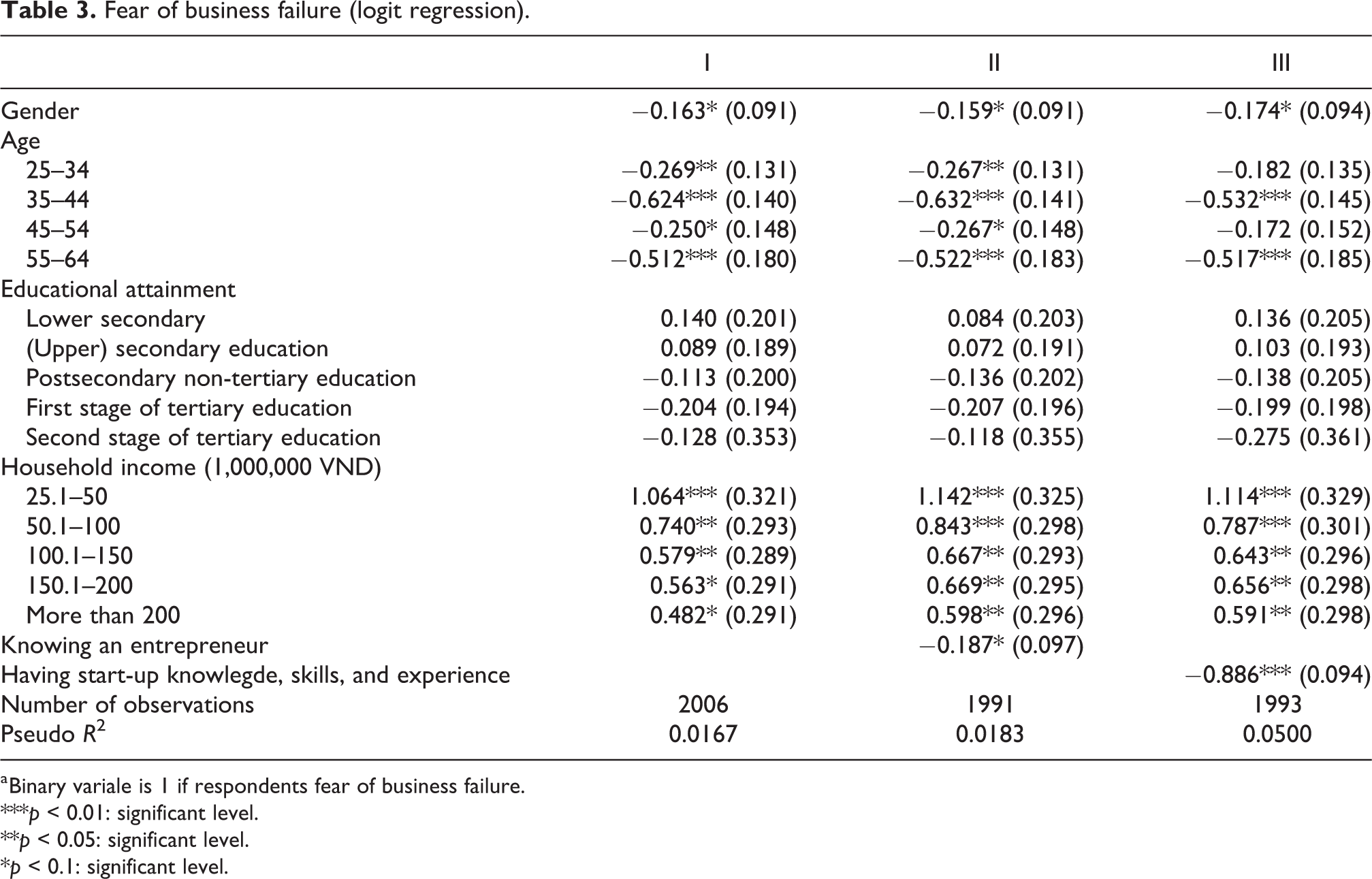
To test the hypothesis H4, fear of failure as a dependent variable is regressed on knowing entrepreneurs. It is controlled for gender, age, educational attainment, and household income. The coefficient in column II of Table 3 indicates a negative effect which is in line with our hypothesis (H4). That means having a social connection with an entrepreneur decreases significant fear of business failure. In other words, the more entrepreneurial role models individuals have, the less fear of failure in starting a business they are. To confirm the hypothesis H5, we run logit regression on having entrepreneurial knowledge, skill, and experience as independent variable, and fear of failure is treated as the dependent variable in the model. The result in column III of Table 3 pronounces that individuals who have human capital (e.g. entrepreneurial knowledge, skill, and experience) are less likely to fear of business failure compared to people without these human capital (p < 0.001). This finding is consistent with our hypothesis (H5). The odds ratio shows that individuals with having entrepreneurial human capital (e.g. knowledge, skills, and experience) are, on average, 0.41 times less likely to fear of entrepreneurial failure than people lacking of business skill, knowledge, and experience.
Fear of business failure (logit regression).
a Binary variale is 1 if respondents fear of business failure.
***p < 0.01: significant level.
**p < 0.05: significant level.
*p < 0.1: significant level.
Table 3 also reveals that gender is significantly associated with fear of business failure, and woman are more likely to fear failure. With regard to the influence of age on fear of start-up failure which is significant and seems to be followed by an inverted u-shape relation, except age group 35–44. Therefore, fear of business failure increases with age in younger years, while it decreases at older age groups (Table 3, column I, and Figure 4). With respect to education and entrepreneurship, as previously mentioned, Vietnam education may not have strong enough to encourage adults to engage in start-up. Indeed, it seems that there is no empirical evidence for indicating the effect of educational attainment on fear of entrepreneurial failure as well (Table 3, column I). When we even repeat a test in which respondents have entrepreneurial knowledge, skill, and experience (see again Table 3, column II), we still find no education-related effect on fear of failure in starting a new venture. In the logit models in Table 3, the findings also pronounce the significant relationship between household income and fear of failure (Figure 5). The coefficients in these cases indicate that the lower the household income an individual possesses, the higher their fear of failure is. It is can be said that Vietnamese adults with higher household income are more business adventure than those with lower household income (p < 0.05).
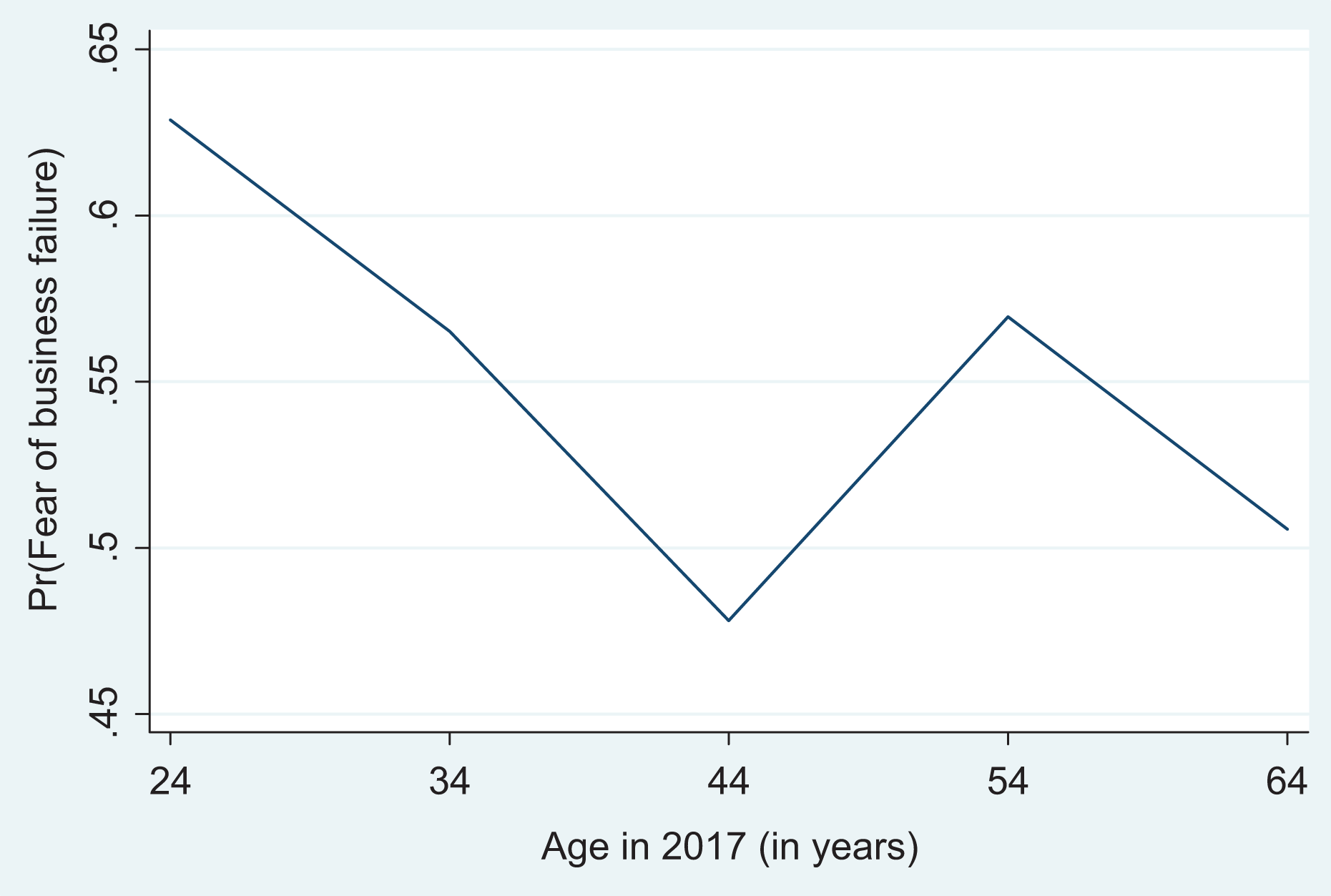
Probability of fear of business failure across age groups of respondents (based on Table 3, column I).

Probability of fear of business failure across household income (in level) of respondents (based on Table 3, column I).
Discussion and conclusions
The study examines the factors that affect the perception of feasibility to start a new business among Vietnamese, among a sample of 2118 respondents. Results show that knowing an entrepreneur is positively and significantly associated with perception of feasibility to start a business, and entrepreneurial knowledge, skills, and experience on an individual’s perception are the major determining factors of starting a venture in Vietnam. The study also indicates that people show more fear of failure when they are less likely to engage in a business, and these effects are more negative in people who are less educated.
The study explores the effect of entrepreneurial role models, having entrepreneurship knowledge, skill, and experience, and fear of failure on individual entrepreneurial perception. We argue that individuals who have social connection with entrepreneurs are more positive perception of feasibility toward entrepreneurship. Furthermore, we indicate that people with gaining start-up human capital (e.g. knowledge, skill, and experience) are stronger positive perception of feasibility to start a new firm than those lacking of these capabilities. We are also interested in the moderating effect of educational attainment on the relationship between fear of failure and perception toward entrepreneurship. We argue further that the negative effect of fear of failure on individuals’ perception of feasibility to start a business is moderated by educational attainment. Moreover, the higher the individuals’ educational level, the weaker is the negative effect of fear of failure on the perception of feasibility to start a business. Besides, this study tests the influence of knowing entrepreneurs, having start-up knowledge, skill, and experience on fear of business failure. We argue that people with having social contact with entrepreneurs are less likely to fear of failure. Also, we argue that having entrepreneurial knowledge, skill, and experience reduces fear of start-up failure. We employ data from the GEM 2017/2018 (APS) for testing the hypotheses in the context of Vietnam.
The empirical findings reveal that a positive impact of connection with “start-up role model” on perception toward entrepreneurship. Our result is consistent with previous studies, for example, Wagner and Sternberg 40 stated that “contacts with young entrepreneurs will reduce costs because they make it easier to get answers to lots of ‘how to’ type questions relate to a start-up” (p. 229). Aside, social networks, for instance, having personal entrepreneurial connection provide opportunities and useful information related to start-up that makes people be more willing to engage in entrepreneurship. Business-knowledge, business-skill, and experience related to human capital help individuals recognize and exploit start-up opportunity 27 and be successful in starting a new venture. 8 Our findings substantiate their arguments in that we find remarkably significant and positive effect of entrepreneurship knowledge, skill, and experience to entrepreneurial perceived feasibility.
As we expect, fear of failure has a negative direct impact on entrepreneurial perception of feasibility. However, this direct link is insignificant. Nevertheless, a moderating effect of educational attainment on the negative relationship between entrepreneurial perception of feasibility and fear of failure is identified. Individuals are, therefore, high level of fear of failure, they have more negative perception of start-up capabilities. “Fear as an avoidance-oriented emotion indicates threat” (p. 5). 41 Fear of failure is associated with high degree of risk-aversion that reduces exploitation of start-up opportunities. 40 –42 The higher the respondents’ educational level, the weaker is the negative effect of fear of failure on perception of starting a business. Moreover, our results confirm that having a personal contact with an entrepreneur, having knowledge, skill, and experience related to start-up also reduce fear of failure. This findings are in a line with previous arguments.
Our study is not without limitations. Older people who are at the age of 59 or more are unlikely to engage in entrepreneurship. “Business creation is clearly concentrated among young and mid-career adults” (p. 36). 43 A sample with older people may increase risk aversion that generates immediate income (e.g. paid employment). Our analysis sample includes older people with more than 59 years old (4%), hence, a further research should exclude these respondents in analyzing fear of failure as a predictor variable. Furthermore, we use a full sample which includes entrepreneurs and non-entrepreneurs. As a result, we neglect the difference in perception of starting a new venture between entrepreneurs and non-entrepreneurs. It is, therefore, highly desirable to examine the determinants of perceived feasibility toward entrepreneurship in a two-isolated respondent sample.
Although our study’s hypotheses are based on the solid theory, future research should focus on integrating a greater number of sociocultural variables into the analysis. Larger data set from all regions in Vietnam may provide more comprehensive results. Moreover, entrepreneurship is influenced by various other variables including demographics and individual’s social position. Future research is needed to evaluate these attributes related to entrepreneurship.
In summary, this study adds to entrepreneurship research in the context of Vietnam by providing the findings on the entrepreneurial perception. To foster wealth creation and job generation, the government of Vietnam is seeking the measure to increase the number of entrepreneurial activities. From a policy perspective, the study shows that officers in education institutions should design and develop special study programs to provide entrepreneurial knowledge and skill for entrepreneurs and young people. Our findings demonstrate the need of entrepreneurship support measures and promotion. For example, youngsters need to be invited more to the classroom or showcase to testify about their career choices, media should focus more on positive entrepreneurial role models. It can be concluded that constraints which hinder the development of entrepreneurial activities may partly be explained by knowledge-related factors.
Footnotes
Declaration of conflicting interests
The author(s) declared no potential conflicts of interest with respect to the research, authorship, and/or publication of this article.
Funding
The author(s) received no financial support for the research, authorship, and/or publication of this article.
