




Abstract
The various advancement in cellular technology has drawn huge attention to green communication by the stakeholders. Base station (BS) sleeping technique has been proposed as a way to reduce energy consumption in cellular networks, however, this may result in service delay for cellular users. In this article, we propose a queueing decision model for BS sleeping technique that maximizes energy-efficient utilization of the BSs in a green communication network while reducing the mean service waiting time for cellular users. The proposed model also ensures an optimal and interference-free resource sharing scheme that effectively enables channel borrowing through BS association in the network, thereby reducing call drop rate and further improving quality of service in the network. Numerical simulations are performed to observe the impact of the proposed model on spectrum access and consequently on the throughput of the green communication network. The article also observed the possible improvement in network delay with the proposed model. Results show that the queueing decision model is more energy-efficient. The model also provides a more spectrum-efficient sharing scheme compared to existing models, thereby enabling better network throughput.
Introduction
In recent years, mobile operators are faced with the challenge of keeping up with subscribers’ demand for higher data services due to advancement in data-hungry applications and exponentially increasing smart devices. Mobile operators, in a bid to meet up with the market demand, are strategically adding more base stations (BSs) to the existing ones. Consequently, an additional cost is incurred in the deployment of these BSs in terms of operational expenditure (OPEX) due to their energy consumption especially in developing countries with rural regions that are off the national electricity grid and are dependent on generators to power the BSs. In such cases, the concern is not only on the cost needed to run the BSs but also on the contribution of these power generators to environmental degradation through CO2 emission. In a recent study, the information and communications technology (ICT) industry which accommodates mobile communications as a sector is shown to contribute 2% of carbon emission to the global carbon footprint. 1,2 In mobile cellular networks, the major source of energy consumption is the BS and it consumes 50–80% of total energy. 3,4 Research has shown that about one-fourth of total energy used to power a BS is wasted when the BS is not experiencing any traffic. 5,6 Thus operators and researchers are faced with the challenge of minimizing energy consumption which constitutes a huge part of OPEX and at the same time maintaining an eco-friendly environment.
The major ways of achieving an energy-efficient network include the improvement of the energy efficiency of the hardware component, selective turning on/off of network components, energy-efficient optimization of the radio transmission process, deployment of heterogeneous cells and the use of renewable energy resources for powering the BS. 7 These approaches have their pros and cons as highlighted in the survey conducted by Wu et al. 7 but they all aim at reducing the energy consumption of the cellular network and greenhouse emissions. A promising approach to minimizing energy consumption is to switch off a BS experiencing low traffic and transfer its associated users to the neighbouring active cells. The turning off of the BSs, sometimes known as BS sleeping technique, primarily achieves energy saving by hibernating the BS periodically. This is generally carried out by setting a decision protocol that puts the BS in the active mode during the peak traffic period and in the sleep mode during the less traffic period. This technique has greatly reduced the unnecessary energy usage of the components in the telecommunication site, most especially in the energy consumption of the BS. 8 –11
A lot of work has been done towards a greener ICT and in reducing the energy consumption of the hardware in a cellular network. The BS sleeping technique has been of utmost interest to the researchers and the service providers because its implementation is easy and cheap since it does not involve the replacement of the existing network hardware. Li et al. 12 proposed the optimization of BS density with a sleeping strategy for one-tier and two-tier networks. The BS locations are modelled as a Poisson point process. The problem is formulated with the main objective of finding the number of BSs in which sleeping technique can be optimally performed. The result shows that energy utilization can be improved by the optimal deployment of BSs with their adopted sleep strategies. In the work of Oh et al., 13 the authors studied the load impact of switching off BSs on the neighbouring cells. Based on this, they presented a distributed switching ON/OFF algorithm which takes into consideration the load levels of neighbouring BSs before initiating switching OFF action. Xiao et al. 14 propose two power consumption techniques to determine the sleeping mode of BSs. Random sleep mode and load-awareness sleep mode are considered to operate within these power consumption profiles. The random sleep mode is designed following the binomial distribution of small cells while the load-awareness scheme operates based on the load level of the BS. Operating probabilities are established for the different sleep modes in order to determine the state of the small cell BSs. In the work of Niu et al., 15 a queuing model for BS sleeping in a single cell is proposed, where there is a trade-off between network delay and energy saving. Contrary to the work we present in this article, their work did not consider the necessary handover and the transfer of the users associated with the sleeping BS to the neighbouring BS. This resulted in increased call dropping and reduced cell coverage during the BS sleeping period. A traffic load variation model that switches off certain BS during the night hours is proposed by the authors in Bousia et al., 16 though they achieved 70% energy savings, their algorithm is not feasible because BS association and resource allocation were not considered. Also, the switching off of the BS throughout the night-time is not an ideal model because of the users that will require network services at that time and in case of emergencies.
In Oh et al., 13 a distributed switching algorithm that enables the BS and the user equipment to share network information among themselves periodically is proposed. The BS switches off after receiving a cleared prompt by the associated neighbouring BS that can provide service to its users. The interactions between the BSs in their scheme are not centrally controlled, therefore, cellular coverage holes can occur using their algorithm. A BS ON/OFF scheme is proposed in the work of Marsan et al. 17 based on the daily traffic pattern of the network users. The authors modelled the cellular traffic as a sinusoidal profile that is dependent on the fixed day and night activities of the users and their routine movement. Similar to the study of Bousia et al., 16 the quality of service (QoS) is not guaranteed in the proposed scheme, because the network user behaviour is a dynamic function that can never be fixed depending on varying circumstances.
The motivation for this work is based on the huge cost needed to power BSs in countries with low on-grid power generation capacity and also on the contribution of power generators used at these BSs to environmental degradation through CO2 emissions. In this article, we propose a BS sleeping decision algorithm that aims to reduce the energy consumption of the underutilized BSs while maximizing the channel capacity. Different decision algorithms have been used to solve various decision-making problems in the past. 18 –20 Our algorithm is based on a BS association mechanism where sleeping BS is able to borrow channels from associated active neighbouring BSs for their users. The coordination among BSs is carried out by the base station controller (BSC) that performs energy conservation by selectively turning off BSs when their traffic is below a specified threshold. This is done with our developed queueing decision model which is used by the BSC to queue traffic for neighbouring cells in a way to improve spectrum channel access, thereby optimizing channel capacity and maximizing energy efficiency. The major contributions of this article are as follows:
Proposal of a Markovian-based queueing model for BS sleeping technique that maximizes the efficient energy utilization of the BSs in a green communication network;
formulation of an optimal and interference-free resource sharing scheme that effectively enable channel borrowing through BS association in the modelled network, thereby reducing the call dropping rate in the network and improving network throughput;
presentation of a dynamic channel borrowing scheme which ensures that users of sleeping BS are optimally assigned channels from neighbouring cells in order to avoid coverage holes in the network; and
formulation of a dynamic algorithm that adjusts BS mode based on traffic for a proper balance between optimal energy savings and QoS assurance in the network.
The rest of this article is organized as follows: The system model and the assumptions of the proposed BS sleeping scheme are discussed in the next section. In the ‘Queueing CTMC model’ section, we present the algorithm of the queueing decision model and the illustration of the energy-saving scheme for both active and sleeping BS modes. The analysis of the proposed scheme, simulation results and technical discussions are presented in the ‘Numerical analysis’ section. Finally, the concluding remarks are given in the final section.
System model
In this article, we consider the use of a dynamic channel borrowing, BS association scheme for maximizing the capacity of a green cellular network with enabled BS sleeping mode. A green communication network consisting of a sleeping BS and K neighbouring BS is considered. We model the system such that a BS goes to a sleep mode when there are
Figure 1 shows the system diagram. The cellular user A is attached to cell A with a BS in sleeping mode. It is assumed that in sleeping mode, BSs are still able to communicate with the BSC which serves as a central server for the virtual green communication network. User A is queued up by the BSC to use a borrowable channel from one of cell A’s neighbouring BSs. Borrowed channels are relinquished to the donor BS upon completion of service to user A. In cell A, cellular users arrive according to a Poisson process with arrival rate

Virtual green communication network.
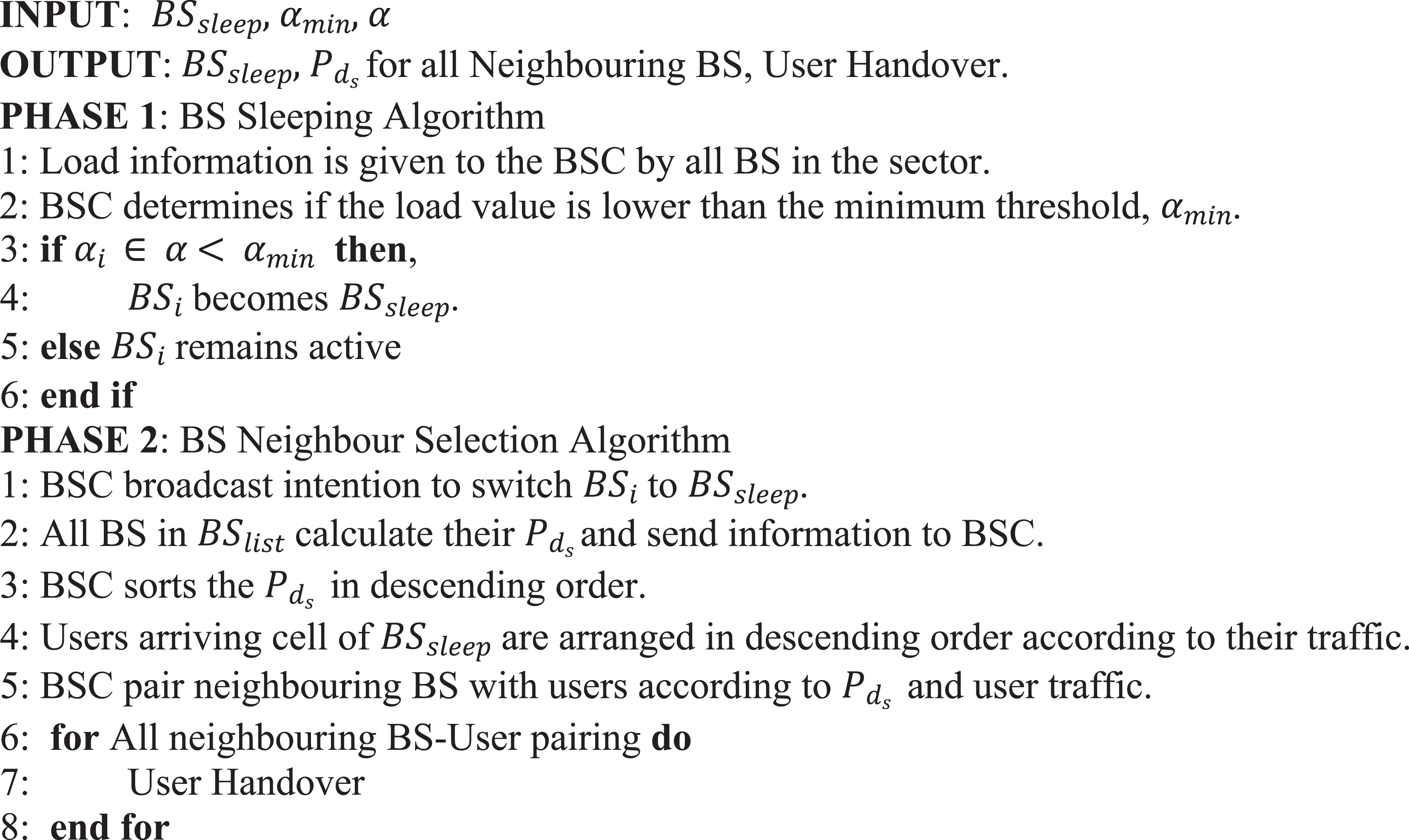
We first model the scenario where BS sleeping mode is not enabled in the communication network. In this case, BS remains active even when there is no user to be served or when traffic is low. The spectrum access is modelled as a continuous time Markov chain (CTMC). The energy consumption and capacity of such a network is thereafter determined. Thereafter, we model the case where BS sleeping mode is enabled. In this case, when there is low traffic or no user in the cell, the BS switches to the sleep mode and can become active when N users assemble in the cell. The spectrum access is modelled as a CTMC with queueing where cellular users attached to the sleeping BS have the opportunity to queue up and access borrowed channels from neighbouring BS.
As depicted in Figure 2, the set of neighbour K is determined by forming a seven-cell cluster with the sleeping BS at the centre. This is similar to the work done by Mwashita and Odhiambo
21
except that all the seven cells are controlled by the BSC instead of the cell at the centre. This makes communication and coordination more effective. As soon as the BSC broadcast the intention to switch off a certain BS because of low traffic, the neighbouring macro BSs calculate the specific dynamic power Seven-cell cluster for neighbour cell determination.

where

where

and the channel capacity for user A when it coexists with another user B in the same spectrum is

where W is the communication bandwidth, no
is the thermal noise power, PA
and PB
are the transmission power for users A and B, respectively, and

where Ps
is the static power consumed when the BS is idle,
Queueing CTMC model
In this section, the network is first modelled as an exclusively active network in which, irrespective of the number of users in the cell, the BS remains active. Later we model the queueing CTMC as a BS sleeping-enabled green communication network where, in a bid to conserve energy consumed within the network, BS is turned off if less than N users are in a cell. The probabilities involved in these transitions are computed and used to derive throughput that can be achieved in each network and the energy consumption of each network.
Exclusively active BS model
We consider the downlink of a single BS where users arrive according to a Poisson process with parameter

Q-state CTMC for the exclusively active BS model. CTMC: continuous time Markov chain; BS: base station.
The Q states of the CTMC.

CTMC: continuous time Markov chain.
Definition of notations.
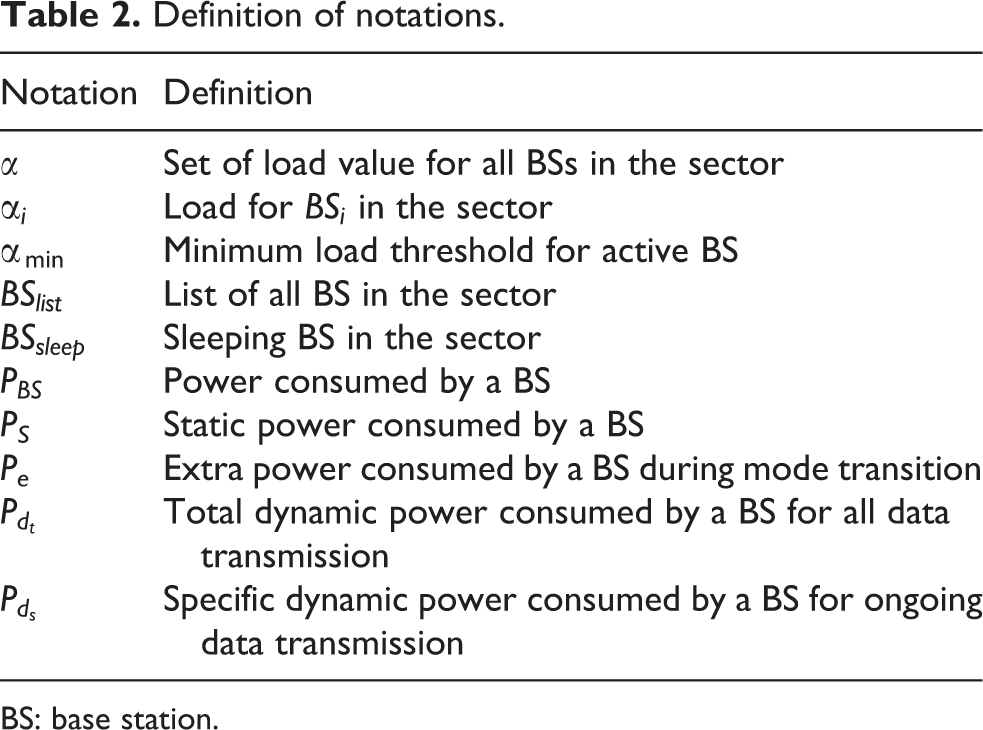
BS: base station.
Generally,


Generally


To determine the steady state probability π, we determine the probability to be in every state listed in Table 1. This is done by solving equations (5) and (6). The results are the steady state probabilities given as


for
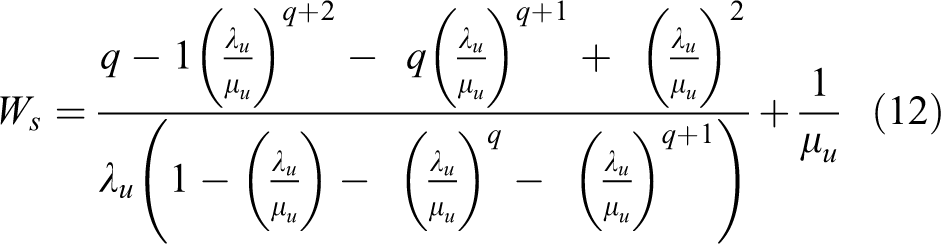
The energy consumption in this cell is as
BS sleeping-enabled model
In this model, we consider the downlink of a single BS where users arrive according to a Poisson process

N − 1. state CTMC for the BS sleeping-enabled model. CTMC: continuous time Markov chain; BS: base station.
Sleeping BS load handover algorithm.



Again, equation (13) represents the flow balance at each of the states in the Markov chain and equation (14) represents the normalization equation that must be satisfied. In general, equation (13) can be written as

for

for

where

The average number of cellular users in the green communication cell is derived as

and therefore

and the waiting time Ws for n users in the cell with a sleeping BS is

where

where the parameters are as defined before and
Numerical analysis
In this section, the system performance of the sleeping BS model which is based on Markovian queueing decision model is evaluated and analysed in terms of BS power consumption, the delay caused to the system and total throughput achievable. The article simulates a green communication network consisting of a sleeping BS and six neighbouring BSs. The system is modelled such that a BS goes to sleep mode when there are 9 users or less in the cell and returns to active mode when 10 users or more assemble in the cell. We have considered a cell with a radius of 1000 m having the BS located at the centre and users randomly distributed around it. We compare the proposed sleeping BS model with models based on exclusively active BS mode. MATLAB (2015b, The MathWorks, Inc., Natick, Massachusetts, United States) is used to conduct the simulation experiments in order to determine the power consumption rate and throughput in a cell using each of the two schemes discussed in the ‘Queueing CTMC model’ section . The goal is to compare the performance of the exclusively active model with our proposed sleeping BS model in order to determine the optimal energy-delay trade-off. Table 3 shows the simulation parameters used in this article.
Simulation parameters. 22

BS: base station.
The performance of the proposed BS sleeping model is validated by comparing it with the method used by Hossain et al., 23 where energy-efficient envelope tracking (ET) power amplifiers were used for BS energy savings. The authors in this work were able to achieve 7–15% energy savings by replacing traditional power amplifiers at the BS with ET power amplifiers. Figure 5 shows the comparison of our proposed sleeping BS model with an exclusively active BS using ET amplifier model. We also compared our proposed model with exclusively active BS using traditional power amplifiers but with coordinated spectrum access as discussed in the ‘Exclusively active BS model’ subsection. It can be shown that by comparing the total power consumption of the three schemes, the exclusively active BS with traditional power amplifiers consumed the most power even with the coordinated spectrum access while our sleeping BS model consumed the least power. Our model showed 46% decrease in energy usage compared with exclusively active BS while the ET power amplifiers had 17% decrease in energy usage when compared with traditional amplifiers.
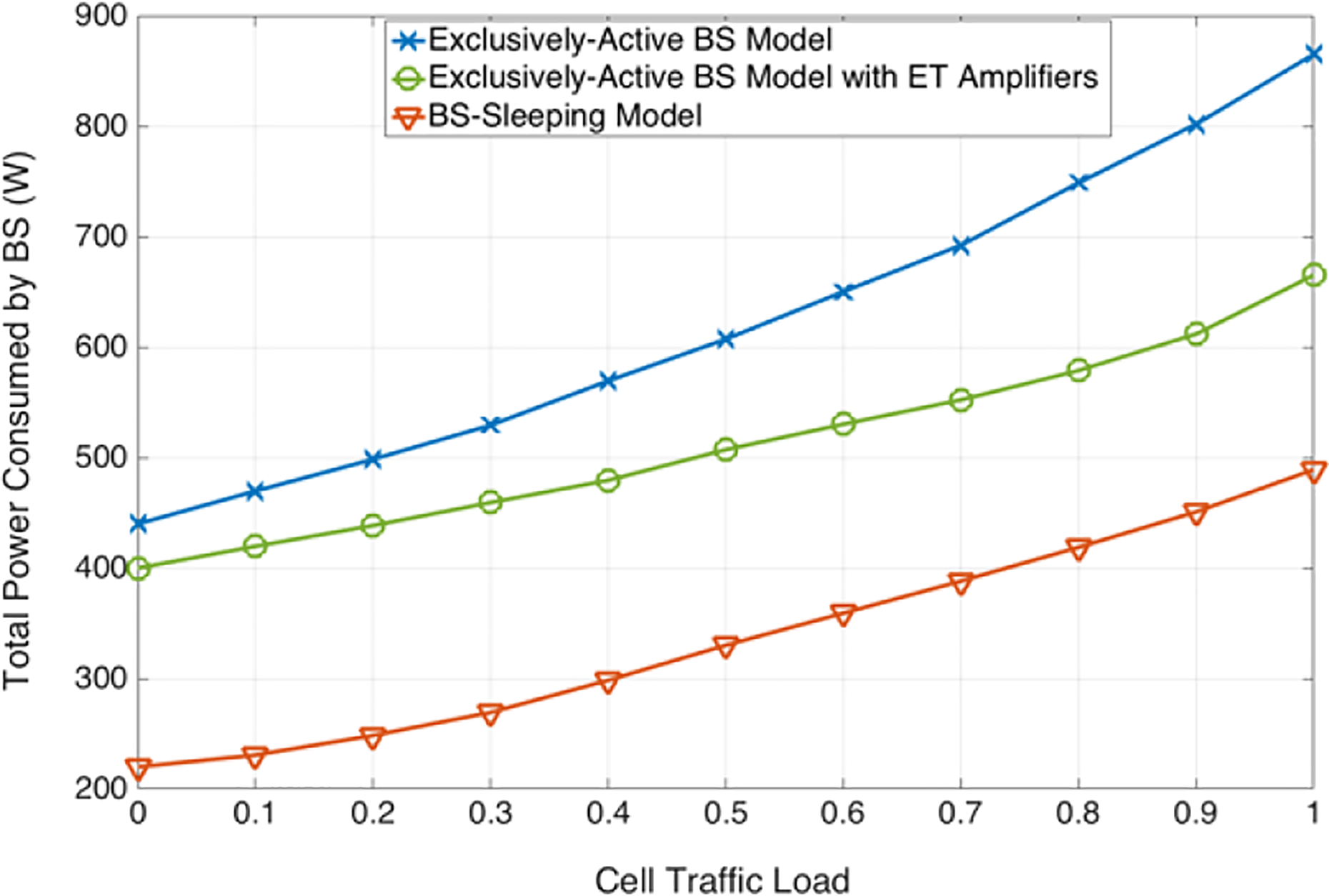
Relationship between total BS power consumption and cell load traffic. BS: base station.
Figure 5 also shows that at no load in the cell, the BS consumes a certain percentage of maximum power consumption

Delay performance in BS sleeping mode. BS: base station.
Figure 7 compares the impact of arrival rate on throughput for both exclusively active BS and BS sleeping models. Both models showed a linear reduction in throughput as the arrival rate is increased. However, the sleeping BS models had a slightly lower throughput especially with high arrival rate due to the reduction in access probability rate. Finally, in Figures 8 and 9, we examine the optimal trade-off between the two models discussed. Figure 5 showed that the sleeping BS model had the best performance in terms of energy savings while Figure 7 showed that exclusively active model had a slightly better performance in terms of network throughput.

Relationship between network throughput and arrival rate.

Energy-delay trade-off with

Energy-delay trade-off with
The reality is that network operators desire both the increase in network throughput and the reduction in operational cost that results from energy savings. Figure 8 shows total power consumed by both sleeping BS and exclusively active BS as waiting time is increased for the case where the arrival rate is fixed at 2 s−1. Figure 9 shows the same comparison for an increased arrival rate of 6 s−1. It can be seen from Figure 8 that when the arrival rate is low, the slight loss in throughput for great savings in total power consumed by the sleeping BS model is worth it as power consumption in this model is very low. However, from Figure 9, as the arrival rate is increased to 6 s−1, and waiting time is increased, the power consumption by the BS rises in the sleeping BS model too. Though it can be seen from the figure that power consumption is still slightly reduced in sleeping BS compared to exclusively active BS with increased waiting time, it may not be efficient to sacrifice network throughput for this small energy savings.
From Figures 7 to 9, at low arrival rates like ₦25.3 billion ($70 million).
Conclusion
In this article, we propose a Markovian queueing decision model for efficient energy usage in green communication networks. The article models the system such that a BS goes to sleep mode when the number of users in the cell is less than an acceptable maximum and returns to an active mode when at least a certain number of users assembles in the cell. The article compares the performance of the proposed Markovian queueing model with the traditional exclusively active BS model using a Markov chain to coordinate spectrum access and also with an existing ET power amplifier efficiency model, both of which does not support BS sleeping mode. Numerical results and simulation results are presented to validate our analysis. Results showed that the proposed BS sleeping model is the most energy-efficient of all the methods with 46% decrease in energy compared to exclusively active BS model. Network throughput is also considerably high especially when using this model with a low arrival rate. Our results showed that network capacity is considerably the same at
Footnotes
Declaration of conflicting interests
The author(s) declared no potential conflicts of interest with respect to the research, authorship and/or publication of this article.
Funding
The author(s) received no financial support for the research, authorship and/or publication of this article.
