




Abstract
Various understandings of enterprise architecture (EA) exist and there is no agreement on them. The various definitions of EA are not always complementary but sometimes in opposition. Within this study, we conduct a systematic literature review to analyze explicit definitions of EA. Based on concepts from the academic field of terminology, we have broken down these definitions into many parts in order to examine each part individually before making generalizations. The findings show how some of the EA definitions are implicit, incomplete, complex, and incoherent.
Keywords
Introduction
Despite growing interest in enterprise architecture (EA), the field is facing a lack of uniformity. Indeed, the literature presents various ways to approach EA, 1 but they are not always complementary or nuanced, and are sometimes in opposition. Various definitions of the term “enterprise architecture” itself exist but there is no agreement on them. This situation may create confusion and conflict concerning the purpose of EA, the way to practice it, and the benefits it provides to organizations. This may also result in a lack of cooperation between professionals practicing EA. 2
Many studies have reported this lack of uniformity in EA, but few explored the nature of this lack. The aim of this exploration of explicit EA definitions found in scientific journals is to identify their most important characteristics, in order to classify their similarities and dissimilarities. We used systematic literature review (SLR) 3 as a well-defined methodology to achieve this objective.
In fact, the rationale of this study can be summarized in the following questions: “If the different perspectives expressed in the definitions of EA are not known, how can people assess the extent of their differences and address this issue? Further, if the definitions are not divided into several similar parts in order to analyze them in depth and compare them according to appropriate methodologies, such as SLR, how can the reliability of the findings be ensured?” The most important contribution of this study is its focus on opening directions for future research concerning the lack of uniformity in EA.
The rest of this article follows the following structure. We present the context of this study and the literature review in the second section, and the research questions and research design in the third section. In the fourth and fifth sections, we present and discuss the results of this. We describe the limitations and the contributions of this study, as well as directions for future works, in the sixth section.
Literature review
Context of this study
Despite growing interest in EA, many researchers and practitioners have described the existence of a lack of “common understanding,” 4 “common terminology,” 1 and “shared meaning” 5 in EA. The existence of various definitions of EA and the absence of agreement on these definitions are considered an important issue, because while some of these existing definitions are complementary, others are in opposition. 5 In fact, although many people worldwide have been actively practicing EA, different and divergent points of view with regard to the significance of the term “enterprise architecture” itself exist. And no universally agreed “baseline of knowledge” exists yet. 6
Related work
Few works have been conducted with the aim to shed light on the lack of uniformity in EA, 7 whereas the literature continues to report this lack. The following works are among those that have addressed this problematic as their main focus.
Schöenherr 4 investigated 126 references, which include journal articles, conference articles, proceeding articles, books, and websites, produced by researchers and practitioners from 1987 to 2008. The results show that the majority of these references do not present a definition of EA. The majority of the definitions cited in these references are not elaborated by their authors but come from other publications. The definitions that were found were classified as one of three different approaches: technology-driven, system-driven, and method-driven.
Lapalme 1 has affirmed that the definitions of EA in the literature are not clear “in terms of scope and purpose.” Three major “ways of approaching EA” have been suggested within this work. Each of these ways of approaching EA has its own characteristics, including a specific definition of EA, concerns, assumptions, and limitations.
Based on the “3 modes” of EA, 8 the “3 schools of thought” 1 and other publications, 5 affirms that architectural works include three different interconnected architectures that are “the technical architecture, the socio-technical architecture, and the ecosystemic architecture.” These architectures correspond to distinct ontological and epistemological assumptions. Each of them requires its specific methods and tools, and is self-regulated.
However, the studies which focus on a lack of uniformity in EA do not use a systematic methodology to guide their investigations. Shah and Golder 9 indicate that some well-recognized organizations, such as the Open group, Microsoft, and IBM, have been working on defining EA, and have also presented work focusing on the problems of defining EA. 10 However, to date no study has essentially investigated the definitions of EA with the objective to illustrate the importance of this issue. Therefore, this study aims to provide a serious elaboration on the problem of defining EA that can be used to reach a broader understanding of EA, as well as provide relevant new research perspectives.
Research approach
Presentation of SLR
According to the objective of this study, which is to provide deeper insights concerning the terminology problem and areas for future studies, we selected SLR as an appropriate methodology. An SLR is a kind of secondary study which applies a well-defined methodology that ensures the identification, analysis, and interpretation of available evidence corresponding to a particular research question. The identification, analysis, and interpretation must be realized in a manner that is unbiased and reproducible. 3
The guidelines of Kitchenham and Charters 3 were followed to realize this investigation. These guidelines divide the process for conducting SLR into three major steps: planning, realizing, and reporting the review. The following sections describe the most important information concerning the planning and realization. This article represents the report.
Planning of the review
The planning of the review comprises its justification, the elaboration and description of the research questions, and the development of the review protocol. The previous sections already justified the importance of this study. We used a primary report developed by one of the authors as a predefined protocol which indicates the planning information to undertake the study. It was not necessary to realize a complex protocol because, as indicated in the next sections, the search, data extraction, and analysis processes of this study are “relatively straightforward.” 3
Research questions
Given that the objective of this study is to identify and categorize elements in EA definitions that might influence the lack of an agreed-upon definition, the main research questions are the following: What is the extent of the differences between definitions of EA, and how can these differences be characterized? What does the evolution of definitions of EA look like?
Execution of the review
The execution of the review comprises the identification of available references, the study selection, the study quality assessment, and the data extraction and synthesis. We present these steps in the next sections.
Identification of available references
Conducting an SLR is a time-consuming process for a single researcher, such as a PhD student, and could easily miss the deadline of its research project. 11 Authors can restrict themselves to the particular types of data sources which are most appropriate for addressing their research questions. 3 In effect, we conducted this step with the aim to keep the search process to a manageable size, and to ensure that the selected references include mature studies. This is why we selected only peer-reviewed journals and used a “relatively straightforward” search process. The underlying assumption is that mature EA studies have certainly been published in journals, and these journals also include the major findings presented or detailed in other types of scientific publications.
In order to search the journals, we consulted three relevant electronic sources: Compendex, Inspec, and Scopus. We selected these electronic libraries because they cover most of the major scientific publications corresponding to EA. In fact, some previous searches performed before this study justify that these electronic libraries return the most relevant results with the paper type selected and the search strings used. Their results also include the majority of those provided by IEEE and AIS electronic library.
The search strings used and adapted to each of the electronic library were “enterprise architecture” OR “enterprise architect” OR “EA” in the title of the publication.
Study selection
The most important elements in selecting primary studies are the inclusion and exclusion criteria. We used the following: Language: English (a large majority of scientific research are published in English). Date of Publication: 1987–2016 (according to the literature, the first EA publication was introduced in 1987, even it did not literally use the word “enterprise architecture”). Document type: journal paper (to keep the study in a managerial size).
The exclusion criteria include additional criteria we took into account to examine the articles found with the electronic libraries. After inspecting the titles and abstracts of the articles, we removed those that have been written in a language other than English. We also removed those with enterprise architecture or EA in their title that do not refer to the discipline of EA (i.e. an article titled “EA-based optimization of hybrid T-slot…”). And finally, we removed those that are not available for free download on the Internet, via the library of our affiliation institution. However, 95% of the articles were accessible.
The first authors (students) worked separately to verify the application of the inclusion/exclusion criteria. The included and excluded references were discussed with the third author (adviser). 3
Study quality assessment and data extraction
The “quality instruments” used to assess the study quality are usually the checklists of factors to be estimated. 3 Within this study, the most important factor that assures the quality of a selected article is the presence of one or more explicit definitions of EA within this article. Because of this, the study quality assessment was performed during the data extraction process. Searches were conducted on the whole content of each article in order to find definitions of EA. We classified the articles that not include a minimum of one explicit definition of EA, and extracted the explicit definitions that were present. In fact, when the verb between the defined element (i.e. enterprise architecture, EA…) and the definition itself (i.e. a discipline…) explicitly indicates an intention of giving meaning, the definition is considered as explicit. For example, explicit definitions come in the following forms: “EA is…; EA refers to…; EA is considered as…; a reference describes EA as….” While implicit definitions, for example, come in the following forms: “EA provides a set of principles…; EA is especially used as; EA can be used to…” We executed the data extraction process separately and compared the definitions extracted for validation. We discussed disagreements on the definitions extracted until finding mutual agreement.
Even if the objective was to keep the study to a manageable size, to assure the study quality, additional searches were conducted online in order to verify if the EA definitions extracted were representative. To achieve this objective, other references that analyzed or identified a list of the most common EA definitions were consulted in order to verify that these definitions were similar to those found in this study. For example, the definitions included in the study of Rahimi et al. 10 were consulted. This study is one of the few that analyzed many EA definitions with the objective to explain “what EA means,” even if this was not the objective of the whole study. The majority of the EA definitions found in the study of Rahimi et al. 10 were already included in the definitions previously extracted in our database. However, eight new explicit definitions found within this study were added to our database. Some definitions available on Wikipedia were also consulted, as well as some on Aris community web. The Aris community web pages propose people to vote for the EA definitions that correspond to their understanding.
It turns out more than 70% of the definitions consulted are similar to those analyzed. Because some of the definitions different than those included in our database are not explicit definitions, or because we cannot find exact references for them, we did not consider them within this study. But this exercise demonstrates how a large majority of the definitions found in journals are derived from EA authors and books, like Lankhorst, 12 Ross et al., 13 Schekkerman, 14 and Zachman. 15 Even if there are some modifications in their structure, almost the same words and terms are used. This also confirms that the extracted EA definitions are representative with respect to the definitions provided by the major professional institutions in EA, as IEEE, Cap Gemini, Forrester, Gartner Group, MIT Center for Information Systems Research, the US government Federal Chief Information Officer (CIO), the ArchiMate Foundation, the US Federal Enterprise Architecture Framework, and the Open Group Architecture Framework (TOGAF). As a result, the definitions selected are representative of those used by both practitioners and researchers.
As a result, we analyzed several explicit EA definitions that were extracted in journal articles and additional sources. Table 1 presents the evolution of references from their identification to the study quality assessment stage, in terms of the number of articles selected and explicit definitions found.
Evolution of the number of articles and definitions.

EA: enterprise architecture.
Data synthesis—framework for subdividing EA definitions
Given the aim to examine each part of EA definitions individually before making generalizations, the division process of the definitions followed models from the field of terminology. The main objective of the field of terminology is to study words, expressions and terms and the context of their use, according to their particular meanings. Because of this, the definition of a concept must be known in order to be understandable. In fact, definition provides a description of the properties of a word, expression, or term and specifies relations between many defining elements. Definition gives an explanation of the meaning of a word, expression, or term and indicates what aspect that makes it different than others. However, terminologists have also been facing issues concerning how a definition must be structured and what models of definition to follow. 16
According to Hurley, 17 a definition includes two distinct parts which are the “definiendum” and the “definiens.” The word or group of words to be defined is the definiendum. The word or group of words that provide the definition is the definiens, 17 According to Seppälä, 18 a definition includes three distinct parts which are the “word to define,” “ a generic element,” and one or many “specific elements.” Attention has been paid to the generic element within this model because it connects the word being defined to a more general concept. This general concept is the first indicator concerning the general category of things in which the word being defined could be placed. The conceptual scope of the generic element is provided by the specific elements, and it sheds light on the difference between one generic element to another. The “copula” is the verb that links the word to define with the generic elements. This copula is important because it can indicate the objective of the definition provided (explication, citation…), for example. 18
Figure 1 presents the final framework used to break down the extracted definitions of EA, and is based on the different parts of a definition presented in the previous sections plus some additional parts that we judge important to be considered. With this division of the definitions in different parts, it became possible to find similarities and dissimilarities between them by comparing equivalent parts. This will prevent the proverbial apple and orange comparison issue. In effect, we used this framework in order to analyze each definition. We used detailed feedback from the second author and reviewers in order to revise and structure the results. We also implemented a test–retest process 3 in order to ensure the consistency of the categorization provided.
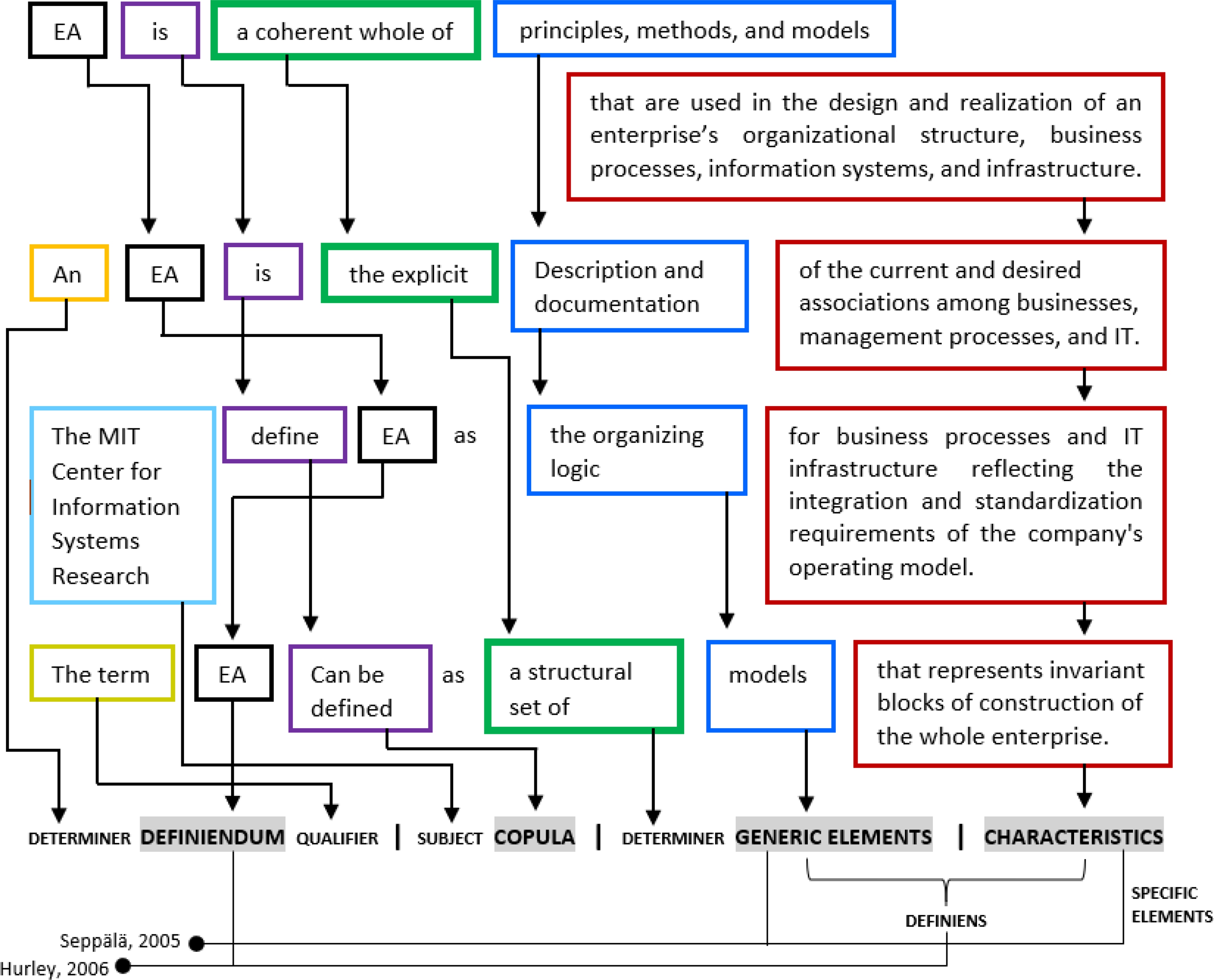
Framework for subdividing EA definitions. EA: enterprise architecture.
The framework for subdividing EA definitions designed within this study and presented previously includes the following four main parts:
Part 1
The “Determiner of the definiendum,” which describes the definiendum. The “Definiendum,” which represents the word to define. The “Qualifier” of the definiendum, which limits the meaning of the definiendum.
Part 2
The “Copula,” which indicates how the rest of the definition presents the meaning of the word to define, and then the agreement of an author to the definition she/he has provided. The “Subject of the copula,” which indicates the publication where the definition is originated, when applicable.
Part 3
The “Generic element,” which indicates what class or group, the word to define belongs to when thought of as a generalized element. The “Determiner of the generic element,” which indicates the essential particularity of the generic element.
Part 4
The “Characteristics” of the generic element, which present more distinguishing details useful to differentiate the generic element among others.
We associated each of the previous four elementary parts of EA definitions to a research sub-question that allows us to answer the main research questions. Table 2 presents these sub-questions.
The research sub-questions.

EA: enterprise architecture.
Data analysis—thematic analysis of EA definitions
We applied thematic analysis techniques in order to answer the research sub-questions associated with the elementary parts of the EA definitions. Thematic analysis techniques focus on examining themes within data. 19 Themes represent the major patterns across data sets which are significant to the description of a phenomenon and correspond to a specific research question. 20 The process of conducting thematic analysis consists of reading data, collecting possible themes, comparing and contrasting themes, and building the final theoretical model that can be summarized in the form of a thematic tree. 21
We conducted a thematic analysis through the process of coding in six phases, according to the guideline of Guest. 21 We applied an inductive coding approach, without trying to fit the themes identified into a preexisting codebook. The codes emerged during the analysis of the definitions. This approach provides themes which are strongly corresponding to the data because assumptions are data-driven. 22 Table 3 presents the phases of the thematic analysis conducted.
Process of conducting thematic analysis.
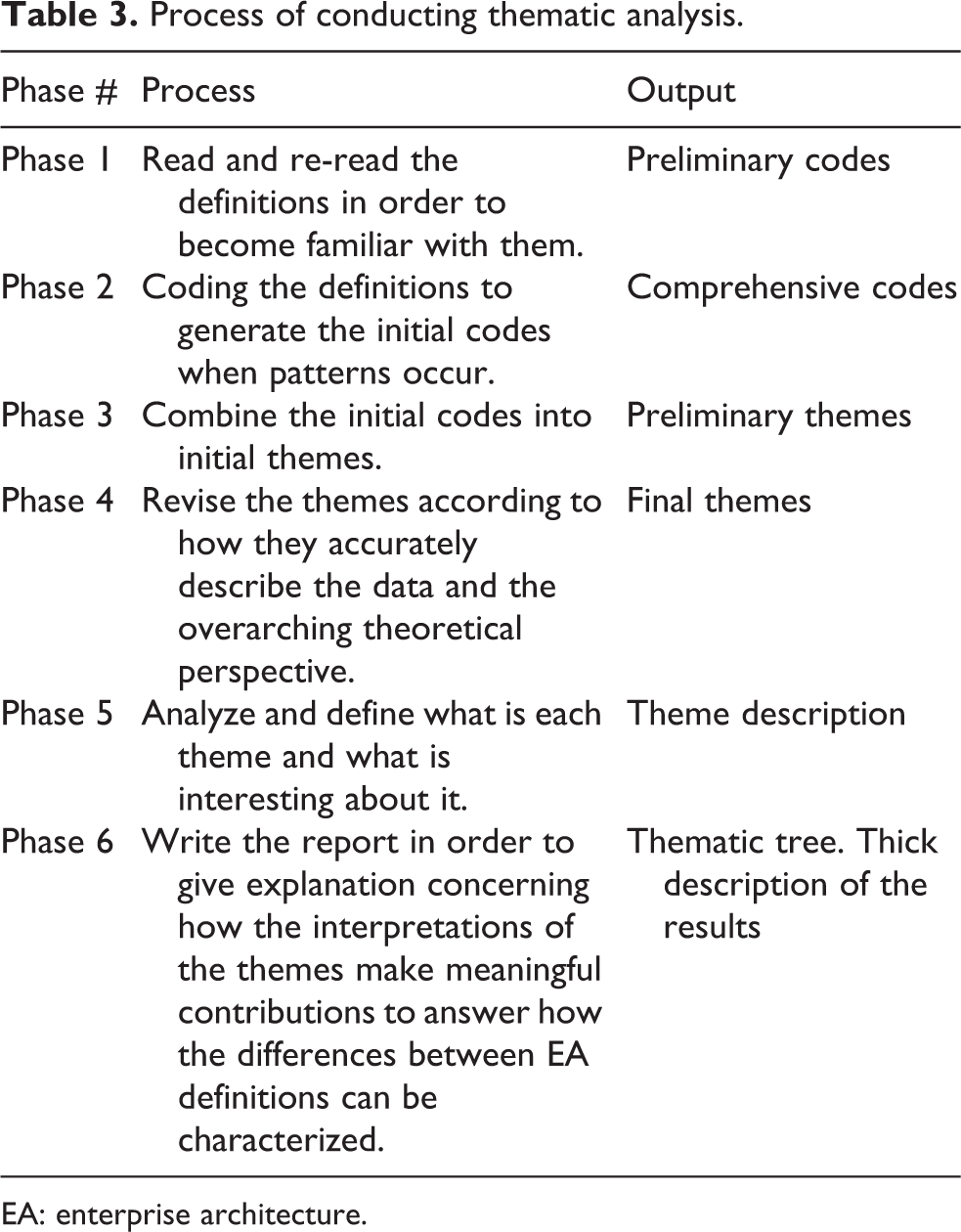
EA: enterprise architecture.
The following section will present the themes found and their interpretation.
Findings
What is being defined in the definition of EA?
The definiendum represents the word to define. In the context of this study, the definiendum is supposed to refer to the word “enterprise architecture.” But this is not the only word used as a definiendum in the extracted definitions of EA. In fact Gartner Inc. and/or its affiliates 23 affirmed that definitions of EA have two focuses because the literature usually describes EA as either a verb or noun. The importance of such evidence is that it can be taken into account to identify whether the definitions intend to describe the same thing, even they apparently refer all to “enterprise architecture.”
An/the enterprise architecture—enterprise architectures
When an indefinite or a definite article (an/the) plays the role of the determiner for the definiendum, authors are considering EA as a noun. It represents a set of specific output or deliverables (i.e. standards, models, principles, requirements…) that EA practitioners must deliver to the organization. 23 To achieve this objective, practitioners are supposed to focus more on the realization of predefined output which can be in the form of a guideline or roadmap that an organization can follow in order to achieve its strategic imperatives. On the other hand, practitioners are supposed to focus less on their daily improvement, as well as on action-oriented tasks. Some authors also use an explicit plural form of EA, which corresponds to a category that considers EA as a set of specific output or deliverables. The following definitions are some examples:
“
“
“
Enterprise architecting
When the definiendum is presented without a determiner, authors consider EA as a verb and refer to “enterprise architecting.” In this context, EA is much more focused on achieving the strategic imperatives of an organization through a continuous process which includes events, changes, activities, and actions that are continuously occurring, evolving, and executed. To achieve this objective, EA practitioners are supposed to focus more on “communicating, creating, and improving” 23 structures and decisions which can help to better manage and adapt the organization day by day. We did not use “enterprise architecting” as a search string within this study because the intention is to analyze only explicit definitions of EA. However, one definition found in the articles used the verb form of EA as shown in the following definition.
“
The term/concept enterprise architecture
Another reason for elucidation concerning the nature of “enterprise architecture” becomes apparent when this word is preceded by a qualifier. We found two distinct qualifiers in the extracted definitions which are “term” and “concept.” The following definitions are some examples:
“The
“The
The Advanced English Oxford Living Dictionaries define a term as “a word or phrase used to describe a thing or to express a concept, especially in a particular kind of language or branch of study.” 30 According to this definition, when authors specify EA as a term, it could indicate that they consider the two words “enterprise” and “architecture,” as a single unit. Then EA can be a technical term, which is a word that refers to a particular meaning within a particular discipline. It is important to identify whether all definitions view the words enterprise and architecture as a single unit or not. For example, one of the extracted definitions has defined EA as follows:
“Enterprise architecture or
Perhaps the word “enterprise” refers to a noun in the previous definition. Like this, it can easily be put aside as the definition did. In fact, in this context the expression “
However, using a qualifier in order to indicate that EA refers to a concept or a term does not bring more understanding related to the nature of the expression “enterprise architecture” or the words “enterprise” and “architecture.” But it provides some information that could indicate, for example, whether EA is a discipline, an architecture in an enterprise, a practicing architecture…even if this information can also be interpreted in a different way.
Another formulation of the definiendum (enterprise architecture, enterprise architectures, enterprise architecting, architecture…) is when it is not accompanied by any determiner (indefinite or definite articles, plural form…) or qualifier (as a term, a concept…). In this context, it is more difficult to have an idea concerning the nature and the meaning of the expression “enterprise architecture.” But 80% of the identified definitions are in this form where authors use directly “enterprise architecture” or “EA.” We call this form of definiendum a “neutral form” because in the context of this study it does not give the opportunity to examine the definiendum as a single unit, without considering the other parts of a definition. The following definitions are some examples of the neutral form of definiendum:
“
“EA is a multi-disciplinary approach that enables enterprises to anticipate or react to necessary business or technical changes.” 34
What is the level of agreement of the authors with regard to the EA definitions they provide?
The copula represents the word or verb that links the definiendum to the rest of the definition. According to the International Organization for Standardization (ISO 704-2000), the main roles of a definition are to “identify a concept and differentiate it from others.” Meyer and Helfert 35 clarify these roles with four aspects on which a definition may focus: “describe, explain, detail or delimit a concept.” They also indicate that the final objectives of these aspects are, “the differentiation of concepts, the identification of terms, the confirmation of the existence of a concept, and the establishment of synonymy between linguistic units.”
The objectives of a definition can greatly help to identify its particular functions. But because this study intends to analyze only explicit definitions of EA, the function of the definitions analyzed is limited. In fact, the copula is a linking verb, which is a verb that simply connects the subject (definiendum) with the words that provide information concerning the subject (generic element), in indicating only a condition or relationship rather than actions. Accordingly, we classified the linking verbs of the definitions following the distance taken by an author—in terms of level of agreement—with regard to the definition he or she has provided. We found the categories affirmation, explanation, and citation, as described in the next sections.
Affirmation
Within this category, the linking verb seems to express the author’s point of view regarding EA, even if a reference is cited with the definition. Also, the linking verb tense used is the present simple, which is meant to explicitly indicate the truth of what EA is. This tense also specifies enough guarantee that there is only one definition of EA, which is the one provided. The linking verbs found within this category are structured in the form: “EA…is/are, refers to, represents.” Some other forms like “we define…EA” are also included within this category of copula. Some corresponding examples include:
“A widely adopted approach providing the required conceptual understanding of an enterprise as well as the way IS facilitates its business processes,
“
Some other definitions found within this category do not use a verb, to express the truth of what EA is. In fact, they use the preposition “as” or just a “comma” to introduce their definition, as shown in the following examples:
“Enterprise Architecture (EA)
“Enterprise Architecture, a discipline with roots back to the 1980s, […].” 35
Explanation
Within this category, the linking verb does not often seem to express the author’s opinion regarding EA as seen in the previous section, even if any reference is cited with the definition. But the linking verb of this category does imply a general opinion, and it also implies that some conditions must be met for the definition in order to really work. Also, the linking verb is in the past tense or present perfect, which does not explicitly indicate the truth of what EA is. And finally, the verb’s tense does not imply that there is only one definition of EA, which is the one provided. Rather, the definition provided seems to simply refer to one of several others. The linking verbs found within this category are structured in the form: “EA…is viewed as, can be viewed as, could be considered as, is considered as, is defined as, can be defined as, has been defined as, has become, has emerged as.” Another verb which is placed before the copula can also be considered in order to place a definition within this category of copula. Some corresponding examples are given in the following section.
“An enterprise architecture (EA)
“It
Another form of definition found within this category uses a personal pronoun before the copula to indicate how the given definition seems to not be the only one, as shown in the following examples:
“[…]
Citation
Within this category, the linking verb and its tense do not influence the distance—in terms of level of agreement—authors take toward their given definitions of EA, because one or many references are clearly mentioned as the providers of these definitions. In this context, it is hard to understand whether authors agree or not with their referenced definitions because their points of view are not clearly given about this. A corresponding example is given in the following section.
“Although there are different perspectives to describe EA (Niemann, 2006
What are the general categories of things in which EA could be placed?
The basic natural answer—instead of explaining the details—in response to someone asking “What is EA?” represents the generic element. In fact, the generic element connects the word to define (definiendum) to a “more general concept” in specifying the category of things to which EA belongs. 42 The function of the generic element in a definition represents a key role, because it is naturally essential to categorize something to be able to compare it to other things in the same category—or a different one—in order to understand its particular traits. But authors have very little flexibility with the generic element because it includes only one or more single words. Also, these words must have a predetermined and clear meaning. Even if the author has the opportunity to explain the context of the generic element in the rest of the definition (the characteristics), the generic element itself plays an essential role in the reader’s first impression of the meaning of the word being defined. However, it was difficult to classify some of the generic elements without investigating the rest of the definition (e.g. the actions executed by the generic element, its function…) in order to understand the context of its use. We found the following five categories of generic elements presented in the next sections.
Deliverable
The generic elements classified within this category refer to a product realized within an organization which describes, schematizes, plans, guides, and controls its operations. This product can be a tool for the structuration of the organization or its activities. It can also be a deliverable to be used to realize the previously mentioned tool. The priority is on the kind of product (software, planning, models, procedure…) that will be delivered in this context. This category of generic element includes the following words: “analysis, architecture, artifacts, blueprint, classification, definition, description, documentation, design, information base, logical structuring, method, model, output, plan, procedure, representation, program, representation, roadmap, solution, and strategy.” For example:
“An enterprise architecture (EA) is the explicit
Tool
The generic elements classified within this category refer to artifacts or tools practitioners used to realize the deliverables presented in the previous category or to carry out actions corresponding to EA contexts. The priority is on the tool itself in this context. And this tool does not correspond to those that have been created by the EA function of the organization. But they can be a standard commercial product usable by any organization in order to produce deliverables. This category of generic element includes the following words: “tool, framework, instrument, principles, method and model.”
“EA […] which can be defined as a coherent whole of
Process
The generic elements classified within this category refer to a set of activities, or stages to be realized in order to accomplish specific outcomes—including deliverables—corresponding to EA contexts. Contrasting with the deliverable category, here the priority is on the realization and the management of the task to be accomplished (communication, decision-making, sociocultural aspects…), but not only on its planning or guidance. The focus here is on the type of process. This category includes the following words: “alignment, mechanism, organization, process.”
“Gartner (2012) defined enterprise architecture as the
Thinking
The generic elements classified in this category refer to the ability of the functioning mind to consider, form, or have an opinion, ideas, memories, thoughts, and so on about how an organization and its environment works. This can be useful in the decision-making process in order to take enlightened decisions in the context of EA. The focus here is on the type of thinking. This category of generic element includes words such as the following: “concepts, understanding, vision.” A corresponding example is given in the following section.
“Enterprise architecture is an integrated and holistic
“The OPEN GROUP supposes that EA is
People
The generic elements classified in this category refer to the people concerned with EA within an organization through their involvement in the aspects corresponding to EA. In this context, the focus is on the people and not in their ability to conceive or pilot outcome, or in the tools they used or produced, as in the previous categories. Only one of the selected definitions corresponds to this category. However, because this study intends to present a complete examination of EA definitions, it is necessary to consider it as it is.
“Enterprise Architecture (EA) refers to the
Discipline and practice
The generic elements classified within this category refer to a study area which corresponds to learning, research and practice of EA. In this context, the focus is on the kind of research or practice field that EA is. Disciplines and practices should encompass all previous categories, but the generic element alone does not provide enough information to deduce it. This category of generic element includes the following words: “approach, discipline, foundation, practice, fields, system of systems.”
“Enterprise architecture (EA) is a
In addition to the generic elements presented above, some others are not sufficiently explicit to be classified in the previous categories. We grouped these definitions in a category of unclassified generic element. Some corresponding examples are given in the following section.
“EA […] It is also an indispensable
“Enterprise Architecture (EA) is an
What aspects of EA do the definitions focus on?
The characteristics of a definition are also called specific elements, traits, or distinguishing details. The central aim of the characteristics is to “specify the conceptual scope” of a generic element. 52 In fact, usually the characteristics provide detailed information which is necessary to differentiate concepts from each other. We then classify the characteristics according to the relationship they have with the generic elements, or with the whole essence of the definition. 52
To achieve this objective, we conducted first an investigation concerning which of the traditional 5W questions—with “How” added—the characteristics answer in order to detail the distinguishing traits of the generic element. Some corresponding examples follow.
However, the characteristics of most of the definitions answer more than one of these questions at the same time. Many of the characteristics include more than one clause. But in order to completely examine and understand the role of the characteristics of a definition—and the role of the whole definition—we also considered each clause individually. This exercise allows us to group all significant characteristics into different categories according to the context they put forward to define EA. We found the following categories.
Function
The characteristics classified within this category focus on the purpose and role that EA plays in an organization. Some of these purposes and roles are described in a very explicit way as something useful (beneficial) that EA brings to an organization, in mentioning, for example, the capacity to: “enable business strategy,” “facilitate the translation from corporate strategy to daily operations,” “achieve alignment between business and technology,” “improve enterprise communications,” and “emphasize interoperability and data sharing.” Some of the other mentioned benefits show a general scope, and are not clearly described such as the ability to: “achieve organizational performance goals,” “describe an enterprise,” “attempt to integrate, govern and analyze enterprise elements,” “be significant to the enterprise management and development functions.”
Principle
The characteristics classified in this category focus on a rule, belief, or conception concerning the function of a complex system and organization used in EA. Some examples of the principles mentioned in the extracted definitions are: “holistic way,” “elements of internal and external business environment,” and “an assembly of parts that work together in a coherent and well-defined way.”
Components
The characteristics classified within this category focus on the parts of an organization on which the function or the principles of EA have an effect. “Goals,” “visions,” “strategies,” “governance,” “business,” “organizational structures,” “tasks,” “activities,” “information systems,” “technological infrastructure,” and “environment” are some examples of the components mentioned in the extracted definitions.
Type
The characteristics classified in this category focus on the type of discipline EA is. “Model-based IT and business management,” “system of systems,” and “enterprise systems engineering” are some examples of the type of discipline mentioned in the extracted definitions.
History
The characteristics classified within this category focus on the year range corresponding to a significant event which happens in EA which is important to be included in its definition.
Some corresponding examples for the previous categories are given in the following section.
“Enterprise Architecture, a discipline
“Enterprise architecture is a
“Moreover, Bernard describes EA as the analysis and documentation of an enterprise
“Enterprise architecture (EA) is a new approach that organizations should practice to
*1History *2Type *3Principle *4Components *5Function *6Components.
Figure 2 presents a thematic tree of EA definitions, including the different themes which are significant to the description of the differences between EA definitions, as detailed in the previous sections.

Thematic tree of EA definitions. EA: enterprise architecture.
What does the evolution of definitions of EA look like?
The investigation of the similitude between the EA definitions analyzed provides another insight that can be used to understand the lack of agreed-upon definition in EA. In fact, the original definitions (originating from a specific source) are regularly modified over time when other authors use them in their articles, with or without a citation. While some of the modifications do not have an effect on the meaning of the definition, other changes greatly affect the meaning of the definition. For example, as part of an article (an/the) placed before EA, some definitions that use EA as a noun are very similar to others that used EA as a general word (singular form, without a/the). Figure 3 presents the evolution of the most repeated definitions to provide a better idea concerning this issue.

Evolution of some EA definitions. EA: enterprise architecture.
Discussion and implications
Considering the investigation of the definiendum which does not always present EA in the same way—as a noun, or a verb, in singular and plural form, as a term, a concept, or a general word (neutral)—it seems there is no agreement with regard to the nature of the words “enterprise” and “architecture” or the expression “enterprise architecture.” How can these two words or this expression could be describing as the same thing if people do not understand or use them in the same way? How is it possible to know whether or not EA definitions are talking about the same thing—the same EA—with the existence of many definiendum (verb vs. noun vs. neutral…) which refer to EA?
Considering the investigation of the copula, which provides good insight concerning whether an author agrees or not with the definition she/he provides (affirmation, explanation, citation), it is clear there is no type of accepted knowledge representation in EA. In fact, approximately 20% of the 160 definitions extracted in the articles mention clearly one or more references as the sources of their definition. Twelve percent of them are explanations and sometimes present references with their definitions. Another observation that corresponds to this information is that an article does not necessarily include just one definition; many of the selected articles include more than one. Often, these definitions are not necessarily complementary, and are not obliged to have the same scope, as mentioned in the work of Lapalme. 1 However, approximately 42% of the 305 articles that satisfy the selection criteria do not include a definition to introduce EA. This observation has incited us to ask how academia and practitioners are comfortable to describe what EA is.
Considering the investigation of the generic elements which provide good insight into the class of things in which EA can be placed, it is obvious that there are different perceptions of EA (deliverable, tool, process, people, discipline) and the elements that compose each of these perceptions are not always complementary. However, some of these perceptions may be. For example, when an author describes EA as a discipline/practice while another one describes it as a tool, it is understandable because tools have usually been used for practicing a discipline. On the other hand, it is completely different when an author describes EA as a process while another one describes it as an outcome, because an outcome is the deliverable of a process. One can often say that the work of EA within an organization could be conducted completely by consultants who provide guidelines, roadmaps, and plans for the deliverables, which the organization can execute in its own way, while someone else is saying that EA work must be conducted by a team of professionals who are permanent fixtures in the organization in order to avoid focusing only on plans, and making sure to focus also on the execution of these plans and their role in the regular decision-making and management of human relationships (process).
Considering the analysis of the definitions’ characteristics, it has become even more obvious that there are different perceptions of EA. This analysis shows what kind of information (What? How? Why? Where? Who? When?) the authors want to provide with their definition. Should all the traditional 5W questions (and the added “How” question) have to be answered in order to provide a complete definition? Also, the difference between the elements of the different categories (function, principle, components, type, and history) found to be the focus of the definitions shows what aspect of EA the definitions put forward in order to describe it. Further, the elements that compose each of the perceptions of the characteristics sometimes lack similarities. For example, while some elements in the category principle refer to a holistic vision of the organization, others refer to a reductionist vision. This is the same thing when some elements of the category principally present EA as a discipline or practice which intervenes on well-defined components of the organization, while others talk about complexity that does not always allow a component to be well defined.
Considering the importance of the differences presented in the different parts of the EA definitions, it is necessary to mention that, in an individual context, some of the definitions found are implicit, incomplete, complex, and incoherent.
Implicit, because the words used to describe “EA” in these definitions are technical words, or intended to be understood in a figurative sense. That is to say, it’s possible for people to interpret these definitions differently. The following definitions are examples:
“Zachman regards enterprise architecture as the
“Schekkerman (2004) argued that EA is a
Incomplete, because these definitions alone cannot provide a complete description of what EA is, even if the words used are not meant in the figurative sense. The following definition is an example:
“The EA is a base of strategic information asset, which defines
One might ask, “What mission?”
Complex, because the structure of these definitions does not facilitate easy reading and understanding. The number of generic elements present in the definition, the presence of one or more qualifiers or determiners along with the definiendum, the generic elements and the linking verb, and the use of many clauses in the definitions’ characteristics can contribute to the complexity of these definitions. The following definition is an example:
“EA is a
Incoherent, because the different parts (definiendum, copula, generic element…) of these definitions seem to be incompatible. The following definitions are examples:
“EA is a
The generic element discusses a discipline while the characteristics show a tool…Maybe it would be different with another structure, like:
“a discipline that provides a set of principles, methods, models and tools used to analyze the services…”; or “EA is a
Technical mechanism as a generic element refers to a process that often focuses on actions. But the characteristics seem to relate instead to deliverables, such as plans, instead of focusing on the process moving the enterprise from a current to a future architecture.
Considering all the observations described in the previous sections, it is not surprising how several researchers and practitioners affirm that EA holds a fragmented literature. As can be seen, there are important differences between EA definitions and sometimes these differences can become divergences. Moreover, an evocation of the existence of many perspectives in EA is usually used to introduce many of the definitions. To deal with this problematic, some authors avoid giving a new definition of EA or do not present only one definition, but a mixture of referenced definitions.
However, from one person to another, individual understandings of the significance of EA can vary. As a result, confusion, misunderstanding, and conflicts can easily arise because of the existence of various EA definitions. In this context, it can be hard to structure an EA baseline of knowledge and to identify the mission and responsibility of each type of EA practitioner. It can also be hard to identify the advantages organizations gain in practicing EA because from one perspective to another these advantages can be understood differently. Further, how can the advantages EA brings to an organization be measured when there is no common understanding concerning what is being measured? This problematic of non-agreed understanding of EA can also be challenging for academic or professional researchers because their findings of their studies can be understood as they are. In fact, “without a common structure and a core theory,” considering EA as a “legally recognized and generally accepted” 6 study and practice area will always be complicated. EA team members must be clear concerning the definitions of EA, even if there are many perspectives, in order to be able to work together. All the perspectives must contribute in order to achieve this objective.
Finally, it is worth mentioning that the purpose of this investigation is not to evaluate or indicate what the structure or the content of best EA definitions is. In a general way, this investigation also does not have the objective to specify how to structure a formal terminological definition. Moreover, the field of terminology itself is “facing many theoretical and methodological challenges” 18 concerning how to build a definition. Also, analyzing only the definition of EA extracted in an article does not generate enough information to identify the perspectives of “EA” reflected in the whole article. It would not be surprising to see that the perspectives presented in the article as a whole differ from the perspectives reflected by the definition of EA it provides. In fact, according to some conversations with several authors in the context of this research, maybe authors do not always pay enough attention to the definition they provide for EA in their research reports. Some of the definitions analyzed within this study also demonstrate this. The section that presents the evolution of EA definitions provides good insight concerning this situation. This study aims to intervene precisely in this context. Both researchers and practitioners could take this investigation into account in order to pay more attention to the definition of EA they provide when they produce a new article in the EA literature. As in any other field, the definition of “EA” plays an important role because it represents the first thing people look at when they want to understand what “EA” is.
In summary, the EA community seems to face the same challenge the Strategy and the Management communities faced in the past. Multiple perspectives, including incompatible ones, were described in the literature of these communities many decades ago. But a meta-analysis of the situation was conducted in order to provide insights to the situation. As a result, some important findings and creations have contributed to providing a much deeper comprehension of these assumptions. The “Theory X and Theory Y model” 65 for management, as well as the “ten strategy schools of thought,” 66 are among the key findings and creations. Even if differences and divergences still take place within those communities today, but there is a much deeper comprehension of the surface underlying assumptions that cause them.
Similarly, the EA community has already started to address this situation in scientific ways. 1,5,7,10,67,68 But to date, it is clear that the studies that have prioritized addressing the problematic related to the existence of various perspectives in EA do not seem to be commonly accepted yet. A meta-analysis of this problematic must continue to be conducted.
However, the existence of various definitions of EA could not represent a problem when considering that it could also provide a broader view that covers all aspects of the discipline. The problem is how these various definitions are used in order to conduct research intended to provide a much deeper and unified understanding of EA.
Conclusion and future research
This study used the methodology proposed by the SLR in order to select 102 journal articles from different digital libraries. 160 definitions of EA were extracted from these articles and additional sources. Based on concepts from the discipline of terminology and thematic analysis techniques, we have broken down each definition into many parts in order to compare them. This strategy facilitates deeper analysis of EA definitions and provides an in-depth understanding of the extent and nature of their differences.
Many differences and divergences between the definitions of EA were found, and sometimes their natures were significant. In fact, the results of this investigation show how some of the definitions found in the EA literature are implicit, incomplete, complex, and incoherent. This situation indicates how it is urgent to take all the existing EA perspectives into account in order to structure them into a common reference, and in turn make EA a more mature discipline.
In terms of contributions, this study provides to practitioners and researchers more structured knowledge that helps to identify and categorize potential factors contributing to the differences in the EA definitions. This could help them to pay more attention when providing a new definition of EA. This study also provides a novel analysis approach to researchers, guided by linguistics models and thematic analysis, to analyze definitions and conduct forward investigations.
This study also provides knowledge to practitioners concerning the different perspectives that exist in the discipline of EA. In fact, the results of this study provide more knowledge to organizations in order to help them choose the EA definitions that are more appropriate to them. It is evident that an organization that is focused on the process to conduct EA will consider “enterprise architecting” more appropriate to designate EA. While another organization which is focused on the specific deliverables that EA can provide—such as planning, roadmaps, and process design—will find it more appropriate to talk about “an or the enterprise architecture” or “enterprise architectures.” This will also help them to hire corresponding team members and consultants, according to their appropriate EA definitions. The perspectives indicated in the EA definitions which are appropriate to an organization will also influence the tools that the EA practitioners of the organization will use to achieve or conduct EA. In summary, the different EA perspectives found in the EA definitions analyzed in this study will provide more knowledge to EA practitioners in order to help them identify the definitions that are more appropriate to their own EA perspectives.
In terms of limitations, only explicit definitions were considered within this study. It would be interesting to calculate the inter-coder agreement coefficient, such as Krippendorff alpha, 3 during the classification process of each part of the definitions in order to increase the validity of this study. According to the citations and original sources of each definition, it would also be interesting to draw attention to the existing liaisons between the definitions in order to evaluate the evolution of the lack of agreed definitions. Another valuable step could be the classification of the definitions according to other aspects such as underlying epistemological, ontological, and praxeological belief systems in order to better highlight their similarities/dissimilarities. It would also be instructive to compare the belief systems shown in the whole content of each article and the belief systems shown in the definitions provided in order to evaluate their degree of coherence. The proposed analysis model can also be converted into computer software and be used to further analyze terminological definitions in any other field.
Footnotes
Authors’ note
This article is the extended version of our previous workshop article entitled: “Defining EA” published in “2016 IEEE 21th EDOCW.” But the contribution of the previous article was extended both in content and in depth. First, we revised and completed the research questions to better adapt them to the scope of the study. Second, we improved and provided more details concerning the research design applied to fully highlight its scientific contribution, including the number of EA definitions analyzed. Third, we proposed a new framework that divides EA definitions into more structured parts in order to deeper analyze them (terminology). Fourth, we grouped the findings into more structured categories in order to better differentiate them from each other (thematic analysis). Sixth, we described a new finding related to the evolution of EA definitions. Seventh, we provided deeper discussions of the findings. Eighth, we replaced most of the definitions provided as examples in the previous article with others and revised all the text and figures. In fact, the current article offers a contribution over and above the previous one.
Declaration of conflicting interests
The author(s) declared no potential conflicts of interest with respect to the research, authorship, and/or publication of this article.
Funding
The author(s) received no financial support for the research, authorship, and/or publication of this article.
