




Abstract
Previous works have demonstrated the possibilities to influence the innovation process in organizations. Although the presented initiatives have their merits, they suffer from a lack of integrated perspective. They are focused on the evaluation of the link between the innovation process and only one of the subsystems of the administration, without considering the implications of the other subsystems. The aim of this article is to define a model of structural equations that summarizes the impact of the variables related to innovation management in organizations. This article first presents the identified variables according to the analyzed literature and then shows which variables were selected by consulting experts on the field. To measure the selected variables some questionnaires were elaborated. The questionnaires were applied in 111 entities of different production sectors. A confirmatory factorial analysis was developed with the obtained measures. Thanks to this analysis, it was possible to verify the incidence of the evaluated variables in the innovation management, allowing the elaboration of the model. The proposed model shows the link between the different variables that contribute to the innovation management process. The analysis confirmed that innovation, as a construct, has a multifactorial nature. The information used as input for the elaboration of the model allowed introducing a new sequence of innovation management from the integrated management of the variables that can influence it. This integrated management ensures effective human resources management, production, and marketing. The findings confirm that innovation needs to be managed in an integrated way with the rest of the administrative subsystems rather than as an isolated process. This way of working allows obtaining better results for the organizations. Based on the multisectorial nature of the research sample, it can be assumed that the obtained results can be corroborated in several fields.
Keywords
Introduction
Although the history of innovation is the history of man, only during the 20th century innovation became an important research topic. Several authors have worked in that topic. An example of a relevant author in this field of knowledge is the Austro-American Schumpeter. 1 Several authors highlighted the importance of innovation for human development in general and especially for organizational development. They distinguished the difference between invention and innovation. Some authors explained that innovation needs to be the result of an intelligent and systematic effort rather than the result of spontaneity or improvisation. This systematic way of working allows generating successful innovation actions with better results.
The 20th century was not only the beginning of innovation studies. There were several big improvements in science as results of innovations, without precedent in history (the revolutions: nuclear, computing, biotechnology, space, nanotechnology, etc.). Innovation management studies spread across the globe. 2 Their applications are observed in different sectors. 3 Innovation management is not exclusive to large enterprises due to their dependence on capital flows, 4 nor for small- and medium-sized enterprises due to their flexibility and adaptability. 5 Similarly, innovation management is not only a research problem at enterprise level but also a number of proposals are developed at more complex management levels such as territorial, national, or regional. 6 –8
At the beginning, innovation was only associated with the generation of creative ideas 9 and radical changes. 10 However, as pointed by several authors, there are innovations aimed at systematic improvements, 11 which are not limited to proposals for new products. Innovations can be also aimed to the improvement of organizational management methods. 12,13
This change of ideas, regarding to how conceiving innovation, leads to a broadening of the spectrum of variables to consider when managing innovation. As a consequence, there is a bigger diversity of variables to be considered in the innovation management. There is a variety of research that study the relation between different variables and innovation. Examples of analyzed variables are human resources, 14 quality management, 15,16 marketing activities, 11,17,18 operation management, 19,20 intellectual property management, 21 and general management. 22 Therefore, and in line with the above studies, there is a need for conceiving innovation management as a system 10,13 with an integral approach. 20 This approach also demands collaborative and networked work. 17
Recognizing and knowing the multifactorial nature of innovation management is an important step for a later proposal of a management model. 15,16 Not taking into account this multifactorial nature may lead to excessive effort in certain areas and a lack of effort in others. A partial approach would increase the possibility of not achieving the expected results, or at least, not showing adequate levels of effectiveness or efficiency. 23 On the other hand, identifying how the various subsystems or administration processes are linked to the improvement of results of innovation management would facilitate an articulated approach to increase the performance of the innovation indicators. 18,20,24 –27 The analysis of structural equations allows evaluating and distinguishing the degree to which certain variables or factors affect a dependent variable that emerges as a result of the greater or lesser influence of the set of independent variables. Once this difference of incidence of the variables is established, it is possible to develop a successful model of innovation management. This work aims to analyze the relationship between the treated variables and their impact in the innovation management.
This article is structured as follows. The second section presents the review of the scientific literature to identify the variables to be considered in the study and to corroborate the contribution of the research. The methodology is presented in the third section, composed by the following steps: Selection of the variables related to the innovation management process, design of the evaluation method, analysis of the perspectives through a factor analysis and confirmation by a model of structural equations. Next, the results are presented in the fourth section, identifying how the variables are grouped and their impact. Finally, fifth section discussed the obtained results, verified with previous investigations. Contributions and limitations of the research are presented as well.
Literature review
The most accepted definition of innovation states that innovation converts knowledge into cash and this is only part of any business. Innovation begins with the detection of a market opportunity. Then, it continues with the development of a solution in the form of a business idea. Finally, it ends after the introduction of the product in the market. 22
From this definition of innovation, it can be noticed that the degree of innovation can be measured through the commercialization of new or improved products that respond to the needs or opportunities detected in the market. Similarly, Frame et al. 28 state that innovation comes from a commitment to capture a market by improving the consumer’s quality-price ratio, either by improving customer satisfaction and/or by reducing the costs of products and services. This provides a direct benefit for the customer and supplier and also broader benefits for society. This new perspective extends the scope of the indicators to the achievement of customer satisfaction and to a reduction in production costs that result in benefits for producers and the market. More current conceptions demand, besides the economic perspective of innovation, the need for environmental and social benefits. 29
As discussed previously, the innovation approach as part of business management has a multidisciplinary character. 23 There are research oriented to one or several disciplines. Administration is the discipline with the most integrating character. It contains the rest of disciplines that are then derived with relative independence by the research object to which they are oriented. In this sense, there are research proposals that address variables of one or the other independent subsystem. Abaza et al. 23 analyze general variables such as management systems or management levels, or variables of quality management such as customer satisfaction, staff training related to the management of human resources.
Perhaps the discipline that has been most investigated is human resources management, with a great emphasis in staff training. 24 Others research address how the different functions of human resources management influence the innovation process 11 taking into account other variables like recruitment, motivation, goals setting, and commitment.
Another discipline extensively investigated in its relationship with innovation is quality management. García-Fernández 25 studied variables such as planning, leadership, process management, product design information, and staff training. In particular, Camisón and Puig-Denia 16 highlight the relationship between technological capabilities as part of quality and its influence on the innovation process.
The marketing process is linked to innovation from its own definition. Nowadays, innovation cannot be successful if its introduction to the market is not ensured. Marketing, as another management’s disciplines, is also analyzed in its relation to innovation, 15 especially the identification of market needs. This makes possible to develop products that address the needs and are in line with technology through the optimum use of the value chain and the design of competitive positioning strategies.
Production management is also analyzed in its link with innovation. Examples are the evaluation of production capacities, 26 the availability of information for decision-making, 16 product manufacturing, 27 product design and its relationship with the supply chain, 30 and the incidence of technology available in innovation. 18 At the same time, it is seen as a relatively independent discipline but highly related to the management of knowledge, concerning the protection of intellectual property. 20
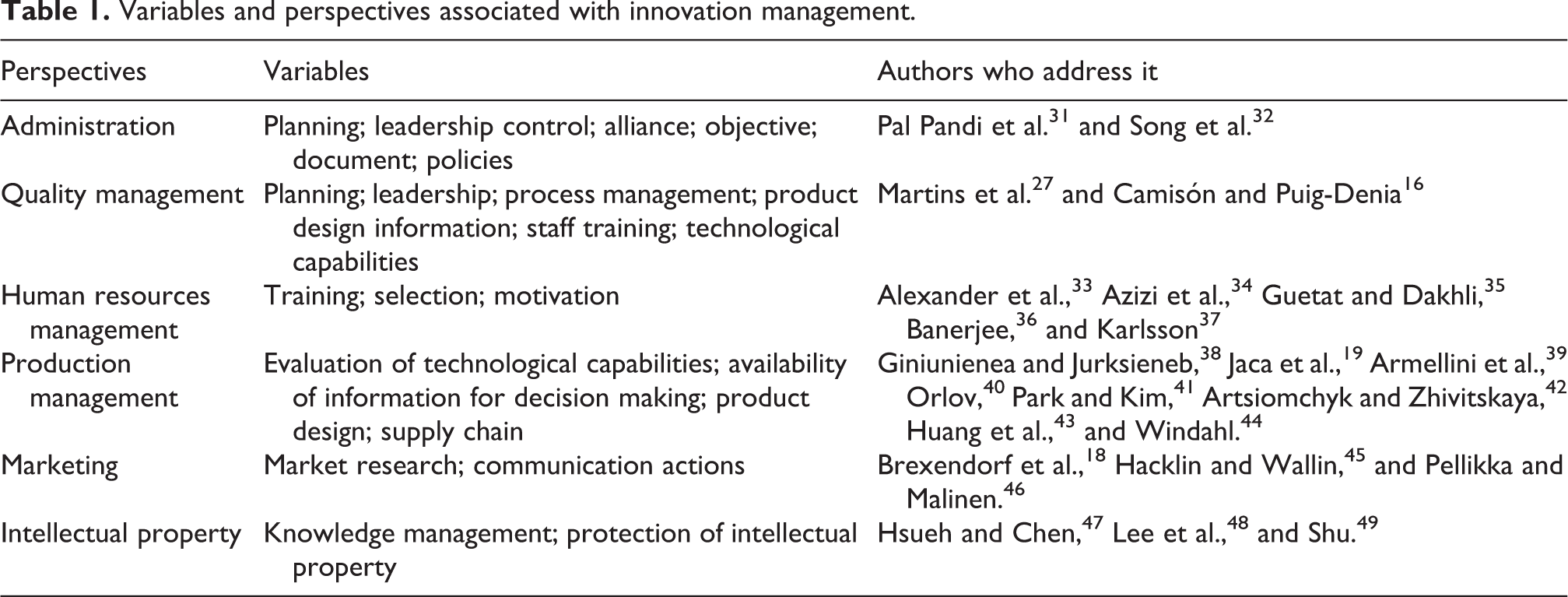
Table 1 presents a summary of the variables and perspectives analyzed in the literature and their relation to innovation management. In summary, there are multiple disciplinary approaches to innovation management. Therefore, it is appropriate to evaluate the degree of interrelation and weighting that is generated in the simultaneous influence of each of these disciplines and their variables contained in innovation management. This supports the research goal proposed in this article.
Variables and perspectives associated with innovation management.
Methodology
This section presents the methodology followed in this research. The steps are described in the following.
Selection of variables related to the process of innovation management
For the selection of variables, we started with the revision and classification of the variables addressed in the literature (summarized in Table 1). The variables were evaluated by a group of experts in the field.
For the selection of experts, the method proposed by Campistrous and Celia Rizo 50 was used. This method combines two selection criteria. The first criterion is the level of knowledge of the expert. The second criterion is the source from which the experts obtained their knowledge. The sources may include the result of their practical experiences and their theoretical training at international or national level. In addition, the existence of other investigations that used this method was investigated, which validated its relevance and the use of the coefficient of competence with a value of 0.8 as a cutoff criterion. This value is considered enough because it guarantees that the experts achieve at least 80% success as possible and its location in the highest quality quartile. The experts were selected according to their coefficient of competence (>0.8).
The experts corroborated the existence of the variables observed in the literature and added others variables. Examples are as follows: “Sales management” due to the best product will have its success conditioned by the effort and skill of the seller and “Planning of human resources,” because both, a deficit or an excess of planning human resource generate negative deviations in personnel motivation and in the costs of the process. The experts proposed modifying the variable “Availability of information for decision making” by the term “Process organization,” given that the first is specified in the second. Finally, they proposed evaluating the management of intellectual property for three of its most recognized and important basic functions related to innovation such as enrichment, protection, and technological surveillance.
Design the evaluation method of variables
To evaluate the identified variables, some instruments were elaborated by developing questionnaires related to management functions, human resources management, production management, marketing, and intellectual property functions. All the variables were evaluated with these questionnaires, using an ordinal scale of 1–10. The reliability of the questionnaires was assessed using Cronbach’s α, which was >0.83 for all them. Apparent validity and content validity were assessed through the review of experts, who accepted its validity.
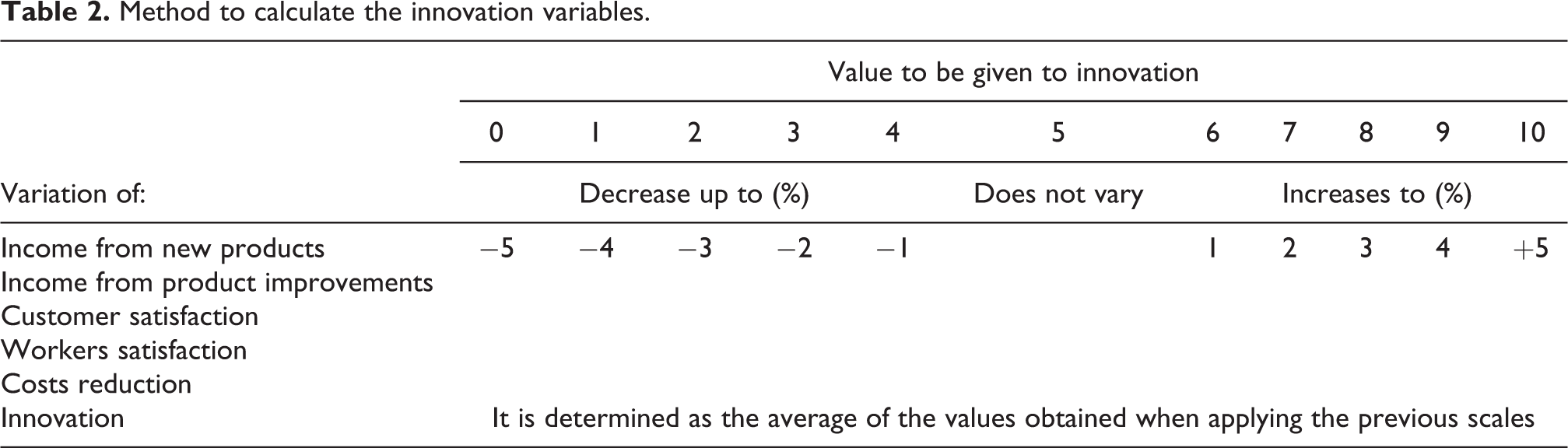
The questionnaires were applied in a set of organizations to evaluate the behavior of each variable. The impact of innovation process was measured through variation in income from new products, variation in income from product improvements, cost reduction, variation in customer satisfaction, and variation in workers satisfaction. These indicators were established in correspondence with the analysis carried out by Frame et al. 28 To integrate these indicators into a variable called Innovation, the method summarized in Table 2 was used.
Method to calculate the innovation variables.
Application of the evaluation method of variables
The designed questionnaires were applied in 111 organizations of different sizes, depending on the number of workers, extent and volume of income, as well as sectors of the economy to which they belong. Table 3 presents a summary of the organizations object of study.
Composition of the sample.

Factor analysis of the results of application of the questionnaires
To evaluate the existence of a relationship between the identified variables and the presence of constructs, a confirmatory factor analysis (CFA) was carried out with the information collected in the surveys to isolate the factorial structure of the group of observed variables, using the IBM SPSS 23 statistical package. 20
The answers showed a Kaiser-Meyer-Olkin (KMO) coefficient of 0.77, a general value of explained variance of 0.79. The Bartlett sphericity test was highly significant. These results allowed confirming the existence of five perspectives with a total of 26 variables that influence the performance level of innovation management. The above is based on the scales established for the interpretation of both indicators. 51 Table 4 presents a summary of the results by variables and perspectives.
Variables and perspectives that influence the management of innovation.
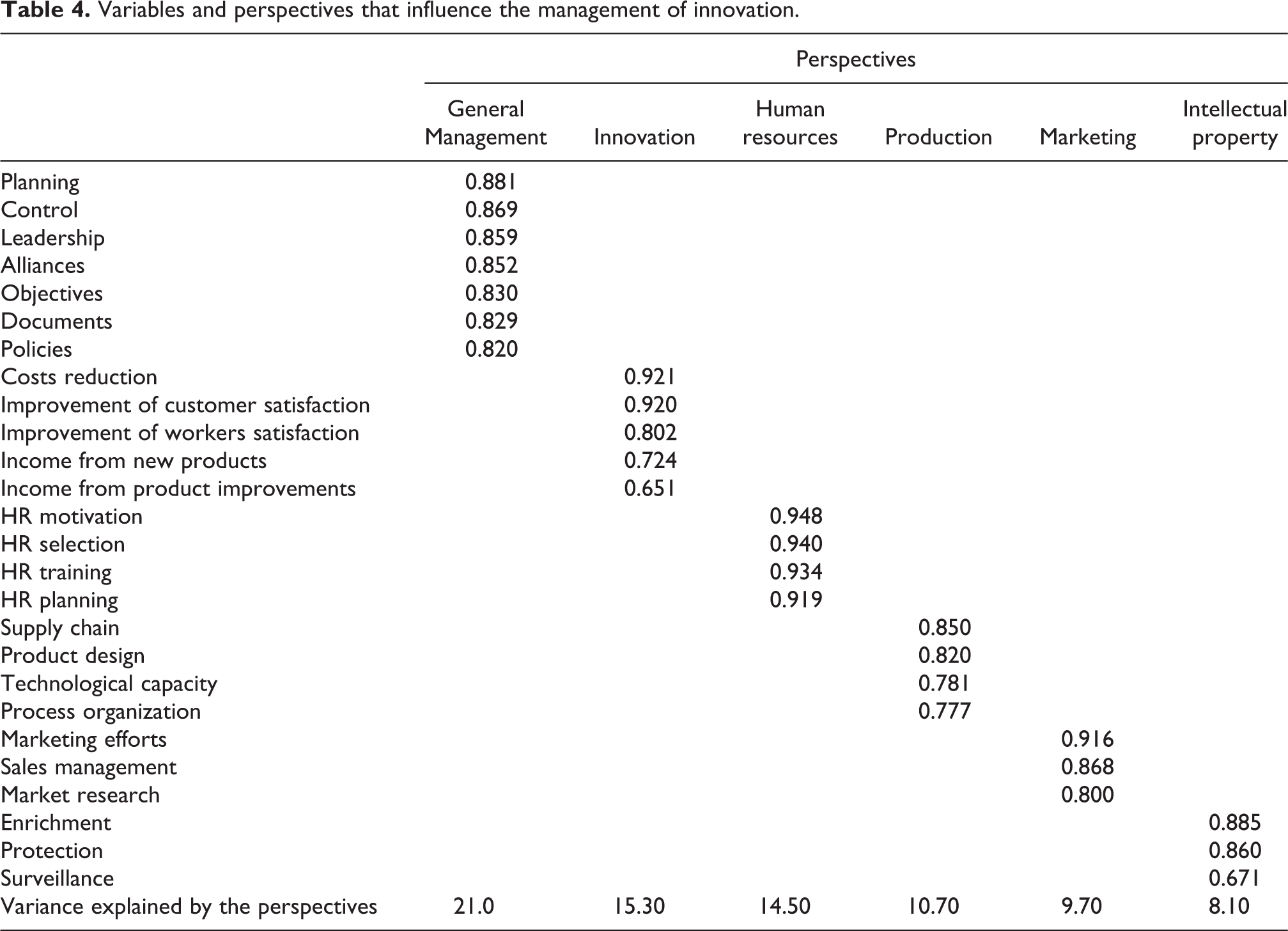
The previous results matched partially with the results expected by the researchers and with the results of the theoretical background. We found six perspectives with relative independence corresponding to recognized disciplines of business administration: general management, innovation, production, human resources, marketing, and intellectual property management. However, the discipline of general administration and quality management matched in one factor, which makes sense, because quality management, under the concept of total quality, assumes the scope and tools of the administration in general. 52 –54 The principles of quality management established by the ISO 9000, 55 such as leadership, the approach to processes, the decision-making based on objective evidence, the management of relationships and other requirements such as policies, objectives, management responsibilities, and documentation as liaison mechanism, are contributions of the administration that are assumed for the quality management.
Construction of the model of structural equation
Once the perspectives were confirmed, a structural equation modeling (SEM) was used to evaluate the structural relationships between these variables. 21 The use of the model allowed corroborating the existence of the perspectives found in the factorial analysis. It also allowed identifying the degree of incidence of each variable in the proposed perspectives and the degree of influence of the perspective in the dependent variable, in this case: the innovation. Based on the previous discussion, it was expected that the incidence of the variables and analyzed perspectives in the expected final result could be corroborated or denied.
After identifying and estimating the model, the adjustment of the data with the suggested model was evaluated following three alternatives: evaluation of the adjustment of general model, the adjustment of the measurement model, and the adjustment of the structural model. The IBM SPSS AMOS 23 was used to design the model. In this article, the suggested model is supported by the above theoretical discussion, as represented in Figure 1. It represents the variables, factors or perspectives in which it is integrated. It also shows the errors associated with the estimation of the influence of each of them, as result of the estimation made by the program during the analysis of the model.
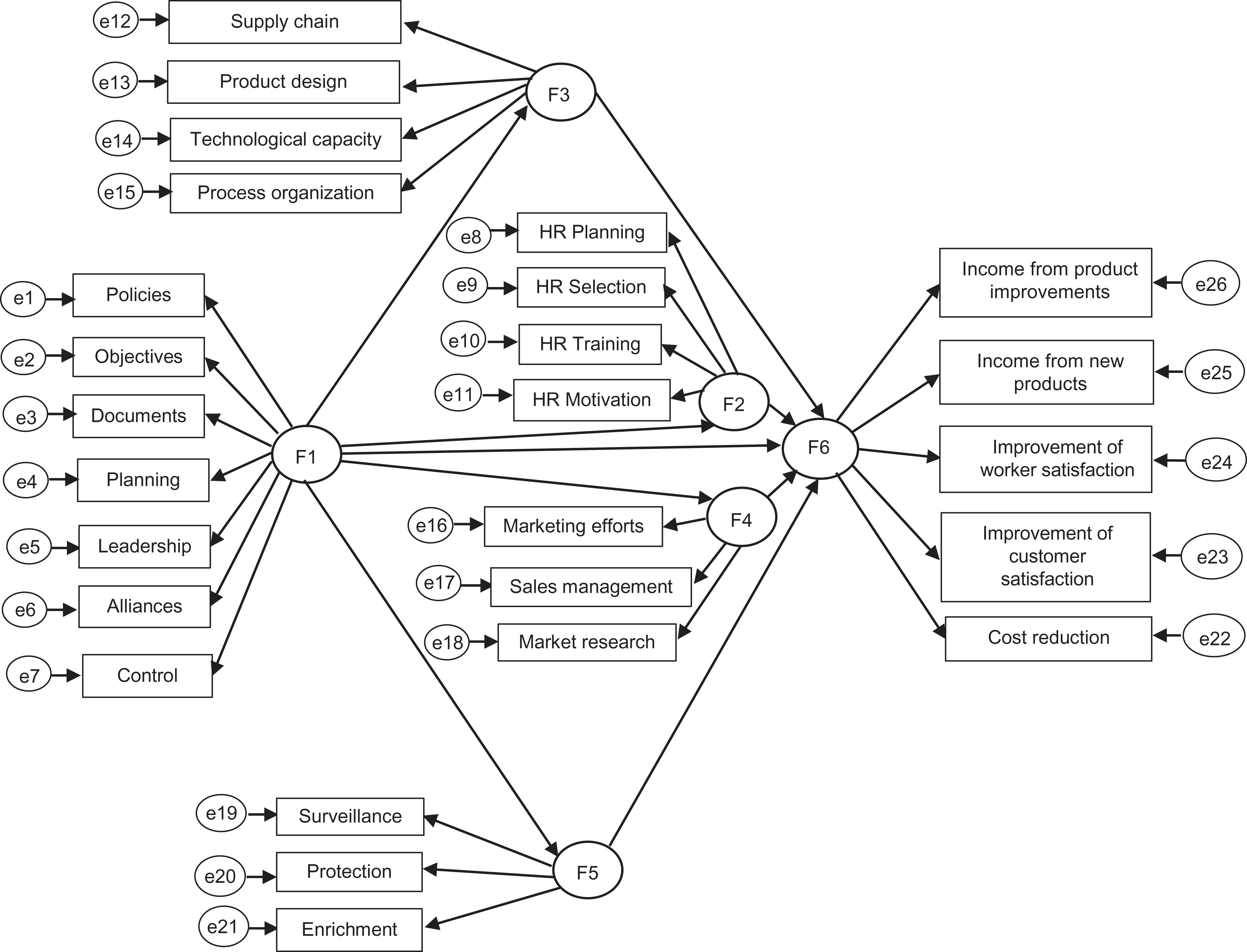
Initial model to evaluate. The meaning of each perspectives is as follows: F1: general management; F2: human resources; F3: production; F4: marketing; F5: intellectual property; and F6: innovation.
Although there are statistical methods that propose an efficient way to differentiate variables and perspectives, the implementation of the structural equation model is justified, allowing test theoretical models with empirical data. 56 –59
Evaluation of the model
To evaluate the model, the indicators established for these purposes were used, as summarized in Table 5.
Validity of the generated model.

Results
Once the variations corresponding to the consequent model were made to enhance the adjustment indicators, the results presented in Figure 2 were obtained.
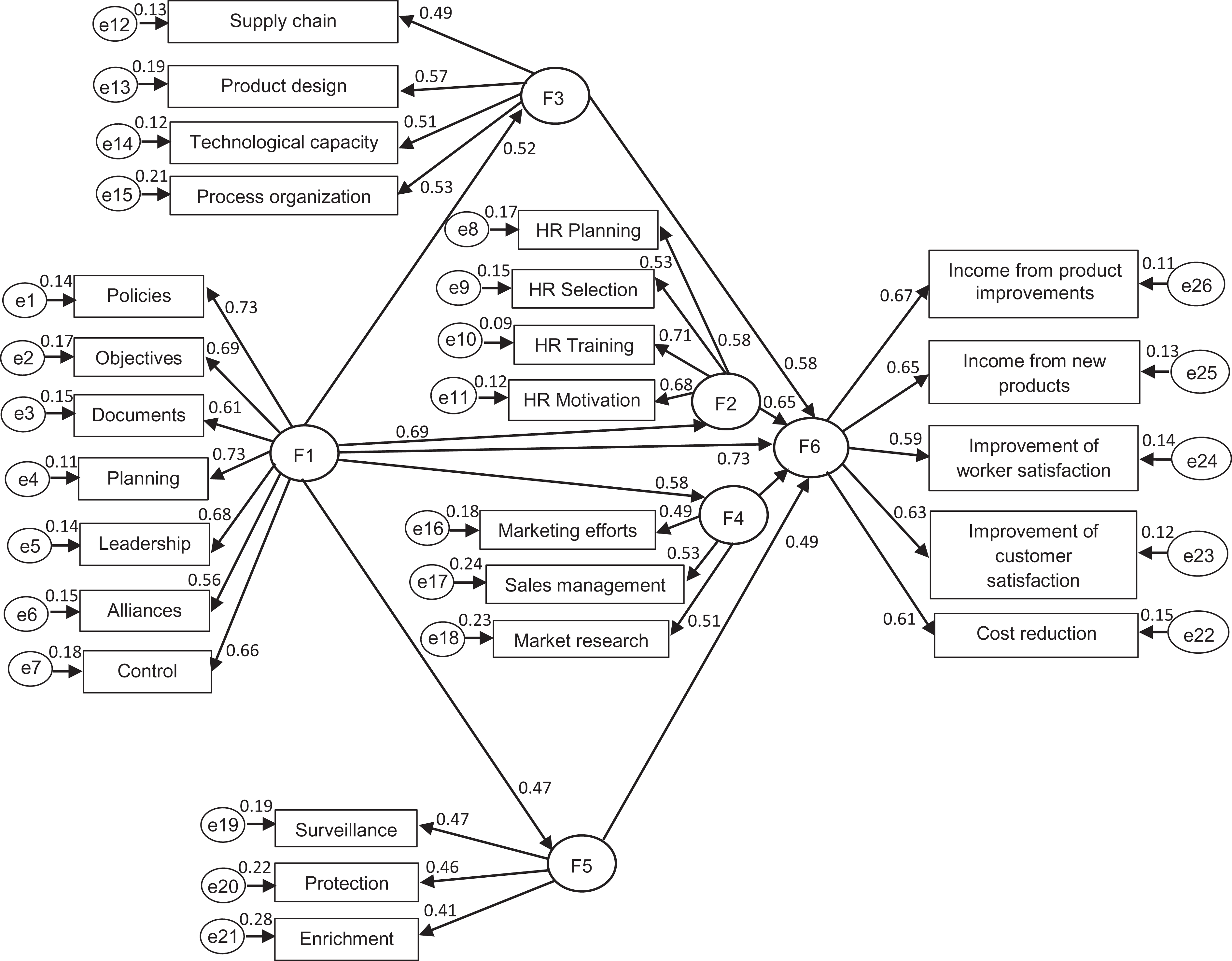
Final model of structural equations. The meaning of F1–F6 is explained in Figure 1.
The observed values make it possible to propose that the model is a representation of the incidences that have the perspectives observed in the innovation of a business organization.
According to the results, the variables that conform the different perspectives, factors, or latent variables show significant levels of relation with the latent variable to which it belongs and levels of mutual influence between them. On the other hand, the perspectives found in general, change their level of incidence in innovation. The greatest influence is seen in the variables associated with administration because it impacts globally in the form of directives in the rest of perspectives. Likewise, there is a high incidence in the perspective “Human resources,” especially in the variables associated with staff training and motivation toward innovation. A minor, but still significantly higher, incidence is observed in the “Production” perspective in which the four variables grouped together affect the achievement of innovation. A bit less incidence was seen in the relationship with the “marketing” perspective, which is key to materialize the innovation: if the new idea is not reached to the market then it does not become innovation. Of all perspectives, the smallest influence was associated with the functions of Intellectual property management. A possible reason could be the low culture of management of intellectual property in the organization.
Table 6 presents the final results of the calculation of the model adjustment indicators. Taking into account these results, it can be concluded that the relationships between the variables compose a robust model. It was possible to verify that all indicators fulfill the established parameters, with the exception of the GFI (0.867) in which only a permissible value was obtained (>0.80) although very close to the traditional one (>0.90). The root mean square error of approximation (RMSEA: 0.069) presents a behavior that is rated as moderate (0.05–0.10). Based on the criteria of the authors 60 –63 presented in Table 5, the adjustment of the model can be evaluated as represented in Table 6.
Adjustment indicators of the model.a

Source: Outputs from IBM AMOS 23.
CMIN/DF: χ 2 value/degrees of freedom; CFI: comparative fit index; GFI: goodness of fit index; AGFI: adjusted goodness of fit index; RMSEA: root mean square error of approximation; PCLOSE: probability of close fit.
aThe meaning of acronyms of indicators can be found in Table 5.
Discussion and conclusions
This article proposes a model of structural equations that summarizes the impact of the variables related to innovation management in organizations. The model was supported by variables based on the literature and shows the relationship between the different variables that contribute to the innovation management process. This model confirms the multifactorial nature of innovation as a construct and shows the effects of the independent variables that determine it. The obtained results are in line with those found in the analyzed literature. There are some differences in terms of the addressed factors or the used classification used by some authors. However, in general, the analyzed authors agree on the considered perspectives: general management, innovation management, production management, human resources management, marketing, and intellectual property management. 14,16,25,27,29
The obtained results in this research corroborate those obtained by previous research in relation to its multidisciplinary conception. 25,31,32,45 They agree on recognizing the importance of the administration function, addressed by the mentioned authors. The validity of García-Fernández’s approach 29 is also verified in relation to variables in the discipline of quality management. However, according to the achieved results, this is perceived under the concept of total quality and not the management of quality as an independent discipline.
The results are in line with authors, such as Alexander et al., 33 Abaza et al., 23 and Guetat and Dakhli, 35 emphasizing the importance of staff training for the studied object, although it enhances previous results by incorporating the recognition of the incidence of others variables of human resources such as motivation or staff selection.
Although we agree with Camisón and Puig-Denia 16 in identifying the relationship between technological capabilities and innovation, other variables are incorporated such as material assurance through the supply chain, product design, and the organization of processes. This confirms the importance of developing innovation management from market studies and sustaining it with successful business strategies. 18,28,34,46
Finally, the incidence of the intellectual property management, recognized by Hsueh and Chen, 47 as part of innovation management was also confirmed, although this was the perspective of less impact. 48,49
The major contributions of this research are focused on two aspects. On the one hand, it corroborates and complements the contributions of previous research that had partially evaluated the incidence of some of the perspectives and (or) variables analyzed on innovation. On the other hand, it analyzes, in a holistic and systemic way, the interrelation between all the analyzed perspectives and their synergistic impact on innovation as a final result. The latter is a relevant and distinctive aspect of the presented investigation.
The generated information allowed the elaboration of the model. At the same time, this leads to state a sequence of innovation management from managing in an integrated way the perspectives that condition it. This way of working ensures an effective management of human resources, production management and marketing. An incremental and sustainable innovation process will be notoriously benefited if it is generated as a result of a systemic performance in the different systems of the administration rather than with isolated actions in some of them. Based on the results of this study, the managers should be aware and act accordingly from understanding that fact. In addition, the impact can be greater if it is understood that the quality of the innovation management process can be highly conditioned by the degree to which it is handled by the top management and materialized in each of the functions and instruments.
A limitation of this research is its development under a cross-sectional approach. The analyzed organizations are different from each other in terms of market, dynamics, number of workers, product natures, technological requirements, and human capacities. These differences limited the possibility of identifying possible particularities of the innovation management process that could be present or made more evident in more homogenous scenarios. On the other hand, as a cross-sectional design was used, and it was not possible to deepen the variability of the innovation management process and the perspectives that condition it over time, which could bring new peculiarities of this process.
Therefore, it is recommended to develop new research to deepen and verify if the results of this research are shown as regularity over time or in more specific business scenarios. The analysis carried out in the characterization of the state of the art, the followed methodology, contributions, limitations, and recommendations presented in this article can be useful for future researchers to deepen the degree of regularity and generalization of the obtained results. Future research can be aimed to evaluate the effects of incorporating other variables not taken into consideration in this research.
Given the composition of the sample, the possibility of exploring the importance of the different perspectives of innovation in each sector could be further investigated. From this general model, it could be possible to evaluate whether there are similarities in each sector or whether there are sectors that behave differently in terms of variables, perspectives, and influence weights.
Footnotes
Declaration of Conflicting Interests
The author(s) declared no potential conflicts of interest with respect to the research, authorship, and/or publication of this article.
Funding
The author(s) received no financial support for the research, authorship, and/or publication of this article.
