




Abstract
The extensive adoption of Internet technology led to a second wave of change in many different industries: education being one of them. As we witnessed the explosion of free online e-learning platforms and videos, physical educational institutions also felt the pressure to enhance their classroom learning experience in order to stay competitive. Coupled with the popularity of mobile devices, physical educational institutions could also utilize a combination of technologies to enhance teaching and learning, increasing their competitive edge. Flipped classroom is the teaching pedagogy which is gaining growing popularity among educational institutions. Fundamentally, it is a way of teaching such that individual learning could be conducted online outside of class, while group interactive learning would be conducted during class time. Since this is a relatively new concept using mobile and Internet technology, literature is limited and there is yet a systematic approach to conduct flipped classroom-related research. Nevertheless, it is gaining much attention in the West. However, teaching style in Asia is different and its feasibility and performance outcome warrant much of our attention. Relatively little research has been conducted on its feasibility in Asian culture, acceptance, as well as the relationship between the pedagogy and learning outcome. Through building the proposed flipped classroom platform in this study, it could facilitate research on flipped classroom in different types of knowledge transfer. Thus, its feasibility and impact on performance outcome could be thoroughly studied across different fields and levels of education in a host of countries.
Keywords
Introduction
The technology movement has always been the catalyst of change: from electricity to computers to Internet then the World Wide Web. As these technologies are being adopted, they created a second wave of change through all these different channels connected to the source. The combination of Internet technology and the World Wide Web has changed seemingly unrelated industries such as publishing, media, as well as the educational sector. Online learning in schools slowly began to take shape when Salman Khan founded khan Academy in 2006. By year 2012, Khan Academy has over 3200 videos released on various topics. Inspired by Khan’s success, renowned universities such as MIT and Harvard also started their free online initiatives (e.g. Coursera, EdX). We have witnessed an explosion of MOOC (Massive Online Open Course), e-learning platforms and education videos appear on the Web each day, making information accessible to a much wider audience. To a certain extent, modern technology becomes part of the problem of physical educational institutions, lowering the entrance barrier and increasing competition, because a wide variety of knowledge which previously could only be learnt from books can now be found in YouTube and other e-learning platforms with an instructor taking the learners through the materials. Moreover, certificates can now be issued by some MOOC courses which makes it much easier and cheaper to learn a specific skill/knowledge and obtain a proof for it. Not only that it is cheaper, but it is also more convenience for the students to learn at their own time and at their own pace. Thus, physical institutions become less attractive with its relatively high fee and a set venue and schedule. 1
However, physical educational institutions could also embrace the same technology using it to enhance in-class learning experience through the implementation of “flipped classroom.” The flipped classroom pedagogy is more than just a mere rearrangement of activities in and outside of class time; nor it is a better preparation for class. Although the definition of flipped classroom is still under debate, quite a few of the literature cited that it broadly involved group-based interactive learning activities in class, and individual learning outside of class. Lage et al. 2 first describe flipped classroom as “inverting the classroom” in which the traditional in-class activities are being conducted outside the classroom and vice versa. More recently, Chiang and Wang 3 also described flipped classroom as a type of blended learning which allows students to use e-learning platform to learn outside of class and interact with teachers during class time. Abeysekeraa and Dawson 4 echoed Chiang and Wang and proposed a theoretical model for empirical investigation. However, at this moment in time, different researchers conduct different activities (digitally and/or non-digitally) and the measurement is not easily generalizable and repeatable.
Moreover, the flipped classroom pedagogy is not particularly popular in Asia where the predominant mode of teaching is in the form of lecture. 5 Students are not encouraged or motivated to participate. Thus, it is often difficult for them to apply the knowledge they learnt in real-life situation because they rely on memorization of facts to achieve higher grades and not the application of knowledge. In the fast-moving world with ever-changing technologies, students must be equipped with more than just factual knowledge but the ability to apply the learnt knowledge to solve problems. 6 This study attempts to propose a holistic platform which could help teachers of different disciplines to adopt new teaching methodology in a fast and effective way in order to equip our students for the challenges of the future. It is different from the existing platform because it focuses not only on the “flipping” part of the pedagogy but also the interactive elements of this teaching method. It is particularly vital in the Asian culture where students are, in general, not motivated to participate. Thus, the system is designed to encourage interactions between teachers as well as peer. Most important, this system could collect all the information about every student learning journey, thus the teachers could use it to analyze their strength and weakness. The students could also utilize this complete profile for revision. Also, it could potentially solve some of the issues in the current flipped classroom research, in which most of the activities are of different forms. This platform could provide a basis of a systemic approach to conducting empirical research across different disciplines and countries.
The proposed platform, which is based on the theoretical framework of Bishop and Verleger, 1 would provide a holistic approach with different ways of instilling basic knowledge including videos, text, pictures, and testing tools to ensure that students obtain the fundamental domain knowledge. Discussion questions or scenarios could be set for in-class as well as out-of-classroom deliberations through the e-platform. Various answers from the students can be selected to be posted in real time in class to generate further comments, or be fed to each participating student out of classroom to encourage peer competition and increase their motivation to participate and learn. The system will also generate a unique e-learning journal for each student so that they could use it for revision purpose, but its most important purpose is for them to track their improvement throughout the course. Teachers could broadcast to all journals or comments on each individual’s journal. The holistic system would contain a vast number of tools and the course structure could be more flexible than the current available platforms to cater for larger teaching needs, also making the course more interesting.
Since, it would be equipped with a number of tools, therefore less time and effort are required of teachers to set up and run a course. Teachers could also change the structure and content as their teaching needs change based on the reception of their students. Thus, they could spend more time understanding students and would have more time but spend less effort in managing the learning differences in each individual, helping them internalize the knowledge learnt. Combining Internet and the recent technologies, teachers could now embrace mobile technologies turning it into a solid learning tool instead of a distraction for students.
Most importantly, the platform provides a chance to closely and systematically study the implementation of flipped classroom: its outcome such as student performance, motivation level, teaching effectiveness, and so on, and its applicability across different academic fields and at different levels of education. The contribution of this research could help academics better prepared for different types of knowledge transfer 7 –10 using technology. It could be used as a tool to conduct more comprehensive studies of e-learning and flipped classroom in Asia and aboard. The findings of future studies based on this platform could help educational institutions to enhance teaching and learning, hence increasing their competitiveness.
The next section of the article will introduce the related literature of the flipped classroom pedagogy. Then the proposed model would be described in more details. The article will conclude with the implications, limitation, and future directions.
Literature review
The tradition teaching pedagogy in the East is mostly teacher-centered where the teacher is the main authority and the mode of instruction is primarily delivered through lectures. 5 Students are more passive because they are generally not motivated to participate; at the same time, grades are the main focus and the means of achieving good results are by memorizing facts. On the other hand, the Western approach is more relaxed, and students are encouraged to learn through their mistakes with their own reflection. Students tend to learn what interest them, thus they are relatively more motivated. 11 Although memorization is not an entirely passive process, 12 but in order to apply the knowledge learnt, students need to internalize it by applying it through discussions and solving problems, which is lacking in the Eastern education system. 13 Due to the more restrictive teaching pedagogy in the East, the flipped classroom mode of teaching has been less receptive because the role of the teacher must be changed from an authoritative figure into a facilitator and a guide in order to encourage interaction and discussions. Also, the course materials would need to be adjusted to allow students to participate in an investigative approach which would involve heavy time investment from teachers. 14 However, Professor Lutz-Christian Wolff started to use the flipped pedagogy in Hong Kong in 2014 and it was found that around 78% of the 125 respondents appreciated this form of teaching. His team also compared the university’s teaching evaluation scores students had given to Wolff in that year and they were higher than those in previous years in all aspects. 15 He later published a related book in legal education 16 providing some empirical evidence using Hong Kong and Mainland students as subjects, that flipped classroom increases flexibility of learning and interactivity within class; even though he also stated that there was also some form of resistance due to students’ developed learning pattern of the past. Nevertheless, the authors concluded that there was perceived advantage of flipped classroom albeit it was very different than the traditional Asian approach. His finding is echoed by Gayeta 17 in the Philippines, who proposed that the flipped teaching pedagogy paved way for a better learning experience. Literature has shown that the traditional lecture style of teaching lacks the opportunity for students to experiment, inquire, learn through solving problem and peer collaboration. Memorization does not necessarily help students to understand the fundamental elements of an argument and acquire the skill set to apply them. 9 Particularly in a large class setting, traditional way of teaching could not cater for all these different interactions. However, through the proposed holistic platform, not only that the teachers could use it to dissipate explicit knowledge, it could also encourage participation from all students even within a large class and the teachers could follow their students’ progress through the digital footprints that they left on the system.
Moreover, scholars in Taiwan 7 found that knowledge transfer could be better achieved using flipped classroom and technology. Song and Kapur 9 went further to propose a “productive failure flipped classroom pedagogy” in which videos are used not to disseminate knowledge but to consolidate knowledge. Their experiment found that both the traditional and the “productive failure” flipped classroom pedagogy have a significant impact on students’ procedural knowledge but the “productive failure” method could also improve students’ motivation to learn. Flipped classroom also provides a good way for students to continuously learn on their own and gain more knowledge through the videos provided by the teachers. 10 McCarthy’s 8 case study also supports the idea that flipped classroom model of teaching allows higher level of knowledge transfer; however, in his study, students believed that they would benefit more with some form of face-to-face interactions, thus the author concluded that a combination of the two should be adopted in contemporary tertiary education institutions. The recent literature above has shown that from teaching mathematics to business to technical skills at secondary and undergraduate levels, the application of technology on the flipped classroom pedagogy is indeed beneficial to both teaching and learning.
Through utilizing technology, students would be equipped with skill sets which could enable them to analyze, then hypothesize and develop their own new knowledge based on what they have learnt, which is particularly useful in a large class setting when teachers could not afford the time to interact with each individual. Using technology to create a system which could help teachers to turn around their mode of teaching effectively and in a timely manner could help to equip our future generations. 6
Bishop and Verleger 1 first proposed a flipped classroom framework in which all activities which could be automated using technology should be done outside class, and that all activities involving human interactions should be done within. They classified flipped classroom technique into two parts which this system based on: human interaction (student-centric) and automation through computer technology (teacher-centric). The proposed system is based on their classification of not using classroom time to deliver lectures, rather, facts are learnt outside classroom; while class time is reserved for teacher and peer interactions in order to internalize, analyze, and apply the facts which students have learnt.
Nonetheless, literature involving flipped classroom, particularly empirical ones, are relatively rare, 4 and there are differences of activities and definitions among them and at different levels of education. However, their report of students’ perception is rather uniform. Most students recounted that they preferred online video assignments rather than text, and that they are better prepared if they are given videos to watch prior to class. 18 Studies have also shown that students prefer interactive class time than in-person lecture. Among those studies, Day and Foley 19 looked at students’ performance and their results are encouraging. More recently in Asia, Chuang et al. 20 empirically tested the relationship between personality traits with the outcome of test performance using flipped classroom pedagogy in learning English. Though positive, a few such studies could not be generalized and DeLozier and Rhodes 21 also agree that very little have been done, thus more research would be needed to study the effect of flipped classroom on learning outcome and effectiveness. Literatures are appearing in the West citing the benefits of e-learning and flipped classroom 22 –24 but not so much in the East where learning style is different. 5 Consequently, this study could potentially provide tremendous benefits for both students and the institutions they are in, particularly in the Asian region where this concept has just started to gain popularity.
As aforementioned, the proposed e-learning platform is based on the theoretical framework of Bishop and Verleger 1 but is also rooted in a large body of literature on student-centered learning theory developed since 1967. 25,26 The structure of the system is based on Bishop and Verleger’s 1 framework of the individual learning of factual knowledge taking place outside of the classroom; whereas interactions take place inside the classroom. The system is equipped with content management tools to enable teachers to create the necessary content for study, as well as tools to create quizzes and tests to monitor their progress. Other functions of the systems are also rooted in theories such as Active Learning, Collaborative Learning, Peer-Assisted Learning, and Learning Style. 27 –30 The interactive case tools provide students the chance to learn through trial and errors and participation. The project discussion tools help to structure discussion between students thus encourage better collaboration. The gaming and instant posting element allows students to compete as well as learn from each other through interactions in class as well as outside the classroom. This proposed platform incorporated the essences of all the different learning theories through facilitating interactions, self-learning, problem-solving, and peer collaboration.
Proposed model
It is proposed that a flipped classroom system which could establish a standard to which systematic research could be conducted must be set up prior to conducting research. This flipped classroom system is different than those of Blackboard, Moodle, Coursera, EdX, or Google form which only provides limited interaction with teachers and their peers. They also lack problem-solving activities. It also includes more functions than social learning platforms which mostly could not help students prepare for class and individual learning (Table 1). 31
The difference between the proposed model and some existing platforms.

The proposed system could allow teachers to use it for both front-end in-class group-based interactions as well as back-end out-of-class individual learning activities. It also provides problem-solving activities and gaming elements to encourage participation and peer learning.
Easily accessible content management tools, including Video/file/picture upload would be provided for creating the course content. Different type of quizzes, such as multiple choice (MC), short questions, essays, true/false for testing students of their understanding of the materials provided. Instant feedback options could also be provided. This could be used outside the class, as well as within the class to heighten participation. Teachers could choose to push their students’ participation scores to all students involved to facilitate friendly competition and increase motivation. The answers could also be used to generate discussions in class.
The flipping of classroom also requires the change in teaching materials. This management tool is needed to facilitate teachers to create new materials easily without the need of in-depth technology know-how. This management tool can also guide the teachers into creating interactive problem-solving activities to encourage higher-order learning. 2. Mobile devices accessible front end: It is expected that all students would bring their mobile devices such as smartphones, tablets, or laptops to school. The front end could be used on any of the mobile devices and/or desktops or laptops, such that the system could be used in-class as well as outside class.
Using mobile devices to digitally capture students’ activities could facilitate the analysis of their performance and provide useful data for empirical research. It has an added benefit of turning the mobile devices, which is usually a distraction to learning, into a tool for learning. 3. Interactive case study tools: After being given either a text or video case study, students would be given different choices or scenarios. Based on their different sequences of choices, each student will reach a different conclusion. Using those outcomes, teachers could initiate in-class discussion between individual students, or groups (Figure 1).
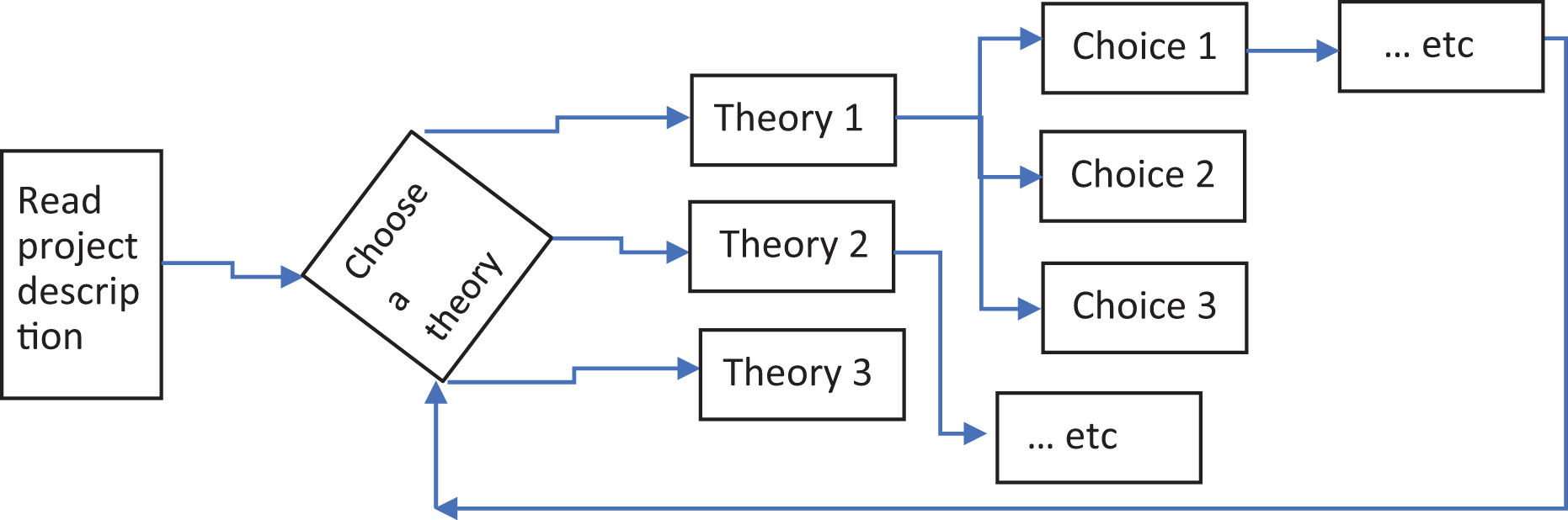
Proposed flow of the interactive case tool.
It is particularly useful when students are learning how to apply theories learnt into real-life situation. The sequence of their choices would be recorded and the teacher could discuss their rationale behind the choices with the students. It is different than offline case study tools because students could experiment with the different choices and the consequences their choices would cause. It helps students to familiarize with the theories and apply them to different situations. Moreover, students could continue their learning at their own pace and teachers could also save time and effort for not having to repeatedly explain different scenarios to different groups of people. Instead this study tool could record student activities; therefore, through analyzing their choices, teachers could understand students’ rationale behind their choices; thus, able to identify their areas of strength and weakness. The results could also be used to conduct research in comparison with the traditional mode of learning in which students focus mostly on memorizing for tests.
For example, students read the materials and/or a video of a real company (e.g. Starbucks advertisement or promotion leaflet of a company). They would be asked what competitive force this company is employing. They would then be given different choices, for example, in Porter’s theory: traditional competitors, suppliers, customers, and so on. After they have made a choice, they would be asked to write down their rationale behind their choices. If it is the correct choice, the system would then display the teacher’s answer and explanation for the students. The system could continue to ask what kind of competitive strategy(ies) the company could employ to combat the force; then more choices would be given. However, if it is not the correct choice or just part of the correct choice (e.g. it could be more than one competitive force a company is facing), then the system would prompt the students about the shortfall of their choices with explanations and allow them to choose again. The system would also be equipped with another option in which students would make their choices in a sequence without knowing whether they are the correct ones. Using the above example, if they make the wrong choice for the competitive force and subsequently use the wrong strategy, then the focal company would go bankrupt. Students could experiment with different combination of choices until they get it right, then the system would show them the explanations prepared by the teacher.
Through trial and error, students learn how theories could be applied in real life and not a mere memorization of points. Working it out through the system allows students to work on their own pace and time. Class time could be used instead to strength their weakness after analyzing the results, teachers could point out the common errors and misunderstanding of concepts in class, or comment on individual study journal (please see point 7 below). 4. Student project discussion tool: Often, students do not know how to systematically conduct discussions on their projects and ideas. The proposed platform provides a tool similar to the above “Interactive case study tools” for students to evaluate their project ideas within their groups. In this case, their discussion and collaboration outside of class could also be guided along the way. The more practices they have, the easier it would be to internalize the materials they have learnt and to apply it to different situations. It also helps them to learn from each other and facilitate team collaboration. 5. Instant posting: Results of MC or even short questions could be viewed instantaneously in class as they are being answered. It is an effective way of initiating in-class discussion as well as tracking individual learning outcome in class.
This is particularly useful for students who are used to lecture mode of teaching. They are usually less motivated in participating in class as explained in the previous section. Students could participate through speaking out in class or their mobile devices. One of the advantages of flipped classroom is the interaction between peers and teacher. However, the problem is also on encouraging students to participate in order to benefit from this teaching pedagogy. This could help to enhance the flipped classroom effectiveness, particularly in a large class setting, this function could allow every student to participate and the teacher could keep track of all their progress. Research could then be conducted through the data captured as well as survey and interviews of participants.
Games: The system could also utilize or link to existing game platform such as https://s176206.wixsite.com/e-learning/scm-game to further encourage participation and increase students’ interest in learning the subject. They could be played individually or in group; in class or outside of class. The example shown had been used in a revision class with a small group of 10 year 4 undergraduate BBA students of supply chain management. It was the first time they revised for test through playing games. Their feedbacks were positive and they indicated that it was fun to revise with their peer; and when they took turn to answer, they learnt from each other’s mistakes. Ultimately, the system aims to collect all the data footprints from students through collaborating with different game platforms or creating its own games. 6. Study journal: A record of what students have learnt and the answers of all the quizzes, case studies, and in-class activities would be listed as a report. Teachers could make comments on individual journal or broadcast to a group or the entire class if common misconceptions are found.
It is important for the students to know what kind of mistakes that they have made and how to correct it. The purpose of the study journal is to reinforce and internalize the knowledge of what they have learnt, and to ensure that they understand the rationale behind the different applications of theories. Often, a case study is not enough for students to fully grasp the complexity of the many uses of a theory. With a study journal, they could have a full profile of all the activities they have conducted, both outside and inside of the classroom; with comments and explanations. At the moment, most systems provide information in a piecemeal fashion. The proposed system is not only beneficial to students but also to the teaching staff who could have a record of everything their students have learnt, making planning and adjustment of the course much easier. It is also a rich field of information for researchers to investigate the effectiveness of this teaching method from different aspects. 7. A simplified prototype of the front end could be found at http://www.cuhk.edu.hk/eLearning/proj/dsme-itstratgen/index.html.
This APP was designed to implement some of the flipped classroom features, such as the delivery of assigned materials (with self-assessment tests) before the lecture, and to encourage higher-order learning and discussions through the use of real cases to help students better internalize the materials they have learnt. The APP was used in part of an IT management course for students studying Integrated Business Administration. Since it was a core course for the integrated BBA program, the background of the students were widely diverse, with their majors ranging from marketing to finance to IT management. They were predominately year 3 students; unfortunately, the system was not able to capture other demographics like gender, GPA, age, and so on. Moreover, due to the limited budget and time constraints, the APP could only provide very limited functionality and no baseline survey could be conducted prior to using the APP. The problem-solving element, interactive activities and the database system could not be implemented, thus the data could only be stored on the student devices. Students were required to submit some of their answers and opinions through e-mails, and these were used to facilitate further discussions during class. A simple preliminary survey was conducted. The scale of their answers ranges from 1—strongly agree to 5—strongly disagree; usable samples being 78.
Most students found that using the APP allowed them to better understand the theories learnt, the mean being 2.14 which was about 82% of the participating students. About 86% of the students thought that the pre-lecture materials were useful for their learning, the mean being 1.85. Almost 90% of the students agreed that the in-class interactions with teachers and peers were beneficial for them (mean 1.8). Overall, about 77% of them agreed that the APP was useful and should be kept as part of the course. Although some of them did not agree that flipped classroom could arouse their interest in the subject (mean 2.78), overall 85% (mean 1.96) were satisfied with the flipped classroom method of teaching.
The proposed model has incorporated functions which could support the “before-during-after” class activities which are the essences of the flipped classroom pedagogy. It could even support the recently proposed “productive failure-based flipped classroom” in which videos are used to consolidate knowledge learnt in class through discussion, rather than before. 9
Often, teachers would teach more than one class of the same course, thus half of the classes being taught by the same teacher could participate in research study using the abovementioned system. The other half could be used as the control group. Longitudinal studies could be easily conducted lasting for 1 year (two semesters). All students could participate in the same test prior to the start of the semester, testing their general knowledge of the course materials. This could then be used as a baseline test. After teaching commences, in the middle of the term, the results of the midterm test could be used to compare learning outcome between groups. At the end of the semester, students could take the same baseline test as revision and the learning outcome of each individual could then be measured. The final exams could also be used for comparisons between groups.
For the flipped classroom participants, a detailed survey could be conducted among them. The survey would measure their perceived effectiveness of the system, the ease of use, the acceptability, and learning experience. Wherever possible, the open-end feedback could be coded for further statistical analysis. The items of the questionnaire could be adopted or adapted from existing scales such as the Technology Accepted Model and Course Experience Questionnaire wherever possible.
Implications
The recent explosion of MOOC and e-learning platforms have inevitably changed the competitive landscape of the educational sector. It puts a certain pressure on physical educational institutions to enhance their students’ in-person classroom learning experience. 1 Coupled with the widely adopted mobile technology, the flipped classroom pedagogy is gaining increasing popularity among scholars in the education sector. The benefits of flipped classroom are manifolds, however, the most significant being that it frees up valuable class time for interactions and discussions between teachers and students. 32 Rather than introducing factual or basic knowledge in class, the fundamental principle of flipped classroom is to request students to familiarize themselves with the basic knowledge which they could then use in classroom discussions, where they purportedly learn how to apply them in an interactive setting. The key issues that remain under intense discussion are: how to ensure that students have enough essential knowledge in order to facilitate meaningful discussions, how to encourage learning outside classroom, what could be done to facilitate learning during in-class interactions, and what is the best way to integrate all of the different aspects together.
Although the idea of coming to class prepared is not new, the “flipped classroom” using the Internet, online materials, and mobile devices is a relative new idea. Various scholars have since shown that online video learning slightly outperforms in-person lectures and that online assignment is as effective as pen-and-papers ones. 18 A recent study suggested that this pedagogy could be more suited to those who are more intrinsically motivated than those who do not. 22 Despite the increase in online learning adoption, scholars agreed that flipped classroom is more than just looking at a few videos outside of class; however, there is no consensus yet over its definition and techniques. Theoretical frameworks are being proposed and empirical studies are mostly being conducted in America and relatively rare in Asia where learning style is different. A recent article on self-direct learning in Hong Kong 33 incorporated many of the flipped classroom ideas; however, it focuses on the primary level. Another qualitative research on Korean flipped classroom suggested that this mode of teaching and learning is indeed helpful in improving higher-order learning, but it could also create problems for students who are used to the traditional lecture mode of learning and may not be willing to change. 6,34 One empirical research on Middle East students was found to support the argument that flipped classroom increases the performance of students and it is also the preferred mode of learning. 35
Flipped classroom has been developing in recent years with the help of technology, nevertheless, empirical research in Asia still seems to be lagging. The proposed study would create a platform which facilitates interactive group learning inside the classroom, while direct computer-based individual learning take place outside. However, it is more than just a tool; it provides a holistic approach to study the effectiveness and the applicability of flipped classroom in Hong Kong tertiary educational sector, where empirical study of flipped classroom or e-learning literature is relatively rare. Longitudinal studies could be conducted using this platform, applying the e-learning flipped classroom pedagogy to one group of students taking the same course with the same teacher. 22 Surveys could be distributed to students of both the participating groups as well as the control groups. Comparisons between groups could then be conducted over time.
The proposed platform contributes not only to flipped classroom literature but could also be repeatable and applicable to the rest of the world due to the generic nature of the platform because it is designed to cater for different type of courses, thus offering the chance of flipped classroom research to a wider audience. The format of the flipped classroom provided more chances for students to engage in critical thinking, enable their own learning, and facilitate interactions and learning from their peers. In addition, the instructor was given more flexibility to provide in-class learning opportunities based on problem-solving activities and be able to offer timely response to students.
More importantly, the flipped classroom pedagogy is not limited to the tertiary sector but applicable to different levels of education. Also, the proposed platform could potentially enhance the learning experience of tens of thousands of students, thus increasing the competitiveness of the physical educational institutions over the online establishments. Moreover, as Alnodel et al. 36 suggested, technologies used in universities could have an impact on the communities which they are in.
Conclusion
The proposed platform (and future studies) is a holistic and systematic way to implement flipped classroom at different levels of the education system. However, it is not without its limitations. In order to increase the ease of use for teachers who do not have the technical know-how, the system must be simple enough to be easily navigated around. It is not possible to include every function that different disciplines may need. Moreover, any change in teaching styles requires a change of mind-set in both the teachers and students; therefore the successful adoption of the system depends on many factors, not just on the system alone. The system has already embedded a host of literature as its basis, and its generic nature allows it to be used by different subjects as well. Nonetheless, further investigations must be done on the system in order to measure its effectiveness and generalizability. Actions have already been taken to create the said platform. Future studies should include but not limited to the implementation across different disciplines, study of its effectiveness on students’ performance, evaluation methods and the suitability of flipped classroom in Asian culture, and so on. This platform could also be used as a basis for many longitudinal studies across subjects and countries which could contribute tremendously to the flipped classroom and digital learning literature.
Most importantly, the aim of this proposed system is to enhance, not replace, the learning experience for physical institutions, and to turn what has become a nuisance in classroom into a learning tool in order to increase physical institution’s competitiveness against the ever-increasing online e-learning platforms.
Footnotes
Declaration of Conflicting Interests
The author declared no potential conflicts of interest with respect to the research, authorship, and/or publication of this article.
Funding
The author disclosed receipt of the following financial support for the research, authorship, and/or publication of this article: The Micro-Module Courseware Development Grant (2015) from the Chinese University of Hong Kong helped create the simplified front end of the sample APP.
