




Abstract
This study explored the effects of the innovation system of start-ups and community support and resources on business performance of start-up companies using a survey of 213 start-ups across the different industry sectors in South Korea. In this article, we adopt the partial least square of structural equation model for analyzing the structural relationships of venture creation activities. First, the findings show that both the local community support and external partnership have significant impacts on the social norms and performance-based culture, but the path coefficient of local community support is somewhat greater than external partnership. Second, the test results also indicate that discovery and exploitation, which can be recognized as the major factors of innovation system in the start-up companies, are highly associated with their dynamic capabilities. Moreover, the dynamic capabilities can be also affected by the social norms and performance-based culture due to the paradigm of open innovation. Third, with regard to the total effect, the combination of discovery and local community support plays a central role for improving business performance of start-ups amid a rapidly changing market and economic environment.
Keywords
Introduction
In the knowledge economy or information society, a knowledge-based view of economic activities is increasingly central for understanding production of new products and processes, for guiding the strategic management of firms, and even for pioneering new market dynamics. 1,2 This new knowledge-based paradigm can also lead to the creation of new ventures as knowledge-intensive firms and lead to the new conception of economic structures involving networked or hyperconnected societies. In this new era, the firms based on knowledge and innovation are characterized as enduring alliances between independent knowledge-creating entities. 3 –5 These independent entities generally have attributes of a semiautonomous organic system, but its specific attributes depend on the type of firm. If the firm has a more hierarchical structure and culture, the degree of autonomy of the knowledge-creating entities within the organization may be low and their identity more machine-like. However, if the firm has a more network structure and culture, the independent knowledge creating entities that comprise the firm may have a high degree of autonomy and a self-regulating system. The firm-based dynamic and network types of knowledge creation have positive advantages: pooling heterogeneous intangible resources or assets, increasing the speed of technological innovation, reducing externalities, managing uncertainty or risk, and so on.
In recent years, the importance of new venture creation, also known as entrepreneurship, and its economic impacts on our society has been addressed by many economists and even industry stakeholder. 6 –8 The number of technology-based start-up companies created per year have risen a new record. Moreover, gross domestic spending on research and development (R&D) is defined as the total expenditure on R&D by percentage of GDP. In 2016, Israel is the highest R&D spending country, accounting for 4.5% (US$14.4 billion ) of their GDP and South Korea is the second highest R&D spending country, accounting for 4.2% (US$59.8 billion) of GDP, following Sweden (3.3%), Japan (3.1%), Denmark (2.9%), and Finland (2.7%). 9
In Korea, the number of technology-based start-ups, which are included in IT service, broadcasting communication service, science and technology-based service, business knowledge service, manufacturing, finance, and insurance, was 0.29 million in 2015, accounted for 14.5% of total number of start-ups, 10 but comparing with above OECD data, which indicates that Korea is the second highest R&D spending country in the world, the ratio is quite small. However, in the same data, the lion’s share of Korean start-ups is consisted of retail and wholesale, restaurant franchises, and accommodation, accounting for 1.05 million of the total 2.01 million or 52.6%.
There are numerous reasons and problems about that phenomenon, so many researchers and policy makers have been attempting to ascertain the reasons and to solve the problems. However, the definition of start-ups is somewhat different across the different organizations and countries: (1) a start-up is defined by a temporary and early-stage organization, (2) it is a spin-off organization from major companies or universities, and (3) it is an organization with high technology and innovation. With respect to the three definitions, the major characteristics of start-ups can be defined by a highly potential and independent knowledge creating organization, but it still needs some supports financially and institutionally.
One of the main issues for the creation of ventures, which is sometimes called commercialization of new knowledge, 11 is to analyze factors for extending start-ups’ life span and its sustainable growth. 12 –14 Although the average life span of start-ups varies across the different industries and countries, the critical level between firm growth and firm death is up to 5 years. 15 Again, in Korea, according to the statistics indicators from the Ministry of small and medium-sized enterprises (SMEs) and Start-ups (MSS) in 2015, only 16.1% of start-ups have more than 5 years of firm age, and the MSS’s industry survey results indicate that the most important factors for successful venture creation and sustainable firm growth are financial support (venture capital, national or local government loan, etc.) accounted for 45.6% of total respondents (start-up’s founders and CEOs), tax cuts accounted for 31.4%, simplification of registration and procedure processes accounted for 11.0%, and support for infrastructure (space, equipment, facilities) accounted for 9.8%.
As mentioned before, most of start-ups open their business with their own idea and management strategies, but they suffer to reach their knowledge infrastructure into the real business procedure because of lack of information and insufficient financial resource. Therefore, the utilization of external resources and local community support plays a significant role in the initial settlement of start-ups. Yet, there are only handful studies for exploring the mechanisms of the venture creation activities with the importance of geographic location and its proximity from public sectors, universities, and even large-sized companies, those are start-ups’ potential external partners who can transfer their technology and information and who might be coinventors or cofounders of start-ups. However, the channel of these external resources makes it possible to serve some useful information and to transfer technology for start-ups without losing their intellectual property rights. 16,17
Moreover, with respect to the venture creation, the role of the local government is mainly to support their local economic development and to induce or promote the creation of the innovation cluster, which has been defined as a geographically proximate set of interconnected companies and associated institutions in a particular field, 18,19 and its innovation complex with a deduction (or reduction) of local (state) corporate income tax, registration or license tax, and so on. In the same manner, the local government is not only a good mediator between start-ups and local or national banks (e.g. venture capital and loan) but also a good channel for receiving the market information and entrepreneurship education. 20,21
Although the local community support and the external partnerships are still the major factors for revitalizing venture creation activities and creating new innovation clusters, the ability of start-ups to respond to the rapidly changing environment in marketplace is also symmetrically important, so numerous studies have addressed the importance of dynamic capabilities for the start-ups. 22,23 According to Teece et al., 24 the dynamic capability framework is the understanding of firms’ operation system in environments of rapid technology change and how and why certain firms take comparative advantage in regimes of rapid change. In general, management strategies and business mechanisms in the large-sized companies are already systemized to respond to the rapid or unexpected market changes, whereas in many of small and medium-sized companies, especially start-ups, they may not be able to respond to the situations or not be aware of the importance of it.
Thus, the early stage of venture creation activities is generally affected or even constrained by a variety of internal and external factors. In other words, these factors affect the opportunities of starting new businesses and their business performance through more complex structures rather than one direction. Accordingly, analyzing the relationship between these factors is like solving a puzzle. As a result, many previous studies are rare to consider the systematic relationships between internal factors (innovation systems) and the external factors (local community support and external resources), even though they are likely to be connected with each other. However, recently, the perspective of open innovation 25 and its related studies attempt to untie the complex structural relationships between internal and external information utilization. 26 –28 According to Greco, 27 the open innovation strategies such as external search breadth and depth as well as coupled open innovation make it possible to describe the interaction between firms’ innovative behavior and external collaborations through a variety of external channels. These relationships and interactions have a positive impact on the firms’ innovation performance.
As a consequence, in this study, we have several research questions interrelated with this situation: To what extent do the relationships between internal factors and external factors affect the venture creation activities? How the relationships are associated with start-ups’ business performance? What factors might explain the importance of firms’ innovation system for improving their business performance amid of rapidly changing market conditions? How do the local community support and external resources affect the venture creation activities? Which external factors are more important for improving business performance of start-ups? What are the economic implications for promoting revitalization of start-ups and small-sized enterprises? The main purpose of this study is to analyze the systematic relationships between external and internal factors for improving business performance of start-ups using a survey samples on start-ups and small-sized enterprises across the different industry sectors in South Korea. There are some specific purposes: (1) to understand the importance of local community support and external resources for opening new businesses, (2) to explore the innovation system of start-ups with respect to their dynamic capabilities, (3) to analyze the structural model framework between external factors and internal factors of start-ups, and (4) to discuss the economic impacts of revitalization of start-ups on our society.
Theoretical background and research hypotheses
Community support and resources for starting new businesses
Perhaps, due to the lack of information and insufficient funding sources, most of start-up companies need to consider their community support and external resources. 29 As we mentioned in earlier, “Introduction” section, to induce the creation of innovation clusters and to build the local innovation complex or science park, wherein the start-ups could start their new businesses, the local community support, which is included in the role of local government for regional development, is a necessary condition for most of the start-ups. The main supports of local government are to provide useful information and entrepreneurship education for starting new businesses, to attempt to remove entering barriers in the market, to simplify registration process, to improve local infrastructure, and so on. Moreover, one of the crucial missions of local government for start-ups is to ease regulations on local banks and angel investors, who provide venture capital for start-ups (i.e. crowdfunding), for the sake of solving financial problems of start-ups. 20,30,31 These activities and support of local government for start-ups can lead to a good community-level culture norms especially performance-based culture and social norms. According to Hopp and Stephan, 20 the conditions for success of early-stage or nascent entrepreneurs are highly associated with the conditions for community cultural norms and performance-based culture. These also significantly affect the entrepreneurial behavior of start-ups and their venture emergence.
Moreover, it is necessary to utilize external resources to maintain stable business performance and to promote their sustainable growth. 22,29 The external partnerships, which are defined as technology transfer or information sharing between transferors and transferees, bring new business sources and information and provide to improve business skills and management strategies of start-ups. 32,33 The social norms and performance-based culture in the community is also connected with the opportunities of external partnerships for start-up companies. In other words, these cultural and social norms can lead to effective collaborations between public and private institutions or between multiple entities.
Following the studies of triple helix, 34 –36 which is defined as a set of collaborations between three major entities such as university, government (especially local government), and industry, the newer mode of innovation system is no longer attainable the successful innovation performance through single entity (government, university, or industry) leading process, but it can be achieved through multiple entity leading process like triple helix. Therefore, starting new businesses or venture creation activities in the area with a systematic innovation system based on the performance-based cultures and social norms is more likely to have opportunities to utilize external resources and to collaborate with external partners (local universities, and public and private institutions). 37
Hence, in the part for community support and resources, the relationships between local community support for start-ups, external partnerships, and social norms and performance-based culture are more likely to have a positive impact on each other. As a result, we can derive below research hypotheses.
Innovation system of start-ups for new market dynamics
In terms of new market dynamics and rapidly changing environments of technology and economy, the innovation system of start-ups can be recognized as the engine for exploring new business plans and strategies and pioneering new market opportunities. According to Zhao et al., 38 entrepreneur(s) of start-ups often have to make a decision to be the first mover in a new market. To take pioneering advantages in the new market, the first movers not only take some risks, but face uncertainties. Again, searching new market dynamics, which is defined as the factors that affect market supply and demand of new products and processes, is an important activity for sustainable growth of start-ups with respect to their dynamic capabilities that provide the competitive advantage in the new market. 30,31,39 Although the mechanism of innovation system is somewhat different across the different industry sectors and technologies, the underlying definition of innovation is based on exploring the new knowledge and opening or sharing knowledge. 40
With regard to the entrepreneurial opportunities for new market dynamics, the theory of discovery, which is generally compared with the theory of creation, provides useful ideas for finding new business items, pioneering new market opportunities, and creating a new technology. According to Farmer et al., 41 discovery is an ability to identify and refine ideas of venture creation activities. It is one of the important innovative behaviors of nascent entrepreneurs, but it generally differs from exploration, which is defined as the search for external knowledge and the acquisition of new knowledge, 42,43 in the innovation ambidexterity. However, by the definition of both discovery and exploration, some of characteristics of those are overlapped. Moreover, another edge of the nascent entrepreneurial behaviors based on innovation refers the characteristics of exploitation, which is to utilize existing resources and information for creating new products and processes. 44 –46 Moreover, exploitation also takes into account the ability for applying existing knowledge into the start-ups’ business strategies, management plans, and even innovation activities. 47
In terms of innovation system of firms with respect to the new market dynamics, the dynamic capability refers the concept of the firm’s ability to react, reconfigure, and identify new opportunities amid a rapidly changing market environment and contemporary business conditions.
22,24,48
The original concept of dynamic capabilities was introduced by Teece et al.
24
According to their study, the framework of dynamic capabilities enhances the firm’s short-term and long-term competitive advantage by capturing internal and external resources and knowledge in the rapid technological change. These characteristics of dynamic capabilities are underlying rooted in the characteristics of both discovery and exploitation within the innovation system of the firm as well as start-ups. Therefore, based on these discussions, we can set up research hypotheses below.
Paradigm of open innovation for start-ups
Unlike the traditional form or closed form of innovation in the past, open innovation has a form that utilize external resources and information dynamically, so business ideas can no longer be limited to internal security in the firm. According Henry Chesbrough’s definition of open innovation, “valuable ideas can come from inside or outside the company and can go to market from inside or outside the company as well.” 25 In particular, start-ups in the paradigm of open innovation play a significant role in the evaluation of a newer mode of innovation system and process because of their inherent characteristics such as “a temporary form of organization.” 28,49,50 Following Spender et al., 49 start-ups are recognized as an engine of open innovation system and process, and they are basically open organizations related with more flexible innovation system and process to adopt external factors.
Moreover, this paradigm of open innovation affects not only the innovation system in the firms but also the public institutions (universities and public laboratories) that are highly collaborated with private companies.
51
This phenomenon can lead to changes in the atmosphere of market environment and even government policies in the midst of plenty of information and knowledge.
52
For this reason, the innovation system in the firms with respect to the new market dynamics, especially in start-up companies, can be affected by the community conditions and cultural norms. Therefore, we want to generate a research hypothesis as below.
Business performance and sustainable growth of start-ups
Business performance of firms has broadly two parts, financial performance and non-financial performance. On the one hand, non-financial performance refers to performance that cannot be measured by monetary units such as quality of brand power and reputation, customer satisfaction with products, organizational performance, and innovation performance. On the other hand, financial performance refers to performance which can be measured by monetary units and financial activities. Particularly, for start-ups or early stage of venture creation activities, financial performance is somewhat more important than non-financial performance and its related activities. 49,53 In a short-term perspective, the financial performance is directly linked to the survival of start-up companies whereas the non-financial performance is more likely to relate the sustainable growth of start-ups in a long-term perspective. However, the most important matter is to manage and harmonize both financial and non-financial performance for developing start-ups.
In general, start-ups are highly influenced by regional characteristics and infrastructures. For this reason, if the local government induces venture creation activities with start-up friendly policies such as reducing corporate tax, building an innovation complex, and promoting venture capital with local or national banks, it is highly probable that the business performance of start-up companies can be increased. 12,54 With regard to implicit factors, there exist some meaningful relationships between the performance-based culture and socially supportive norms in the local community and business performance of start-up companies. According to Hopp and Stephan, 20 community-level cultural norms for starting new businesses impact the entrepreneurial behaviors such as entrepreneurial self-efficacy and motivation. Thus, these also lead to the improvement of business performance of start-up companies.
By definition of dynamic capabilities, the ability of start-ups to react and identify new market and business opportunities creates new ideas and skills to improve their business performance. 24,55,56 According to Wu, 22 dynamic capabilities play a significantly role in entrepreneurial resources to enhance start-ups’ business performance and also it plays a good indicator to mediate between entrepreneurial resources and performance. Moreover, following Mathivathanan et al., 57 dynamic capabilities can be used for understanding the overall impact on the enhancement of firms’ performance.
Hence, although the level of impact of both factors (community-level of performance-based culture and socially-supportive norms, and dynamic capabilities in the system of start-up companies) on business performance of start-ups is different from each other, those have a significant relationship with start-ups’ business performance. Therefore, we want to set up the research hypotheses below.
Research model and data
Model framework
In this article, we adopt the partial least square with a structural equation model (PLS-SEM) framework for building upon the empirical model that describes the systematic relationships between internal and external factors. Figure 1 illustrates the conceptual model structure that is based on the research hypotheses presented in the previous section. In Figure 1, λi represents an independent or variable for i construct, ∀i=1,…,4, and ηj indicates an intervening variable for j construct, ∀j = 1,2. Finally, θ is a dependent variable in this model. Each path in Figure 1 shows the hypothetical relationships among latent variables.

Conceptual model structure.
Moreover, in Figure 1, the model structure consists of two different parts: one is a part for community support and resources; another is a part for the innovation system of start-ups. In the part for community support and resources, there are three major latent variables: (1) local community support for start-ups, (2) external partnerships, and (3) social norms and performance-based culture. Analogously, in the part for innovation system of start-ups, there are also three latent variables: (1) discovery, (2) exploitation, and (3) dynamic capabilities.
Data description
The data set in this article was collected by both on/off-line surveys with 213 start-up companies across the different industry sectors in South Korea for the year 2016. The survey respondents are basically a founder or CEOs of the start-up companies located in the university facilities, local innovation park or complex, public and private institutions. As mentioned in “Introduction,” the average life span of start-ups is up to 5 years. Correspondingly, in our sample, 77.9% of start-ups in the age of firms is under 5 years and the age of firms under 2 is 55.4%. Moreover, the number of employees in most of the start-ups is below 10, accounting for 80.8% out of the total sample. In addition, the number of male respondents (founders or CEOs) is overwhelmingly larger than the number of female respondents. In the age distribution, the age between 30 and 49 is the most frequent, accounting for 66.2% out of the total sample. Table 1 represents characteristics of a survey sample.
Characteristics of a survey sample.
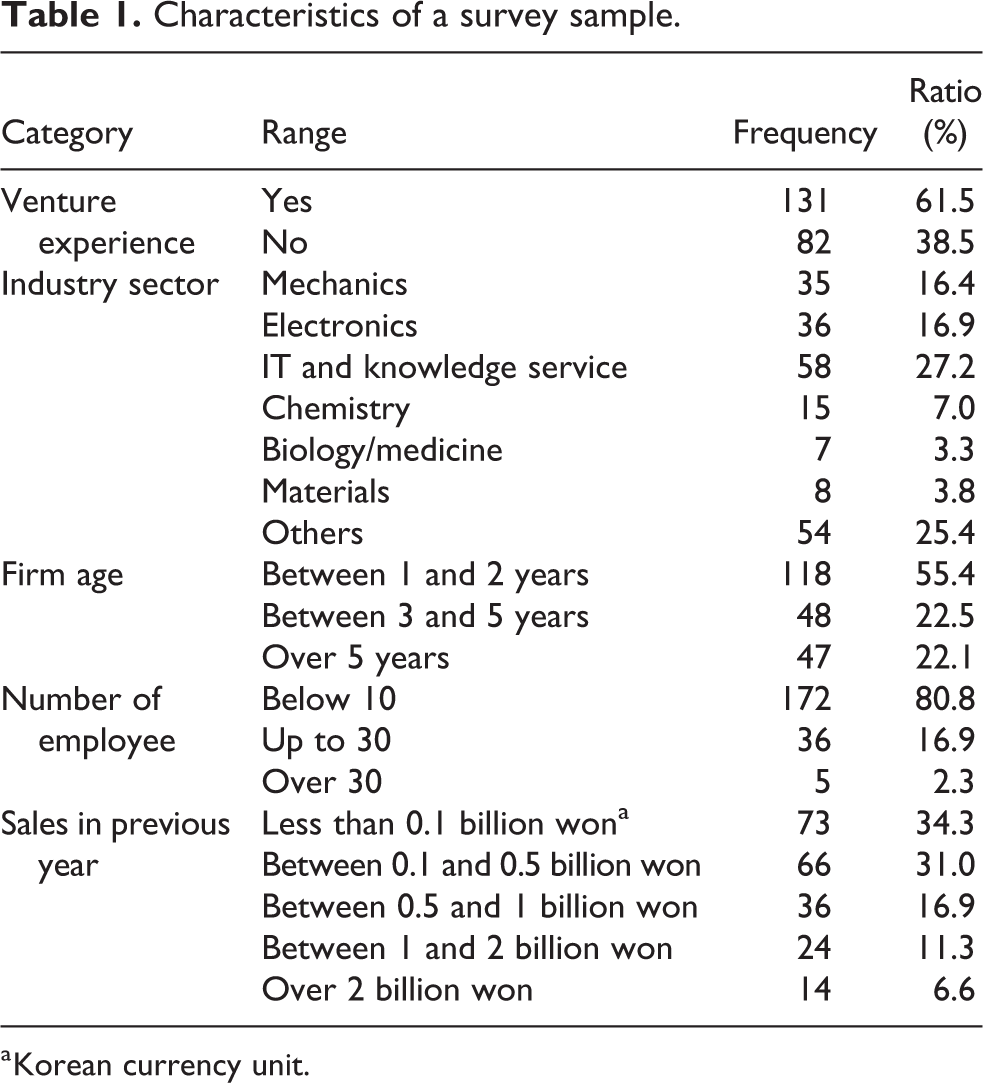
a Korean currency unit.
Table 2 represents the characteristics of measurement variables. Each latent variable or construct contains several measurement variables with specific items (see more details in Figure 1). The rating scale of each measurement variable follows seven-point Likert-type scale. Most of measurement variables use an agree–disagree manner with seven-point Likert-type scale, but some measurement variables take a place of an agree–disagree manner by an insufficient–sufficient manner or a slow–fast manner. To evaluate the financial performance of start-ups, there are three major indicators: (1) net profit per year, (2) growth rate of sales per year, and (3) rate of return on investment (ROI). In this article, we adopt the rate of ROI, which refers a ration between net profit and cost of investment.
Characteristics of measurement variables.
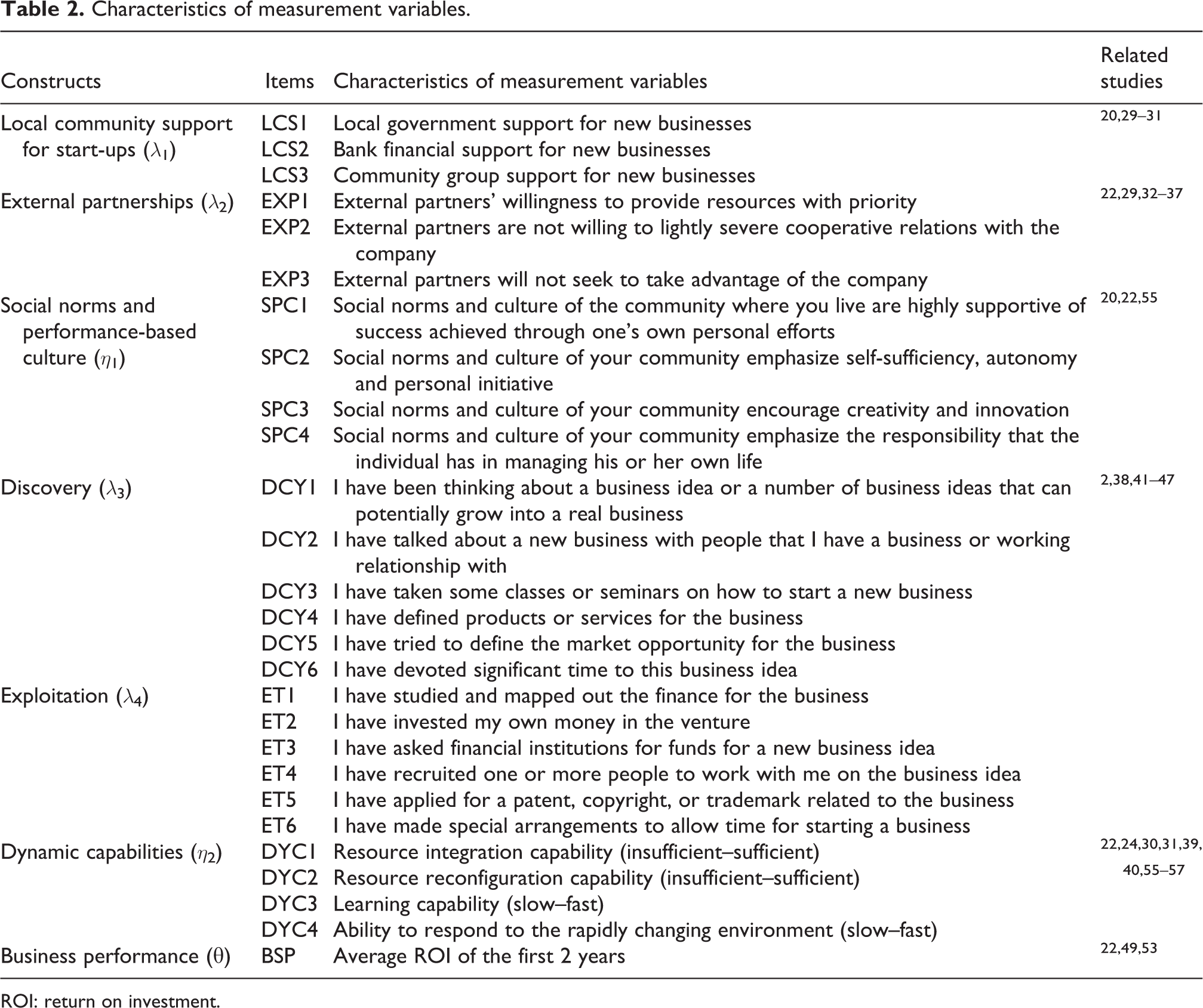
ROI: return on investment.
Results
Model validity and reliability
Table 3 represents the test results of validity and reliability for latent variables in the model. It also displays the factor loadings in outer model and the four different test indicators. First, if the factor loadings in each latent variable are significantly large (i.e. approximately over 0.7), the latent variable has high factor correlations, which can increase a goodness of fit of the PLS-SEM. Most of factor loadings are greater than the critical value with 0.7, but a few factor loadings, EXP3 and DYC1, are a little bit below the critical value.
Validity and reliability test for latent variables.

Second, the model fit assessment in PLS-SEM is somewhat different from ordinary least squared models, so the four test indicators in Table 4 can be utilized for testing validity and reliability. Since the values of Cronbach’s α in each latent variable are greater than the critical value with 0.7, the model can be assessed that there exists a high internal consistency and validity in the model. Moreover, with respect to the critical values of average variance extracted (AVE) (greater than 0.5) and composite reliability (greater than 0.7), all the values are greater than the critical values, so there exist a significantly high convergent validity and reliability in the model. Table 4 shows the result of the discriminant validity test. The result indicates that the model has both appropriate convergent and discriminant validity.
Discriminant validity test.a

a Values in the diagonal are coefficients of the square root of AVE.
Results of hypothesis testing
Based on the Figure 1 with research hypotheses in the previous section, Table 5 represents the results of hypothesis testing. We could accept all research hypotheses with at least 95% statistical confidence. In the part for community support and resources, the local community support for start-ups has a highly positive relationship with social norms and performance-based culture at 0.1% level of significance (hypothesis 1), and, similarly, the result of hypothesis 2 indicates that the start-ups’ external partnerships, which can be generally induced by the local government’s support and the geographic proximity between start-ups and other external entities, such as university, public and private institutions, and large-sized companies, are significantly connected with social norms and performance-based culture at 0.1% level of statistical confidence.
Results of hypothesis testing.a

a Parentheses are standard deviation.
*p < 0.05.
**p < 0.01.
***p < 0.001.
Moreover, in the part for innovation system of start-ups, the dynamic capabilities in the start-ups have positive relationships with both discovery (hypothesis 3) and exploitation (hypothesis 4) at 0.1% and 5% levels of significance, respectively. However, discovery, which is known as one of the components for induced innovation, has a stronger impact on the dynamic capabilities in start-ups than exploitation has. The dynamic capabilities are also positively affected by the social norms and performance-based culture (hypothesis 5). Both the intervening variables, social norms and performance-based culture (hypothesis 6) and dynamic capabilities (hypothesis 7), have a highly positive impact on the business performance in start-ups, ROI of the first 2 years, but the dynamic capabilities have more impacts on business performance than social norms and performance-based culture.
Interpretation of path coefficients
The path coefficient analysis for latent variables indicates the magnitudes of direct and indirect effects on the dependent variable. Moreover, one of the advantages of this path coefficient analysis is that it makes it possible to evaluate which independent variable has more impact on the dependent variable. First, in the part for community support and resources, there are two ways to evaluate the indirect relationships between local community support, external partnerships, and business performance: (1) a path via social norms and performance-based culture and (2) a path via dynamic capabilities (see more details in Figure 1). The indirect effect of local community support on business performance via social norms and performance-based culture is λ 1→η 1→θ = 0.096 and via dynamic capabilities is λ 1→η 1→η 2→θ = 0.041. Similarly, the indirect effect of external partnerships via both channels also can be calculated by λ 2→η 1→θ = 0.029 and λ 2→η 1→η 2→θ = 0.012, respectively. Second, in the part for innovation system of start-ups for new market dynamics, the indirect effect of both discovery and exploitation on business performance via dynamic capabilities only can be calculated by λ 3→η 2→θ = 0.142 and λ 4→η 2→θ = 0.079, respectively. To sum, within the indirect effect, discovery (via a path of dynamic capabilities) and local community support (via a path of social norms and performance-based culture) have more impact on business performance of start-ups than other independent variables.
Because of structural characteristics of the model framework (see in Figure 1), there is no direct effect of all independent variables on the dependent variable, but there is only direct effect of two intervening variables on the dependent variable. The direct effect of the social norms and performance-based culture on business performance of start-ups is η 1→θ = 0.149 and the direct effect of dynamic capabilities is η 2→θ = 0.419. As a result, the dynamic capabilities have a higher impact on business performance than the social norms and performance-based culture. These can be interpreted that, ceteris paribus, for every one unit (Likert-type scale) increase in the dynamic capabilities and the social norms and performance-based culture on business performance of start-ups can be expected to increase approximately 0.419 and 0.146, respectively.
Finally, we want to consider the total effect of all four independent variables on business performance of start-ups. Total effect is defined as the sum of all possible direct and indirect effects. As a result, the total effect of discovery and exploitation in the innovation system of start-ups for new market dynamics is their indirect effects itself. However, the total effect of the local community support and external resources is a little bit complicated because of two channels of their path coefficients. The total effect of local community support on business performance can be calculated by sum of two paths, (c 1→η 1→θ = 0.096) + (λ 1→η 1→η 2→θ = 0.041), so it can be calculated by 0.137. Similarly, the total effect of external partnerships can be calculated by 0.041. Thus, remarkably, within the total effect, discovery has the highest impact on the business performance of start-ups and the local community support for starting new businesses also has highly significant impact on the business performance.
Conclusion
This study explored the effects of the innovation system of start-ups and community support and resources on business performance of start-up companies using a survey of 213 start-ups across the different industry sectors in South Korea. We have utilized seven different latent constructs included in input–output variables to estimate the research objectives by adopting the PLS-SEM. First, the findings show that both local community support and external partnerships have a positive impact on the social norms and performance-based culture, but in the magnitude of path coefficients, the effect of local community support is greater than external partnerships on the social norms and performance-based culture. While the range of external partners or resources in start-ups can be varied across different types of knowledge dissemination channels, the local community support for starting new businesses, such as the institutional support of local government (cutting local corporate income tax, creating innovation complex or related infrastructure, and easing business registration process), the financial support of local banks and investors (venture capital and low interest rate loans), and informative support of community groups (market information and entrepreneurship education), is strongly connected with the social norms and culture for start-ups.
Second, the findings also indicate that knowledge-based factors, such as discovery and exploitation, in the innovation system of start-ups are positively associated with the dynamic capabilities for exploring new market dynamics. By the nature of knowledge, defined as exploring new things and collecting new information, discovery can be recognized as the engine of new market dynamics and it leads to more innovative outcomes, which are the crucial part of dynamic capabilities of start-ups, than exploitation. Moreover, the dynamic capabilities of start-ups can be affected by the social norms and performance-based culture in their local community due to the shortage of information and scarce financial resources. Third, in terms of the total effect on business performance of start-ups, both the discovery in the innovation system of start-ups and the local community support for starting new businesses are the most significant factors for increasing business performance of start-ups. Moreover, two intervening variables, social norms and performance-based culture and dynamic capabilities, have a positive and significant impact on business performance of start-ups. Although a variety of factors can affect the start-ups’ business performance, the findings might tell us that the combination of the discovery in the innovation system of start-ups for new market dynamics and the local community support play a significant role in improving the business performance of start-ups amid a rapidly changing market environment.
In this study, we would like to provide broadly two practical implications: (1) the aspect of policy changes in the local government and (2) the aspect of innovation system of start-ups. First, in the aspect of policy changes, the local government support plays an important role in the venture creation activities. According to a survey by Korean MSS regarding the inconveniences to the government’s support system for start-ups and SMEs, 10 14.7% of survey respondents answered the complex of registration and procedure processes as inconveniences. Moreover, 14.3% of survey respondents answered the insufficient information about the supporting programs and policies as inconveniences. For these reasons, the local government should consider to simplify the application process of supporting programs and to establish the systematic information provision system for promoting more venture creation activities in their region and community. Second, in the aspect of innovation system of start-ups, focusing on the improvement of innovation system through enhancing discovery activities is more important for the growth of firms. In short-term, since the discovery activities are recognized as the main engine of start-up companies to search new business plans and strategies, these make it possible to increase their business performance. Moreover, in the long-run perspective, improving the innovation system of start-ups can be used for an underlying resource that enhances their business performance and also provides a new knowledge to produce new products and processes in the midst of a rapidly changing market and economic environment.
Despite the meaningful results from this study, there are some shortages and limitations. The most major issue is that the scope of data is limited to South Korea. However, there exist both advantages and disadvantages. The findings from this study can be used for the analysis of Korean industries, especially for start-ups, but it is difficult to apply directly to industries of other countries because of different market and economic environments across different countries. Nevertheless, it is still a meaningful indicator for exploring the structural relationships of venture creation activities. In further studies, we expect that the findings from this study can be used as an important indicator of venture creation activities using international data.
Footnotes
Declaration of Conflicting Interests
The author(s) declared no potential conflicts of interest with respect to the research, authorship, and/or publication of this article.
Funding
The author(s) disclosed receipt of the following financial support for the research, authorship, and/or publication of this article: This research was supported by the Daejeon University fund (2016).
