




Abstract
Economic growth occurs when an economy’s production at the full employment level increases. Increase in the production at the full employment level is shown by an outward shift of production possibility frontier (PPF). The aim of this study is to measure capacity growth of an economy by utilizing equation of the PPF. The present study takes into account a bowed-out (concave to the origin) PPF in order to measure economic growth. Thus, at first, concavity conditions are obtained. Besides, the study augments Cobb–Douglas production function by assuming the nature of technological progress as Harrod neutral. For this reason, concavity conditions are obtained assuming Harrod neutrality. The first result of the article documents that there are conditions in order to guarantee positive economic growth. The second result indicates that growth of productive capacity depends on (i) rate of growth of labour, (ii) rate of growth of level of technology (rate of growth of the labour productivity) and (iii) elasticity parameters, under specific conditions. Based on these results, our study formally proves that the long-term or natural or potential rate of growth is determined by rate of growth of effective labour.
Introduction
When an economy’s production at the full employment level increases, one can say that economic growth occurs. The expansion in the production at the full employment level is expressed by a shift of production possibility frontier (PPF) outward. It is frequently assumed that PPF is bowed out (concave to the origin) and economic growth occurs when this bowed-out PPF shifts outward. The former studies on this subject constitute a vast literature explaining the possible shapes of PPF (see, for example, the studies of Bator 1 Worswick, 2 Green, 3 Herberg and Kemp, 4 Melvin, 5 Mayer, 6 Panagariya, 7 Minabe, 8 Panagariya, 9 Minabe, 10 Kemp and Tawada, 11 Tawada, 12 Wong 13 and Dalal 14 ). However, measuring growth of an economy based on a shift of the bowed-out PPF seems to be a neglected problem. This article attempts to measure economic growth as an outward shift of PPF by using equation of bowed-out PPF.
Note that Mert obtains the equation of PPF under Hicks neutrality 15 and measures economic growth using the equation of PPF under Hicks neutrality. 16,17 However, Hicks-neutrality assumption is not compatible with steady-state or long-run equilibrium analysis, but Harrod neutrality is compatible with long-run equilibrium analysis (see the work of Uzawa 18 ). Acikgoz and Mert 19 show that if Hicks neutrality is assumed, then a study which is based on long-run analysis should assume level of technology constant. The assumption of ‘constant level of technology’ limits economic growth analysis since economic growth mainly stems from technological progress. Thus, our study unlike the previous study, thanks to assuming Harrod neutrality, is able to make a link between technological progress and economic growth.
Initially, Nutter 20 investigates growth of production at the full employment level by using PPF. Then, Levine 21 criticizes Nutter 20 , claiming that indexes of production are biased for the USSR with respect to the United States. Nutter 22 replies this comment emphasizing that his contribution on measuring economic growth is theoretical rather than statistical. Drechsler 23 discusses statistical problems of economic growth, using mainly statistics of Hungary. Similarly, Moore 24 makes an analysis on the statistical problems of measurement of economic growth using data of the Soviet economy. Henderson et al. 25 suggest using satellite data on lights at night in order to measure economic growth. They find evidence for regions of sub-Saharan Africa for the period of 1992–2008. Their results imply that empirical growth is different from the growth based on national income data. Labaj et al. 26 display different explanations on measuring the economic growth and emphasizes that new measurements should include economic, social and environmental objectives. Extending the models, which are based on data envelopment analysis, with indicators of environmental issues, they measure social performance. Unlike the previous studies on the measurement of economic growth, the present study aims to measure economic growth based on a shift of bowed-out PPF outward.
What matters such a measurement? Our study formally shows that true measurement of economic growth of a sector is mainly determined by (i) rate of growth of the level of technology (rate of growth of the labour productivity) of the growing sector, (ii) rate of growth of the labour of the growing sector and (iii) elasticity parameters, under specific conditions. Note that the long-term or natural or potential rate of growth of an economy is also determined by growth rate of labour and growth rate of technology. 27 The sum of growth rate of labour and growth rate of technology is equal to growth rate of effective labour. 28 Thus, taking into account these results, our study formally proves that the long-term or natural or potential rate of growth is determined by rate of growth of effective labour. As a result, our contributions are (i) measuring economic growth based on a shift of bowed-out PPF outward and (ii) proving formally that the long-term or natural or potential rate of growth is determined by rate of growth of effective labour. We need to emphasize that unlike previous studies, our study obtains the equation of the PPF under Harrod neutrality, and based on this finding, it explains the conditions for one sector’s potential (long-term) growth. Note that only Harrod neutrality is compatible with steady-state or long-term analysis. Besides, again we need to emphasize that apart from previous studies, the present article formally proves that the long-term or natural or potential rate of growth is determined by rate of growth of effective labour; that is, the long-term or natural or potential rate of growth is determined by the sum of growth rate of technology (rate of growth of the labour productivity) and growth rate of labour. Recognize that elasticity parameters also determine the long-term or natural or potential rate of growth under specific conditions.
Note that some empirical studies assume the sum of labour productivity growth and labour growth as a beginning point of their sources of growth analysis (see, for example, the studies by Klenow and Rodríguez-Clare, 29 Acikgoz and Mert 30 and Kılıçaslan et al. 31 ); however, some of these use total factor productivity growth rather than labour productivity growth in their analysis (see, for example, the studies of Abu-Qarn and Abu-Bader, 32 Eng, 33 Cardona and Garcia 34 and Chen et al. 35 ). According to the empirical findings of Deliktas and Balcilar, 36 Hicks-neutral technical change is not appropriate for their growth analysis. However, the basis of their analysis is total factor productivity growth. Note that total factor productivity growth occurs when the nature of technological progress is Hicks neutral. Barros et al. 37 assume Hicks-neutral technological change for investigating the productivity growth of seaports of Brasilia and they show that assuming Hicks-neutral technological change is not appropriate for that analysis. Kumar and Russell, 38 Henderson and Russell 39 and Walheer 40 find evidence that the nature of technical change is non-neutral. The present study invites to a debate pointing out that empirical analysis, which is based on a strict theory, whether assume Hicks neutrality (i.e. using the term total factor productivity) or Harrod neutrality (using the term labour productivity). To us, since Harrod neutrality is compatible with steady-state or long-term analysis, empirical analysis which is based on a long-term analysis should also assume Harrod neutrality in order to make an analysis compatible with the theory. Finally, our explanation on productivity does not depend on a game-theoretic framework. However, investigating mutual relationships of agents is an important issue for a productivity analysis. As an example, Matveenko et al. 41 show three types of behaviour of agents whose productivities are different, based on a model of production and externalities in network with two types of agents.
The article is organized as follows: The following section explains the equation of PPF under Harrod-neutrality assumption. Then, the second derivative of production possibility curve is shown. After that, possible shapes of PPF are shown under Harrod-neutrality assumption. Based on the findings, three cases are listed for positive economic growth in the ‘Three cases for economic growth’ section. Finally, conclusions are presented.
Equation of PPF under Harrod neutrality
Suppose that there are two sectors which produce commodities x and y. Production functions are in Cobb–Douglas form


where Q is the quantity of production, A represents the technology level, K is the capital, L is the labour, and μ and λ are the elasticity parameters. It is assumed that the identifying assumption of the technology is Harrod neutral, and μx, μy, λx and λy are all positive values. Lower indices represent the sectors.
The isoquant curve for x is the following

where a and b are parameters (ax > 0 and bx > 0).
Writing a tangent at any point on isoquant curve

Similarly, for y



Note that there exist conditions for technical efficiency; since it is assumed that ax > 0, ay > 0, bx > 0 and by > 0, it is obvious that
Production efficiency exists at the point where isoquant curves are tangent to each other. Thus, equation (5) equals to equation (2) at the production efficiency conditions


Rearranging (7)

Multiplying both side of the


Since


Since

Equation (13) is the equation of the PPF.
Since
Since capital elasticity of output is equal to


Since


As

Leaving alone ax and ay for equations (2) and (5), equations (19) and (20) can be written as follows


Using the last two equations, equation (18) becomes

Finally, as

Note that

Thus, (23) is the equation of PPF under Harrod neutrality. By definition, equation (23) should have a negative slope. The possible shape of PPF is determined by the second derivative of equation (23).
Second derivative of PPF
Preliminaries
It is assumed that level of technology has a positive value Since technical efficiency is valid, it is assumed that Since Thus, in the light of the conditions above, the followings are true.
Since

is written.
Then if equation (24) is negative, PPF will be negatively sloped.
The possible shape of PPF is determined by the second derivative of equation (23).
The second derivative of equation (23)
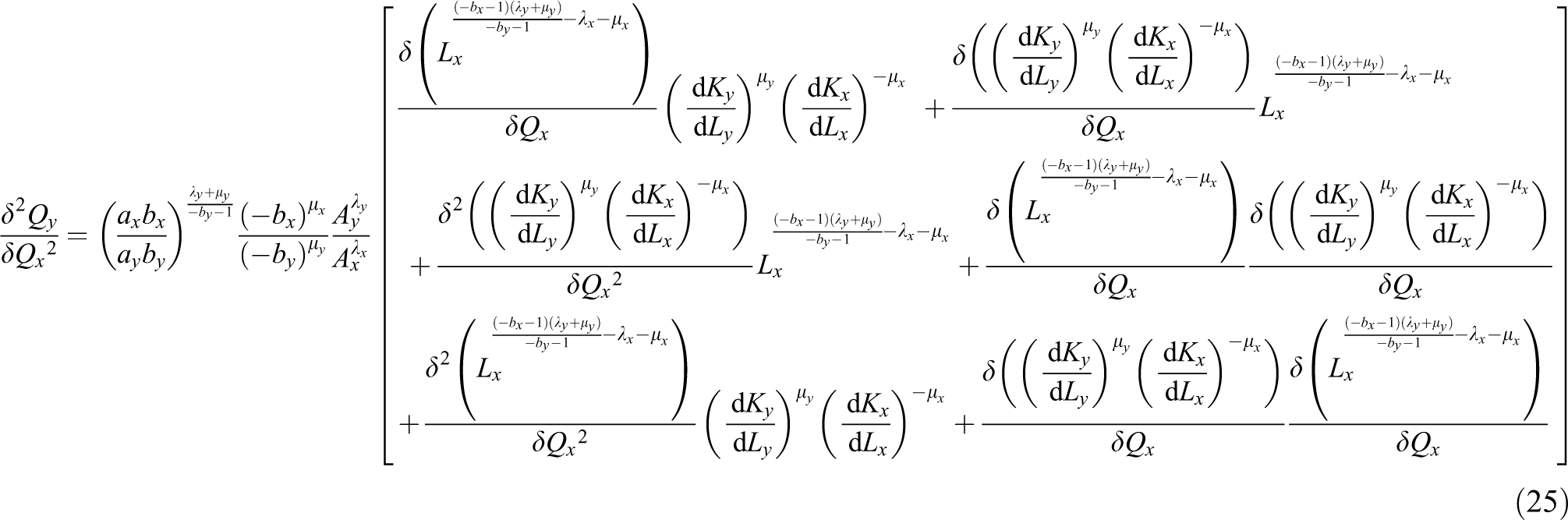
Since

Since

Recognize that

Possible shapes of PPF under Harrod neutrality
Under certain conditions, shape of the possibility frontier can be linear, bowed out (concave to the origin) and bowed in (convex to the origin). Table 1 gives these conditions. Note that those conditions are exactly same as indicated in the work of Mert 15 . However, Mert 15 assumes Hicks neutrality. Therefore, assuming Harrod neutrality does not change the conditions which determine possible shapes of the possibility frontier.
Possible shapes of the PPF under different returns to scale conditions and under Harrod neutrality.

Source: Author’s own results.
PPF: production possibility frontier.
Among the conditions in Table 1, we use the concavity conditions in order to measure the economic growth.
Measuring economic growth using bowed-out PPF under Harrod neutrality
Equation (23) can be rewritten as

We measure only the growth of sector x. Then, suppose that dQy = 0. Thus, equation (30) can be written

Implementing rules, the following occurs

Since it is assumed

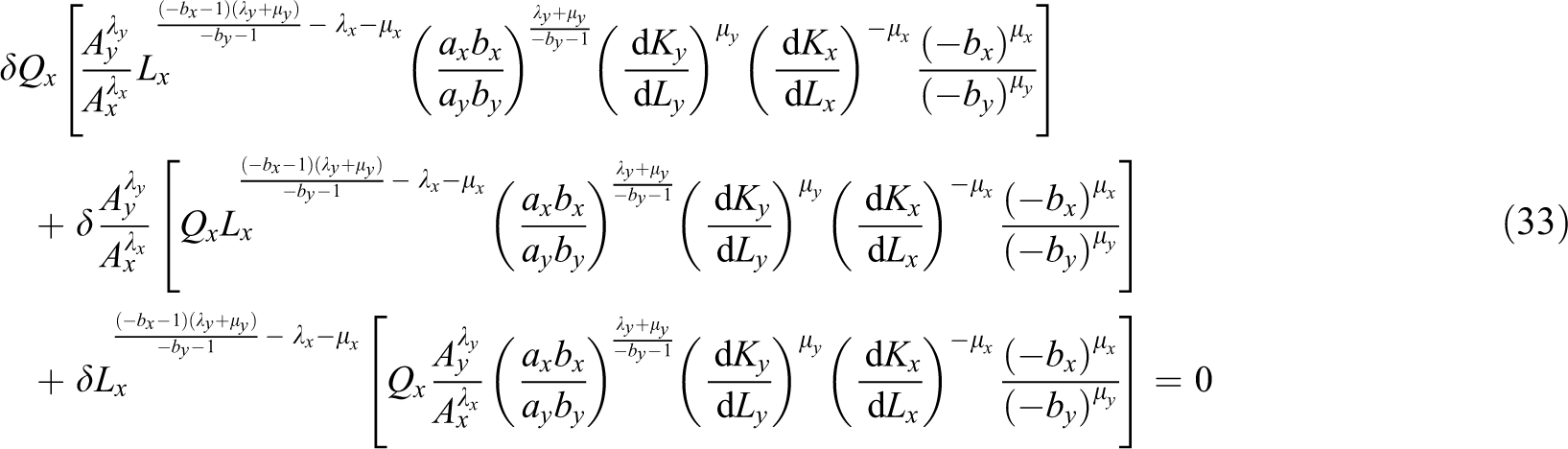
Rearranging equation (33)


Assume that

Leaving alone


Rearranging (38)
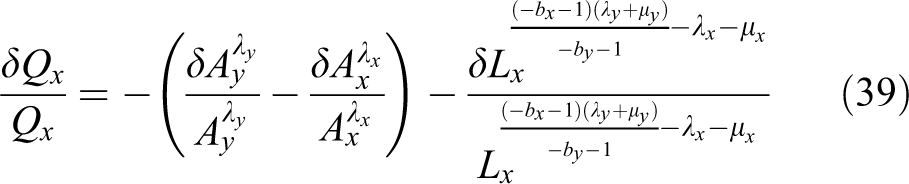
Recognize that steady-state equilibrium is an equilibrium where full-capacity condition holds for. Besides, at steady-state equilibrium, returns to scale conditions are constant for the growing sector. Then, equation (39) becomes
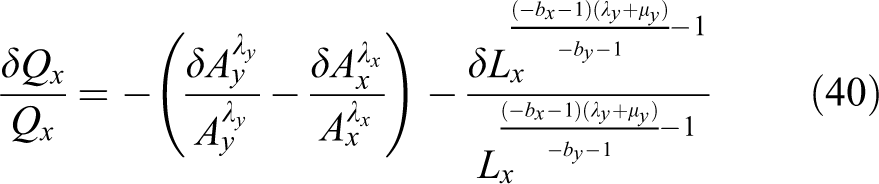
Rearranging equation (40)

Since
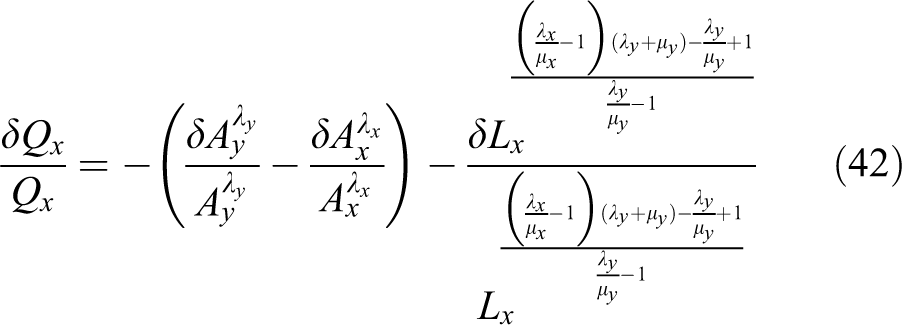

Assuming

Since it is assumed

Three cases for economic growth
According to equation (45), there are three cases for measuring economic growth of one sector: One sector can grow thanks to (i) only a rise in the labour
Case 1: Economic growth stemming only from a rise in the labour
Taking into account equation (24) and the results in Table 1, for the concave PPF, if one sector grows positively thanks to a rise in the labour if if
Note that it is assumed if if
Thus one can prove the following proposition.
Proposition 1
When only one sector grows in an economy which produces two goods, (i) if the nature of technological progress is Harrod neutral, (ii) if returns to scale conditions are constant for the growing sector, and (iii) if capital elasticity is same for two sectors, then growing positively thanks to a rise in the labour of growing sector requires the followings: if if
The proposition above is suitable for the bowed-out PPF. One can see from Table 1 that if
In that case, Proposition 1 will be rewritten as follows.
Proposition 2
When only one sector grows in an economy which produces two goods, (i) if the nature of technological progress is Harrod neutral, (ii) if returns to scale conditions are constant for the growing sector, and (iii) if capital elasticity is same for two sectors, then growing positively thanks to a rise in the labour of growing sector requires the followings: if λx > λy, then μ > λy and if λx < λy, then μ < λy and
Case 2: Economic growth stemming only from a rise in the level of technology
Equation (24) shows that if one sector grows positively thanks to a rise in the level of technology

Case 3: Economic growth stemming from a rise in the labour and level of technology
Equation (24) shows that if one sector grows positively thanks to a rise both in the labour and level of technology, then rate of growth equals to

In that case, Proposition 2 should also hold for.
Conclusion
The objective of this study is to analyse the conditions of economic growth by using equation of bowed-out PPF and by assuming the nature of technological progress as Harrod neutral. In order to measure, first, the equation of the PPF is obtained. Then, concavity, convexity and linearity conditions are listed in Table 1.
Depending on concavity conditions, it is shown that there are three cases in order to measure the rate of growth of one sector. First, one of the sectors of a two goods economy can grow thanks to only a rise in the labour. In that case, the condition is the following: If the nature of technological progress is Harrod neutral, if returns to scale conditions are constant and if capital elasticity is same for two sectors, then growing positively thanks to a rise in the labour of growing sector requires (i) if λx > λy, then μ > λy and
Second, one of the sectors of a two goods economy can grow thanks to only a rise in the level of technology. This case simply equates rate of output growth of one sector (which produces commodity x) to
Third, one of the sectors of a two goods economy can grow thanks to a rise both in the labour and level of technology. In that case, rate of output growth of one sector (which produces commodity x) equals to
Recognize that the long-term or natural or potential rate of growth of an economy is determined by growth rate of labour and growth rate of technology. 27 Accordingly, the sum of growth rate of labour and growth rate of technology is equal to growth rate of effective labour. 28 As a consequence, taking into account this result, our study formally proves that the long-term or natural or potential rate of growth is determined by rate of growth of effective labour. Note that elasticity parameters also determine the long-term or natural or potential rate of growth under specific conditions. This is the main contribution of our study. This article recommends for further studies that one can calculate and compare growth performance of countries based on equation (47). This is the main suggestion of our study.
Footnotes
Declaration of Conflicting Interests
The author(s) declared no potential conflicts of interest with respect to the research, authorship, and/or publication of this article.
Funding
The author(s) received no financial support for the research, authorship, and/or publication of this article.