




Abstract
A Port Community System (PCS) is an electronic platform that links the multiple systems operated by private and public organizations. Accordingly, PCSs can be interpreted as complex service system networks that coproduce services. The study proposes a three levels top-down methodology which aims to interpret existing PCS in order to: provide a formal description of this system network based on the enterprise architecture concepts of a PCS; illustrate how each actor of a PCS offers or requires services; and present a new approach to the measurement of services based on the Goal-Question-Metric paradigm.
Introduction
Maritime and port logistics are experiencing deep transformations due to several relevant factors, such as: technological innovations; increase in trade both globally and regionally; liberalization, internationalization, and globalization of markets; and adoption of new strategic and productive models. 1 Furthermore, the globalization of supply chains is having relevant effects on shipping and on the development of the ports.
These phenomena, on the one hand, require the adoption of workflow management systems, in order to facilitate the Business-to-Business (B2B) and Business-to-Administration (B2A) interactions; on the other hand, they are determining a progressive change in the way of managing ports, which are currently competing by adding value to the services they provide to the network as a whole. 2
Accordingly, ports can be considered as complex networks, which are required to coordinate flows of merchandise, property rights, payments, and information in the global supply chain. 3,4 The key success factor of these networks, which are supported by electronic platforms called Port Community Systems (PCSs), is largely based on a strong collaboration between all the involved public and private organizations, 5 establishing a link between different types of technologies, processes, people, and standards. 6
Adopting a new modeling approach based on the ArchiMate notation language, this study considers PCSs as service system networks, namely configurations of resources (people, technologies, and organizations) that coproduce services, with the main aim being to cocreate value. 7,8 Actually, the value cocreation is the final purpose of a service system network. Considering that investigating the impact of these relationships on the cocreated services is not an easy task, the main aim of this study is to propose a methodology for modeling and measuring services within a PCS. More specifically, adapting the methodology described in the context of a single window system design and development 9 to the case of PCS, this study intends to propose a methodological approach articulated in three levels: a top-level model, a service-level model, and a measurement-level model based on the Goal-Question-Metric (GQM) approach. 10 A case study concerning the PCS of Salerno, in the south of Italy, will complete the analysis of these models.
The remainder of the article is structured as follows. The second section will focus on PCSs considered as service system networks, while the “A methodology for the modeling…” section will propose a methodology for the modeling and the performance measurement of a service-oriented PCS. The next three sections will explain this methodology illustrating the abovementioned models, which have been subsequently investigated and discussed in the context of the PCS of Salerno in the “The case study: The PCS of Salerno” section. The last section will conclude, also drawing on the future development of the research.
PCSs as service system networks
As stated in the previous section, a PCS is an electronic platform that links the multiple systems operated by its members, namely both private and public organizations (such as ship owners, handlers, road rail or river carriers, warehouse owners, trading partners, customs, port authority, and coast guard). The first generation of PCSs carries on this function using a central information platform fundamentally based on bilateral applications. Moreover, this IT architecture had high maintenance costs, at the same time obstructing the future development of new services and communication channels.
The second generation of PCSs has been built on a more flexible platform modular middleware, more specifically on a smart structure that provides modular information exchange services via the port community platform. 2
Indeed, public organizations have already implemented electronic platforms, aiming to improve the coordination between PCS’ organizations. However, as it will be better explained later, these technologies have still several problems, such as: (i) limited efficiency, due to their scant ability in managing large amounts of data; (ii) communication difficulties, because of a lack of a common mapping of data to be processed; and (iii) low flexibility. According to scholars, 6,11 integration between all the PCSs’ actors is a political and negotiating process, which requires an agreement on the way they are going to electronically interact, connecting their systems.
IT supports optimization and automation of port and logistic processes, allowing a single submission of data, which means connecting logistic chains. 12 Several technologies (namely wireless, broadband, data warehousing, and data mining) are providing more choices and options to customers. 13 Therefore, information sharing strongly influences the quality of interactions and the effectiveness of the collaboration between the parties, at the same time making a constant alignment of stakeholders’ business models possible. The latest generation of PCSs is a powerful tool to achieve faster access to information, with one of the main effects being to enhance the cooperation between all the involved actors, at the same time promoting service coproduction and strengthening the process value cocreation.
Recent studies have highlighted the strategic relevance of interorganizational relationships within a PCS, 14 at the same time focusing on the value cocreation due to these relationships. 2,15 Accordingly, PCSs can be configured as service-based value networks, aiming at creating value through the exchange and coproduction of services. 16 Due to information sharing, each actor of a PCS is considered as an organization that provides services to other actors, at the same time receiving other interrelated services from other PCS’ organizations, which means improving their ability to cooperate. Zhang et al. 17 have highlighted the importance of combining information technology, business process, and human behavior, with the main aim being to enhance service operations and delivery, to stimulate innovation and value creation to customers. Therefore, such an approach requires the adoption of an interdisciplinary perspective. 18
Consistently, and in accordance with Mueller et al., 19 PCSs can be viewed as a Service-Oriented Architecture (SOA), which can be developed at different levels, more specifically: at the firm level, by firms interested in providing customer value; at a network of firms interested in benefiting themselves in the supply chain as well as their customers; or at the market level by governmental entities. 3
In fact, PCSs have the characteristics underlined by Mueller et al.
19
about SOA, related to the value creation: PCSs allow integration between several applications, value reconfiguration processes, and more agile forms of IT development. The adoption of the SOA perspective allows strengthening organizational agility and competitiveness. More specifically, Legner and Heutschi
20
have identified three main areas of SOA adoption that are characterized by defined goals and related benefits: SOA reduces the system integration costs since it is a standardized integration infrastructure. SOA decreases enterprise-wide IT costs. SOA reduces the time-to-market of IT projects, with regard to decoupling application domains. SOA enhances IT support for end users, facilitating the integration of business processes.
19
In this scenario, both consolidated technologies such as SOA and emerging technologies as big data can be used to implement PCSs. In particular, big data can play an important role in the future development of a new generation of PCSs. As stated by Chen et al., 21 “big data also brings about new opportunities for discovering new values, helps us to gain an in-depth understanding of the hidden values, and also incurs new challenges, e.g. how to effectively organize and manage such datasets.” There is indeed an increasing request to improve existing services or to introduce new ones in a PCS; examples are big data value about movement of goods and human beings, safety, and collective intelligence.
This means that the characteristics of PCSs evolve over time, 22 due to the continuous innovation in the IT systems upon which PCSs are built. As a consequence, enterprise systems need to be constantly and regularly reengineered, in order to respond to the abovementioned changes. Along this path, enterprise architecture, which can be considered as the base of enterprise system engineering, is a proficient tool to help stakeholders managing system engineering and changes. Accordingly, enterprise architecture is not only an IT issue, but a strategic and organizational challenge. 23
More specifically, the rise of service-oriented IT innovations will cause excellent opportunities for researchers who are stimulated in investigating behavioral, technical, and organizational issues. Scholars 13 have pointed out that growing knowledge regarding IT-related design is stimulating organizations to configure service relationships, in order to generate new value. Additionally, it is making possible to improve the efficiency, effectiveness, and innovation of both organizations and the PCS network as a whole.
However, it is not an easy task to assess such a value cocreation process, representing an issue particularly important in a service-oriented system such as a PCS. Actually, the detection of performance evaluation tools is still an open issue.
As a general approach, a measurement system based on four pillars has been proposed
24
: service quality measures that refer to the relationship with customers; productivity measures, concerning the relationship with suppliers; compliance measures, dealing with the relationship with supervisory authorities; and sustainable innovation measures that cover the relationship with competitors.
However, this approach risks to remain at a conceptual level. Therefore, there is a need to provide more in-depth models at an operative level, aiming at supporting PCSs’ organizations to perceive and measure the benefit deriving from the abovementioned IT service-based collaborations.
This study aims to contribute to this debate by providing a methodology for modeling and measuring a service-based ICT system able to make the collaboration between all the PCSs’ organizations involved in the logistic processes more and more effective. This methodology will take into account guidelines established for the design and implementation of enterprise architectures, adopting the ArchiMate language,
25
in order to: propose an abstract architecture of a PCS through SOAs; develop a formal model, in the ArchiMate language, representing a service-oriented network of cooperating organizations; and provide guidelines for modeling and measuring the cooperating organization performances.
A methodology for the modeling and the performance measurement of a service-oriented PCS
Organizations are involved in reengineering programs, whose aim is to improve existing services through the improvement of the underlying processes. Process and service reengineering are usually triggered as a consequence of users’ requests of high-quality services or by the pressure of competition. Furthermore, the search for new market opportunities often drives organizations to supply innovative services especially when they are based on technological innovations.
Whatever the motivation may be, the improvement of existing services or the proposal of innovative ones, in dependence of the context where reengineering programs are pursued, the concepts of enterprise architecture and network of organizations 23 stimulate a reflection on the structure from which services are produced and consumed. In this study, the definition of enterprise provided by the ISO 15704 standard 26 (as “one or more organizations sharing a definite mission, goals, and objective to offer an output such as a product or a service”) has been enlarged in order to take explicitly into account both public- and private-sector entities (a governmental agency, a small and medium size firm, a corporation, a corporate group, and so on) populating the PCS networks.
Additionally, from a theoretical perspective, investigating service-oriented PCS suggests combining macro, meso, and micro levels of analysis, 27 in order to take into account the point of view of both a single PCS organization and the network as a whole (defined by the businessdictionary.com as “A group of legally independent companies or subsidiary business units that use various methods of coordinating and controlling their interaction in order to appear like a larger entity” 28 ). Although previous literature has provided the basis for the definition of a service-oriented PCS architecture, this last definition of network of organizations is a useful complement since it focuses on the methods of coordination and control necessary to activate interactions among PCS participants. Along this line of thought, according to the standard ISO/IEC/IEEE 42010, a (system) architecture can be defined as “fundamental concepts or properties of a system in its environment embodied in its elements, relationships, and in the principles of its design and evolution.” 29
In this scenario, this study intends to propose appropriate models for the representation of PCS, more specifically: a top-level meta-model aiming to provide a formal description of a network of organizations based on the SOA concepts of a PCS; a service-level model through which different points of view, centered on the concept of service, are illustrated to understand how each actor of a PCS offers or requires services providing value to other actors or to end users. This step would elicit the main characteristics of existing services or the identification of new ones; and a measurement-level model based on the GQM approach.
The implicit background of these steps is the single window system design and development; according to IMO
9
and the UN/CEFACT Recommendation No. 33, a single window is a facility that allows parties involved in trade and transport to lodge standardized information and documents with a single entry point to fulfil all import, export and transit-related regulatory requirements. If information is electronic, then individual data elements should only be submitted once.
The meta-models are indeed parts of the output derived from the following methodological steps: designing the top-level meta-model of a PCS using an SOA; developing the relevant stakeholders’ views using a service-oriented notation; designing a model for the measurement of services, based on the GQM approach; implementing models and subsystems within the PCS context, deriving them from the generic meta-models; and measuring the services to obtain either quantitative or qualitative performance data.
The meta-models discussed in the following two sections (“Top-level model” and “Service-level model” sections) can be considered as outputs from steps 1 and 2, respectively. They are general enough to be taken as a reference for the explanation/design of a service-oriented PCS. Step 3 is shown in the “Measurement-level model: The GQM approach” section, where the GQM is used for designing a model for the measurement of services. Steps 4 and 5 are discussed in the “The case study: The PCS of Salerno” section, which presents the case study, illustrating how the generic meta-models can be applied to the design, implementation, and evaluation of an actual PCS.
Top-level model
A top-level SOA architecture of a generic PCS can be represented as follows (see Figure 1).
The diagram illustrates that some of the most relevant PCS organizations are connected by means of a virtual communication bus, where most of the data and information exchange between participants can occur. Two main values are cocreated by the interrelated organizations operating within a PCS: the movement of goods and human beings and enforcing the law, public order, and safety.

Top level model for a generic PCS.
The first value is obtained through the cooperation between private organizations, shown in the figure at the bottom side of the PCS, such as Terminal Operator and Shipping Agency.
The collaboration between public organizations, such as the coast guard and the fiscal police shown at the top of the figure, enforces the law, public order, and safety. The port authority also plays a key role, taking into account that, in many countries, it is responsible for the coordination of private entities operating in the port area.
This model for networking and cocreation of the value for the PCS, represented in the first dotted area of the figure, can be replicated with similar characteristics in different types of communities. For example, the diagram shows a community for logistics and transport whose actors, Carrier and Distribution Hub, work together for the cocreation of value, which is the delivery of goods in road transport.
Furthermore, the different communities can also cooperate through a mutual exchange of services. The intercommunity bus, as shown in the figure, implements this feature for communications and exchange of data and services enhancing also the cocreation of new integrated services.
The model represented in Figure 1 suggests that data are collected according to the specific needs of enterprises or governmental institutions where the SOA provides the underlying technology that enables the exchange of data and the provision/consumption of services. However, the emerging needs to increase the performances of a PCS and to identify new services drive both researchers and professionals toward proposals based on big data. These needs require studies that make clear the impact of big data on the provision of services (i.e. movement of goods and human beings) as well as on the public order and safety that can benefit of big data analytics techniques described in Gandomi and Haider. 30
Service-level model
In the context of a PCS, establishing and maintaining a coherent enterprise architecture is a challenge. Appropriate conceptual tools to cope with such a complexity are viewpoints, views, and architecture description languages.
29
In this study, the ArchiMate language is adopted in order to: identify stakeholders of a PCS; identify the services provided by organizations operating within a PCS; model the architectural viewpoint of relevant organizations by means of views; and discover the opportunities of architectural improvements that can lead to higher quality services.
Taking into account that PCSs consist of many organizations, it is not possible in a single study to illustrate the point of view of each of them. Therefore, according to the top-level model illustrated in Figure 1, the following subsections will focus on the shipping agency view and the forwarder view as examples of entities operating inside and outside, respectively, the intercommunity bus.
The shipping agency view
A shipping agency usually provides many services such as support services for the master of the vessel; intermediation services on behalf of forwarders; brokerage contracts for the transport of goods and movement of human beings; and receipt or delivery of goods on behalf of end users.
Therefore, the shipping agency has been selected as one of the key actors within a PCS due to its relationships with both private organizations (especially the shipping company that in turn means a strong collaboration with the master of the vessel) and public organizations (especially the customs and the coast guard).
In the first case, one important business area of a shipping agency is to provide assistance to ships belonging to shipping companies for which they work. Shipping agencies are related to shipping companies, looking after their interests and having their representation. They coordinate the entry and exit liaising with port terminal operators as well as carry out operating and bureaucratic practices relating to ships and transported goods. Actually, shipping companies need to have a trustee in every port, who is familiar with local laws and regulations. Accordingly, services provided by the shipping agency to the shipping company and the master of vessel play a key role, since a shipping agency represents the shipping company in all the administrative formalities required by public-sector organizations, especially the customs and the coast guard.
Taking into account, the guidelines established for the design and implementation of enterprise architectures, it is opportune to distinguish the layers of analysis, such as a business level (services and processes), an application level (rules, routines, application logic, etc., implemented as software applications), and a technological level. This standard division in levels, presented in the ArchiMate language, allows to dominate the complexity of enterprise architectures. Considering the top-down nature of the methodology proposed in the current study, in this and in the following sections a description at the business level is provided, representing both the provision of support services and the business collaborations.
As far as the provision of support services is concerned, according to the shipping agency viewpoint, the key process is named “support services for the master of vessel.” It consists of the submission of the arrival manifest of goods (named “MMA” in the diagram) and as the departure manifest of goods (named “MMP” in the diagram). Other kinds of services provided to the master of vessel are the “support services for third-party actors,” which are intended to simplify the interactions with local private operators; for example, these services are required by the master of vessel during the berthing of the vessel in the harbor. Furthermore, there are many other services usually provided by a shipping agency: “brokerage contracts,” “receipt or delivery of goods,” “intermediation services,” and so on, which can be required by other organizations or individuals.
As far as the business collaborations are concerned, the diagram focuses on the most relevant relationships managed by a shipping agency, namely those with the customs and the coast guard (indicated with the symbol The relationship with the customs permits the authorization for the import/export of goods. The relationship with the coast guard concerns the clearance for the arrival/departure of a ship. in Figure 2). In very concise words:

The Shipping Agency view.
This collaboration is necessary because the master of the vessel (or the shipping company) requires a service from the shipping agency to obtain the authorization concerning the submission of the MMA/MMP document, in which the shipping agency conveys to the local authorities the list of goods in arrival/departure. The customs and the coast guard cooperate with the shipping agency to provide the primary service to the master of the vessel. Indeed, this collaboration can be further detailed in terms of services provided by the roles “customs” and “coast guard.”
The forwarder view
The forwarder organizes the transport of goods from origin to destination on behalf of an exporter, carrying out the activities related to international trade, such as customs clearance, the permission of public health, and general safety of products and people. Moreover, the forwarder gives assistance and advice to enterprises, working at the same time with the tax authorities facilitating international transactions and allowing targeted and effective controls.
Figure 3 shows the interaction between different PCS organizations, such as forwarders, exporters, and importers of goods, during the execution of articulated business processes that, in this specific case, are the processes for the importing/exporting of goods.
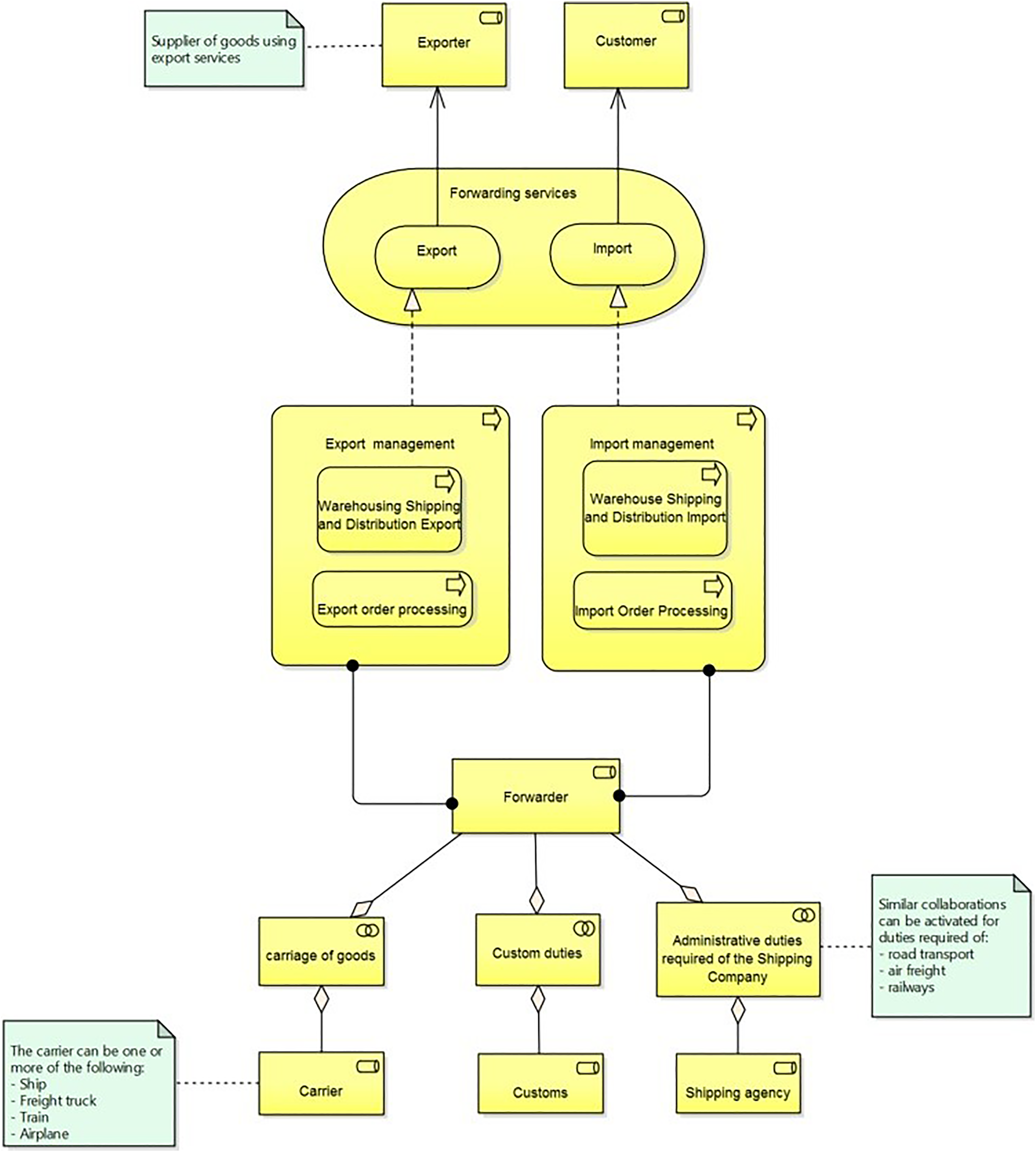
The Forwarder view.
Services provided by a forwarder and utilized by other organizations show this interaction. In the diagram, the forwarder provides and implements a set of services divided in two parts: services for import and services for export of goods, which are accessible, respectively, from import companies and export companies. The underlying business process, which can be broken down into many basic tasks, forms and implements the delivery of these services.
For example, the forwarder implements the export service using an appropriate business process (export management) that involves different subprocesses such as warehouse, shipping and distribution concerning the physical management of the goods, and the export order process relating to the administrative activities necessary for the monitoring and control. In turn, each of these basic activities can interact with people, software, and so on, although this aspect is not illustrated at the abstraction level shown in the diagram.
It is worth noting that the forwarder interacts with several other roles in order to offer its own services to other parties. In the diagram, the forwarder interacts through the collaboration relationships with the following roles: carrier (carriage of goods), customs (custom fulfillments), and shipping agency (administrative fulfillments required when the movement of goods asks for the services of a shipping agency).
Focusing on this last relationship, the shipping agency (which represents the shipping company identified for maritime transport) provides intermediation services for the forwarder. More specifically, the shipping agency implements the service through an intermediation process that handles the negotiation with the shipping company and prepares the plan for the maritime transport. Therefore, the collaboration between the shipping agency and the forwarder takes place through the export management processes, illustrated in the diagram (see Figure 4).

The collaboration view for maritime transport.
It should be observed that the ArchiMate 2.0 diagrams provide a simplified set of icons to represent processes at a high abstraction level. When a more detailed notation is necessary, the Business Process Model and Notation (BPMN) should be used, as illustrated in the case study of the port of Salerno (see Figure 1A in Appendix 1), where the details of the export management process will be described.
Measurement-level model: The GQM approach
Even though the trend toward a service society is still underway, there is a lack of models that allow us to cope with the problem of how to measure performance due to the cocreation of services. Indeed, as stated above informational needs for the measurement of services have been identified in four main categories: quality, productivity, compliance, and sustainable innovation 24 ; however, the discussion remains at a conceptual level and the lack of operative methods does not make possible to assess the real benefits deriving from the improving of existing services or the introduction of new ones.
In this section, the GQM approach to measure services is proposed.
GQM is a well-known method aiming to define and implement measurement mechanisms for the evaluation of software products, development processes, and organizational resources in software engineering projects. 10 The GQM is a goal-oriented measurement method in the sense that the first step for the deployment of a measurement mechanism is the specification of goals concerning an organization and its projects; this allows the organization to focus on relevant issues. Once a goal related to the object of measurement (a product, a process, or a resource) is stated, the second step consists of deriving a set of questions for the goal. Each question is used to characterize the goal and it is then considered as a reference for the third step, whose purpose is to suggest a set of relevant metrics for the question. The question and metric steps refer to the informational needs of an organization that wishes to evaluate if products, processes, and resources comply with the stated goals. Therefore, the interpretation of the said measurement takes into account the organizational context, environment, and goals.
In order to apply the GQM approach in the service sector, the objects of measurement can be interpreted as follows:
Product/Service: a set of both material and immaterial components that fulfills the specific needs of users.
Process: a set of related activities initiated by an event and performed by one or more business participants in order to release an output, perceived as a value by the process client.
Resource: means or capacity, either material or immaterial, aiming at the production of services; for example, businesses involved in a process that implements a service, hardware, software, physical, or virtual space.
This interpretation is coherent with the ArchiMate 2.0 framework, which states that a service is implemented by means of a process and that the process is enacted by means of resources.
Figure 5 shows the hierarchical structure of GQM. Three levels comprise a GQM measurement model:
Conceptual level (Goal). A goal is identified as an object to be measured.
Operational level (Question). A set of questions is used to characterize a goal related to an object of measurement. One or more questions allow us to qualify the object of measurement (product/service, process, resource) with respect to a given viewpoint.
Quantitative level (Metric). Data are collected and associated with every question so that the outcome can be expressed in a quantitative way. GQM states that the data can be objective, when it depend on the object that is being measured, or subjective, when it depends not only on the object that is being measured but also on the viewpoint from which it is taken.
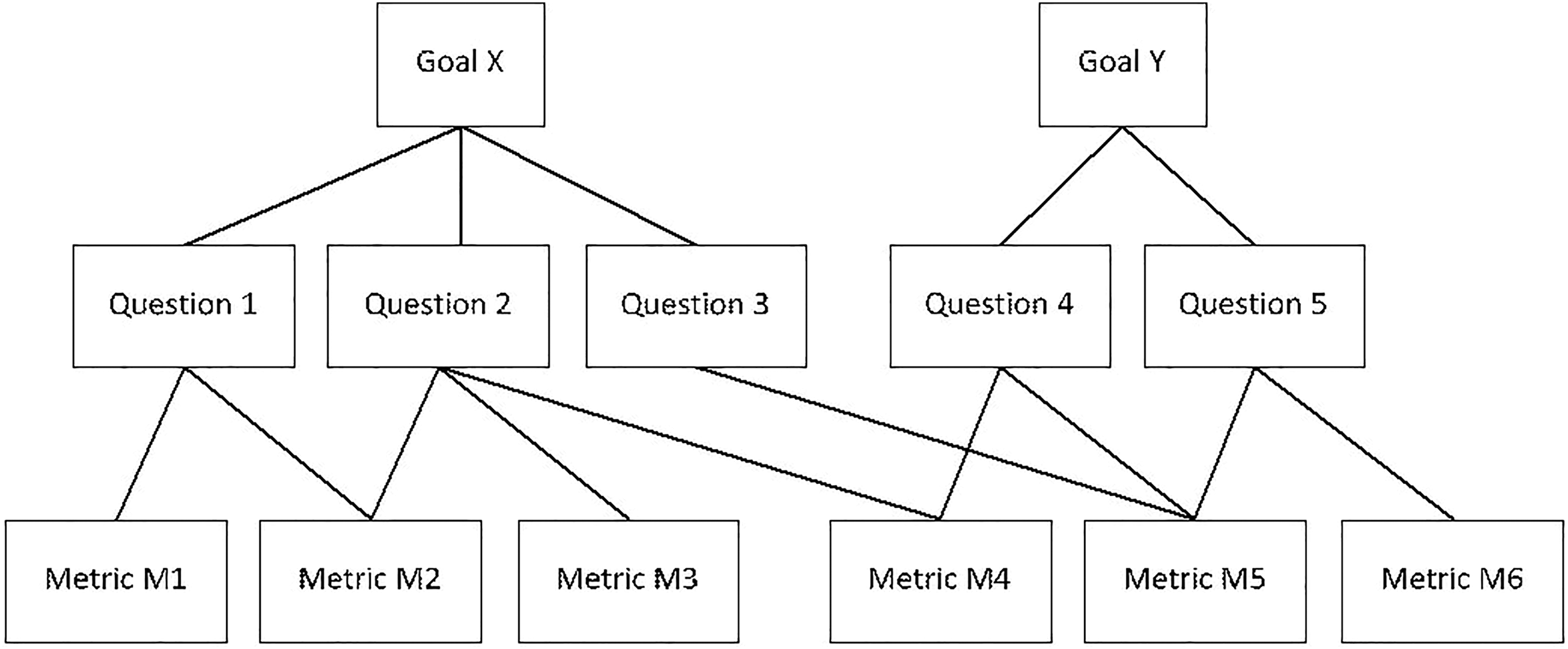
GQM model hierarchical structure (adapted from Encyclopedia of Software Engineering – 2 volume set).
Taking into account the abovementioned categories for measuring services (service quality, productivity, compliance, and sustainable innovation measurements), 24 two relevant examples of the GQM approach are provided.
A first example, illustrated by Table 1, concerns how to measure the quality of service of a single window system by means of a GQM model to evaluate service availability. Other quality properties, for example, timeliness or ease of use can be derived in a similar way. In addition to the usual section that describes the goal, the questions, and the related metrics, the second row of Table 1 reports a description of a service and some useful definitions to better define questions and metrics.
GQM model for the goal: high quality of service of a single window system.

MTTRB: Mean Time to Recover after a blocking outage of service; MTTRNB: Mean Time to Recover after a non-blocking outage of service.
It can be assumed that the goal actors of a PCS want to reach is “high quality of service, in terms of availability of the Single Window System, from the point of view of the users of provided services.”
Accordingly, questions Q1, Q2, and Q3 characterizing the goal and the related metrics provide quantitative data to evaluate whether the goal is reached within the observation period. It is relevant to underline that the GQM approach provides an interpretation model against which it is possible to evaluate in a quantifiable way if the business goal is achieved during the service supply. In the proposed example, it is sustained that the availability of a service reaches a high standard if in the observation period (a month): the number of blocking outage of service is at most 1 and the service is in operation M1 ≥ 98%; the number of non-blocking outage of service is less than 4; the Mean Time to Recover after a blocking outage of service (MTTRB) is less than 4 h; The Mean Time to Recover after a non-blocking outage of service (MTTRNB) is less than 8 h.
A second example concerns the productivity (i.e. efficiency) in providing services. Therefore, taking into account that services are implemented by the underlying processes, the efficiency of a process determines the efficiency and the effectiveness of the related services. The following metric, called residual duration (RD), assesses how much time is necessary to complete a process still in execution and it is an example of performance measurement that can be used by the service provider (the point of view of the service provider in GQM terms). Usually, a process is modeled by means of a visual formalism such as BPMN that illustrates both the process structure as a set of activities and the relationships among them (in Appendix 1, an example of a BPMN exporting process within a PCS is provided). From a process model, many execution instances can be derived where each process instance has its own set of executed activities, execution time, current state, and other properties. There are indeed two variants of RD, depending on the kind of services that are taken into consideration. The first one, residual_duration1, is very simple and can be applied when the duration of a process that implements a service is standard, as in the case of many services provided by public administrations. Let P be a process and ip an instance in the execution of P. The following function defines residual_duration1 for a given instance of P:

The second variant of RD, residual_duration2, is adopted when a standard duration (SD) of a process cannot be determined because process instances are subject to significant time variations. This is the case, for example, of import/export processes in maritime transport. Let I be the set of all created process instances for a process P, some of them in a completed state and the remaining ones in the executing state. The RD of ip at time t can be assessed by evaluating the difference between the average duration of completed process instances at time t and the current duration (CD) of ip.


where the function sigma first selects all the completed process instances from I by means of the filter, then it applies the function “instance_duration” on each completed instance summing their durations. The function work counts, by means of the predicate pred, the number of completed instances.
With respect to the average duration of the completed process instances, the measure “residual_duration” can be interpreted as follows. If its value is zero, a delay will be accumulated from now on. If the value is less than zero, the process is late, otherwise the RD represents an assessment of the time needed to complete the service provision.
The case study: The PCS of Salerno
The methodology illustrated in the previous sections has been applied in a specific context, the PCS of Salerno, an urban port of southern Italy. This port has been selected as a case study mainly for two reasons: It is a relevant hub with ports of Europe, Africa, America, and Asia. However, its strategies can be affected by the shipping companies, which might modify their routes to minimize the average cost per unit transported. Therefore, the competitiveness of the port of Salerno largely relies on timing and efficiency. It is an urban port, which means that its strategies can be influenced by the relationship with the local environment, especially its viability. Indeed, the port of Salerno is very closed to the city, with one of the main consequences being provoking a negative impact on the local traffic, asking for enhancing the relationship with the retro-port. Additionally, the area where it is located impedes a physical development. Consequently, the carriers intend to decrease the operating time by optimizing the flow of merchandise; nevertheless, the length of the exporting processes is perceived to be too long, because of bureaucratic and administrative procedures.
To investigate the case study, the interactions between the organizations operating in the port of Salerno have been identified. The aim is to study their contribution to the value cocreation, also taking into account the contribution that the second generation of PCS will provide to such a cocreation.
More specifically, the steps of analysis are based on the methodology illustrated in the previous sections that are worth revoking: a top-level model, through which a description of the PCS of Salerno based on the enterprise architecture concepts is provided; a service-level model, through which different points of view, based on the concept of service, are illustrated. Bearing in mind that the ArchiMate 2.0 diagram represents processes at a high level of abstraction, a more detailed notation is provided, using the BPMN language concerning the export management process (see Appendix 1); a measurement-level model, based on the GQM approach.
As for the top-level model, this study benefits from the involvement of the research team in a project, named Smart Tunnel (see: http://goo.gl/0Fgfbc), a platform for intelligent logistic services which intend to maximize the efficiency and the security of urban ports. Furthermore, the project aims to eliminate the inefficiencies of the bureaucratic procedures, at the same time enhancing the efficiency of the transport of goods in urban areas.
Figure 6 illustrates the architecture of the Smart Tunnel project, which corresponds to the top-level meta-model of the methodology illustrated in “Top-level model” section. In this way, Figure 6 provides a more detailed representation of the PCS bus, as illustrated in Figure 1, connecting public authorities (coast guard and customs) with private-sector entities. More specifically, the top-level meta-model illustrated in Figure 1 has been implemented in the port of Salerno: After a clear identification of all the actors and comprehension of their roles, the research team investigated the main characteristics of their information systems, especially focusing on public-sector authorities, in order to unveil the factors that impede connecting them with those of private-sector entities.

The architecture of Smart Tunnel project: The Supply Chain point of view (source: Bisogno et al., 2015).
The main models and technologies used for the implementation of Smart Tunnel system are the following: ArchiMate diagrams for the top-level representation of organizations and collaborations among organizations; BPMN diagrams for the modeling of business processes working within a PCS (see Appendix 1); SOA for the exchange of data and for the provision/consuming of services; Cloud Computing for the centralization of hardware resources and software applications and for the processing of big data.
Public authorities are represented at the top of Figure 6. PMIS, which stands for “Port Management Information System,” is adopted by the Italian coast guard while performing the administrative procedures connected to the arrival/departure of ships and monitoring the traffic within the port waters. Automazione Integrata Dogane Accise (AIDA) is the information system of the Italian customs and supports the electronic customs clearance of goods. It is also a tool with which firms, public-sector entities, and EU countries communicate. It was designed according to a single window approach.
The analysis of these systems (PMIS and AIDA) showed that they do not interface directly with the legacy systems of the organizations involved in the maritime transport chain. Accordingly, the bus makes these digital interactions possible by connecting the different IT systems of all the actors of the PCS of Salerno.
The service-level model is largely based on information collected through a direct observation of the way of providing and receiving services among the actors of the PCS of Salerno involved in the Smart Tunnel project. Furthermore, several interviews with some of these actors were performed, as Table 2 illustrates.
Interviews with operators in the port of Salerno.

AIDA: Automazione Integrata Dogane Accise.
In Appendix 1, Figure 1A shows the process of export-containerized cargo that takes place in the Port of Salerno, highlighting the role of the (public and private) actors involved. As we will illustrate better in Appendix 1, interpreting the PCS of Salerno as a service-oriented network has a significant impact on the process structures as well as on the combination of technology, organization, human resources, business models, and management. 31 In the investigating context, the PCS reduces the number of transactions and allows actors to share information, facilitating the coordination among the activities of the entire export process. As highlighted by the CEO of the shipping agency “Michele Autuori”: “It is necessary to innovate the information systems. As a matter of fact, information is often shared through traditional means (phone, fax, email, etc.). Additionally, the same information has to be processed more than once with various parties.”
The last step of the methodology illustrated in the previous section is the measurement model. In this case study, the execution time of the export process activities carried out by the shipping agency “Michele Autuori” was observed. More specifically, two measurements, and subsequent interviews, were carried out, in two different months. For each activity, Table 3 shows the SD, CD, and RD, according to the formula illustrated in “Measurement-level model: The GQM approach” section: residual_duration1(P, ip) = standard_duration(P) – current_duration(ip).
Interviews with operators in the port of Salerno.

SD: standard duration; CD: current duration; RD: residual duration.
The CD of the process is lower than 7 and 8% of the SD. However, several individual activities show negative deviations involving interorganizational relationships.
Based on these findings, the CEO of the shipping agency confirmed the critical nature of the interorganizational relationship and asserted that the adoption of more advanced information technologies would increase the cooperation with their customers and partners, ensuring the reduction of the whole duration of the process.
Discussion
The PCS of Salerno, considered as a complex service system network, has been investigated through a modeling approach based on the ArchiMate notation language. Accordingly, the relationship among the organizations of the PCS of Salerno has been interpreted in terms of coproduction of services.
The formal description of the PCS bus, based on the enterprise architecture concepts, and its implementation in the PCS of Salerno, is going to simplify the information flow concerning the logistic processes as a whole: Each organization, while it maintains its own information system, avoids processing the same data several times. According to Zhang et al., 17 a higher level of digitalization enables firms to improve their efficiency and effectiveness as well as interorganization capabilities to exchange information, cooperating and collaborating with other partners of the supply chain.
In the same way, the service-level view provided in previous sections, subsequently applied to the export process of Salerno, has paved the way for the identification of each actor of a PCS as well as of its relationship with other organizations, based on the services provided/received. In this perspective, it has highlighted the importance of combining the views of different actors, making it clear their cooperation in providing services of higher quality. In other words, both the intercommunity bus and the service-level views are enhancing the awareness of each PCS actor to be a coproducer of a set of services, along with the supply chain.
The shipping agency, as described in the “The shipping agency view” subsection, is an important node of the port network, so the quality of its services can influence the value cocreation, as shown in the export process that involves several key players such as the shipping company, the forwarder, the customs, the coast guard, and the master of the vessel.
Because of its role, the shipping agency concentrates a large amount of data which are quite complex to manage. This complexity and its central role in the value cocreation make the service-based relationship approach particularly suitable and require the adoption of advanced PCS systems to evaluate the quality of these services. As for the model illustrated by Figure 2, the collaboration between the shipping agency, the coast guard, and the customs is largely simplified since the data collected by the shipping agency are transmitted to the PMIS and the AIDA information systems. In so doing, the enterprise service bus, shown by Figure 6, implements the collaboration model of Figure 2 through a message exchange mechanism.
The GQM approach, which is the last step of the methodology proposed in this study, allows to define and implement measurement mechanisms for the evaluation of the quality of services provided within the PCS. Wang and He 32 observed that the GQM is an empirical method (no goal, question, or metrics are formally defined or ensured to be quantitatively measurable a priori). Therefore, they proposed a practical methodology which aims to measure the deployment in GQM comprehensive of a set of formally defined measurements to strengthen the GQM paradigm in order to build software engineering measurement systems. However, restraining it to a predefined set of goals and measurements would restrict its wide applicability. In effect, GQM is a philosophical approach that can be applied not only to software engineering problems/technologies but also in other fields as well. Accordingly, and taking into account that the GQM is a goal-oriented measurement method, organizations of the PCS of Salerno involved in the case study are progressively appreciating its ability to better support their decision-making process. Actually, both the question and the metric steps relate to the informational needs of the involved organizations, principally aiming to improve competitiveness and to evaluate if services provided comply with the stated goals. Accordingly, the measurements have been identified taking into account both the abovementioned four pillars (quality, productivity, compliance, and sustainable innovation) 24 and the characteristics of the organizational context of the PCS of Salerno. More specifically, the previous section gave an example concerning a typical quality measurement, expressed by the time of execution during some operational activities.
To summarize, the analysis of the PCS of Salerno through the methodology proposed in this study has helped the port community actors to gain a complete knowledge of the reciprocal interactions from different viewpoints. As Figure 6 shows, the proposed approach facilitates the interactions between the information systems of all the network actors. Actually, as underlined by Van Baalen et al., 2 information sharing is not a sufficient condition for the complete integration between port community actors because a full integration can be achieved only when information is shared and all decisions are aligned to accomplish the global network objectives. Accordingly, a standard language has been adopted, making the information sharing and the management control inside the port community possible. In fact, through the proposed methodology, the interactions between all the actors have been investigated in a service logic perspective, preventing gaps in strategic objectives of the network. 13 Indeed, according to Osborn et al., 33 service management theory reflects the interorganizational and interactive nature of contemporary (public) service provisions. Accordingly, the approach adopted in this study has implicitly taken into consideration the service-dominant logic literature, according to which services should be considered as the result of shared processes. 34,35 From this perspective, the concept of coproduction, coupled with the concept of service, entails cooperation, paving the way for achieving specific results through a mutually beneficial relationship. 31 To put it differently, the proposed methodological approach tries to stimulate the adoption of a service-based view in the second generation of PCS, advancing to a third generation, which can foster the cocreation of value.
Conclusions
This study has highlighted the possibility to investigate PCSs as complex service-oriented networks, adopting formal models written in the ArchiMate notation. The first generation of PCS was based on central information platforms, namely bilateral applications. Considering the shift from the first to the second generation of PCSs, founded on platform modular middleware characterized by a higher degree of flexibility, the model proposed in previous sections intends to enhance the efficiency of the entire supply chain, at the same time enhancing the efficiency of each organization.
This approach provides tools to observe the service-based relationship between all the PCSs’ actors and, consequently, to understand in what way each organization contributes to the value cocreation and to the competitive advantages of the entire network. Additionally, it facilitates the process of innovation within the port, providing a conceptual tool able to evaluate the contribution of each actor within the PCS, improving the efficiency of the whole network. In this vein, the top-down methodology illustrated in previous sections provides guidelines for the design, implementation, and evaluation of SOAs that improve the interactions and the performances of cooperating organizations.
Accordingly, the methodology proposed in the study aims to go beyond a near-sighted vision based on the perspective of each actor, without considering the relationship between them, favoring the collaborative processes that lead to the value creation. According to Parola et al., 36 port competitiveness is a multidimensional concept, which is built around the ability of port authorities and business players to perform value-added activities. 37,38
To conclude, from the point of view of data managed by participants of a PCS, it is worthwhile to do the following considerations. First, although the data collected by enterprises and governmental institutions serve their own peculiar purposes, the integration of at least a part of these data leads to the problem of high-volume management. Second, since the data managed within a PCS are structured, semi-structured, and unstructured, we can perceive the variety of created data. Third, the rate at which data generated are high and the logic of Smart Tunnel (and, more generally, the top-level model illustrated in Figure 1) is capable to react analyzing them in order to provide appropriate services. Fourth, the architecture of Smart Tunnel is open to the plug-in of new subsystems such as big data analysis components, aiming at the extraction of hidden value. These characteristics allow the provision of processing capabilities that enable big data management in the PCS setting. This last aspect is only mentioned in the article, so future development of this research will investigate all the potentialities of PCS in the big data scenario.
Footnotes
Declaration of Conflicting Interests
The author(s) declared no potential conflicts of interest with respect to the research, authorship, and/or publication of this article.
Funding
The author(s) disclosed receipt of the following financial support for the research, authorship, and/or publication of this article: Department of Management & Innovation Systems (University of Salerno) provides the authors funds to pay the fee for the publication.
Appendix 1
Figure 1A illustrates the activities of the export process, the role played by each actor, and their interorganizational relationships. The diagram points out all the services provided and received by each organization. Additionally, it underlines the cooperation with the customer which occurs at various points of the process and can lead to slowing down or compromising the whole process.
The interaction between organizations is essentially based on the efficiency and effectiveness of the entire process, which determines intense relationships among the different actors of the PCS of Salerno (shipper, transporter, forwarder, customs, shipping forwarder, shipping agency, and terminal operator).
The shipper starts the export process because a service for the shipment of merchandise is required. Therefore, the shipper contacts the forwarder by asking for a bid. In order to make such a bid, the forwarder interacts, respectively, with the shipping agency for the listing of sea transport and with the transporter for the listing of the land transport. Based on the quotations received, the forwarder presents an offer to the shipper who can reject, accept, or request amendment. If the shipper refuses, the process ends; if he accepts, immediately or after the requested changes, the shipper arranges the goods to be shipped and requests a container from the forwarder.
After this transaction, the shipping agency carries out the booking for loading and transmits it to the terminal operator with the order to arrange the container, which will be collected from the transporter.
The transporter takes the containers both to the shipper and, once filled, to the terminal operator. During the transport, the transporter holds the documents concerning the goods prepared by the shipper.
Two other copies of these documents are sent to the forwarder and the shipping agency. The former produces the declaration at customs (DAU) submitted electronically, obtaining the Movement Reference Number (MRN). The latter fills the bill of lading, which will be summarized in the cargo manifests and later sent to the shipper or to a bank delegated to receive payment.
The DAU is delivered to the terminal operator for boarding and to the shipping forwarder inserting it in the departure manifest of goods (MMP) to be presented to the customs. If the DAU complies with the MMP, the customs authorizes the loading of the goods.