




Abstract
Project budget and schedule overruns are becoming critical challenges within the petroleum and chemical industry due to a sharp decline in the oil prices and the subsequent impact this has had on the global financial market. Although innovative project control systems (PCSs) are typically employed in this sector, experience reveals that such systems do not guarantee project success unless they are effectively implemented. The effective implementation of such systems should show financial governance and control, improved profit and financial forecasting, and the ability to forecast and mitigate negative cost impact. This study aims to identify, examine, and prioritize the enablers and barriers linked with successful implementation of PCS. A multicriteria model was used to collect, evaluate, and analyze data from petroleum and chemical firms in Saudi Arabia. A total of 9 enablers and 15 barriers were identified. The research revealed that skilled project team members and clear definition of roles and responsibilities are key enablers of successful PCS. The most critical barriers identified by this study were poor skills in scheduling and controlling along with a distrust of the control system. Other barriers identified include disparate control systems between owner and contractor and vague contract deliverables. These findings emphasize the need to (1) build a project team with the right skills and clear roles, (2) develop a control system that is accurate and trusted by the project team, and (3) develop a shared understanding between owner and contractor about the control system and contract deliverables, in order to successfully implement PCS.
Keywords
Introduction
The petroleum and chemical industry is considered as the key sector that drives the development of Saudi Arabia’s economy. According to the annual report of the Saudi Arabian Business Council, 1 Saudi Arabia is the second largest oil producing country, next to Russia, with nine massive oil refineries, producing approximately 13% of the world’s share of oil. Billions of dollars have been invested to increase its production capacity through the development of numerous oil and gas mega projects. Further, Saudi Arabia is classified as one of the largest petrochemical suppliers in the world, with nearly 15% of the market share profile, 49 petrochemical products, and over 59 projects. Successful delivery of petroleum and chemical projects, in terms of both time and cost, is considered to be a critical issue in Saudi Arabia. 1 –3
Petroleum and chemical projects, in particular refineries, pipelines, and petrochemical plants, contain a high level of uncertainty and risk due to their large scope of work, long project duration, technological complexity, and multiple geographical sites. 4 Miller and Lessard 5 included three additional contributors to uncertainty in such projects: resources and market risks, engineering and design complications, and construction difficulties. The large number of organizations and stakeholders involved in petroleum and chemical projects such as owner, contractor, government, and customer is another potential source of uncertainty. 6 Given the high level of uncertainty within these projects, proper monitoring and control of project performance is vital to avoid cost overruns, limit financial losses, and improve predictability. The utilization of a project control system (PCS) that measures and evaluates the variance between the project plan and actual project performance plays an essential role in achieving successful outcomes.
A PCS involves data gathering, analysis, and management processes that are used to forecast, predict, and understand the time and cost outcomes of a project or program. 7 –10 A review of previous literature shows that several project control techniques, such as program evaluation and review technique, earned value analysis (EVA), and critical path method, have been developed and used to design a PCS for many organizations. In addition, a variety of software programs have been developed to support the application of these project control methods. 11,12 The problem is that these techniques, though beneficial, are only part of the solution, on their own they do not constitute a project control process.
To date, the literature on project control has focused on examining the PCSs themselves particularly the design and development of new systems that use complex mathematical tools and employ high levels of information technologies. However, these tools and technologies cannot deliver project control unless they are effectively implemented.
There is a paucity of literature addressing the issue of PCS implementation. This study provides new understanding through the identification of the most impactful enablers and barriers for successful PCS implementation within the petroleum and chemical industry in Saudi Arabia. The study examines the importance of enablers and barriers by proposing a fuzzy analytic hierarchy model (FAHM) to target planning decisions that improve the functionality and performance of a PCS. The objectives of this study are as follows: to examine the main enablers and barriers to PCS implementation in the petroleum and chemical industry in Saudi Arabia and to establish a multicriteria model to evaluate and prioritize the identified enablers and barriers.
The remainder of this article is structured as follows. “Enablers and barriers of PCS implementation” section presents the key enablers and barriers of PCS implementation. Following this, the research methodology is described in “Research methodology” section, and the results of the study are reported in “Data analysis and results” section. The final sections present the discussion and conclusions of the study.
Enablers and barriers of PCS implementation
The literature review shows that only a small number of papers have addressed the issue of identifying the main characteristics of PCS implementation. PCS is the process of integrating all aspects of the project plan, validating that the plans are comprehensive and consistent with requirements, initiating mechanisms for project control, and communicating the integrated project plan to those responsible for the project’s work packages. 9 In this context, project planning and control mechanisms are generally considered as a root cause of many enablers and barriers of PCS implementation. Backlund 13 suggests three criteria for successful PCS implementation: (1) planning and controlling process, (2) the experience and analytical ability of project personnel, and (3) the commitment of a high management.
Jiang et al. 14 found in a study on project control effectiveness in the software development industry that all the project managers interviewed agreed that the analytical ability of project personnel is considered a key driver for effective PCS implementation in their sector. Safronova and Dokuchaev 15 point out that effective project planning is a critical dimension to PCS implementation. The findings from the same study also show that the most critical success factors for implementation are (1) effective control processes and (2) commitment of top management. Hyde 16 identifies two dimensions for PCS implementation in any organization: (1) implementation strategy and (2) employing a knowledgeable project control staff.
Görög, 17 in his empirical study of the petroleum and chemical industry, stressed that successful project management is dependent on the proper use of PCS and procedures. The study lists two key dimensions for implementing effective PCS in the petroleum and chemical industry: (1) effective project planning and (2) effective project control. Project managers must be familiar with these systems and procedures and their implementation. Milosevic and Patanakul 18 identified that an effective implementation strategy, including information technology and standard project control processes, is critical for the successful implementation of PCS. Benjaoran, 19 in his empirical study of five small and medium-sized contractors, introduced a new system for cost control based on the EVA concept. The implementation of this system identified general limitations related to both physical and psychological factors including information technology, effective human resources, management support, and user acceptance.
This short literature review has shown that the enablers and barriers of PCS can be cluster around five main dimensions. These are (1) project planning, (2) performance measurement, (3) top management involvement, (4) project management team, and (5) implementation strategy. The enablers and barriers that relate to each of these dimensions are discussed below.
Enablers
For many organizations, PCS implementation begins with effective project planning including a clear scope plan, accurate and detailed work breakdown structure (WBS), effective resource management plan, effective schedule management plan, accurate cost baseline, and an effective risk and quality management plan. 17,19,20 Garza 21 identified both (1) established clear performance measures and (2) common planning formats as two planning enables of PCS.
An effective project plan needs to be controlled through implementing valid performance measurements. 22 These measurements refer to effective change control management, an accurate progress measurement system, frequent evaluation, reporting, standard use of EVA, analysis and diagnosis of reported project variances, and realistic forecasting of project cost and duration at completion. 22 –24 Within performance measurement, Olawale and Sun 25 showed that the EVA technique contributes significantly to PCS implementation. Benefits from EVA have also been supported by Görög 17 as it provides a baseline for comparison between the planned/actual schedule and costs to make informed decisions on project outcomes.
Top management involvement is a major driver of PCS implementation effectiveness. Recognition that the PCS is a business requirement, coordination between different control tools and systems, and clear identification of project control procedures are important enablers of PCS. 26 –29
The project management team is another significant dimension of implementing PCS. In order to improve PCS, the organizations must ensure that their project management community has the necessary skills to understand the concept and philosophy of PCS. 30 Mehta 29 found that skilled and experienced project personal and clear responsibility assignments were positively related to enhance PCS execution.
From a system perspective, a successful implementation strategy is one that encompasses information technology, training in the utilization of computer software and procedures, definition of the requirements for a PCS, and the development of PCS guidance and work instructions. 21,31,32 Pellicer 33 reported that both the standardization of a control management process and the implementation of “best practice” project control enhance the effectiveness of PCS by reducing the effort required to collect and enter data and produce reports.
In summary, the enablers of PCS can be grouped into five dimensions: project planning, performance measurement, top management involvement, project management team, and implementation strategy. Across these five dimensions, 26 enablers have been classified (see Table 1).
Enablers to PCS implementation.

PCS: project control system; WBS: work breakdown structure; EVA: earned value analysis.
Barriers
Although the enablers of PCS have been addressed in the literature, little is published about the barriers of PCS. It is crucial, therefore, to examine the barriers that affect PCS implementation. Based on the reviewed literature, the barriers of PCS are found within just two of the five dimensions previously described: (1) project planning and (2) project management team.
The absence of clear planning for project objectives has been identified as a major barrier of PCS. 25,34,36 Complex project objectives lead to increased complications in PCS implementation. Specifically, within petroleum and chemical projects, the variance between the owner and contractor in defining their PCS is an issue that limits the effectiveness of PCS implementation. Studies that focus on this area emphasized that failure in planning a control methodology for a particular contracting strategy, inaccurate planning for contract deliverables, inaccurate planning for payment of contractors, and indistinct criterion used to define project completion are the main barriers to PCS. 4,37,38
In the project management team dimension, barriers refer to the lack of experience of the project team, a lack of clearly defined team members roles, and dislike or distrust of control systems. 14,29 The effective implementation of PCS requires full alignment of the project team that is typically in conflict with the natural human sense for freedom that resists any attempt toward the evaluation and measurement of performance. Based on the above, eight barriers are listed in Table 2.
Barriers to PCS implementation.
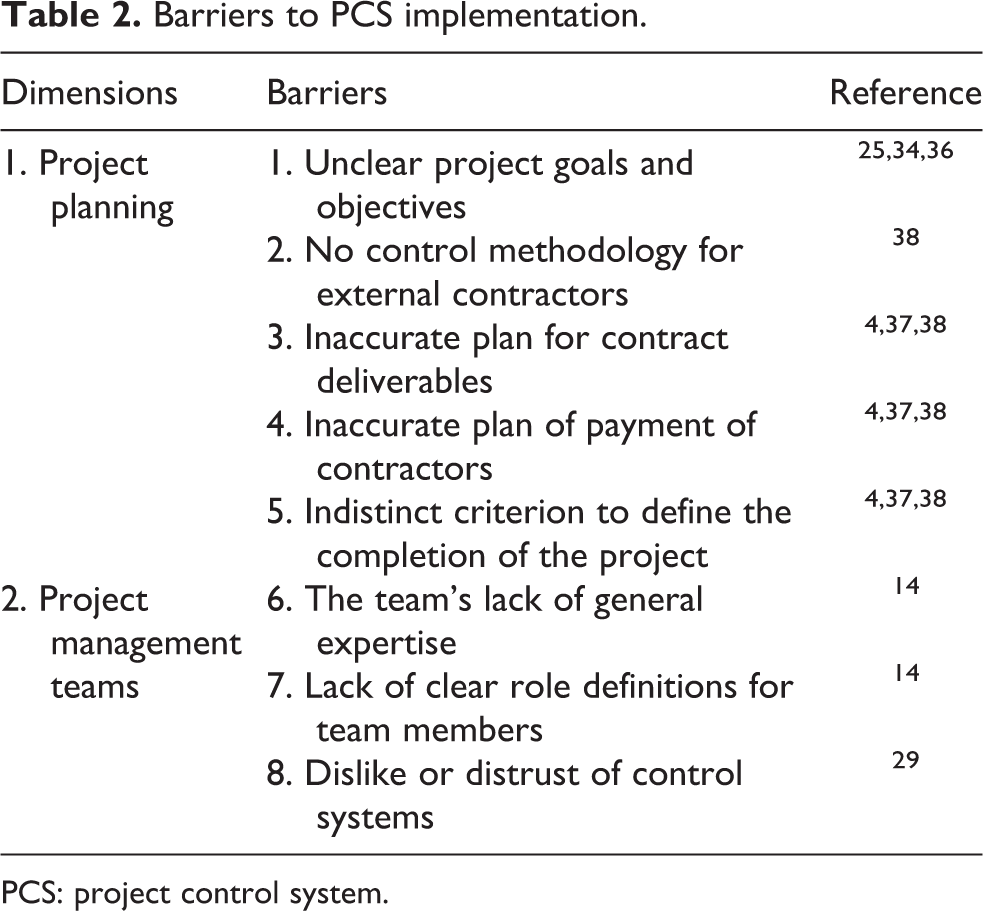
PCS: project control system.
Although previous research in this area has identified many key enablers and barriers of PCS, no work has been carried out on the prioritization of those factors that can guide the organization to achieve a major improvement on PCS implementation. An examination of how both enablers and barriers affect the implementation of PCS in petroleum and chemical projects is key to understanding the philosophy behind the effective implementation of PCS. Therefore, this study uses a fuzzy multicriteria process for identifying the critical enablers and barriers of PCS.
Research methodology
Multicriteria model for enablers and barriers of PCS implementation
Prioritizing the enablers and barriers of PCS implementation involves quantifying the relative importance of those subjective factors based on the viewpoints of experts in the industry. The prioritization process in this study gives rise to difficulty in the ranking of multiple subjective factors as well as the uncertainty of human preferences that can affect the reliability of the final results.
The analytic hierarchy process (AHP), introduced by Saaty, 39 is a powerful decision-making methodology for solving problems with multiple, and usually conflicting, factors to determine the priorities among those factors. It uses a multilevel hierarchical structure consisting of overall goal, decision factors, and subfactors or alternative options. In this context, the AHP helps to capture both subjective and objective aspects of a decision by reducing complex decision problems to a series of pairwise comparisons and then synthesizing the result. These comparisons are used to obtain the weights of importance of the decision factors and the relative performance measures of the alternatives in terms of each individual decision factors. The concept of pairwise comparison in the AHP depends on comparing each pair of factors in the same level to achieve the most suitable compromise among the different factors not optimizing each single factor. 40 –42
Although the AHP is considered one of the most effective decision-making tools, always guided by the decision maker’s experience and capable of translating users’ evaluation into a multifactor ranking, it is difficult to map qualitative preferences to point estimates. Hence, a degree of uncertainty exists with some or all pairwise comparison values in the AHP method. Buckley et al. 43 enhanced Saaty’s AHP where the decision makers are allowed to employ fuzzy ratios in place of exact ratios to deal with the difficulty for people assigning exact ratios when comparing two factors.
This study employed Buckley’s method, FAHM, which integrates the AHP method and fuzzy weights in an attempt to meet the challenge of multiple decision-making and the uncertainty and vagueness of human preferences.
The objective of the FAHM is to break a complex evaluation problem into a multilevel hierarchical structure, with the main goal defined as level 1, decision factors as level 2, and subfactors as level 3. Factors are then compared at each particular level of the structure using fuzzy numbers in pairs to evaluate their relative preference, and the results are ranked using mathematical calculations. 44
The analysis methodology of FAHM employed in this study can be described with three main steps: (1) pairwise comparison, (2) aggregating the fuzzy evaluation of sample members, and (3) calculating final weight for each factor. 45 –48
Step 1: Pairwise comparison
In order to prioritize the factors in the FAHM, a pairwise comparison matrix and the corresponding triangular fuzzy number (TFN) is generated for each factor in a particular level of the FAHM. The TFN (ǎ) is the result of a pairwise comparison between two factors and consists of three values

Equation (1) defines the fuzzy set membership shown in Figure 1 as

Fuzzy set membership.
Linguistic scales of fuzzy AHP.

AHP: analytic hierarchy process; TFN: triangular fuzzy number.
Using this scale, the pairwise comparison matrix Ǎ of a group of factors in FAHM is constructed. This matrix includes all TFNs ǎij generated from the pairwise comparison process between elements i and j for all i, j ∈{1,2,…, k,….n} as shown in equation (2)
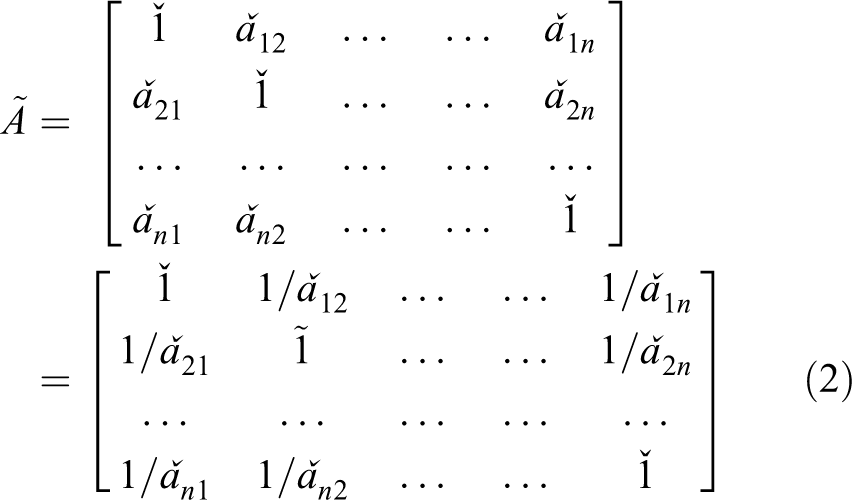
where

In addition, the consistency index (CI) and consistency ratio (CR) are the main parameters used to test the reliability for each judgment matrix


where
Step 2: Aggregate the fuzzy evaluation of sample members and calculate the fuzzy number
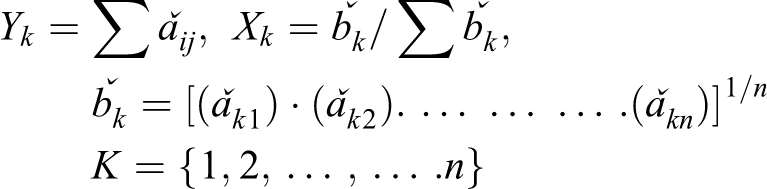
Fuzzy pairwise comparisons can be combined by the use of the geometric mean and also for lij , mij , and uij which delivers fuzzy group weightings. Geometric mean operations are commonly used within the application of the AHP for aggregating group decisions 49

where (
Based on the combined results of all decision makers, the priorities of each factor have been estimated using the geometric mean method of Buckley as shown in the following equations 43,50,51 where


Step 3: Calculating final weight for each factor
In order to complete the comparison process for each enabler and barrier in a nonfuzzy ranking method, nonfuzzy value should be calculated. Since the FAHM technique is based on fuzzy sets theory and fuzzy interval, it is not always obvious how to determine the optimal alternative and this involves the issue of ranking fuzzy numbers or defuzzification. The literature review has shown that even though more than 30 defuzzified methods have been proposed in the last 25 years, five methods seem to be major: center of area (COA), bisector of area (BOA), mean of maximum (MOM), smallest of maximum (SOM), and largest of maximum (LOM). In general, COA, BOA, and MOM methods are giving approximately the same results where as for the SOM and LOM approaches have a wide variation in the results. The reason for this is that these two methods use the two extreme smallest or largest values for the calculation of the nonfuzzy numbers. 52 –54
In this study, COA method has been employed to defuzzify the previously calculated fuzzy weights. The COA defuzzification method effectively calculates the best compromise between multiple output linguistic terms in FAHM by converting the membership of the output linguistic variables into numerical values. This method calculates the best nonfuzzy performance value (BNP) using the following equation (Hsieh, Lu et al., 2004) 55 :

However, there are important operation laws of the two TFNs ǎ1 = (l
1, m
1,




Application of the model
The methodology in this research is to identify the enablers and barriers of PCS from a comprehensive literature review that is consolidated using experts’ opinions. To achieve this purpose, 26 enablers and 8 barriers of PCS have been identified throughout the literature review. In the next phase, key informant interview methodology was implemented to elicit data from industry experts. A total of 12 experts from both owner and contractor companies, with between 20 and 35 years of experience as project managers, cost engineers, and/or schedulers in large Saudi oil, gas, and petrochemicals companies, were asked to identify enablers and barriers of PCS based on their experience. The results identified the final list, based on both the literature and expert’s opinions, of 29 enablers and 19 barriers classified within five main dimensions: project planning, performance measurement, top management involvement, project management team, and implementation strategy. As those enablers and barriers are subjective by their nature, the prioritization process is complex and uncertain. Therefore, a multicriteria model in fuzzy environment is developed to help the decision makers to select the critical factors that best suit their needs.
The first step in applying this model is to clearly identify the main goal (level 1) as well as the factors (level 2) and subfactors (level 3) that affects this goal (see Figure 2).

Multicriteria evaluation model for research problem.
The second step is to develop the survey questionnaire for the research model. Four cost engineers from two petroleum and chemical companies tested a draft of the survey’s questionnaire. The validation of those four cost engineers resulted in some survey’s questions to be changed. The validated questionnaire consists of six main sections presented as pairwise comparison. The first section compares the relative importance of the five main dimensions of PCS implementation, while the subsequent five sections compare the relative importance of subfactors (enablers and barriers) within each dimension. The evaluation methods utilized pairwise comparison on a scale of 1 to 9 as shown in Table 3.
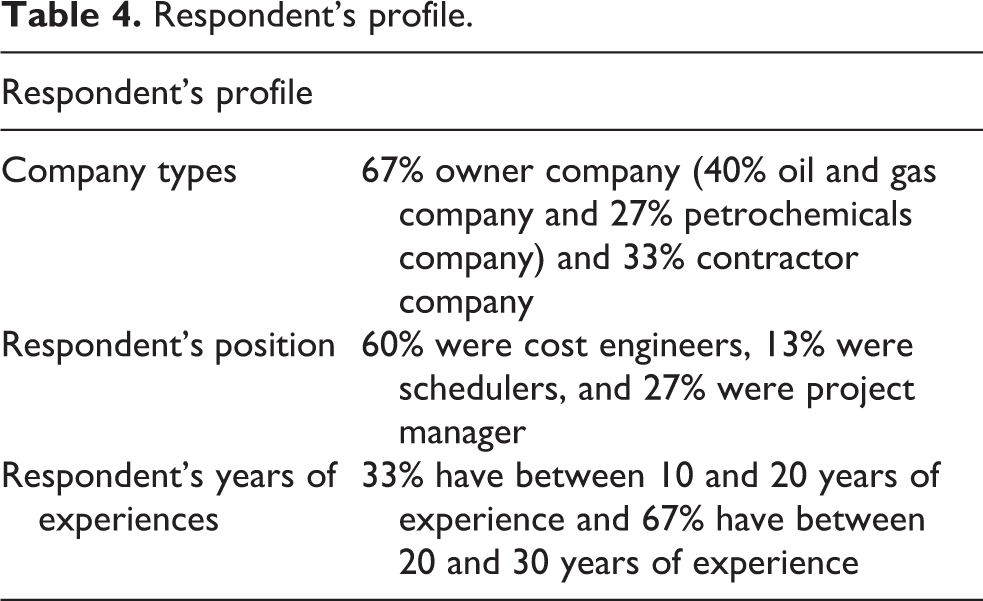
A total of 50 questionnaires were administered via e-mail to people from large owner and contractor companies in the petroleum and chemical sector. From this sample, a total of 17 questionnaires were completed and returned representing a 34% response rate. This response rate was expected due to the high level of competitiveness and confidentiality that exist within the petroleum and chemical industry. Two returned questionnaires were excluded as they failed the consistency test. Table 4 shows the respondents’ profile collected from the questionnaires (n = 17); 67% of the responses were from owner companies (where 40% were oil and gas companies and 27% were petrochemical companies), while 33% were from contractor companies. In terms of the respondents’ position profiles, 60% were cost engineers, 13% were schedulers, and 27% were project managers. In addition, 67% of the respondents had more than 25 years of experience in the petroleum and chemical sector.
Respondent’s profile.
Data analysis and results
Relative importance of the five dimensions to PCS implementation
This section describes the three steps of FAHM analysis used to obtain the final weight for prioritizing the dimensions of PCS.
Step 1: The pairwise comparison matrices are generated according to the preferences of the 15 respondents about the main dimensions of PCS implementation: (U1) project planning, (U2) performance measurement and evaluation, (U3) top management involvement, (U4) project management teams, and (U5) implementation strategy. Applying the linguistic scales from 1 to 9 to the corresponding fuzzy numbers (see Table 3), the following matrixes were generated (Figure 3).

The pairwise comparison matrices for the main dimensions of PCS implementation. PCS: project control system.
Step 2: This step aggregates the fuzzy evaluation of sample members’ k (k = 1,2,…,15) and generates a combined pairwise matrix as shown in the following example:

The other elements of pairwise comparison matrix were calculated using the same equation. A combined pairwise matrix of the five dimensions of PCS implementation is shown in Table 5.
Pairwise matrix of the five dimensions.

Step 3: The final weight for each dimension Ui

ř2, ř3, ř4, and ř5 are calculated as ř1.

Furthermore, the fuzzy weight of each dimension Ui can be obtained as follows:

Finally, the COA method has been applied to calculate the BNP value with the interest of obtaining the nonfuzzy weight for each dimension Ui . This has been achieved using the BNP value as follows:

The final weights of the five dimensions of PCS are calculated and listed in Table 6. The FAHM analysis indicates that the skills of project team members with weight 0.488 is the most important dimension of PCS implementation, followed by project planning (0.317) and performance measurement (0.268). These results indicate that the human element in terms of skills, experience, responsibilities, and the attitudes toward PCS is vital to the success of PCS implementation.
The weights and rank of the five dimensions of PCS.

PCS: project control system.
Relative importance of enablers and barriers for PCS implementation
The previous procedures were used to analyze the second level of the FAHM in order to obtain the weight of each enabler and barrier. Respondents were asked to judge the relative importance of the 29 enablers and 19 barriers using a pairwise comparison method. The enablers and barriers were compared with respect to dimensions, and the global weight for each enabler and barrier was calculated. Global weights in the FAHM are obtained by multiplying the weight of enabler or barrier by its dimension weight. Among these ranked enablers and barriers, this study has identified 9 enablers and 15 barriers as crucial factors of successful PCS implementation (see Table 7). Only the enablers and barriers with a global weight higher than 0.05 are included in Table 7. The results of the FAHM suggest that skilled and experienced project team members with clearly defined roles and responsibilities attained the highest rank with 0.398 and 0.112 weight scores, respectively. This result confirms that the skills of the project team is a key factor for the successful PCS implementation. The rest of the critical enablers are mainly relating to the project planning and performance measurement dimensions, and they are ranked in order of importance as accurate physical performance measurement (0.105), effective risk management plan (0.085), effective schedule management plan (0.070), frequent evaluation of physical project (0.061), accurate cost baseline (0.059), accurate WBS (0.056), and analysis and diagnosis of reported project variances (0.052).
A top critical enablers and barriers to PCS successfully implementation.

PCS: project control system; WBS: work breakdown structure.
The barriers of PCS are ranked as poor skills in scheduling and cost management (0.251), disparate control system between owner and contractor (0.135), vague contract deliverables (0.130), dislike or distrust of control systems (0.126), lack of information communication (0.114), the team’s lack of general expertise (0.102), lack of commitment from management team to the PCSs and tools (0.101), lack of clear role definitions for team members (0.98), unclear project milestones (0.095), poor reporting system (0.077), inability to keep track of current status and changes (0.072), lack of an effective cash flow plan (0.063), unclear project goals and objectives (0.063), lack of standard processes with (0.063), and week control methodology for external contractors with (0.051).
As shown in Table 7, the weighting of the barriers is generally much higher than the weightings of the enablers. This suggests that focusing on barriers is a helpful approach to identify areas for the improvement of PSC implementation.
Findings and discussion
The main objective of this study was to identify, examine, and prioritize the enablers and barriers of successful PCS implementation in petroleum and chemical projects. To do this, a multicriteria model has been employed to analyze multiple significant factors within five dimensions: project management team, project planning, performance measurement, implementation strategy, and management involvement. An FAHM was used to assist decision makers to make comparisons between those subjective factors and to prioritize them based on their needs. Using Buckley’s analysis methods, the weight of each dimension, enabler, and barrier is depicted in Tables 5 to 7.
The results of this study indicate that an effective project planning process and efficient performance measurement mechanisms play a significant role in implementing PCS successfully. While technical engineering skills are critical for successful petroleum and chemical projects, these skills are no longer sufficient to deal with the uncertainties and complexities of such projects in dynamic market. 30 Other competences, particularly planning and cost engineering, are necessary to achieve project objectives. In addition, effective project planning and performance measurement are key for successful PCS implementation. Of these two, our study suggests that the planning process has the greater impact. A project plan defines the baseline and performance indicators for any control methodology. Therefore, establishing an effective and realistic project plan can directly improve the outcomes and deliverables of PCS. 56
This study identified 9 enablers and 15 barriers that should be considered prior to any PCS implementation. The highest ranked enablers relate to the project management team; building a project team with the right skills and clear roles appears to have the highest influence on successful PCS implementation. Team members of large petroleum and chemical projects should be able provide accurate schedules, cash flow, expenditures, forecast, and reports as the basis for any PCS. 29 In addition, clearly defined roles and responsibilities for each team member along with sufficient experience and skill for each role will inevitably have a positive impact on project success. This result supports the “fit for purpose” approach to linking project success with project control proposed by Oni. 57 The importance of having a project management team with clear roles and the right skill set is supported by the analysis of the barriers in this study. Poor skill in scheduling and cost management is identified as the highest ranking barrier to successful PCS implementation (see Table 7). The team’s lack of expertise and a lack of clear role and definitions for team member are also found to be critical barriers to success.
The analysis of barriers indicates that the control system used by the project team is a key to implementing PCS successfully. The implementation of project control is more successful when the team uses a control system that is liked and trusted by the project team and supported by top management. This finding reflects human nature about the perception of control and the subjective ways in which people may resist performance controls unless they are trusted and supported. In addition, the study suggests that a PCS should also be accurate, allow frequent physical evaluation of the project, track current status and changes, and provide analysis and diagnosis of project variances. In summary, for successful implementation of PCS, a control system must be both accurate and trusted by the project team.
Differing perspectives on PCS between the owner and contractor is an interesting and important issue in this study. Vague contract deliverables and project milestones have been ranked as critical barriers to PCS. These two barriers are particularly significant in petroleum and chemical projects, which are usually carried out under different contracting strategies. Defining client acceptance criteria is vital in implementing PCS, there must be a common understanding between the owner and contractor of the project scope of work, cost, milestones, deliverables, and standards. Both parties should develop shared mechanisms and parameters to clearly define and control for any exceptional changes to the original scope, critical path, and the challenges that will be encountered throughout the life cycle of the project. 4,37,38
Unexpectedly, the results from this study show that implementation strategy and top management support have little impact on successful PCS (see Table 6). Implementation strategy was ranked as one of the least important of the five dimensions examined. Only two elements of implementation strategy appear in Table 7, both identified as barriers to successful PCS implementation; these are lack of information communication and lack of standard processes. This supports previous research that suggests that effective control systems should enable a project team to receive relevant and accurate information in a consistent and timely manner. 17 Similarly, top management involvement not found to be significant to PCS in this study. Although control is one of the management functions, 29 implementation of PCS is an operational rather than a strategic activity. This is understandable as strategic control focuses on business performance while the focus of operational control is on analyzing and measuring project performance. This is consistent with the other results from this study that indicate that operational issues, project management team, project planning, and performance measurement are most important for successful PCS implementation.
Conclusion and implications
The current financial situation in the petroleum and chemical industry has compelled the decision makers in this sector to improve their strategic capabilities by implementing PCSs. Effective PCS plays a significant role in enabling organizations to achieve their project objectives successfully. 56 Projects that are completed behind schedule and over budget often suffer from failed or inadequate PCS. 4,6,37 In this context, organizations are strongly recommended to implement a PCS that can help to increase profit, provide the ability to forecast and mitigate negative cost impact, and provide a baseline to make informed decisions on project outcomes.
The task of implementing a PCS for an organization particularly in petroleum and chemical industry proves to be difficult and requires a comprehensive understanding of a wide range of factors and aspects. To date, there is no published empirical study that identifies the critical factors of PCS implementation. This study seeks to address this missing link introducing a new model for PCS implementation.
The article proposes a framework to support the decision makers in implementing PCS successfully by identifying the critical factors that assist in PCS implementation (enablers) and the difficulties that impair successful implementation (barriers). A total of 9 enablers and 15 barriers were identified as crucial to PCS implementation. These enablers and barriers were classified into five main dimensions: project team members, project planning, performance measurement, implementation strategy, and management involvement.
This study has identified a number of critical factors that have positive effects on PSC. Successful PCS implementation in petroleum and chemical projects requires (1) a project team with the right skills and clear roles, (2) a control system that is accurate and trusted by the project team, and (3) a shared understanding between owner and contractor about the control system and contract deliverables. In addition, the most critical factors that have a negative effect on PSC have been identified as poor skills in scheduling and cost management.
The proposed framework is based on the FAHP approach. It is considered as a comprehensive approach for the evaluation and synthesis of elementary factors, based on multifactors evaluation and pairwise comparison. This methodology meets the challenge of multiple decision-making and the uncertainty and vagueness of human preferences.
The first limitation in this study is related to the validation of the findings. Although a reliability test has been conducted to evaluate the integrity of the research results, extended industrial testing of the developed model in an actual PCS implementation process would be a significant addition to understanding. A second limitation is related to the focus on the petroleum and chemical industry. The enablers and barriers of PCS implementation in this study have been derived from a review of project management literature but have been refined through an expert project panel with a primary focus in the petroleum and chemical industry. Although it expected that the findings might have general applicability, further studies in different sectors should be carried out to validate this assumption. Moreover, future research could extend the scope of this study to establish the relationship between the critical factors for successful PCS implementation and their impact on project performance.
Footnotes
Acknowledgements
I acknowledge that the manuscript has been submitted solely to this journal and is not published, in press, or submitted elsewhere. I have checked the manuscript submission guidelines and complied with any specific policy requirements specified.
Declaration of conflicting interests
The author(s) declared no potential conflicts of interest with respect to the research, authorship, and/or publication of this article.
Funding
The author(s) received no financial support for the research, authorship, and/or publication of this article.