




Abstract
Dispute is recognized as critical cause of deficiency and low performance in construction projects. Plenty of studies have been done in construction dispute management recently; however, there are no studies on construction dispute elimination. This study aims to propose a building information modeling (BIM) approach to control conflict causes before the occurrence of dispute. BIM is one of the latest platforms that promote a high level of collaboration, information sharing, and coordination where its implementation ranges from project initialization to completion stage. The circumstances associating with BIM technology can be utilized to explore the possibilities in conflict and dispute resolution system. Questionnaire surveys are used to collect the primary data. Analytical hierarchy process (AHP) and multi attribute utility technique (MAUT) are adopted to develop an algorithm and a decision-making framework to manage and resolve the potential conflict causes, particularly for the Malaysian construction industry. Data analysis emerged that five critical conflict factors in Malaysian construction industry are insufficient monitoring of CPM scheduling and updates requirements; failures to understand and correctly bid or price the works; delay in running bill payment; inadequate contractors’ management, supervision, and coordination; and error and omission in design that are originated from time, cost, quality, and documentation. Further analysis to prioritize BIM functions in construction conflict management has been done by the combination of AHP and MAUT results. Consequently, it is affirmed that clash detection and cost estimating, 4D scheduling, 3D visualization and structure analysis as BIM functions obtained the highest score to control conflicting factors.
Introduction
The construction industry plays a vital role in socioeconomic development. Various resources and collaborations have to be provided to construct particular infrastructures. Construction process typically encompasses standard procedures such as planning, designing, procuring, constructing, maintaining, and demolishing, which necessitate the involvement of variety of organizations, firms, and individuals such as consultants, main contractors, and subcontractors. Inevitably, each participant possesses individual aim and objective that could be in conflict with the goal of the project. 1 Therefore, implementation of complex construction projects is bounded by many problems due to distinctive expectation, value, and goal among project practitioners, and conflict seems inevitable. 2 The negative impact of conflict on performance of construction organizations is extensively documented by a number of studies in several undertaken projects. 3 This conflict may cause to increase delay in actual project implementation, discontinuity of the work, and in some cases suspension of the projects. 4 However, conflict control may improve the relation between project team and provide significant benefits to the organization.
The existence of several problematic issues in construction projects may trigger conflicts, which may damage the project procedure and lead to dispute occurrence and costly litigation. 5 It is suggested that in case of more complex and larger projects, the dispute is higher. 6 Moreover, it is affirmed by various authors that for several years the construction industry is a pioneer in disputes. 7 In this circumstance, companies and governments may require to expend millions of dollars annually in terms of direct costs (lawyers, claims consultancy, work suspension, completion postponement) and indirect costs (destruction of working relationships, promotion of suspicion between main practitioners, and lack of team work) to resolve the construction dispute problems. 8 In this regard, direct cost of dispute is computed around 0.5–5%of contract value. 9
Occurrences of several conflicts and unexpected dispute are perceived in Malaysian construction industry that is surrounded by dissatisfactions and problematic issues. 10 Moreover, the study by Memon et al. 11 revealed that in Malaysia89% and 92% of the projects face cost and time overrun, respectively. Several authors considered conflict, dispute, arbitration, and costly litigation as a result of this delay and cost overrun. 12,13 An examination of the Malaysian annual audit report from 2006 to 2014 confirmed that the aforementioned problems still have remained in the industry. The abovementioned problems increased the rate of the claims as the main problematic issues in this industry. 14 Consequently, the complexity of the projects and availability of different technical problems in Malaysian construction industry paved the way to form numerous conflicts and subsequently disputes. In addition, it is confirmed by Malaysian Economic Transformation Program. 15,16 Aforementioned issues and huge amounts of money and time to avert dispute problems and risk of litigation encourage the researchers to develop more efficient ways of resolving disputes.
Despite building information modeling (BIM) promotion within the construction industry around the world, none of the studies focused on dispute prevention by conflict management through application of BIM concept as one of the advance technologies in construction industry. Thus, the objectives of this research are set to (a) identify the causes of conflict encountered by client, contractor, and consultant under the BIM working environment and (b) determine the efficiency of each BIM function in controlling the named causes and develop a decision-making framework. The research outcomes are very useful for academia and construction industry, as it can assist in conflict management within the least allowance time and budget. It helps in minimizing dispute occurrence rate, which will indirectly boost productivity rate, quality enhancements, and customers’ satisfaction. The proposed algorithm and framework can be used as a benchmark for future studies to examine each function of BIM in relation to construction conflict and dispute management. The result thus can be used to develop a framework for dispute mitigation.
Cause of conflict
The review of literature revealed that previous studies developed concepts to use diverse attitudes of disputants to reach consensus agreement, to examine the ability of project organization to settle disputes, to collect different attributes of construction disputes to create a database, and to predict dispute occurrence to provide suitable dispute resolution at early stage of dispute occurrence. Most of the approaches shed light upon the sole particular area and are applicable only after dispute occurrence. In addition, it can be seen that focal point of previous studies is on the cure rather than dispute prevention in the construction industry. For instance, Chou et al. 17 compared several machine learning techniques to see how they can predict dispute occurrence. Their study illustrated the efficiency and effectiveness of hybrid machine learning techniques for early anticipating of dispute occurrence using conceptual project information as model input. This system gave the opportunity to the practitioners to select a proper dispute resolution method at the early stage of occurrence, but its concentration was on the cure rather than prevention. However, latest 10 years’ studies that related to this area are listed in Table 1.
List of studies in dispute management.

MAS-COR: multiagent system for construction dispute resolution; ADR: Alternative dispute resolution.
Definition of claim, conflict, and dispute
Researchers attempted to exhibit the procedure of escalating dispute in the spectrum by linking the terms “claim,” “dispute,” and “conflict.” 8 First, they defined claim as “an assertion of a right to money, property, or a remedy, and can be made under the contract itself; for breach of the contract, for breach of duty in common law, or on the quasi-contractual basis.” They commented that unresolved claim can be converted to dispute easily. In brief, the relationships of conflict, claim, and dispute are exhibited in a modified diagrammatic form as shown in Figure 1.

The spectrum of conflict. 8
Figure 1 illustrates that conflicts can be connected in terms of the period of claim notification and dispute resolution. At the beginning stage of claim notification, the severity of conflict is situated at the lowest level, and its intensity climbed when claims remained unsettled for a long period of time and will be simply converted as dispute. Consequently, most of the claims and disputes may be the outcomes of previously neglected conflicts.
Disputes are referred as the long-term unresolved claims and uncontrolled disruptive conflict. Although conflict is well-known with its unpleasant implication and consequences, other positive and functional aspects of conflict must not be ignored. In fact, innovation and progression will vanish without the existence of conflict. 24 In contrast, conflict can be dysfunctional with initial traducing, devastating, and dysfunctional outcomes that can be considered as parasites in organizations. 25 Therefore, the light shed upon the area of conflict is to pose control and mitigate its inefficiency and disruptive consequences that can affect project performance due to disputes among participants. 4,26
The studies by Yates and Hardcastel 8 and Kumaraswamy 27 exhibit that hierarchy of events must take place to begin a dispute. This procedure approximately can be compared with accident occurrence in the construction site. Heinrich 28 developed a theory called Domino theory to prevent accident and injury before occurrence. Heinrich’s Domino theory states that accidents result from a chain of sequential events, metaphorically like a line of dominoes falling over.
Based on the theory by Heinrich, 28 dispute occurrence involves a number of metaphorical dominoes that fall of one domino, triggering the next event until the appearance of disruptive consequences of dispute in the projects. Based on Heinrich’stheory, 28 removing one of the key factors can stop the whole process and prevent disruptive results. A question here is that which dimension is to be removed. Based on Figure 1, conflict is allocated between claim notification on one side and dispute resolution on the another side and has the lowest intensity in the early stage of claim notification. Moreover, according to Mitkus and Mitkus, 29 conflicts can be managed, but disputes must be resolved by binding or nonbinding dispute-resolution methods. In this situation, managing conflict in the early stage may assist to prevent disruptive dispute occurrence within minimum time and expenses. Functional conflict should be guided to preserve its useful role in construction working procedure, while dysfunctional conflict must be managed or eliminated proactively before converting to dispute. Thus, in order to clarify the BIM role in conflict management, the graphic illustration by Kumaraswamy 27 has been updated as depicted in Figure 2. Application of BIM in conflict management will be discussed in detail in the following sections.

Relationship between conflict, claim, and dispute.
Building information modeling
According to National Institute of Building Science, 30 BIM was being defined as “a digital representation of physical and functional characteristics of a facility and a shared knowledge resource for information about a facility forming a reliable basis for decisions during the project life-cycle.” BIM utilizes data to create a database of information, in concurrently with its 3-D virtual representation; it effectively improves the design, construction, prefabrication, and operation of the facility. 31 Connecting 3-D geometric model to the schedule data presented another effective function that is 4-D visualization; 4-D visualization can provide several efficient advantages that facilitate site planning and management, anticipate the occurrence of crucial problems, and simplify the process of site management and practice. The other levels of BIM technology are 5-D (cost estimating) and 6-D (facility management (FM)) which possess more key roles in facilitating the process of construction work. 32
BIM assists the participants within the industry to improve the accuracy and speed of building engineering and construction management at all stages. Successful implementation of BIM in projects associated with significant benefits, including enhancement of design quality, increased productivity rate, and cost and time reduction, which lead to less conflict occurrence. A comparative review of BIM implementation in building and infrastructure industry has been done by Shou et al. 32 They examined several case studies and main BIM uses in academic publications and some examples are summarized in Table 2. This analysis has been done to identify the level and area of BIM implementation. As illustrated in Table 2, BIM has been utilized for various goals and objectives such as performance improvement, cost estimating, safety management, and so on.
List of BIM implementation area.

BIM: building information modeling.
BIM implementation in Malaysia has been recommended by the Director of Public Works Department (PWD) in 2007. 52 Their main purpose to apply BIM was to decrease the cost of construction projects and prevent design errors in the planning phase of the projects. Two of the initial projects in Malaysia that applied BIM system completely are National Cancer Institute of Malaysia and Sultan Ibrahim Hall of UTHM. 53 A comparative review of BIM implementation in first two projects in Malaysia has been done by Latiffi et al. 53 to obtain how BIM affected these projects. They identified that both projects are affected positively by BIM implementation in terms of cost, time, project design, project process, and communication.
However, none of the studies and projects in Malaysia and also other countries considered BIM as dispute mitigation approach by controlling conflict causes in the early stage of occurrence. Thus, in this study BIM with its potential functions is considered as a new strategy for controlling conflicts related to the client, contractor, and consultant and endeavor to prevent disputes. To obtain aforementioned priorities, there are several proficiencies that can be considered as the main BIM functions. Some of BIM functions that are being utilized in Malaysia are described in Table 1A. These functions are as follows: FM, shop-drawing process, scheduling (4-D), cost estimation (CE), structural analysis (SA), clash detection (CD), and 3-D visualization. Therefore, an effective framework based on BIM concept should be capable of controlling the causes of dysfunctional conflicts between different parties and convert them to functional conflicts, where claims and disputes will be mitigated as work progressions have been improved. As this study focuses on the client, contractor, and consultants conflicting factors, the applications of BIM in conflict reduction relationships are explained in detail in the following sections.
Client-related factors
Cost and financial issues, construction time scheduling, and on-time decision-making are the conflicting factors related to the client. 54 BIM, with its efficient functions, can be utilized to manage the aforementioned conflict causes. Firstly, 3-D and 4-D BIM functions are intended to provide the accurate design visualization and time scheduling, which closely reflect the real-time progress, assist in sound decision-making, and reduce the number of variation orders. Secondly, BIM can assist the client to manage its financial issues by integrated 5-D BIM model, which possesses the ability to precipitate the quantity surveying tasks, which can immediately apply any changes occurred in both schedule and budget allocation. Thus, effective monitoring and same execution of changes will promote a trustful environment between the client and the designers. 55 Furthermore, working environmentequipped with BIM has the lower possibility of omissions, prevented change orders during the delivery process which ultimately result in the elimination of dysfunctional conflicts and reduction in project expenses and duration.
Consultant-related factors
Documentation factor is the significant area of conflicts pertinent to the consultants within construction projects. BIM is equipped with the abilities to facilitate management and controlling documentary issues. According to Latiffi et al., 56 BIM can assist consultants in conflicting factor reduction by(1) presenting a principle to assist the architects to incept the process of evolutionary design, (2) providing an efficient mode to enhance design and documentation quality, (3) reducing drawing issues and conflict errors, and (4) decreasing design conflict issues by integrating the overall system and enhance communication. Therefore, these benefits associated with BIM can ensure the timely generation and confirmation of working information, allow the combination of several project documents, instant submission of drawing, and implement frequent quality examination control. All of these tailing benefits ensure that the actual work coincides with the proposed design, where the rate of conflicts will be reduced and productivity heightened.
Contractor-related factors
Conflict issues pertinent to contractors are closely interrelated to construction execution and site management and control. Inappropriate planning and scheduling, wrong selection of construction methods, poor site management, incorrect organizational structure,and procurement methods and schedule are established as the common causes of conflict by contractors. Most of the conflicts will be triggered when contractors spend excess time and money due to improper working attitude and management procedure, which lead to inefficient asset and finance management. BIM is playing a crucial role in settling these problems. The 3-D function of BIM enables real-life virtual visualization of construction building that assists to enhance site management, construction procedure, and improve the organizational structure that is required in the initial stages of the projects. Moreover, 4-D attribute of BIM is having potential in providing the most reliable project time scheduling and eases the examination of different phases of construction work and activity sequences. This will secure the agreed completion time for the project. Furthermore, the ability of BIM to generate automatic quantity takeoff and cost estimation in the design stage ensures secure project implementation cost, which is useful for the contractor to prepare a right financial plan to deliver the project. Utilization of all these BIM functions by contractors indicates that they possess the opportunity to perform a comprehensive procurement schedule and effective management before the actual execution.
Causes of conflict
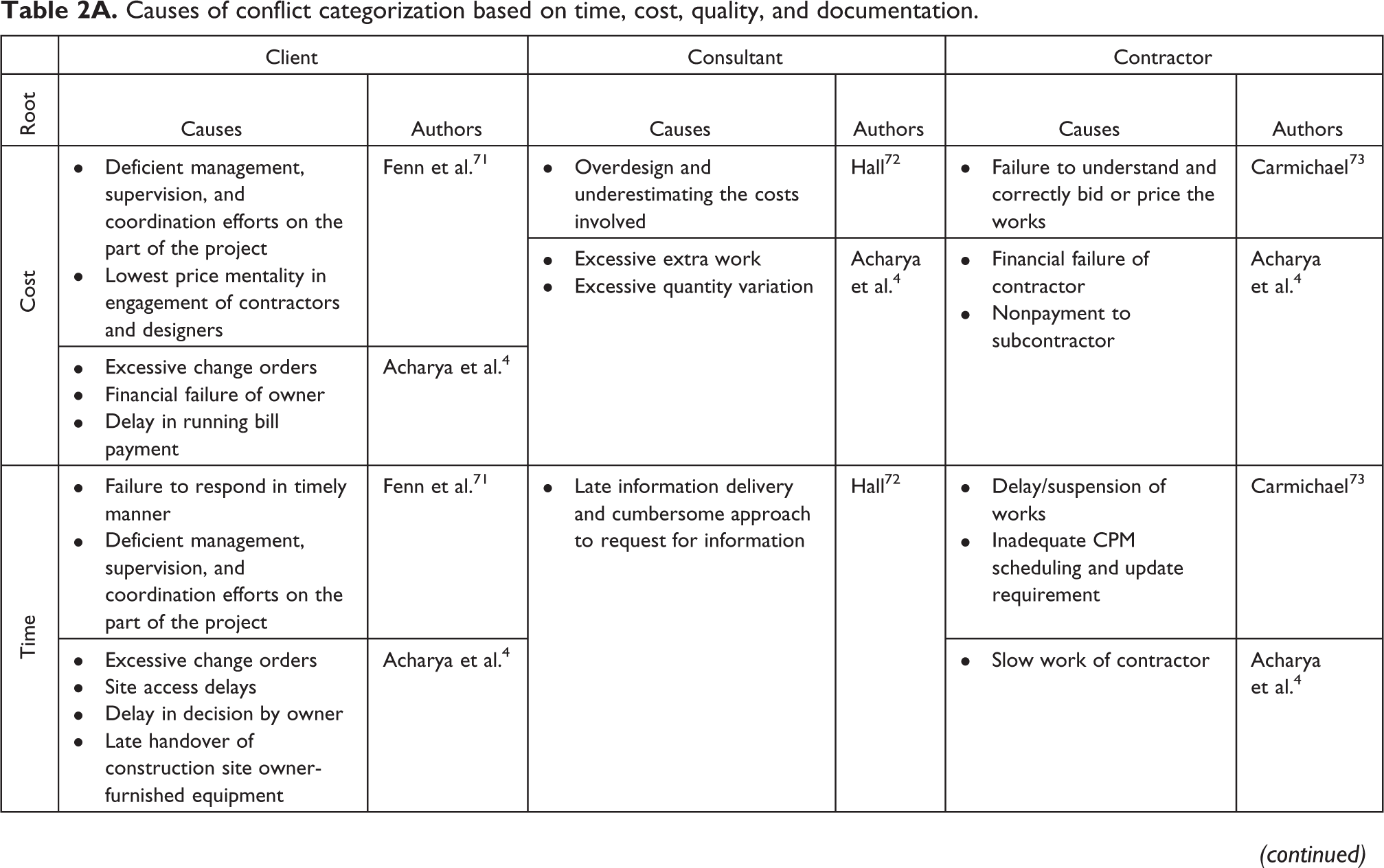
The importance of construction conflict and dispute management encouraged researchers to conduct several studies to extract causes of conflict and dispute in this industry. To examine the causes of conflict and dispute, an in-depth literature review has been done and various variables are extracted. The factors are illustrated in Table 2A.
Research methodology
Questionnaire surveys are distributed to professional experts in the construction field. From the gathered questionnaire, 16 most significant causes are specified using average index technique. Most of the identified causes originated directly or indirectly from cost, time, quality, and documentation-related issues. Then, a theoretical model contains analytical hierarchy process (AHP), and multi attribute utility technique (MAUT) is developed to enable the participants to choose the appropriate function of BIM in controlling the causes of conflict. The intention of applying AHP and MAUT together is to mitigate the percentage of personal error. Moreover, both tangible and intangible factors in computing data can be utilized quantitatively by MAUT. The application of these two methods (AHP and MAUT) will provide the weighted score for each BIM function based on the highest score. The MAUT with its extensive capacity can be utilized in the following areas, namely: specify the alternative and relevant attributes, assess each alternative regarding different attributes, exhibit attributes preference by allocating relative weight, integrate attribute weight and satisfaction rate of each alternative, and prepare sensitivity and at the end make a decision.
In current practice, decisions concerning BIM functions to manage conflicts are based on qualitative assessment and related to previous experience. It is extensively true that qualitative evaluations are subjective in nature, and the results can be affected by the personal preference of the decision makers. Application of MAUT assists to prevent this kind of problems and obtain reasonable results. 57 Converting the problems to a single objective problem during the accurate assessment of utility function is one of the main benefits of MAUT utilization. According to Fellows et al., 58 MAUT is a method that can provide object measurements in subjective areas. Moreover, it has been applied in different areas such as maintenance, quantity surveying, project procurement, and also dispute resolution. 57 In addition, the study by Cheung and Suen 57 affirmed that MAUT utilization can reduce the subjective elements that affect the decision-making process and increase accuracy. The basic of MAUT technique is the allocation of a number called outcome utilities to each outcome state. The satisfaction or desirability rate of each attribute is called utility (normally expresses as Ui). The overall concept of MAUT contains two main attributes with respect to both model and utility weight derivation. The purpose of MAUT application in this study is to integrate both priority rates for each criterion and utilities derived from BIM functions to identify the suitability of each BIM function in conflict management.
AHP is multi decision-making techniques that can be used to achieve the most appropriate alternative by pairwise comparison between several criteria.
59
It assists the decision makers to solve sophisticated problems and assess both qualitative and quantitative data in principled methodologies under conflicting multicriteria by converting complicated systems to hierarchical form with several levels.
60
Moreover, subjective appraisals and objective realities are synthesized into legitimate hierarchical AHP that has a wide range of application in decision-making, including selection alternatives among different choices, alternative assessment, cost–benefit analysis, resource allocations, planning and development, and priority and ranking.
61
According to Aminbakhsh et al.,
62
the main advantages of AHP are as follow: Measuring and minimizing the inconsistency of expert’s judgments. Avoiding respondent bias in decision-making. Giving cooperative decision-making through agreement utilizing the geometric mean of the individual judgments. Obtaining the degree and level of values by pairwise comparison in conjunction with rating, and it is proper for multiobjective, multicriterion, and multiactor decisions with any number of alternatives. Doing scale evaluation rather than measurements that is convenient for modeling circumstance without particular measures (e.g. modeling risk and uncertainty). It also reveals the relative merits of alternative solutions for anMAUT problem.
63
However, Figure 3 reveals the proposed integrated model of BIM-conflict relation based on applying AHP and MAUT to identify how BIM may control conflicting factors pertinent to client, contractor, and consultant in the construction industry.

BIM-conflict relation diagram. BIM: building information modeling.
The causes of conflict that have been extracted from literature review are highlighted in the questionnaires through outputs from average index technique. The data collected is analyzed with the average index formula based on Majid and McCaffer. 64 Questionnaires are distributed to local authority, developers, engineers, architects, and quantity surveyors who directly involved in construction dispute resolution and experienced in BIM platform. Hundred questionnaires are distributed, and of which 45 respondents responded. With 30 sets of valid questionnaire, it indicated 30% response rate. The sample size achieved the minimum requirement of the central limit theorem in probability theory. 65 The reliability and validity tests have been performed. Cronbach’s α was applied in this case to understand whether the data provide a good support for internal consistency reliability. Moreover, Kaiser–Meyer–Olkin (KMO) Bartlett’s validity test is performed to show whether the sample size used for analysis is adequate. The results of all tests have been illustrated in Table 3. The reliability statistic showed the Cronbach’s α value of 0.952 from the correlation of the 29 factors. This value is larger than 0.70, which presents a great support for the consistency of the results. 66 The KMO value was 0.610, which exceeded the recommended value of 0.6 to be valid. 67,68,69 Likewise, the Bartlett’s test was 657.030 with significance 0.000, which is less than 0.05. Hence, the data set is valid and reliable for analysis.
Reliability and validity test of questionnaire data.

KMO: Kaiser–Meyer–Olkin.
Distributions of respondents are categorized by discipline, management position, project involvement, and conflict experience. Respondents’ discipline and their conflict experience have been illustrated in Tables 4 and 5, respectively. Majority of respondents (60%) possessed more than 10 years of working experience. Furthermore, all the respondents have minimum 5 years of working experience. Results show high reliability based on the practitioners’ experience, who are evaluated as experienced respondents.
Respondents’ background.

Respondents’ conflict experience.

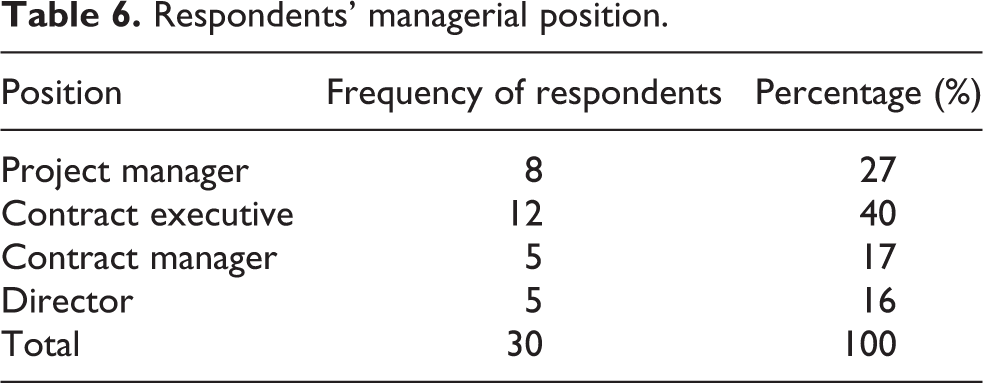
Meanwhile, Table 6 shows the position of respondents involved in construction industry. There were 30 respondents, including 5 directors, 5 contract managers, 8 project managers, and 12 contract executives. They were in right position to answer the questions regarding conflict causes in construction industry and trustful information has been gathered. In order to prevent quantitative measurement bias and response bias, respondents are required to comment on other professions except his/her own profession. Measurement bias will be triggered from an error in collected data and measuring process, while response bias is a type of bias where the respondents consciously or subconsciously provide responses that they think the researcher intended to know.
Respondents’ managerial position.
Result
In this study, BIM is considered as an efficient concept to control and manage conflict occurrence, but selection of the appropriate BIM function to solve a particular type of conflict may not be subjective. Therefore, it is necessary to analyze the functions objectively based on each function performance before the final selection. Thus, based on previous explanations in methodology part, MAUT and AHP are employed to reduce the subjective components and encourage transparency in the decision-making process. This model comprises set of criteria, set of utility factors, and set of weightings for criteria. Accordingly, the following steps are required to carry out this study: extract and examine conflict factors related to client, contractors, and consultants to determine the predominant selection criteria for different BIM functions, determine BIM function ability to facilitate computation of utility factors for each function, collect utility factors for each BIM function, collect weighting for selected criteria, and compute the score for each function and examine how each one can control different conflict factors.
Part A: Causes of conflict by client
Many authors contended that the relationships between construction players and parties are harsh and easily spark off to conflicts and litigation. 70 Thus, to ensure the reliability, the questionnaires are directed to the representatives in the PWD Malaysia to rank the cause of conflict by client, contractor, and consultant from the least important to the most important. The significance of each factor is ranked based on the average index value. The list of top six significant causes of conflict by the clientsis shown in Table 7. The result from the survey shows that there are several conflict issues between client and main contractor. Delay in running bill of quantities and excessive change orders are the first two main causes of conflict by owner that directly involve contractor. This situation can affect the contractor’s ability to finance the work that can delay or sometimes suspend the progress of work and impress the cost and quality negatively.
Main cause of dispute by client.

Cause of conflict by contractor
One of the major groups to shed light in construction industry is contractors and subcontractors. They are required to complete the works within an anticipated timeand agreed budget andto achieve the quality that is expressly and impliedly stated in the contract. However, due to the huge responsibility, contradictions always happened and led to the formation of conflicts and disputes. From the gathered data, a total of 11 factors have been identified as causes of conflict by the contractor. The significance of each factor is ranked based on the average index value as mentioned in previous part. The eight significant causes of conflict by contractors are revealed in Table 8.
Main cause of conflict by contractors.

Insufficient monitoring of CPM scheduling and update requirements is ranked as first causes of conflict by contractors. Indeed when the planning is based on defective scheduling documents, it provides ground for delay in work and requests for an extension of time by contractor that can lead to adversarial behavior and conflict in projects. Failure to understand and correctly bid or price the works is ranked as second significant causes of conflict by contractors. Wrong CE and acceptance of incorrect bid by contractors may decrease their profit margin and sometimes collapse their business opportunity. In this situation, the rate of problematic claims by contractors will be increased to cover their expenses. For instance, some contractors try to cheat using quadratic and low-quality material different with actual that is quoted in the contract, but they claim quoted price for the particular items as assigned in the contract that is higher than actual expenses for provided item by contractor. Inadequate contractor management, supervision, and coordinationare ranked as third causes of conflict by contractors. Contractors have the role to manage project implementation from commencement until completion and delivery. So, lack of project management competency by contractors creates several issues that can directly affect the cost and quality of the project and trigger problematic conflicts and disputes.
Causes of conflict by consultant
This part depicts outcomes concerning the causes of conflict by consultants. Seven factors are identified from the obtained data. These factors are ranked and sorted based on the level of significance as per defined by respondents and further reclassified into three significant factors of conflict by consultants as shown in Table 9. The factor of design error and omission is one of the crucial issues of conflict that obtained the highest score as the cause of conflict by consultants. Several factors such as clients’ requirements, quality of the work, feasibility of implementation by contractors, and so on must be considered by consultants in designing a particular project. Therefore, the competency and experience of consultant in contract administration and design preparation are really critical to obtain a successful project in amicable environment.
Main causes of conflict by consultant.
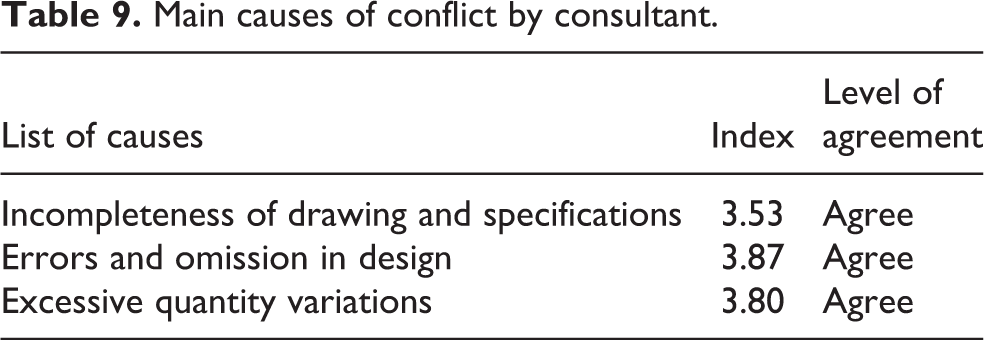
As previously mentioned, there are abundant causes of conflict by client, contractor, and consultant. For instance, as stated by Acharya et al., 4 one of the consultant causes of conflict is differing of site condition, where it was considered as main critical causes of conflict in the Korean construction industry. However, it is pinpointed that it is not considered as an effective factor in context of Malaysia. Thus, to suit the applicability and genuineness, the analyzed outcomes revealed that the top five high effective causes of conflict in the Malaysian construction industry are insufficient monitoring of CPM scheduling and update requirements; failures to understand and correctly bid or price the works; delay in running bill payment; inadequate contractors’ management, supervision, and coordination; and error and omission in design. In contrast, factors such as failure to appoint a project manager by client, consultant failures to understand its responsibilities under the design team contract, and contractor failure to plan and execute the changes in works are ranked as ineffective factors in triggering conflict. Thereby, late payment, wrong CPM scheduling, frequent change orders, excessive variation, and incomplete design and specification are very prevalent throughout the industry, heightening conflict and dispute. It is obvious that conflict causes in the Malaysian construction industry originated from cost, time, quality, and documentation. Finally, to properly address these issues, the final results gathered are categorized based on cost, time, quality, and documentation as illustrated in Table 10.
Conflict causes based on their characteristics.

The main factors of conflict by client, contractor, and consultant are classified based on the root causes including cost, time, quality, and documentation. Since their originality is known, efficient and proper techniques and tools should be in place to manage the causes of conflict before they emerge to dispute. Thus, BIM concept is being considered to overcome the challenges related to time, cost, quality, and documentation in construction projects. It is positive that the conflict management will be much effective and accurate as BIM is an intelligent tool that offers great visualization, interoperability, coordination, and so on. Therefore, it is decisive to identify the efficiency of each BIM function in relation to time, cost, quality, and documentation so that proper solution can be initiated before conflict occurrence.
Part B: Utility factor gathering for MAUT
This part determines the utility factors for sustainability of cost, time, quality, and documentation within BIM functions. The outcomes are contributed by BIM professional experts in Malaysia, with the utilization of their professionalism and previous experience. In this section, the respondents are required to allocate the score of 10–110 when appraising the degree of importance of each BIM function against each criterion. Such statement is in parallel with the explanation of Cheung and Suen, 57 which marks allocation excluded “0” to avoid mathematical errors. From the inputs gathered, the average results of utility factors are summarized in Table 11.
Summary of mean utility factors matrix for BIM functions.

SA: structural analysis; CD: clash detection; SP: shop-drawing process; CE: cost estimation; FM: facility management.
Table 11 illustrates the utility value for each BIM function based on different criteria. For instance, cost estimating has the highest utility value and 3-D visualization function has the lowest utility value for cost. The useful performance range of each tool can be easily obtained from Table 11 and further integrated with AHP to gain the weight percentage for each criterion. It can vary according to project managers’ professional perspective regarding the originality of conflicts and select the most appropriate BIM function to manage and control the potential conflicts. Figure 4 reveals the proposed integrated model to control and prevent conflicts in the construction industry by applying BIM based on the result of Table 11. This figure shows that BIM application with its valuable functions puts main practitioners (client, consultant, and contractor) on a virtual environment and provides a level of effectiveness, collaboration, communication, and cooperation that enables the integration of the whole construction procedure practitioners. Moreover, potential abilities of BIM provide better understanding about project requirements for the owner; help the consultant team to analyze, design, and develop project design based on owner priorities; and facilitate project implementation. Furthermore, it assists the contractor to manage the construction project in right way and overall facilitate conflict identification and control for all three groups to achieve a successful project within acceptable time, cost, and desired quality.

Integrated model to mitigate conflict in construction projects.
Algorithm for selecting BIM functions
An effective algorithm is then developed based on the outcomes obtained to facilitate the selection of BIM functions to control conflict and guarantee project productivity. The algorithm is constrained to seven BIM functions discussed throughout this study, and it is based on the following assumptions: (1) recognition of conflict symptoms,(2) selection of BIM function by applying AHP and MAUT based on different criteria, and (3) the objectives that determine the applicability of BIM functions are cost, time, quality, and documentation. The decision-making algorithm is developed based on these assumptions by following four major steps. The steps are illustrated in Figure 5 and explained in detail below.

Decision-making flowchart of selecting BIM function to control conflict.BIM: building information modeling.
Step 1: Monitoring the project to identify the symptoms of conflict and claims
The first step is to identify the potential conflicts’ symptoms, as every cure starts from the roots. From the analyzed outcomes previously, some significant causes of conflict by client, contractor, and consultant were identified. These symptoms will then be further assessed to determine the conflict causes.
Step 2: Assessment the conflict causes to identify their originality
Conflict assessment is a crucial process to measure project performance and then allocate suitable approach to manage and control it. Different factors such as direct cost, indirect cost, loss of quality, and delay can be considered when assessing conflict causes. For current study, the results show that majority of the identified causes are related to cost, time, quality, and documentation. Thus, they are being utilized as the main criteria in this study to evaluate each BIM function by applying MAUT. The results of MAUT for BIM function based on experts’ experience are illustrated in Table 11. The table is applicable for different projects based upon the preferred focus field of study.
Step 3: Weighting identification for criteria
The third step is to specify the weight for each criterion. As exemplified, the conflict causes by client, contractor, and consultant are originated from the cost, time, quality, and documentation. These four factors are considered as criteria when assessing BIM function. To reflect the difference between the selected criteria, each of them is assigned with a weight in accordance with its relative importance comparatively with other criterions. The setting of the weight is completed by the professionals who have profound knowledge in conflict management and are capable of utilizing AHP technique. The AHP process utilizes pairwise comparison technique to recognize the participation percentage of each criterion for conflict occurrence. The experts are required to judge on the four standing criteria. This pairwise comparison is conducted by a nine-point scale as shown in Table 12.
Nine-point pairwise comparison scale. 59

The allocation of the weight for each criterion requires logical and analytical thinking and only suitably done by experts who possess the wide range of knowledge about conflict and dispute in construction industry. To demonstrate the practicality of the process, the following preference vector (matrix A) as shown in Table 13 is being utilized as each criterion in relation to others. This table demonstrates the importance of each criterion against other criteria. For instance, the criterion of cost is two and three times more important than time and quality, respectively. To identify the eigenvector for each criterion, matrix A is normalized by applying simple computation to determine the weight that is assigned to each criterion. Table 14 reveals a distributive summary of the result based on the four criteria and their relative scores, which was sorted in descending order.
Ranking criteria (the preference vector for criteria-Matrix A).

Eigenvector for each criterion obtained from AHP model.

Step 4: Prioritizing BIM functions by combining the result of MAUT and AHP
After the weights are calculated, the potential contribution of each BIM function is computed. By calculating the priority rate for each BIM function, the most efficient function to control and manage conflicts is selected. The complete multiattribute selection of BIM function is exhibited in Table 15.
Final multi attribute calculation for PWD case study.

SA: structural analysis; CE: cost estimation; SP: shop-drawing process; FM: facility management; CD: clash detection; PWD: Public Works Department; AHP: analytical hierarchy process.
Discussion
As exemplified in Table 15, CD (48.98%) and cost estimation (49.30%) emerged as the most appropriate functions to control and manage the factors that are cost-oriented. When 4-D concepts are being incorporated into the BIM process, estimation and quantification are made easier;beacuse once the 3-D model is developed, a material’s quantity report is instantaneously available. In addition, relying upon the sophisticate software, some software are capable of instantaneously generating pricing information. Thus, quantities can be extracted easily and automatically updated when any modifications are executed in the modeland thereby conflict issues will not be triggered. This can be credited as building information models that are formed to scale in 3-D space, thus all related systems can be instantly and automatically identified for any clashes or interferences. Model analysis contributed to project evaluation process and significantly mitigated construction conflicts and construction waste.
For the time criterion, two functions are selected. The first one is CD (25.67%), as 3-D coordination can be initiated after the completion of the model to precipitate the detection of clashes (hard clash or soft clash) conflicts, so that corrective actions and remedies can be applied at the earliest phase. The second function is scheduling (4-D animation) with 25.33%, which manages the time factors by simulating and anticipating the sequence of construction activities, potential time–space conflicts, and accessibility problems.
From the portrayed outcomes for quality criterion, CD, SA, and 3-D visualization surmounted the top three highest scores with 17.10%, 15.51%, and 15.18%, respectively. Inevitably, these factors are playing a critical role in controlling quality factors in construction projects, as quality is indirectly proportional to conflict formation. While, on the other hand, 3-D visualization (10.03%) and SA (9.74%) have been opted in managing the documentation problems. Structure analysis can synchronize analysis result and design information to prepare a much reliable contract document, mitigate errors and omissions in contract interpretations, and enhance the quality of the final works, where all these contributed toward reduction in conflicts and disputes.
Based on the revealed outputs, CD obtained the highest cumulative score (100.83%). It emerges as the critical and effective element in controlling and managing conflicts before further conversion to disputes. CD guarantees design accuracy and reduces possible variation orders and claims, and such issues are unavoidable in the conventional project delivery process. With effective CD, it will definitely prevent the unnecessary rework, repetitive quantity takingoff, variation works, and so on, which might trigger additional cost, time, and resources or lead to conflicts or disputes.
On the contrary, shop drawing and FM function are not as outstanding as others. This indicates the low degree of appreciations and comprehensions, and they are rarely being utilized and applied in the Malaysian construction industry. It should be pinpointed that if the weight of each criterion and utility factors for BIM function differs in other cases, the exemplified outcomes undoubtedly will be different and a new function might be selected.
The framework as shown in Figure 5 is established to provide a decision-making procedure in easing the selection of the most proper BIM functions in managing conflicts within minimum time and budget. This framework can be utilized by individual practitioners or the government to control payment issues, delays, disruption, and financial issues in construction projects. If it is being employed efficiently, it will further improve management processes and boost the productivity rate. Furthermore, by applying this framework, the costs allocated for conflict management can be greatly reduced; simultaneously, it will avoid the costly arbitration and litigation fees and associating indirect costs.
Furthermore, utilizing the framework in construction projects can facilitate the dispute resolution methods such as in negotiation or adjudication as the accessibility and completeness of precise construction data will precipitate the judgments. Other than that, it can also facilitate the overall project execution and encourage prompt communication and coordination between different parties in the enriched project milieu. Completion of the project within desired time, cost, and quality and less conflict stipulation are the intended outputs that can be expected by wise application of this framework.
This framework contains two segments: current study and new or future studies. According to the results of the AHP, MAUT, and the last multi attribute calculation (Table 15), the first segment illustrates selected functions for each criterion based on the current study that is useful in managing conflicting factors based on their originality. While the latter part portrays the procedure for a new case in which the priority rate, project specification, and conflicting factors are different and new set of distinct results might be obtained. This study provides a different decision-making process by considering human bias and external factors. Application of this particular approach makes the process much transparent and objective, while concurrently, the users’ ability to control and manage conflict will be maximized too. Moreover, the critical criteria for BIM function selection that are identified through this study are time, cost, quality, and documentation. The selected criteria and their weights are not constants, and they should be changed based on project circumstances and the originality of conflict causes. Therefore, the practitioners in construction are suggested to obtain consultations from BIM experts to expand the comprehensions and appreciations regarding its functions before further decision-making.
Conclusion
Dispute destructive affection in construction industry motivates researchers to conduct several studies in this area. However, examination of literature as illustrated in Table 1 showed that most of the previous studies concentrated on construction dispute settlement and tried to facilitate the application of alternative dispute resolution methods instead of dispute occurrence minimization and elimination. Although BIM has recently attained widespread attention in the construction industry, no study has identified the role of BIM in dispute resolution and conflict mitigation in the construction industry to provide a practical framework to be applicable in construction conflict management. Several areas of BIM application have been illustrated in Table 2, and lack of attention to its ability in construction conflict management is utterly obvious.
Hence, this study focused on construction conflict management by the application of BIM. In this regard, this research has identified the causes of conflict and dispute from the perspective of clients, contractors, and consultants. Based on the results, most of the significant causes originated from time, cost, quality, and documentation such as failed to pay variation claims, poor monitoring of CPM scheduling and update requirements, and the late issue of design information or drawings. Likewise, the efficiency of each BIM function against each criterion (time, cost, quality, documentation) has been appraised by applying MAUT. Subsequently, AHP is utilized to recognize the weight for each criterion. Eventually, the combination of the outcomes of MAUT and AHP formed a table related to precedence of BIM functions. A framework is then developed to provide guidance to interested practitioners. This framework is started by recognition of conflict symptoms in construction projects and followed by checking the originality of causes. AHP and MAUT are then applied to identify the weights for each criterion, and the most appropriate BIM function to control the causes of conflicts is selected. Proposed framework may assist the practitioners in construction projects to control conflict in early stage and minimize dispute occurrence proactively.
However, like other studies, certain limitations need to be considered in this study. Firstly, the construction industry covers very extensive and complex environment, where so many disciplines work together. It will be exhausting to access each kind of construction stakeholder; therefore, the sample of this study consisted of only three major participants of a project that is clients, consultants, and contractors. Despite the major participants have participated in the survey, noninvolvement of other groups may have affected the unanimous result of the study. Secondly, about 60%of respondents have more than 10 years of experience in construction conflict. However, during data processing, the responses of conflict experienced participants were strange. For example, although some respondents indicated that they have conflict experience, they responded to all items for the mixed response (neither agree nor disagree). This scenario might have also limited the quality of survey results. Finally, the proposed framework is designed based on Malaysian context, and the results can vary in other countries according to the project managers’ professional perspective regarding the originality and magnitude of conflict causes to select the most appropriate BIM function to manage and control the potential conflicts.
Footnotes
Authors’ note
ChangSaar Chai is currently affiliated with School of the Built Environment, University of Reading Malaysia, Iskandar Puteri, Johor, Malaysia. The authors are also indebted to the members of building information modeling and quantity surveying department at CIDB Malaysia.The authors specially thank Dr Hashim Bin Yusoff (Head of Manager) and Mr Ruduan Bin Omar (supervisor of Quantity Surveyor Department) for their cooperation and patience to fill the entire questionnaires in kind manner thereby enabling reliable data.
Acknowledgements
The authors would like to thank the editors and reviewers for their valuable comments and suggestions that have improved the quality of the article. The authors would also like to extend thanks to the Mr. Bachan Singh for his guidance during data collection, without his guidance this work would not have been completed and the members of building information modeling and quantity surveying Department in CIDB Malaysia for their cooperation and patience to fill up the entire questionnaires in kind manner to collect reliable data.Finally, the authors would like to thanktheir supervisor Prof Aminah Md Yosuf for her continues support and motivation.
Declaration of conflicting interests
The author(s) declared no potential conflicts of interest with respect to the research, authorship, and/or publication of this article.
Funding
The author(s) disclosed receipt of the following financial support for the research, authorship, and/or publication of this article: Universiti Teknologi Malaysia Flagship Grant, Vote: 03G55.
Appendix 1
List of BIM functions.

| Function | Utility to improve the process of construction work |
|---|---|
| 3-D visualization | BIM provides a great visualization tool enabling designers and contractors to work together to identify and resolve problems with the help of the model. It enables the display of holistic picture of a project by applying the multiple project data sets to the 3-D building model components. |
| Clash detection | Traditionally, design drawings must be coordinated to assure that different building systems do not clash and can be constructed in the allocated and allowed space. Most clashes are identified when the contractor received the design drawings at later stage and by that time, rectifications are too late. With clashes being detected at later stage, delay is triggered and spontaneous remedies need to be made to avoid the accumulating expenses. BIM enables potential problems to be identified earlier during the design phase and resolved them before construction begins. |
| Structure analysis | Without BIM, each type of analysis requires a distinct model to produce. One of the main issues in structural firms is that the professional engineers consumed long period of time in transferring data from one software to another, configuring the analyzing model to a usable format in applied software and harmonizing the result of design and analysis with documents manually. In this situation, BIM structural engineering software such as Revit Architect provides the ability to transfer the data directly from the Revit Structure building information model to analysis software and most importantly, all analysis, design, and documents will be synchronized. |
| Cost estimation | Cost estimation can be developed with the utilization of BIM model to obtain a reliable cost planning and it also enables the practitioners to link BIM model and sophisticated estimation software. This linkage will synchronize any changes that occurred through the whole estimating cycle automatically. Therefore, this function can assist in the obtaining cost-related or expenditure-related assessments where early settlement of differences and conflicts can be initiated before disputes emerge. |
| Scheduling (4-D) | In fourth dimension (4-D) of BIM concept, 3-D geometry is integrated with time to facilitate the scheduling procedure in construction process. Any project component in a 4-D model possesses geometric features which illustrate its 3-D shape, while simultaneously, associating with time features that represent the commencement and completion durations of that particular element. Therefore, the practitioners can utilize 4-D model of BIM to simulate the sequence of construction performance which enhance them with the virtual and visual understanding of the construction process. |
| Shop drawing | In conventional practice, it is commonly acceptable that 2-D drawings are being used throughout the whole project delivery process, which the common encountered predicaments are trigged due to ineffective communication. Such situation can be avoided with the wise utilization of BIM approaches, as it eases visualization overview and provides effective communication through 3-D BIM models. After generation of the complete 3-D BIM model, 2-D shop drawings can be generated and being used. |
| Facility management | Operation, maintenance, improvement, and adaption of building and infrastructure asset are considered as part of project management. Facility management covers an extensive area including multidisciplinary and independent disciplines with a common goal to improve building performances to achieve occupants’ satisfaction and such intention can be achieved through proper utilization of BIM. |
Appendix 2
Causes of conflict categorization based on time, cost, quality, and documentation.
| Client | Consultant | Contractor | ||||
|---|---|---|---|---|---|---|
| Root | Causes | Authors | Causes | Authors | Causes | Authors |
| Cost | • Deficient management, supervision, and coordination efforts on the part of the project • Lowest price mentality in engagement of contractors and designers | Fenn et al. 71 | • Overdesign and underestimating the costs involved | Hall 72 | • Failure to understand and correctly bid or price the works | Carmichael 73 |
| • Excessive extra work • Excessive quantity variation | Acharya et al. 4 | • Financial failure of contractor • Nonpayment to subcontractor | Acharya et al. 4 | |||
| • Excessive change orders • Financial failure of owner • Delay in running bill payment | Acharya et al. 4 | |||||
| Time | • Failure to respond in timely manner • Deficient management, supervision, and coordination efforts on the part of the project | Fenn et al. 71 | • Late information delivery and cumbersome approach to request for information | Hall 72 | • Delay/suspension of works • Inadequate CPM scheduling and update requirement | Carmichael 73 |
| • Excessive change orders • Site access delays • Delay in decision by owner • Late handover of construction site owner-furnished equipment | Acharya et al. 4 | • Slow work of contractor | Acharya et al. 4 | |||
| Quality | • Poor communications among members of the team • The absence of team spirit among the participants • Reluctant to check for constructability, clarity and completeness • Failure to appoint a project manager | Fenn et al. 71 | • Failure to understand its responsibilities under the design team contract • Over design and underestimating the costs involved • Design and specification oversights and errors or omissions resulting from uncoordinated civil, structural, architectural, mechanical and electrical designs • Incompleteness of drawing and specifications | Hall 72 | • Inadequate contractor management, supervision, and coordination • Failure to plan and execute the changes of works • Reluctance to seek clarification | Carmichael 73 |
| • Excessive change orders • Lack of space in construction site • Owner furnished material | Acharya et al. 4 | • Incompetent contractor • Major defects in maintenance • Local people interruptions/protest • Subcontractor inefficiency • Mentality of contractor • Defective construction (quality | Acharya et al. 4 | |||
| • Defective design • Errors and omission in design • Differing site condition | Acharya et al. 4 | |||||
| Documentation | • Inadequate tracing mechanisms for request of information • Discrepancies/ambiguities in contract documents | Fenn et al. 71 | • Late information delivery and cumbersome approach to request for information • Incompleteness of drawing and specifications | Hall 72 | • Failure to understand and correctly bid or price the works • Lack of understanding and agreement in contract procurement • Reluctance to seek clarification | Carmichael 73 |
| • Confusing requirements of owner • Project scope definition not clear • Unbalanced risks |
Acharya et al. 4 | • Specification related | Acharya et al. 4 | |||