




Abstract
Due to high involvement of human resource management (HRM), it has been a challenge for the organization to manage the external turbulence like war or government policy changes. This makes the HRM department play a crucial role to manage their employees together with the welfare of the organization. The main purpose of the article is to investigate the relationship between strategic HRM (SHRM) practices and organizational commitment (OC). Hypothesis was developed considering seven key SHRM practices and OC and subsequently testing based on data from 52 oil and gas companies in Libya. The findings using structural equation modeling revealed that employees are more committed to the organization when they get best SHRM. Internal career ladders on job training and pay for performance were the key SHRM practices identified that influence employee’s commitment toward the organization. Further, it was shown that the employees are more concerned of their job security and dynamic working environment. Employees with the help of organizational support will be able to contribute to enhance OC.
Introduction
In today’s competitive market, high involvement of human resource management (HRM) has been increased. It is the challenge for the organization to deal with the internal capabilities to cope up with the external turbulence like war or change in government policies. Nowadays, organizations are prioritizing on good HRM practices as a planned approach in order to establish open, flexible, and caring management style. Managers from all levels are involved in such HRM practices for scanning of internal and external environment, staffing and recruitment, strategy formulation, strategy implementation, and evaluation and control. 1 –3 Despite the importance of HRM practices in the organization addressed by many researchers and academicians like in the past decades, the country like Libya is still experiencing HRM issues. Due to lack of staffing and recruitment policies occurred during the war, many oil companies in Libya, after the revolution, had a massive economic fall. Since, after the revolution, the Libyan oil industry along with the other industries had a massive fall economically; therefore, this research wants to identify the strategic management policies of the Libyan Oil companies that survived during the war and have flourished after the war. Many of the previous researches focused on the relationship between HRM practices and organizational performance, but very few studies focused on the effect of strategic HRM (SHRM) practices on increasing organizational commitment (OC) and trust of employees. 4 OC is considered as an indicator to testify that the employees are able to meet organizational goals as per organizational tasks.
OC is very important in order to achieve organizational tasks. OC maintains the relationship between organization and employees. Thus, it is very crucial to investigate the ways to foster OC among employees effectively. Morrow 5 mentioned that there is a need for the researchers and academicians to focus on the subject of factors influencing OC thoroughly. Thus, this research takes into account SHRM practices in order to investigate its effect on OC.
Managers who fail to recognize the negative impact of revolution and the risk exposure of their companies and do no crisis planning find them in very bad situation. It was during Libya revolution that the oil companies were in conflicts and were paused due to huge safety concern. Most of the oil companies closed their operations during the revolution and leave behind gathered dust. After the revolution, many oil companies went through a major reorganization that was intended to centralize strategic management of oil companies in Libya.
This research highlights on the need to use strategic human resource practices that can improve OC. The present research has organizational inputs toward performance measures. The first goal of the study is to evidence regarding the role of SHRM practices in Libya. The second goal is to identify the SHRM practices that improve organizational commitment. The third goal is to explore the relationship between SHRM practices, perceived organizational support (POS), and OC in the context of Libyan oil and gas companies.
Literature review
The exchange of quality is influenced by perceived contribution to the exchange; loyalty or public support; positive effect for one another; and quality based on trust, commitment, and respect. 6 Thus, social exchange theory (SET) is used as a theoretical underpinning for the study predicting organizational support for the employee based on the quality of relationship exchange between managers and employees of oil and gas companies in Libya. SET is a concept of developing interaction skills among people during their lifetime with the rapid development of communication and performance. 7 A theoretical alignment between organizational support and OC can be determined by SET. According to SET, employee’ commitment to their organization is performed with the beliefs that organization appreciates the contribution of the employees. 8 Gillis 9 acknowledged that the interpersonal relations and social interaction are described through SET. According to the SET, an individual does not use same style or behavior at the same time. Furthermore, Baker 10 mentioned that SET is derived from the interaction between two entities. Ostroff and Bowen 11 relied on social exchange to propose that human resource practices shape work force attitudes by molding employee perceptions of what the organization is like and mirror their treatment toward the organization.
The employee–organization connection can be taken as a social exchange relationship between the employee and the organization and organizational commitment as the employee’s psychological attributes and feelings after the establishment of such relationship. Any risk perceived by employees in the organization will affect their trust in the organization. This phenomenon can be explained using the SET. The organization invests in employees who then return something to the organization. However, Liu and Deng 12 attempted to develop organizational commitment through SET and found that there is a need that the organization provides a good working environment for its employees, who in turn show commitment to the organization. Based on this concept, researchers have put forward various models such as the employee–organization fitness, expectation-met, organizational justice, organizational support, and retrospective models. Therefore, this research focuses on SET as a single theory that voluntarily engage treatment of employee perceptions toward the organization.
SHRM practices
SHRM was defined as “the pattern planned human resource deployment and activities intended to enable organization to achieve its goals.” 13 SHRM practices refer to the deployment and activities to achieve organizational success through a pattern of planned behaviors. 3 In this study, the field of SHRM research is discussed critically for the improvement and advancement of literature on HRM systems. HRM increases the quality of HR which consumes a source of sustainable competitive advantage according to resource-based view. In order to link organizational and employee goals, OC is considered as the main factor. 14 SHRM practices play a crucial role in enhancing productivity and efficiency of organization by employing practices like internal career ladders (ICLs), formal training (TR) systems, result-oriented performance appraisals (PAs), employment security (ES), employee voice and participation, and performance-based compensation. 15
Internal career ladders
Internal career opportunities are defined as “the extent to which an organization has an ICL or provides internal career opportunities for its employees.” 15 It has been shown that policies of internal career opportunities are related to higher employees’ pay satisfaction and job satisfaction. 16 Employees who are not satisfied are likely to seek career opportunities outside the organization and are less willing to put in extra effort to comply with the organization policy. Specifically, having a policy of internal career opportunities reflects an organization’s commitment to its employees. As such employees who believe their organizations are committed will be more secured and are more willing to put in more effort than what are required of them.
The wide range of HRM practices employed in past empirical studies includes providing TR programs, incentive systems, employee participation, clearly defined jobs, internal career opportunities, and selectivity practices. 17,18 Thus, for the employees in the initial stage of career, path for the bright long-term future is very important. Thus, the organization providing such career ladders has high level of belief of organizational support.
Formal TR system
Organization always expects employees to come with the requisite skills that can enhance and achieve organizational goals. TR is still important for the employees fully versed with skills and knowledge in order to fit in the organization and to be a valuable asset for the team.
Work-related education and TR is very important for the employee development including interaction with supervisors and coworkers. Armstrong 19 mentioned that employees with high level of education are most likely to get opportunities for the TR to improve their skills. Thus, PA system is very important in order to identify the TR needs for the employees. Bakan 20 mentioned that during the working life, the education and TR performed by the employees are still redundant in the same working lifetime. The need of TR obtains new knowledge with new skills and new attitude is very important for the employees in their everyday aspect working life.
Performance appraisals
PA is the part of performance management that is based on organizational and employee goals together. PAs are conducted once in a year without any surprises and help the employees to focus on the formal goals and performance expectations that influence employee’s pay and rewards or promotions. According to Jordan, 21 PA is the process that is used to evaluate and support employees for the job performance. PA is very important for the management of organizational performance and also to identify the ability of employees toward the tasks associated. PA helps to enable the challenge of communication; increase productivity by providing timely feedback to employees; and make effective organizational decisions on the pay, professional development, and promotion. 22
According to Daley and Vasu, 15 PA is used for making judgment decisions pertaining to promotion, pay, retention, and transfer of employees. PA also helps organizations for the validation of selection and hiring procedures and understanding organization’s culture.
Employee job security
Job security is considered as an important factor for the job. The job in government and private consists of huge difference of job security. Private jobs have less security as compared to the government jobs due to long procedure for the termination of employees.
Employment market in the organization due to its flexibility through national policies with existing high standards and policies of income and ES has become key component. 23 Bashir and Ramay 24 studied various factors like work environment, job security, pay satisfaction, and participation in decision-making affecting employee’s commitment toward organization and found that work environment and job security have high commitment toward organization, whereas pay satisfaction and participation were having low correlation with commitment.
Employee participation
Employee participation is in response to the movement of quality in the organization where an individual is encouraged to accept responsibility for quality performance. Traditional SHRM with an efficient-oriented model is based on skills and abilities of employees within the organization. With traditional SHRM practices including selection, compensation, incentives, continuous employee development and employee engagement led to discretionary SHRM practices relate to team effectiveness. 25
Khatoon et al. 26 presented the SHRM practices in relation to performance using dimensions like HR strategy and organization, strategic recruitment, selection of HR, strategic TR and development, strategic performance, and employee participation in management. The study found that employee participation management and strategic performance management must be coped up with the modern business development.
Clearly identified jobs
Targeting jobs involves identifying employee’s personal values, skills, and goals that will increase employee satisfaction. Defining jobs clearly and precisely is very crucial for the organizations in order to increase ambiguity and increase efficiency and well-documented employees that can facilitate organization’s operational activities. Daley and Vasu 15 clearly defined jobs enable employees to understand their job responsibilities. Such understanding will facilitate the use of facilities to help them to accomplish their tasks efficiently and successfully. Clearly identified jobs help the employees to locate and make necessary contacts along with increase in focus and sense of purpose necessary for sustainable job performance.
Pay for performance
Pay for performance (PP) is measured as total income and additional benefits in the form of wages and salaries during an accounting period are considered as compensation. In the HR activity, compensation is very crucial to provide comprehensive and consistent measures for the employees. Compensation system enables the employees to improve their knowledge, skills, and abilities increasing their motivation and enhance in quality of employees along with their retention.
However, Colvin and Boswell 27 introduced the concept of action and interest alignment linking behavior and organizational strategy for developing employee’s ability and identify behavior of the employees effectively. Furthermore, Harris 28 examined the impact of SHRM practices on organizational performance and found that TR, compensation, and performance management is positively able to influence organizational performance.
Research method
This study uses probability sampling technique with simple random sampling approach for the data collection. In Libya, there is only one government owned company, National Oil Corporation of Libya, that has been awarded projects to explore oil. A survey was undertaken to gather all the appropriate data by the use of a structured questionnaire. In order to achieve sufficient sample size and generalizability of the result, the sample frame for this study consisted of all 52 oil and gas companies in Libya that employed at least 50 employees. Unlike most previous studies of HRM, the data on SHRM implementation have been gathered from low- or middle-level managers within the oil and gas industries of Libya. The population was drawn from a telephonic conversation with the HR department. After the telephonic conversation with the oil companies, it was found that there are approximately 1906 low- and middle-level managers. Thus, 1906 managers are considered as a total population for the study.
The hypotheses derived from the review of literature are as follows:
In order to determine the model fit, various goodness of fit indices (GFIs) were considered for the study. An absolute fit index includes χ 2, GFI, and root mean square error of approximation (RMSEA). Absolute fit indices measure how well the model accounts for observed covariance in the data. 29 The incremental fit indices include comparative fit index (CFI) and normed fit index. Incremental fit indices compare how well the proposed model fits the data in relation to a baseline model that assumes independence among all the variables. 30 Lastly, parsimonious fit indices can be measured by normed chi-square (χ 2/df).
Results
Demographic profile of respondents
The demographic characteristics of the respondents are shown in Table 1. According to Table 1, most of the respondents hold a bachelor’s degree. In addition, 48.9% are in the age range of 40–49 years. Furthermore, about 48% of the employees have at least 5 years of experience in the work field. This indicates that the respondents are familiar with company practices and policies.
Demographic characteristics of respondents.

Note: N = 331.
Table 2 shows the descriptive statistics of the data and the bivariate correlations are presented. The present study contributes to the understanding of the best SHRM practices on employee trust among low or middle level managers. However, this study finds that SHRM practices (ICLs, PAs, TR, employee security, employee participation, PP, and job description (JD)) have a positive relationship with employee trust (see Table 2).
Mean, SD, and bivariate correlations of the variables.
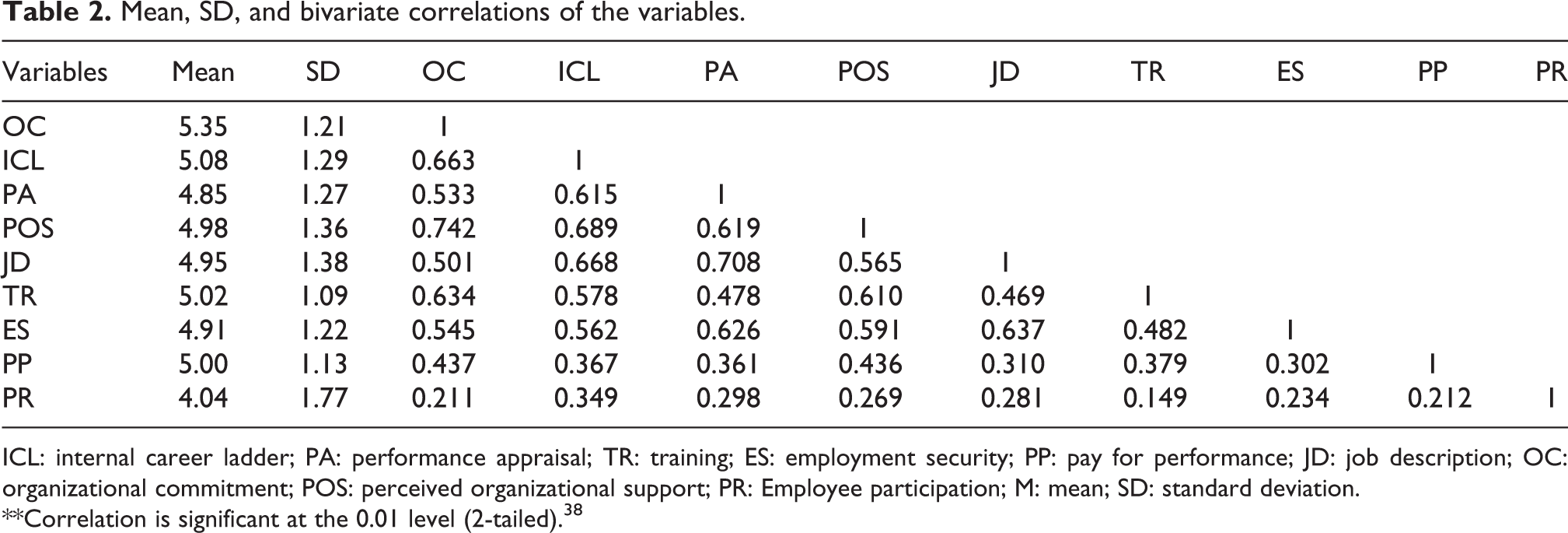
ICL: internal career ladder; PA: performance appraisal; TR: training; ES: employment security; PP: pay for performance; JD: job description; OC: organizational commitment; POS: perceived organizational support; PR: Employee participation; M: mean; SD: standard deviation.
**Correlation is significant at the 0.01 level (2-tailed). 38
Although, according to the previous studies, HRM practices are key elements for successful innovation and performance in the organization, not many empirical investigations have supported the SHRM practice–trust relationship. On the one hand, there is agreement on the relationship between HRM practices and performance, while on the other hand, there are inconsistencies in the literature about the contents of these practices.
Confirmatory factor analysis
We conducted confirmatory factor analysis in order to ensure that the convergent and discriminant validity is achieved. The study hypothesized a significant influence of SHRM practices on POS and OC in the Libyan oil and gas companies. The hypothesized model was evaluated using GFIs in order to confirm the structural model fit that was further also accepted by Cunningham 31 who mentioned that support for the hypothesized model can be achieved with an effective and acceptable goodness fit criteria. Structural equation modeling was used to confirm the hypothesized model in the form of structural model. The standardized regression coefficient for the model is provided in Table 3.
Standardized regression weights for the final model.

CR: critical value; POS: perceived organizational support; EC: employee commitment; ICL: internal career ladder; TR: training; PA: performance appraisal; PP: pay for performance; ES: employee security.
***Path coefficient is significant at the 0.001 level. 38
In the measurement model, it was noticed that the average variance extracted (AVE) for all the variables was above the required level of 0.50. Thus, it is confirmed that the criteria of AVE was satisfied. The result on AVE also provided an additional support for convergent validity. It was also possible to provide the discriminant validity between the factors due to positive definite issue of the matrix. Construct validity is confirmed based on GFIs Hsieh and Hiang 32 reported in the earlier section. Evidence of convergent validity is found based on high factor loadings (greater than 0.50) of all factors. 33
Coefficients’ values are derived by dividing the variance estimate by its standard error. When the critical value or z-value is greater than 1.96 for a regression weight (standardized estimates), the parameter is statistically significant at the 0.05 levels. The significance level was achieved after the modification indices and removal of few redundant measured items.
As shown in Figure 1, the overall re-specified model was within the acceptance levels. The four major fitness indices like GFI, TLI, RMSEA, or CFI were used for evaluating the model fit. The absolute values like GFI and RMSEA, incremental values including CFI and TLI, and parsimonious values like χ 2/df were used to confirm the model fit.

Final model.
An examination of the GFIs showed that the model fitted the data effectively (χ 2 = 1099.766, df = 798, p = 0.000). The GFI = 0.866, AGFI = 0.848, CFI = 0.968, TLI = 0.966, RMSEA = 0.034, and χ 2/df = 1.378. These findings provide support for the role of TR and appraisals as a determinant of the impact of SHRM practices on organizational commitment consistent with the findings of Bal et al. 34 and Lamba and Choudhary. 35 At the organizational level, Nishii and Wright 36 examined the outcomes of HRM and argued that most of the research has focused on the job group level, that is, different jobs have different practices with a different business unit. This research also found similar findings to the studies by Nishii and Wright 36 and Paul and Anantharaman 37 having a positive relationship between SHRM practices and organizational commitment. The results confirmed that the SHRM practices have significant positive effect on OC. With the significant standardized regression weights of all the constructs and items, the overall square multiple correlation was found to be 0.69 (69%), which is considered a very active and important finding of the study.
Conclusions and implications
Employees with the help of organizational support will be able to contribute to enhance organizational commitment. Libyan oil and gas companies must be able to motivate their employees by compensating based on their performance. Superiors must be supportive to the employees and work together to meet organizational goals and objectives. Employees and managers must have good cooperative skills and work in the field as a team in order to overcome the problems and increase commitment. Compatibility between SHRM practices is very important in order to increase commitment of employees. Managers must understand the internal requirements for successful strategic implementation and they must insist that careful attention is paid to the requirements of first-rate execution of the chosen strategy. They personally must be able to lead the process of strategic implementation and execution of SHRM practices. Developing strategic objectives, linking the motivation and reward structure directly to achieve result, and initializing policies and procedures for proper implementation of strategies are crucial for the organization.
Findings indicated that since employee motivation and JD are a strong factor for trust and commitment of employees, there is a need to give attention to benefits and compensation, employee motivation, and evaluation and satisfaction of employees in the organization. Since the research was analyzed based on the perception of low- or middle-level managers who are also part of employees in the organization, top management must share experience and knowledge with its subordinates to improve commitment and trust of their employees along with increased motivation.
The main implication for managers is that the strategic role must be in line to increase commitment of employees. From the validation of the framework, it is obvious to make sure that all the HRM functions are in accordance with increasing productivity along with the organizational objectives. Thus, operating in a stable and dynamic environment, managers and employees need to work as a team in order to develop new knowledge and complete tasks for effective productivity. At an organizational level, it is crucial for the managers to understand different strategic characteristics favoring both the firm and the employees. Thus, efforts should be undertaken with more case studies linking the relationship between managers and employees toward the importance of SHRM practices for commitment and trust in the oil and gas sector. In future research, thus instead of limiting the survey to top-level management, it is suggested to focus on the opinion from employees throughout the oil and gas industry and perform a comparison of the results. It is suggested for the managers to make a checklist to target their productivity weaknesses and attempt to fulfil such weaknesses in an effective way.
Footnotes
Acknowledgements
The authors wish to thank gratefully to the anonymous reviewers for their valuable and instrumental suggestions leading to the improvement of this article.
Declaration of conflicting interests
The author(s) declared no potential conflicts of interest with respect to the research, authorship, and/or publication of this article.
Funding
The author(s) disclosed receipt of the following financial support for the research, authorship and/or publication of this article: The authors would like to acknowledge University Malaysia Pahang for providing financial support through the project RDU 160302.