




Abstract
Leadership has been subjected to so many studies examining the high performing organizations in literature. The aim of this study was to investigate the moderating roles of leadership effectiveness and job stress on relationship between paternalism and leadership-induced stress. Survey method was used to tap responses from 276 employees from corporate organizations. Results, especially on significant interactions, show that only the interaction between paternalism and job stress significantly predicted leadership-induced stress. Leadership-induced stress was lowest for employees who perceived high paternalism and low job stress and was highest for employees who perceived low paternalism and low job stress. However, leadership-induced stress was higher in employees who perceived low paternalism and low job stress than in employees who perceived low paternalism and high job stress. Leadership-induced stress was also higher in employees who perceived high paternalism and high job stress than in employees who perceived high paternalism and low job stress. The results have implications for research and practice.
Introduction
Leadership has been identified as constituting highly important contextual factors which affect employees in the workplace. 1 By extension, leaders play central roles that affect employee behaviours such as voicing their concerns, making suggestions or endeavouring to improve operations. 1,2 These suggest that the interface between organizational leaders and their followers, usually referred to as leader–follower relationship, or more simply as superior–subordinate relationship, is a complex one. Superior–subordinate relationships are depicted to be of various qualities and types in leadership literatures. 3,4 The most popular characterization is that of leader–member exchange (LMX), which is defined as the quality of the relationship between an employee and his or her immediate superior in the workplace. 5 Another possible characterization of superior–subordinate relationships is paternalism.
Paternalism rests on the notion that managers take personal interest in subordinates’ off-the-job lives and personal problems and try to promote subordinates’ welfare. 6 Paternalistic leadership is defined as ‘hierarchical relationship in which a leader guides professional and personal lives of subordinates in a manner resembling a parent, and in exchange expects loyalty and deference’ (p. 493). 7 It is a style of leadership which combines strong discipline and authority with fatherly benevolence and moral integrity couched in a personalistic atmosphere. 8,9 A paternalist relationship therefore is a situation in which a person with authority takes the role of a parent by protecting and paying attention to the subordinate as a duty, 10 while the subordinate in turn reciprocates through respect, commitment and compliance. 11
Whether focus is on LMX or on paternalism, expectations that leaders will be effective in leader–follower relationships usually overwhelm whatever can be expected of followers. Ironically, whether leaders meet up with these expectations is usually as determined or reported by their followers. Thus, leadership effectiveness is the extent to which followers perceive their leader as humane, considerate, fair, trustworthy, dynamic, motivating and supportive. 12,13
Literature review
The romance of leadership concept
The romance of leadership concept refers to the idea that people tend to be biased in their preferences to understand and explain all, especially, important but ambiguous organizational events in terms of its leadership particularly when the causes of such events are not readily determinable and to conclude that organizational leaders should be held responsible for either positive or negative outcomes in organizations. 14,15 More specifically, people are said to romanticize leadership when they take for granted that responsibility for company performance, be it good or bad, is exclusively that of company leaders. 16 This tendency is, understandably, prevalent when companies are performing very well or very badly. 16 It also predisposes followers to regard actions of people in leadership positions (presidents, chairmen, managing directors, executive directors, etc.) as the most vital – of all organizational factors – to organizational survival and success. This understanding about organizational leadership is a product of the imperative of a quest into the social construction of leadership itself with its associated strong focus on ‘the good’ in leadership. While according to Meindl et al., 15 invaluable knowledge about the qualities and behaviours of leaders may be gleaned from followers’ continuance romance of leadership, the behavior of which offers important insights into how followers conceptualize leaders’ behaviours and their potential impacts. As Meindl 14 specifically points out, this approach assumes that followers react to, and are more influenced by, their constructions of the leader’s personality than they are by the ‘true’ personality of the leader.
LMX, job stress and leadership-induced stress
As a dyadic approach to understanding superior–subordinate working relationships, 17 the LMX theory explains how superiors develop LMX relationships with subordinates. 18,19 Immediate superiors, usually referred to as supervisors, build one-to-one (or dyadic) relationships with subordinates over time through exchanges or interactions with the quality of relationship predicting subordinates’ attitudes and behaviors. 20 Although supervisors determine LMX quality, both supervisors and subordinates mutually interplay in the dyadic work relationships. 21 Harris and Kacmar’s 22 study indicate that employees in poor LMX show high level of job stress, which can be a result of poor relationship. Given the way it arises, such stress may qualify as leadership-induced stress. Leadership-induced stress can be defined as an unpleasant job-related challenge which employees perceive during relating with their superior at work; a situation the subordinate also perceives as difficult to cope with. 23 Leadership-induced stress can also be situated in the psychological contract theory which stresses that violations of employees’ implicit expectations may result in unpleasant reactions leading to employees’ frustration, anger, aggression and violence. 24 For instance, in low-quality exchanges, Janssen and Van Yperen 20 observe that supervisors and subordinates often confine to contract-based exchanges, role-defined interactions and hierarchy-based downward influence. On the contrary, a high-quality LMX suggests a good supervisor–subordinate relationship in which the supervisor treats his subordinate with a high degree of cordiality 3,4 Accordingly, employees in high-quality LMX enjoy the confidence, favour and support of their supervisor on opportunities and privileges, which are exclusively within the supervisor’s discretion such as priority information, and stronger performance ratings. 18 As such, a high-quality LMX has been argued to reduce job stress and reduce leadership-induced stress compared to a low-quality LMX. 22,23 Lawal’s 23 study shows that a decrease in LMX results in an increase in leadership-induced stress and that high LMX reduces the unpleasant impact of low interactional justice on leadership-induced stress, especially under conditions of high co-worker support.
Paternalism, culture and leadership-induced stress
In his cultural theory, Hofstede 25 characterizes employees in developing societies as collectivist in which, according to Triandis, 26 successful leaders should be supportive and paternalistic (i.e. maintain the harmony of the workgroup, solve workers’ personal problems and be generally helpful and considerate). Such leaders also assume the role of parents and consider it an obligation to provide protection to others under their care; subordinates, in turn, reciprocate such care and protection of the paternal leadership by depending on the leader and by showing loyalty, deference and compliance. 27 Paternalism is reinforced by another but exaggerated belief about power inequality (power distance) between leaders and their subordinates prevailing in collectivist cultures, which suggests that the differences in power or authority between leaders and their subordinates are assumed to be very wide for which reason subordinates ought to simply defer to their superior’s control. 27,28
Paternalistic leadership research has shown that paternalistic leaders may influence employees not only by developing social exchange relationship with them but also by impacting how they perceive themselves. 29 Specifically, paternalistic leaders provide care, nurturance and guidance to employees in their professional and personal lives in a parental manner. 30 Paternalistic leaders also affect subordinates’ behaviour through increasing trust in and satisfaction with their leaders 31,32 and through being the referent of subordinates’ perception of interactional justice. 33 Given the strong conceptual bearing of LMX on paternalism, employees who belong to paternalistic cultures are inclined to engage their superiors in paternalistic relationship which is expected to reduce their stress. As leaders perform the role of parents with its obligation of providing protection to the subordinates, the subordinates in turn reciprocate through loyalty, deference and compliance to the leader. 27 Paternalist leadership is also said to decrease the perception of uncertainty as paternalistic leadership behaviours are developed to humanize and remoralize the workplace, 34 thus making paternalism to be viewed as an alternative solution for some social and organizational problems in contemporary practices. 35
Uncertainty and ambiguity are reduced through high power distance beliefs which predispose subordinate employees to accept the authority of their superiors without question. 36 According to Harris and Kacmar, 22 uncertainty and ambiguity are typified as employees’ role stressors and can be eliminated through constant and direct flow of information and support from superiors. 22 Employees in collectivist cultures are likely to value being in paternalistic relationships with their superiors out of desperation to avoid uncertainties and ambiguities at work. Researchers have also argued that the LMX construct is important due to its collectivistic cultural values 37 and the importance it attaches to personal relationships in social activities, 38 especially in Asian and African settings. To Chen and Fahr, 39 members of high power distance cultures are accustomed to a paternalistic leadership style. Thus, a follow-up work on Hofstede’s 25 cultural dimension confirms that Nigeria and other African societies are indeed collectivistic and are high on power distance beliefs and on uncertainty avoidance. 27 Although literature on paternalism in Nigeria is virtually non-existent, it is expected that knowledge gained from this study will provide basic understanding for further study in Nigerian and African organizations.
Paternalism, job stress and leadership-induced stress
Although a good LMX can be a good antidote to job stress, LMX may lose its potency to track job stress. When the relationship between superior and subordinate becomes too cordial, the superior begins to delegate his duties and responsibilities to the subordinate. The additional assignments may progressively increase the workload of the subordinate which he/she may not be able to cope with. The likelihood that the subordinate will continue to take up the superior’s responsibilities is demonstrated in a curvilinear relationship found between leader–follower relationship and stress. 22 It can be interpreted as meaning that a subordinate’s stress may continue to increase as s/he gets more intimate with the superior – with the stress getting to an extreme level. Specifically, in line with the findings of that study, individuals who enjoy high-quality leader–follower relationships with their supervisors may experience more stress than do their counterparts in moderate-quality leader–follower relationships. Why this may be the case can also be understood in the light of the social exchange theory. According to the social exchange theory, 40 any social exchange between two people entails obligations, which may be explicit or just implied or mutually understood. As such, individuals feel bound to help those who have helped them because when one person does something (e.g. a favour) for another person, there is an expectation of a future return. 41 Due to this understanding, usually described as ‘norm of reciprocity’, employees in paternalistic relationships who enjoy their superior’s fatherly care, favour, trust, preference and support would continue to oblige the superior’s requests for assistance with additional job responsibilities until they become ‘stressed out’ by the resulting burden and workload.
Paternalism, job stress, leadership effectiveness and leadership-induced stress
Studies on the impact of organizational leadership on subordinate employees have been widely reported in leadership and organizational behaviour literatures. For example, positive supervisor behaviour that was negatively correlated with employees reported psychiatric disturbances in Gilbreath and Benson’s 42 study. Also, Adebayo 43 found Nigerian police personnel who perceived high transformational leadership behaviours in their leaders to be more motivated than their counterparts who perceived low transformational leadership behaviours. These suggest that leadership effectiveness bears heavily on followers’ satisfaction and well-being.
Our understanding and conceptualization of the problem
Given the forgone, employees under the control of effective but paternalistic superiors may be expected to report less leadership-induced stress than their counterparts who are subordinated to ineffective but paternalistic superiors. In other words, paternalistic relationships with subordinates notwithstanding, superiors’ ineffectiveness can make an enormous difference. Specifically, superior’s effectiveness, compared to ineffectiveness, should help bring about a significantly reduced level of leadership-induced stress regardless of the level of paternalism.
Being the rallying point in leadership issues, leadership effectiveness should also be able to moderate subordinates’ job stress and paternalism enough for them to escape leadership-induced stress. In other words, leadership effectiveness may buffer the relationships of job stress and paternalism to leadership-induced stress. For example, when superiors are effective, this can reduce the unpleasant influences of the duo of low paternalism and high job stress on leadership-induced such that subordinates will not experience levels of leadership-induced stress that they cannot cope with.
Ensuring that leadership-induced stress does not occur, or does not escalate where it occurs, becomes imperative given common knowledge that organizational leaders are instrumental to reducing or eradicating stress in organizations. If such leaders – for whatever reasons – can be perceived or reported by their subordinates as inducing stress themselves, questions that would be difficult to answer would continue to arise as to whether efforts at rehabilitating stress in employees would not be inducing more stress in them than can possibly be targeted for rehabilitation.
Rationale and possible outcomes
Whether subordinates experience stress which they can directly attribute to their superiors at work, or the extent to which they experience it – if they do – would appear to depend on several factors notable among which might be job stress (or stress associated with work), leadership effectiveness and paternalism. First, the likelihood that immediate superiors, who assign jobs to and monitor subordinate employees at work, would not be exculpable from the latter’s experience of their job as being stressful is very strong. This is because most of the time, what job activities a subordinate undertakes and decisions about how well he/she is faring on the job are largely at the discretion of the immediate superior, especially in this part of the world. Consequently, subordinates may simply perceive their immediate bosses as being, at least, contributory to the stress associated with doing their jobs. Given this background, we reasoned that stress associated with work should have to do with stress that is perceived to be directly induced by immediate superiors. And on the strength of their theoretical relationship (both belonging to the same stress construct), we proposed a strong positive relationship between job stress and leadership-induced stress. We envisaged the proposed relationship being positive as a further confirmation of the validity of the leadership-induced stress construct.
Second, all that it takes for a superior to be effective in the reckoning of his/her subordinates should be more than enough to prevent – in the subordinates – the experience or perceptions of stress that are directly attributable to the superior. As such, leadership effectiveness was expected to play a role in whether or how much of leadership-induced stress that the subordinates reported. That role was envisaged as an indirect one such that the leadership effectiveness would have an indirect relationship with leadership-induced stress.
Third, whether or the degree to which subordinates reckon or relate to their superior at work like a father (Figure 1), that is, paternalism, was one factor with seemingly high potentials to negatively influence leadership-induced stress. This likelihood derived from the seemingly strong conceptual similarity/overlap between paternalism and LMX on the one hand and the empirically established curvilinear relationship between LMX and work-related stress. 22

Model of leadership-induced stress.
Fourth, the conceptual reasoning that paternalism might ultimately result in very high levels of leadership-induced stress – comparable to the level of job stress induced by LMX in Harris and Kacmar’s 22 study – was considered worth exploring. This was considered crucial to the entire study because it is simply instructive that paternalistic relationships with superiors should normally insulate subordinates against leadership-induced stress.
Fifth, given inherently stressful nature of most jobs, employees were expected to possess various, latent levels of job stress in them regardless of the influence of paternalism. Also, employees’ perceptions of the effectiveness of their bosses were, expectedly, various. Therefore, these two factors, that is, job stress and leadership effectiveness, were employed as moderators of the relationship between paternalism and leadership-induced stress. Specifically, we expected that the level (i.e. high or low) of job stress or/and leadership effectiveness would determine whether, when or to what degree employees would respond to paternalism with leadership-induced stress.
Finally, stress, in general, and work-related stress have constituted a crux in organizations, especially in the quest for employee wellbeing and high-quality work life. Therefore, whatever knowledge would further understand of major stressors in the workplace and how they can be tackled is worth seeking. For example, knowing that paternalism can lead to, rather than ameliorate, leadership-induced stress would go a long way to make possible and easier the prediction and rehabilitation of leadership-induced stress.
The study therefore hypothesized that Perceived leadership-induced stress would reduce as paternalism increased. Employees who perceived high job stress despite experiencing high paternalism would report more leadership-induced stress than employees who perceived high job stress and experienced low paternalism. Employees who were under the control of paternalistic but effective superiors would report lower leadership-induced stress compared to employees under the control of paternalistic but ineffective superiors. Employees in paternalistic relationships who perceived high job stress and high leadership effectiveness would report lower leadership-induced stress than employees in paternalistic relationships who perceived low job stress and low leadership effectiveness.
Method
Participants
The survey was conducted across banking, telecommunication and manufacturing sectors from Lagos, south west of Nigeria with 276 participants consisting of 47% female and 53% male, 41.7% junior cadre, 50.7% middle cadre and 7.6% senior cadre employees whose ages and job tenures ranged from 22 to 60 years and 1 to 30 years, respectively. Participants, who were all literate in spoken and written English, also possessed various academic qualifications with the least being secondary school certificates. The sample was selected mainly through stratified random sampling to ensure that fairly equitable but representative number of junior and middle-level employees, as well as male and female employees, participated in the study. A few senior employees were also surveyed but accidentally. Typically, junior and middle-level employees are a robust sample for organizational leadership research.
Instruments
Socio-demographic items were presented first in the questionnaire, followed by paternalism, quality of leadership, job-induced tension and leadership-induced stress items. Socio-demographic questions were asked about employees’ gender, age, job tenure, position, marital status and educational qualification.
Paternalism was measured with the 13-item Paternalism Scale 44 on a five-point response format. Two sample items from this scale are ‘My manager makes decisions on behalf of his/her employees without asking for their approval’ and ‘My manager tries his/her best to find a way for the company to help his/her employees, whenever they need help on issues outside work (e.g. setting up home, etc.)’. Internal consistency reliability obtained for the scale in the United States and India ranged from 0.82 to 0.91, 45 while the α coefficient generated for the scale in this study was 0.79.
Leadership effectiveness was measured with the eight-item Quality of Leadership Scale, 46 which is a subscale of the Copenhagen Psychosocial Questionnaire, a comprehensive measure of workplace psychosocial variables. The quality of leadership scale measures subordinates’ perception of the extent to which their workplace superior exhibit eight (8) core roles of organizational leadership. Responses to the scale are given on a five-point Likert–type format ranging from ‘To a very small extent’ (1) to ‘To a very large extent’ (5). Sample items on the scale include ‘My boss appreciates the staff and shows consideration for the individual’ and ‘My boss is good at work planning’. A good coefficient α = 0.77 was found for the scale during a reliability analysis performed in this study.
Job stress was measured using the seven-item Job-Induced Tension Scale. 47 This scale requires participants to indicate – on a Likert-type rating format – how stressed they feel while fulfilling the requirements of their jobs. Harris and Kacmar 22 report the scale to show a very good psychometric property with Cronbach’s α reliability of 0.80. The current study also generated a Cronbach’s α of 0.85 for the scale. Sample items from the scale include ‘Problems associated with my job have kept me awake at night’ and ‘I work under a great deal of tension’.
Leadership-induced stress was measured with the Leadership-Induced Stress Inventory, 23 which is made up of 33 items. It measures subordinates’ perception of the extent to which their immediate supervisor induces stress in them. Responses to the items of this scale are given on a four-point Likert-type format from Strongly disagree (1) to Strongly agree (4). The higher the score of an employee on the scale, the more leadership-induced stress the employee perceives. Lawal 23 report sound psychometric properties for the scale including a Cronbach α = 0.95, a split-half coefficient = 0.89 and convergent and discriminant validities of 0.43 and −0.72 with the negative affect scale and the positive affect scale of the Positive and Negative Affect Schedule (PANAS), respectively. A Cronbach α = 0.87 was also obtained in this study.
Procedures
After permissions to conduct the survey had been sought and obtained from the various organizations that participated in the study, the researchers liaised with their human resources departments towards administering the questionnaires. Following the liaisons, the questionnaires were administered according to the sampling technique mentioned above. Completed questionnaires were retrieved after a month of distribution. Following data collection, data analysis was carried out with the aid of a moderated regression analysis. And to include the categorical variables in the moderated regression analysis, the researchers recoded some variables into ‘dummy’ variables, ensuring that the resulting dummies became one variable less than the number of its former categories. To create the interaction terms for moderation test, each of the predictors was centred at its mean after which participants’ scores on the independent variable were multiplied with their scores on the moderators (i.e. Paternalism × Leadership effectiveness, Paternalism × Job stress, and Paternalism × Leadership effectiveness × Job stress). All these were carried out as specified for moderated regression. 48 –50 The predictors were then fed into the regression analysis. Where there were significant interactions, the appropriate software/worksheets for illustrating such interactions – as specified by Dawson and Richter 51 – were employed for this purpose.
Results
A moderated regression analysis was carried out to test the independent and joint contribution of predictor variables on leadership-induced stress, that is, hypotheses 1 to 4.
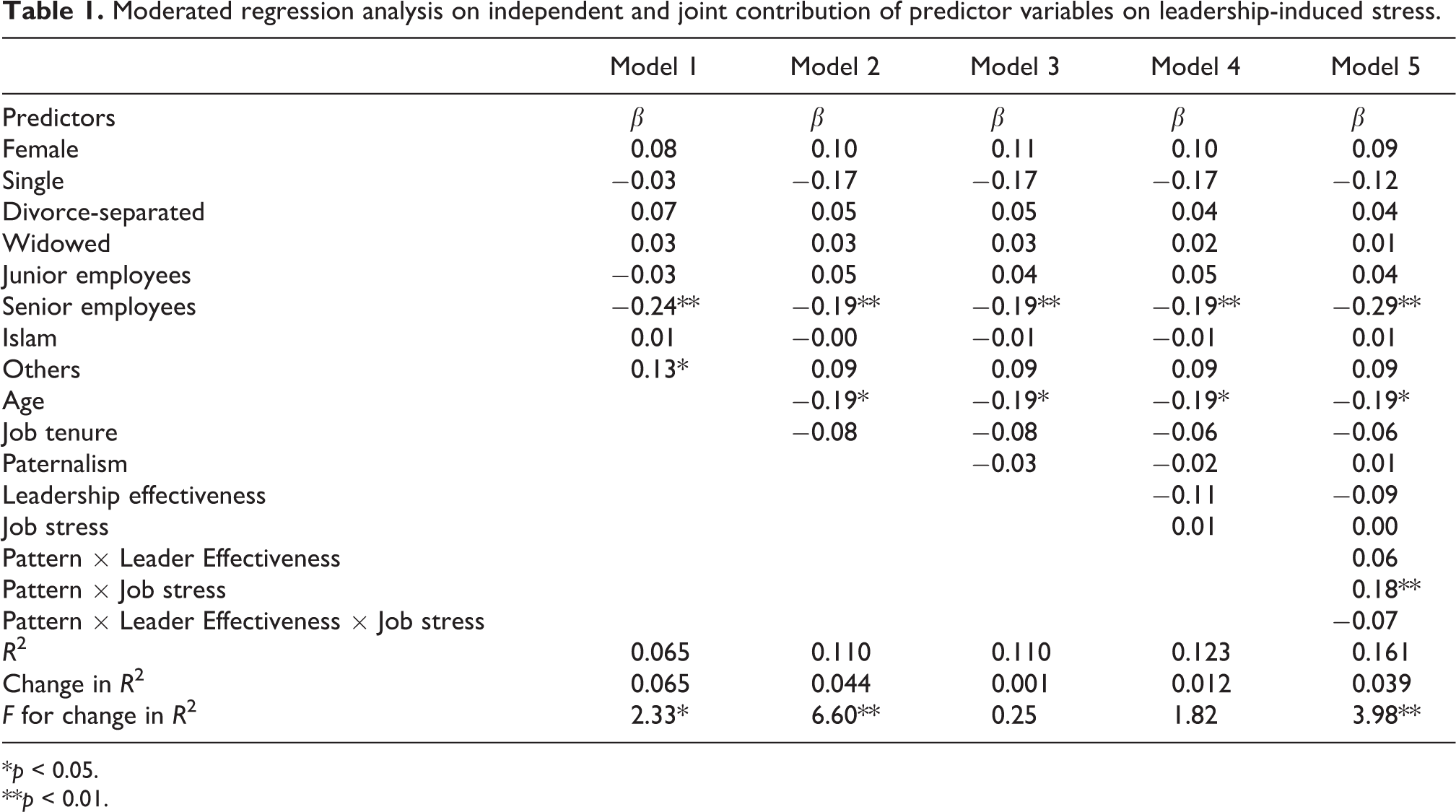
The moderated regression had five models as shown in Table 1. The first model shows the influence of the categorical demographic variables involved in the study on leadership-induced stress. These are sex, marital status, job cadre and religion. The dummy variables to which these categorical variables have been recoded – together – contributed a significant 6.5% of the variance in leadership-induced stress (R 2 change = 0.065, F (8, 267) = 2.33, p < 0.05).
Moderated regression analysis on independent and joint contribution of predictor variables on leadership-induced stress.
*p < 0.05.
**p < 0.01.
The second model shows the influence of the two continuous demographic variables (age and job tenure) which were introduced in model 2. Their joint contribution of 4.4% to the variance in leadership-induced stress, after controlling for the joint contribution of the categorical demographic variables, was also significant (R 2 change = 0.044, F (2, 265) = 6.60, p < 0.01).
The independent variable, paternalism, which was entered alone into the regression in model 3, accounted for an insignificant 0.1% of the variance in leadership-induced stress (R 2 change = 0.001, F (1, 264) = 0.25, p > 0.05). The unique contribution of paternalism was also not significant on leadership-induced stress (β = −0.03, p > 0.01), meaning that paternalism did not predict leadership-induced stress contrary to the hypothesis which assumes the contrary that perceived leadership-induced stress would reduce as paternalism increased.
The two moderators in the study, leadership effectiveness and job stress, were entered into the regression equation in model 4. Their joint contribution of 1.2% to the variance in leadership-induced stress was not significant (R 2 change = 0.012, F (2, 262) = 1.82, p > 0.05) despite controlling for the influence of all the variables entered in all the previous models. Furthermore, none of the two moderators had a significant influence on the variance in leadership-induced stress: leadership effectiveness (β = −0.11, p > 0.05); job stress (β = 0.01, p > 0.05). The mean leadership-induced stress scores of the different levels of paternalism, leadership effectiveness and job stress (involved in the prediction of leadership-induced stress) are provided in Table 2.
Leadership-induced stress scores for the various levels of the main predictors.a

SD: standard deviation.
aGiven the significance of the two-way interaction between paternalism and job stress, a post hoc analysis is carried out by plotting the graph of the interaction using Dawson’s slopes. The resulting graph and the mean scores of the four different groups of the interaction are presented in Table 3 and Figures 1 and 2.
Model 5, which is the last in the moderated regression analysis, features the entry of three interaction terms into the analysis. These interaction terms were paternalism by leadership effectiveness, paternalism by job stress and paternalism by job stress by leadership effectiveness. After controlling for the influences of all the variables in models 1 to 4, the three interaction terms jointly contributed a significant 4.0% of the variance in leadership-induced stress (R 2 change = 0.04, F (3, 259) = 3.98, p < 0.01), but only one of them had a significant independent influence on leadership-induced stress. Specifically, only the interaction between paternalism and job stress was significant on leadership-induced stress (β = −0.18, p < 0.01). This result supported the hypothesis which states that employees who perceived high job stress despite experiencing high paternalism would report more leadership-induced stress than employees who perceived high job stress and experienced low paternalism.
Tables 2 and 3 show that employees who perceived high job stress despite experiencing high paternalism had higher mean leadership-induced stress score (
Mean table for the moderation influence of job stress on the relationship between paternalism and leadership-induced stress.
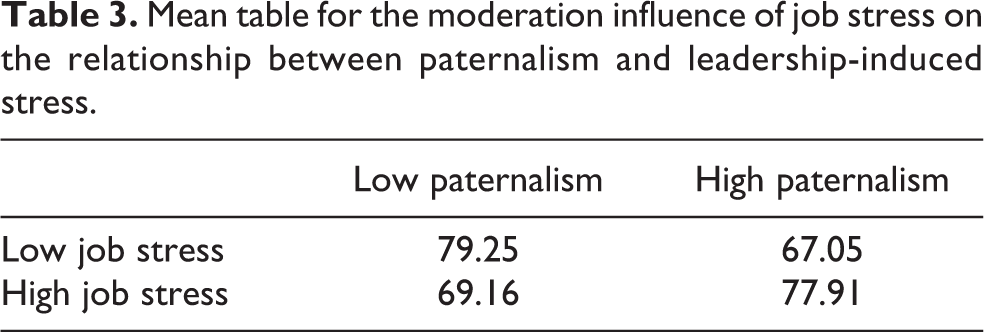
The pattern of interaction in Figures 2 and 3 also make the interaction more instructive than merely providing support for hypothesis two. As these figures reveal, the leadership-induced stress scores varied widely depending on the levels of paternalism and job stress. For instance, for employees who experienced low paternalism, leadership-induced stress score was higher when job stress was low (

Graph of the moderation influence of job stress on the relationship between paternalism and leadership-induced stress.

Bar chart of the moderation influence of job stress on the relationship between paternalism and leadership-induced stress.
The influences of the two other interaction terms on leadership-induced stress were not significant. These included the interactions between paternalism and leadership effectiveness (β = 0.06, p > 0.05), and among paternalism, job stress and leadership effectiveness (β = −0.07, p > 0.05). The non-significant interaction between paternalism and leadership effectiveness do not support the hypothesis which states that employees who are under the control of a paternalistic but effective superior will report lower leadership-induced stress compared to employees under the control of a paternalistic but ineffective superior. This finding suggests that leadership effectiveness does not have either an enhancing or an aggravating influence on the relationship between paternalism and leadership-induced stress. Similarly, since the three-way interaction involving paternalism, job stress and leadership effectiveness do not significantly influence leadership-induced stress, there is no support for hypothesis 4 which states that employees in paternalistic relationships who perceive high job stress and high leadership effectiveness will report lower leadership-induced stress than employees in paternalistic relationships who perceive low job stress and low leadership effectiveness. The finding also suggests that the relationship between paternalism and leadership-induced stress is not subject to the moderation by any levels or combinations of job stress and leadership effectiveness. Finally, all the main variables and interaction terms in the study accounted for 16.1% (R 2 = 0.161) of the variance in leadership-induced stress.
Discussion
Paternalism did not significantly predict leadership-induced stress contrary to hypothesis one (1), although not hypothesized, each of leadership effectiveness and job stress was also expected to significantly predict leadership-induced stress, but neither did. These non-predictions of leadership-induced stress by each of paternalism, leadership effectiveness and job stress are at variance with theoretical and empirical positions on the interrelationships among these variables. 22 –24
The interactions between paternalism and leadership effectiveness, and among paternalism, job stress and leadership effectiveness, did not significantly predict leadership-induced stress. While the outcomes of these interactions were also unexpected, they were not very surprising, given the significant interaction between paternalism and job stress on leadership-induced stress and the insight this interaction provided. As the statistical exercise which brought this about was aimed at knowing the extent and directions to which job stress would moderate the relationship between paternalism and leadership-induced stress, it was instructive to closely examine the pattern of interaction. As implied by the findings, high paternalism can bring about a meaningful reduction in leadership-induced stress only when job stress is low. This is consistent with Harris and Kacmar’s 22 assertion that employees may become burdened with so much work and responsibilities occasioned by their high-quality LMX relationships with their superiors and thus become stressed on their jobs. Since high job stress also resulted in a significantly lower leadership-induced stress than low job stress under conditions of low paternalism, it might follow that employees who were not in paternalistic relationships were simply not experiencing stress that was attributable to their superiors just because they had no paternalistic relationships with those superiors.
This finding further underscores the need to shed more light to the direction of relationship between paternalism and leadership-induced stress. As can be observed from the results, leadership-induced stress was lower for employees who experienced high job stress only if such employees were not in paternalistic relationships with their immediate superiors. This suggests that though leadership-induced stress is another form of stress just like job stress, it does not have to be an outcome of job stress. It also suggests that whether an employee is in a paternalistic relationship or not appears to be a stronger determinant of the incidence of leadership-induced stress. If paternalism is not considered, employees will not have any reason to attribute their leadership-induced stress to job stress. In such instance, unwilling victims of paternalism would find the culture of paternalism burdensome.
Overall, paternalism is a major indirect player in the development and exacerbation of leadership-induced stress. This becomes imperative in view of the finding in this study that job stress is a major determinant of whether paternalism will predict leadership-induced stress, more so that high levels of paternalism seemed to drive employees into job stress which also made them respond with leadership-induced stress. The typically overbearing influence of paternalistic leadership on subordinate employees somewhat explains why the former would overly defer to their paternalistic leaders to the point that job stress would become an important marker of the relationship between paternalism and leadership-induced stress. Corroborating this assertion are studies which, in part, found that paternalistic leaders go as far as influencing their subordinates’ self-perception, 29 providing subordinates with care and guidance even in their private lives 30 and through being the referent of subordinates’ perception of interactional justice. 33
Conclusion
Paternalism seems to be a norm, as organizational culture does not permit employees to be a ‘lone ranger’ or to be independent of such relationships. In most public institutions, for example, a ‘lone ranger’ is believed to be ‘too full of him/herself’ and can thus become a prime target of victimization. The potentials of such a culture to cause conflict and drawbacks rather than progress are quite rife as it tends to be pervasive just as it continues to be promoted. It is the same culture that gave birth to the ‘man-know-man’ idea in Nigeria, which is the major basis for appointments, recommendations, promotions and selections.
Nevertheless, as the study shows, no matter how important or prevalent paternalism is in Nigeria, it can, among other things, very easily breed stress – attributed to paternalistic leadership – except the involved subordinate employee is free from the assigned or delegated work responsibilities. This is a very rare feature of paternalistic relationships in Nigerian institutions.
Leadership-induced stress was lowest for employees who perceived high paternalism and low job stress and highest for employees who perceived low paternalism and low job stress.
Leadership-induced stress was higher among employees who experienced low paternalism and low job stress than among employees who experienced low paternalism and high job stress.
Leadership-induced stress was higher among employees who experienced high paternalism and high job stress than among employees who experienced high paternalism and low job stress.
The rallying point which underlies the entire conclusion is that high paternalism can bring about a meaningful reduction in leadership-induced stress only when job stress is low.
Footnotes
Declaration of Conflicting Interests
The author(s) declared no potential conflicts of interest with respect to the research, authorship, and/or publication of this article.
Funding
The author(s) received no financial support for the research, authorship, and/or publication of this article.