




Abstract
In human resource management practices of various nations, companies have to adapt to the local specifics. This claim is strongly supported by the results of the international Central and Eastern European International Research Team research. Based on the instances of research conducted in various countries, we can clearly see that only the ‘best practice’ is not enough when used exclusively, and a ‘best fit’ perspective has to support it, which optimizes the usage of resources to the local economical–social environment. Our notes revealed that non-central areas have many more employees per human resource (HR) specialist, which may result in excess tasks. In the case of companies from Central Hungary (Nomenclature of Territorial Units for Statistics 2 region), one HR professional usually deals with 55 employees, while in non-central regions, this number may reach up to 112 workers. This means that in non-central areas, HR employees have double the work. Also, their daily operative work may bring in a huge overload, which concerns all functions of HR. Critical issues are HR planning, training, development and keeping talented individuals (talent management), which mean serious questions and problems for companies that are not in the Central Hungarian region.
Keywords
Introduction
This research is a part of a long-term research cooperation – Central and Eastern European International Research Team (CEEIRT), which summarizes the research results of universities from Central and Eastern Europe. During our research, we try to understand the human resource (HR) trends’ flows and characteristics, which appear due to the effects of economical and social changes within a country. We evaluate HR practices and roles apparent in the local subsidiaries of multinational enterprises.
Europe follows the universal American perspective (‘best practice’) in many regards, but there are multiple differentiating attributes, which call for the individual interpretation of the European Human Resource Planning. Brewster 1 stressed the importance of the fact that American Human Resource Management is criticized due to their level of applicability to European practice. An important fact to note is that prior research considers Europe the most differentiated and colourful continent. For example, of the 10 clusters of the Global Leadership and Organizational Behavior Effectiveness (2004) research, 5 clusters are European. 2 The number of countries in Europe, meaning both the national and cultural variety, was constantly on the rise after World War II. Culture researchers like Hofstede, 3,4 Laurent, 5 Adler 6 and Trompenaars and Hampden-Turner 7 all attested to the fact that countries close to each other geographically on micro level, and even continental areas on macro level may have definitive differences, for example, in the practice of management. Due to the respective histories of the region’s countries, their respective economic development levels and the centralization of the Socialist era, different variations of human resource management (HRM) practices and methods were developed. As Brewster said, these countries only showed the characteristics of modern HRM in barely noticeable shades due to them being developed in the previous system. 8 After World War II, redrawn borders broke the Western European-type organic development of personal activities of the region. 9 The HR profession did not profit from the exclusively administrative operations in the Socialism era, mostly due to the strict state overseeing, and had its development halted. Thanks to the explosive spread of multinational enterprises in the region after Socialism ended, the modern approach of HRM appeared, which basically deals with questions related to the coherent interpretation of employment, development and management of a company’s employees. Its theoretical framework draws from the philosophy of behaviour sciences, strategic management, human capital and employment relations. 10 The HR managers of countries under change had to deal with cutting numbers right after the privatization. The appearance of multinational companies rearranged the map of labour markets in previously socialist countries. 11 Apart from technical knowledge, competence in foreign languages also became an important factor. Human relations became a key factor, and the fact that these companies mostly managed to realize higher performance than local ones became apparent. The Cranet research and domestic HR workshops both proved that the HR field shed its exclusively administrative role. Most countries in the region saw the posts of the highest management integrate it as a function, and many HR leaders are now part of the line management. During the time of the great slump of 2008, the complexity of activities related to employees experienced a significant increase. This made the importance of HR leaders and their apparatuses even more obvious. Domestic HRM’s advance followed by leaving the development phases of American and Western European HRM in the dust with dramatic speed. The main focus of professionals employed by today’s most successful companies shifted to questions related to human capital. 12 After the regime change, many HR research centres were established in Hungary, some of which are Kovács, 13 Kővári, 14 Gaál, 15 Poór et al., 16 Bakacsi et al., 17 Gyökér, 18 Lévai and Bauer, 19 Makó et al., 20 Tóthné, 21 Bokor et al., 22 Karoliny 23 and many others.
Brewster 24 stressed that significant differences can be seen in the HR practices of various nations, and multinational enterprises must adapt to local specifics. The CEEIRT international research’s results also attest to this fact. Based on the research examinations conducted in the various countries, it is apparent how the well-performing ‘best practices’ can’t be used alone, as they need a ‘best fit’ perspective to fill in the gaps. This optimizes the usage of resources to the local economical–social environment. Our experiences and perspective suggest that HRM practices show differences even between the borders of a single country, due to different demographic attributes and economical development levels. In this research, we analyse the HR conditions of Hungarian companies taking part in the evaluation, broken down to central and non-central areas of the country.
Our analyses deal with HR using local Hungarian resources, which differentiate between the Central Hungarian region and the non-central areas. The reason for this distribution is the convergence criteria of the European Union which identifies the Hungarian Nomenclature of Territorial Units for Statistics 2 regions – except for Central Hungary – convergence regions. It means that in these regions, the per capita Gross Domestic Product value does not reach the 75% of the European average. Based on the international research results, our presumption that: HR specialists working in convergence regions are more overworked. For non-central companies, conducting basic HR processes is a more significant problem. Different troubles arise on the fields of recruitment and selection for companies in the Central Hungarian region, and those in the other territories. Non-central companies spend significantly less on training and development. Talent management and long-term HR planning in non-central areas aren’t conducted, which could also mean the 5–10 year long specific planning of internal resources.
According to the reports of the State Audit Office of Hungary, the rural development programmes between 2007 and 2011 have not indicated the expected impact on the rural welfare. This study focuses on finding the HR-related reasons to this effect. The recent market trend shows a significant shortage on labour force. Based on the current HR researches, rural areas are in an even worse situation because the migration of valuable labour force appeared there before the crisis. Considering these problems, the aim of this article is to present empirical evidence on the disparities of HR practice in the Hungarian rural and urban areas.
Methodology and model development
The current study aims to provide with a new perspective on an international research project. The goal of the CEEIRT research program was to map up the most important similarities and differences regarding the Central Eastern European HR practices. After the outcomes of the project obviously highlighted the diversity among the European member states, it appeared to be an interesting question whether these characteristics could be observed within the countries as well or not? Furthermore, in case territorial disparities clearly occur, what are the circumstances and the reasons for that? The model of the CEEIRT research based on the following elements which strengthens it’s credibility.
The first (2008–2009) research analysis, which became a basis for long-term research work in 2010 25 –27 , and the present (2011–2013) research analysis are descriptive, drawing from objective data. The personal company interviews and online data collection used the same questionnaire for the ease of statistical analysis, the data collected were codified and the answer codes were analysed. While designing the research model (Figure 1), we drew both from our prior research 28 and international results. During the evaluation, the state of affairs we perceived was also cross-referenced with other research results’ experiences, as we based on:

Model of research.
Models from the areas of HRM (Brewster et al. 28 ) and International Management. 29,30 While integrating these models, we also based on our 2004 research on 42 Hungarian local subsidiaries of multinational companies and the CEEIRT research’s analyses from 2008 to 2009 31 (step 1 – research on international and regional level).
Our domestic and international experiences related to the CRANET (CRANET is a 42-country non-governmental organisation HR research partnership, to which the Department of Leadership and Management, University of Pecs Faculty of Economics is a member since 2004, and the Faculty of Economics and Social Sciences, Szent István University (SZIU) since 2011) HR analyses conducted at the Department of Leadership and Management, Faculty of Economics, University of Pécs; SZIU; Selye János University and the Faculty of Economics in Subotica, University of Novi Sad, Serbia 32 –34 (step 2 – research on company level).
The fresh theoretical and empirical results of our collected and published research on the field of knowledge management, such as Dobrai and Farkas 35 , Dobrai 36 and Dobrai et al. 37
Research experiences which were collected during the evaluation of change management, 38 management counselling 39 and company and international culture 40 during recent years.
Our most recent HR research, which was conducted due to the appearance of the great global slump of 2008 41 (step 3 – research on HR level).
During our research, we evaluated the following areas:
Attributes of the local subsidiaries: the most important organizational and economic attributes (the origins of the main subsidiary, the year of establishment of the subsidiary, the main operational area of the company – sector – the size of the organization – based on the income and total employee number – the productivity statistics, the mandate in the value chain and the main steps and processes of development).
Key indicators of the HR tasks: the count of HR managers in the HR department, and their workload, and main indicators which describe the importance, results and efficiency attributes of the HR workflow (rate of labour costs within total costs).
Main HR indicators of the time interval in question: importance of the HR function, presence of foreigners, foreign delegation of locals, role sharing between the central management and the local HR, role of the local HR in designing and operating various HRM subsystems, most important key competences and main resources of professional development of HR managers.
Knowledge management on the field of HR: main routes, methods and attributes of knowledge flows.
Future of the HR: changes most important for HR, which will happen in the next 12–24 months.
Data of employees replying to the questionnaire: data related to the current HR department and its employees.
Our questions were mainly focusing on the attributes of the evaluated subsidiaries apparent for 2012–2013. Most of the answers were collected during interviews. A smaller portion was received via the www.ceeirt-hrm.eu web survey. In the first round, 12 countries took part in the CEEIRT research (2008–2009), and we received 289 answers from eight countries, of which 279 were usable. Our current analysis (2011–2013) yielded 280 answers, of which only 254 were usable. Finally, to make sure that minimal statistical conditions were assured, we only made the detailed report for five countries. One hundred and eighteen Hungarian multinational companies took part in the research, of which 92 were included in this analysis after cleaning the database. The data was codified and evaluated in SPSS 22.
Results
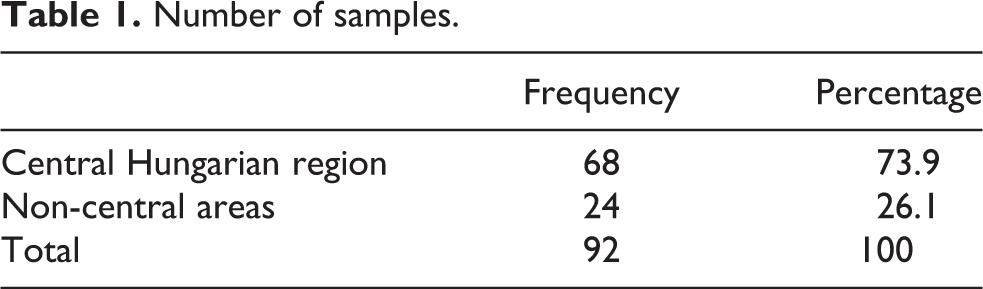
Of the 118 foreign, legally independent subsidiaries included in the questionnaire data collection, 68 conduct operations in the central region, while 24 work outside (Table 1). In our current analysis, we could not include the answers of 26 participants. The fact that less participants came from the non-central area is by no means surprising, as even other national HR researches, like the DGS Global (2011) note that the Central Hungarian region or companies from the central area are usually over-represented.
Number of samples.
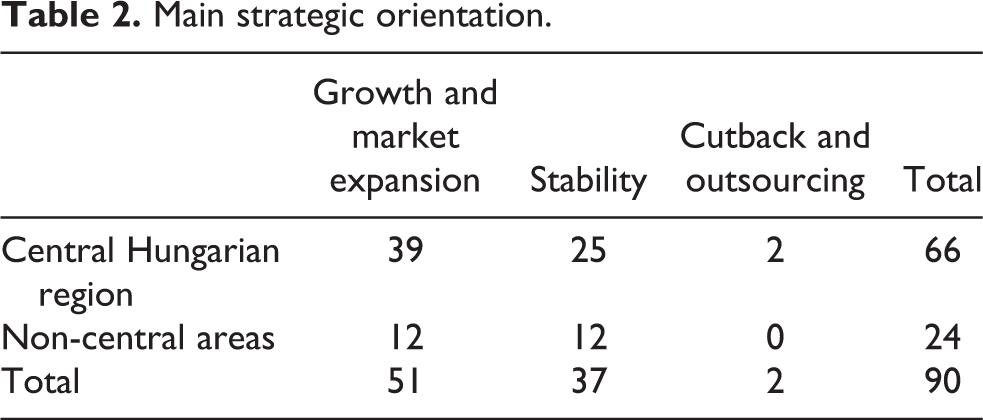
During the research period, the majority of Hungarian participants (56%) designated growth and market expansion as the most important strategic orientation routes. Preserving stability was a part of 40% of the participants’ strategic orientations, while cutbacks were employed by barely 2% (Table 2). The companies from the central area mainly follow growth strategies, unlike non-central companies. The basic strategic orientation routes have an effect on the subsidiary’s HR practice, and HR managers have different problems to solve in each of the three cases. When looking at the specific problem of wages, the companies which follow a growth strategy orientation have to calculate with a higher employment rate requirement, the increase in rate of wages and a higher labour cost. In the case of backwards development strategy orientation, wages barely, or do not, increase. The labour costs are rather increased by costs related to cutbacks in most occasions. The HR managers of stagnating companies have to focus on keeping the employees of the company. The main goal is to prevent migration from the company, by slowly increasing wages. This is also the point where employment stops are put in order. Most of the companies are big ones based on their staff, and most of the participants (60%) employ more than 250 people (Table 3). It is important to highlight that although a minority of the subsidiaries is small and medium-sized enterprises based on their size (number of staff), all the Hungarian companies analysed are parts of larger international companies and thus were regarded as large enterprises from an operational and management point of view.
Main strategic orientation.
Total number of employees.

Our present research further attests to the understanding that some of the decisions related to HR functions are more apparently influenced by the members of the (local) hierarchy, while others by the members of the HR department. This understanding was also reached by other analyses. 42,43 Most of the interventions in the key functions of HR were considered to be results which were finalized by the highest leadership based on the perspectives of the participants’ majority (Table 4). These decisions were generally made by discussing them with the HR department. This area does not reveal differences between the companies from the Central Hungarian region and the convergence ones.
Primary responsibilities for local major HR issues.
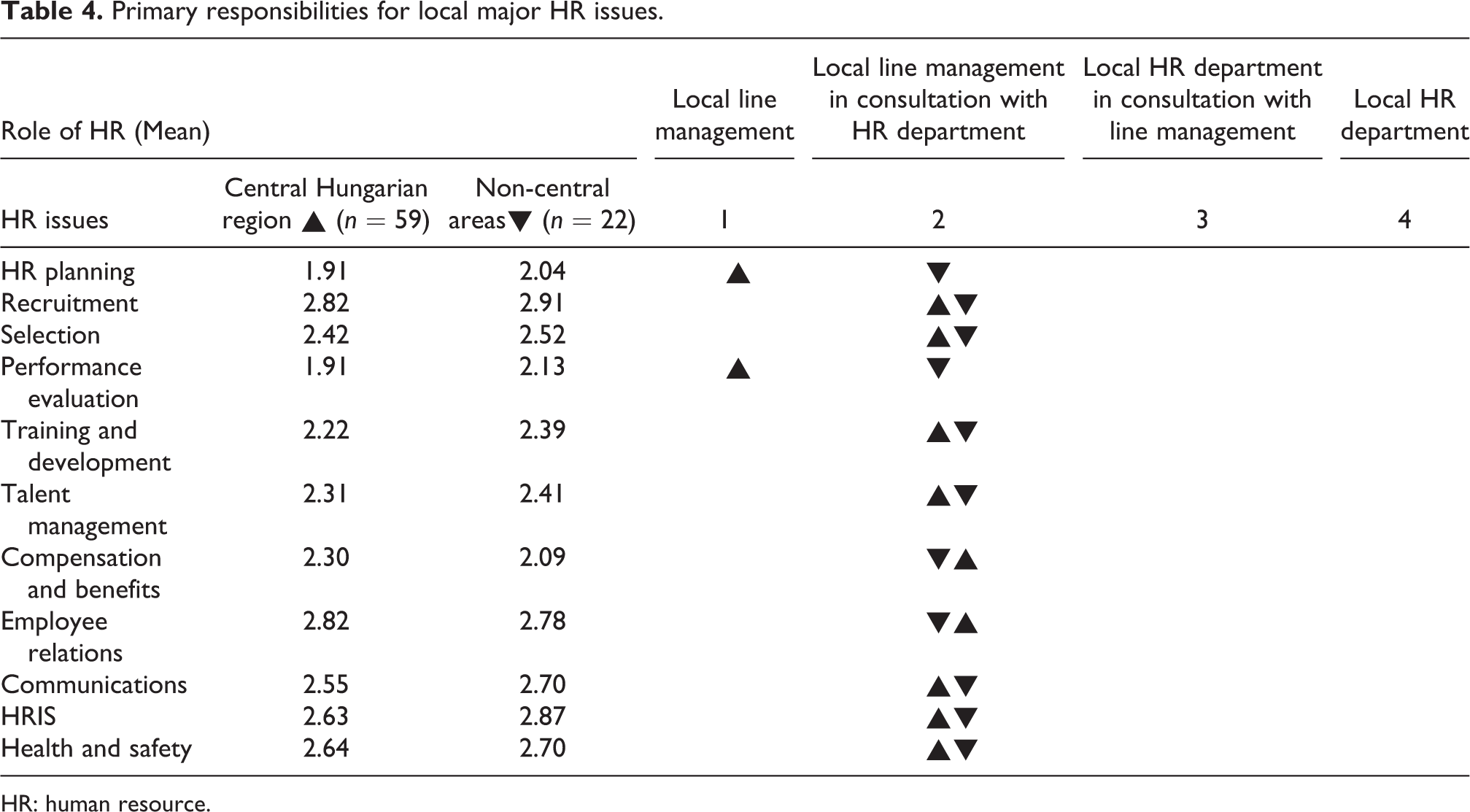
HR: human resource.
The labour cost to operating cost ratio is one of the frequently analysed indicators of the importance of the HR function in a company. According to this logic, the effects of HRM have a stronger and more direct influence on the company’s performance if this ratio is higher.
According to the indicator which represents the weight of HRs, we can see that the non-central companies’ majority have their labour costs below 30% within operational costs (Table 5). These companies supposedly follow a cost-efficiency strategy, though wages have an important role in acquiring and keeping employees as well.
Annual labour cost.

Literature sources view the relative weight of training costs as an important factor in modern and successful HR work (when compared to the total annual labour costs). Twenty-six percentage of the companies which answered this stated that their training budget is below 1%. Forty-four percentage of the participants answered between 1% and 3%, and nearly 30% answered above 3% as their amount spent for training and employee development. Non-central companies’ training costs are more rarely above 3%, most of them keep their training expenses between 1% and 3%. However, within our sample, the group with less than 1% is also significant (Table 6). The Central Hungarian companies show an increased focus on the importance of training, however, which they consider a condition for having quality labour in the long-term. Properly motivated, highly educated and trained, high-quality labour also means an edge in the competition.
Relative size of training budget.

The companies participating from the central region employ nearly 100,000 workers, and have 1826 HR professionals within their ranks. The non-central companies employ 25,000 workers, while their HR management consists of 224 professionals. The chart shows how the number of employees per HR colleague vastly differs between the two groups. For non-central companies, an HR professional has to deal with significantly more employees, which may also mean a huge excess workload. The Central Hungarian region companies have one HR colleague for an average of 55 employees, while the non-central number is 112, more than double that (Table 7)! This means that their operative workflow may generate huge overwork, which touches on all HR process areas (selection, performance evaluation, training-development, communication and so on). This may signify the fact that HR managers in non-central companies are more overworked, when compared to those of the central region.
Number of employees per HR position.

HR: human resource.
The participants of the questionnaire evaluated the challenge of managing the processes of the various HR areas on a 1–5 scale (Table 8). During the analysis, the most critical HR areas’ ranking was led by employee relations, slightly overcoming performance evaluation and training development. The central region and the convergence regions have similar views on the rankings, but the results we got suggest that non-central companies consider all HR activities to be harder. Three areas can be specifically highlighted, which is consistent with our prior conclusions as well. Non-central companies consider the training-development function a more troublesome challenge compared to the ones in the Central Hungarian region. This can also be said about talent management and HR planning. This should be considered a significant conclusion, since these areas also form important HR strategy functions, which fundamentally determine the condition system in which HR can effect even organizational performance. A company can react to challenges it will face if it aims to build its resources regularly. A company needs its employee development activities, since nowadays’ labour market simply does not offer properly educated labour in sufficient quantity without limits. Training and developing employees become a requirement due to the competency deficits 44 unearthed during the performance evaluation. This can be said for current assignment, where the employee’s training is the activity, but if the prospective employee has to be prepared for a future assignment, it shifts to the development of said employee. Keeping and developing talented individuals are the company’s investment for success, which requires the HR side to prepare training opportunities and talent management programs, which act as both tempting extras and forces keeping the employees in the company.
Critical areas of HR (on a 1–5 scale, on average).
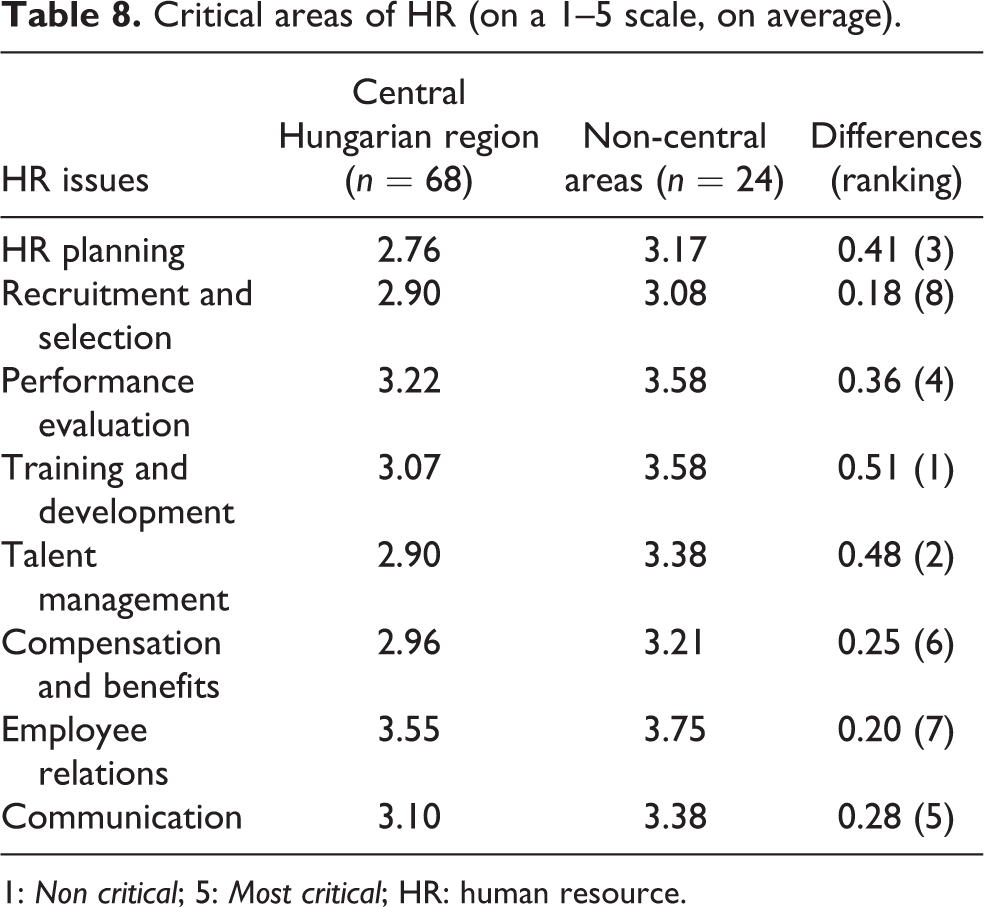
1: Non critical; 5: Most critical; HR: human resource.
Selection is fundamentally defined by the quality of the labour supply. Our results clearly show that selecting office workers means a significantly more challenging task for non-central companies, while the Central region’s companies deemed finding physical workers to be the more significant challenge (Table 9). Language competence means a problematic area in both groups, but knowledge of foreign languages is even rarer in the case of non-central companies. Keeping talented individuals was considered more positively by the Central Hungarian companies, but the responses clearly hint at the fact that difficulties also arise related to this area. The absence of quality labour may endanger long-term sustainability. Based on the differences in answers, the challenge of keeping talented individuals in the organization resurfaces and has to become a fundamental question for companies following a strategic thought pattern.
Typical HR conditions (on a 1–4 scale, on average).

1: Not typical at all; 4: Absolutely typical; HR: human resource.
The differences between the HR conditions of the central and non-central regions were also proven significant by statistical analyses. The χ 2 test proved a significant connection (p < 0.002) with a medium-level confidence (V = 0.418) in the case of evaluating the challenge of selecting physical workers, and a significant connection (p < 0.021) with a low-level confidence (V = 0.301) for office workers. This connection was foreshadowed by the average values of the answers as well. The interpretation of foreign language competence also proved to be significant (p < 0.033) with a low-level confidence (V = 0.279) for both the Central Hungarian region and the non-central areas. Based on the results of the research is recommended for the case of non-central companies more widely to deal with different talent management programs which help the company in attracting, keeping and developing employees.
Discussion
While analysing the Hungarian data of the CEEIRT international research, we came to the conclusion that there are significant differences between the HR conditions and practices of companies operating in the central and the convergence regions, respectively. The companies taking part in the analysis were all subsidiaries of international corporations, which brought modern HRM methods (best practices) with them. However, non-central HR managers have difficulties with keeping up on various levels, as they cannot conduct their strategically important HR functions. These are fundamentally required for the optimal process of HRM. Our question was conducted along this thought. We deem that our first question, which states that the HR managers employed by companies in non-central areas are more overworked, holds true. The number of employees one HR manager works with supports this fact. There is a shocking difference in this number between the Central Hungarian region (55 employees) and the convergence regions (112 employees), more than double. However, this data also means that the non-central regions have an edge in cost-efficiency of the HR department. We deem that our second question, which states that non-central companies have a harder time managing basic HR processes, also holds true. This was supported by how the various HR issues were criticality evaluated. For every question we asked, we saw that non-central companies considered this as a more significant challenge. They saw HR planning, training and talent management as the most critical issues. We deem that our third presumption also holds true. Companies operating in the Central Hungarian region and in the non-central area perceive recruitment and selection as areas with different problems. The convergence regions had more difficulties with recruiting office workers, most notably procuring and keeping talented individuals. Employee devotion and keeping talented individuals are processes that have an intimate relationship with employee development. Employee development helps pave the way for talented individuals to unleash their potential. Companies that operate in the non-central area usually spend less on training and development, which prevents the previous from growth. Based on this fact, we deem that our fourth presumption also holds true. The main point of talent management is to forecast the need for HRs and to plan to satisfy this need in the form of HR practices, which help the company in attracting, keeping and developing employees. Based on the results, we can deem our presumption related to this can also hold true, since non-central companies believe HR planning, training and development and keeping talented individuals all pose serious questions and problems. Our stance in the matter is that adhering by Creelman’s 45 related conclusions would be beneficial for both central and non-central companies: talent management is not simply a function of HR, but more of a way of thinking, suggesting that talented individuals are the core of a company’s long-term success. Based on the results of the research, this perspective is recommended for the case of non-central companies more widely.
Footnotes
Declaration of conflicting interests
The author(s) declared no potential conflicts of interest with respect to the research, authorship, and/or publication of this article.
Funding
The author(s) received no financial support for the research, authorship, and/or publication of this article.