




Abstract
Within engineering, procurement and construction (EPC) companies operating large engineering projects by means of their supply chains, procurement plays a key role in project execution. During project execution, deviations from desired performance in terms of time, cost and quality take place. Procurement can contribute considerably to such deviations as well as to reduce or possibly eliminate them. By means of a multiple case study of three best-in-class EPC companies, the article shows that companies use different ways, namely strategy modifications, process modifications and combined modifications, to deal with project deviations.
Introduction
It is recognized that business competition has shifted over time from a situation of individual enterprise versus individual enterprise to one of supply chain (SC) versus SC. 1 This is perhaps more obvious for a project-oriented business, whereby large engineering projects have an edge in terms of scale and complexity, especially regarding the involvement of tiers in the project outcome delivery. 2 In fact, large engineering projects are characterized by huge financial and resource effort as well as high probabilities of failure, and once finished, ‘projects have little use beyond the original intended purpose’ (Miller and Lessard, 3 p. 437). In addition, these projects are facing an ever-growing complexity, in both structure and context; this is mainly caused by the involvement of more and more diverse and strongly interrelated elements, 4 and addressing the complexity is one of the major and most recurrent features of such projects.
In particular, when we focus on large projects delivering complex capital goods, they have economic significance, and the governance of their design and construction is a fundamental determinant of their outcomes. Large projects, such as those related to the delivery of buildings, airplanes and plants, typically involve many tasks that interact to create a complex solution landscape.
It is apparent, on the one hand, that an increasing trend towards adopting this kind of project is taking place (e.g. from construction 5 to oil and gas 6 to nuclear power 7 industries); on the other hand, it seems there is another common feature characterizing them: large projects experience erosion of value during execution. 6
So, if it is clear that competition is now played on the field of the whole SCs, also for project-oriented business, it becomes clearer why project management 8 and SC management 9 scholars have increasingly focused their attention on the management of complex projects.
State of the art and problem setting
The relevance of large engineering, procurement and construction projects
Within the variety of project typologies, 10 the importance of engineering, procurement and construction (EPC) projects is widely acknowledged in the fields of civil engineering, plant engineering and so on, mainly because of the increasing requirements from the client in terms of reduced project cost and a shorter schedule. 11 In EPC projects, the contractor has the responsibility for project cost, quality and schedule (usually) under a fixed price. This contractor is almost always selected by a client through a competitive bidding process. In detail, the client issues a request for proposal for the order and invites a number of likely contractors to submit bids. Of course, the client evaluates contractors on the basis of a number of criteria (see the multi-attribute bid evaluation criteria in the work done by Cagno et al. 12 ), such as bidding price, past experience, past performance, company reputation and the proposed method of delivery and technical solutions (which also applies in the acquisition of critical items, as in the study by Masi et al. 13 ), and, most of all, price. The selected contractor undertakes a set of tasks including EPC by coordinating subcontractors and main suppliers within the limits of the predetermined budget and schedule. Given all that has been mentioned above, EPC projects can suffer from a number of issues, such as very high interdependence of activities with complex process relationships, overlaps, overall work fragmentation (vertical de-integration), complex organizational structure and uncertainty in prediction of desired outcomes. 14 This is also aggravated by the fact that, by definition, each project is unique not only in terms of design but also in terms of manufacturing and technological requirements and constraints.
Because of this uniqueness and complexity, only the best contractors can still manage to fulfil the requirements of a large project successfully, supported of course by their whole SC. 2 In particular, the most impacting set of tiers of the SC in the EPC industry is that operating in engineering to order fashion, which basically includes the contractor, its subcontractors and their main suppliers. The reason for this impact lies within a general shift over the last decades towards the procurement of more and more complex (and costly) items/systems. This differing distribution of expenditure, particularly for the project materials, is symptomatic of a context in which the contractors ‘increasingly play the role of integrators and coordinators of the entire realization process’ (Cagno and Micheli, 2 p. 148), while on the other hand, subcontractors and main suppliers have to be able to design and produce the more and more complex items/systems needed. 15 As a result, very competitive subcontractors are vital for the success of the projects, of the contractors and of their whole SCs in cascade. In addition, local suppliers employed by the owner of the project are becoming more frequent (typically but not only in the Middle East), and socio-eco-political events and globalization are making the context riskier. Thus, a greater integration or at least coordination between contractor, subcontractors and suppliers is necessary for EPC projects. 14 Nonetheless, within this SC integration literature, a discussion of the importance of procurement is largely missing, 16 with some exceptions related to early sourcing decisions, 17 comparison of procurement methods 18 and adoption of innovative procurement systems. 19 Still, the relevance of procurement management in the EPC sector is high: in fact, procurement can be exploited to leverage a project’s performance and to reduce costs 20 and, according to Yeo and Ning 14 and Alarcón et al., 21 the relevance (in both positive and negative sense) of procurement management is mainly related to the fact that (1) procurement connects engineering and construction, (2) procurement is highly dependent on external companies, (3) procurement needs communication and negotiation with external parties, (4) project materials’ cost represents a high proportion of the total costs of the EPC project and (5) complex supplies are very difficult to manage.
EPC projects and procurement
Experience in the EPC sphere confirms how, during project execution, considerable deviations may occur between the real performance and the planned one. The nature of these deviations is extremely variable and may depend on both external causes, of which the company has practically no control, and internal causes, related to the three EPC company business processes: EPC. Procurement, in particular, probably has the greatest impact on the project. Buying may account for up to 80% of the total value of a project 15 and for up to 45% in the case of critical supplies. 22 The high impact of procurement on project performance is just as evident with regard to time: consider the long lead-time item, whose buying process begins even before the actual beginning of the project activity. Lastly, the end quality of the system is highly influenced by the quality of the items purchased; EPC companies act by choosing a supplier capable of guaranteeing an adequate level of quality.
Problem setting
Current environmental changes require reorientation of the purchasing function, leading to the recognition of its strategic role. The evolution of purchasing, from a mere buying function to a strategic function, has been accompanied by a growing interest among researchers in providing helpful methodological support. According to Ellram and Carr, 23 three main streams of research, partially overlapping, can be found in the purchasing literature: specific strategies employed by the purchasing function; purchasing’s role in supporting the strategies of other functions and that of the firm as a whole; and purchasing as strategic function of the firm. However, a little more than a decade ago, 24 another stream of research appeared about the impact of purchasing strategy on firm performance. In particular, as regards companies mainly working on projects (such as EPC companies), the overall firm performance strongly depends on the performance of the projects. 25 Within such projects, procurement has the task of identifying the most suitable buying strategy (or differentiated strategic actions for heterogeneous categories of objects or subjects 26 ) or buying behaviour (i.e. the degree of effort in each step of the buying process) to satisfy the triple constraints of time, cost and quality (further detail on the identification of the most suitable strategy or buying process can be found in the studies by Masi et al., 13 Azambuja et al., 17 Kraljic, 27 Elliott-Shircore and Steele, 28 Syson, 29 Olsen and Ellram, 30 Bensaou, 31 Lilliecreutz and Ydreskog, 32 Gelderman, 33 Van Weele 34 and Hong and Kwon 35 ).
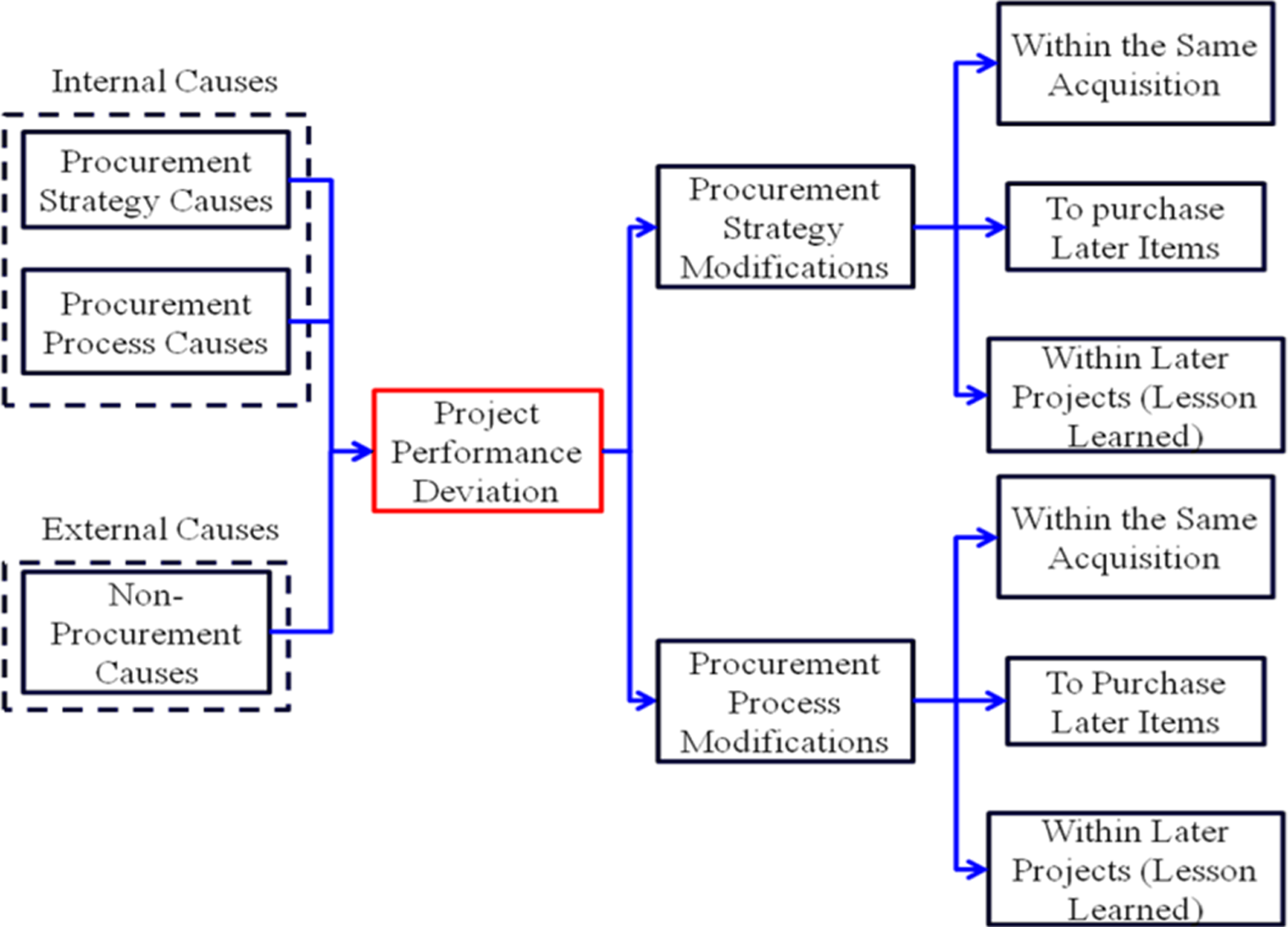
The chosen structure of the buying process may in turn have a high impact on the significant performance areas of the EPC industry (e.g. specifically on the supplier selection issue, see the research by Masi et al. 13 ; on the specification processes, see the work done by Nellore and Söderquist 36 ). The prime interaction between procurement and project performance could therefore be based, at first glance, on the relevant levers of procurement: strategy and process. It is precisely through the chosen positioning of these two levers that procurement may modify project performance, thus contributing to the creation of possible deviations from the planned performance (one of the main issues discussed in the article by Petit and Hobbs 37 at project portfolio level), both in a positive and in a negative way, not necessarily in project environments, in the same way as recently expressed by the authors Mendes Primo 38 and Kim, 39 concerning the ‘extended’ impact related to actions/approaches/events in supply (chain) management. In the same way, procurement can choose the most suitable positioning of the levers to contribute towards recovering any deviations that may be generated during project execution from causes attributable to procurement itself, other functions/project execution phases or external causes (a concept similar to the ‘remedies’ for project crises described by Hällgren and Wilson 40 ). To the knowledge of the authors, there is an almost complete lack of literature on the subject (for hints on the link between ‘procurement’ and ‘project performance’, see the study by Fallahnejad 41 and the related references, where plenty of information about the link between ‘list of causes’ and ‘timeliness’ can be found, but not about the more general link between ‘project deviations’ and procurement), which has stimulated interest in understanding (1) how procurement can contribute to causing performance deviations during project execution and especially (2) how it can be used in turn to realign the actual project performance with the desired one.
In general terms, it is considered that procurement may be associated with project deviations in the two dimensions (or ‘levers’) of purchasing strategies and purchasing process. In fact, these dimensions determine the contribution of procurement to project performance in terms of time, cost and quality and may be directly influenced by the same. On the other hand, the ‘remedial actions’ adopted by procurement to recover performance deviations can therefore be based on modifications made to purchasing strategies and processes. These changes can be considered as realignment actions between the desired performance and that obtainable through a specific positioning of strategy and process levers. More specifically, it is suggested (Figure 1) that the positioning of the levers may be modified for a single purchase, subsequent purchases within the scope of the same project or structurally for future projects (lessons learned).
Positioning of the procurement levers.
Research objectives and methods
The objective of the study was twofold: identifying ‘critical’ strategies and phases of the purchasing process that can be considered the main cause of performance deviations in EPC projects on the one hand and understanding how strategies and phases of the buying process can be modified to guarantee a realignment of actual performances with desired performance on the other. The study was, moreover, conducted on two levels of analysis: the first was an analysis of ‘average’ situations of procurement behaviour (both in contributing towards performance deviations and the decision to reposition the levers to achieve performance recovery); the second focused on the behaviour adopted in individual projects executed by the company.
Given the characteristics of the research objective (mainly, understanding ‘how’ a rather complex phenomenon works), the most suitable methodology is a ‘case study’ method. In particular, a ‘single case study’ method was deemed not proper, given the absence of a ‘critical or extreme case’); rather, the choice of a ‘multiple case study’ was considered the most appropriate (based on the work done by Herriot and Fireston, 42 Voss et al. 43 and Yin 44 ).
Research was thus extended to three well representative best-in-class EPC companies having a large branch in Italy and operating globally, through focused semi-structured interviews. The scales used are detailed through the remainder of the article.
As for the sample, the first company works as a main contractor for realizing energy plants, chemical plants, petrochemical plants, refining plants, fertilizer plants, cement plants, and oil and gas and water pipelines. Their clients are both public owners and private owners. The main geographical areas served are North America, South America, northern Europe, southern Europe, Asia, the Middle East, West Africa and Pacific Australia, but the Middle East and West Africa are the main ones. The main characteristics of the projects usually performed by the company are summarized in Table 1. The company is trying to increase the number of strategic projects performed and the degree of riskiness, because they usually ensure higher net profits.
Project characteristics – company 1.

The second company works as a main contractor for realizing energy plants, chemical, petrochemical, refining, fertilizer and cement plants, fine chemical, food, pharmaceutical and agro-industrial plants and, to a lesser degree, production facilities for oil and gas fields. Their clients are mainly private owners. The main geographical areas served are both northern and southern Europe. The main characteristics of the projects usually performed by the company are summarized in Table 2.
Project characteristics – company 2.

The third company works as a main contractor for realizing chemical, petrochemical, refining and fertilizer plants and, to a lesser degree, energy plants. Their clients are mainly private owners. The main geographical areas served are the Middle East and north-eastern Europe. The main characteristics of the projects usually performed by the company are summarized in Table 3.
Project characteristics – company 3.

The subject required the selection of respondents with certain characteristics: knowledge of the specific characteristics of project management; multi-project vision; and in-depth knowledge of purchasing strategies and process.
The difficulty of administering the questionnaire to a single entity with all of the three above-mentioned characteristics meant that the interviews were conducted with procurement managers flanked by professional figures actively involved in projects (project managers, project audit managers, etc.). To eliminate the possibility of misunderstandings or distortions regarding the subjective perception of the interviewer, a few days after the interview, a report was sent to each of the respondents to obtain feedback on the results obtained.
As regards the definitions of strategy and process, this research is grounded in previous works related to the EPC industry, 25 and different standardized strategies are reported in Table 4 (the excerpt contains only the strategies relevant to this research), while the list of the phases of a standard procurement process (within the EPC industry) can be described as material take-off, supplier research, market price prediction, supplier qualification, purchase requisition, supplier selection and final choice, development of the system supporting the relations, order management and inspection, shipping and knowledge management. Further details about the process can be found, for example, in Table 14.
Procurement standardized strategies (ps) and characteristic action plans.a

Source: adapted from Micheli et al. 25
aThose terms in italic are the most characteristic of every ps.
Results: Aggregate level
The cross-case analysis of the case studies enabled the results described below to be obtained.
Strategies causing deviations
Table 5 shows the strategies considered by the three companies as the cause of performance deviations (as reported in Table 5, as “X”), and the impact of each one on the pertinent performance areas: time, cost and quality. ‘***’ indicates that the strategy and impact were selected by all companies interviewed; ‘**’ indicates that they were selected by two companies out of three; ‘*’ indicates that they were selected by only one company out of three.
Procurement strategies causing deviations.

T: time; C: cost; Q: quality.
The strategy ‘purchasing management’ was chosen by all three companies as the cause of deviations in time and cost performance. This strategy aims to reduce the number of suppliers for a certain item (or cluster of items), in order to reduce the complexity and management costs of the supplier list, with greater standardization of the characteristics of the specific item (cluster of items). All of the respondents gave the same reason for this impact: the reduction of the number of suppliers involves a virtual increase in the bargaining power of each of them, who, aware of the reduced competition, set out more disadvantageous sales conditions for the buyer company, with negative consequences on project performance in terms of time and cost.
Two companies out of three (company 2 and company 3) selected the strategy ‘exploit competition’ as the cause of qualitative deviations in projects. This strategy is aimed at finding new suppliers more suited to the supply of the item, or, as more often occurs, to increase the number of possible suppliers of an item, in the hope that more competition will lead to a reduction in costs. However, both companies highlighted how often the new suppliers come from emerging countries and, lacking the experience and proper skills, are not capable of guaranteeing the desired quality standard. The only company that did not choose this strategy said that, to avoid the problem of poor quality, this strategy should be always accompanied by the use of the strategy ‘support the supplier’ aimed at developing the supplier’s performance.
One company (company 2) chose the strategy ‘bargain management’ as having a negative impact on time and quality performance: overuse of bargaining may generate hostile supplier behaviour, which is translated into inferior performance in terms of time and cost, with negative consequences on project performance. The two companies that avoided this strategy did so in order not to come up against the above-mentioned problems. Only one company (company 3) selected the two strategies support the supplier and ‘alternative solutions’ as generators of quality deviations. The first of the two involves quality deviations since a supplier improvement strategy, if closely bound to project time constraints, can lead to the impossibility of achieving quality performance levels and can affect the overall project quality. The second may also lead to project quality deviations for a different reason: the use of alternative components often compromises the overall quality of the system.
Process phases causing deviations
Table 6 shows the process phases considered by the three companies interviewed as direct causes of performance deviations in EPC projects and the impact of each one on the pertinent performance areas (time, cost and quality).
Procurement process phases causing deviations.

T: time; C: cost; Q: quality.
Material take-off is a phase shared between engineering and procurement, which activates the buying process of an item. The three companies selected it as a cause of time deviations in projects. In fact, the execution of this phase often involves delays because of the issue of P&I (Piping and Instrumentation) documents, none of which immediately provides – per se – a complete list of all of the items to be purchased (the list of secondary items is not available in the initial project phases). This situation leads to delays in the execution of the more procurement-related sub-phase: ‘match with other buys’. All this involves serious delays that affect project performance.
Similarly, the three companies selected the supplier research phase as a cause of time deviations. The search for suppliers is, in fact, particularly time-consuming, especially if (as is often the case) the constraints imposed by the client on the supplier are very strict. All the companies, however, try to mitigate this impact by dedicating a high number of resources to the execution of this activity.
All three companies selected the two phases, namely, supplier qualification and purchase requisition as causes of time deviation. However, it is necessary to point out that two companies (company 1 and company 3) selected purchase requisition as having a negative impact because of the length of time it requires, especially in the case of suppliers characterized by poor engineering skills. Company 2 indicated the same deviation, but related to supplier qualification, and specifically to the fact that suppliers with inadequate engineering skills are often approved, causing serious delays in obtaining quality technical drawings. So while the first two companies prefer to approve a greater number of suppliers, and then pare down the list in the purchase requisition phase, the first company would prefer to work with a lower number of approved suppliers, to reduce any delays in obtaining drawings. Therefore, the different attribution derives exclusively from a different structuring of the purchasing process. The second company did highlight, however, that this case might also lead to quality deviations in projects.
The three companies chose the supplier selection and final choice phase as a cause of time deviations. During this phase, technical and business-contractual adjustments are made which are particularly time-consuming. In fact, continual technical adjustments involve continual revisions of the commercial/business agreements, often causing delays (because of the difficulty in understanding which offer is really the most advantageous). It is necessary to underline also that, if on the one hand, the time necessary to perform technical adjustments increases with the increase in the technical complexity of the item (causing a simultaneous increase in the time required to make business-contractual adjustments), on the other hand, the time spent on technical adjustment is reduced with the reduction in the complexity of the item, but that required for business adjustment remains practically unchanged and therefore its total impact on the time necessary for the execution of this phase increases.
The three companies selected the order management and inspection phase as a cause of time deviations. In fact, to ensure the level of quality required by the client, a considerable amount of time is often necessary for the inspection of the items purchased, leading to project delays. Furthermore, company 2 selected this phase as having an impact on quality as well: if this phase is not carried out with the proper attention (or not carried out at all) or is outsourced, it causes serious quality deviations with serious repercussions down the line.
Procurement strategy as a lever for deviation recovery
Table 7 shows how the different companies use strategy modifications as levers to recover project deviations (‘Y’ means that the lever is used, ‘N’ means it is not used).
Strategy modifications.
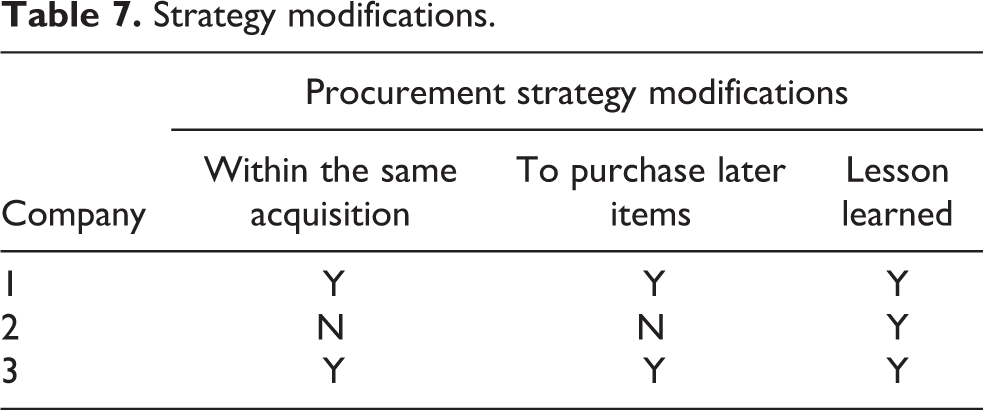
Two companies out of three (company 1 and company 3) use strategy modifications within the same acquisition or for the purchase of subsequent items within the same project. The second company, however, does not modify the purchasing strategy in progress, as purchasing strategies are considered extremely rigid, and therefore any modifications would involve unacceptable ‘switching costs’. Nonetheless, changes in strategies are made in ‘no-choice’ conditions, namely in situations where the only possible option is a change in strategy (clear inadequacy of the supplier, stoppages, force majeure etc.). All the companies use strategy modifications for subsequent projects (as lessons learned).
Procurement process as a lever for deviation recovery
Table 8 shows how the different companies use process modifications as a lever to recover project deviations (‘Y’ means the lever is used, ‘N’ means it is not used).
Process modifications.

Only two companies (company 2 and company 3) use process modification as a lever within the same acquisition or for subsequent acquisitions in the same project. These same companies, however, do not use process modifications for future projects (lessons learned). Company 1 does not use process modifications for projects in progress but only for future projects. In reality, process modifications are not permitted in this company, but changes in the level of priority according to which the different phases are to be carried out are allowed. Company 1 therefore, not being able to modify the process underway, can make changes to future projects (lessons learned). It thus seems clear that when the process is more flexible (and can be modified for projects in progress), it is not modified for future projects and vice versa.
Effectiveness of the levers
Table 9 illustrates which performance recovery actions are generally aimed at, with regard to procurement, for each of the three companies interviewed. All the companies interviewed use procurement levers for the recovery of delays: this indicates the high pressure on time which EPC companies (particularly procurement) are subject to. Company 1 is the only one to use procurement levers also to recover cost deviations; company 2 takes corrective measures aimed also at the recovery of quality deviations. The fact that two companies do not implement, through procurement, actions aimed at the recovery of cost deviations may seem surprising. The explanation lies in the fact that they already work with extremely limited costs that do not produce major project deviations. However, the fact that only company 2 uses procurement levers for the recovery of quality deviations lies in the major difficulty encountered in order to reach the level of quality typical of the sector.
Orientation of recovery actions.

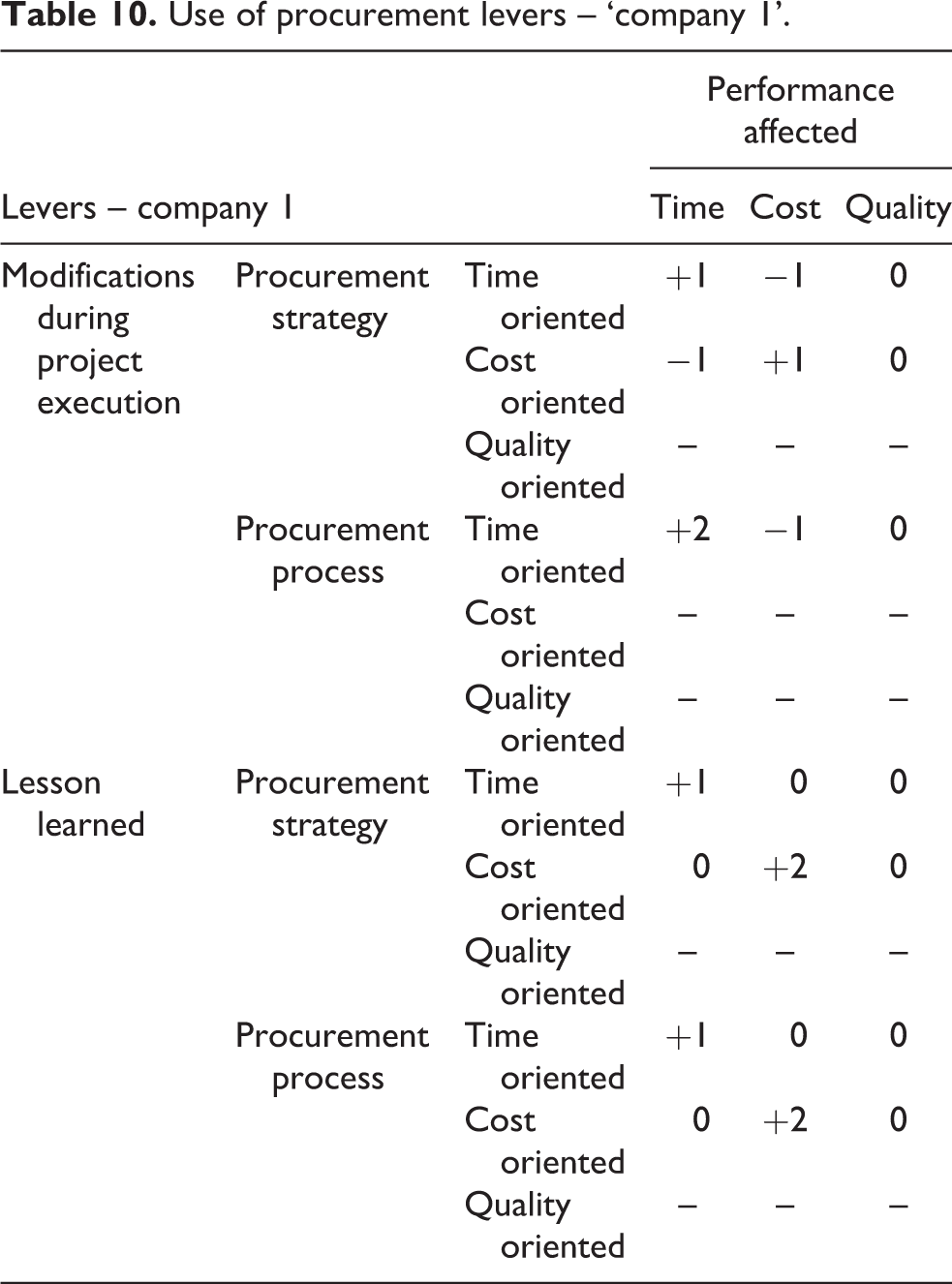
These results are confirmed also by the effectiveness attributed by each company to each of the levers used. Tables 10 to 12 show the effectiveness attributed by each company interviewed to the different levers. The grey cells identify minimum modifications (the priority of process phases for company 1) or exceptional modifications (the no-choice situations of company 2).
Use of procurement levers – ‘company 1’.
Use of procurement levers – ‘company 2’.

Use of procurement levers – ‘company 3’.

It must be underlined that no differences were found in terms of use and effectiveness between the modifications (strategy or process) made within the same purchase and those made for subsequent purchases in the same project. Hence, these two actions have been merged into one single action: ‘modifications during project execution’.
The clearest result is that each recovery action carried out during the same project, aimed at improving a specific performance, requires accepting the deterioration of another (or the other two in the case of quality): the use of a lever is equivalent to the use of a trade-off between performance areas. The situation is different, however, in the case of modifications suggested for future projects (lessons learned), since both the orientation of the modifications (aimed at improving any/all possible performance areas in the company’s perception) and the effectiveness of the actions vary. In particular, modifications as lessons learned are not made following the use of a trade-off, but as structural modifications, which, in principle, must not penalize any of the other performance areas (they identify a new trade-off curve). It is also necessary to report the high effectiveness attributed by company 1 to process modifications in terms of phase priority: these priority modifications are made only when they generate a considerable improvement in time performance, while slightly penalizing cost performance.
Implications
This first level of analysis highlights the existence of different strategies for managing project deviations through procurement. Company 1 does not use process modifications (in the full sense of the term) to recover deviations in projects but employs strategy modifications, with resulting process modifications (as illustrated before, each strategy is associated with a process structure in terms of phases executed as well as the emphasis with which they are executed), aimed at recovering time and/or cost deviations (Figure 2).

Performance deviation recovery methods – ‘company 1’.
Company 2 (Figure 3) does not, however, use strategy modifications to manage deviations, but prefers to employ process modifications aimed at the recovery of time and/or quality deviations, because of the high rigidity attributed to buying strategies (the switching costs sustained are deemed too high).

Performance deviation recovery methods – ‘company 2’.
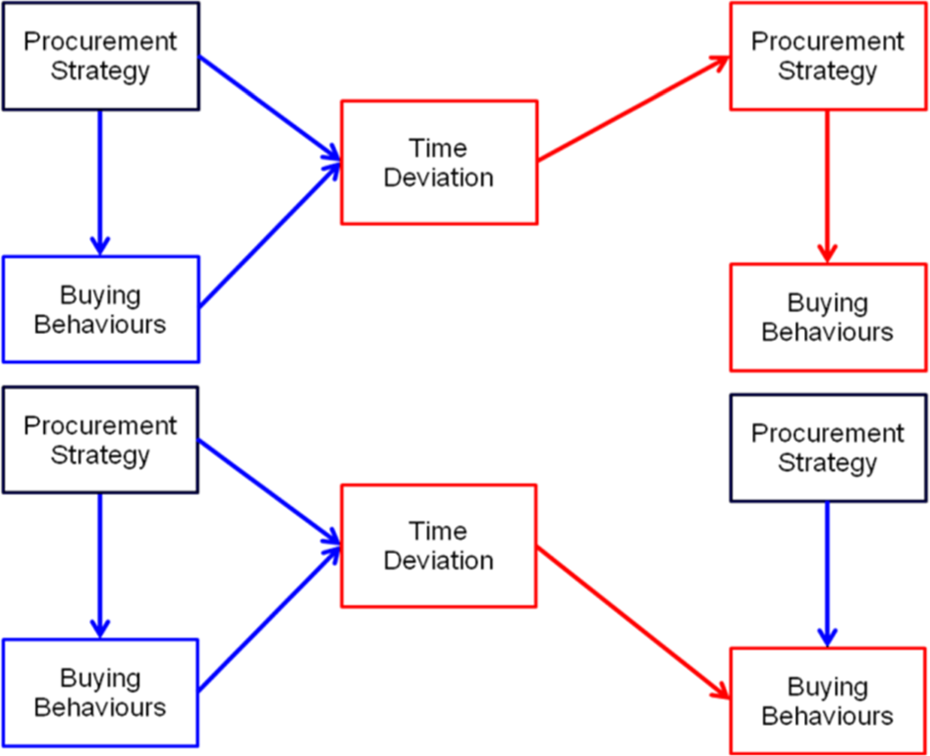
Company 3 (Figure 4) instead showed the most flexible strategy for managing project deviations. In fact, this company uses both strategy and process modifications, aimed at recovering just time deviations, depending on necessity.
Performance deviation recovery methods – ‘company 3’.
It must be underlined how in the case of Company 1 (which does not use process modification for projects in progress) and Company 2 (which does not use strategy modifications for projects in progress), greater flexibility in deviation management (which would allow both procurement levers to be used) would enable more deviations to be recovered with greater effectiveness. It is therefore plausible that these deviation management strategies derive from guidelines, by now consolidated, from higher levels within the organization.
Results: Project level
The second level of analysis focused on the analysis of the individual projects executed by the EPC companies interviewed. The analytical approach to the procurement levers is completely analogous to that adopted for the first level of analysis: procurement as a causative factor and recovery lever of performance deviations in projects through strategy and process. Three projects were analysed with characteristics similar to the average project executed by each company. The analysis of each project enabled the joint effect of strategy and process on the project performance as both the cause of deviations as well as a recovery lever to be assessed.
Strategies causing deviations
Alpha project – Company 2
The first project analysed, hereafter referred to as the alpha project, concerns the realization of a chemical plant by company 2. The project characteristics are shown in Table 13.
Project characteristics – ‘alpha’ project – company 2.

Deviation I
The first performance deviation caused by procurement concerned the purchase of metal structures by adopting the strategy exploit competition. This purchase caused a deviation in time performance. The technical and delivery characteristics of the item in fact reduced the number of possible suppliers to a single vendor with which the company had never conducted business relations. The cause of the deviation was linked to the decision on which of the supplier’s production units should produce the required structures. In fact, the supplier owned two units in which the said structures could be produced: the first in North Korea and the second in China. The buyer company was prompted to assign the order to the production unit situated in China for cost reasons. The inability of the supplier’s unit to produce the item requested in terms of time and quality caused the above-mentioned time deviation, which impacted the corresponding performance of the entire project.
Table 14 shows the purchasing process followed. More specifically, the column ‘suitable process’ shows the suitability of each phase of the process to be followed for a defined strategy (‘****’ indicates very strong emphasis/effort on the selected phase, ‘*’ indicates very light emphasis/effort on the selected phase); in the columns ‘relevance’, ‘risk’ and ‘novelty’, depending on the degree of impact on these three pertinent project characteristics, ‘Y’ indicates that the phase must be carried out, a blank cell indicates that the phase may or may not be carried out and ‘N’ indicates a phase that must not be carried out.
Purchasing process – ‘alpha’ project – company 2.

RFI: request for information; RFP: request for proposal; RFB: request for bid.
In this case, the causes of the deviations are attributable to both the strategy and the process. In particular, the deviation can be put down to the combined effect of a strategy and process incapable of mitigating the risk of supply failure. In fact, the strategy of assigning the entire supply to a single supplier was not accompanied by a process capable of minimizing the risk. More specifically, the phases that highlighted problems with company 2 were as follows: Supplier qualification: As can be noted from the table, the supplier’s production unit was approved only after the order had already been assigned to that unit. Order management and inspection: The expediting phase was performed without using a resident expediter who could monitor the progress of the supply in real time, anticipating any problems that could cause delays.
Deviation II
The second deviation that arose during this project is linked to the supply of the same item that caused the first deviation. Following the delivery failure by the first supplier, part of the supply was removed from the first order and assigned to a local supplier on the project vendor list. This local supplier was not able to comply with the time and quality restrictions set by the supplier. In fact, during production, the supplier went bankrupt which forced it to discontinue the supply in question.
The strategy followed for this purchase was ‘promote competition’. Table 15 shows the buying process actually followed.
Purchasing process (revised) – ‘alpha’ project – company 2.
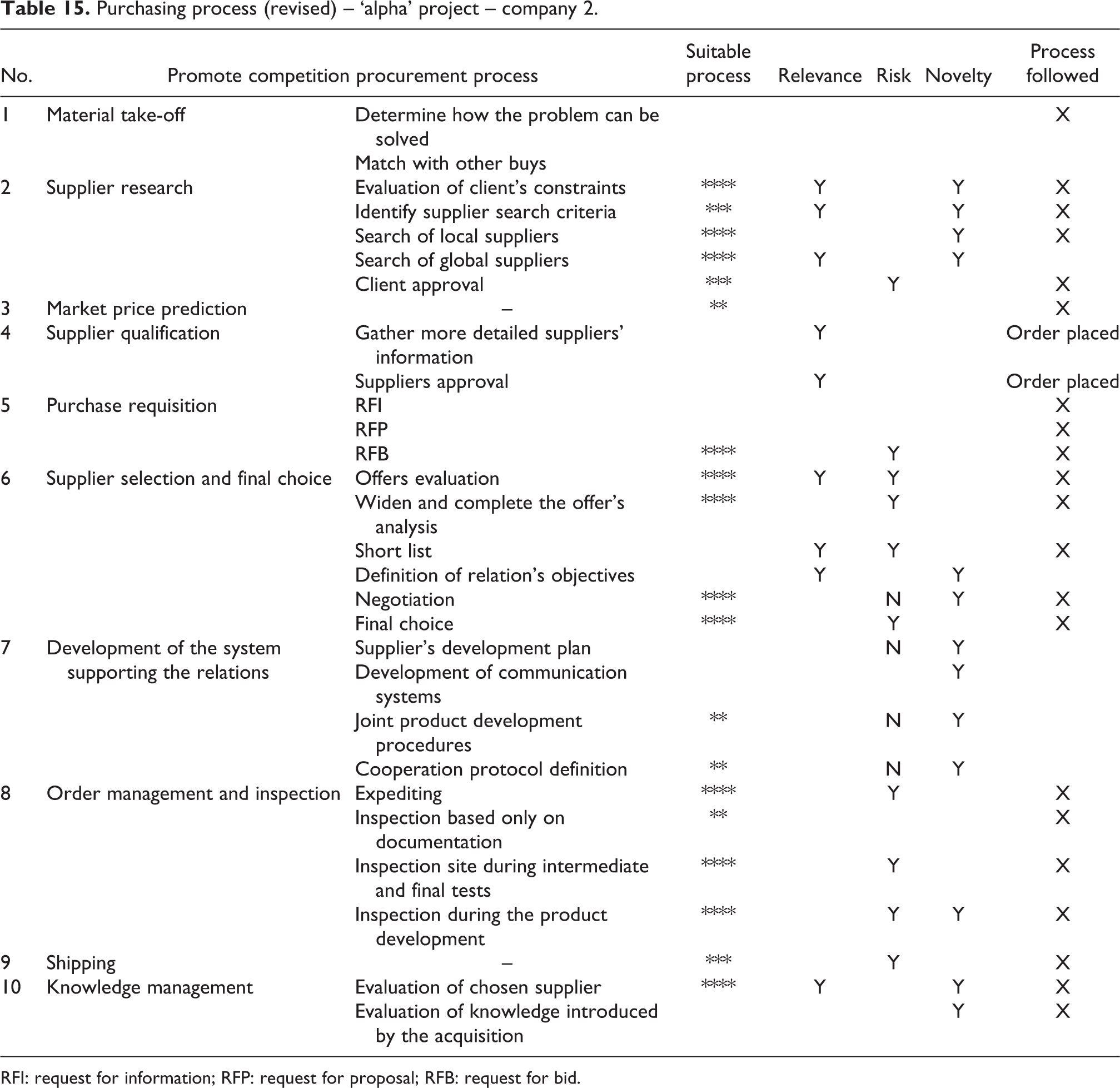
RFI: request for information; RFP: request for proposal; RFB: request for bid.
The precise analysis of a single project enabled the combined effect of the incorrect application of buying strategy and process to be identified. First, with regard to the buying strategy, to reduce the risk of supply failure, it would have been more appropriate to divide the supply among a number of suppliers; in second place, a more in-depth approval phase (before order placement) would have allowed to identify the difficult financial situation in which the supplier actually was.
Beta project – Company 3
The second project analysed was a revamping project for a plant produced by the company known as company 3 (Table 16).
Project characteristics – ‘beta’ project – company 3.

Deviation I
The first deviation analysed concerned the purchase of one of the main items. More specifically, it involved the purchase of a sea water pump, adopting the strategy ‘partnership’.
The item in question was subject to non-conformity with contractual requirements.
From the purchasing process followed (Table 17), it is instantly clear how two phases of fundamental importance for a strategy that requires a close relationship between the buyer company and the producers were not followed: ‘joint product development procedures’ and ‘cooperation protocol definition’.
Purchasing process – ‘beta’ project – company 3.

RFI: request for information; RFP: request for proposal; RFB: request for bid.
Deviation II
The second project deviation analysed concerned the purchase of piping for the same project.
In order to reduce a delay accrued during the engineering phase, the purchase was managed directly by the project manager following a ‘premium price’ strategy. Despite the need to limit times, because of the delays accrued in previous phases, the entire purchasing process was carried out when a ‘short track’ process was required to enable the overall procurement duration to be compressed in order to recover the delays previously accrued.
Procurement as a performance deviation lever: Effectiveness of the actions
Alpha project – Company 2
To recover the performance deviation which arose during the alpha project, company 2 decided to use both available procurement levers, process modification and strategy modification, within the scope of the same acquisition. The process modification concerned the degree of emphasis with which the order management and inspection phase was carried out: to increase the degree of control over the progress and quality of the supply, it was decided to use an expediter and an inspector employed by the supplier. The other procurement lever used was strategy modification within the same purchase: part of the supply was removed from the initial order and assigned to a new supplier (‘new supplier’, once again). The initial strategy of exploit competition was changed into promote competition. The second strategy allows for a reduction of the impact of the failure risk of a supplier through the division of the risk between a number of suppliers and shows the company’s intention to mitigate ex post a risk to which it was exposed by assigning the entire order to one single supplier with which the company had never conducted business relations. Table 18 shows the effectiveness of the measures taken.
Effectiveness of the procurement levers – ‘alfa’ project deviation I – company 2.
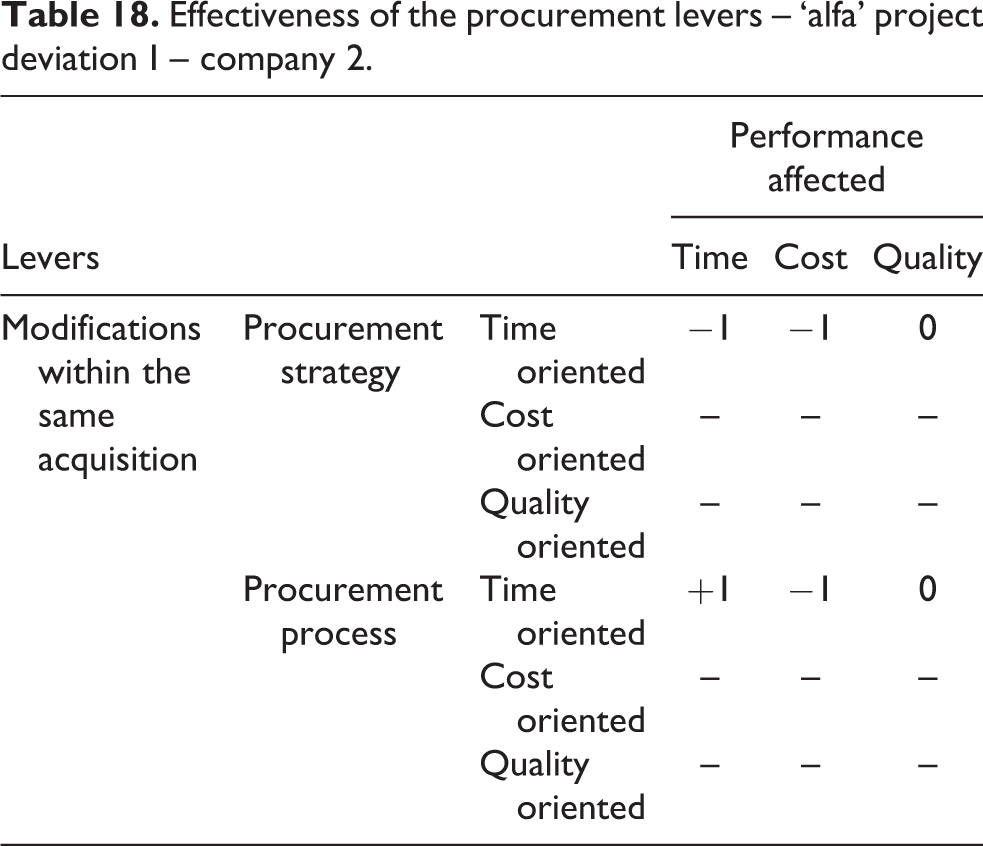
The strategy modification had a negative impact both on time and on cost performance. The increased cost is attributable to the switching cost sustained to modify a purchase strategy in progress. The negative impact on time performance is owed to the fact that the new supplier to which the remainder of the order was assigned was unable to supply the quantity requested in that it went bankrupt The process modification made (intensification of the order management and inspection phases) instead had a positive impact on time performance with a slight deterioration in cost performance attributable to the cost of the expediter and inspector employed by the supplier. At this stage, to recover the additional delay accrued with the strategy modification, the company decided to adopt the same strategy modification, but this time dividing the supply between three suppliers to further reduce the risk of failure of the entire remaining supply. Table 19 shows the effectiveness of the second strategy modification, which allowed for the partial recovery of the time performance with further deterioration of the cost performance.
Effectiveness of the procurement levers – ‘alfa’ project deviation II – company 2.

Gamma project – Company 3
As regards the ‘gamma’ project (Table 20), the lengthy time span required for the technical and commercial adjustment of the offers received for the purchase of an item (not specified during the interview) caused a time deviation that could be recovered with the use of a procurement lever.
Project characteristics – ‘gamma’ project – company 3.

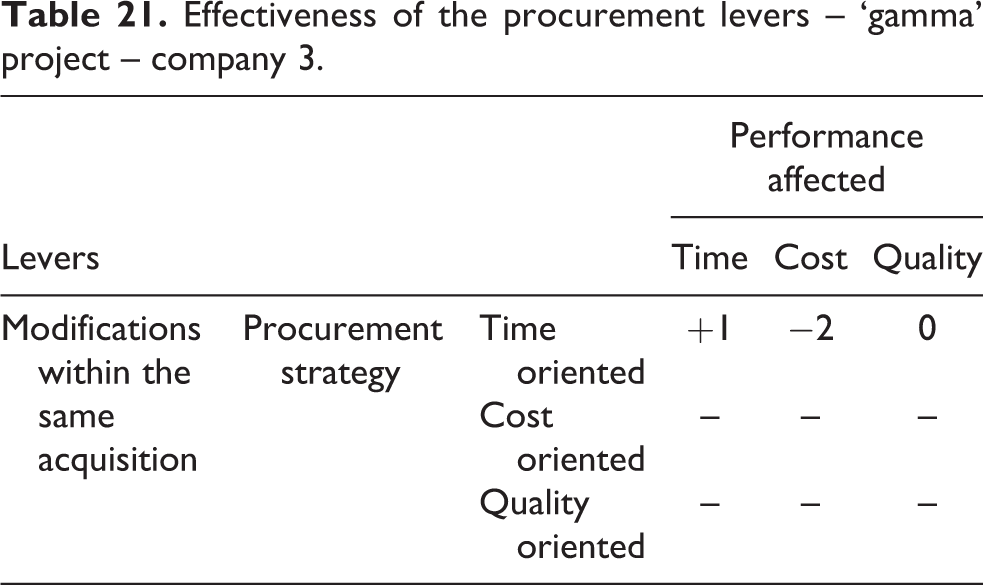
More specifically, the company opted for a strategy modification within the same purchase from bargain management to partnership with a single supplier. Table 21 shows the effectiveness of the modification made. It is easy to see how the time reduction achieved by performing the adjustment with a single supplier involved higher costs for the purchase of the specific item because of the reduced competition.
Effectiveness of the procurement levers – ‘gamma’ project – company 3.
Discussion and suggestions
The empirical analysis allowed for the identification of some recovery measures that can be taken to anticipate any performance deviations that may arise during the execution of EPC projects. These suggestions were classified as (1) strategy and (2) process modifications.
Strategy level
The exploit competition strategy is normally used with the aim of reducing costs. In fact, new suppliers, which often come from emerging countries, have leaner cost structures which enable them to offer products at a lower price. Nonetheless, the lower prices are often accompanied by lower quality because of the limited experience of these suppliers. The projects analysed therefore showed that such a strategy, if not adopted with the proper caution, might lead to performance deviations. In particular, the examples analysed suggest some corrective measures that can be adopted a priori to avoid the above-mentioned deviations: the use of the strategy exploit competition requires the proper execution of the ‘order management and inspection’ phase; the use of the strategy exploit competition requires the proper execution of the ‘supplier qualification’ phase, and particularly that it needs to be carried out before assigning the order to the supplier; the use of the strategy exploit competition is not very suitable for ‘critical items’ where the adjective critical means strict time, cost or quality constraints; with high volumes to be purchased, the strategy exploit competition should be changed into promote competition and the whole supply should be split between a number of vendors to reduce the risk of supply failure; for new suppliers with high improvement potential, the strategy exploit competition should be changed into a support the supplier strategy, which develops the ability of the supplier to comply with the requested time, cost and quality performance.
The strategy partnership is normally used when the supplier requires close collaboration between the buyer company and the vendor right from the initial project solution development phases. The projects analysed again allowed some guidelines in the use of this strategy to be defined, which enable performance deviations to be avoided: The strategy partnership requires the proper execution of the inspection phase, particularly with regard to the sub-phase ‘inspections during product development’ in order to ensure the correct realization of the solution developed together. The strategy partnership requires the proper execution of the ‘development of the system supporting the relation’ phases, particularly of the two sub-phases joint product development procedures and cooperation protocol definition in order to ensure a correct level of communication between the companies involved to guarantee a full understanding of the joint objectives.
The strategy bargain management requires that the company be willing to invest time and resources to negotiate with suppliers to obtain the best time and cost conditions for the supply. Nonetheless: the bargain management strategy is not suitable when there are strict time and cost restrictions, which, because of the highly favourable conditions for the buyer company, may involve the inability of the vendor to guarantee the promised performance; the excessive use of greater bargaining power, on which this strategy is based, may involve opportunistic conduct by the vendor.
Process level
As highlighted before, the purchasing process followed by a company depends on the strategy adopted and the project characteristics. For this reason, process suggestions cannot disregard the strategy used and the project characteristics within which the purchase is made. However, there are some process suggestions that may be adopted regardless of the purchase strategy and project characteristics.
More specifically: in some cases, the purchasing process requires adaptation to supplier characteristics: the analysis of the above-mentioned projects highlighted how suppliers from emerging countries are often quite insensitive to the time and cost restrictions set: for these suppliers, adaptation of the process could consist in the intensification a priori of expediting actions (through a resident expediter, for example); the supplier qualification phase requires special care, particularly regarding the damaging effects that may be caused by the execution of this phase after the assignment of the order.
The analysis of above-mentioned project also enabled the recommended purchasing process for some purchase strategies to be defined.
To sum up, Tables 22 and 23 show the recommended modifications following the analysis conducted (the cells marked ‘x’ identify the modified phases).
Reviewed ‘exploit competition’ purchasing process – strategy.

RFI: request for information; RFP: request for proposal; RFB: request for bid.
Reviewed ‘partnership’ purchasing process – strategy.

RFI: request for information; RFP: request for proposal; RFB: request for bid.
Concluding remarks
Overall, the article basically grounds on and expands the hints from the research by Fallahnejad 41 and related references, stemming from the link between list of causes and timeliness to move forward, towards a more general – and significantly more complex – link between project deviations and procurement, specifically in its relevant levers ‘strategy’ and ‘process’. In the light of the evidence provided, further research is to be performed, both in terms of additional cases to corroborate/find stronger evidence/relations and in terms of refinement of some of the issues, taken separately.
Footnotes
Declaration of conflicting interests
The author(s) declared no potential conflicts of interest with respect to the research, authorship and/or publication of this article.
Funding
The author(s) received no financial support for the research, authorship and/or publication of this article.