




Abstract
Limited research has described a segment of consumers who prefer subtly branded luxury products, rather than conspicuous consumption. However, in comparison with the enormous amount of research mentioning conspicuous consumption, there has been only very limited research into “inconspicuous consumption,” leading to calls for more research in the area. In this article, we describe a discrete choice experiment examining the luxury product preferences of Chinese consumers, the largest market segment for luxury products. We describe and test a theoretical model investigating how product characteristics (logo prominence, price, and brand), peers’ attitudes and behaviors, and other individual characteristics influence consumers’ choice of a luxury bag. For each brand, a prominent logo was preferred, but a very large minority preferred a subtle logo. However, the effect of price, attitudinal and social factors varied across luxury brands. Implications for research and practice are discussed.
Introduction
Display of luxury items has long been recognized as a method for individuals to signal their status to others. As far back as 1899, Veblen (1899, p. 59) wrote that conspicuous consumption (along with leisure) was a “. . . means of showing pecuniary strength, and so of gaining or retaining a good name.” Since Veblen wrote his influential book in 1899, many authors have discussed the various motivations for conspicuous consumption. Like Veblen, some have suggested that many people buy luxury products for what they symbolize (e.g., Bagwell & Bernheim, 1996; Dubois & Duquesne, 1993; Eastman et al., 1997; O’Cass & McEwen, 2004). Others have argued that buying luxury products is often motivated by the wish to conform with the behavior of an affluent social group, or to differentiate from an undesirable social group (Leibenstein, 1950; Phau & Prendergast, 2000; Vigneron & Johnson, 1999).
The use of luxury products for affiliation with an affluent social group or for differentiation from an undesirable group has been said to result in three potential effects: “bandwagon,” “snob,” and “Veblen” effects (Leibenstein, 1950). The bandwagon effect is when the demand for a product increases because other consumers are buying the product, but the snob effect is the opposite—demand for a product decreases due to (too many) other consumers buying the product. The Veblen effect is when demand for a product increases because it has a higher price (Leibenstein, 1950). Inherent in all three effects is the idea that luxury products are visible to others, and recognizable as high-priced goods that confer status on consumers who can afford to buy them. In fashion, the recognizability (or conspicuousness) of luxury brands is often enhanced by the use of prominent logos or design elements that are easily recognized as symbols of a brand—such as Burberry’s trademarked check pattern. The snob, bandwagon, and Veblen effects also imply that consumers’ preferences for luxury goods will depend on the attitudes of their peers, on the popularity of different products in the marketplace, and on the price of desired luxury products. In this study, we describe a discrete choice experiment to test these hypothesized effects, and in particular, to extend recent work suggesting that some consumers prefer luxury products that are less conspicuous, as discussed in the following section.
Although luxury items have been associated with the idea of conspicuous display since Veblen used the term “conspicuous consumption” in 1899, there has been recent interest in consumers who prefer more subtle logos (Han et al., 2010). Such consumers are said to choose relatively expensive goods that are only recognizable by people who share similar tastes and values (Granot et al., 2013). These consumers could be said to practice “inconspicuous consumption”—preferring logos that are recognizable by their friends, but not by the majority of consumers (Eckhardt et al., 2015). Such high-income consumers are said to be able to identify “unrecognisable” signals or subtle logos of luxury brands, and thus high-income consumers can use inconspicuous consumption to signal their social class horizontally and differentiate themselves from low-income consumers (Han et al., 2010). Despite the increasing interest in inconspicuous consumption, there has been very little empirical research with consumers in this area. Although the research in this area will increase, at the time of writing, we could find only seven studies reporting data collection about consumers’ inconspicuous consumption (Berger & Ward, 2010; Granot & Brashear, 2008; Han et al., 2010; Makkar & Yap, 2018a, 2018b; Ting et al., 2018; Wu et al., 2017). Of those, three had very small sample sizes—17 or less (Granot & Brashear, 2008; Makkar & Yap, 2018a, 2018b), another had only 33 participants (Wu et al., 2017), and another was only a brief report with no information on sample size (Berger & Ward, 2010). In response, Eckhardt et al. (2015), who conducted a major theoretical review of inconspicuous consumption, called for “empirical research on the complexity of inconspicuousness in a variety of cultural and consumer contexts” (p. 820). This research responds to that call.
A second gap in the research into inconspicuous consumption is that almost all of the research in the area has been conducted with Western consumers (Berger & Ward, 2010; Granot et al., 2013; Han et al., 2010). An exception is a study by Wu et al. (2017), who interviewed Chinese consumers and investigated why they might buy luxury products that lack the highly visible logo typically associated with a luxury product. However, that study examined only luxury Chinese brands, and did not investigate the preferences of Chinese consumers for subtlety branded luxury Western brands. Chinese consumers now represent the largest group of purchasers of those luxury brands, accounting for 33% of the global luxury market (D’Arpizio et al., 2018). In addition, several authors have suggested that the motivations of Chinese luxury buyers may be different from those of Western buyers. In a widely cited article, Wong and Ahuvia (1998) suggested (but did not test) that Southeast Asian consumers will place more emphasis on publicly visible possessions (such as luxury goods). Since that article, an analysis of Chinese consumers living in Europe suggested that they have higher brand consciousness, and use luxury consumption more than European consumers to define success (Mo & Roux, 2009). Another cross-cultural study found that young Chinese consumers scored higher on both materialism and conspicuous consumption than a comparable sample of young U.S. consumers (Podoshen et al., 2011). Although consumer incomes are converging across countries, cultural value differences across countries appear to be resulting in even stronger differences in consumer behavior, making it increasingly important to understand the impact of national cultures on consumer behavior (de Mooij & Hofstede, 2002). However, as noted above, no previous studies have examined whether some Chinese consumers demonstrate the preference for subtly branded luxury products observed with some Western consumers (Berger & Ward, 2010; Granot et al., 2013; Han et al., 2010).
In the face of this recent (limited) evidence that some Western consumers prefer subtle branding of luxury products, but an almost absence of research in this area with Chinese consumers, the largest single market for luxury products, this study examines the frequency of the preference for subtle branding among Chinese consumers. The study also extends prior research by examining how consumer preferences for prominent versus subtle branding vary across different price points and different luxury brands—an analysis that has not been conducted previously (with either Chinese or Western consumers). The study examines whether these preferences vary with individual attitudinal characteristics (status consumption and susceptibility to peer influence), peer characteristics (whether friends own a luxury brand and their attitude to different brands), income, and other personal characteristics (gender, age, and residential location). We describe a discrete choice experiment examining the preferences of a wide variety of mainland Chinese consumers across potential combinations of different luxury bag attributes. In the next section, we describe the background and conceptual development for the study, and then go on to describe the study, the results, and the implications for research and for marketing practice.
Background and Conceptual Development
The theoretical model tested is shown in Figure 1. This framework is structured based on the findings from the background in-depth interviews with 32 luxury fashion consumers in China. Reflecting an individual’s actual purchase decision, the study analyses consumer choice as a result of the combination of a number of factors. These include the product’s key characteristics—Logo Prominence, Price, and Brand, shown in the top left-hand corner of Figure 1, attitudinal factors, shown in the top right-hand corner of Figure 1—the individual’s need for signaling social status (Status Consumption) and their susceptibility to peer influence (Peer Influence), and social factors, shown in the bottom right-hand corner of Figure 1—whether their friends possess the brand (Friend Has [brand]) and how they believe their friends rate each luxury brand (Friend Rating [brand]). In addition, the analysis also includes the participant’s income and control factors (their age, gender, and residential location). In the following sections, the reasons for inclusion of each of the elements in the model are discussed.
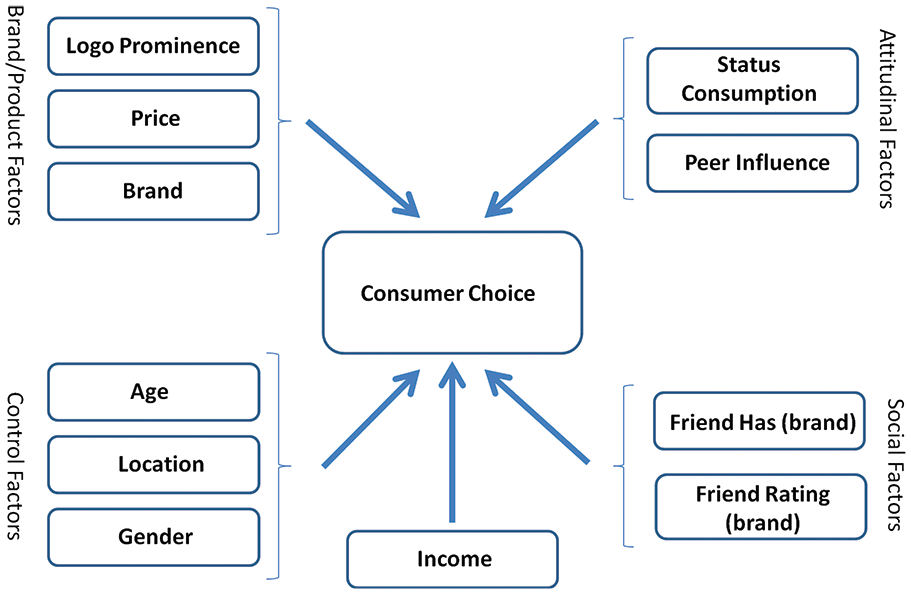
The theoretical framework.
Logo prominence
The principle of conspicuous consumption, as discussed above, suggests that consumers will prefer luxury brands that are easily recognizable, including, but not limited to, an easily recognizable logo. A preference for an easily recognizable (or prominent) logo may be even more common in Asian markets where the concept of face might encourage preference for publicly visible products (Wong & Ahuvia, 1998). Indeed, some industry advice for marketing luxury products in China recommends that “logos on products need to be as prominent as possible” (Bowman, 2008). In contrast, some research has found that some Western consumers (particularly those who are wealthier and who are low in the need for status signaling) prefer subtle, rather than more prominent or “loud” logos (Han et al., 2010). A small qualitative study in China has also suggested that some Chinese consumers prefer subtly branded Chinese luxury products (Wu et al., 2017), but did not investigate Chinese consumers’ preferences for prominent or subtle branding of well-known Western luxury brands. Research has, therefore, not established whether the preference for subtle logos sometimes reported is present in Asian consumers, and/or if preference for a subtle logo varies across different Western luxury brands and different price points. In response, this study examines the extent to which consumer preference for a subtle or prominent logo may differ across different luxury brands, price ranges, and consumer characteristics. The study examines the preferences of Chinese consumers, a group which is of theoretical interest due to the argument that their preferences for luxury goods are different (Wong & Ahuvia, 1998), and which is also of critical market importance as the largest group of purchasers of luxury products (D’Arpizio et al., 2018).
Price
All else being equal, a higher price is likely to be associated with higher status (Rao & Schaefer, 2013). Standard economic theory frequently discusses a price–demand curve, which implies that (all else being equal) demand will be greater for products that are lower-priced (e.g., Gillespie, 2014). But consistent with the status associated with high-priced products, some authors have discussed upward-sloping demand curves, which reflect that a luxury product may be more attractive to consumers if it has a higher price (e.g., Amaldoss & Jain, 2005). However, Rao and Schaefer (2013, p. 788) have argued that “the formal literature in marketing . . . is somewhat limited in the area of conspicuous consumption.” In particular, there has been little experimental investigation of upward-sloping demand curves and the extent to which they might vary across higher- and lower-priced products within the same product category. In addition, if consumers do indeed prefer luxury products that are more expensive, it is not clear whether this preference for a higher-priced product will depend on the conspicuousness of the product—including the prominence of the product’s logo. This research, therefore, investigates the effect of different price points across different levels of logo prominence and different luxury brands, which variously represent high, medium, and low price ranges for luxury bags.
Brand
The brand has long been recognized as an important feature of a product (e.g., Fry, 1967; Marquardt et al., 1965). Many studies have shown that brands influence consumers’ choices and that they are willing to pay a premium for brand names (e.g., Faircloth et al., 2001; Kohli, 1997). One study has suggested that the prestige of a luxury product brand is particularly important for Chinese consumers, especially those with a tendency for high social compliance (Zhou & Wong, 2008). The prestige of a brand is likely to have a larger effect on purchase intention when the product category is conspicuous (Steenkamp et al., 2003). However, it is less clear whether the importance of brand prestige will vary across different price points and different levels of logo prominence in the same conspicuous product category—in this study, luxury bags. Therefore, the study examines the extent to which consumers’ choices vary across different brands, at different prices, and with different levels of logo conspicuousness.
Friends’ ownership of a brand (“Friend Has”)
A large body of evidence shows that consumers’ choices are likely to be influenced by the behavior and the attitude of referent individuals—including, though not necessarily limited to, friends (e.g., Bearden & Etzel, 1982; Childers & Rao, 1992; Eckhardt & Houston, 1998; Fishbein et al., 1970). One friend behavior that is likely to influence consumers is whether their friends own a particular brand (Friend Has), because a friend owning a brand suggests a strong endorsement of the brand by the friend. An effect of friend ownership would be consistent with a consumer preference for conformity (e.g., Brewer, 1991). Conversely, however, consumers also often display a need for uniqueness, so people may choose to buy a different product merely to be different from other consumers (Amaldoss & Jain, 2005). In Asian societies, there are generally more positive attitudes to conforming, so among Chinese consumers, the effect of Friend Has is expected to be positive—that is, if a friend owns a brand, that brand is expected to be more attractive to the consumer. However, Amaldoss and Jain (2005) found that as the price of a luxury product increased, the product became more attractive to those who valued uniqueness (“snobs”). It is, therefore, possible that the effect of Friend Has will vary according to the price of the product and also due to the consumer’s susceptibility to peer influence. So, the model includes, for each brand, whether a friend of the participant owns the brand (Friend Has), after allowing for the effects of other factors (including the price of the product and each consumer’s susceptibility to peer influence).
Friend rating
Consistent with the evidence on the importance of referent individuals discussed above (e.g., Bearden & Etzel, 1982; Childers & Rao, 1992; Fishbein et al., 1970), friends’ ratings of different brands are likely to be important for consumers’ choices. Although friends’ ratings are likely to be associated with friends’ ownership of those brands, it is possible (and for luxury brands, very likely) that friends may aspire to own a particular brand (and thus rate it highly), without owning the brand. Friend Rating thus constitutes an additional potential predictor of consumer choice, after allowing for Friend Has. The ratings of friends may be particularly important for Chinese consumers, following the suggestion that Asian consumers are more likely than Western consumers to be influenced by their peers (Wong & Ahuvia, 1998). As a result, the model examines the effect of logo, price, and brand after allowing for participants’ reports of the opinions of their friends about each brand (Friend Rating) and whether their friends own each brand (Friend Has).
Status consumption
As well as the brand/product and social factors discussed above, a consumer’s choice of a luxury product is likely to be influenced by attitudinal factors, as shown in Figure 1. The first of these, Status Consumption, has been defined as “the motivational process by which individuals strive to improve their social standing through the conspicuous consumption of consumer products that confer and symbolise status” (Eastman et al., 1997, p. 54). Differences in self-reported status consumption have been shown to be positively correlated with ownership of brands reputed to be higher in status than competing brands (Eastman et al., 1997; O’Cass & McEwen, 2004; Phau & Leng, 2008). All else being equal, therefore, consumers with higher levels of status consumption are, therefore, more likely to prefer high- status brands, so the consumer’s level of Status Consumption is included in the model.
Peer influence
The second attitudinal factor likely to influence consumers’ choices is their susceptibility to the influence of their friends. Although, as discussed above, there is substantial evidence that consumers will be influenced by the attitudes of their friends (e.g., Bearden & Etzel, 1982; Childers & Rao, 1992; Fishbein et al., 1970), some consumers will be more susceptible than others. That is, susceptibility to interpersonal influence is a general trait that varies across individuals (Bearden et al., 1989; McGuire, 1968). Consumers who are low on susceptibility to peer influence are, therefore, less likely to be influenced by the behavior and/or attitude of their friends (in this model, Friend Has and Friend Rating). As discussed previously, Wong and Ahuvia (1998) have argued that Asian consumers are more likely than Western consumers to be influenced by their peers. However, within any Asian country, individuals will vary in their susceptibility to the influence of others. Consumers’ susceptibility to the influence of referent others (i.e., their friends, family, and/or others they look up to [Peer Influence]) is thus included in the model.
Income
Peoples’ probability of buying luxury products will obviously depend on their income. The study excluded participants with a monthly household income of RMB10,000 or less, in order to obtain a sample where many participants might reasonably be assumed to aspire to ownership of a luxury product—at least a lower-priced item from one or more of the brands examined in the study. However, the average white-collar worker’s monthly salary in China in the first quarter of 2017 was only RMB7,665 (JPM Media Corporation, 2020), so higher-priced luxury items are unlikely to be affordable for most Chinese consumers. Income may also influence peoples’ preference for a conspicuous or subtle logo: a previous study in the United States found that income was an important factor affecting the choice of a luxury brand and preference for a prominent logo (Han et al., 2010). Participants’ monthly household income was, therefore, included in the model.
Age, location, and gender
Apart from income, consumers’ preferences for luxury products may also be affected by other demographic characteristics, such as age, location, and gender. Although these characteristics are not of theoretical relevance, it is possible that older/younger consumers, those in different geographical areas (who may be more or less exposed to promotion of particular brands), and males/females may have different preferences for different combinations of luxury brand features. As a result, age, location, and gender were included in the model as control factors.
Methodology
Discrete choice modeling was used for the study because it allows assessment of the importance of different variables for choice by examining the trade-offs made by consumers who are asked to choose between different combinations of variables at different levels. The technique is well-established and has been widely applied to the study of multiple-choice problems in marketing and other fields (Louviere & Hensher, 1983), such as recreation (Louviere & Hensher, 1983; Morey et al., 1991), transportation (Truong & Hensher, 1985), banking (Dauda & Lee, 2015), and choice of wine (Kelly et al., 2015; Lockshin et al., 2006).
The study used a 42×2 orthogonal design (Louviere et al., 2000), with 32 choice sets, with each choice set containing four choices. A balanced incomplete block design was used to generate four blocks of choice sets, with each block containing eight choice sets. In each choice set, participants were asked to choose their preferred handbag from four options, with each option containing different levels of luxury handbag brands (four options), price (four options), and logo conspicuousness (two options). An example of a choice set is shown in Table 1. In addition, following Louviere and Woodworth (1983), four common choice sets were added to each block to anchor judgments on a common scale. The common sets asked participants to compare luxury handbag brands with each at the lowest price, at each level of logo, and at the medium-high price, again at each level of logo. Each block of 12 choice sets thus formed the basis of four different questionnaire versions, each containing eight different choice sets and four common choice sets. After viewing each choice set, participants were asked to select their most preferred option for that choice set. The details of the choice scenario and other measures are shown in Table 2.
Example of a Choice Scenario.

Variables and Levels.
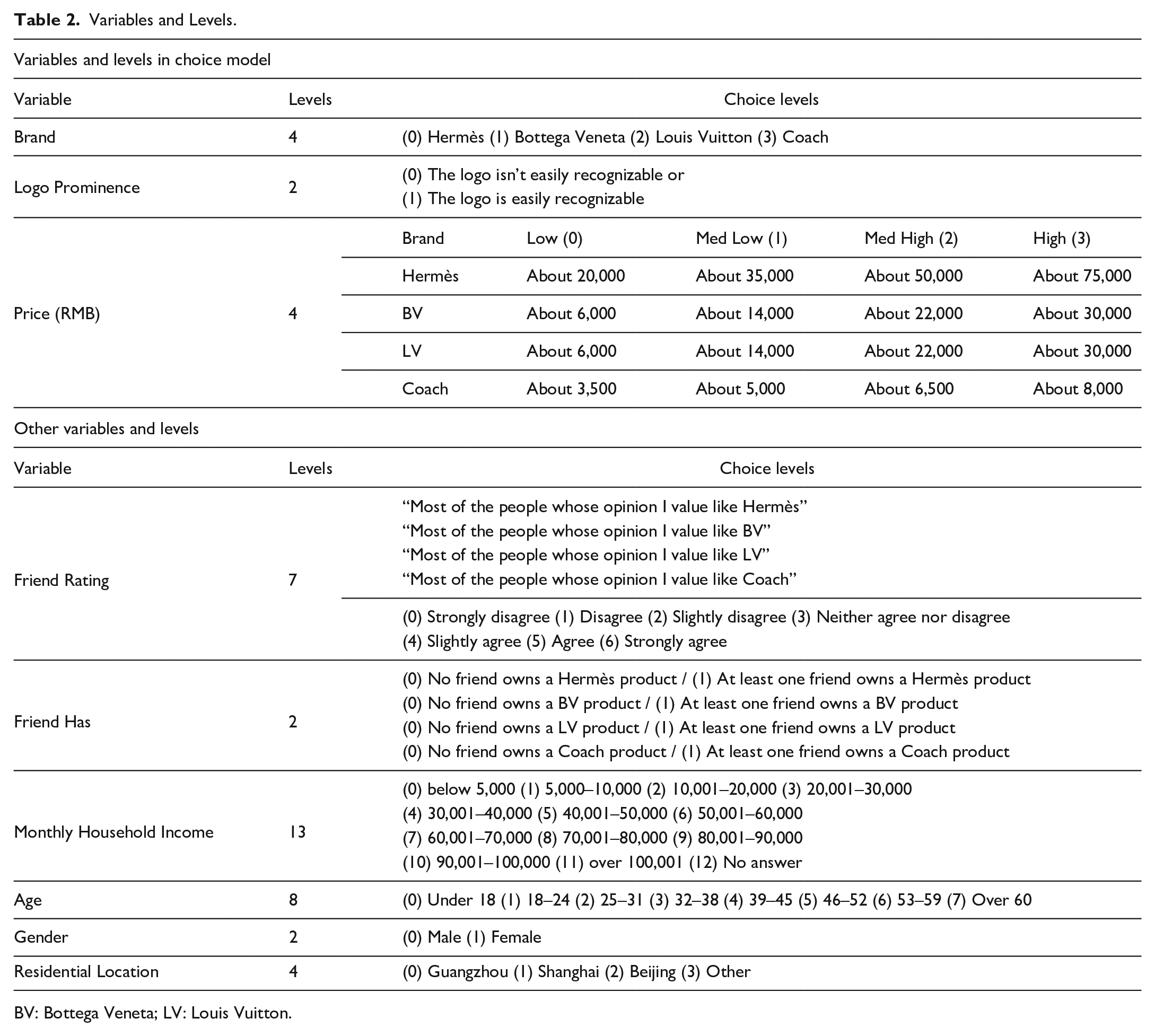
BV: Bottega Veneta; LV: Louis Vuitton.
Luxury brand handbags were chosen as the focal product, because as a highly visible item, they have been used in previous research examining luxury brand prominence and status signaling (Han et al., 2010). In addition, background in-depth interviews with 32 luxury fashion consumers in China had found that luxury brand handbags were the most frequently purchased luxury fashion products for interviewees. Four brands were selected for comparison: Hermès, Bottega Veneta (BV), Louis Vuitton (LV), and Coach. These brands were selected for a number of reasons: first, they were frequently mentioned by both males and females as aspirational luxury brands in the background interviews. Second, the four brands represent a range of prices, with typical product prices ranging from Hermès (the most expensive) to Coach (the cheapest). The brands also reflect variations in logo prominence, with Hermès and BV generally characterized by more subtle logos, and LV and Coach generally characterized by more prominent logos. Within each brand, however, different products will carry more or less prominent logos, making the brands realistic targets for a discrete choice experiment investigating the effect of varying levels of brand prominence across brands and different price points.
Four price points were chosen for each brand for inclusion in the choice scenarios. These price points were chosen to reflect a realistic price range for each brand’s normal product range, thus excluding limited or special editions (such as products made from exotic leather, which are extremely expensive), and any bags that are atypically inexpensive for the brand, (such as a canvas product, which sells at a relatively low price). Based on the typical price range for each brand, four evenly distributed price ranges (representing low, medium/low, medium/high, and high-priced products) were then estimated for each brand. The price points to be included in the choice scenarios were determined as the mid-point of each price range. As shown in Table 2, this process resulted in different but overlapping price ranges across the brands, reflecting the brands’ actual market prices.
Logo prominence was captured in the choice scenario by asking participants to choose between options of “the logo is easily recognizable” or “the logo isn’t easily recognizable.”
In addition to the questions requiring choice of the most preferred option from each choice set, participants were asked a series of questions to assess their (a) status consumption, (b) susceptibility to peer influence, (c) perception of their friends’ evaluation of each brand, (d) whether their friends possess a product from each brand, (e) income, (f) gender, (g) age, and (h) residential location.
Status consumption was measured using a scale adapted from Eastman et al. (1999). Their scale was altered to change one negatively worded item to positive wording to provide scale consistency. The Eastman et al. (1999) scale (and the revised scale) measures status consumption with five separate responses to statements, each measured using a 7- point Likert-type scale. The measurement items used are shown in Appendix 1. A summary score for status consumption was obtained for each participant by averaging their scores across the five items, following previous usage of this scale (Han et al., 2010).
Susceptibility to peer influence (Peer Influence) was measured using “Susceptibility to Interpersonal Influence” scale by Bearden et al. (1989), with the omission of one of their 12 items. This scale measures susceptibility to peer influence with separate responses to statements, each measured using a 7-point Likert-type scale. The measurement items used are shown in Appendix 1. A summary score for Peer Influence was obtained based on a participant’s average score across the items, following previous usage of this scale (Bone, 1995).
Participants’ perceptions of their friends’ evaluations of each brand (Friend Rating) were assessed by asking, for each brand, agreement with the statement “Most of the people whose opinion I value like this brand.” Agreement was measured on a 7-point Likert-type scale ranging from strongly disagree to strongly agree. Whether a participant’s friends possess any of the four brands included in the choice scenarios (Friend Has) was assessed by asking them, for each brand, to indicate whether one or more of their friends has that brand, as far as they know.
Participants were asked to indicate their monthly household income on a 13-category scale, ranging from less than RMB5,000 to more than RMB100,000. As the target sample was limited to participants with a monthly household income of greater than RMB10,000, participants who reported a monthly household income of RMB10,000 or less and those who did not answer this question were excluded from the study. Participants’ income was subsequently re-categorized into two groups, RMB10,001 to RMB30,000 (66.4%) and more than RMB30,000 (33.6%).
Participants were asked to report their age, measured in eight categories ranging from less than 18 to 60 years and older. As the focus of the study was on participants from 18 to 59 years, participants outside that age range were excluded. The remaining six age categories were subsequently recoded for modeling into three categories (18 to 31 [34.9%], 32 to 45 [46.4%], and 46 to 59 [18.8%]).
As there is evidence that purchases by both males and females are important in the China luxury market (Bain & Company 2015), data were collected using a quota system to obtain a sample comprising 50% male participants and 50% female. Similarly, because some authors suggest that the behavior of Chinese consumers may vary across different regions (Zhang et al., 2008), data were collected using a quota system, with 30% of participants from each of the highly developed “Tier 1” cities of Beijing, Shanghai, and Guangzhou (Sinclair, 2010), and 10% from other parts of China. For modeling, location data were re-coded to classify respondents’ locations as in a Tier 1 city, or elsewhere in China.
Although participation in the study was limited to those with a monthly income of more than RMB10,000, it is likely that many participants would be unable to afford the luxury handbags at the higher-price points in the choice scenarios. As a result, consistent with the study’s aim of investigating participants’ aspirational choices, and to prompt a realistic choice, participants were given the following scenario, combining windfall income from a year-end bonus, and the opportunity for someone to buy a luxury bag for them overseas at a lower price (a very common method of luxury product purchase for Chinese consumers):
Imagine that each year you receive a year-end bonus, and this year, it is likely to be in the range of RMB40,000 to RMB80,000. A month before you are due to receive your year-end bonus, your boss says that he/she is going to Europe and is happy to buy a luxury bag for you as part of your year-end bonus. The bag will cost much less in Europe than in China, so this gives you a chance to get a luxury bag at a cheaper price than you would pay in China. After paying for the bag, if the bag is cheaper than your bonus, your boss will pay you the balance of your bonus in cash. If you choose a bag that is more expensive than your bonus (which may vary from RMB40,000 to RMB80,000), you will pay the difference to your boss.
The questionnaire was developed in English and translated into Simplified Chinese (the written form of Chinese used in Mainland China). Back translation (Brislin, 1970) was used to ensure that the translation was successful. Following recommendations by Bryman (2008), a pilot questionnaire was tested with a convenience sample, resulting in only minor changes to wording. After finalization of the survey, data were collected using an online survey sent to randomly selected members of a Nielsen online panel of people living in Mainland China.
Four blocks of the questionnaire, plus the additional questions, were evenly distributed among 304 participants.
Analysis
Following Allaway et al. (2006), the data were analyzed using SPSS (version 23) to conduct Multinomial Logistic Regression, using choice data from the 304 respondents, thus comprising 3,648 observations. The resultant model does not reflect the repeated measurement nature of the data, and instead employs the model as a forecasting device (Louviere & Hensher, 1983). Parameter estimates from this type of model will be consistent, but confidence intervals for the parameters will be incorrect, so significance tests need to be interpreted very cautiously (Louviere & Hensher, 1983).
The Multinomial Logistic Regression model requires one choice alternative (here, one brand) to be used as the reference category. The choice of other brands is then modeled relative to the choice of the reference category. LV was chosen as the reference category for two reasons. First, as the leading market share luxury brand (Deloitte University 2016), the brand is an obvious potential dominant option with which comparisons with other brands can be made. Second, as one of the two mid-range luxury brands in the choice scenario, it allowed a comparison with choice of a high-price brand (Hermès), a low-price brand (Coach), and with the other mid-range luxury brand, BV. The study, therefore, estimated a model showing preference for Hermès, BV, and Coach relative to LV. As the parameter estimates are relative to the reference category, LV, the interpretation of the model is that for every unit increase in the independent variable, the probability of buying Hermès, BV, and Coach (respectively) relative to LV goes up (and vice versa) (UCLA Statistical Consulting Group, n.d.).
Results
Table 3 summarizes the overall sample and choice characteristics. As shown in Table 3, LV was the most preferred brand, being preferred in 29.2% of the choice scenarios. Participants chose an easily recognizable logo in 54.3% of the choice scenarios, and unsurprisingly, were most likely to prefer a low price (chosen in 36.4% of scenarios). More surprising, however, was that the high-price option was the second most commonly chosen option, being chosen in 30.5% of the choice scenarios.
Overall Sample and Choice Characteristics.
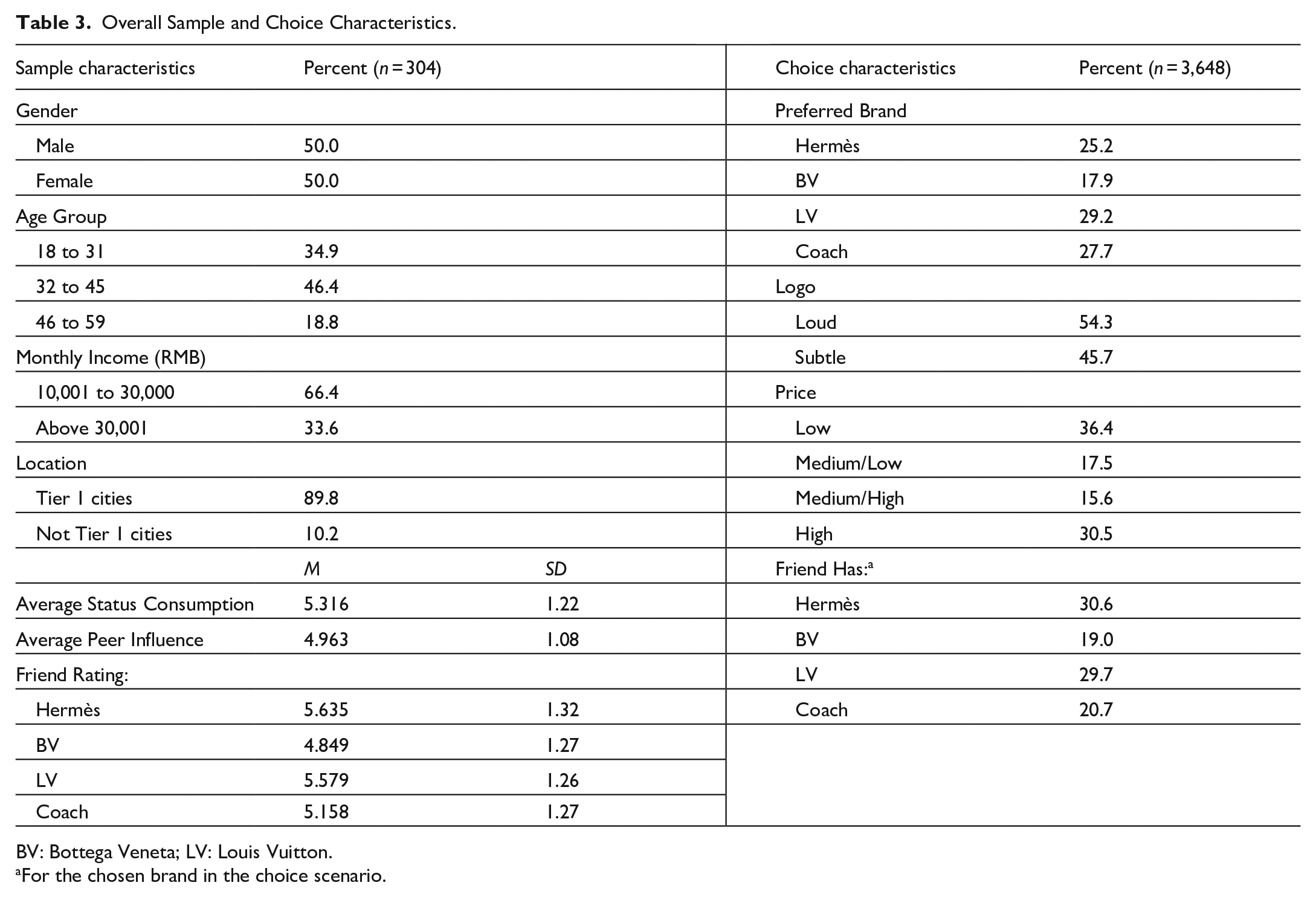
BV: Bottega Veneta; LV: Louis Vuitton.
For the chosen brand in the choice scenario.
The model was highly significant (p < .001), with a chi-square of 1,293 and 66 degrees of freedom. The pseudo R2 estimates ranged from .319 (Nagelkerke) to .129 (McFadden). There is disagreement on the interpretation of pseudo R2 estimates (Petrucci, 2009), however, many authors (e.g., Cerri et al., 2014; Tabatchnick & Fidell, 2007) argue that the R2 estimates obtained in a multinomial logistic regression can be interpreted in the same way as R2 estimates in linear regression, that is, as indicating the amount of variance in the dependent variable that is explained by the independent variables. That argument would, therefore, suggest that from 31.9% to 12.9% of the variability in brand choice is explained by the independent variables in this model.
Table 4 summarizes the results of the model, showing the significance of each variable in the overall model (columns 2 and 3) and for each brand (columns 4 to 9), and the size and direction of the estimated beta coefficients. As shown in Table 4, as the effect of a number of independent variables varies across the three brand choice models, the following discussion focuses on similarities and differences across those brand choice models.
Predictors of Choice for the Whole Sample and for Each Brand.
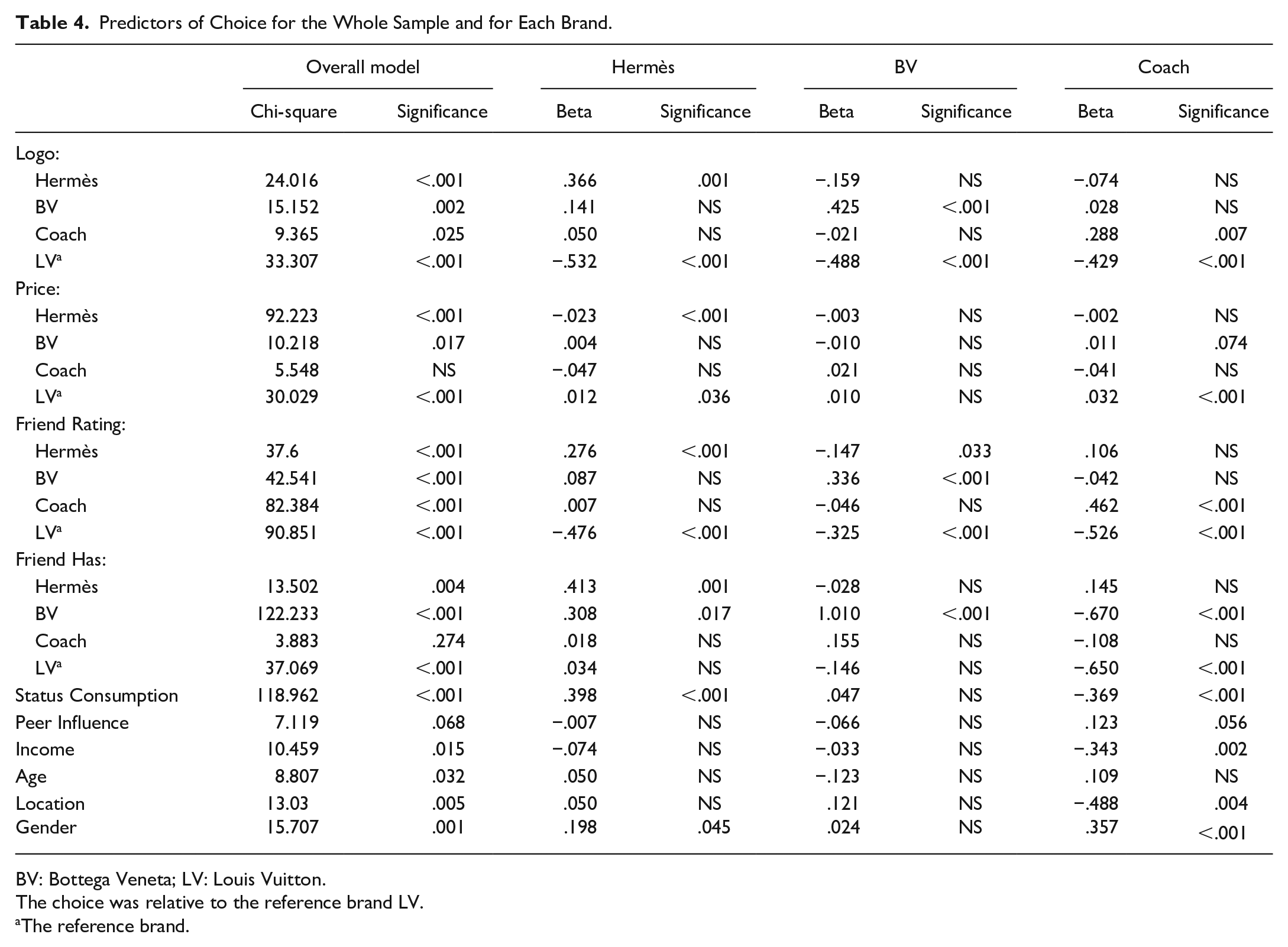
BV: Bottega Veneta; LV: Louis Vuitton.
The choice was relative to the reference brand LV.
The reference brand.
Table 4 shows a consistent effect of Logo Prominence across the three brand models—each brand was more likely to be chosen, relative to LV, if their logo was more easily recognizable.
In addition, after allowing for the prominence of the logo of the chosen brand, the effect of the LV logo was significant and negative in all three models. That is, if the LV logo was prominent, each of the other brands was less likely to be chosen. Unsurprisingly, the Logo Prominence of a brand not chosen was not significant in predicting the choice of another brand, relative to LV. For example, in the model predicting choice of Hermès, prominence of the BV and Coach logos was not significantly associated with the probability of choosing Hermès, relative to LV.
The effect of Price was much less consistent than the effect of Logo. As with Logo, the price of unselected brands (e.g., BV and Coach prices in the Hermès model) was not significant at the 0.05 level in any model. But consistent with normal price–demand curves, Hermès price was significantly and negatively associated with the probability of choosing Hermès, relative to LV, and LV price was significantly and positively associated with the probability of choosing Hermès and Coach. However, the probability of choosing BV, relative to LV, was not associated with either BV or LV price, and Coach price was not associated with the probability of choosing Coach, after allowing for the other factors in the model.
Perhaps unsurprisingly, Friend Rating of each brand was significantly and positively associated with the probability of choice of the brand (each significant at p < .001).
Similarly, probability of choosing each brand was negatively associated with Friend Rating for LV (each significant at p < .001). Each brand was, therefore, more likely to be chosen, relative to LV, if Friend Rating of the brand increased, and/or if Friend Rating for LV decreased.
In contrast, the effect of a friend having one or more of the comparison brands was not consistent across models. A friend having Hermès or BV increased the probability of choice of those brands, relative to LV. However, a friend having Coach did not increase the probability of choice of Coach, and a friend having LV was only significantly (negatively) associated with the probability of choosing Coach. In addition, a friend having BV was significantly associated with choice of each of the other brands—increasing the likelihood of choosing Hermès, but decreasing the probability of choosing Coach.
The effect of Status Consumption varied markedly across brands. For Hermès, the highest-priced brand in this experiment, Status Consumption was significantly and positively associated with preference for Hermès. In contrast, for Coach, the lowest-priced brand, Status Consumption was negatively associated with preference for Coach. For BV (with LV, one of the two mid-priced brands), Status Consumption was not associated with preference.
Surprisingly, Peer Influence was not significantly associated with preference for any brand (albeit marginally associated with preference for Coach). Post hoc analysis showed that the lack of a significant association between Peer Influence and preference for any brand was due to the effect of Status Consumption. That is, when Status Consumption was removed from the model, Peer Influence was significantly associated with preference for Hermès and Coach—positively for Hermès and negatively for Coach.
Despite the large price differences across and within brands in the different choice scenarios, Income was only significantly (and negatively) associated with preference for Coach, indicating that higher income was associated with lower preference for Coach, relative to LV. Location was also significant only for Coach, with participants living outside Tier 1 cities less likely to choose Coach, relative to LV. Female participants were more likely to prefer Hermès and Coach, relative to male participants. Age was not significant for predicting choice of any brand.
The discussion above shows that, on average, participants preferred more easily recognizable logos, which were chosen in 54.3% of scenarios (see Table 3). However, that percentage also shows that subtle logos were preferred in a substantial minority of choice scenarios (45.7%). To investigate whether any of the participant characteristics predicted preference for a subtle logo, a logistic regression was run, using choice of logo (subtle = 0 and loud = 1) as the dependent variable, and the same independent variables as predictors, with the addition of brand chosen, to assess whether one or more of the independent variables was a significant predictor of the choice of a subtle logo. Backward elimination was then used to remove non-significant variables, progressively removing the least significant independent variable, until only significant (p < .05) and marginal (0.5 ≦ p < .1) variables remained. Only two variables remained, Status Consumption and Income, but the R2 estimates for the model were very low (.004 [Nagelkerke] to .003 [Cox & Snell]). The model results are summarized in Table 5. The model shows that participants with higher levels of Status Consumption were more likely to choose a product with a loud logo (p = .003), and those with a higher income were marginally less likely to choose a product with a loud logo (p = .067). No other variables were significantly associated with choice of a loud versus subtle logo.
Backward Elimination Predicting Logo Choice.

Discussion and Conclusion
The results show that the effect of some variables is consistent across brands, but also reveal marked differences in the effect of other variables across brands. The effect of logo was one of the most consistent findings: for each brand, participants were more likely to choose the brand if the logo was prominent. This result could be explained by a preference for conspicuous branding, consistent with a Veblen effect (Bagwell & Bernheim, 1996).
However, the results also revealed that a substantial segment preferred a subtle logo (45.7%, from Table 3). Preference for conspicuous branding is, therefore, in no way universal, but the backward elimination model showed that only Status Consumption (p = .003) and Income (p = .067) predicted choice of a subtle logo. Although this experiment included high- and low- priced luxury brands (Hermès and Coach, respectively), the finding of a majority of consumers preferring a conspicuous logo (54.3%), yet a very large minority segment preferring a subtle logo (45.7%), suggests that a product range that incorporates both prominent and subtle logo products is most likely to meet the diverse preferences of consumers.
The effect of price was much less consistent across brands, and showed interesting variations from what might be expected on the basis of typical price–demand relationships, even for luxury brands, where a higher price, and its associated status, sometimes results in increased demand (or an “upward sloping demand curve”; Deaton & Muellbauer, 1980). Hermès was the only brand that showed a typical price–demand relationship: a higher price for Hermès and a lower price for LV were both associated with lower probability of choice of Hermès. This typical price–demand relationship is despite Hermès being the most expensive brand in the experiment and, therefore, the brand where response to price might be expected to be most inelastic, according to a classic Veblen effect.
On the contrary, preference for Coach was not associated with changes in the price of Coach, although increased price of the reference brand (LV) was associated with increased preference for Coach. As the lowest-priced brand, Coach is likely to have been preferred by those who wanted to minimize the price they paid for a luxury brand, thus explaining the apparent price inelasticity to changes in Coach pricing. Other participants appeared to prefer LV (the highest market share luxury brand) at the lower levels of its price range, but their preference switched to Coach if the LV price increased, thus explaining the response to changes in LV price.
Preference for BV was even less consistent with a typical price–demand relationship: within the price range of the experiment, changes in the price of both BV and LV were not associated with a change in the choice of BV. The reasons underlying this apparent price inelasticity (within the experimental parameters) by those who chose BV are unclear.
However, BV was the only brand where Status Consumption was not associated with brand preference. This finding suggests that participants who chose BV (the least popular brand, chosen in only 17.9% of scenarios) are less influenced by price or by the status associated with the product than by the attitudes and behavior of their friends: both Friend Rating and Friend Has BV were highly significant for preference for BV (and with logo, were the only significant predictors of preference for BV).
The results suggest that within the luxury brands included in the experiment, BV is differentiated in the mind of consumers, highly attractive to those who chose it, who are therefore price inelastic to changes in the prices of both BV and LV (within the parameters of the experiment). LV, while occupying the same middle price range for luxury brands as BV, is apparently not seen as a substitute for this segment, because a friend having LV, and/or a lower price for LV, did not decrease their probability of choosing BV. Instead, choice of BV was determined by Logo Prominence (as with all the brands), but beyond that, only by friends’ attitude and behavior. This positioning of BV as a brand where friends’ attitudes and behavior are particularly important, even relative to other luxury brands, is reinforced by BV being the only brand where Friend Has BV was significant in influencing choice of the other brands. For those who chose Hermès (a higher-priced brand), a friend having Hermès and/or BV increased the probability of buying Hermès, perhaps because friends having Hermès and/or BV would suggest enhanced attitudes toward, and increased usage of, luxury brands among the friendship group, therefore increasing choice of the highest-priced brand, Hermès. In contrast, a friend having BV decreased the probability of choice of Coach, relative to the higher-status reference brand, LV, possibly because a friend having BV created aspirations for a higher status brand.
Unsurprisingly, Friend Rating was significantly and positively associated with choice of each brand, and Friend Rating of LV was negatively associated with choice of other brands. Even after allowing for Friend Rating, a friend having the brand (Friend Has) was associated with choice of both Hermès and BV. In addition, as discussed above, a friend having BV increased choice of Hermès. However, for Coach, a friend having Coach did not increase preference for Coach, whereas a friend having LV increased preference for LV, relative to Coach. This difference in the effect of friends’ brand ownership across the brands, coupled with the negative associations between both Status Consumption and Income and choice of Coach, suggests that Coach is not as strongly positioned as a luxury brand as the other brands in the experiment. This perception of a lower status for Coach would also be consistent with its lower price range, relative to the other brands. For Coach, friends displaying the brand (that is, a friend having Coach), appears to be insufficient to increase choice of Coach. In contrast, perceived endorsement of the brand (that is, Friend Rating) or an increased price of the reference brand was positively associated with choice of Coach. The results suggest that for brands strongly positioned as high status (such as Hermès, BV, and LV), product display by referent others will increase preference. However, brands that aspire to be seen as luxury brands, but which may not be seen as such by consumers (such as Coach), may require more active brand promotion and endorsement. As discussed above, participants living outside Tier 1 cities were less likely to choose Coach, possibly due to lower brand awareness and penetration, thus providing additional evidence of the need for increased spending on brand building by less-established brands. The bandwagon effect—when demand for a product increases because other consumers (here, referent individuals) buy the products—therefore appears to be less important for Coach, the lowest-priced brand in the experiment.
Implications for management
The results show some clear implications for the marketing of luxury products in China. First, as noted above, though the majority preference for a conspicuous logo is consistent with long-standing discussion of conspicuous consumption, the data show that a very large minority of Chinese consumers appear to prefer a more subtle logo. A product range that incorporates both prominent and subtle logos is, therefore, most likely to match these varying consumer preferences. A preference by some consumers for more subtle logos has only relatively recently been noted among Western buyers (Berger & Ward, 2010; Han et al., 2010)—and has not previously been noted for Chinese consumers—so it is possible that the size of the segment preferring subtle logos will increase over time. Certainly, the size of the segment that prefers more subtle logos is inconsistent with industry advice for luxury products in China that “logos on products need to be as prominent as possible” (Bowman, 2008). So luxury bag brands may benefit from reviewing whether their brand value might be extended by the addition of a high-priced line with subtle branding but with recognizable design features, to address the desires of consumers who do not want to display a prominent logo, instead preferring a subtle logo positioned as high status, which will be recognized by their aspirational group.
The results also show that pricing of luxury products is complex, with neither the competing economic theories of a standard price–demand nor an upward sloping demand curve explaining the results. Previous research has shown that the consumption occasion and social context can influence consumers’ price sensitivity, but did not examine variation in price sensitivity within one product line (Wakefield & Inman, 2003). In this study, a standard price–demand curve was observed only for Hermès, and the results show no support for an upward sloping demand curve. The results suggest that price may have a nonlinear effect on preference, being less important for mid-price luxury brands, such as BV and LV, because their prices are within an acceptable price range for their target segments. In contrast, the most expensive brands (here, Hermès), may show higher-price elasticity because a decrease in price brings the product closer to an acceptable price point for a target segment—such as, in this experiment, consumers who obtain a windfall gain, and those who may otherwise prefer lower-priced luxury brands. In contrast, brands which are less strongly positioned as a luxury brand (here, Coach), may not be seen as an acceptable option, so a decrease in price for Coach did not result in an increase in demand. Hence, the marketing strategy needs to ensure that the brand is strongly positioned as a luxury brand. Ideally, demand for the brand will then become price inelastic (within a realistic range) to increases in the brand’s price, or decreases in its competitors’ prices—a situation that BV appears to have attained, albeit for a smaller segment of consumers.
The finding that Coach was significantly less likely to be preferred by participants living outside Tier 1 cities also shows the importance of ensuring that a brand is seen as aspirational in emerging markets. As the lowest-priced brand in the experiment, Coach would be expected to be more attractive to consumers in regions where average incomes are lower, such as, for China, outside Tier 1 cities. The finding that Coach was less attractive to consumers in these areas suggests that the brand is failing to attract potential buyers in areas that are likely to become progressively more important for luxury brands.
Implications for further research
The study shows that there are differences in consumers’ preferences for subtle and prominent logos, and that these preferences are consistent across different luxury brands in that a majority of those who chose each brand preferred a prominent logo. However, as discussed above, a large minority preferred a subtle logo, though only Status Consumption (p = .003) and Income (p = .067) predicted this preference. Further research could investigate these and/or other predictors of preference for a subtle logo. For example, it is possible that a sample with more participants at higher incomes will have increased power for predicting preference for a subtle logo. It is also likely that preference for a subtle logo will be strongly influenced by a participant’s friends’ opinions about the desirability of logo prominence. Further research could investigate this and other factors that may influence preference for a subtle logo.
The differences between brands also suggest promising areas for research. In particular, the reasons for differences in the effect of price between Hermès (where a typical price–demand response was observed), BV (where participants were apparently price inelastic—within the experimental parameters—to changes in the price of BV and/or its competitors), and Coach (where consumers’ preferences were related to the price of LV, the reference brand, but not to the price of Coach), are not clear. These differences may be the result of consumers ascribing different levels of status to different brands, and/or to strong differentiation by BV, resulting in lower price elasticity by consumers who prefer that brand. Future research could attempt to determine the reasons underlying these different responses across brands to variations in price.
Limitations
As with all research, the study has limitations. First, although large number of choice scenarios (3,648) provided substantial power, a large majority of participants (89.8%) lived in Tier 1 cities, resulting in a lack of power for comparisons between Tier 1 and non-Tier 1 locations. Although this limitation has no impact on estimation of the effect of other variables, the models may lack power for detecting differences across locations.
The second limitation concerns the ability of the sample to represent views of current customers of luxury brands. The buying power at any income level is much higher in developing economies such as China, so direct currency conversions underestimate actual buying power. Nevertheless, participants at the lower end of the income scale for the experiment would not represent a key market segment for luxury brands. However, luxury product purchases have become the norm in other Asian societies, such as Japan (Haghirian, 2011), so these consumers represent an important potential market for luxury brands, albeit perhaps only for occasional purchases and/or purchases of lower-end items. Understanding the drivers of preference and choice for these consumers is thus critical for marketers and for researchers.
A final limitation concerns the design of the experiment, and its elicitation of brand choices through the description of a hypothetical end-of-year bonus. To ensure that participants identified their most preferred brand under different choice conditions, they were not given the option of not choosing any brand in a scenario. This design could potentially inflate choice of Coach (the cheapest brand), because under the description of the scenarios, participants were told that they would (hypothetically) be able to retain any bonus that was not spent on a bag. The effect of any inflated preference for Coach does not appear to have been major (Coach was only the second most preferred brand, after LV, and was preferred by only 2.5% more than Hermès). However, predictors of preference for Coach should be interpreted with caution, because they may instead, for some participants, reflect a preference to not buy any of the brands.
Footnotes
Appendix 1
Acknowledgements
We would like to thank Professor Jordan Louviere for his enormous help in designing the choice set and for his suggestions concerning questionnaire design, and Professor Hing-Po Lo for his advice on the analysis and interpretation.
Declaration of conflicting interests
The author(s) declared no potential conflicts of interest with respect to the research, authorship, and/or publication of this article.
Funding
The author(s) received no financial support for the research, authorship, and/or publication of this article.