



Abstract
In response to concerns about child safety within Australian organisations, the Victorian Child Safe Standards (the Standards) were established in 2022. In turn, Early Childhood Education and Care (ECEC) services in Victoria have revised systems, practices, and policies to ensure compliance. However, there is a notable lack of research examining the implementation of the Standards. This study explores the perspectives and experiences of ECEC professionals in implementing the Standards. Adopting a mixed-method approach, 48 online surveys were administered, followed by 10 interviews. Survey results indicated a need for formal, whole-of-service training, although most participants expressed confidence in their understanding and ability to implement the Standards. Barriers to implementation included time constraints, competing priorities, and a lack of formal training. Thematic analysis of the interviews revealed the Standards had a significant impact on participants’ daily practices and service policies, particularly in promoting child agency, child rights, and privacy.
Keywords
Introduction
Over 35 years since Article 19 of the Convention of the Rights of the Child (CRC) enshrined children’s rights to be protected from harm (United Nations, 1989), new and ongoing challenges exist for the health, wellbeing, and safety of young children across the globe. In recent years, children’s lives have been impacted by numerous social, economic, political, environmental and educational crises (e.g., COVID-19 pandemic; United Nations Children’s Fund, 2020), highlighting the need to prioritise child protection to support healthy development. In response to growing community concerns regarding child safety within Australian institutions, the Government of Victoria, Australia, established the Victorian Child Safe Standards in 2022 (further referred to in this paper as “the Standards”).
Victorian Child Safe Standards (CCYP, 2022)
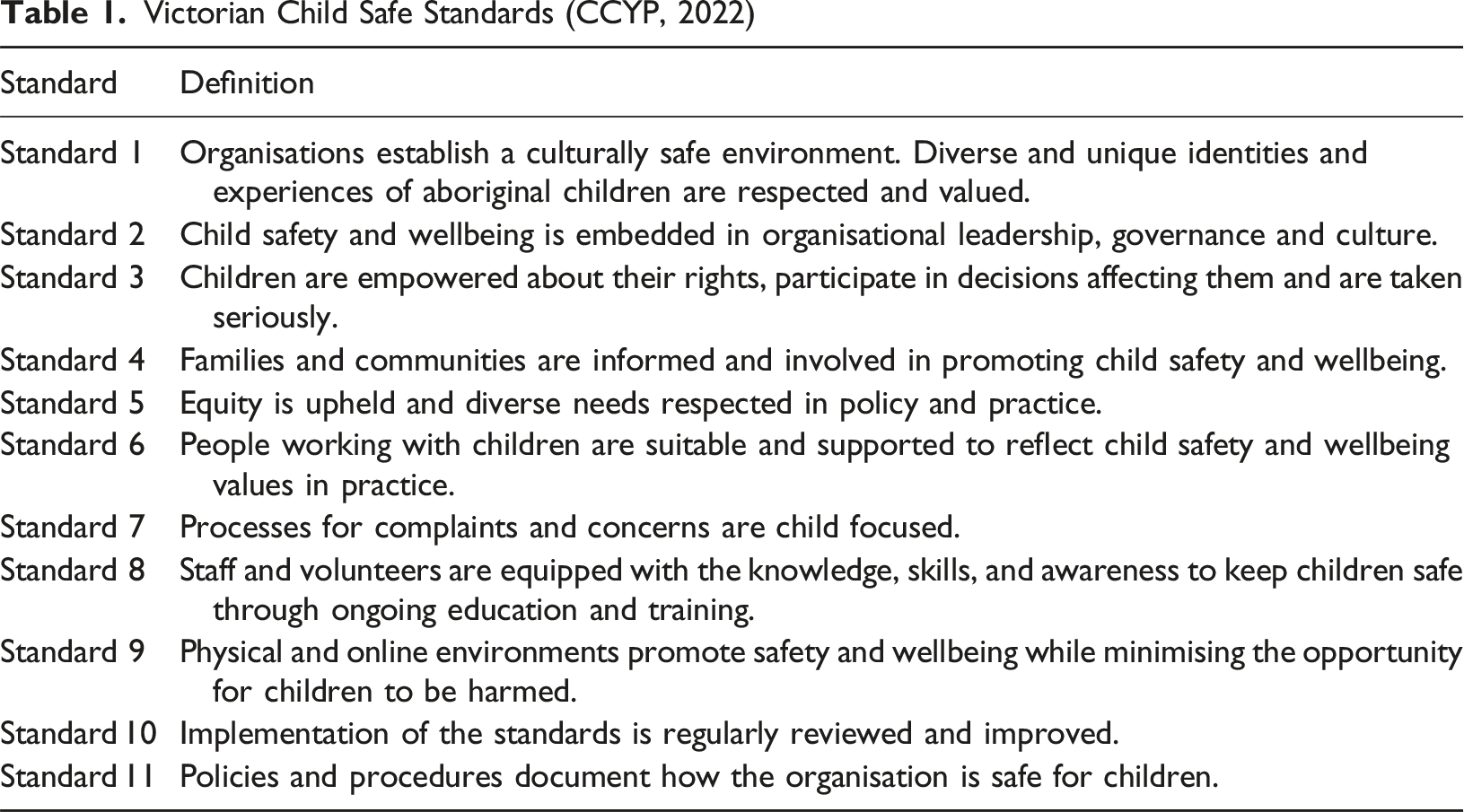
As reported by The Royal Commission (Royal Commission, 2017), Australian institutional responses to child abuse revealed persistent failures to prevent and respond appropriately to child abuse. Child abuse and neglect have lifelong negative impacts on survivors, including an increased likelihood of post-traumatic stress disorder (Demers et al., 2021; Finch et al., 2021). Research highlights the need to implement policies and protocols that guarantee child safety, as institutional responses can significantly influence the impact of such abuse, either mitigating or exacerbating its effects (Royal Commission, 2017). With the ongoing prevalence of child maltreatment in Australian institutions (CCYP, 2023), there is sufficient evidence to suggest deficiencies in organisational policy and practices. How the Standards may or may not support institutions to reduce child abuse, harm and neglect, particularly in ECEC settings, is important to study. The present study explores how ECEC professionals implement the Standards in policy and practice.
Despite the availability of resources for ECEC services (e.g., educational posters, templates and guidelines), there is a notable absence of research examining how professionals in the field implement the Standards. ECEC professionals play a key role in supporting children’s safety and wellbeing and are uniquely positioned to identify and respond to potential maltreatment. Studies indicate that having a well-developed framework or intervention is essential for effective implementation (particularly in health and learning settings); however, its effectiveness relies less on design and more on how it is applied in real-world settings (Albers et al., 2016; Francke et al., 2008). Competence is also closely tied to effectiveness, as those implementing a framework impact quality delivery (Durlak & DuPre, 2008). Specifically related to child abuse and neglect, Brunborg and colleagues (2024) identified low competence as a key barrier to ECEC professionals not reporting child maltreatment.
This study aims to fill the gap in literature on the implementation and effectiveness of the Standards in ECEC services by exploring how professionals understand and apply them. It also identifies successful practices, barriers to implementation, and the perceived efficacy of the Standards in promoting child safety. While previous research has examined ECEC educators’ roles in child protection (Walsh et al., 2023), this is the first study to focus on the Standards’ implementation in service policy and educator practice from ECEC professionals’ perspectives.
Method
Theoretical Framework
The United Nations Children’s Fund’s (UNICEF) Child Wellbeing Framework (Gromada et al., 2020) was used as the theoretical framework for this study. UNICEF’s Framework offers a multi-level framework with the child at the centre (see Figure 1), similar to Bronfenbrenner’s (1979) ecological theory of child development. However, UNICEF’s Framework offers a specific perspective on wellbeing, relevant to the intent of the Standards to support children’s safety and wellbeing (Commission for Children and Young People (CCYP), 2022). The Child Wellbeing Framework presents a holistic view of child wellbeing from multiple environmental levels. The concentric spheres of influence place wellbeing and safety outcomes for children at the heart, including health and academic outcomes, and subjective life-satisfaction perspectives of the child (Gromada et al., 2020). The present study focuses on the safety and wellbeing of children as impacted by the implementation of the Standards in ECEC settings, which can be viewed through the outer rings of the world of the child (activities and relationships), the world around the child (networks and resources) and the world at large (context and policies). In the present study, the world at large radiates outward from the Standards to policies including the National Principles for Child Safe Organisations and the CRC, and the context of global concerns for child health and safety in a polycrisis (Gromada et al., 2020; Lawrence et al., 2024). Multi-Level Child Wellbeing Framework. Reproduced With Permission From Gromada et al., 2020, p. 6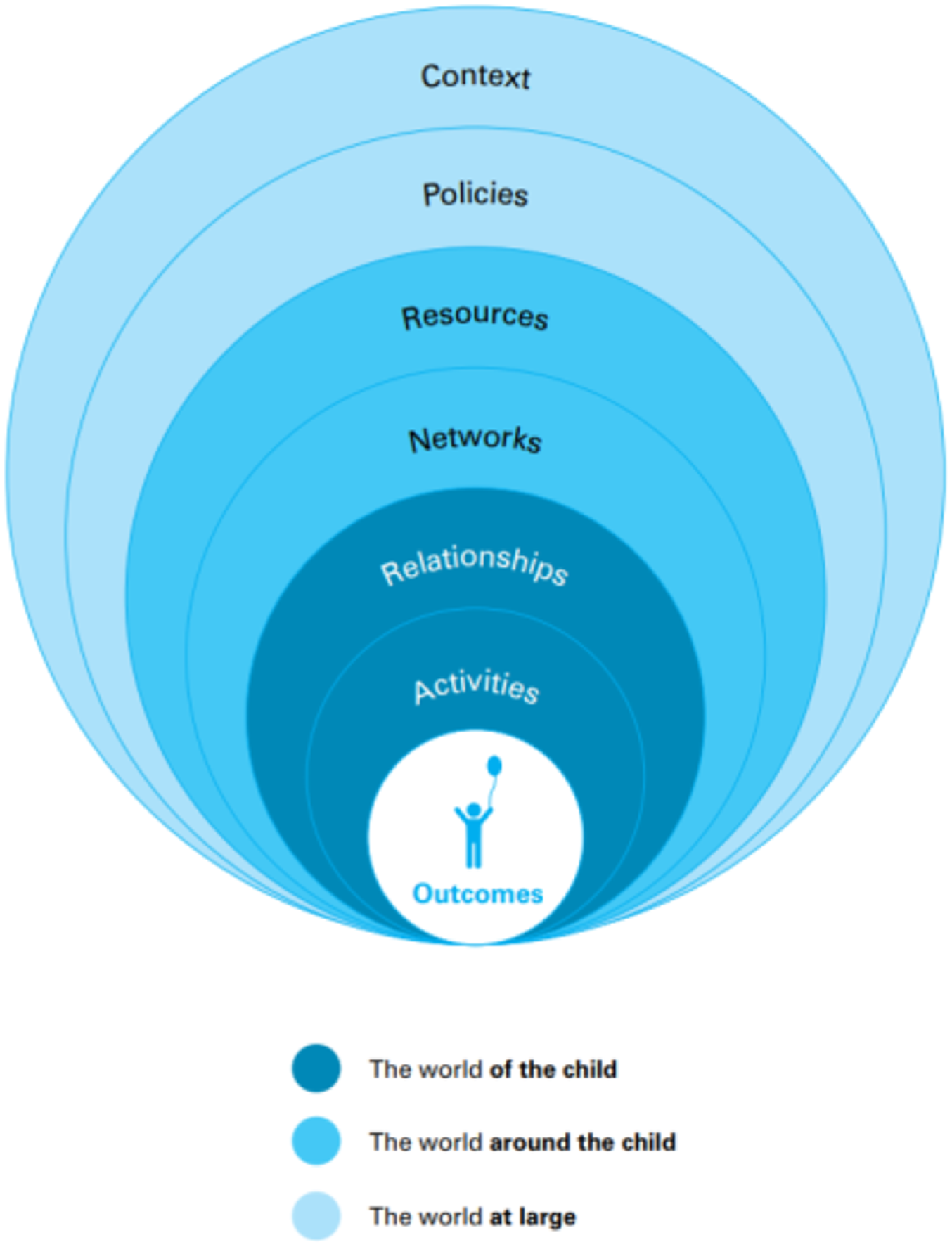
Methods
This mixed-methods study consisted of an online survey administered through Qualtrics and an optional online interview conducted via Zoom.
Online Survey
Questions regarding how participants understood and implemented the Standards in their ECEC setting were included through multiple-choice and open-response questions. For example, participants were asked about training they had undertaken, priorities at their service regarding the Standards, and barriers or successes. Responses informed questions for follow-up interviews.
Online Interview
Interviews aimed to better understand how each of the Standards was implemented in practice, what the barriers or misunderstandings might be, what impact participants believed there has been on policies and practices, and any gaps that need to be addressed. Interview questions focused on participants’ experiences and perspectives on implementing the Standards and how future implementation could be better supported.
Participants
Forty-eight participants were recruited for the online survey between July and September 2024 primarily via a professional research network of over 350 members working in ECEC across Australia. Participants were also recruited via relevant social media sites (e.g., LinkedIn). From the initial 48 survey participants, ten participants then took part in an online interview.
Survey Participants
Survey Participant Demographics
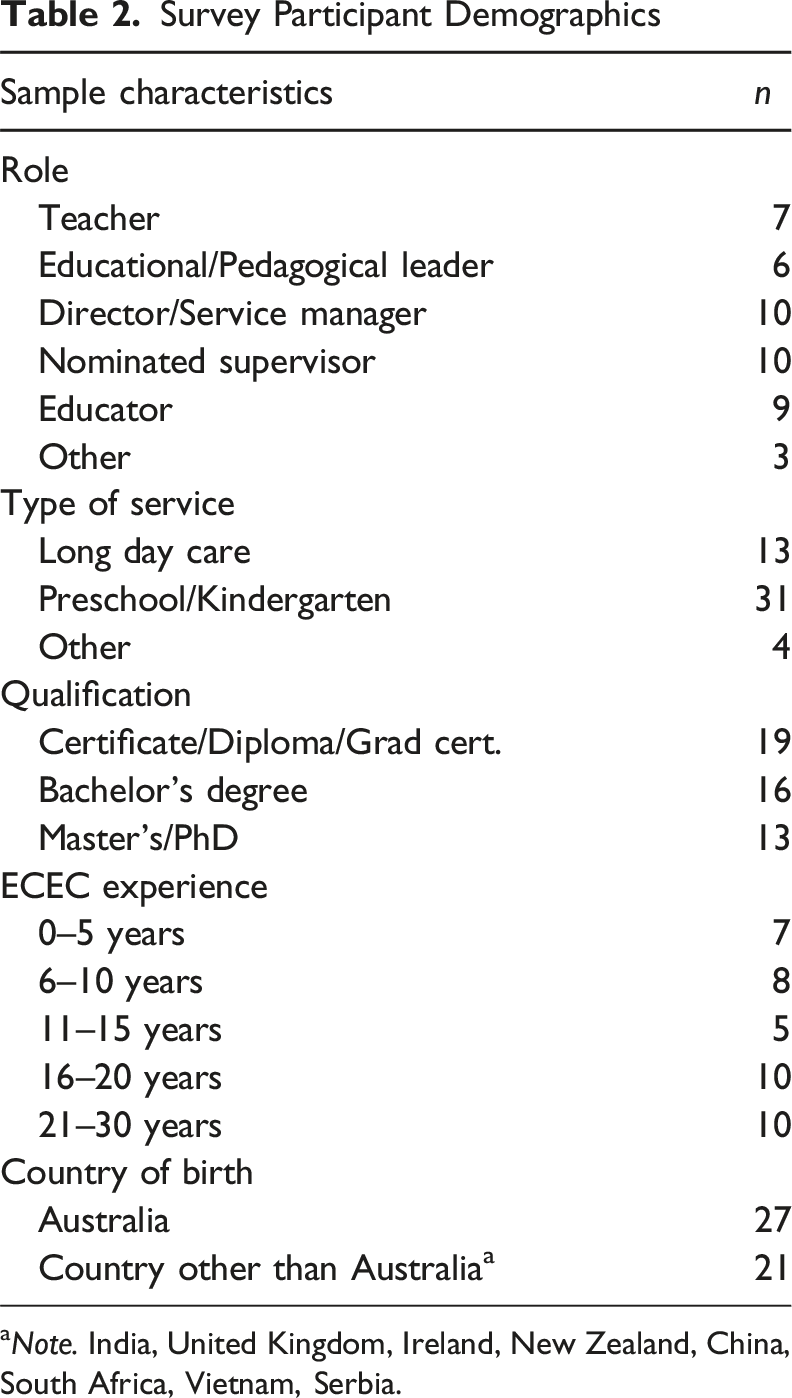
aNote. India, United Kingdom, Ireland, New Zealand, China, South Africa, Vietnam, Serbia.
Interview Participants
Interview participants reported being in their role for between 2.5 and 10 years. Roles included teachers, directors, pedagogical and educational leaders. Participants worked in metropolitan Melbourne and rural/regional areas across Victoria. Most interview participants oversaw or led the implementation of the Standards in their services.
Ethics
Ethics approval was obtained before participant recruitment (HREC Project ID 30188). Participants provided informed consent. No identifying participant information is included in this study.
Data Analysis
Qualitative analyses were guided by phenomenology, which posits that understanding others’ subjective experiences is valuable (Moustakas, 1994). Transcripts were analysed in NVivo, and thematic analysis (Braun & Clarke, 2022) was used to identify, analyse, and report patterns in the data. Rather than using a deductive approach, where frameworks and theory constrain the themes, an inductive analysis process was used to capture new, emerging themes. This approach ensured participants’ views and experiences were described without imposing preconceived categories.
Braun and Clarke’s (2022) six-phase inductive thematic analysis process guided the data analysis. Following data familiarisation, three researchers coded one transcript together to agree on an initial coding structure. Two researchers then coded a transcript independently, and the third researcher checked the coding. The three researchers then discussed and refined the initial coding structure. Next, the agreed-upon codes and definitions were used to independently code the final ten transcripts. The researchers met to discuss any discrepancies. The broader themes were then identified and defined and used to interpret the underlying meaning of the data. The researchers named and defined the themes, the order of the theme presentation and key quotes were selected for reporting.
We analysed the quantitative survey responses with a content analysis approach (Krippendorff, 2018). This method allowed us to systematically identify and categorise response patterns and examine frequency of responses for each response option. We report response patterns using percentages.
Findings
Survey Findings
Most participants (92%) reported that the Standards are “very important” in protecting children’s safety and wellbeing. Most participants (80%) reported feeling “very confident” or “confident”, compared to zero participants reporting they felt “not confident” in implementing the Standards. Participants generally found the Standards to be effectively implemented at their service, with 33% reporting they were implemented “very effectively”, 29% “effectively” and 38% “moderately effectively”.
The survey responses revealed that training was a key factor in implementing the Standards. Sixty percent of respondents had undertaken some formal training, however, 28% said they had not received formal training, and 12% were unsure. Training varied from one-off training (50%), ongoing training (17%), coaching or mentoring (17%), whole-service training (61%), individual (17%), and small group (22%) training. Many participants felt they required further training (40%), but some were unsure (28%). The results showed that training was the biggest priority for many services (44%), with a preference for a whole-of-service approach (26%). Most participants (72%) reported that visitors and volunteers at the service were not required to complete any training in the Standards.
Most participants (80%) reported some challenges in implementing the Standards. Barriers to implementation did exist, including “too many competing priorities” (60%), “lack of time” (60%), and “lack of awareness of Standards amongst colleagues and leadership team” and “lack of training” (32%). One participant (P9) reported, “The sector is under immense strain. I hold the safety and well-being of children with utmost importance, but we are expected to become experts in so many areas without time or support for ongoing learning.”
Survey findings also revealed children’s rights are being highlighted and actioned, evident when a participant (P30) stated, “There has been a shift in privacy rights for children around toileting and the use of photos in the program…”. Moreover, participants addressed an overall increased awareness of child safety, “the topic is at the forefront of our planning, discussions and reflections.” (P21)
Interview Findings
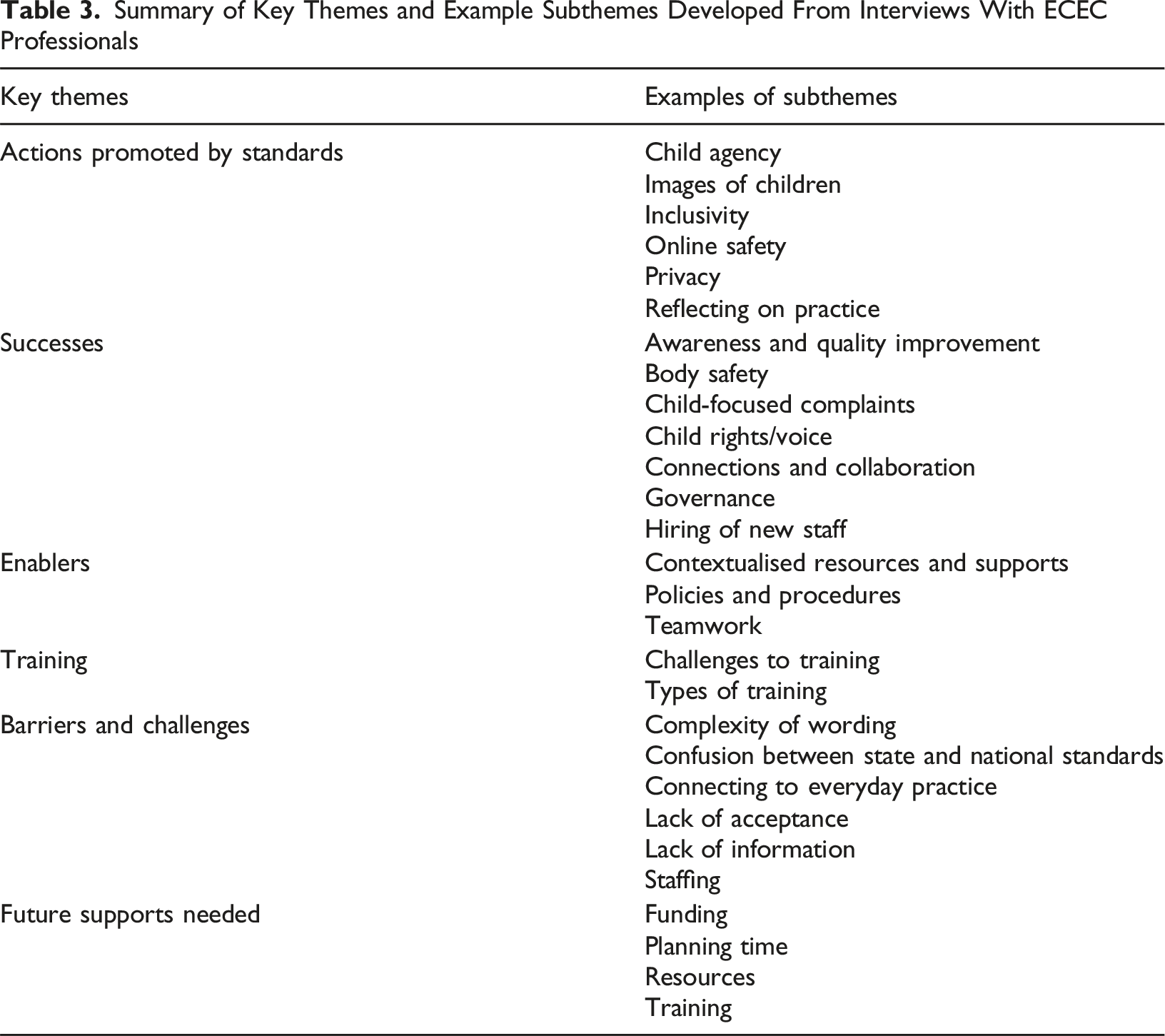
Summary of Key Themes and Example Subthemes Developed From Interviews With ECEC Professionals
Actions Prompted by Standards
Participants described various changes in their practice that were prompted by the Standards. The actions and the implementation of policies within ECEC services related to child agency, images of children, inclusivity, online safety, privacy, and reflecting on practice (see Table 3).
Child Agency
Participants described deliberate actions to increase child agency in their services, such as including children in discussions and decision making about safety procedures. One participant, for instance, said “. . . when we're doing [service] philosophies or documentation, we're taking the time to consult with children (to) try and find out what that looks like for them. As part of our strategic plan, one of our pillars is empowered children.” (P7)
Images of Children
Participants spoke about the Standards prompting changes in the way they used images of children in the educational program, which included gaining child assent in taking and using photographs. One participant described educator critical reflection: Instead of dumping a hundred photos up onto a digital platform, actually making considered choices about what they’re sharing and why. And consulting with children when we do. (P7)
Inclusivity
Some participants discussed the ways in which their service have taken action to promote inclusivity for children and families living with disability, Aboriginal and Torres Strait Islander families, LGBTQI+ families, and families from a variety of cultural backgrounds. For example, “We are taking measure(s) to make our centre as welcoming and approachable as possible so that when they come in, the moment they step in they get that sense of, oh, this is the centre we belong.” (P10)
One participant (P8) described actions for understanding families’ culture that were “beyond tokenistic”, “embedded and appropriate” for “all cultures within our space” while another participant (P9) gave the example of using inclusive language such as “special person’s day” instead of Mother’s or Father’s Day.
Online Safety
Participants shared how the Standards made them think more deeply about children’s safety in the online environment. One participant talked about how the Standards “prompted further review” of their “child safety curriculum” to address and discuss online safety issues with children; “If we’re using YouTube, talking about how we’re searching for and how things might come up that we’re not looking for. And what would we do in those situations?” (P1)
Privacy
Participants described how the Standards enabled actions, such as obtaining grants or permissions for installing privacy doors in children’s toilets to address safety issues and promote the privacy and safety of children. For instance; We had one child that was able to actively say why they weren’t using the toilets at kinder, and that was because they didn’t have doors like the ones at school do. And so I went to the committee . . . and . . . we looked into getting doors on the cubicles. . . so that it gave the children sort of that sense of privacy. (P9)
Reflecting on Practice
The Standards also provoked deeper consideration of whether participants were enacting child safe practices. This included reflections on how to ensure the Standards were implemented in contextually relevant ways (P8), and reviewing policies to ensure they were followed (P4). Another participant commented: I’m accountable and responsible for ensuring that the practices that we say that we do, really connect into child safety and take place. I make sure we’re constantly reflecting on this. It’s also my role to through those reflections see how we can continuously improve. (P8)
Successes
Participants were asked about what successes they had in relation to implementing the Standards, including any actions implemented resulting in favourable outcomes. Participants shared a range of successes, such as promoting online safety and child privacy, and promoting inclusivity, which were discussed in detail under the theme, “Actions prompted by Standards”. Additionally, other successes discussed included awareness and quality improvement, body safety, child-focused complaints, child rights/voice, connections and collaboration, governance and hiring of new staff (see Table 3).
Awareness and Quality Improvement
Participants spoke about how the Standards prompted greater awareness in their reflections about quality improvement by checking against the Standards. One participant reported: …we’re doing the 6 monthly sort of checks and that’s not just on the things that we’re working towards. It’s also checking on things we felt we were sort of meeting the standards, and how we can either make sure that we don't accidentally fall backwards. That we can keep moving forward and strengthening. (P7)
This same participant described the Standards as a framework that guided decision-making, and how such a framework provided clearer ideas for staff on what appropriate and child-safe behaviours looked like within services: I think it’s partly really given us the confidence to stick with the robust procedures that we've had, and to not back off on that but also given us that framework that . . . has guided a lot of the decisions we've made about professional development (P7)
Another participant (P1) described how the Standards assisted in identifying successes and gaps in promoting child safety, as well as areas in which staff needed further support and professional development.
Body Safety
Participants commented on the inclusion of activities and conversations within programs where children were taught and introduced to body safety issues. For instance, Body safety around, understanding what your needs are, and how you can articulate that and empower yourself to say that no, you don’t want a hug, that no, you need space from someone, and someone needs to respect that. (P8)
Child-Focused Complaints
The establishment of processes for families and staff to report any complaints regarding child safety issues was also reported: Now we do have a specific child safe standard complaint process in regards to if staff or educators have done something that another staff member [believes] is not within the child safe standards. We can report it and we also have a complaint process for families to report things as well. (P4)
Child Rights/Voice
Participants also commented on how they were successfully including children’s voices in decision-making for programs, as well as how the Standards were incorporated across their program. So, the child safe standards, particularly around children's voice and empowering them, …. we’re incorporating across the curriculum. They’re wanting to do things about how they're being safe with each other. Being able to articulate their thoughts and wishes with their friends if they’re wanting to do things or not. Just a lot of modelling and around that stuff. (P1)
One participant (P3) described how children were provided with “scripts” and “simple phrases” to empower them in speaking up and describing their emotions. Several participants described how the Standards prompted them to “think more deeply and act more authentically in terms of children’s rights” (P2), for instance, providing avenues for children to share their experiences in ECEC services and ensuring that children’s assent is sought for photo-taking and sharing of information.
Connections and Collaboration
Participants spoke about how the Standards promoted more connections and collaborations with other organisations and teams, such as allied health, Indigenous representatives, and inclusion support teams. We had a child that was in a wheelchair and had some developmental needs. We made sure that we reached out to the kinder inclusion support team and then within that team they were able to provide us with equipment and resources that would help our service to be better equipped for the child to make it more inclusive. (P9)
Governance
Successes in governance were also observed by some participants when cross-checking their policies, procedures and online environments against the Standards. One participant (P7) described a “very collaborative” culture of leadership and governance through consultation with people at all levels of the organisation and with children and with families as well. The Standards also provided “a helpful cross check for us in terms of governance thinking about policies, online environments, and so forth, and procedures around” (P7).
Hiring of New Staff
In the area of hiring new staff, one participant (P7) reported of robustness in their screening processes and how the Standards provided justification for their recruitment processes that conform with child safety regulations. Another participant (P4) described induction processes and training for new staff to ensure that the Standards are met.
Enablers
Participants discussed a variety of enablers and supports that promoted the successful implementation of the Standards in their service, including contextualised resources and supports, policies and procedures, and teamwork (see Table 3).
Contextualised Resources and Supports
Participants commented on resources they found helpful in enabling their thinking and understanding of child safety. Online resources on the Standards (such as videos and tip sheets) (P6; P1; P2), were mentioned as useful in guiding practice, as well as The Commission for Children and Young People (CCYP) website. One participant said, “But the CCYP website… often, it's one of those places you can really lose yourself in deep reflection. There's such good supportive material.” (P6)
Other participants mentioned resources such as self-sourced books (P2; P6), posters created by service providers (P8), and local Indigenous groups to help educators understand what culturally safe practice looked like (P3). Resources were also useful for promoting families’, children’s, and educators’ knowledge of child safety: We have the easy language guide on display in reception for families that’s framed, and it sits with our child safe standard display and reception. And I do use that for the team as well, I find it’s a very kind of accessible piece. (P2)
Another participant (P9) described the use of books and songs that were helpful for teaching children about body safety and boundaries.
Policies and Procedures
Some participants described how the Standards served as a guide for reflections and discussions on policies and procedures that their services were doing well, and areas for improvement. One participant noted how the Standards aligned with the National Quality Standards (NQS) for Australian ECEC services: …the child safe standards align beautifully with the NQS, which is great. So, there were things that we already knew that we were doing well. So, we've got that in our action plan. And then there are things that we need to do better. So that sort of forms the actions for us and then it looks even closer at each of those areas. (P6)
Teamwork
Good relationships and teamwork amongst staff in ECEC services contributed to successful implementation of the Standards, as described by one participant, “To continue the success, I truly believe (in) teamwork . . . We have built a good team already.” (P10)
Training
Participants described how ongoing professional development and training was important for their understanding and application of the Standards (see Table 3).
One participant (P3) said: “You actually need to attend a really good training first to understand what it does mean . . . and what it looks like in your service.” Training was particularly “helpful when we were first implementing the new standards” (P1). Website training resources with guides and examples on how to implement each standard were also found to be useful: …there were, as I said, examples on each standard, on what the assessors would want to see. That was the best training, in my opinion, that I’ve ever done because it was broken down into this is what we want to see. And I could write down . . . what am I already doing okay and I possibly might need to improve in. (P4)
Types of Training
Types of training varied across different ECEC services, including whole-of-service training that could be in the form of “online modules training developed in-house from their provider” (P5), online training with externally-sourced experts (P7), online training to be completed individually by all staff at a service (P4), or sharing of latest information and knowledge about the Standards by ECEC leaders or appointed personnel with their staff (P7, P10). Several participants (P9, P2, P4, P10) described having team trainings occurring at staff meetings or internally organised sessions, with some participants highlighting the importance of reflecting on various aspects of the Standards and how to implement them as a team. Participants also described induction training provided to new staff (P2).
Challenges to Training
There were, however, barriers to training raised. Participants who were in roles where they were responsible for leading the implementation of the Standards commented on how the resources and knowledge they obtained had to be self-sourced, for example “everything that I’ve learned I guess I’ve just done it through research.” (P6).
Some participants (P1, P6, P7) commented on a lack of training materials and clear documentation when the standards were revised in 2021: …at the beginning was that we didn’t have a lot of those resources when the standards came out that there was sort of a wait period. And I had to sort of cobble together some things to help us with that. (P7)
Not all participants experienced training within their ECEC organisations, and for one participant (P3) who worked in a regional service, online trainings such as webinars, were therefore useful. Other challenges included lack of motivation for training due to lack of funding: “…but because there’s no funding they don’t get paid to do the training. The staff often don’t want to do any further training unless there’s, you know, like they get paid for their time for doing the training.” (P3)
Areas identified by participants where further training was needed included cultural and body safety.
Barriers and Challenges
Although two interview participants stated that they had not experienced any barriers or challenges, most discussed a range of barriers and challenges to successful implementation of the Standards (see Table 3). These included a lack of acceptance from the whole community (for instance, in actions to promote inclusiveness in ECEC services), complexities in the wording of some of the Standards, connecting the Standards to everyday practice, a lack of information on how to implement the Standards, lack of consistent staffing, and confusion between state and national Standards.
Additionally, some participants indicated that capturing children’s voices had been challenging. For example, one participant stated, “So, it’s children and young people, and babies. So how can we adapt some of the language to make it more focused towards the children?” (P6)
Promoting cultural safety was also discussed by some participants as being challenging: We’ve been looking around cultural safety for Aboriginal children and young people attending the service. And we are not a very culturally diverse area where we provide the kinder. So, we find that sometimes there’s not that concrete example in terms of how we’re supporting Aboriginal children, young people in the service, and being culturally safe with them because we don’t have those cohorts. (P1)
Although some participants described the various ways their services communicated to families about the Standards, other participants identified challenges in promoting families’ input and communicating information about the Standards. For example, “I don’t think it’s being communicated to families particularly actively. We do have statements up at all services, we will communicate about particular things, but not necessarily explicitly linking it to the child safe standards.” (P7)
Finally, some participants discussed a disconnect between expectations and implementation, particularly when it came to being assessed. For example, Sometimes the disconnect between the very holistic embedded intention of the child safe standards and the way that it can be assessed. We’ve come across that, and I think that could be better supported by that shift in how the department assesses the progress. Because we’re not putting too much time and effort into educators remembering you know, Standard 1 to 11. It’s more about how it’s being done and if we do it at a really integrated way off the top of their head when they’re asked by an assessor. (P7)
Future Supports Needed
Participants identified a range of supports that would facilitate future implementation of the Standards (see Table 3). For example, some participants discussed that more funding for staff training in the Standards, as well as additional planning time and resources were needed. Specific strategies that were identified as potentially being useful included, resources that supported gaining family input, putting the Standards in simple and easy to understand language, sharing of ideas and information about implementing the Standards across services (e.g., through forums or social media) and increasing awareness of the Standards, and resources that allow services to track their progress on the implementation of each Standard. Finally, further training for all staff members, particularly refresher training, was identified as being needed, specifically training that was consistent, ongoing, and kept staff up to date with new information.
Discussion
This study has gained insights from ECEC professionals supporting children within uncertain and complex times and social systems. ECEC services are part of the world around the child, and the child’s world at large includes policies such as the Standards. These multiple, interconnected environmental layers impact children’s safety and wellbeing (Gromada et al., 2020). Using a mixed methods approach, this study aimed to explore ECEC professionals’ experiences implementing the Standards as a component of the ecological system of young children’s lives and wellbeing. This is the first study we know of collecting empirical data on this topic, and findings provide much needed evidence of success and effective practice, as well as challenges and barriers to implementing the Standards.
Findings indicated that most participants were confident in understanding and implementing the Standards, and felt they were effective in protecting the safety of children. However, barriers to implementation exist, and participants expressed the need for more formalized and ongoing training. Importantly, findings illustrated a wide range of actions taken and successful practices implemented because of the Standards, particularly in areas of ECEC professionals’ confidence, making children’s rights visible and the need for ongoing training.
Introduction and implementation of the Standards needed, and continues to require, ECEC professionals to make changes to policies and practices. Successful change or reform requires ‘buy-in’ from those responsible for the transformations. Research shows teachers have higher motivation for change when it aligns with their beliefs (Briggs et al., 2018). Participants in this study expressed motivation for introducing the required changes of the Standards, as they viewed them as important. Participants also reflected on practice, collaborated with others, took action and experienced successes in relation to implementing the Standards.
Change can also create feelings of anxiety and disempowerment due to the barriers of time pressure, increased workload and external accountability (Armstrong, 2023; Grant et al., 2016). These barriers were evident in the accounts of ECEC professionals in this study. However, confidence in their capability to successfully implement the Standards was high, suggesting their belief in the beneficial nature of changes from the Standards (Loo & Agbenyega, 2015). This study highlights effective changes to child safety practices in ECEC due to the Standards implementation, but further support is needed to increase professionals’ buy-in and motivation. While ECEC professionals work within various systems and policies for child wellbeing (Gromada et al., 2020), they need ongoing, targeted support to enact change. Conversely, factors that enhance ECEC teachers’ ability to navigate reform include viewing themselves as leaders and change agents (Lee et al., 2022), effective professional development (Garvis et al., 2013), practical strategies for pedagogical change (Blewitt et al., 2021), leadership training (Fenech, 2013), and self-initiated learning (Armstrong, 2023).
Change is supported by effective and targeted professional development (Garvis et al., 2013). ECEC professionals’ skills can be strengthened through building knowledge, practical strategies and self-initiated learning (Armstrong, 2023; Blewitt et al., 2021). While participants in this study reported training was a key factor in their implementation of the Standards, they also highlighted the need for further ongoing training. In a profession that is experiencing high stress and burnout (Stein et al., 2024), and whose work is diverse, complex and time consuming (Harrison et al., 2024), adding extra demands of training may be challenging. Thus, accessible, streamlined, whole-of service approaches to ongoing training may reduce the burden on ECE professionals.
The main objectives of the Standards, apart from embedding safety and accountability, are to create a culture of inclusion and to empower children (Victorian Government, 2024). Of particular interest in this study were the actions reported by participants that specifically targeted children’s privacy and agency. These actions align with the Victorian Early Years Learning and Development Framework and Early Years Learning Framework, which promote children’s agency and their positions in society as rights holders and active participants (Australian Government Department of Education, 2022; Department of Education and Training & Victorian Curriculum Assessment Authority, 2016). Furthermore, children’s rights to be considered and heard are recognised internationally through the Convention on the Rights of the Child (United Nations, 1989). This study has elucidated tangible ways these macro-level world at large contexts and policy can inform and influence the relationships and world around the child, and therefore children’s rights, safety and wellbeing (Gromada et al., 2020). Moreover, listening to children and enacting their ideas and voice in ECEC requires respectful, safe and participatory environments (Mesquita, 2022). In making seemingly small and daily changes to practice, such as installing toilet doors and re-thinking the taking and usage of children’s photographs, ECEC professionals in this study not only traverse and enact the ecological layers of child wellbeing but empower and foreground children’s rights and voices. The nuanced, child-focused and real-world actions taken by ECEC professionals to hear the concerns of children and prioritise their wellbeing, make visible both respect and the affordance of rights.
Conclusion
There are some limitations to this study. Although the survey participants were diverse in terms of roles, ages of children worked with, qualifications, and experience, the sample was relatively small, which limits generalisability. Additionally, children’s and families’ perspectives on the Standards were not included. Despite these limitations, the current study offers a new contribution to an evolving area of research examining ECEC professionals’ experiences implementing the Victorian Child Safe Standards and therefore have implications for practice and future research. Findings revealed that training on the Standards can be both a challenge and enabler, highlighting the need for the development of additional resources and support mechanisms for ECEC professionals, with the potential to improve compliance with the Standards. Findings also highlight innovative examples of how the Standards have been interpreted by ECEC professionals, which have resulted in effective and tangible practices to support the safety and wellbeing of children. Future research could focus on evaluating the effectiveness of training for implementation of the Standards, as well as including children’s and families’ perspectives. For ECEC professionals who operate as a nexus in the ecology of policy, practice and affordances of children’s rights, safety and voice, sharing of their perspectives and everyday successes is welcome and timely.
Footnotes
Acknowledgements
Thank you to the participants who generously contributed their time to this study and to Nicole Talarico for valuable input into the study.

Ethical Approval
Ethical approval for this study was obtained from the University of Melbourne Human Research Ethics committee (HREC Application no 2024-30188).
Informed Consent
Written informed consent was obtained for anonymised participant information to be published in this article.
Funding
The authors disclosed receipt of the following financial support for the research, authorship, and/or publication of this article: This study was supported by the Faculty of Education (FoE) Early Childhood Funding 2024.
Declaration of Conflicting Interests
The authors declared no potential conflicts of interest with respect to the research, authorship, and/or publication of this article.