



Abstract
The revised Australian Early Years Learning Framework (EYLF) places greater emphasis on assessment as learning (AaL), however there is limited research exploring AaL practices in Australian ECE services, particularly with consideration to the impact of digital documentation. This qualitative study, undertaken as an Honours research project, adopted the Mosaic approach in exploring children’s perspectives on and experiences with AaL in centres that utilise digital documentation. Findings revealed that while children may be afforded some opportunities to contribute to and revisit their assessment documentation, their experiences typically fall short of educators’ reported practice and EYLF expectations. Though differences between paper-based and digital documentation formats that influence children’s AaL experiences are highlighted, educators’ intentionality and understanding of AaL are identified as vital to fostering and promoting children’s AaL opportunities and experiences.
Keywords
Introduction
Observation and assessment of children’s learning, development and wellbeing are longstanding, key practices that support responsive curriculum in early childhood education (ECE). Internationally, many ECE curriculum documents require educators to document assessment information about children as a basis for planning (Ministry of Education, Singapore, 2022; New Zealand Ministry of Education [NZMOE], 2017; Finnish National Agency for Education, 2022). In Australia, the National Quality Framework (NQF) mandates that pedagogical practice is driven by the assessment and planning cycle which includes collecting and analysing information about children’s learning and development before planning, implementing, and evaluating the educational program (Australian Children’s Education and Care Quality Authority [ACECQA], 2024). Each stage of the assessment and planning cycle must be documented as evidence that a “planned and reflective approach” is taken in “implementing the program for each child” (ACECQA, 2024, p. 139).
Recently, international curriculums have promoted assessment processes that are participatory and meaningful to children. For example, New Zealand’s Te Whāriki, highlights the benefits of self-assessment when children are afforded opportunities to revisit their documentation (NZMOE, 2017). Likewise, Singapore’s Nurturing Early Learners advises teachers to make children’s learning visible to them, thereby providing opportunities for children to “revisit and reflect on their learning experience” (Ministry of Education, 2022, p. 88). In Australia, the release of the revised Early Years Learning Framework (EYLF) in 2022, signaled a shift in assessment practice to more clearly emphasise three types of assessment - assessment “for children’s learning” otherwise known as formative assessment, assessment “of children’s learning” otherwise known as summative assessment, and assessment “as learning” (AaL) (AGDE, 2022, p. 25). AaL emphasises children’s voices and aims to “facilitate children’s awareness, contributions and appreciation of their own learning” (AGDE, 2022, p. 25). When children are involved in assessment, it becomes a learning experience that supports their developing understanding of their own learning processes and identities as learners (Arthur et al., 2024; Carr, 2001). Promoting children’s contributions to assessment is founded on the premise that children are rights-holders and competent agents.
While the revised EYLF places greater emphasis on AaL, there is limited research exploring AaL practices in Australian ECE services, particularly with consideration to the impact of digital documentation. This paper reports on findings from a qualitative study that investigated children’s experiences with AaL, firstly through seeking to understand educators’ AaL practices and secondly through investigating children’s perspectives on their assessment documentation and experiences.
Assessment as Learning in ECE
Originally developed in higher education, AaL expands the assessing role of teachers to include students as active participants in evaluating their own learning (Baird et al., 2017; Dann, 2002; Earl, 2013). AaL is defined as a process where students reflect on their learning and adjust their understanding based on personal monitoring of their learning (Earl, 2013). While AaL has been more explored in schools and universities, emerging ECE literature is beginning to define and contextualise its relevance and application (Arthur et al., 2024; Margrain et al., 2022; McLachlan et al., 2023; Yılmaz et al., 2021). In ECE settings, AaL is increasingly understood as a participatory assessment process that involves children in documenting learning, capturing their contributions to assessment, and fostering awareness and appreciation of their own learning (Arthur et al., 2024; McLachlan et al., 2023).
Although the term “AaL” is not commonly used in ECE, its principles are embedded in several pedagogical approaches. For example, the internationally influential pedagogical documentation practiced by the educators of Reggio Emilia in Italy emphasises children’s reflection on and self-assessment of learning (Rinaldi, 2005) as they “revisit previous experiences” through documentation to “observe how their skills and competencies have developed” (Thornton & Brunton, 2015, p. 113). Carr’s (2001) learning story approach to documentation emphasises the active involvement of children throughout the assessment process, underscoring the importance of “seeking the perspectives of the learner” (p. 92). Equally significant are opportunities for children to revisit their learning stories, allowing them to reflect on their learning experiences and shaping their identities as learners (Carr, 2011; Carr & Lee, 2019). Despite a limited focus specifically on AaL, the ECE literature highlights benefits related to two integral dimensions of AaL - firstly children’s contributions to assessment and documentation processes, and secondly their access to revisit assessment documentation afterwards.
Contributing to assessment documentation has benefits for children’s learning, cognitive development and the construction of learner identities (Basford & Bath, 2014; Carr, 2011; Carr & Lee, 2012; Pascal & Bertram, 2016; Rinaldi, 2005). Rinaldi (2005) suggests that when children are involved in assessment, they represent their learning to others as well as to themselves, observing themselves from an external angle from which their learning can be modified and enriched. Basford and Bath (2014) describe this as a metacognitive process in which children become “aware of how they are learning” (p. 120). Pettersson’s (2020) study found that when children were involved in the documentation process through drawing, they were enabled to extend their previous learning and take it in a new direction, developing what the EYLF describes as understandings about “what they like to learn” (AGDE, 2022, p. 25).
Opportunities for children to revisit their assessment documentation later is also an important dimension of AaL which promotes children’s reflection on their learning processes and identities as learners (Bath, 2012; Carr, 2011; Rinaldi, 2005; Sousa, 2019; Yılmaz et al., 2021). Carr (2011) found that revisiting documentation promoted learning conversations between children and educators where children were able to “retrace the past” and “evaluate the achievement” (p. 267). In revisiting, children are able to examine their previous learning, developing self-assessment and reflective skills (Rinaldi, 2005; Yılmaz et al., 2021), and metacognitive thinking (Pyle et al., 2020). This process was characterised by Sousa (2019) as children’s discovery of themselves “as learners in learning” (p. 381).
Accessibility of documentation is an important prerequisite for young children’s revisiting. Rinaldi (2005) describes the Reggio Emilia approach to pedagogical documentation as the visualisation of children’s learning processes where the legibility of documentation to young children is emphasized in order to offer children opportunities for reflection and learning (Rinaldi, 2005). In ECE, documentation has traditionally been presented in paper formats such as portfolios (Klenowski, 2010), documentation panels or wall displays (Thornton & Brunton, 2015), and talking and thinking floorbooks (Warden, 2015). The accessibility of paper-based documentation was evident in Carr’s (2011, p. 261) research when children “spontaneously picked them up” and “reviewed the stories” (Carr, 2011, p. 261). However, as digital documentation becomes increasingly adopted in ECE services, its impact on children’s participation with and access to their assessment documentation remains unclear and warrants further research.
Assessment as Learning in the Context of Digital Documentation
Over the past decade, there has been a significant shift in documentation practices from paper-based to digital documentation using platforms specifically designed for ECE (Beaumont-Bates, 2017; Cowan & Flewitt, 2021; Goodman & Cherrington, 2017; Hooker, 2019; Kervin et al., 2023; Nuttall et al., 2023). Introduced as an enhancement to traditional paper-based documentation (Goodman & Cherrington, 2017), digital documentation has transformed educators’ documentation practices (Cowan & Flewitt, 2021; Gallagher, 2018). Digital documentation is accessible on a variety of devices including computers, tablets and phones; supports multimedia such as photos, video, and audio recordings; and includes instant messaging functions between services, educators and families (Beaumont-Bates, 2017; Goodman & Cherrington, 2017; Stratigos & Fenech, 2021). Despite an apparently rapid uptake of digital documentation in ECE, research exploring the impact on the experiences of educators, families and children is still emerging (Beaumont-Bates, 2017; Cowan & Flewitt, 2021; Hooker, 2019; Kervin et al., 2023).
The limited literature reveals both supports and barriers to children’s contributions to digital assessment documentation. On the one hand, the multimodality of digital technology affords opportunities for very young children to contribute to assessment documentation (Goodman & Cherrington, 2017; Hooker, 2019; Kervin et al., 2023; Knauf & Lepold, 2021). For example, research from New Zealand found children contributed by taking (Goodman & Cherrington, 2017) and selecting (Hooker, 2019) photos to add to their documentation. Hooker (2019) found children had greater opportunities to be involved in digital assessment when educators documented alongside children which did not happen with paper-based portfolios. On the other hand, research has identified potential challenges to children’s contributions related to digital documentation. Concerns have been raised about the degree to which children can be engaged to use digital apps (Harrison et al., 2019) and White et al. (2021) reported that despite voice recording functionality, educators found it challenging to incorporate children’s voices through audio recording into documentation.
In relation to revisiting digital documentation, the literature again identifies both supports and barriers. Cowan and Flewitt’s (2021) study found that digital documentation is highly accessible for children given the audio and visual capability and some children were found to be “keen to watch videos” and engage “intently” with documentation (p. 13). However, research also identifies variability in digital documentation accessibility and frequency of children accessing it (Cowan & Flewitt, 2021; Goodman & Cherrington, 2017). Distinct from paper-based documentation, digital documentation requires children’s access to digital devices to access and revisit assessment documentation. Goodman and Cherrington’s (2017) survey found 82% of participating settings provided digital documentation access for children. However, Cowan and Flewitt’s (2021) study revealed that the adult-oriented design of the digital platform presented challenges for children to navigate. As such, the accessibility of digital documentation for young children remains unclear.
A parallel provision of both digital and paper-based documentation was reported in some studies. Nearly two-thirds of the services in Goodman and Cherrington’s (2017) survey kept both digital and paper-based documentation. This duplication may result from the perception of digital documentation as a tool to communicate with parents rather than collaborate with children (White et al., 2021) and which predominantly serves the needs of adults rather than children (Stratigos & Fenech, 2021). As such, children’s voices may be absent from digital documentation. Following a literature review about digital documentation in ECE, Stratigos and Fenech (2021, p. 27) cautioned that digital documentation may position children as “passive subjects to be observed, written about, viewed and shared, rather than as active participants in the construction and documentation of their learning” and called for urgent research attention to ethical digital documentation practices that support children’s rights. In response to this call and the limited research exploring the impact of digital documentation on AaL practices, this study aimed to investigate children’s experiences and perspectives on AaL in the context of both paper-based and digital documentation. The key research questions were: • Do children contribute to their assessment documentation? If so, in what ways? And what are children's perspectives on the assessment and documentation process? • Do children have access to revisit their assessment documentation in the service? If so, in what ways? And what are children’s perspectives on revisiting documentation? • What enables and constrains children’s AaL experiences?
Methodology
This study adopted an interpretivist paradigm, recognising that both children and educators construct meanings based on their lived experiences within the ECE settings (Lather, 2006; Merriam & Tisdell, 2015). In alignment with this perspective, the Mosaic approach provided a framework for listening to children’s perspectives, positioning them as experts in their own lives who are capable of actively constructing and communicating meaning (Clark, 2017). Both interpretivism and the Mosaic approach share a commitment to understanding experience from the perspectives of participants and to valuing multiple, contextually situated realities. This integration supports a polyvocal exploration of experience, while also attending to the diverse ways in which children and educators express, perceive, and interpret their worlds. Ethics approval was obtained from the University of Sydney Human Research Ethics Committee (2023/096).
Participants
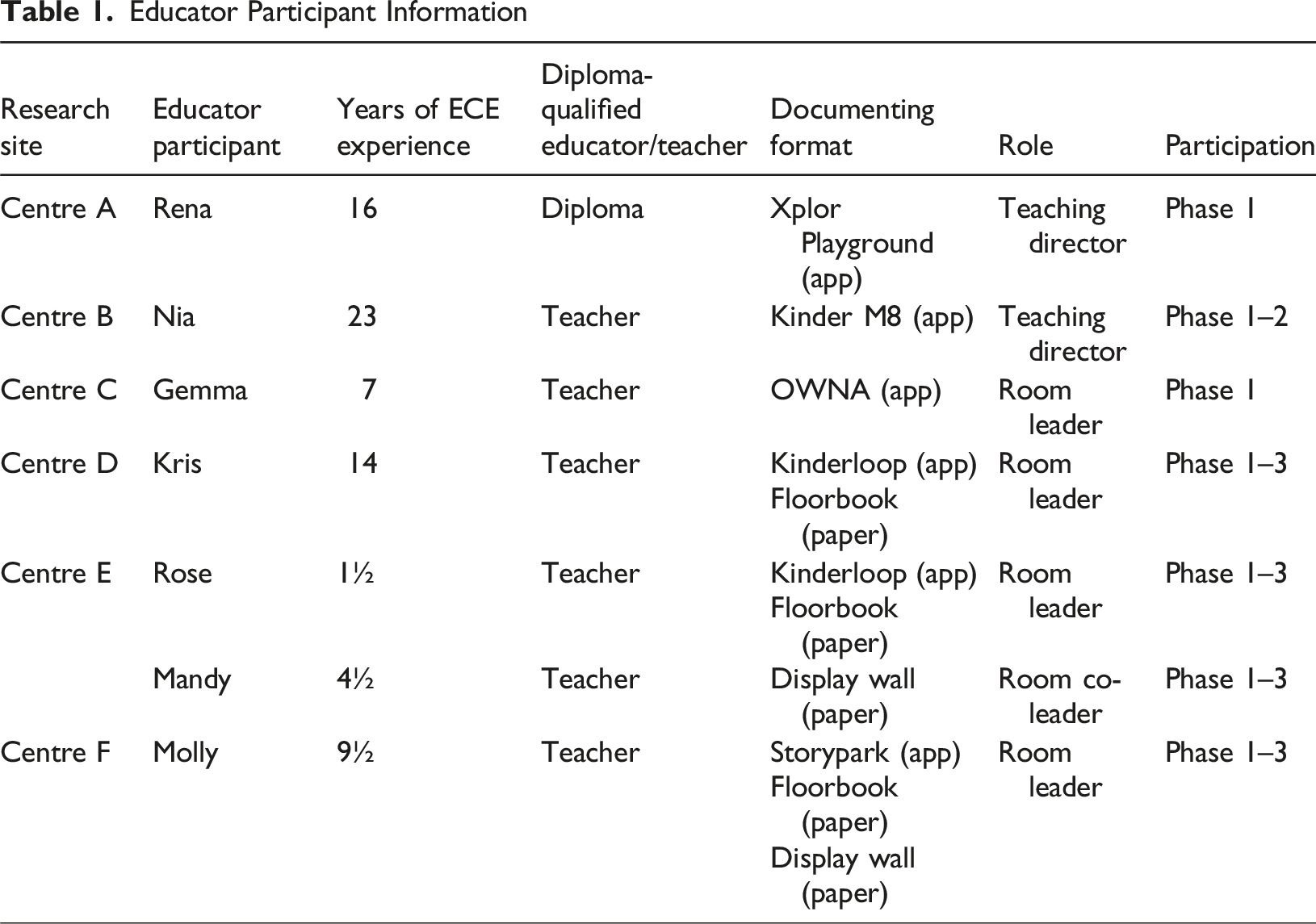
Educator Participant Information
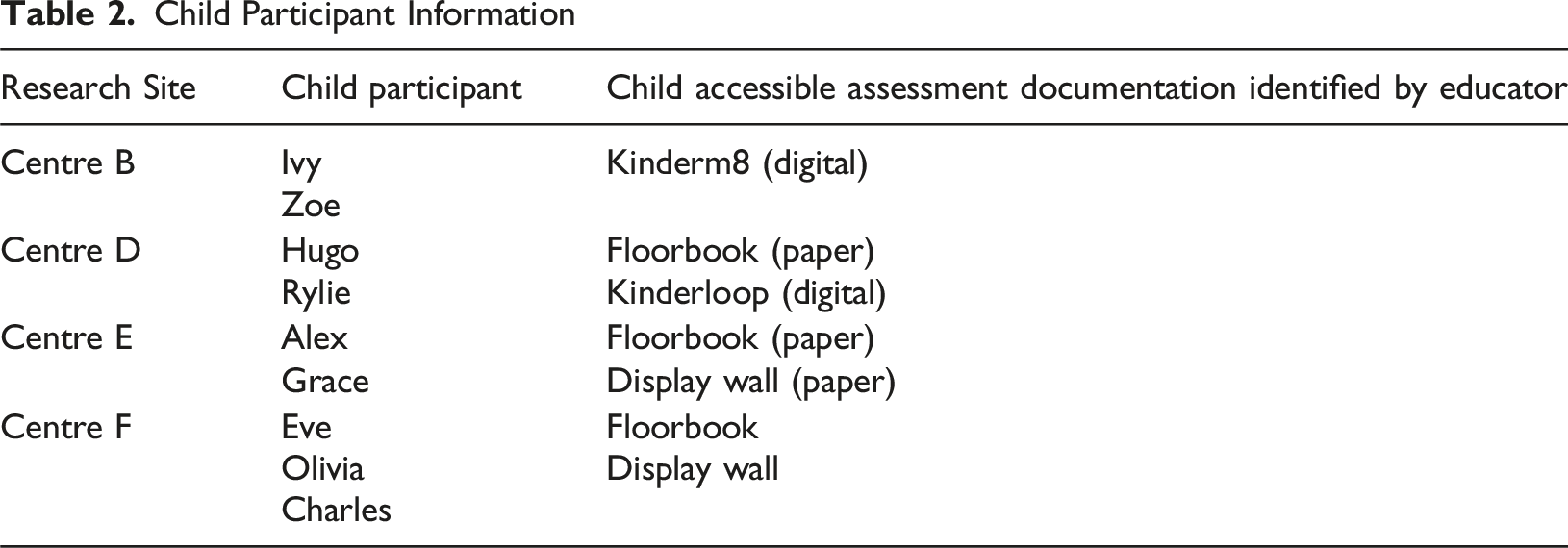
Child Participant Information
Data Collection
Drawing on the Mosaic approach, which integrates multiple methods to explore children’s lived experiences, the study employed a three-phase data generation process with both educators and children. (1) Interviews with educators: semi-structured individual or focus-group interviews were conducted at each service to explore educators’ perspectives and practices regarding AaL. While the focus of the study was on children’s experiences, the Mosaic approach recognises the value of insights from adults familiar with children’s lives, without undervaluing children’s own voices (Beasley et al., 2021; Castilla, 2025; Clark, 2017). As educators shape the conditions for children’s AaL opportunities, their perspectives were essential. (2) Child-led tours: in four of the six participating services—where educators indicated that children had access to their documentation—children guided the researcher on a tour of their assessment documentation. Rooted in the Mosaic approach, child-led tours are a way of listening where children direct both the content and the flow (Clark, 2017). While typically used to explore physical environments (Beasley et al., 2021; Clark, 2017), this study adapted the method to focus on children’s documentation. Children shared pieces of assessment documentation of their own choice, with open-ended prompts used to elicit their perspectives. Tours differed from interviews in their mobility and child-led structure, allowing for a more dynamic form of communication, where the researcher learns from more than the spoken words but every subtle choice that children make as they direct the tour (Sæther et al., 2024). Tours were audio recorded, and supported with field notes and reflective journals to capture both verbal and non-verbal expressions. (3) Data-prompted interviews with educators: these interviews invited educators to reflect on and interpret children’s perspectives shared during the tours (Kwasnicka et al., 2015). The Mosaic approach indicates that revisiting children’s perspectives with familiar adults can deepen interpretation by drawing on their knowledge of the child (Clark, 2017; Waters-Davies et al., 2023). Following an initial data analysis of children’s tours, prompts were identified and used in interviews at three of the four services continuing into phase three. Centre C withdrew due to a COVID-19 outbreak after completing phase two.
Data Analysis
Data were analysed using Braun et al. (2019) six-stage reflexive thematic analysis to identify patterns of meaning across the dataset. The process was as follows: (1) Familiarisation: Familiarisation began during the transcription process, enabling initial engagement with the data. This was followed by repeated reading of the transcripts to deepen understanding. (2) Generate codes: Codes were developed and refined through an iterative process, where new codes emerged from the data while existing codes were simultaneously applied to relevant segments. (3) Construct themes: The first author reviewed the codes generated and collated similar codes into potential themes. (4) Revise themes: The second author joined in reviewing and refining the thematic structure. Discussion helped clarify relationships between codes and led to the identification of four overarching themes. (5) Define themes: Each theme was further refined by reviewing associated coded data to determine the central organising concepts. Theme names were then developed to capture their essence. (6) Produce the report: The analysis was linked back to the research questions and situated within the broader literature to produce the final report.
Findings and Discussion
The findings are organised under four themes: (i) Children’s AaL experiences shaped by documentation format; (ii) Children’s positive experiences; (iii) Educator misunderstandings about AaL; and (iv) Educator intentionality matters.
Children’s AaL Experiences Shaped by Documentation Format
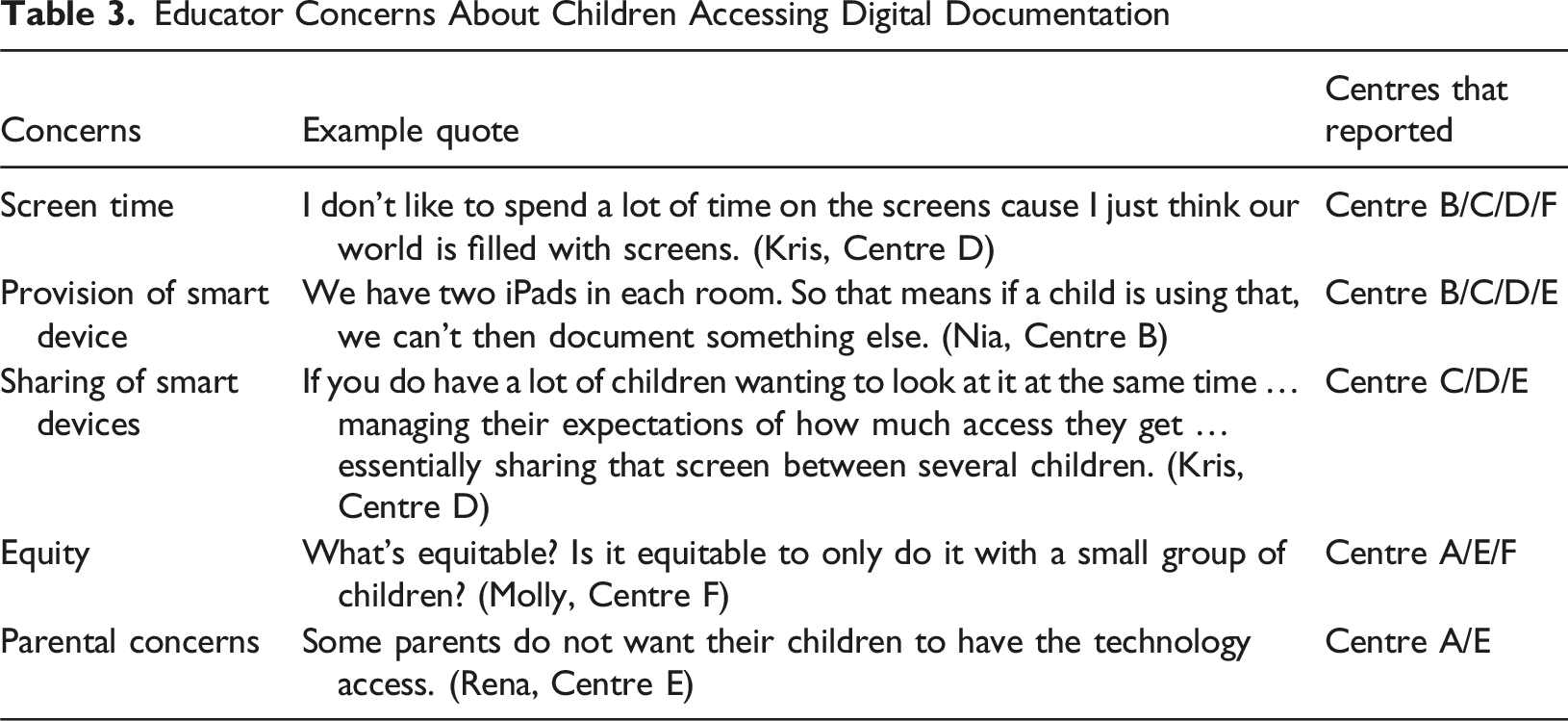
Educators believed children’s AaL opportunities were shaped by the choice of documentation format. While all six centres used digital documentation, three also maintained paper-based formats (see Table 1). Educators from these centres perceived paper-based documentation to be more accessible for children, consistent with previous research findings (Goodman & Cherrington, 2017): The paper-based is probably more easier access for the children … they know where they (floorbooks) are and they know they can access them when they like. (Kris, Educator, Centre D)
Educator Concerns About Children Accessing Digital Documentation
Opportunities to Contribute
Educators (except at Centre A) reported various methods through which children contributed to both digital and paper-based documentation (Tables 4 and 5). Children’s contributions to paper-based formats were described as tactile and physical: It’s a more tactile thing … they can help you stick the things in the book … draw on it … carry it around. (Molly, Educator, Centre F) Educator Reports of Children’s Contribution to Paper-Based Assessment Documentation Educator Reports of Children’s Contribution to Digital Assessment Documentation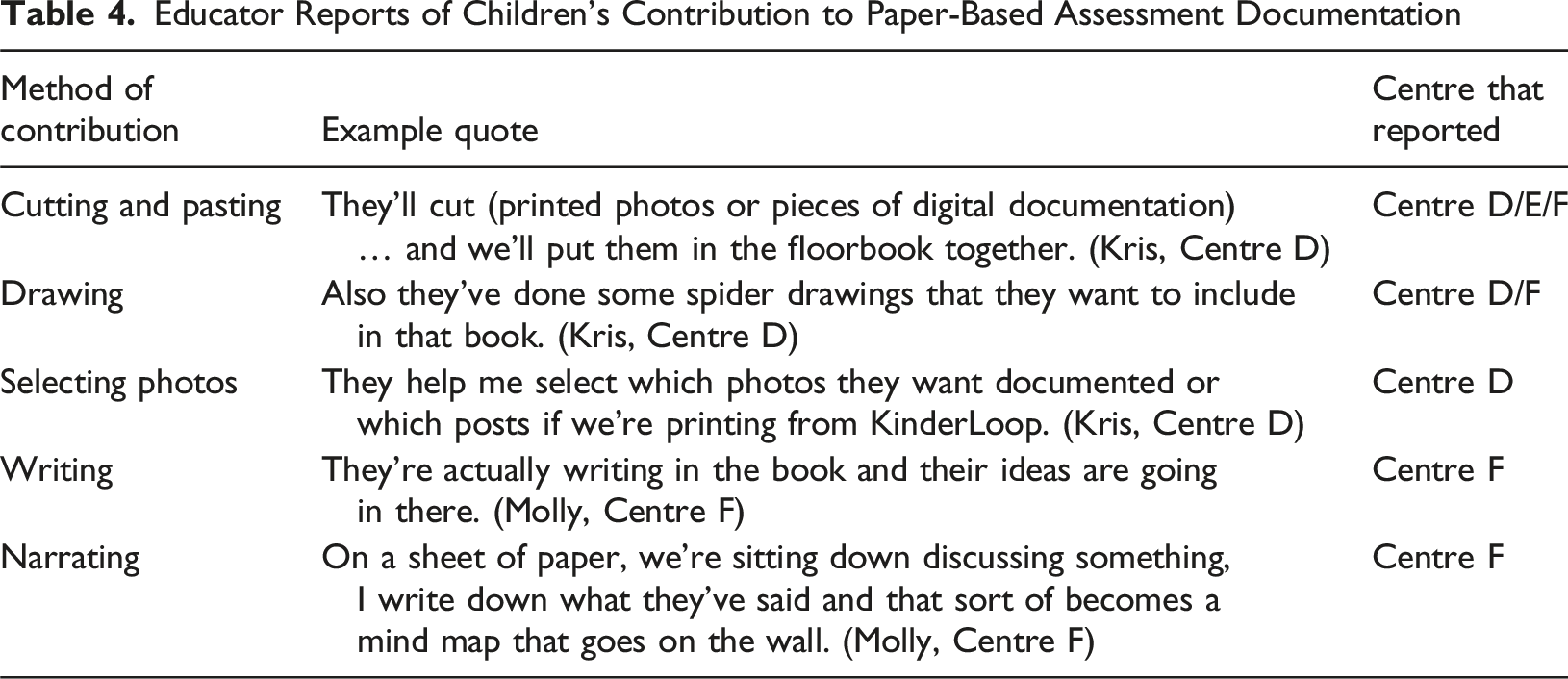
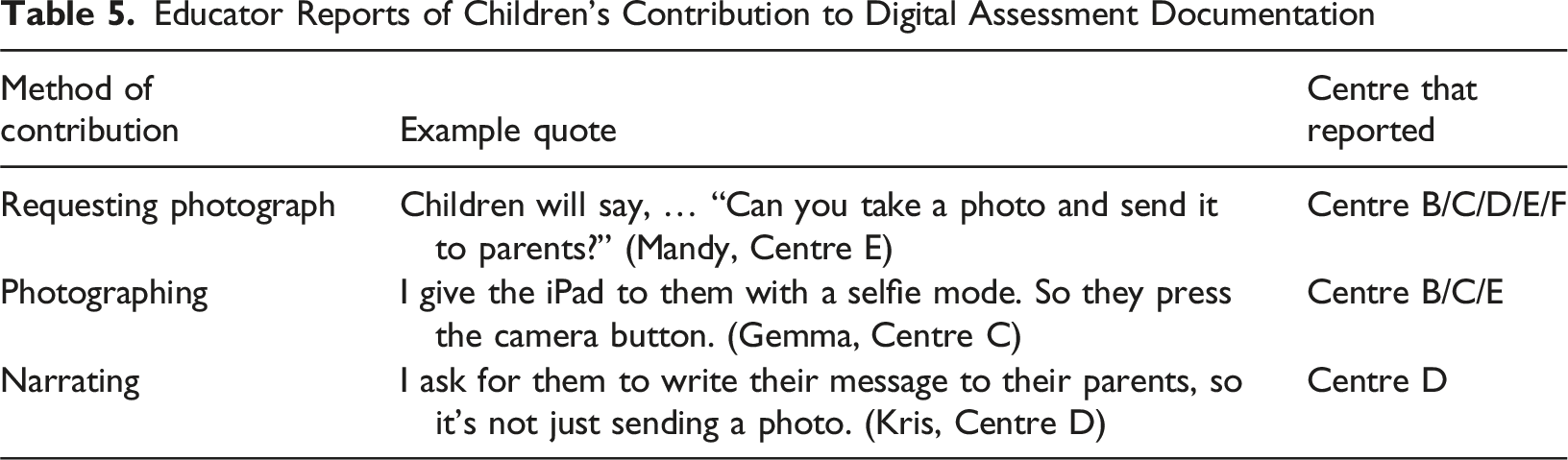
In contrast, digital contributions were often visual with children requesting or taking photos, echoing Goodman and Cherrington’s (2017) finding that photography was the most common form of child eportfolio contribution. Although photos were used in both formats, child requests for photographs were only reported in digital documentation: Particularly these children have gone through the service knowing that Kinderloop exists and how Kinderloop works as a communication technology … If they’ve done a drawing that they want their mum and dad to see, they’ll ask for us to take photos. (Kris, Educator, Centre D)
Educators also described children narrating messages or using the camera independently. However, descriptions of digital contributions often centred on communication with parents, rather than reflection on learning, consistent with previous research findings (Kervin et al., 2023; Stratigos & Fenech, 2021; White et al., 2021).
During child-led tours, children spoke proudly about their contributions: Sometimes I take photos. (Alex, Child, Centre E) Hey, I think I draw that one … Yeah, I draw this one. (Hugo, Child, Centre D) This is my picture (drawing on the wall) … I tried to write my name. (Charles, Child, Centre F)
However, some children’s accounts contrasted with educators’ reports: Did you help with choosing the photos, or cutting photos out? Or sticking photos in? (The Researcher) No. Molly [educator] did that. (Eve, Child, Centre F)
While most educators reported children contributed to documentation, these opportunities were limited in scope and rarely supported reflection on learning. Digital formats appeared to offer fewer methods of contribution, with photography dominating and few services prompting for children’s thoughts. Though more methods were described for paper-based formats, children’s accounts indicated that such opportunities were not consistently made available. This reflects a gap between current practice and EYLF expectations, which suggest that children’s contributions should help them “reflect on their learning and develop an understanding of themselves as learners, what they like to learn, and how they learn best” (AGDE, 2022, p. 25).
Opportunities to Revisit
Problems Experienced During Child-Led Tours of Digital Documentation
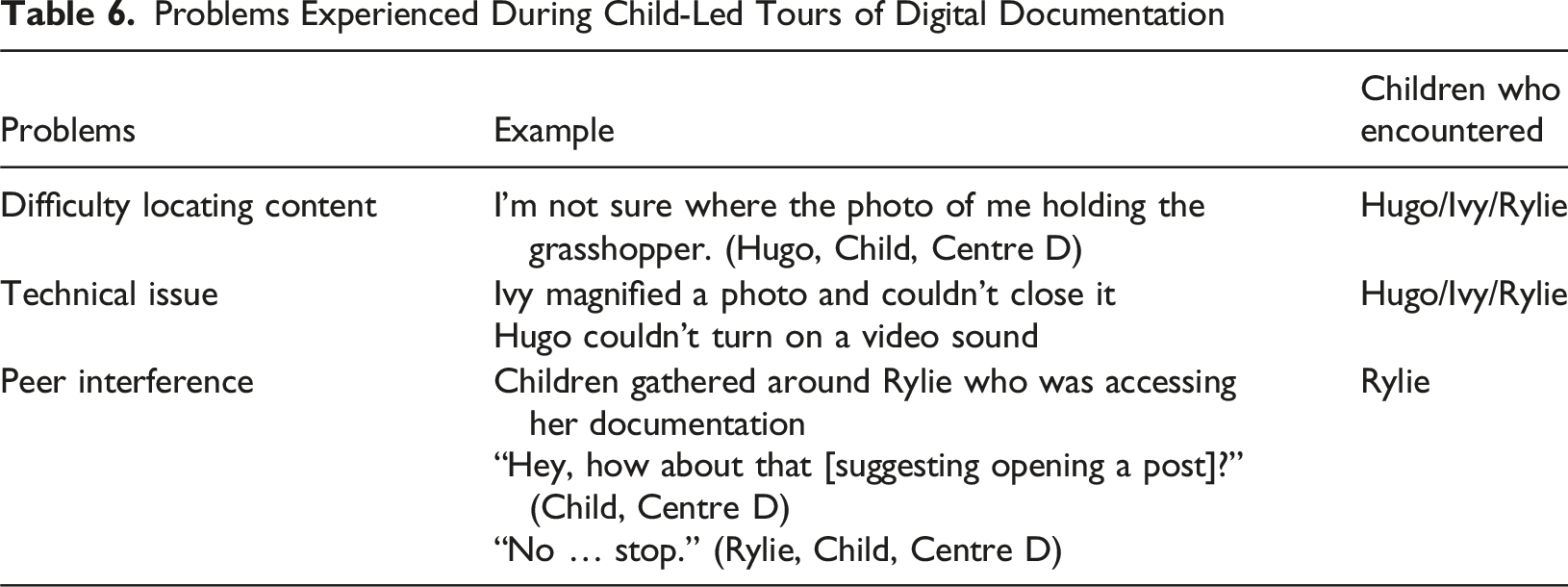
The challenges observed during child-led tours suggest that digital documentation can undermine children’s opportunities to revisit their learning unless educators provide intentional support. This aligns with Wahlgren’s (2024) findings that children often depend on adults to interact with digital documentation. However, multimodal elements such as videos were appealing to children—consistent with Cowan and Flewitt (2021).
Paper-based documentation was reportedly accessible in all three centres using it, but children’s accounts told a different story. In Centre E, Georgia appeared unfamiliar with the floorbook, which was stored above the lockers. Alex confirmed: We don’t look at it (the floorbook). (Alex, Child, Centre E) You don’t really look at it? Not very often? (Researcher) No we only look at the front (cover). (Alex)
Similarly, children at Centre F reported little revisiting experience: Do you look at this book very often? (Researcher) No. Never. It’s our first time. (Eve) Is it the same for you, Olivia? Have you read this book before? (Researcher) No. (Olivia, Child, Centre F)
Positioning of paper-based documentation was revealed as an important factor that influenced children’s revisiting experiences. In Centre D, children could access floorbooks independently at any time, allowing for autonomous revisiting experiences. In the data-prompted interviews, Mandy from Centre E, reflected that she might have constrained children’s access to the floorbook by placing it away from them due to concerns of it getting damaged. Similarly, Molly from Centre F also considered the positioning of floorbooks and suggested educators could be more proactive in facilitating children’s revisiting experiences. Notably, educators in these centres reported intentionally choosing to keep floorbooks in order to provide access for children. Similar to digital documentation, this finding suggests that without educators’ intentional support and reflection, even with the seemingly more accessible paper format, children could still miss opportunities to revisit their assessment documentation.
Children’s Positive Experiences
Children across all services expressed enjoyment during the revisiting process, regardless of format. While revisiting, children engaged in a range of activities. Most commonly, children recalled past experiences with enthusiasm and demonstrated awareness of their learning: We were sorting the colour in the box. (Ivy, Centre B) I was measuring animal. (Hugo, Centre D) We painted our hands. We put the rainbow colours. And then we print it. (Grace, Centre E)
Peer interaction occurred in six of the nine children’s tours. Children gathered around when one child was giving a tour, conversing and sharing perspectives about the documented happenings. Despite some children not having access to their documentation before, they still enjoyed revisiting it with their peers. Recreating learning experiences was less common, demonstrated only by Hugo and Riley. During Hugo’s tour of the floorbook, he was provoked by the collected drawings to repeat the drawing experience. During Riley’s tour of the app, she was reminded by a video of a group dance and started to hum and recreate some of the movements. Reflecting on learning was rare, with Hugo being the only child who reflected on his learning and demonstrated his knowledge of the learning process: That was my practicing turn. So, that’s why it wasn’t pretty good. (Hugo, Child, Centre D) I am supposed to say red light when I turn around … but I did it wrong. (Hugo, Child, Centre D)
Hugo’s reflections were all prompted by videos, supporting the idea that digital formats can aid comprehension through multimodality (Knauf & Lepold, 2021).
Educator Misunderstandings About AaL
Educators in five of the six centres demonstrated misunderstandings about AaL. In four centres, educators appeared to confuse AaL with formative assessment, Rena (Centre A) explained that because the curriculum was initiated by children and based upon their learning, children were “indirectly—participating in assessment”. Gemma (Centre C) expressed a similar sentiment: We have educators’ input, parents’ input, community links and everything, but our observations are based on children’s learning, so that’s kind of their way of input in their learning and documenting.
Some educators also equated gaining permission with AaL: We ask them, “Do you want us to take photos?” “Do you want us to write about it?” We’re asking them for their permission. (Nia, Centre B)
While asking children’s permission is an ethical practice, it does not in itself constitute AaL. The examples described by these educators suggest little or no meaningful involvement or contribution from children which can hardly be seen as AaL given the lack of any real opportunities for children to develop awareness of or reflect on their learning. This finding echoed Cameron et al.’s (2018) study, where only 12% of respondents to a survey in New Zealand gave an accurate description of AaL. Educator misunderstandings about what constitutes AaL, while understandable given the relatively recent inclusion of AaL in the revised EYLF, puts opportunities for children to engage with AaL at risk and suggests the sector may benefit from professional development in this area.
Educator Intentionality Matters
Educator intentionality emerged as a key factor shaping children’s AaL experiences. As discussed above, Centre D was the only setting where children confirmed their contributions and access to assessment documentation, both paper-based and digital, as reported by the educator. While floorbooks were used specifically to record children’s project-based learning, educators mostly documented digitally on a daily basis. Centre D educators intentionally documented while on-the-floor, affording children opportunities to see and engage in the documentation process and inviting children’s contributions to digital documentation: They obviously see us writing and sometimes we’ll ask for their input while we’re writing about the day. (Kris, ECT, Centre D)
In this way, Kris and other educators in the service were able to intentionally seek children’s perspectives while documenting and support children to become familiar with the use of the digital platform. As such, a culture of children engaging with their documentation and assessment processes was built in Centre D. Notably, challenges of digital documentation access were both reported by educators and experienced by children during their tours in Centre D (see Tables 3 and 6), highlighting the importance of educators’ intentionality in alleviating the inherent limitations of this documentation format. This also resonates with previous findings (Goodman & Cherrington, 2017; Hooker, 2019) that despite challenges presented in revisiting digital documentation, it is possible with appropriate planning and equipment.
In many of the participating services, an apparent lack of educator intentionality to support children’s AaL was identified, undermining children’s opportunities to contribute to or revisit their assessment documentation. The lack of educator intentionality may have resulted in different AaL opportunities being experienced by different child participants within the same setting. For example, Georgia in Centre E could not identify any contribution to the floorbook during the tour, which contrasted with Alex’s experiences. This difference was discussed in the follow-up interview with the educators, who explained: Georgia actually has less input. For Alex, he’s more taking initiative. And then Georgia is not so active as Alex. So I think just different personality … (Mandy, Educator, Centre E)
The lack of opportunities for some children to engage in the assessment and documentation processes should not be simply attributed to their different ways of being. Instead, educators have a responsibility to reflect on their practice and intentionally support all children’s AaL experiences through an individualised approach. This further reinforces the call for professional learning on the benefits and practice of AaL.
Limitations
This Honours research was limited in scope, exploring the perspectives of seven educators and nine children on assessment as learning at one point in time. Future studies may benefit from a broader range of participants, opportunities to understand AaL practices over time, observational methods that explore AaL practices in a naturalistic way, or AaL experiences for younger children. Limitations also lie in the recruitment of child participants who were nominated by educators potentially introducing selection bias by favouring children perceived as more articulate or engaged with documentation, and thereby shaping the perspectives captured in the study.
Conclusion
Since the inclusion of AaL as a key practice in the revised EYLF, this is the first known study to explore children’s experiences and perspectives of AaL in Australian ECE settings. While children in some ECE services may have some opportunities to contribute to and revisit their assessment documentation, their experiences typically fall short of educator reports and EYLF expectations. While documentation format - paper-based or digital - influenced children’s AaL opportunities, educator reflection and intentionality were identified as key to improving children’s access to AaL experiences. Importantly, educator misunderstandings about Aal were identified pointing to the need for professional development to build awareness of the benefits of AaL and the intentional practices that can promote it with consideration to different documentation formats. The findings of this study contribute to the emerging body of research about AaL in ECE, and, importantly, add children’s voices to the conversation.
Footnotes

Funding
The authors received no financial support for the research, authorship, and/or publication of this article.
Declaration of Conflicting Interests
The authors declared no potential conflicts of interests with respect to the research, authorship, and/or publication of this article.