




Abstract
Early childhood education (ECE) is an ideal environment to promote risky play. To date, few studies have explored ECE educators’ perceptions of risky play for children birth to 3 years. Therefore, the aim of this study was to explore educators’ perceptions of risky play in ECE for children birth to 3 years. Eight participants from 7 different ECE services across New South Wales and the Northern Territory, Australia, participated in semi-structured interviews. Interviews were conducted via Zoom, using a predetermined script. Data were analysed using deductive thematic analysis and guided by Social Ecological Theory. Microsystem factors (e.g., the ECE setting, educators’ knowledge, attitude and experience) and mesosystem factors (e.g., relationships between educators, children and families) were the main factors identified as being important. This study highlights important factors in risky play for children birth to 3 years.
Introduction
Risky play is a form of play that is exploratory and challenging with unpredictable outcomes. It is diverse in nature but can be catalogued into nine broad categories: (1) Play with great heights; (2) Play with high speed; (3) Play with dangerous tools; (4) Play near dangerous elements; (5) Rough and-tumble play; (6) Play where the children can ‘disappear’/get lost; (7) Play with impact; (8) Vicarious play; and (9) Play near risky elements (Sandseter, Sando, & Kleppe, 2021). Risky play is recognised, internationally, as a key form of children’s play in early childhood as it develops children’s coordination, balance, perceptual and spatial awareness, fine and gross motor skills and helps to build children’s cognitive, social, and emotional skills (LeMasters & Vandermaas-Peeler, 2023; Sandseter, Sando, & Kleppe, 2021; Spencer et al., 2021).
Risky Play and Early Childhood Education
Early childhood education (ECE) settings provide a unique environment for the promotion of risky play and thus risky play is intentionally included in national and international ECE curricula and related policy documents. For example, the New Zealand Early Childhood Curriculum, Te Whāriki suggests that children attending ECE should regularly participate in risky play that involves heights, speed, tests of strengths and the use of real tools (Ministry of Education New Zealand, 2017, p. 28). Likewise, early childhood curriculums from Scotland and Norway encourage children to evaluate and master risky play through physical challenges. (Ministry of Education and Research, 2017; Scotland Government, 2018). The Australian Early Years Learning Framework (V2.0) also highlights the importance of risky play (Australian Government Department of Education (AGDE), 2022). Outcomes 1 and 3 suggest that children should be encouraged to take considered risks and that educators should provide environments that are well-planned and challenging thus encouraging risk taking and risky play experiences (AGDE, 2022). The Early Childhood Australia Statement on Play further supports the participation of risky play for young children and highlights the importance of vigorous activities that incorporate elements of risk taking and risky play (Early Childhood Australia, 2023).
Early Childhood Educators’ Perceptions of Risky Play
Early childhood educators play a critical role in the provision and facilitation of risky play in ECE settings. Thus, several studies have explored educators’ perceptions of risky play in ECE settings (Brussoni et al., 2015; Little et al., 2012; Liu & Birkeland, 2022; Sandseter, 2012, 2014; Tsujitani, 2023; Višnjić Jevtić et al., 2022). These studies highlight perceived educator- and ECE-related factors which facilitate or hinder risky play in ECE settings. Perceived educator-related factors which influence risky play in ECE settings include, but not exclusively, the philosophy, cultural values and attitudes of educators (Brussoni et al., 2015; Liu & Birkeland, 2022; Višnjić Jevtić et al., 2022), qualifications and professional development of educators (Višnjić Jevtić et al., 2022), sex of the educators (Sandseter, 2014); and educators’ childhood experiences (Tsujitani, 2023). Specifically, educators that have higher qualifications (i.e., degree qualified) or have had positive personal experiences with risky play and outdoor play or are male are more likely to promote and facilitate risky play experiences in ECE settings. Conversely, educators who are afraid that children may injure themselves during risky play are less likely to promote risky play in ECE settings. Perceived ECE-related factors highlighted by educators include the philosophy of the setting (Speldewinde et al., 2023), the setting type and ages of children that attend (Kemp & Josephidou, 2021; McFarland & Laird, 2018) and the outdoor environment and regulatory requirements that the setting adheres to (Little et al., 2012).
In addition to the forementioned studies, other studies have explored educators’ perceptions of the benefits of risky play in ECE settings. Educators suggest that risky play in ECE settings promotes balance, stability, fine and gross motor skills, as well as strengthening social and emotional skills and overall well-being (Sando & Mehus, 2021). However, most studies which have explored educators’ perceptions of risky play focus on children 3 to 5 years. While these studies provide important knowledge and understanding to the field, research is also needed which explores educators’ perceptions of risky play for younger children (i.e., birth to 3 years).
Risky Play for Children Birth to 3 Years
Few studies to date have explored risky play in ECE settings for children aged birth to 3; most of which focus on features and affordances of the environment for risky play or how young children assess the environment for risky play. For example, Kleppe et al. (2017, 2018a) explored the characteristics of risky play for young children and the affordances of the ECE environment which facilitate risky play for children aged birth to 3 years. Their studies highlighted different characteristics of risky play for children aged 2–3 years compared to children under 2 years and aspects of the environments (such as versability and flexibility) that are potentially important for risky play for children aged birth to 3 years. Quinones (2023) recently explored how the outdoor environment enables or constrains infants’ risky play practices and Tangen et al. (2022) explored how toddlers can assess and manage risks in challenging natural environments. Little (2022) employed a case study design and explored the influence of a redesign in an outdoor environment on toddler’s play behaviours and their educators’ attitudes and responses to children’s risky play. Specifically, their study showed that despite initial concern, educators were supportive of the new environment and the environment afforded opportunities for diverse play including risky play.
The Current Study
To date, very few studies have explored educators’ perceptions of risky play for children aged birth to 3 years (Chaney, 2018; Kybartas et al., 2024). However, these studies only included one ECE settings and involved very few educators. Thus it is important to further explore educators’ perceptions of risky play for children aged birth to 3 years as they are often the gate keepers of risky play and either encourage or discourage children to participate in risky play. Therefore, the aim of this research was to explore educators’ perceptions of risky play specifically for children aged birth to 3 years within an Australian context.
Methods
Data for this qualitative case study were collected through semi structured interviews. Eight participants (i.e., ECE educators) were purposefully recruited (Kervin et al., 2023) from seven ECE services in New South Wales and Northern Territory, Australia. All participants were employed in either long-day care services (extended opening hours) or preschools (reduced opening hours). Semi structured interviews were conducted over Zoom (20–30 min each). The interviews, comprising 18 pre-prepared questions, provided an opportunity for participants to talk broadly about their perspectives, reflections, attitudes, and practices pertaining to risky play for children aged birth to 3 years. Examples of interview questions included ‘Can you please provide some examples of what risky play in an ECE setting might look like for children aged birth to 3 years?’, ‘What do you see are some the benefits/challenges of risky play for children aged birth to 3 years?’, ‘What factors do you think influence risky play for children aged birth to 3 years in ECE settings?’ The interviews were conducted by the main researcher (NB) and transcribed verbatim using the Office 365 transcription function. Each transcript was closely checked with the audiovisual file to ensure accuracy. The reliability and validity of the data was ensured through member checking (Kervin et al., 2023). Prior to data analysis, data were anonymised to ensure confidentiality.
Data were deductively analysed using the six-phase approach as described Braun and Clarke (2006). The interview transcripts were reviewed individually by each researcher (NB, KT, RJ). Each researcher independently noted initial ideas and then generated initial codes. Codes were then collated by individual researchers to form themes. Coded themes and sub-themes were then compared and discussed until consensus was achieved. Deductive data analysis was informed by Bronfenbrenner’s Socioecological Theory, which suggests that children develop within a complex, interrelated systems of environments (microsystem, mesosystem, exosystem, macrosystem and chronosystem) (Bronfenbrenner, 1979), and within these systems there are a range of elements that directly and indirectly impact children, their learning and development (Hayes et al., 2022). The microsystem, mesosystem and exosystem were the focus of this study. The microsystem involves the immediate elements surrounding the child such as age, sex, family characteristics, ECE settings, neighbourhood, peers and/or socioeconomic status (Bronfenbrenner, 1979; Robinson et al., 2018), while the mesosystem describes the connections and interactions between the elements in the microsystem (Bronfenbrenner, 1979; Feriver et al., 2022). The exosystem comprises elements further removed from the child such as parental employment or governing organisations (Kearns, 2010), and although children do not directly engage with these elements, they still have the potential to impact children through the influence they may have across systems.
Data were collected between May and July 2023 and data were collected until saturation was reached (Kervin et al., 2023). Ethics approval for this project was obtained through the XXX Human Research Ethics Committee (2023/049).
Results
Participant Demographics
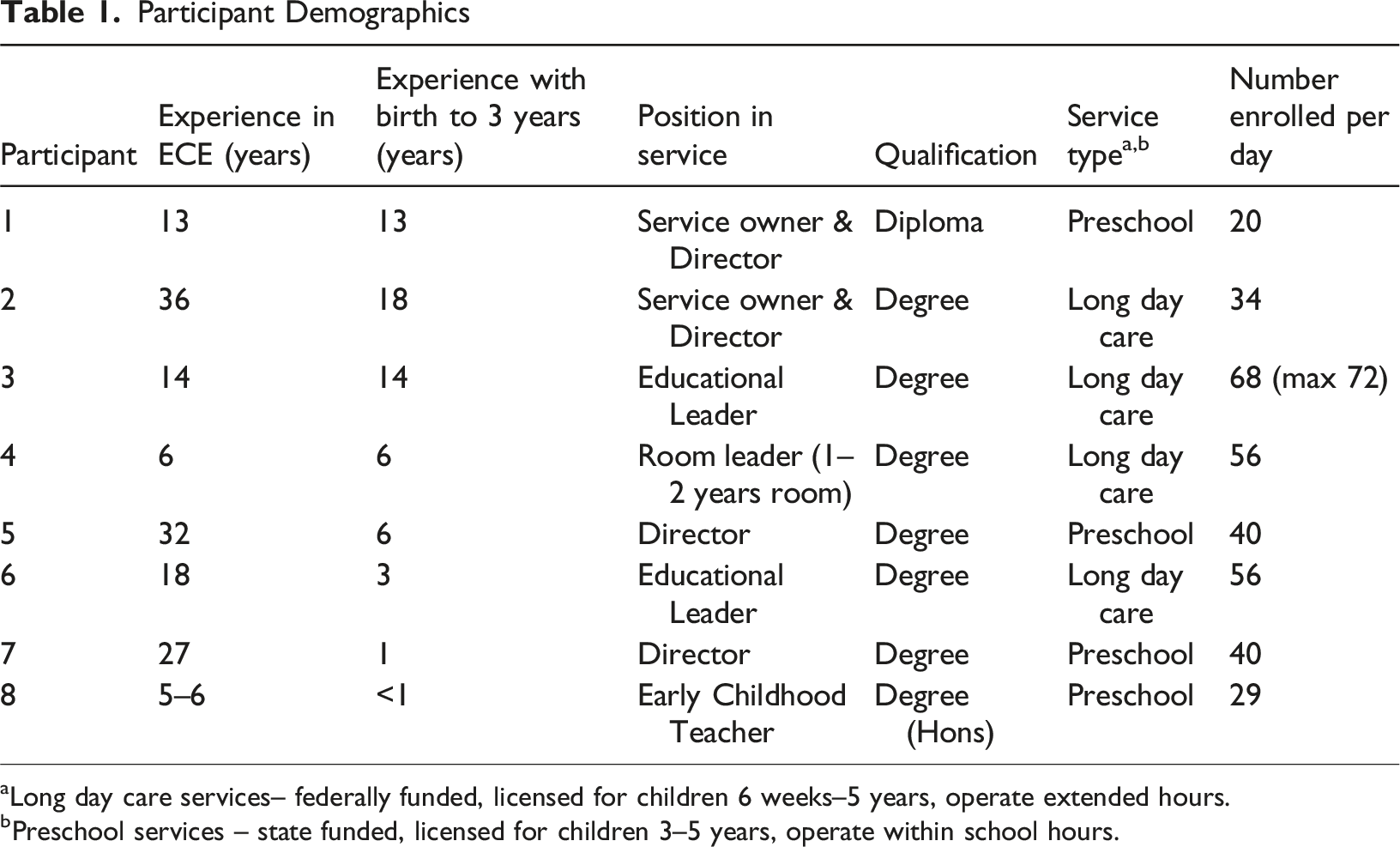
aLong day care services– federally funded, licensed for children 6 weeks–5 years, operate extended hours.
bPreschool services – state funded, licensed for children 3–5 years, operate within school hours.
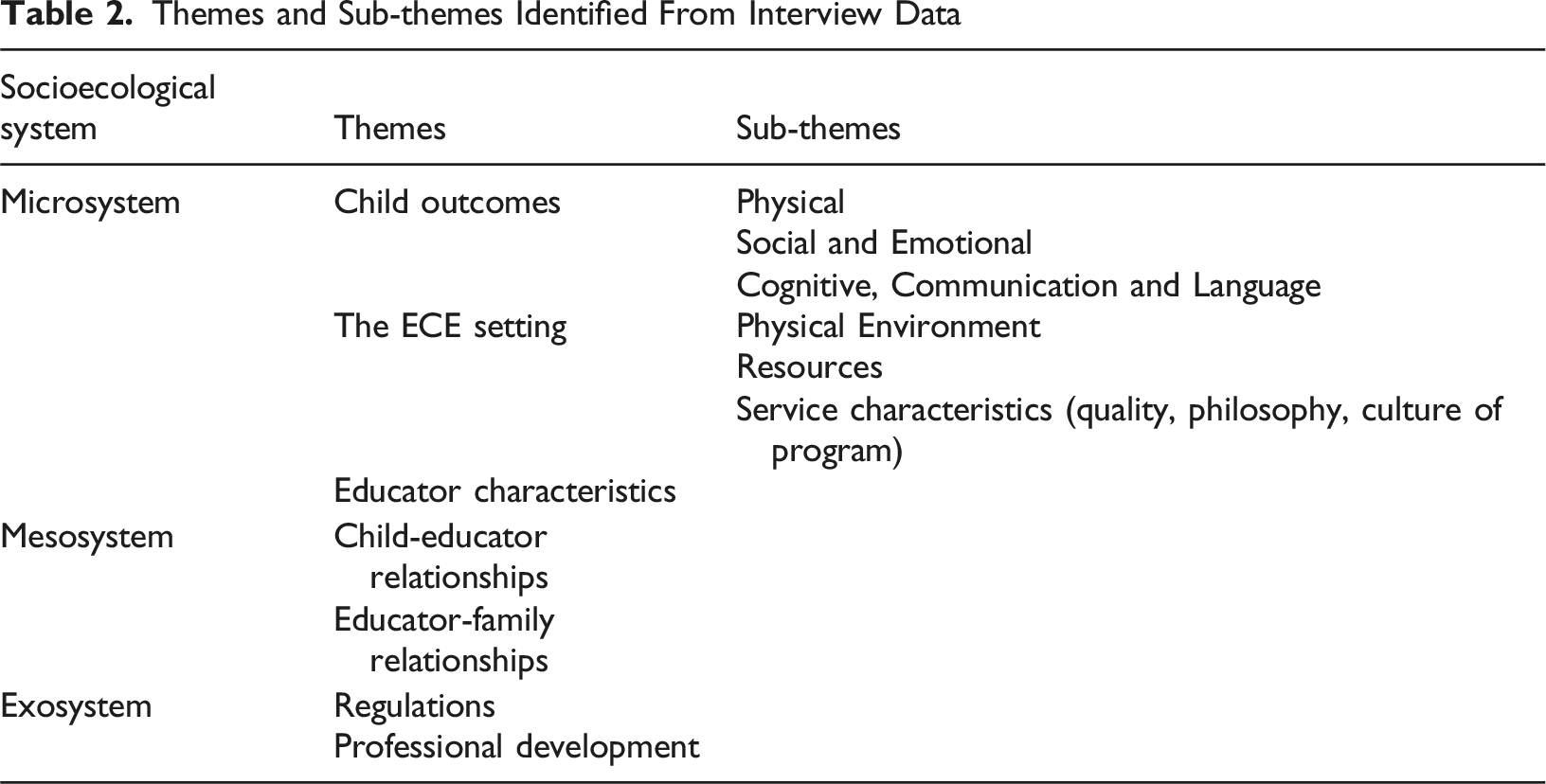
Themes and Sub-themes Identified From Interview Data
Microsystem
Three themes (child outcomes, the ECE settings, educator characteristic) aligned with the microsystem.
Child Outcomes
Five participants suggested that risky play tested children’s limits and boundaries resulting in improved proprioception skills, gross and fine motor skills.
Participants also suggested that risky play resulted in positive emotional-social and cognitive outcomes, for example, improved cooperation, turn-taking, problem-solving skills, self-confidence, self-esteem, communication and language development. Participants suggested that the social element of risky play encouraged conversations between children and between educators and children. For example, participant 2 recalled a conversation that they had with a child about changing the width of a plank that they were walking on and what might happen if the plank was thinner and participant 7 recalled situations where children had offered to help their peers as they participated in risky play (e.g., one child holding the chair while another climbed up on the chair).
Only one educator detailed chid outcomes specifically in relation to children birth to 3 years. Child outcomes aligned with other’s perceptions and included gross and fine motor, self-esteem, self-confidence and cooperation. “They’re using their muscles, like gross, their larger muscles, but also if they’re climbing up, they’re using their fingers… lots of the fine motor as well…definitely social and emotional, self-esteem and self-confidence when they kind of push themselves and they finally get down that slide, or when they climb that wall that they’re been working on or just stand up on some furniture that they’ve been trying for ages. You can see beautiful examples, even with toddlers saying ‘no put your foot there, that worked when I did it’. Even for the younger ones like babies who aren’t verbal they’re always watching their peers and what they’re doing. So, there’s lots of vicarious learning.” (P8).
The ECE Setting
Participants described several factors of the ECE environment pertinent for risky play for children in general. These included: the physical environment, resources and service characteristics (quality, philosophy, culture of program). All educators suggested that the physical environment (i.e., indoor, outdoor, natural, built) had a key role in supporting risky play. Five participants suggested that the natural (i.e., outdoor) environment was perhaps the main facilitator of risky play due to the affordances available in the outdoor environment.
Participants suggested that a well-resourced environment that enabled different types of risky play (e.g., play with heights, speed, dangerous elements) was important. Specifically, five participants mentioned the importance of loose parts and open-ended resources/experiences where children were not predefined about how they engaged with such materials. Examples of loose parts included: pipes, logs, uneven surfaces, sticks, rocks, hammers, and nails.
Five participants mentioned the importance of the philosophy, culture, policies and program as being important facilitators of risky play within ECE settings. Participants suggested that the philosophy and culture of the services, as well as individual philosophies of educators was important. Several participants suggested that the attitude of the leadership team was important in the facilitation of risky play. Leadership teams who value risky play and recognised it as a necessary part of children’s growth and learning were highlighted as being important.
In relation to children aged birth to 3 years, some participants highlighted the importance of resources within the inside and outside environment that allowed children to climb onto and up, such as uneven surfaces with varying levels of complexity. Participants suggested that these types of resources for children aged birth to 3 years helped them learn how to balance and coordinate their bodies. Additionally, participants suggested that loose parts were important for children birth to 3 years but the type and size of loose parts needed to be carefully considered. No specific examples regarding philosophy, culture, polices and programs that were pertinent for children birth to 3 years were discussed.
Educator Characteristics
All participants expressed that the educators’ knowledge, attitude, and perception of risky play were fundamental factors in the facilitation of risky play in ECE settings. Participants suggested that if educators were knowledgeable about risky play and had a positive attitude towards risky play, then the children were more likely to have good experiences with risky play. Conversely participants suggested that if educators were nervous or anxious and reacted when children participated in risky play then the children would feel nervous and potentially not feel safe. “the most challenging thing for me as a teacher is supporting them [the children] through that [fear] because if I get a little too scared or overwhelmed with what they’re doing then that rubs off on them” (P3),
One participant discussed the impact of educators’ attitudes specifically for younger children (i.e., children birth to 3 years). “Children, especially the younger ones, like babies and toddlers, they’re are aware of how the adults around them are feeling, and so if they have a parent or an educator who is anxious about taking risks or is really safety conscious, they can unintentionally push that onto the children and then the children think that they can’t do that.” (P8).
Mesosystem
Two themes (child-educator relationships, educator-family relationships) aligned with the mesosytem.
Child-Educator Relationships
Many participants discussed the importance of relationships in implementing risky play. Specifically, participants described the importance of really knowing the children and their strengths. They suggested that developing a meaningful relationship with the children and understanding their interests created a secure base from which children can go out and explore. Participants explained that knowing the children and knowing their abilities enabled them to make informed decisions about what environments, experiences and resources they needed to offer to nurture and develop their children’s skills through risky play. Interestingly, two participants specifically mentioned the ‘Circle of Security’. They suggested that children, especially younger children (i.e., children birth to 3 years), were more likely to participate in risky play if they had a sense of belonging, felt comfortable and safe and had a relationship with a trusted adult.
Educator-Family Relationships
Most participants suggested that the biggest challenge in implementing risky play for children aged birth to 3 years was family perspectives and families’ knowledge about risky play. They highlighted the importance of connecting with families, communicating clearly with families and educating families about the importance and benefits of risky play. Participants agreed that parental perceptions were important but suggested that they should not define if risky play was offered, instead risky play should be determined by the service philosophy and educator’s knowledge. “I think sometimes there are misunderstandings… parents think risky play means unsafe play, because their child might fall or scrape their knee or become scared. They look at those times and think that it is unsafe because their child got hurt instead of thinking ‘OK, so they took a risk, it didn’t pan out how they thought it would. How can we do it again?’ This is what a lot of educators are trying to do and trying to communicate to parents…” (P4).
Exosystem
Two themes (regulations and professional development) aligned with the exosystem.
Regulations
Some participants suggested that the risk of injury or safety concerns were barriers which prevented them from encouraging risky play activities. Participants were cognisant of the paperwork that needed to be completed if a child was injured, as well as the potential impact of regulatory bodies being notified about incidences. Generally, participants were aware of current regulations but there was still a sense of fear in relation to risky play and the regulations.
Professional Development
Some participants highlighted the importance of professional development and training (e.g., courses, webinars) for educators regarding risky play. Participants suggested that professional development would be beneficial in further upskilling and knowledge building which would then give them more confidence and competence in providing risky play for all children in ECE settings.
Discussion
This is one of the first study to explore educators’ perceptions of risky play for children aged birth to 3 years. This study highlighted several general themes that aligned with the microsystem, mesosystem and exosystem of Socioecological Theory (e.g., child-related outcomes, factors related to the ECE setting and educator characteristics, child-educator relationships and educator-family relationships, regulations and professional development). Of particular interest to this study were the themes that related to children birth to 3 years. Themes aligning with the microsystem and mesosystem were identified for children birth to 3 years, thus these are the focus of the discussion.
Microsystem
The perceived positive child outcomes for children birth to 3 years mentioned in this study included fine and gross motor skills, self-esteem, self-confidence and cooperation. To date, only one study has explored the perceived benefits of risky play for children birth to 3 years (Kybartas et al., 2024). In Kybartas et al.’s (2024) small study, educators’ suggested that the main benefit of risky play for children birth to 3 years was the potential for children to test their limits. Positive child outcomes in older children have been well documented. For example, Brussoni et al.’s (2015) systematic review of 21 studies showed that outdoor risky play was positively associated with children’s physical and social outcomes. Their review analysed three types of risky play (disappear/get lost, heights, rough-and-tumble) and showed that risky play in all three areas provided significant benefits to children’s physical and social behaviours (Brussoni et al., 2015). The positive child related outcomes of risky play from birth are important as they further reiterate the importance of risky play for all children, irrespective of age. Risky play may look different for different aged children, for example, risky paly experiences for children birth to 3 years are usually shorter in duration, but none the less, current evidence supports the notion that children of any age benefit from participating in risky play.
In this study the physical environment was highlighted as a perceived facilitator to risky play in ECE for children birth to 3 years. It is well established that that the outdoor environment is the most common physical environment that promotes risky play (Little, 2022; Sandseter, Kleppe, & Sando, 2021) and when children spend more time in the outdoors, children spend more time in risky play (Ernst et al., 2021), resulting in improved learning and developmental outcomes (Johnstone et al., 2022). Only one study has explored the benefits of the outdoor and indoor environments on children aged birth to 3 years. Kleppe’s (2018a) study specifically investigated the benefits of the outdoor and indoor environment for children aged 1 to 3 years of age. Their study highlighted that both the indoor and outdoor environments offer a wide range of affordances for risky play (i.e., both environments offer children the opportunity to climb, jump, balance, slide, swing and grasp a variety of objects including dangerous tools) (Kleppe, 2018a). Consistent with this study, they highlighted the importance of different surfaces (e.g., mattresses, grass) in enabling the provision of rough-and-tumble play as well as providing children with the opportunity for vicarious learning through watching or interacting with older children (Kleppe, 2018a). Given the dearth of studies which explore the affordances of the physical environment (both indoor and outdoor) for children birth to 3 years, further research will be beneficial.
Resources, such as loose parts, available within ECE environments were also highlighted as key factors related to risky play for children birth to 3 years. Loose parts are resources that are mobile and can easily be moved around the environment, for example sticks, balls and plastic tubes. To date, a few studies have explored affordances for risky play in ECE settings for children birth to 3 years in general (e.g., Kleppe, 2018b; Little & Stapleton, 2023), however no studies have specifically explored the affordances of loose parts in relation to risky play for children birth to 3 years. Several studies, in older children (3–5 years) have explored the impact of loose parts play on children’s learning and development (Caldwell et al., 2023; Spencer et al., 2019, 2021). For example, Spencer et al. (2019) investigated educator’s perceptions of the benefits and challenges of loose parts play in the outdoor environment of ECE settings. They suggested that loose parts provided multiple social and cognitive benefits for preschool children (Spencer et al., 2019). Likewise, a study by Caldwell et al. (2023) showed that loose parts play extends children’s physical competence and increases physical activity time. Although these studies focus on older children it is reasonable to suggest that risky play involving loose parts may also enhance child-related outcomes for children aged birth to 3 years. However, as suggested by educators in this study, it is critically important that the type of loose parts available to children birth to 3 years are appropriate.
Other factors associated with the microsystem identified in this study related specifically to the educators, that is, educators’ attitudes, experience and training. In general, educators with positive attitudes towards risky play and those that had more experience and training with risky play were more likely to provide risky play experiences. Consistently, studies have shown that educators who had a positive understanding and view of risky play are more likely to implement this style of play with young children (LeMasters & Vandermaas-Peeler, 2023; Liu & Birkeland, 2022; Sandseter, 2012). Furthermore, several studies have shown that educators who engage in professional development regarding risky play have increased self-efficacy in their ability to promote risky play in ECE settings (Szpunar et al., 2023; van Rooijen et al., 2020; van Rooijen & Newstead, 2017). Recommendations for professional development focusing on risky play should include information about implementation, safety, regulations, parents’ and educators’ knowledge and attitudes (van Rooijen & Newstead, 2017). Within the Australian context there are limited opportunities for professional development which focuses on risky play, thus there are ample opportunities for pre-service teacher training and in-service training to be explored, especially those that focus on children aged birth to 3 years.
Mesosystem
The mesosystem refers to the connections between elements in the microsystem (Feriver et al., 2022) and includes the relationship between educators and children and educators and families (Feriver et al., 2022). Educators in this study suggested that children birth to 3 years need positive educator-child interaction and a sense of security when they participate is risky play. Kleppe (2018b) explored staff-child interactions in 1–3 year olds in relation to risky play. They highlighted the importance of positive and intentional staff-child interactions for young children regarding risky play. They support the notion that staff-child interactions in relation to risky play should be underpinned by warmth, responsiveness, sensitivity, joint attention and/or joint problem solving and promotion of self-regulation. Consistent with this study, they also suggested that understanding and knowing the children’s needs and behaviours was key factor in enabling children’s participation in risky play.
These concepts align closely with the Circle of Security model (as mentioned by participants in this study). The Circle of Security model suggests that children feel safe to explore (e.g., participate in risky play opportunities) when they know that they can ‘return’ to a trusted adult and seek comfort and reassurance (Powell et al., 2009). This provides a secure base and safe-haven for children which supports healthy emotional development and strong relationships, and in turn enables them to explore and be challenged further. Risky play involves children exploring new opportunities, experiencing the feeling of uncertainty and pushing their limits. Extending educator understanding of their role in risky play for children birth to 3 years is critical in promoting risky play. Considering the Circle of Security, educators have a role to play in both the exploring phase and the returning phase. During the exploring phase where children are actively participating in risky play experiences, educator’s role is to support the children, encourage the children to be risky and celebrate successful risky play experiences. During the ‘return’ phase of the Circle of Security, educators offer a place of security, protection and encouragement. Further training focusing on the Circle of Security in risky play would be beneficial for educators.
It is well-documented that synergy between families and educators have positive learning and developmental outcomes for young children (Liu & Birkeland, 2022; MacQuarrie et al., 2022). In this study, strong partnerships with families and educators were identified as a potential factor contributing to risky play for children birth to 3 years in ECE settings. Chaney (2018) explored parents’ and educators’ perceptions of toddlers’ risky play in ECE settings and highlighted that importance of the alignment of parents’ and educators’ beliefs about risky play (i.e., when parents and educators had a similar outlook on risky play, children were better supported to engage with risky play in a healthy and safe manner) (Chaney, 2018). Additional studies that explore workable strategies that enhance the synergy between parents and educators would result in a unified support approach for children’s early years experiences, growth and development.
This study provided educators with an opportunity to reflect on their pedagogical practice regarding risky play for children aged birth to 3 years. At a sector level, this study highlighted some of the key factors which influence the provision of risky play in ECE settings for children aged birth to 3 years. However, to gain further insight into educators’ perceptions of risky play for children birth to 3 years, studies with a larger sample size; including educators from all states and territories of Australia would be beneficial. Further discussion with educators that currently work with children birth to 3 years would provide a deeper understanding about pedagogy and practice. It is interesting to note, that despite the intention of the study being clearly explained and the interview questions explicitly asking about children aged birth to 3 years, educators often found it difficult to answer the questions for children aged birth to 3 years or to provide examples for children aged birth to 3 years. It remains unknown why educators seemingly found it challenging to discuss risky play specifically for children birth to 3 years. The apprehension to discuss risky play for very young children may have been related to their own experience, (i.e., some educators had limited experience with risky play for very young children), or their own beliefs about risky play (i.e., risky play is potentially too dangerous for very young children) or their confidence and competence related to risky play (Kemp & Josephidou, 2021; Kleppe et al., 2017). Further research is needed to explore this further.
Strengths and Limitations
This further explored educators’ perceptions of risky play for children birth to 3 years in ECE settings. The was underpinned by the Socio Ecological Theory, which provided a platform for rigorous analysis and discussion, offering clarity and an informed approach. The use of semi-structured interviews were an effective methodology for gaining in-depth understandings of educators’ perceptions and pedagogy. Member-checking and collaborative data analysis were employed to ensure that the data were reliable and trustworthy. However, the results of this study should consider the following limitations. The sample size was relatively small, although data were collected until saturation. Participants were recruited mainly from New South Wales. It is plausible to suggest that perceptions of educators from other states and territories across Australia maybe different. Participants were purposively sampled which meant that, in some instances, educators were not working in ECE settings which catered for children aged birth to 3 years. Although this is a limitation, all participants did have some experience with children aged birth to 3 years.
Conclusion
This study explored educators’ perceptions of risky play in ECE settings for children aged birth and 3 years - an area which has been previously under-researched. Risky play has significant learning and developmental benefits for children of all ages, which extend beyond early childhood into adult life. When risky play is encouraged and supported for children aged birth to 3 years by educators, peers, and families then children’s learning can be extended. Further research exploring risky play in ECE for children aged birth to 3 years would be beneficial to further inform educator’s pedagogy and practice.
Footnotes

Funding
The authors received no financial support for the research, authorship, and/or publication of this article.
Declaration of Conflicting Interests
The authors declared no potential conflicts of interest with respect to the research, authorship, and/or publication of this article.