



Abstract
Early childhood pedagogical leadership has been found to enhance program quality by assisting educators to reach deeper understanding of pedagogical practices. In the early years of school where pedagogical tension resides, research on early childhood pedagogical leadership is scarce. Furthermore, there are few models of early childhood pedagogical leadership that describe how early childhood pedagogical leadership might be enacted in practice. This paper presents a relational model of early childhood pedagogical leadership that was developed from the findings of an investigation into early childhood pedagogical leadership enactment in school settings. The practical elements of pedagogical leadership outlined in this model may assist educators to understand how they can lead continuous improvement while empowering their colleagues and building leadership capability of their team.
Introduction
Children around Australia commence school at various ages, ranging from three years of age to six years of age, depending on the jurisdiction and sector. Nevertheless, between the ages of five and eight years, in the early childhood phase of life most children will be enrolled in and attend school. In early childhood, access to positive and responsive interactions with adults, and active, play-based experiences and are fundamental to supporting the development of neural pathways and holistic development (Victorian Curriculum and Assessment Authority, 2016). The introduction and revisions of policies such as the Early Years Learning Framework (EYLF) (ADGE, 2023) and National Quality Standard (NQS) (ACECQA, 2018) over the last fifteen years have brought a focus on quality early childhood education and care (ECEC) to Australia. Through the articulation of pedagogical principles and practices, outcomes and standards educators and service leaders use these policies to enhance program quality through ongoing cycles of planning, implementation and evaluation (ADGE, 2023). In addition to promoting quality pedagogical practices, both policies highlight the important role that leadership plays in enhancing program quality in ECEC. Despite early childhood being internationally and nationally recognised (see United Nations Educational, Scientific and Cultural Organisation [UNESCO], 2022; VCAA, 2016), Australian policies have centred on birth to five settings, and failed to include school settings, where many children attend programs between the ages of three and eight years. Neglecting to include schools as early childhood settings in these policies contributed to pedagogical tension and leaves school principals to make decisions about quality, presenting challenges for the educators who work in the early years of school (Hesterman & Targowska, 2019). This paper seeks to raise awareness of the importance of early childhood pedagogical leadership in school settings to support educators to enhance program quality and ensure children in the early years of school have access to quality play-based programs. This paper will present a model of pedagogical leadership that was developed from a larger research project, offering practical implications for enacting early childhood pedagogical leadership in school settings.
Pedagogical challenges in the early years of school
Pedagogy in the early years has become a contested debate both internationally and nationally. Australian schools have faced increased pressure for academic achievement since the introduction of the Australian Curriculum (ACARA, 2020), which has been compounded by high-stakes testing such as NAPLAN. Despite the evidence supporting the benefits of play-based pedagogies (see Yogman et al., 2018), play has become a contested debate amidst political agendas that seek to solely focus on literacy and numeracy outcomes at the expense of nurturing the whole child (for example, Polesel et al., 2014). Surmounting from this political agenda has been an international trend known as ‘schoolification’ in which play is no longer considered sufficient for learning, and formal, teacher-directed practices have taken its place in the early years of school (Hesterman & Targowska, 2019). Amongst this pressure, educators are grappling with how to utilise play-based pedagogies effectively, indicating confusion about how to intentionally engage in children’s play, document learning and honour children’s thinking and agency (Pyle et al., 2018). The development of deeper and shared understandings of pedagogical practice however is possible with pedagogical leadership (Fonsén et al., 2020). As such, early childhood pedagogical leadership is critical for the early years of school.
Early childhood pedagogical leadership
Pedagogical leadership is fundamental to ensuring children from birth to eight years have access to high quality programs to maximise holistic learning outcomes. Researchers have found that when pedagogical leadership is present in a service, teaching practices are enhanced, increasing the overall quality of the service (Harrison et al., 2019; Siraj-Blatchford & Manni, 2006). Pedagogical leadership fosters the learning of educators, challenging their conceptions and understandings, advocating the rights of children, and supporting educators to develop deeper understandings of pedagogy and practice (Page & Tayler, 2016; Siraj-Blatchford & Manni, 2006). In the early years of school, where educators grapple with implementing play-based pedagogies and meeting academic demands, the presence of early childhood pedagogical leadership has never been more pivotal, yet unlike services and preschools, schools are not required to have educational leaders.
The recent revision of the EYLF introduced the principle “collaborative leadership and teamwork,” (ADGE, 2023, p. 19), while the NQS has stipulated a requirement for ECEC services to appoint an “educational leader” who “leads the development and implementation of the educational program and assessment and planning cycle” (ACECQA, 2018). While these policies mandate requirements for owners and directors of ECEC services to appoint experienced and knowledgeable educators to undertake the role of educational leader (Page & Waniganayake, 2019), there is no such requirement for school contexts. Consequently, confusion and ambiguity surround pedagogical practice in the early years of school, and many schools do not have early childhood pedagogical leaders to support educators and guide the programs and practices that are used in the early years (Fabry, 2023). Additionally, pedagogical leadership and decisions may be left to school principals who lack contemporary understandings of early childhood development and research and have limited or no experience teaching young children (Fabry et al., 2022; Stamopoulos, 2012). Furthermore, research by Hesterman and Targowska (2019) found that principals lack of understanding of early childhood development compromised teachers’ ability to implement appropriate practice including play-based pedagogies in the early years of school. However, when early childhood pedagogical leadership is present in school settings, educators have been found to be supported to overcome pedagogical challenges, and Principals have developed an understanding of the importance of the early years (Fabry et al., 2022). Despite the impact of early childhood pedagogical leadership in school settings, there is little evidence about how this role might be enacted in practice. Models of early childhood pedagogical leadership from ECEC services such as long day care and preschool are also limited in describing how the role might be enacted in practice.
Ambiguity surrounds early childhood pedagogical leadership, particularly in Australian contexts where pedagogical leadership remains an under researched field (Cross et al., 2019; Stamopoulos & Barblett, 2018). Existing research on pedagogical leadership has largely reported on participant views of pedagogical leadership (for example Fonsén & Soukainen, 2019) the challenges of pedagogical leadership (Klevering & McNae, 2019) and the tasks that educators, leaders and directors more broadly undertake (see Hujala et al., 2016). Researchers have called for the construction of practical models of early childhood pedagogical leadership that describe how the role might be enacted in context (Heikka et al., 2022; Palaiologou & Male, 2019). The following sections contribute to this gap in literature by presenting a practical model of pedagogical leadership that was developed from a large research study that investigated the enactment of early childhood pedagogical leadership in school settings.
Enacting early childhood pedagogical leadership in schools: A research study
The model described in the following section of this paper was developed from analysing the findings from a larger PhD research study that spanned three years (Fabry, 2023). The research study sought to investigate the factors that influence teachers’ pedagogical practices in the early years of Western Australian primary schools. Additionally, the study sought to understand how effective early childhood pedagogical leadership could be enacted to assist teachers to implement the pedagogical principles and practices of the EYLF (DEEWR, 2009). Through three phases of data collection including an online survey, interviews and three case studies, perspectives and observations of practice were garnered from Kindergarten and Pre-primary teachers, early childhood pedagogical leaders and school principals. The research project received ethics approval from Edith Cowan University Human Research Ethics Committee (number 19301). Findings from the case study phase have previously been reported (see Fabry et al., 2022). The focus of this paper is to present a model of early childhood pedagogical leadership that is relevant and useful for educators who are leading in school settings. While the data was collected in school settings where educators work with children from 3–8 years of age, the findings may have relevance to early childhood pedagogical leaders working across the ECEC sector and are useful in establishing a common understanding of pedagogical leadership across ECEC service types and settings.
Early childhood pedagogical leadership: A model of enactment for school settings
The model below positions early childhood pedagogical leadership as a relational and responsive practice that educators can employ in their school to support the professional growth of colleagues and lead ongoing improvement. The social-constructivist epistemology that framed the study was confirmed as the findings revealed that early childhood pedagogical leadership was socially and culturally constructed within the school context. Findings pertaining to the enactment of early childhood pedagogical leadership also revealed that relational cultural theory was evident in the way that early childhood pedagogical leaders (ECPLs) supported educators with pedagogical practice.
Relational cultural theory, like social-constructivist theory recognises knowledge and understanding develops through interactions with others and that the multiple truths exist based on individual knowledge and experience. Additionally, relational cultural theory provides a theoretical framework that places human connection and relationships as being central to growth (Jordan, 2017). Jordan (2017) writes that as human beings, we long to “feel competent and able, to matter, to make a difference,” and that in our efforts towards improvement “we turn to one another to keep going” (p. 236). It is through our connection with others, in which we experience mutual empathy that we are supported and enabled to learn and grow (Tuttle et al., 2022). Findings from this study aligned with relational cultural theory, revealing that leading improvement was only possible through connection and trusting relationships with educators. The relational focus of this model is significant in the early years of school where pedagogical leaders work in partnership with educators, school leaders, children and families to build collective understandings and collective responsibility to support children’s learning, development and wellbeing.
The model comprises of three distinct sections. The outer ring highlights the support structures that enable ECPLs to effectively implement pedagogical leadership in school settings. The inner green ring emphasises the relational and responsive elements of pedagogical leadership that are the foundation of leading improvement. Finally, the cluster of circles in the centre identify the collaborative elements of early childhood pedagogical leadership that empower educators as critical decision-makers, value their autonomy and develop their professionalism (see Figure 1). A relational and responsive model of early childhood pedagogical leadership.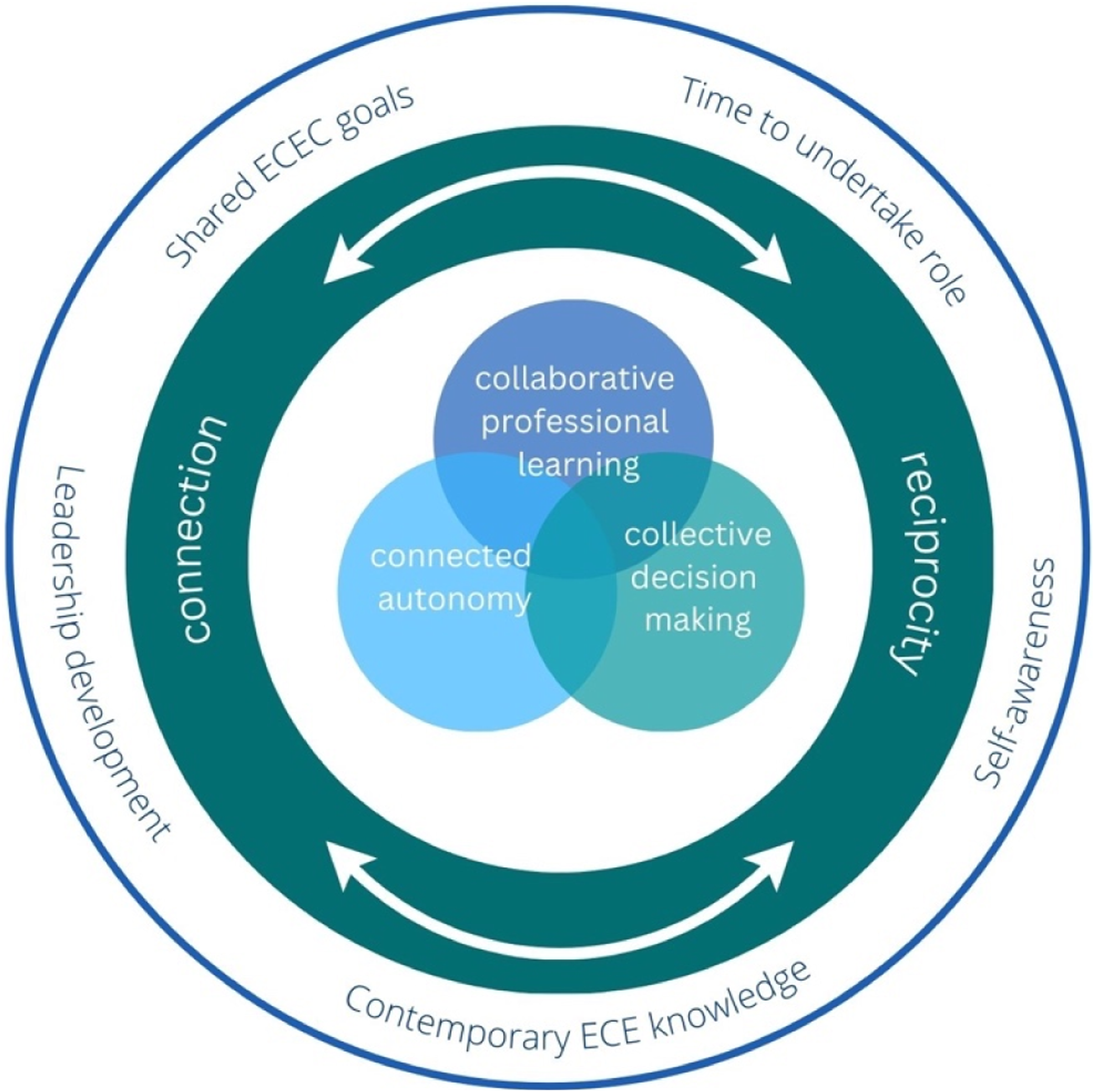
Factors supporting the enactment of pedagogical leadership
ECE contemporary knowledge
With current and contemporary knowledge of early childhood policy and research, (Fabry, 2023) identified that pedagogical leaders were able to lead improvement by assisting colleagues to build deeper and shared understandings of early childhood pedagogy, lead reflective practice and provide educators with feedback and guidance. Furthermore, pedagogical leaders in the study were described as gaining the respect of educators when their knowledge was current and ongoing. Deep professional knowledge is essential for pedagogical leaders to promote reflective practice mentor, guide and lead colleagues to improve practice, because they first have to understand research and policy to assist educators with implementation (Fonsén & Soukainen, 2019; Klevering & McNae, 2019). Proficient knowledge is critical to the role of ECPLs in school settings where many educators and school leaders are primary trained and lack an understanding of learning and development in the early years (Fabry, 2022).
Time to undertake the role
Time is integral to effectively lead early childhood pedagogical improvement. ECPLs require time to undertake tasks such as planning collaborative meetings and professional learning, reading research, sourcing videos and resources to share with colleagues, conducting classroom observations and checking in with colleagues, monitoring practice, meeting with school leaders. While research in services has found time to be a critical factor enabling pedagogical leaders to undertake their role (Denee & Thornton, 2021), time is also a crucial consideration in school settings to support pedagogical leadership. Converse to the allocation of time, a lack of time was found to lead to ineffective pedagogical leadership. Time is therefore a critical condition to effectively leading improvement and cannot be taken for granted, as the workload involved with leading improvement was reported to be high.
The workload associated with leading pedagogy compromises educators’ wellbeing when it erodes their personal time. Educators work on weekends and in evenings to prepare for collaborative meetings and undertake leadership tasks when they are not provided with sufficient time (Fabry, 2023; Rönnerman et al., 2017). While time is essential, these findings reveal that pedagogical leadership is inadequately resourced. Educational leaders in services and schools may lead out of a moral obligation to support children and colleagues, sacrificing their own time and wellbeing and without renumeration. In school settings, literacy and numeracy leaders, or Heads of Learning Areas are compensated with time and renumeration. Exploiting the time and expertise of ECPLs risks causing stress, burnout, and reduced well-being and may deter educators from considering leadership roles in future.
Shared goals across the setting
Shared goals across leaders within school settings is critical for ECPLs to effectively undertake their role. Alignment between the pedagogical leaders’ beliefs and goals for improvement and those of the school principal and executive staff was integral to effectively leading pedagogy and practice. Shared goals are particularly pertinent in school settings where the prioritisation of academic achievement can be at odds with holistic outcomes for children. When school executive staff and ECPLs held disparate views and beliefs, participants reported that conflict arose, and pedagogical leadership and improvement was stifled. Shared goals can be achieved however, through regular, respectful and reciprocal communication between pedagogical leaders and service or school leaders and by sharing power for decision-making (Hujala et al., 2016; Tam, 2018). Shared goals are pivotal to successful enactment of distributed leadership resulting in aligned communication of the vision and direction to educators (Rouse & Spradbury, 2016). Shared or co-developed goals in schools rely on back-and-forth dialogue and negotiation to ensure leaders at all levels have input into the pedagogical improvement process and are aligned in their values and vision. In addition to shared goals, ECPLs benefited from opportunities to develop their leadership knowledge and skill.
Leadership development opportunities
Access to leadership development was found to assist ECPLs to effectively undertake their role, particularly those who were educators and new to leading colleagues. Through participation in external workshops, mentoring from other leaders in the setting, utilising the knowledge of a network of leaders or pursuing their own leadership development through further education, their leadership understanding and skill was enhanced, enabling the ECPLs to lead with greater confidence. Positional leaders play a critical role in nurturing the growth of pedagogical leaders and assisting them to develop their knowledge and skills (Denee & Thornton, 2021). With deeper understanding of leadership, pedagogical leaders’ confidence and self-identity as a leader is enhanced (Douglass, 2018; Fonsén & Ukkonen-Mikkola, 2019). Not all pedagogical leaders, however, have opportunities for the development of leadership knowledge and skill which can impinge on their effectiveness to lead.
Numerous pedagogical leaders described being ineffective in their role as they were challenged to understand the nature of leading and influencing others and struggled with collegial relationships. It is well documented that educators have limited opportunities for leadership development and learning, which leaves them feeling unprepared to effectively undertake leadership roles (Klevering & McNae, 2019; Rouse & Spradbury, 2016). The updated NQS (ACECQA, 2018) now stipulates that educational leaders are supported, and their roles and responsibilities clearly defined. In ECEC services such as long day care, assessment and rating processes ensure that these requirements are adhered to, however, in school settings the role of early childhood pedagogical leadership, and professional development opportunities are often void. In addition to leadership training, ECPLs identified that their effectiveness in undertaking the role was enhanced through reflective practice.
Self-awareness
Regularly engaging in self-reflection assists ECPLs to improve their effectiveness as leaders. In this study, pedagogical leaders reported continuously reflecting on how effective they were in leading and supporting their colleagues, requesting feedback directly from educators and identifying areas where they were leading successfully and areas where they could improve their leadership assisted them to enhance their leadership skill and undertake the role more effectively over time. While pedagogical leadership is usually associated with reflecting on and therefore improving the practice of others, researchers argue reflection on the self and the impact of one’s own leadership practice enables pedagogical leaders to improve the effectiveness of their role (Fonsén & Soukainen, 2019). Furthermore Hallet (2013) proposes pedagogical leaders normalise reflective practice within their teams when they engage in self-reflection.
Cultivating a culture of relational trust
A foundation of responsive relationships was identified as central to leading programs and practice (Fabry, 2023). Pedagogical leaders were found to cultivate a culture that was both relational and responsive to educators by developing connections and practising reciprocity which in turn established relational trust within the school. These components were not mutually exclusive, rather, the development of connections was interdependent on reciprocity. Through two-way conversations, connections were developed, while those connections in turn enhanced the depth of ongoing dialogue. Both connection and reciprocity subsequently contributed to the development of relational trust between ECPLs and educators contributing to the culture in each school.
Forming relational connections with and between educators
Forming connection with educators and between educators was found in this study to be fundamental to cultivating a relational and responsive culture in which early childhood pedagogical improvement could be engaged and sustained. The ECPLs fostered connections with educators by spending time in their classrooms, engaging in daily informal conversations, getting to know them as individuals, and affirming their strengths. These actions reflect the ontology of relational pedagogy (Papatheodorou, 2009). ECPLs asked questions to learn about the teacher’s previous knowledge, training, experience, and confidence to engage with and embed pedagogical change in their classroom. Connection and mutual trust are developed when dialogue is frequent and where relationships, respect and honouring educators occurs daily (Fullan & Edwards, 2022; Gibbs, 2020; Heikka et al., 2022). Dialogue was enhanced when ECPLs observed educators practice. Previously reported as a strategy for monitoring improvement (for example, Ärlestig & Törnsen, 2014; Siraj-Blatchford & Manni, 2006), observations can be used to initiate relevant and meaningful dialogue and enhance relational connections with educators.
Developing connections between educators was also considered integral to fostering a relational and reciprocal culture in which pedagogical improvement could be led and sustained. Through regular discussions to determine and document shared goals and values for pedagogy and practice, educators felt connected to a purpose for their work and the team that shared in their improvement journey (Coleman et al., 2016; Heikka & Suhonen, 2019). Relational cultural theory views human growth as transpiring “through and toward connection” with others (Jordan, 2017, p. 231). The ECPLs in this study appeared to understand educators “courage, confidence and a sense of strength” would “grow in connection” (Jordan, 2017, p. 231) with their colleagues and the leaders. Fostering connections with educators and enabling educators to successfully embark on pedagogical improvement required the practice of reciprocity.
Practising reciprocity
Reciprocal and ongoing dialogue enabled all participants involved in pedagogical improvement to share their experience, feel heard and be supported in a relational and responsive culture. Frequent interactions were mutually beneficial to ECPLs and educators. The “two-way flow of information” (Colman et al., 2016, p. 786) was not confined to collaborative meetings and discussions but was embedded in the ECPLs everyday ways of working. ECPLs learned about improvement by talking with and listening to the educators who were also experiencing the improvement and change process (Papatheodorou, 2009). ECPLs made time to listen to educators share their knowledge, reflections, challenges, and successes. While engaging in regular dialogue supports educators’ professional development and allows educators to freely share their experience and concerns the ECPLs gained the trust of educators by listening to and valuing their perspectives (Heikka et al., 2019; Klevering & McNae, 2019).
Listening to educators is pivotal in progressing improvement by supporting educators’ development of knowledge and skills through the process and adapting to educators’ experiences (Denee and Thornton, 2017; Papatheodorou, 2009). Pedagogical leaders who regularly communicate with educators find out first-hand which aspects of improvement are successful and which aspects are not. They can then identify and rectify problems or challenges in a timely manner to ensure progress can be maintained (Fullan, 2019). As the ECPLs gained important insights about enacting and leading improvement, they were able to provide adaptive and responsive support.
Feedback and guidance were offered by ECPLs in this study to assist educators with pedagogical improvement in response to dialogue and observations. Pedagogical leaders provide honest feedback because they believe they have a moral obligation to the children in the service and to ensuring shared goals and values are implemented in practice (Heikka et al., 2022; Heikka & Suhonen, 2019). Through established connections with ECPLs, educators were receptive of guidance and feedback, without feeling that their professional identity was compromised. Educators were also able to speak freely with ECPLs about their challenges, enabling ECPLs to offer emotional support when educators experienced feelings of “uncertainty and disequilibrium” during the improvement process (Rouse & Spradbury, 2016, p. 505). Educators in this study reported the support from ECPLs made them feel heard and their well-being was valued and respected in the process (Denee & Thornton, 2017). Within the construct of early childhood pedagogical leadership, emotional support and relational trust play a pivotal role that in assisting educators to engage in and sustain continuous pedagogical improvement.
Collectively the findings of connection, reciprocity and relational trust contribute to the existing literature on early childhood pedagogical leadership by presenting the centrality of relationships within the ECPL role. Greater emphasis on the centrality of relationships within the role of early childhood pedagogical leadership may attract more early childhood educators to identify as leaders and confidently embody leadership practices and roles as relationships are central to their roles as early childhood educators (Douglass, 2018; Stuart, 2018). Research on early childhood pedagogical leadership often describes tasks that require relationship with others, such as leading dialogue and discussions, collaborative professional learning, reflection and developing shared goals, as well as distributed approaches to leading (see Heikka et al., 2019). Forming connection, practising reciprocity and developing relational trust with and between educators expand existing models of pedagogical leadership, contributing practical ways in which positive relationships might be developed. In addition to cultivating cultures of relational trust, pedagogical leaders generate a collective responsibility for ongoing improvement.
Generating collective responsibility for improvement
ECPLs led and sustained pedagogical improvement by generating a collective resolve whereby educators viewed improvement as their responsibility. This was achieved when ECPLs nurtured ongoing collaborative growth, empowered educators as decision-makers and valued their autonomy.
Nurturing collaborative professional growth
In generating a collective resolve toward pedagogical improvement, ECPLs in this study created opportunities for educators to regularly learn and collaboratively develop their professional understanding. Professional growth was nurtured through a social constructivist and relational lens in which ECPLs facilitated “pedagogical encounters” involving dialogue, and critical reflection (Riddle & Hickey, 2022, p. 4) that enabled both ECPLs and educators to build new or deeper knowledge about policy, research, pedagogy and practice. Discussions were relevant to the school context, and involved deliberation on practice which could not be achieved without connection to educators’ prior knowledge, and current experience (Molla & Nolan, 2020). In these dialogical exchanges educators were valued as critical knowledge bearers in the co-construction of pedagogical understandings and practices within the team, and ECPLs considered themselves as learners in this process. Uncertainty was not viewed as a deficit, rather learning was considered part of the process of improvement that was both ongoing and necessary for all staff involved in improvement. When educators learn with and from colleagues their perspective on pedagogy evolves as they are introduced to new ideas by their colleagues (Nolan et al., 2021) and encouraged to engage with innovation.
ECPLs generated a collective commitment to improvement by following a distributed approach to leadership in which they encouraged educators to not only share responsibility for improvement, but for leading improvement with colleagues as well. Collaborative leadership is reflected in the recent revision of the EYLF (AGDE, 2022) as a pedagogical principle that supports ongoing teacher and educator professional learning and a collective commitment to supporting children’s learning, development and wellbeing. While ECPLs in this study held contemporary knowledge of early childhood research and policy, they valued the knowledge and experience of the educators and recognised their ability to effectively influence and support their colleagues to collectively work toward common goals for improvement. Previous research has found when educators feel respected as leaders of learning they feel validated and motivated, making them more likely to share their ideas and assist in leading ongoing improvement (Fullan & Edwards, 2022). Building the leadership capability of others is integral for ongoing improvement and for the sustainability of the early childhood profession (Siraj & Hallet, 2014). Through ongoing professional learning, educators were equipped with deeper understandings to question current practice and contribute to collective decision-making.
Empowering educators as decision-makers
The empowerment of educators as decision-makers facilitates a collective effort towards sustained improvement. ECPLs emphasized the inclusion of educators as valued team members, allowing them direct input in setting goals for improvement and determining corresponding steps. Drawing on the notion that change is more effective when driven by those most affected (Douglass, 2018; O’Neill & Brinkerhoff, 2018), this approach acknowledges educators as professionals capable of creative thinking, granting them “catalytic agency” to pursue self-determined goals (McDowall Clark, 2012). Furthermore, a commitment to ongoing pedagogical improvement was fostered through encouraging educators to challenge the status quo and critically examine existing practices in alignment with the National Quality Standard (ACECQA, 2018). Critical reflection challenges educators thinking, deepens understanding and fosters innovation, enabling educators to identify misalignments between practice, policy and research, set goals for improvement and enhance pedagogical practices (Heikka & Suhonen, 2019; Klevering & McNae, 2019). The co-construction of goals and steps toward improvement respects educators as professionals, values their agency (Molla & Nolan, 2020) and counters prevalent discourses that undermine teacher expertise and contribute to burnout and attrition (Carroll et al., 2022). By positioning educators as decision-makers and critical thinkers, this alternative approach challenges conventional ‘top-down’ reforms, offering a path to boost professional identity, self-efficacy, and retention, while simultaneously fostering continuous improvement in early education. As governments grapple with how to improve educational outcomes for children, opting for ‘top down’ reform that implicates teacher inadequacy as cause of low student performance, educators’ professional identity is compromised, leading to attrition from the workforce (Heffernan et al., 2022). This model of early childhood pedagogical leadership advocates for a paradigm shift that recognises educators as critical participants in improvement, empowering them as experts capable of making informed decisions to enhance educational outcomes for children. Alongside valuing teacher agency in decision making, educators were encouraged to exert autonomy.
Encouraging connected autonomy
Generating a collective resolve to pedagogical improvement was possible when ECPLs valued and respected educators’ autonomy to engage with change. Change was not forced upon educators, alternatively educators were able to engage with improvement when they were ready. ECPLs held realistic expectations that improvement would take time and enabled educators to choose what and how improvement would be undertaken through a process often involving trial and error (Heikka & Suhonen, 2019). Valuing educators’ autonomy appeared to enhance educators’ self-efficacy as well as their confidence to improve practice. Nolan and Molla (2021) argue autonomy enhances pedagogical practice as educators are motivated to pursue professional development and seek opportunities to continue learning and reflecting on practice. While some educators in this study were found to have autonomy over improvement in their classrooms, they were also working toward common goals.
In generating collective resolve to improvement, ECPLs encouraged educators to exercise autonomy in ways that enabled them to work towards the shared vision. Through collaborative meetings ECPLs maintained educators’ connection to the shared purpose for improvement and assisted them to make their own decisions by facilitating discussions about possible strategies and ideas that could be implemented. They valued the uniqueness of each teacher and fostered individualism rather than expecting educators to follow a pre-determined agenda (Coleman et al., 2016). McDowall Clark and Murray (2012) assert educators do not have to be uniform in the details of their practice. They argue that what is integral to improvement, is educators’ connection to the higher purpose and vision. Creating cultures where educator agency and autonomy is promoted (Priestly et al., 2015) is an integral element of pedagogical leadership.
Professional growth, collective decision making and autonomy, as practical ways to generate collective resolve to pedagogical improvement enhance conceptualisations of early childhood pedagogical leadership. While previous models of leadership in early childhood settings focus on the tasks of leaders (Coleman et al., 2016) this model of pedagogical leadership recognises the pivotal role of educators in the process of ongoing improvement.
Conclusion
Despite the correlation between pedagogical leadership and quality provision in ECEC, pedagogical leadership remains relatively under-researched with limited conceptualisations and understandings of the place of early childhood pedagogical leadership in school settings (Fabry, 2022). The model presented in this paper hopes to broaden conceptualisations of ECEC in Australia to include schools as settings in which children’s learning and development are nurtured up to the age of eight years. Furthermore, this paper and model offers a way of understanding how the role of early childhood pedagogical leadership might be supported and effectively enacted in schools, to assist educators to overcome complex pedagogical challenges. While the model was developed from data collected in school settings, the relational and responsive elements may be useful in understanding the practical actions that all educational leaders can take to lead the development of quality programs and practices across the ECEC sector. These elements of pedagogical leadership may also be useful in generating shared understandings and conversations about pedagogical leadership across all service types within the ECEC sector. It is hoped that this paper and model ignites conversations about the pivotal role of pedagogical leadership in the early years of school and how educators and children might be enabled to thrive in these settings.
Further research and models of effective enactment of pedagogical leadership in diverse early childhood settings is required to develop more comprehensive understandings of leadership across the birth to eight sector. Further research into pedagogical leadership in school settings may additionally raise awareness of this integral role in supporting educators and enhancing outcomes for children as they transition into and through the early years of school. Advancing the understanding and development of early childhood pedagogical leadership across all birth to eight settings will ensure that educators are empowered in their work with children, while strengthening the profession.
Footnotes
Declaration of conflicting interests
The author(s) declared no potential conflicts of interest with respect to the research, authorship, and/or publication of this article.
Funding
The author(s) received no financial support for the research, authorship, and/or publication of this article.
