



Abstract
This paper explores children’s understandings of Acknowledgement to Country practices and Aboriginal knowledges. Guided by the relational lenses of respect, responsibility and reciprocity, we conducted focus groups with children across five Australian early education centres. We found that Acknowledgement practices were evident through recitation of their Acknowledgement to Country, engaging with artefacts, and/or discussion of artworks. Secondly, children demonstrated emerging understandings about place names, the symbolic use of flags for places and people, and Australian plants and animals. Thirdly, Aboriginal cultures as living cultures were evident in temporal discussions about people and culture. Finally, imaginative play implied efforts to make sense of Aboriginal concepts and language. Across the study, children were active in experimenting with ideas in their own meaning making. Acknowledgement to Country was not a moment in the day; rather, it was embedded throughout the day through routines, storytelling, play and creative activities, all designed to foster learning.
Introduction
The authors of this paper offer our deepest respect to the traditional custodians of all Aboriginal Countries on which we work and live, particularly the lands of the Dharug people on whose land this research was conducted. These lands always were and always will be Aboriginal lands. Our authorship team includes one Indigenous scholar (Michelle Lea Locke) and six non-Indigenous scholars. Acknowledgement to Country practices are becoming customary in early childhood education and care (ECEC) settings. Invited by the ECEC service of our University, our project explores these practices from the perspectives of different actors. The ECEC centres in the service are situated on six campuses in a wide suburban area of a major city, serving university staff, students and local communities. At some centres, children and educators have a diversity of languages and countries of origin, while others are predominantly English speaking. All centres have been exploring and introducing Indigenous knowledges into the curriculum for several years. Phase one of this project involved the interviewing of educators (Townley et al., 2023). This paper reports on our findings from phase 2, the child focus groups. In this paper we use the term Aboriginal in our findings because the sites are on Aboriginal land. In the literature review and method section, we adopt the terms used by the authors we discuss. Elsewhere, we use the term Indigenous as a broader term to include to Torres Strait Islander people, or Indigenous people outside of Australia.
Literature review
There is an emerging body of work on Acknowledgement practices in ECEC (Kitson & Bowes, 2010; Locke, 2022). We use the term ‘Acknowledgement to Country practices’ to encompass not only a daily protocol of speaking or singing an Acknowledgment, but all opportunities for children to engage with Aboriginal knowledges embedded in the physical environment and programming in their service (Townley et al., 2023). The guiding framework for ECEC practitioners is the Early Years Learning Framework for Australia (V2.0) (EYLF) (Australian Government Department of Education, 2022). Recent revisions to this framework require ECEC services to embed Indigenous perspectives in their philosophy and practices, and the EYLF provides examples of what this means in the learning outcomes. The EYLF approach, underpinned by the theoretical concept of cultural responsiveness, now extends beyond responding to the cultures of families and communities present at the centre, to actively focus on ‘embedding Aboriginal and Torres Strait Islander perspectives in all aspects of the curriculum’ (p. 24), highlighting the importance of this work regardless of whether or not Indigenous families are known to be at the centre.
Embedding Indigenous knowledges in education settings brings benefits to Indigenous children and communities (Shay & Oliver, 2021). Examples of these benefits include the engagement of Aboriginal communities in ECEC and improved literacy and numeracy skills (Maher & Buxton, 2015), and affirmation of cultural identity (Webb, 2022). Non Indigenous families also benefit from this work, but this is less well researched and understood. Morrison et al. (2019) argue that a culturally responsive pedagogy benefits not only Aboriginal students, but all students in Australia’s diverse classrooms. A contested space, the ‘cultural interface’, exists between Indigenous and Western knowledge systems, which educators and children need to be able to explore (Nakata, 2007). Navigating this space can result in a transformed pedagogy that aligns with the shared values of the whole community, and connects children to the land on which they are learning and living (Sisson et al., 2020). Whilst Indigenous educators are the most valuable, capable leaders in embedding Indigenous knowledges in ECEC (Locke, 2022), non-Indigenous educators must share responsibility for this work. However, educators often lack the confidence to do this well (Townley et al., 2023).
By listening to how children talk about Indigenous knowledges, we come to understand what children are learning rather than what we intended to teach them. However, there is little research into how children understand Indigenous knowledges. Webb (2022) explores the cultural schema that support identity for Aboriginal children in ECEC, finding that a relational pedagogy that honours Aboriginal knowledges builds autonomy and agency. Duncan (2017) encourages us to include children’s voices in reconciliation pedagogies, however, we could find no research which listened to young non-Indigenous children’s voices on Acknowledgement practices. This research set out to engage with children in conversations about Acknowledgement to Country practices, explore their understandings, and use these to inform the embedding of Indigenous knowledges in ECEC environments.
We included young children in this research also because we recognise the role that children play as active agents in shaping and contributing to their worlds (Graham & Fitzgerald, 2010). The issues we discussed in this project were of relevance to the children. We were interested in their experiences and reflections, and what we might learn from their narratives about impactful pedagogical approaches to lay the foundations of respect for Aboriginal peoples.
Methodology
This research respectfully employs an Indigenous methodological approach, approaching children’s understandings of Acknowledgment to Country practices through the relational lenses of respect, responsibility and reciprocity (Moreton-Robinson, 2017). Our methodology and our analysis is guided by Indigenous relatedness theory, which argues that all peoples and entities (plants, animals, waterways and sky) are connected. With this connection comes responsibility and accountability to one another, requiring mutual respect (Wilson, 2008).
This research benefitted from the trust and relationships built in phase one of the project when a steering committee was established including two non-Indigenous ECEC managers, an Aboriginal ECEC educator, and two Aboriginal scholars from the University. The steering committee provided guidance across all elements of the project, from study design and data collection, through to the interpretation of findings and development of recommendations. Researchers met with the University Aboriginal Elders to report on the project, to offer our findings in a spirit of reciprocity, hoping that the research may be useful to their local community. Engagement with the Elders earlier in the project was not possible due to COVID-19 health restrictions in place at the time.
Focus groups were conducted with 69 children across five of the early learning centres, following parent/carer written consent, and child assent. We ensured children’s assent in a relational process (Dockett & Perry, 2011), with a familiar educator being present in the focus group so children felt safe, paying attention to their body language, and providing a choice of other activities if they indicated dissent. We sat at the level of children to build rapport, usually on the floor. Assent was ongoing as children could wander in and out of the conversation, to experience what they were being asked to do (Nilsson et al., 2015). Formal ethics approval was obtained from Western Sydney University (Approval number H14181).
Given that visual methods are recommended for research involving children (Pimlott-Wilson, 2012), we began each focus group by asking children about flags displayed at their centre: the Aboriginal flag, the Torres Strait Islander flag and the Australian Blue Ensign. This was followed by a discussion prompted by familiar artefacts and art from around their own centre. (When we use the word artefact we mean a made object that holds knowledge of a living culture.) The children could make choices about what to show us (Ceballos & Susinos, 2022). Children were shown a video of other children participating in Acknowledgement to Country (Ethnic Community Services Co-operative, 2018) to prompt recall and talk about their own experiences (Nilsson et al., 2015).
The focus of our data collection and analysis were the children’s voices. Familiar educators participated in the conversations to varying degrees, to encourage children to share their ideas. Continuity was provided by having the lead author present for all focus groups. Two other authors participated in one focus group each. Focus group transcripts were checked for accuracy and coded by the lead author, assisted by NVivo software. The data was initially coded to a set of seven principles that had been developed in phase one of the project, when analysing data from educators and parents and carers of children (Grace et al., 2021). The codes were refined and validated through discussion and writing with the other authors. The two initial codes of encouraging families to travel the journey, and prioritising time for reflection, were not present in the data from the child focus groups. Children rarely discussed the third code, relationships with Aboriginal people and communities. The codes of the importance of knowledge of local Country, and the resources and practices that were present for children to engage with, were strongly present in the data. Similarly, code six, children’s engagement with Aboriginal knowledge in the context of multiculturalism was apparent in the children’s focus groups. Our analysis is, at times, speculative and inclusive of multiple meanings, a deliberate ‘disposition to accommodate the complexity and ambiguity of children’s accounts’ (Graham & Fitzgerald, 2010, p. 138) and to acknowledge the playful creative storytelling of children as exploring multiple meanings and possibilities (Koch, 2021). As a result, the seventh code, that of sharing difficult knowledge with children, was further developed by the authors through considering how children engaged with artefacts and knowledges, resulting in the theme of imagination and play. This process resulted in four themes: Acknowledgement practices, this land on which we play, First Peoples first, and imagination and play. When attributing quotes, we have labelled the focus groups Site 1 to Site 5.
We deliberately do not identify which of the participating children were Indigenous, knowing it was more important to allow children and families agency and privacy in choices about disclosing their Indigeneity. Rather we remained open about the possibilities for all children’s cultural identities, and worked with the ambiguity of these possibilities in each focus group. Whilst this project consulted with Aboriginal people through the Steering committee, our analysis was largely developed by non-Aboriginal researchers, from conversations with predominantly non-Aboriginal children about their experiences and understandings of Aboriginal knowledges and practices within their early learning centres. We particularly thank the Aboriginal members of the steering committee for the feedback they provided.
Findings and discussion
We present our findings and discussion around four themes developed from our data.
Acknowledgement practices
Across all sites, children spoke about a range of practices and knowledge that they held, and showed us different artefacts and art. These included making suggestions of songs, singing to us, reciting their Acknowledgement to Country, discussing their artworks and Dharug numbers, naming story books, and showing us clapsticks, symbol stones, a didgeridoo, and baby dolls. The children identified many items as Aboriginal, including boomerangs, cars, dinosaurs and paper.
A range of artwork was evident in the centres that reflected engagement with indigenous knowledges. Children discussed artwork present in the centres including dot paintings, painting on leaves, painting with sand, footprints, and artwork arranged in the shape of the Aboriginal flag. ‘Aboriginal spots’ (site 4) were identified on a coolamon, and white ‘dots’ and ‘lines’ (site 3) on the face of a baby doll signified an Aboriginal baby. There was a strong association of red, black and yellow with Indigenous art because ‘there’s a lot of Aboriginal people who use those colours for painting’ (site 1). The sun featured as a subject in some children’s Aboriginal paintings ‘because a lot of Aboriginal people make the sun’ (site 1). Paintings did not always feature a sun, other subjects included a chicken and an elephant.
Plants and animals were a core element of children’s knowledge about Aboriginal Country. At one site, a toy possum and platypus were shown to the researcher. At another site the children talked about which animals were cooked and eaten by Aboriginal people, and identified various kinds of bush tucker in a puzzle. Demonstrating the practice of paying attention to Country, during this focus group children moved to the window to observe the lorikeets nesting in the tree outside, whose progress they had been watching over the previous weeks. At this centre, the Acknowledgement to Country protocol began with paying attention to the sensory experience of examining a basket of natural objects. We were shown a display of paintings of whales, with one child explaining their significance as ‘they are whales found around Australia’ (site 5). When asked whether they could see anything from Aboriginal culture, children pointed out a fabric wall hanging which was a landscape painting with a range of animals found in Australia (Figure 1). Animal art.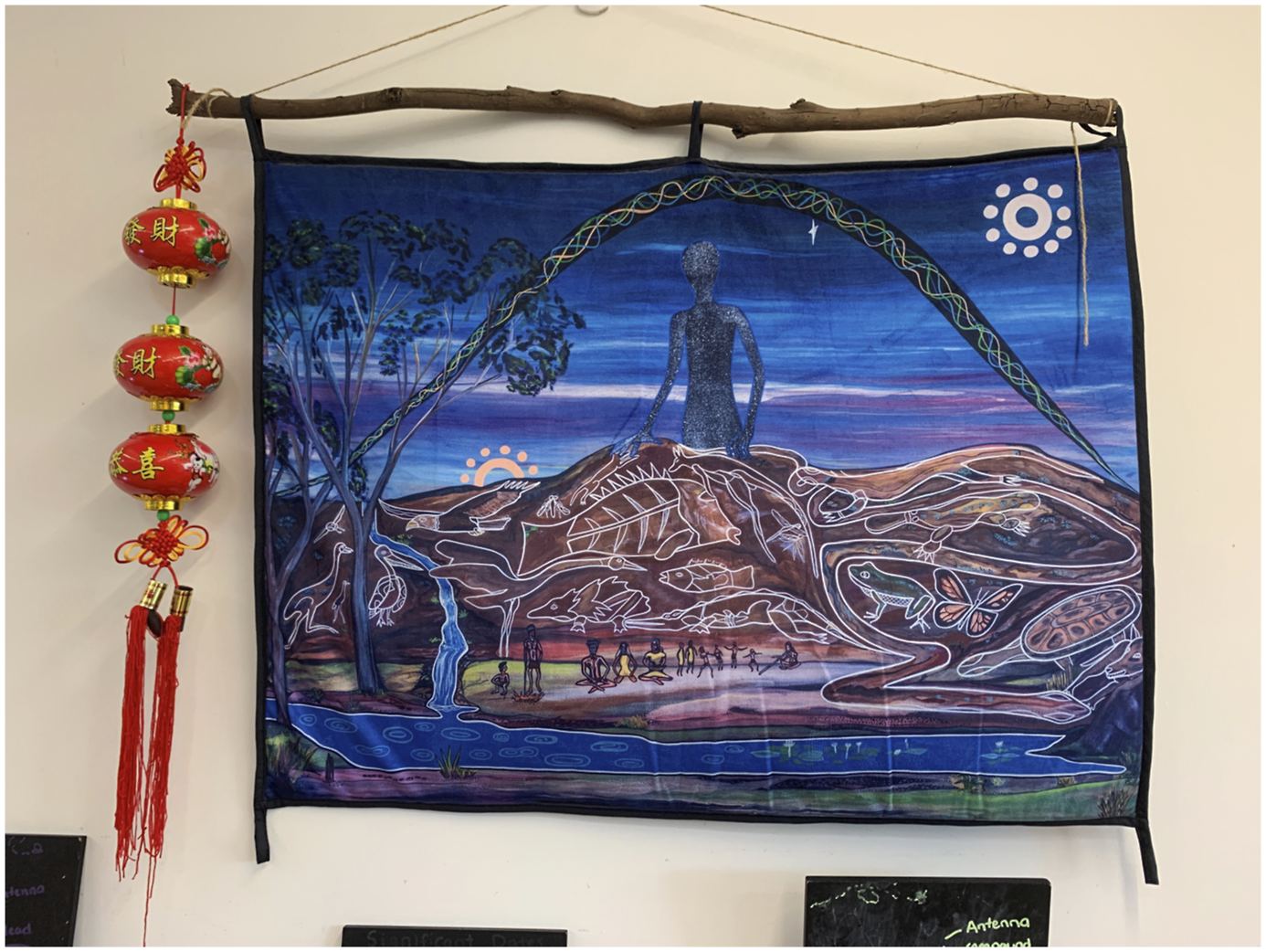
A range of songs were discussed or suggested by the children. For example, one group joined in with their educator to sing Red Black and Yellow, with accompanying actions. Some children demonstrated an ability to attribute ownership of songs, with one child reporting on the death of the singer of one song they knew, another associating the song Taba Naba with the Torres Strait Islander flag.
Children’s engagement with Aboriginal stories was evident in the centres. There was a wall display of children’s artwork generated from their book week exploration of How the birds got their colours (Albert & Lofts, 2004). The children at this centre were so engaged in the focus group that they requested the researcher read a story at the end. In another centre Welcome to Country (Murphy & Kennedy, 2016) was named as a favourite book. Children in two centres raised the Dharug book Baby Business (Seymour, 2019). At Site 5 the children had crafted a diorama of the story, using dolls and craft materials such as paper and cardboard, leaves and wood. The diorama showed two babies sitting in the bush, beside a campfire, together with a bundle of leaves tied up with a leaf (Figure 2). The children retold the story, with some prompting from their educator. The bundle of leaves was for a smoking ceremony, where ‘they make it into fire and put the baby on it’. When asked why, a child explained ‘because they wanted to name the baby’. In the story, the baby’s totem is the bee. One child explained how to gather honey in the bush ‘they just take the bees off and then we take honey and then the bees get it.’ The grammar in the last quote perhaps indicates that the child places themselves both within and outside of Aboriginal knowledge, as they work through understanding their own identity and its relationship to the knowledge present in the centre activities. Baby Business diorama.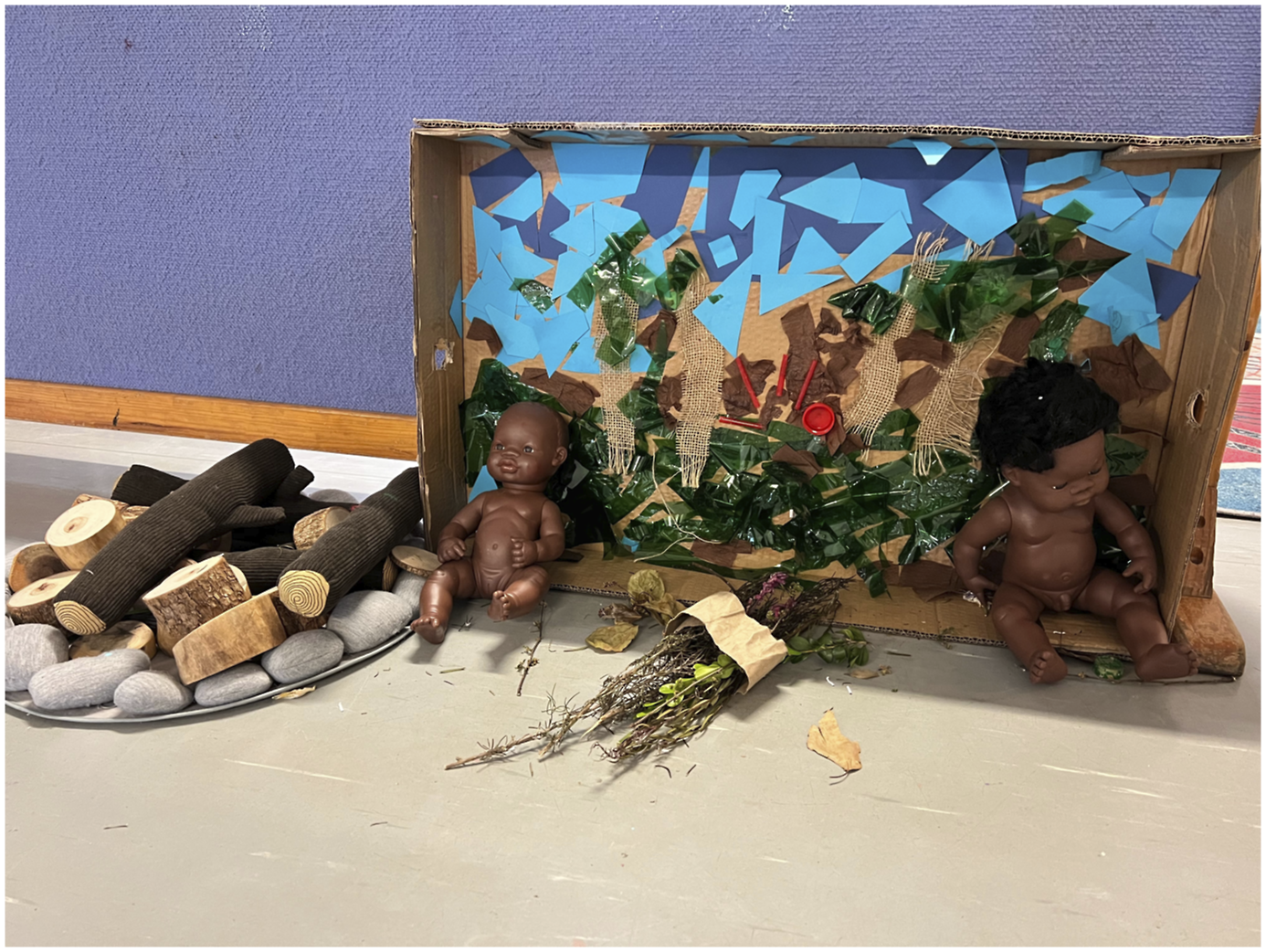
Habitual Acknowledgement to Country routines were evident in the centres. After watching the video, children in four of the focus groups showed us their Acknowledgement protocol. In one centre, this began with children taking a natural object, such as a seed pod from a basket, and describing the sensory experience of holding their natural objects. They then recited an Acknowledgement, together, phrase by phrase, following the educator’s lead. In the other three centres children demonstrated their Acknowledgement song, with actions. Children expanded on the meaning of the Acknowledgement, for example one said: ‘we love sharing your land’ (Site 5) during the explanation of their Acknowledgement protocol.
This land on which we play
In some centres the Aboriginal flag and the Torres Strait Islander flag were displayed, in others the Australian Blue Ensign was also included. Children expressed familiarity with the flags, one saying ‘I saw them on telly’ (site 3). Some children understood that all three flags were Australian, but, most commonly the Blue Ensign was identified as Australian: ‘one is from Australia’ (site 1). Children knew that the colours of the Aboriginal flag were important, and could explain their symbolism. The yellow central circle was consistently recognised as representing the sun. Most groups explained that the red was the ‘land’ (site 3, 4), or ‘the ground’ (site 2). The black was explained as symbolising ‘the people’ (site 5) or ‘black humans’ (site 2). At site 3 there was a debate between children about the meaning of the colour black, whether it meant ‘Aboriginal skin’ or ‘the darkness when it was night time’. The Torres Strait Islander flag was harder for children to place, one group knew what it was, two groups hazarded that it was from America.
In four of the five groups, the mention of Australia prompted a statement such as ‘I live in Australia’ (site 3 and 5), followed by a discussion of where the children lived. Many children proffered the suburb names around the centre as where they lived, some giving a street name and sometimes house or apartment number. It was more difficult for the children to identify the Aboriginal name for the Country on which they lived, or where their centre was situated, particularly in the context of a discussion about suburbs. Researcher: Do you know which Aboriginal people are in this part of Australia here? Child 1: No but I only know about Australia land Researcher: Is Aboriginal land different to Australia land? Child 1: Yeah it is. [names two suburbs and two major roads] … Researcher: Does anyone know the name of the place where we are here in the centre? Child 2: I know Child 3: It is, ah, Kindy (Site 4)
When prompted, some could accurately identify the Country of the centre, but most children had not yet integrated their understandings that the names for the places they know (usually given by colonisers) also had Aboriginal names, despite the fact that children learn the linguistic concept of synonymy during the preschool years (Hadley et al., 2016). One child asserted ‘We are not on Dharug Land …. We are in Australia.’ This illustrates the complexity of understanding that where we are is simultaneously Australia, Dharug Land, and the familiar suburb. In one centre, the children had explained that bush tucker was found on Dharug Land, but were stumped by the question from the researcher of ‘Where’s Dharug Land? … If I wanted to go there where would I go?’ (site 2), except for one child who silently pointed their thumb to the ground. This illustrates a developing understanding that where we are is simultaneously Australia, Aboriginal Land, and the familiar suburb.
In one centre children had made some progress in integrating the complexity of scale, Aboriginal names and settler names. The land was named at a superordinate level as earth, a subordinate level as the snake mat where we sat, or the house number where we live, and with an Aboriginal name. Researcher: My house is on Wangal land. And where I work that’s on Burramattagal land. Do you know what land we are here? Child: Earth Researcher: Earth. Yes. Educator: Aboriginal land Child: This is a snake. Researcher: Oh, on the mat. Yes, it is. Child: Not a real snake, it’s a pretend snake Child: [prompted by educator] Dharug Land Researcher: Dharug Land! Yes. So what is Dharug land? Child: Dharug Land is where we live Child: I live in a Dharug land too Child: I live at number 16 with a one and a six. (Site 5)
This integration was still tenuous, the exchange finished like this: Researcher: And what about [settler name of centre location], is [settler name] in Dharug Land or not? Child: No (Site 5)
We know that there is a further complexity to the naming of Dharug land, where Wangal and Burramattagal are clan groups within the Dharug language group. Interestingly, this possibility may be evidenced by the child’s statement ‘I live in a Dharug land too’. This child’s use of ‘a’ (i.e., indefinite article to introduce a general rather than specific noun) could imply that the child thinks of ‘Dharug’ as a synonym for the superordinate concept of country. Alternatively, the child could have more complex understanding about the Dharug language group. Ultimately, though, some children had not developed an understanding that Dharug land and the settler suburb name to be the same place. At another site, after watching the video, children were asked what land their own centre was on, and one child explained that ‘I only learned about the solar system’ (site 1), implying that they recognised a gap in their knowledge of Aboriginal place names.
From ages 2 to 5 children are developing their semantic knowledge of place, building superordinate and subordinate categories, semantic webs and networks (Webb, 2022). Most pre-schoolers are learning to categorise words into superordinate categories (e.g., Country) and subordinate terms (e.g., Aboriginal and settler place names), but the challenge for children is learning to do that alongside learning about synonyms for both superordinate and subordinate terms. Explicit instruction alongside naturalistic exposure helps. Engaging with Aboriginal naming of Country at this age is an opportunity to integrate Aboriginal and settler knowledge in their semantic networks, from the solar system to the land on which we sit, in the same way children learn that a mother can simultaneously be an aunty and a daughter, and be referred by ‘mum’, a given first name, and a surname.
First peoples first
The children also positioned Aboriginal knowledges within multicultural environments. In one centre, there was a display of painting for NAIDOC week. (In Australia, NAIDOC week celebrates the history, culture and achievements of Indigenous peoples.) Researcher: Do you know … why you did [these paintings] for NAIDOC week? … Child: Because we need to respect the Aboriginal people Researcher: Mmm. And NAIDOC week is a time for us to do that more? Child: Remember the Aboriginal people Researcher: Yes, why do we do that? Child: Because we can take care of the land and make the land nice and clean for the Aboriginal people
Respect for Aboriginal people is embedded in art activities, and from this the child makes a connection between respect, taking responsibility for taking care of the land, and the reciprocity of acting in a way that contributes to an important outcome for Aboriginal people.
Tragically, respect for Aboriginal peoples is contested in wider Australian societal discourse, and consequently in education (Bodkin-Andrews & Carlson, 2016). There were glimpses of this contestation in the children’s conversations: Researcher: You talked about paying your respects to Aboriginal people. What does that mean? Child: Being kind to them Researcher: Oh, good answer, being kind. What else might it mean as well? Child: I don’t like being kind to Aboriginal …. Researcher: Paying respect Child: They always, they always fighting (Site 2)
In another group: Researcher: You said Aboriginal people were nice people. Do you know some Aboriginal people? Child: No (Site 4)
Knowledge of Aboriginal people seemed abstract for this child, who believes that they do not know any Aboriginal people. Probably, the children are echoing opinions they have heard from others, and trying to reconcile what they have learned about respect and Aboriginal people.
Children in two centres showed us the dark-skinned baby dolls that they associated with Aboriginal people. Whilst the presence of these dolls bring a welcome diversity to dolls’ skin colour, it may also reinforce the misconception that all Aboriginal people have dark skin: Researcher: Do Aboriginal people have to have black skin? Child: Yes Researcher: Yes? Child: Some people and babies have black skin. (Site 3)
Understanding that the colour black on the flag represents Aboriginal people, that many Aboriginal people have dark skin, but that many Aboriginal people do not have dark skin are quite complex concepts, that many adults have not grasped (Carlson, 2016; Heiss, 2022). This exchange, and the debate in the previous section over the meaning of the black colour in the flag, illustrate children navigating this complexity.
An important phrase in many Acknowledgement protocols is ‘past and present’ (site 2). An invitation to tell us what they knew about the flags generated from one child the comment of ‘that’s in the olden days’ (Site 3), in reference to the Aboriginal flag. Another child offered their knowledge about the olden days as their contribution to what was happening in the video: ‘I know in the olden days, some cars and buses and trucks that gets scrapped’ (Site 3). Aboriginal peoples and knowledges were most easily situated, for most children, in the past. When prompted to explain what ‘present’ meant, one child offered that ‘Santa could bring your presents’ (Site 2). In one focus group a discussion about respect led to a child trying to make sense of what they knew about peoples and history, as evidenced in this exchange: Researcher: We’re very new in Australia and Aboriginal people are the First People on this land and that’s why we respect them. They looked after the land for so long. Child: They are not the longest people Researcher: Tell me more about that. Child: Because the cavemen [pause] (Site 1)
This child was trying to understand the timeframe of what they knew about ‘cavemen’, probably meaning prehistoric peoples from European history, and the history of Indigenous people in Australia.
Children rarely talked about contemporary Aboriginal people, or Aboriginal people that they themselves had met. Researcher: Can anyone tell me anything about Aboriginal people today? [pause] Researcher: Do you know any? You’ve probably got some in the centre, or that you live with or work with or play with? Or any come and visit? [No response] (Site 2)
This contrasted with a discussion of what it means when they hear the clapping sticks, as a child offered: ‘it comes from an Aboriginal who paints [present tense] them’ (Site 2). At site 2 the educator prompted children to remember when an Aboriginal educator visited the centre and children dressed up in animal costumes. By the age of 4 or 5 years most children understand and use present and past tense to describe current and past events respectively (Hoff, 2013). In the focus groups their use of tense is mixed, suggesting that they are in the process of making sense of how Aboriginal people are spoken about as both past and present. Knowing that Aboriginal people lived in the past, and not knowing that there are probably Indigenous people present in their day to day, is congruent with the explanation that Aboriginal people are in some other location. Researcher: Do you know any Aboriginal people that live around here? Child: No. Researcher: No? Child: They live, they don’t live here, … It is a really big world (Site 3).
This indicates that the children rarely expected Indigenous people to be present in their day-to-day world, as their peers or educators.
There were instances when the children associated learning about Aboriginal culture and knowledges with building common ground in a multicultural society. When discussing songs associated with Aboriginal knowledges, one child suggested ‘We are Australian’. The children and the educator then sang: ‘We are one, but we are many, and from all of the lands of the earth we come. We share our dreams, we sing in one voice. I am, you are, we are Australian.’ The child had made an association between Aboriginal songs, and the concept that as Australians we can find common ground in a multicultural country.
One centre has a significant Chinese population. Here, a red Chinese lantern hangs alongside the fabric wall hanging (Figure 1), representing two of the cultures explored through the programming and activities. Conversation in this focus group conflated Chinese and Aboriginal cultures on a number of points, by children of European heritage. For example, one child was showing the Aboriginal animal puzzle to the researcher, and described the pictures as ‘a Chinese fish … I’ve got a Chinese lizard’ (site 3). After viewing the video, one child’s observation was ‘they talk in different languages. They speak Chinese words’ (site 3). Some of the children speak Chinese rather than English at Site 3, hence the language he does not understand is described as Chinese. By experiencing all of these various cultures, children have the opportunity to actively build their understanding of which different knowledges might be associated with which people and cultures, and how language is integral to culture.
Imagination and play
Sometimes in the focus groups, the educator used a rote-learning style to lead the conversation and prompt children’s knowledge. While not usually a preferred way of nurturing children’s learning, there may be a need to do this because respect for Aboriginal people is demonstrated by following correct language and protocols. We also found that children engage imaginatively with Indigenous knowledges in a way that creates ambiguity and possibility.
At Site 4 the children had fun talking about artefacts and symbols (Figure 3), although not many of their assertions were accurate. For example, the witchetty grub is described as a ‘snailworm’, the meeting place symbol is described as a ‘sun’, ‘spider’, and ‘this is a scribbly scrubbly one, this is a crazy eyeball’ (Site 4). The kangaroo tracks are ‘Number one Aboriginal’, and they do look like the number one, upside down (Site 4). One child told a long, involved story, sparked by the Aboriginal flag, about stars: Child: So the black stars are the bad stars and the red stars are the good stars. Yellow stars are the good stars too. Those bad stars. Good stars. And good stars are hitting the black stars so that’s why this is the Aboriginal stars. ... Researcher: So can you tell me about this being the bad one? Child: So that bad one likes to take all the peoples up to the moon. Researcher: Okay. Child: Like those bad guys, if the bad guys hit you under the moon you will die. Researcher: That is terribly sad. Child: When I was at my home and I was sleeping and I have a dream of that. Researcher: Did you? Child: It was a person of the star that was black. It was … scary. (Site 4) Acknowledgement basket.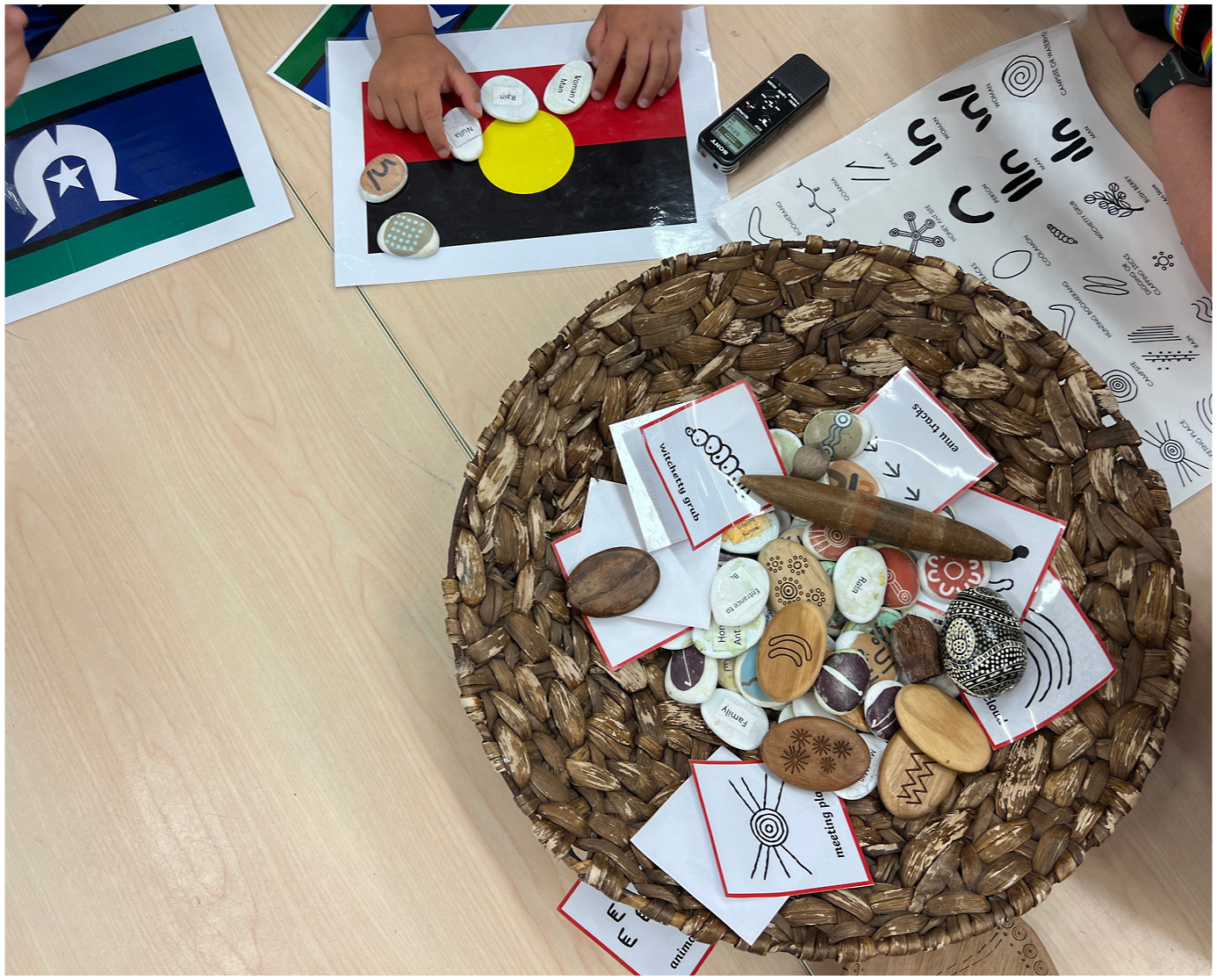
The educators offered an explanation that the previous week the children had explored stories about Aboriginal astronomy, and that the child’s story may have been linked to this work. Discussing a wooden coolamon with carvings (Figure 4) the same child began a long explanation with ‘this is a really special board so it can sting you, see that little tiny, you can’t see it but I can see it because it is magic’. Here, the child recognises that important Aboriginal knowledge is embedded in markings on artefacts, accessed by storytelling (Yunkaporta, 2019). Coolamon.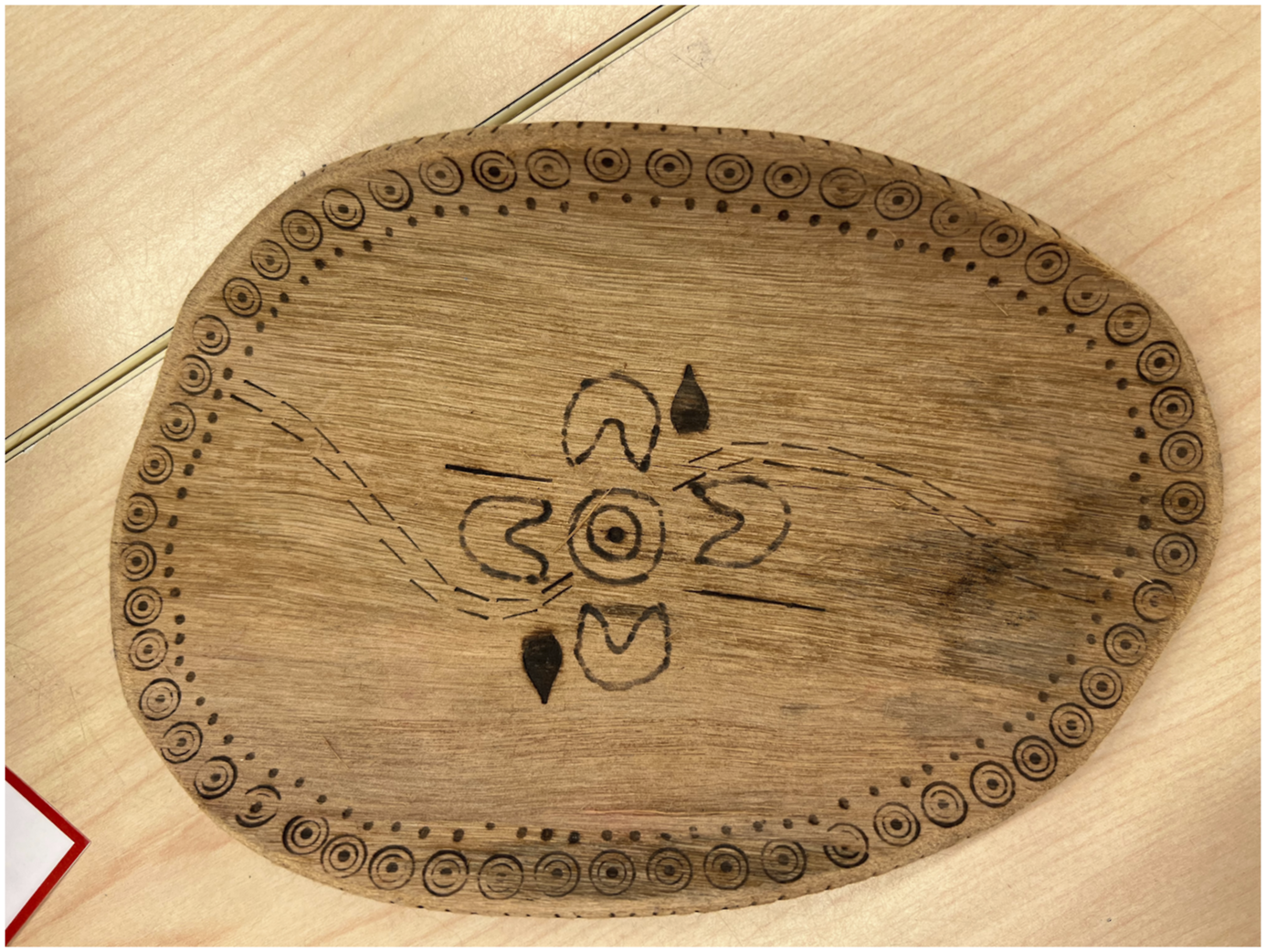
Elsewhere, after identifying the Torres Strait Islander flag, one child said: ‘That’s the land of our, of my people’. (Site 5). The educators were confused by this statement. Either the child was from the Torres Strait Islands (and the educators were unaware of this), or the child was trying out language and ideas, demonstrating that they know the significance and protocol of identifying and naming the land for Indigenous people. This child went on to say ‘and I’ve got two old grannies’ (Site 5), which may have been inspired by the book Baby Business which this group discussed. Culturally relevant storytelling has been used to make early literacy curricula relevant to Indigenous children (Schroeder et al., 2022). We found that storytelling embedded in Indigenous knowledges enables learning.
Children suggested Aboriginal names for where we were, like ‘gomorrah’ and ‘womil’ at Site 5, ‘knucklewa’ at Site 4. At Site 5, one child stated ‘I know someone in the wommeroi’, another named the land of a nearby park ‘garun or garin’. These names were unfamiliar to the educators. These utterances seem to imply that the children are either repeating Aboriginal names they had heard others say, or that they have an emerging implicit understanding of the phonotactics of other Aboriginal words they have heard, generating new words in keeping with their basic phonological knowledge of Aboriginal words. Our interpretation of this data is that children are playing with languages as they make meaning of Aboriginal knowledges. In New Zealand, bi-lingual classrooms for young children that move fluidly between te reo Māori and English, can support identity and literacy and language skills for all children (Denston et al., 2022), which may be an additional benefit of introducing Aboriginal languages in Australian ECEC.
The way that children expressed concepts and explored language demonstrated that Aboriginal knowledges were incorporated into their play and sensemaking. In their conversations, the artefacts and symbols are not novel, but an everyday part of their play. We know that play cements ideas (Fleer, 2021). Although appropriation of Aboriginal knowledge and identity is not appropriate for adults (Carlson, 2016), Indigenous educator Narelle Twist uses a pedagogy of play with Aboriginal language and practices with all children to explore shared identity (Somerville et al., 2019). In our study this imaginative play perhaps opens up an ambiguous space that supports sensemaking, reduces othering, and creates the possibility of Aboriginal peers being present in the centre.
Discussion and conclusion
Acknowledgement to Country is more than the daily protocol of reciting or singing an Acknowledgement to Country (Townley et al., 2023). Acknowledgement to Country includes facilitating children’s imaginative engagement with Aboriginal knowledges and perspectives through songs, art, artefacts, games and routines. This playful engagement where children explore the cultural interface (Nakata, 2007) develops their understandings of Indigenous perspectives. The children in our research were active in experimenting with ideas in meaning making, and demonstrated emerging understanding. ECEC settings can serve as powerful sources for motivating social change, and redressing societal misunderstandings and prejudices. ECEC settings lay critical foundations for life-long learning (Australian Government Department of Education, 2022), including learning and thinking about identity and social justice. Engagement with Aboriginal knowledges is central to laying these foundations. The revised EYLF requires educators to embed Indigenous perspectives in their philosophy and practices; this paper helps us understand how to do this. This journey requires confidence, reflection and strong pedagogical leadership to take each small step (Townley et al., 2023). Paying attention to children’s engagement and understanding supports this journey. Through listening to children’s voices we come to understand what they know, the impact of our activities and narratives, and whether these build the understandings we intend.
One limitation to this work is that engagement with Elders was limited, partly due to the impact of COVID-19. Second, all centres were from the same organisation, with similarities in each centre’s approach. Future research across a number of services, including playgroups, over a series of visits to the same children, would build on this work. This paper provides important insights into children’s understandings to support educators respond to the revised EYLF, and identifies the potential for further work in an under-researched area.
Footnotes
Declaration of conflicting interests
The author(s) declared no potential conflicts of interest with respect to the research, authorship, and/or publication of this article.
Funding
The author(s) disclosed receipt of the following financial support for the research, authorship, and/or publication of this article: This work was supported by Western Sydney University Early Learning Ltd.
