




Abstract
Economic inequality is a key challenge of our time. Prior research investigating the relationship between economic inequality and mental health has yielded inconclusive results, particularly when relying on objective indicators (e.g., Gini coefficients). While some studies have found a negative relationship, others have shown no significant association. A growing body of work suggests that these inconsistencies may reflect the fact that objective indicators do not adequately capture how inequality is experienced and appraised by individuals. In the present study, we examined the relationship between perceptions of increasing economic inequality and psychological distress in two East Asian countries—China and South Korea. Through two secondary data analyses, we consistently found that individuals’ subjective perception of increasing economic inequality was associated with greater psychological distress. Notably, this subjective perception yielded a larger effect than objective inequality as measured using Gini coefficients. Furthermore, among the objective measures of economic inequality, we found that wealth inequality—specifically, house-price Gini coefficient—was more strongly associated with psychological distress compared to income inequality. We speculate that this may be because wealth inequality is more visible in people's immediate environments. Our research contributes to a better understanding of the mental health effects of economic inequality, emphasizing the importance of subjective and context-specific experiences of economic inequality.
Economic inequality is a key challenge of our time. In fact, inequality in terms of income, wealth, and opportunity has been increasing in many parts of the world (Milanovic, 2016, 2022). At the same time, we are facing a mental health crisis. Amplified by the COVID-19 pandemic, levels of anxiety and depression are increasing, while subjective well-being is plummeting (Blundell et al., 2022). This raises the following question: Are the two phenomena linked?
Social psychology has a long tradition of researching people's subjective well-being as an important psychological contributor to personal development, social relationships, and overall functioning in the larger society (Diener, 1984). However, it has paid much less attention to psychological distress, even though mental suffering affects millions of people globally, with depression being the most common form (Lim et al., 2018). This lack of social-psychological focus on psychological distress is surprising, given its significant personal and societal consequences.
Economic inequality has been associated not only with lower subjective well-being (Alesina et al., 2004; Delhey & Dragolov, 2014; Oishi et al., 2011) but also with greater risks of depression (Ribeiro et al., 2017). For example, research has found higher rates of depression in US states with greater economic inequality (Dev & Kim, 2020; Pabayo et al., 2014). Moreover, higher local-level income inequality in São Paulo was associated with greater rates of depression (Chiavegatto Filho et al., 2013), and higher income inequality across Chinese provinces was associated with more frequently reported depressive symptoms (Du et al., 2019). Research suggests that it is anxiety about one's social status that might increase stress levels, making inequality a potential driver of psychological distress (Buttrick & Oishi, 2017).
Surprisingly, not all studies find support for the negative relationship between economic inequality and mental health (Ngamaba et al., 2018; Sommet & Elliot, 2022). A key reason for these inconsistencies might be that much of the prior literature relied on objective indicators (e.g., Gini coefficients), which do not capture how inequality is experienced in everyday life. Because psychological distress is shaped by subjective appraisals, objective inequality may be an imperfect proxy for the psychological processes through which inequality affects mental health. Thus, instead of asking whether objective inequality is broadly associated with reduced well-being (Sommet et al., 2026), we posit that it may be more fruitful to investigate how changes in perceived inequality influence psychological distress.
Across two studies conducting secondary data analyses, we explore whether individuals’ subjective perception of increasing economic inequality is associated with greater psychological distress. We then compare the effects of this subjective perception with those of objective economic inequality as measured by income and wealth Gini coefficients, and test whether socioeconomic status operates as a moderator. Herein, our research contributes to a better understanding of economic inequality and its link to people's mental health outcomes when economic inequality is rendered salient in their local environments—in our case, because of a temporal change.
The Link Between Economic Inequality and Mental Health
Many social scientists define economic inequality as the asymmetric distribution of wealth or income. In this article, we use the term “economic inequality” to encompass both income inequality (disparities in earnings or income levels) and wealth inequality (disparities in accumulated assets or net worth; Byrne, 2024; Piketty, 2014). Economic inequality between individuals with the highest and lowest economic status can be found in most countries across the world (Anand & Segal, 2017; Milanovic, 2016), and has risen dramatically (Hung, 2021; Milanovic, 2022). Since 1995, the top 1% of the world's population has received nearly 20 times more of the global wealth than the bottom 50% of humanity (Piketty et al., 2022). Those at the top are increasingly culturally, economically, and physically distant from those at the bottom (Dorning, 2015). The COVID-19 pandemic has further amplified this trajectory, possibly to unsustainable new levels (Blundell et al., 2022; Sepulveda & Brooker, 2021).
Seminal research from across the social sciences has shown that economic inequality is negatively associated with subjective well-being (Alesina et al., 2004; Oishi et al., 2011; Pickett & Wilkinson, 2015). For example, analyzing data from the General Social Survey, Oishi et al. (2011, 2018) found that Americans reported lower well-being in years with higher inequality. Similarly, in years with greater inequality, their life satisfaction was lower (Oishi & Kesebir, 2015). Chinese respondents also experienced lower well-being in years with greater inequality (Du et al., 2019).
However, not all research supports these findings (Ngamaba et al., 2018). Some studies suggest that economic inequality has no significant relationship with subjective well-being or may even have a positive association in certain contexts (Berg & Veenhoven, 2010; Rözer & Kraaykamp, 2013; Sommet & Elliot, 2022; Zagorski et al., 2014). For example, in China, individuals in rural areas reported higher life satisfaction where inequality was greater (Cheung, 2016). Similarly, economic inequality measured by county-level Gini coefficients was positively associated with the subjective well-being of Chinese residents in rural areas (Knight & Gunatilaka, 2010; Knight et al., 2009).
At the same time, other studies conducted in China have yielded more nuanced findings. For instance, Du et al. (2019) found that higher inequality was associated with lower well-being among Chinese respondents. In addition, Jiang et al. (2012) reported that while inequality correlated negatively with happiness overall, city-level inequality correlated positively with happiness when controlling for identity-related inequality and other covariates. Other researchers have argued for a non-linear relationship between economic inequality and subjective well-being, observing that well-being increased with inequality up to a certain threshold and then decreased as inequality continued to rise (Ding et al., 2021; Wang et al., 2015). These conflicting findings underscore the complexity of the relationship between economic inequality and well-being, which the existing literature cannot fully explain.
Psychological Appraisals of Economic Inequality
One possible explanation for these inconsistencies lies in researchers often relying on objective measures at the national level, such as Gini coefficients, when analyzing the relationship between inequality and psychological outcomes. However, people often misperceive national-level objective inequality (Gimpelson & Treisman, 2018). Instead, they tend to be more accurate in estimating objective inequality at the local level (Johnston & Newman, 2016). We define local-level objective inequality as disparities in income or wealth within a person's immediate environment or region. Local-level objective inequality may act as a situational trigger that makes differences between the “haves” and the “have-nots” more salient (Newman et al., 2015). As material and social differences materialize and are more visible in people's immediate environments, local-level objective inequality might therefore be particularly influential in shaping their psychological experiences (Firebaugh & Schroeder, 2009; Zhao et al., 2021).
Recent theory in social psychology further suggests that humans actively appraise the economic inequality in their immediate environment (Gobel & Carvacho, 2024; Phillips et al., 2025). Thus, we think that it is important to distinguish between local-level objective inequality and people's subjective inequality perceptions (i.e., individuals’ appraisals of inequality in their lived environment). Indeed, social psychological research demonstrates that the effects of economic inequality are better understood at the subjective rather than the objective level (Peters & Jetten, 2023; Willis et al., 2022). Appraisals of inequality can determine whether economic inequalities lead to feelings of relative deprivation or optimism about future economic opportunities. For example, recent research highlights that economic inequality can evoke perceptions of either downward or upward mobility (Melita et al., 2023), with only the former reducing well-being (Melita et al., 2026).
One consequence of the important role that appraisals play in understanding the effects of economic inequality is that appraisals of increasing inequality may be particularly distressing. Whereas stable levels of inequality may become psychologically normalized over time, increasing inequality might communicate that the distribution of opportunities and rewards is shifting. Perceiving that inequality is worsening may therefore heighten concerns about declining mobility (Melita et al., 2026). Consistent with this idea, prior research shows that rising inequality is associated with weaker beliefs in meritocracy and lower optimism about upward mobility (e.g., Newman et al., 2015; Wolak & Peterson, 2020). In the present research, we tested whether subjective perceptions of increasing inequality would also be more psychologically consequential for people's mental health.
Socioeconomic Status as a Moderator
Another potential explanation for the inconsistent relationship between inequality, mental health and well-being is that people across different socioeconomic strata experience the psychological effects of economic inequality differently. For example, prior research has shown that local-level inequality relates to stronger feelings of unhappiness and psychological distress among low-income residents compared to high-income residents (Ahern & Galea, 2006; Oishi et al., 2011; Roth et al., 2017; Sommet et al., 2018). This might be explained by the fact that individuals with lower socioeconomic status can rely less on others in times of financial hardship (Jachimowicz et al., 2020).
Evidence from non-western contexts also points in a similar direction. For example, Fang and Rizzo (2012) found that income inequality was associated with worse health among low-income households in China compared with high-income households. Likewise, Wang et al. (2015) reported that the negative effect of income inequality on happiness was concentrated among poorer individuals. These findings suggest that socioeconomic status may moderate the psychological consequences of inequality across both Western and East Asian settings.
At the same time, it is important to note that here again the literature provides inconsistent evidence, as other studies have shown that individual income does not moderate the relationship between income inequality and subjective well-being (Kelley & Evans, 2017), status anxiety (Layte & Whelan, 2014), or depressive symptoms (van Deurzen et al., 2015). Thus, it remains unclear whether the effects of economic inequality depend on an individual's socioeconomic status. In the present research, we set out to examine whether household income would moderate the association between perceptions of increasing inequality and psychological distress (and, where applicable, we also tested the interactions between income and objective inequality).
The Present Research
The present research was motivated by existing inconsistencies in the literature when researching the link between economic inequality and mental health. We set out to examine the link between objective inequality, subjective inequality, perceptions of increasing inequality and psychological distress in two East Asian countries—China and South Korea. While much of the previous research has focused on positive well-being outcomes like happiness and life satisfaction (Wienk et al., 2022), relatively few studies have directly examined whether perceived economic inequality is linked to negative mental health outcomes. In one notable exception, Du et al. (2024) recently demonstrated that subjective economic inequality predicted increased depressive symptoms (alongside lower life satisfaction) over a one-year period. Building on these findings, the present study focuses on psychological distress (e.g., sadness, anxiety, depression) as the key outcome.
We conducted secondary data analyses using two representative data sets. The first data set, the 2018 Chinese Family Panel Survey, included data on depressive symptoms (e.g., feeling depressed, sad, or lonely, or experiencing restless sleep) and perceptions of the severity of wealth inequality. The second data set, collected in 2019 and consisting of a representative sample of South Korean citizens living in Seoul, included data on negative affect (e.g., anxiety, fear, distress) and perceptions of worsening income inequality. Both negative emotions and depression are manifestations of psychological distress. While frequent negative emotions indicate elevated day-to-day distress, depression reflects clinically significant mental health decline. By using different measures across the two studies, we examine our research question, tapping into complementary facets of psychological distress.
Study 1
Study 1 tested whether perceptions of economic inequality severity would be associated with psychological distress in China. We conducted secondary data analysis using the 2018 Chinese Family Panel Survey. The Chinese Family Panel Survey has been looking at various aspects of modern Chinese families, such as family structure, family relationships, and social values, since 2010. We chose data from 2018 as the most recent data available that was not impacted by the COVID-19 pandemic.
Following the market transition, China has undergone significant economic and social changes. Since the reform period began in the 1970s, economic inequality has risen from 0.3 in the 1970s to 0.5 in the 2000s (Xie & Zhou, 2014), placing China at a similar level of inequality as the USA and among the most unequal countries globally. For example, China's Gini coefficient in 2018 was 0.47 according to the Chinese National Bureau of Statistics. Unsurprisingly, these economic changes have been accompanied by drastic social changes in the labor market, which has become more competitive and stressful, and they may have important repercussions for people's subjective well-being and psychological distress.
Method
Participants
After excluding participants with missing data for income and education, we analyzed data from 17,961 respondents from the Individual Self-Report section of the 2018 Chinese Family Panel Survey (Mage = 32.3; SDage = 14; 49.7% females).
Measures
Psychological Distress
A modified version of the Center for Epidemiologic Studies Depression Scale (Radloff, 1977) assessed individuals’ depressive symptoms. The measure consisted of the following six items: “I am in a low spirit”; “I find it difficult to do anything”; “I cannot sleep well”; “I feel lonely”; “I feel sad”; “I feel that I cannot continue with my life.” The respondents indicated their depressive symptoms for the previous week on a 4-point scale (1 = never (less than 1 day); 2 = sometimes (1–2 days); 3 = often (3–4 days); 4 = most of the time (5–7 days)). The items were averaged into a psychological distress score (α = 0.75, M = 1.54, SD = 0.48).
Perceived Economic Inequality Severity
Perceived economic inequality severity was assessed by asking the participants the following question: “How would you rate the severity of inequality between the rich and the poor in China?” Responses were given on a 10-point scale (0 = not severe to 10 = extremely severe; M = 7.29, SD = 2.29).
Objective Economic Inequality
We calculated the Gini coefficient for each Chinese province based on household income from the Household Questionnaire data of the Chinese Family Panel Survey .
Sociodemographic Covariates
We controlled for the respondents’ age; gender (1 = female, 0 = male); family income (self-reported in yuan per annum); education level (0 = illiterate/semi-literate, 1 = nursery, 2 = kindergarten/preschool class, 3 = primary school, 4 = junior high school, 5 = senior high school/secondary school/technical school/vocational senior school, 6 = three-year college, 7 = four-year college, 8 = Master’s degree, 9 = PhD); ethnicity (1 = Han Chinese, 0 = other); marital status (1 = married, 0 = other); and urban or rural residence (1 = urban, 0 = rural).
Results
Table 1 shows the demographic information of the sample; Table 2 shows the inter-variable correlations amongst the key variables; and Table 3 shows the key associations of the demographic variables and perceived economic inequality severity. We used multilevel mixed-effects regression to test our central hypothesis that perceived economic inequality severity would be associated with psychological distress. The analytic sample comprised 17,961 individuals (Level 1) nested within 31 provinces (Level 2). Province-level Gini coefficients were included as Level 2 variables in subsequent analyses. All continuous variables (including family income, perceived inequality severity, and province-level Gini coefficients) were grand-mean centered. The interaction between income and perceived inequality severity represents a within-level (Level 1) interaction, whereas the interaction between income and province-level Gini coefficient represents a cross-level interaction.
Descriptive Statistics (Study 1).

Inter-Variable Correlations (Study 1).

Note. Confidence intervals are shown in square brackets.
p < .05. **p < .01. ***p < .001.
Mixed Linear Regression Predicting Economic Inequality Severity (Study 1).

Note. Marital status (Dummy 1): 1 = married, 0 = other; Marital status (Dummy 2): 1 = divorced and widowed, 0 = other.
In the first step, we entered the individual-level variables (e.g., age, gender, education, income, ethnicity, marital status, rural/urban residence), which yielded several significant associations with depressive symptoms. Gender was positively associated with depressive symptoms (B = 0.02, SE = 0.00, t(12,831) = 10.13, p < .001), indicating that female respondents reported more frequent depressive symptoms than male respondents. Family income (B = −0.00, SE = 0.00, t(12,029) = −4.26, p < .001) and education (B = −0.02, SE = 0.00, t(12,682) = −6.06, p < .001) were negatively associated with depressive symptoms, suggesting that respondents with greater family income and higher education reported less frequent depressive symptoms.
In the second step, we estimated an unconditional random-intercepts model to examine the proportion of variance in depressive symptoms attributable to provincial differences. We captured provincial-level variations using a random intercept to improve the robustness of the model. The intraclass correlation coefficient was .016, indicating that approximately 1.6% of the variance was between provinces. We first added our key variables of interest—province-level Gini coefficient and perceived economic inequality severity—to this model, which improved the model fit, as shown by the reduction in AIC. This model explained 36% of the variance. As can be seen in Table 4, perceived inequality severity was significantly correlated with depressive symptoms (B = 0.01, SE = 0.00, t(12,837) = 7.80, p < .001), indicating that, in our sample, the greater the perceived inequality severity, the more frequent the depressive symptoms. However, province-level inequality was not correlated with depressive symptoms (B = 0.22, SE = 0.28, t(36) = 0.77, p = .76). Finally, the within-level interaction effect between family income and subjective perceptions of inequality severity was not significantly related to depressive symptoms (B = 0.00, SE = 0.00, t(12,832) = 0.80, p = .42). The non-significant interaction effect remained when using income quintiles instead of continuous income (see Oishi et al., 2011). Similarly, the cross-level interaction between family income and province-level Gini coefficient was not significant (B = –0.00, SE = 0.00, t(36) = −1.12, p = .47), suggesting that the association of objective inequality with depressive symptoms did not differ across income groups.
Mixed Linear Regression Predicting Psychological Distress (Study 1).

Note. Marital status (Dummy 1): 1 = married, 0 = other; Marital status (Dummy 2): 1 = divorced and widowed, 0 = other.
p < .05. **p < .01. ***p < .001.
Our primary analyses are cross-sectional and use the 2018 wave of the Chinese Family Panel Survey. We selected 2018 because the South Korea data set was collected in 2019 and does not provide comparable multi-wave measures. Nevertheless, we additionally analyzed the 2014 and 2016 waves of the Chinese Family Panel Survey as a robustness check to find out whether the cross-sectional association was replicated across survey years and whether its magnitude changed over time. 1 Using the same covariates as in the main model, a linear mixed-effects analysis showed that, in all waves, perceived inequality severity was significantly associated with higher levels of depressive symptoms (Bs = 0.04–0.09, ps < .05), whereas objective inequality did not yield significant correlation effects. Importantly, the association between perceived inequality severity and depressive symptoms became stronger over time: the slope was relatively modest in 2014, increased in 2016, and was most pronounced in 2018 (Figure 1). This temporal pattern suggests that perceptions of economic inequality may have grown and become increasingly consequential for psychological distress in China.

Effect of perceived increasing inequality on psychological distress across three waves of the Chinese Family Panel Survey (2014, 2016, 2018). Each point represents the standardized regression coefficient (slope) of perceived increasing inequality predicting psychological distress in that wave. Error bars indicate 95% confidence intervals. The increasing slope suggests that the association between perceived increasing inequality and psychological distress strengthened over time.
Discussion
In a representative sample of Chinese citizens, the more respondents perceived economic inequality to be severe, the more frequently they reported depressive symptoms. This effect was robust when controlling for demographic information, whether individuals resided in rural or urban China and when taking into account the heterogeneity of Chinese provinces. Importantly, the positive association between subjective perceptions of inequality severity and depressive symptoms remained significant even when controlling for objective levels of economic inequality as measured by the provinces’ Gini coefficient. Moreover, the respondents’ family income did not moderate this relationship. Finally, an additional analysis of the combined Chinese Family Panel Survey waves from 2014, 2016, and 2018 yielded converging evidence, showing that the association between perceived inequality severity and psychological distress persisted across multiple time points and became more pronounced in recent years. This pattern underscores the robustness of our findings and suggests that perceptions of economic inequality may have become increasingly consequential for mental health in contemporary China.
In summary, Study 1 provides evidence for the link between perceptions of inequality severity and greater psychological distress. We think that perceptions of inequality severity are likely to involve an appraisal of both its magnitude and its progression over time. Perceptions of economic inequality are often informed by what individuals think is happening to their immediate social network (Chambers et al., 2014; Cruces et al., 2013). When individuals judge economic inequality as severe, they are likely to perceive it as not only significant in magnitude but also deteriorating, reflecting a sense of local escalation (see Newman et al., 2015; Wolak & Peterson, 2020). Given the recent increases in economic inequality in China (Xie & Zhou, 2014), and given that we found that the link between perceived inequality severity and depressive symptoms strengthened over time, we think it is likely that the participants incorporated this experience in their judgments of the severity of economic inequality. Because we cannot know this with certainty, Study 2 addressed this limitation by directly asking a representative sample of South Korean citizens residing in Seoul if economic inequality had worsened.
Study 2
Study 2 directly tested whether perceptions of worsening economic inequality were associated with psychological distress among residents of the South Korean capital, Seoul. South Korea, too, has experienced substantial social and economic changes, initially yielding rapid economic growth after the Korean War, known as the “Miracle on the Han River.” Indeed, the South Korean economy is now the twelfth largest in the world. At the same time, economic inequality has significantly increased over the past couple of decades, reaching levels higher than those in many European countries (Lee, 2017). Indeed, in 2018, the Gini coefficient for South Korea was 0.35 according to the Korean Statistical Information Service. Seoul has over 9 million inhabitants with representative levels of income inequality, and ranks highest among South Korean cities in terms of house-price disparity.
Method
Participants
The respondents were a representative sample of 519 South Korean citizens living in Seoul, who completed a survey in 2019 and thus prior to the COVID-19 pandemic (Mage = 44.4; SDage = 13.7; 49.1% females). The participants were recruited by a professional survey company using stratified sampling based on the population distribution across Seoul's districts, thereby ensuring representativeness at the metropolitan level. In the present sample, 7 districts had fewer than 15 respondents each. To ensure sufficient statistical reliability at the district level, these districts were excluded from the analyses. The final analytic sample therefore consisted of 490 individuals nested within 18 districts.
Measures
Psychological Distress
The respondents reported the extent to which they had experienced each of ten negative emotions (distressed, upset, guilty, scared, hostile, irritable, ashamed, nervous, jittery, afraid) taken from the Positive and Negative Affect Scale (Watson et al., 1988) over the previous month on a 5-point scale (1 = not at all to 5 = a lot). A psychological distress score was computed by averaging across all the items (α = 0.84, M = 2.43, SD = 0.65).
Perceived Economic Inequality Increase
Subjective perceptions of increasing economic inequality were assessed by asking the participants how much they agreed with the item “Income inequality is getting worse today” on a 4-point scale (1 = I don’t agree at all to 4 = I totally agree; M = 3.24, SD = 0.59).
Objective Economic Inequality
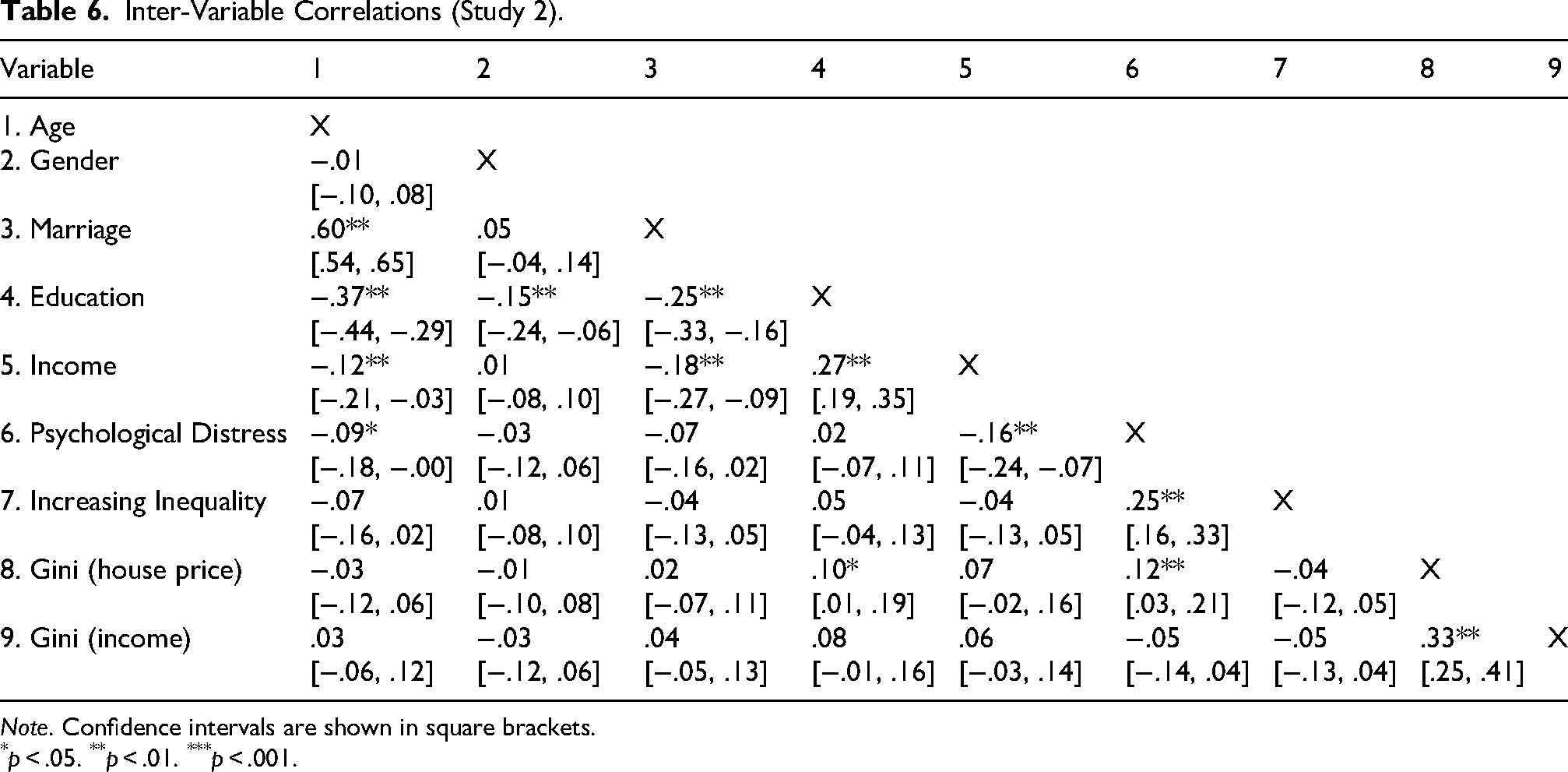
Gini coefficients for each district in Seoul were taken from past research that used two different methods to calculate the Gini coefficients. First, Kang and Koo (2023) calculated a house-price Gini coefficient based on the per-square-meter price of property transactions using publicly released data from the Ministry of Land, Infrastructure, and Transport in Korea. Second, Kim et al. (2022) calculated an income Gini coefficient using annual household incomes from the National Health Insurance Service. While the income Gini coefficient captures disparities in household income, the house-price Gini coefficient reflects inequality in housing wealth. Notably, the two indices were only modestly correlated (r = .33, p < .01), indicating that they measure overlapping yet distinct forms of inequality.
Sociodemographic Covariates
We again controlled for the respondents’ age; gender (1 = female, 0 = male); marital status (1 = married, 0 = other); household income (1 = less than 1 million South Korean won (KRW), 2 = 1–2 million KRW, 3 = 2–3 million KRW, 4 = 3–4 million KRW, 5 = 4–5 million KRW, 6 = 5–6 million KRW, 7 = 6–7 million KRW, 8 = 7–8 million KRW, 9 = 8–9 million KRW, 10 = 9–10 million KRW, 11 = more than 10 million KRW); and education level (1 = elementary school, 2 = middle school, 3 = high school, 4 = junior college, 5 = undergraduate, 6 = Master’s and above).
Results
Table 5 shows the demographic information of the sample; Table 6 shows the inter-variable correlations among all the key variables; and Table 7 shows the key associations of the demographic variables and the perceived economic inequality increase.
Descriptive Statistics (Study 2).

Inter-Variable Correlations (Study 2).
Note. Confidence intervals are shown in square brackets.
p < .05. **p < .01. ***p < .001.
Mixed Linear Regression Predicting Perception of Increasing Inequality (Study 2).

Note. Marital status (Dummy 1): 1 = married, 0 = other; Marital status (Dummy 2): 1 = divorced and widowed, 0 = other.
We used multilevel mixed-effects regression analysis to test the association between the perceived increase in economic inequality and negative emotions. The analytic sample comprised 490 individuals (Level 1) nested within 18 districts (Level 2). District-level income Gini and house-price Gini coefficients were included as Level 2 variables. The intraclass correlation coefficient was .027, indicating that approximately 2.7% of the variance in negative emotions was attributable to between-district differences. All continuous Level 1 variables (e.g., household income and perceived inequality increase) were grand-mean centered prior to analysis. District-level inequality indicators (income Gini and house-price Gini coefficients) were also grand-mean centered. We estimated random-intercepts multilevel models with individuals (Level 1) nested within districts (Level 2). The interaction between income and perceived inequality increase represents a within-level (Level 1) interaction, whereas the interactions between income and each district-level Gini coefficient represent cross-level interactions.
In the first step, we again entered the individual-level covariates (e.g., age, gender, marital status, education, income). While education was not significantly related to negative emotions (B = 0.01, SE = 0.02, t(481) = 0.16, p = .87), income had a significant negative effect (B = −0.05, SE = 0.01, t(481) = −3.60, p < .001), suggesting that respondents with higher household incomes reported fewer negative emotions.
In the second step, we again added our key variables of interest—income Gini coefficient, house-price Gini coefficient, and perceived economic inequality increase—to this model, which improved the model fit, as shown by the reduction in AIC. We found that perceived economic inequality increase was positively associated with negative emotions (B = 0.25, SE = 0.05, t(481) = 5.24, p < .001), indicating that, in our sample, the greater the perceived economic inequality increase, the more frequently negative emotions were reported. Additionally, the house-price Gini coefficient (B = 3.26, SE = 0.86, t(481) = 3.77, p < .001), but not the income Gini coefficient (B = −1.70, SE = 0.91, t(481) = −1.86, p = .06), was associated with more negative emotions. The within-level interaction effect between family income and perceptions of economic inequality increase was not significantly correlated with negative emotions (B = −0.02, SE = 0.02, t(481) = −1.34, p = .11). Neither the cross-level interaction effect between family income and the house-price Gini coefficient (B = 0.77, SE = 0.41, t(481) = 1.87, p = .06) nor the interaction effect between family income and the income Gini coefficient was significant (B = –0.20, SE = 0.41, t(481) = −0.5, p = .62). These results suggest that the links between objective inequality and negative emotions were quite similar across income groups. We summarize these results in Table 8.
Mixed Linear Regression Predicting Psychological Distress (Study 2).

Note. Marital status (Dummy 1): 1 = married, 0 = other; Marital status (Dummy 2): 1 = divorced and widowed, 0 = other.
p < .05. **p < .01. ***p < .001.
Given the relatively small number of Level 2 units (18 districts), we tested the robustness of our results by conducting Bayesian multilevel regression analyses with the model specifications given above. Bayesian analysis provides more stable estimates under conditions of limited higher-level units (McNeish & Stapleton, 2016). The results converged with those from the frequentist analysis—that is, perceiving an increase in economic inequality was again significantly associated with negative emotions (posterior mean = 0.25, 95% confidence interval [0.15, 0.35]). Thus, the Bayesian results lend additional support to the robustness of our findings.
Discussion
Study 2 found that, in a representative sample of South Korean citizens residing in Seoul, subjective perceptions of increasing economic inequality were associated with a greater experience of negative emotions. This effect was robust when controlling for demographic information and whether using frequentist or Bayesian analyses. Importantly, subjective perceptions of increasing economic inequality were positively associated with the experience of negative emotions over and above the Gini coefficients. Thus, Study 2, using a different East Asian sample, corroborated the findings that the perception of increasing inequality was associated with more psychological distress. This was equally the case for lower and higher incomes, as individuals’ income did not moderate this relationship, which is consistent with Study 1.
Importantly, while the income Gini coefficient was not associated with the experience of negative emotions, the house-price Gini coefficient was positively associated with the experience of negative emotions. The house-price Gini coefficient captures wealth inequality, which in many countries has risen more than income inequality (Piketty et al., 2022). Wealth inequality is also more visible and thus might matter more for mental health. In other words, it is much easier for residents to look up the price that their neighbors paid for their houses or flats, whereas it is not always obvious how much money they earn. Our findings suggest that visible and tangible disparities, such as those in housing wealth, may have stronger psychological consequences than less observable income gaps. This highlights the need for future research to distinguish the multiple dimensions of objective economic inequality.
General Discussion
Across two representative samples from East Asia, we found that perceptions of increasing economic inequality were associated with more psychological distress. In China, the participants who perceived economic inequality to be more severe were more likely to report depressive symptoms. This link between perceived inequality severity and depressive symptoms grew stronger in the years from 2014 to 2018. Similarly, in South Korea, the residents of Seoul who perceived income inequality to have worsened experienced higher levels of negative emotions.
Importantly, these subjective perceptions consistently showed stronger associations with psychological distress compared to objective indicators of inequality, highlighting that how inequality is appraised in daily life seems to be more directly related to mental health. At the same time, in Study 2, objective inequality based on house prices—a proxy for wealth inequality—was significantly associated with higher levels of negative emotions, whereas the income Gini coefficient was not. One possible explanation for this discrepancy is that disparities in housing wealth are more visible and easier to infer in everyday life (e.g., housing prices are publicly accessible and salient in neighborhood comparisons), making them more psychologically consequential than less observable income gaps.
Finally, we found that the positive relationship between perceptions of increasing economic inequality and greater psychological distress applied to both low-income and high-income individuals, as we found no evidence that socioeconomic status moderated this relationship.
Theoretical Contribution
Our findings align with prior social psychological theory emphasizing the importance of subjective and context-specific experiences of economic inequality for the understanding of its effects (Gobel & Carvacho, 2024; Willis et al., 2022). Indeed, recent longitudinal evidence from China showed that subjective perceptions of inequality predicted lower well-being later in time (Du et al., 2024). Our findings add to this literature by demonstrating that it might be the subjective appraisal of increasing levels of economic inequality that is especially associated with psychological distress.
These findings help reconcile inconsistent findings about the relationship between objective economic inequality and mental health more broadly—some studies have demonstrated a negative relationship (Oishi et al., 2011), whereas others have found no significant association (Sommet & Elliot, 2022). Whereas stable levels of inequality may become psychologically normalized over time, appraisals of increasing levels of economic inequality might communicate that the distribution of opportunities and rewards is shifting. As a result, such appraisals may change whether economic inequalities are met with optimism about future economic opportunities or feelings of relative deprivation. Our findings show that when individuals appraise economic inequality as increasing, they report worse mental health outcomes. This resonates with other recent research showing that economic inequality causes different consequences for well-being depending on whether it is construed as downward or upward mobility, with only the former reducing life satisfaction (Melita et al., 2026).
Moreover, our findings provide initial evidence that objective inequality based on wealth, such as the house-price Gini coefficient, might be more strongly related to psychological outcomes than objective inequality based on income, such as the income Gini coefficient. We speculate that this is the case because wealth inequalities are easier to experience in daily life than income inequalities. Indeed, because local-level objective economic inequality is often visible in material and social differences, it can act as a situational trigger that heightens awareness of disparities between the “haves” and the “have-nots” (Newman et al., 2015). This aligns with prior theorizing that economic inequality becomes psychologically consequential when it is salient in individuals’ minds (Gobel & Carvacho, 2024).
In South Korea, for instance, house prices are publicly accessible and readily available on various websites, making it easy for individuals to perceive their relative position based on housing prices. Thus, it is not surprising that the house-price Gini coefficient is associated more strongly with mental health outcomes compared to the income Gini coefficient, which may be less immediately noticeable. Furthermore, while the disparity in disposable income in South Korea has fallen since the COVID-19 pandemic, wealth disparity continues to rise. Given that wealth inequality has risen more sharply than income inequality in many countries, its psychological consequences warrant further investigation.
Interestingly, our research did not find evidence that socioeconomic status moderated the relationship between perceived economic inequality and psychological distress. While some studies have suggested that local-level objective inequality is associated more strongly with feelings of unhappiness, anxiety, or depression among low-income individuals (Ahern & Galea, 2006; Oishi et al., 2011; Roth et al., 2017; Sommet et al., 2018), other studies have reported no moderating effect of income on this relationship (Kelley & Evans, 2017; Layte & Whelan, 2014; van Deurzen et al., 2015). Our findings are consistent with the latter body of research. One possible explanation for this lack of moderation is that the cultural context of East Asia, with its emphasis on collectivism and interdependence (Gobel & Miyamoto, 2024), may buffer the psychological effects of income disparities across socioeconomic strata. Future research could explore this hypothesis further.
Limitations and Future Research
Although this study offers valuable insights based on representative data from two East Asian cultures, it is not without limitations. One limitation is the reliance on secondary data analysis, which constrained our measures to those pre-existing in the data sets. For example, while the Chinese data set assessed perceptions of the severity of economic inequality, it did not explicitly measure perceptions of increasing inequality. However, this concern was partially addressed by the South Korean data set, which focused directly on perceptions of worsening income inequality. Nonetheless, perceptions of economic inequality were measured using single items in both data sets. While the South Korean data set (collected in 2019) used a measure of perceived increasing economic inequality, the lack of an explicit time frame may have introduced some ambiguity. Future research should replicate these findings with multi-item measures that have stronger psychometric properties.
Another limitation concerns the differences in how psychological distress and objective inequality were measured across the two studies. First, while the Chinese data set focused on depressive symptoms, the South Korean data set measured negative emotions, which can be precursors to depression. Second, objective inequality was calculated using different methods: it was computed from the data set in China and derived from existing literature in South Korea. These differences introduce measurement heterogeneity and therefore limit direct cross-study comparability. At the same time, the fact that we observe a converging association between subjective perceptions of increasing economic inequality and psychological distress across two distinct data sets provides some confidence that this relationship is not specific to a single operationalization or context.
It is important to note that we analyzed data collected prior to the COVID-19 pandemic, which is a significant contextual factor to consider. While this ensures that the observed effects cannot be attributed to pandemic-related disruptions, it also means that the findings may not fully capture the current socioeconomic climate characterized by a significant cost-of-living crisis. Future research should replicate this study with more recent data to explore whether the patterns observed here hold in the post-pandemic world.
Finally, there are important national differences between China and South Korea. These differences may shape how inequality cues are perceived, how economic change is interpreted, and how psychological distress is expressed. Moreover, the cross-sectional nature of the data limits our ability to draw causal inferences. Longitudinal studies and experimental designs are needed to clarify the causal direction of the relationship between the perception of increasing inequality and psychological distress. Future research could examine national differences in the experience of economic inequality and the mechanisms linking it to mental health outcomes.
Conclusion
Across two representative samples, we demonstrate that perceptions of increasing economic inequality are strongly associated with psychological distress in two East Asian cultural contexts—China and South Korea. The present research emphasizes the importance of subjective and context-specific appraisals of economic inequality for understanding its psychological consequences. Future research should build on these findings by employing longitudinal designs and exploring additional cultural factors. In doing so, scholars can deepen the understanding of how economic inequality shapes mental health and inform policies aimed at mitigating its adverse effects.
Footnotes

Funding
The authors received no financial support for the research, authorship, and/or publication of this article.
Declaration of Conflicting Interests
The authors declared no potential conflicts of interest with respect to the research, authorship, and/or publication of this article.