




Abstract
Despite the prevalence of intertemporal decision-making in interpersonal contexts, few studies shed light on how the facial expression of the proposer influences the recipient's intertemporal choices during human interactions. Addressing this gap, the authors conducted a three-experiment investigation into how smiling—one of the most important facial expressions conveying a willingness to engage in cooperative and pleasant social exchanges—shapes others’ intertemporal choices. Experiment 1 examined the effect of smiling on intertemporal choices in a real-life context; Experiment 2 focused on the mediating role of interpersonal trust in a laboratory setting; and Experiment 3 explored how environmental uncertainty moderated the influence of smiling on intertemporal choices. The results demonstrate that smiling led to more farsighted choices through the mediation of interpersonal trust, and environmental uncertainty moderated the mediating role of interpersonal trust. Thus, this research may provide a tool to nudge people into making far-sighted choices.
Introduction
In daily life, people often face choices involving the trade-off between smaller-but-sooner benefits and larger-but-later benefits provided by others. For example, human resource (HR) managers offer two different ways to be paid (e.g., get a smaller bonus immediately versus get a larger bonus over a period of time); fund managers recommend two different types of fund (e.g., get a smaller payoff immediately versus get a larger payoff in the long run); or a salesperson may suggest similar products that can be used for different periods of time. The decision-making process that involves judging and choosing among outcomes occurring at different points in the future is referred to as “intertemporal choice,” and requires decision-makers to weigh and make trade-offs between small immediate benefits and large future benefits (Frederick et al., 2002; Loewenstein & Prelec, 1992). Intertemporal choice is not only associated with undesirable behaviors, such as alcoholism (Petry, 2001) and pathological gambling (Alessi & Petry, 2003; MacKillop et al., 2006). Myopic decision-making at both the individual and policy levels may also lead to excessive consumption and debt accumulation, hinder long-term stability and growth, and trigger economic crises (Du et al., 2022; Malliet et al., 2020). Considering that many intertemporal choices occur in interpersonal interactions, it is of great importance to investigate how to make far-sighted decisions in intertemporal choices occurring in interpersonal interactions.
During human interactions, expressions are important clues. As one of the most important facial expressions in social interactions, smiling has crucial social adaptive significance, often representing a willingness to engage in cooperative and pleasant exchanges (Scherer & Wallbott, 1994). Smiling can promote trust and cooperation with others (Johnston et al., 2010), and is therefore particularly important for intertemporal choices. Intertemporal choice is not only a question of discounting delayed payoffs because of their distance in time; it also depends on trusting that delayed payoffs will occur (Jachimowicz et al., 2017). In intertemporal choices, people should wait for the larger benefits. Thus, trusting in the person who proposes the intertemporal choice, as a kind of interpersonal trust, is especially crucial for people waiting for larger-but-later benefits. Therefore, smiling and interpersonal trust are important for intertemporal choices. Previous studies on intertemporal choices and trust have mainly focused on political trust, community trust, and generalized trust (Cai et al., 2020; Jachimowicz et al., 2017). Few studies shed light on the effect of interpersonal trust on intertemporal choices. In the present research, we focus on interpersonal trust and intertemporal choices because, during human interactions, interpersonal trust is important.
Understanding the effect of smiling on recipients’ intertemporal choices can provide new knowledge of intertemporal choices and nudge people to make more far-sighted intertemporal choices. Despite the importance of studying intertemporal choices in interpersonal interactions, this topic has not been empirically examined to date. We addressed these questions by pursuing three research objectives. First, we examined the effect of smiling at others on the recipients’ intertemporal choices. Second, we investigated whether smiling at others promoted the recipients’ trust in the proposer and, in turn, intertemporal choices. Third, we explored the moderating role of environmental uncertainty in the above relationships.
Smiling and Interpersonal Trust
In human interactions, we unconsciously process information about other people's facial expressions to form predictions about many of the individual's traits (Oosterhof & Todorov, 2008). Smiling is recognized faster and more accurately than other expressions, leading to a dominant recognition effect (Nummenmaa & Calvo, 2015). Hence, smiling, compared to a neutral facial expression, is evaluated as more sincere (Cross et al., 2023; Reis et al., 1990), pleasant (Li et al., 2020; Szarota, 2010), and trustworthy (Calvo et al., 2017, 2019; Olszanowski et al., 2019). Smiling also has an effect on social interactions when measured in terms of economic exchange games. For example, in the trust game (Berg et al., 1995), trustors allocate more money to good trustees, with smiling reflecting stronger interpersonal trust (Fareri et al., 2012; Van't Wout & Sanfey, 2008). Moreover, in the ultimatum game (Güth et al., 1982), responders have a higher probability of accepting an unfair benefit-sharing offer when it comes from smiling proposers (Mussel et al., 2013). Furthermore, in the prisoner's dilemma game (Tucker, 1950), players are more willing to cooperate with opponents who are smiling (Bell et al., 2017; Mieth et al., 2016; Xiong et al., 2021). Looking at additional evidence, for both adults and children (Barnes et al., 2016; Siegel et al., 2015), products with the appearance of a smiling face induce stronger purchase intentions (DeCosta et al., 2017; Kraak & Story, 2015; Williamson & Szocs, 2021). Given these findings and that benevolence (understood as the extent to which a trustee is believed to want to do good for the trustor) enhances trustworthiness (Colquitt et al., 2007; Mayer et al., 1995), one can hypothesize that smiling can increase interpersonal trust: Hypothesis 1: Smiling to others increases recipients’ interpersonal trust.
Interpersonal Trust and Intertemporal Choices
Interpersonal trust significantly and positively predicts prosocial behavior, such as enhancing levels of empathy (Thielmann & Hilbig, 2015), facilitating cooperation (Baston, 2009), increasing helping behaviors (Rotenberg & Boulton, 2013), and promoting well-being (Guo et al., 2022). Moreover, evidence exists that a higher level of trust is associated with lower risk perception (Cruwys et al., 2021; Lu et al., 2015; Ryu et al., 2018; Siegrist & Bearth, 2021; Zavareh et al., 2022). For example, greater trust is associated with lower infection risk perception in the context of COVID-19 (Zavareh et al., 2022). Further, studies on the perception of nuclear threat (Ryu et al., 2018), food risk (Guo et al., 2021; Lu et al., 2015), and earthquake risk (Han et al., 2017) have also found a buffering effect of trust. Through a dynamic multiplayer decision-making task, Park et al. (2014) found that individual trustworthiness directly affects decision outcomes. The suggestions of highly trustworthy individuals are adopted more often, which then affects multiplayer decision outcomes. Zeng (2018) explored the relationship between interpersonal trust and risky decision-making using a simulated balloon adventure task and found that individuals with high interpersonal trust tend to be risk-seeking. An individual’s high level of interpersonal trust reduces perceptions of risk and they thus tend to be risk-seeking. Conversely, individuals who lack trust are more cautious and risk-averse.
In intertemporal choices, whether the benefits of the future option will be as expected is at risk (Berns et al., 2007; Frederick et al., 2002; Prelec & Loewenstein, 1991). Delaying gratification may only make sense when individuals believe that they will actually receive the delayed reward in the future if they opt to wait for it. Thus, delaying gratification may depend on interpersonal trust. Evidence exists that there may be a connection between trust and delayed gratification—for example, children with absent fathers (who might therefore be less inclined to trust others) are more likely to prefer smaller immediate rewards over larger delayed options (Mischel, 1961); individuals who are less cooperative in a trust game also behave more impulsively in a temporal discounting task (Harris & Madden, 2002); and when rewards are promised by an experimenter but never provided, or delivered inconsistently, the preference for immediate gratification increases in humans and other animals (Kidd et al., 2013; Mahrer, 1956; Stevens et al., 2011). Michaelson et al. (2013) found that people are more reluctant to wait for delayed rewards from people with untrustworthy faces. Cai et al. (2020) also showed that villagers who lacked trust in the village’s collectives preferred to receive a whole year's interest as a lump sum rather than monthly payments as a way of avoiding profit loss. Jachimowicz et al. (2017) argued that when making intertemporal decisions, an individual needs to have sufficient trust in the realizability of the delayed option, otherwise they will choose the immediate option. They found that intervening to increase community trust results in significantly more favorable far-sighted choices in intertemporal choices among poor individuals in Bangladesh. In other words, increasing trust can change individuals’ perceptions of values, motivations, and other long-term goals, and then promote far-sighted choices in intertemporal choices. Thus, trust promotes a preference for a long-term option in intertemporal choices. We therefore propose the following hypothesis: Hypothesis 2: A proposer’s act of smiling facilitates more far-sighted choices, primarily through the mechanism of increasing the recipient’s trust in the proposer.
Moderating Effect of Environmental Uncertainty
In everyday life, human interactions are influenced not only by person-oriented (e.g., expressions, language, behavior) but also environmental (e.g., time, place, culture) factors (Neufeld et al., 2006). Environmental uncertainty refers to environmental harshness as well as environmental unpredictability (Mittal & Griskevicius, 2014). On the one hand, environmental harshness refers to the frequency with which external elements lead to disability and death at various ages within a population—the higher the rates of illness and mortality, the more severe the environment is considered to be (Ellis et al., 2009). On the other hand, environmental unpredictability is characterized by the variability in the levels of environmental harshness across time and space (Ellis et al., 2009). Temporal unpredictability relates to the fluctuations in the likelihood of disability and mortality over time—for instance, the uncertainty in foreseeing the commencement and cessation of viral transmission (Ellis et al., 2009). Spatial unpredictability pertains to the varying likelihood of disability and mortality across different regions and countries, such as the transmission of a virus between various geographical locations (Ellis et al., 2009; Young et al., 2020). The more uncertain the environment, the greater the difficulties, which may result in undesired behaviors, such as lying, cheating, and agreement violation (Grover & Malhotra, 2003), and lower levels of trust. Longitudinal studies in the USA and the Netherlands have found that social trust decreased during the COVID-19 pandemic (Lo Iacono et al., 2021; van der Cruijsen et al., 2022). In China, both social trust and political trust decreased at the beginning of the pandemic, and both types of trust decreased most in places with high risk (Liu et al., 2023). Increased uncertainty and resource scarcity may also exacerbate in-group–out-group distrust. Evidence exists that people in areas with high uncertainty about the external environment are more group-conscious, leading to less trust of out-group members (Fincher & Thornhill, 2012; O'Shea et al., 2020; Zhang, 2018) and lower extraversion and openness (Thornhill et al., 2010). Environmental uncertainty can also lead individuals to adopt self-protective behaviors—for example, firms with high environmental uncertainty tend to have lower levels of interpersonal trust among their employees, including between subordinates and superiors (Zanini & de Castro Almeida, 2009). Based on the reviewed research, environmental uncertainty diminishes interpersonal trust, and the impact of smiling on intertemporal choices might be weakened. This leads to the third hypothesis: Hypothesis 3: The mediating role of interpersonal trust between smiling and individuals’ intertemporal choices is moderated by environmental uncertainty.
Overview
To test our hypotheses, we conducted three experiments. Experiment 1 was designed to test Hypothesis 1 and examined the effect of smiling on intertemporal choices in a real-life setting. Experiment 2 was designed to test Hypothesis 2 and investigated the effect of smiling on intertemporal choices and the mediation of interpersonal trust between smiling and intertemporal choices in a laboratory setting. To test Hypothesis 3, Experiment 3 explored the moderating role of environmental uncertainty in the indirect effect of smiling at others on recipients’ intertemporal choices, mediated through interpersonal trust. In what follows, we report on the participants, conditions, measures, and data exclusions for the three experiments. 1
Experiment 1
Experiment 1 investigated the impact of smiling on intertemporal choices within a real-world context.
Participants
The z-test menu in G*Power 3.1 (Faul et al., 2007) was used for logistic regression (binary) to determine the required sample size. Assuming an odds ratio of 3, Pr (Y = 1|X = 1) H0 = .45, with a statistical test power of 1 – β = .90 and a two-tailed test of α = .05, the required minimum sample size was 53. A total of 61 participants—41 females, with an average age of 20.24 years (SD = 1.59), and 20 males, with an average age of 19.75 years (SD = 1.16)—was recruited from a university in China. This sample provided an 80% power to detect an effect as small as an odds ratio of 2.70 in a logistic regression with a 5% false-positive rate.
Design
The independent variable was facial expression (i.e., smiling versus a neutral expression) and was a between-subjects variable. The dependent variable was intertemporal choice. The participants were randomly assigned to the smiling group (n = 30) or the neutral expression group (n = 31). The smiling group consisted of 7 males, with an average age of 19.86 years (SD = 1.07), and 23 females, with an average age of 20.48 years (SD = 1.91). The neutral group included 13 males, with an average age of 19.69 years (SD = 1.25), and 18 females, with an average age of 19.94 years (SD = 1.06). There were no significant differences in the ages of the participants, t(59) = 1.32, p = .193, d = 0.33, and the gender ratio, χ2 = 2.39, p = .174, between the two experimental conditions.
Manipulation of Smiling or Neutral Expression
Two video clips were prepared featuring the same individual with a smiling facial expression in one clip and a neutral facial expression in the other. All other factors were held constant between the two clips, including the instructions, video background, attire, duration, and voiceover (identical prerecorded audio). The instructions in the videos were as follows: Hello there! I am the supervisor for this experiment and I want to thank you for participating. In this experiment, we have two options for distributing the participation fee. Specifically, you have the option to choose between receiving ¥30 [yuan] today or receiving ¥32 in one month’s time. Please inform the experimenter of your choice.

Final frozen frame of the video: a neutral expression is depicted on the right and a smiling expression on the left.
To test the manipulation of smiling or a neutral expression, we enlisted another 65 college students—17 males, with an average age of 20 (SD = 1.01). They were randomly assigned to smiling expression (n = 31) or neutral expression (n = 34) and then asked to answer the following questions: “Is the person smiling or not?” (1 = yes, 2 = no) and “To what extent is the person smiling?” (1 = not at all, 2 = slightly, 3 = moderately, 4 = broadly). The results showed that, for the neutral condition, all 34 participants thought that the person was not smiling, while for the smiling condition, 17 participants thought that the person was smiling and 14 participants thought that she was not smiling, χ2 = 25.25, p < .001. In addition, the participants in the smiling condition (M = 2.23, SD = 0.50) rated a greater extent of smiling than those in the neutral condition (M = 1.18, SD = 0.41), t(63) = 9.84, p < .001, d = 2.44. The results showed that the manipulation of smiling was successful.
Procedure
On arriving at the laboratory, the participants signed an informed consent form and were introduced to the experimental task. The experiment then proceeded as follows:
Performance of an unrelated task: the participants completed a road-salt task, which was unrelated to intertemporal decision-making. Watching videos and making intertemporal choices: the participants were presented with a video. The video showed an individual claiming to be a supervisor with either a smiling or neutral expression. In the video, the supervisor introduced two options for receiving renumeration for the unrelated experimental task: either receiving ¥30 on the day or receiving ¥32 in one month’s time.
2
After viewing the video, the participants made their choice based on a video prompt. Considering that Study 1 was a field experiment, if the participants had been given several binary intertemporal choices, it may have deviated significantly from the decision-making scenarios they encountered in daily life—and this deviation could have affected the experimental results. Thus, following previous studies (Jiang et al., 2016; Reimers et al., 2009), Experiment 1 employed a single-item measure for intertemporal choice. Control variables: to control the influence of the video's attributes, the valence (e.g., “How happy is she?”), attractiveness (e.g., “How excited is she?”), dominance (e.g., “How dominant do you think she is?”), and arousal (e.g., “How attractive is she?”) were measured on a 7-point Likert scale after watching the video.
Results
The mean of the ln-transformed delay discounting is −6.27 (SD = 1.54), with values ranging from −9.90 to −2.94. To examine the effect of smiling on intertemporal choices, a logistic regression analysis was conducted using IBM SPSS Statistics 26, with the participants’ intertemporal choice (0 = today, 1 = one month later) as the dependent variable and smiling (1 = smiling, 0 = neutral expression) as the independent variable, controlling the effect of age, gender, valence, arousal, dominance, and attractiveness. The results indicated that the effect of smiling on intertemporal choices was significant (Table 1), showing that smiling at the participants prompted them to choose the larger-but-later rather than smaller-but-sooner option.
Logistic Regression of Smiling Experssion on Intertemporal Decision-Making (n = 61).

Note. Smiling and gender are dummy variables. 1 = smiling expression; 0 = neutral expression; 1 = male; 0 = female; CI = confidence interval.
*p < .05.
Experiment 2
Experiment 2 investigated the effect of smiling on intertemporal choices and the mediation of interpersonal trust in a laboratory setting.
Participants
A priori power analysis was conducted using G*Power 3.1 (Faul et al., 2007) to determine the required sample size for an independent samples t-test. Assuming a medium effect size of d = 0.50 (Cohen, 1988), with a statistical test power of 1 – β = 0.80 and a one-sided test of α = 0.05, the required sample size was 102. We recruited 113 college students from a university in China to participate in the experiment. Nine participants, who always chose either the larger-but-later or the smaller-but-sooner option in all the intertemporal choices (i.e., did not switch), were excluded, leaving 104 valid participants—26 males, with an average age of 19.85 years (SD = 1.71), and 78 females, with an average age of 18.86 years (SD = 0.53). This sample provided an 80% power to detect an effect as small as d = 0.50 in an independent-samples t-test with a 5% false-positive rate.
Design
The independent variable was the facial expression of HR managers (i.e., smiling versus neutral expression) and was a between-subjects variable. The dependent variable was intertemporal choice.
The participants were randomly assigned to the smiling group (n = 51) or the neutral expression group (n = 53). The smiling group consisted of 12 males, with an average age of 20.17 years (SD = 2.04), and 39 females, with an average age of 18.90 years (SD = 0.55). The neutral group included 14 males, with an average age of 19.57 years (SD = 1.40), and 39 females, with an average age of 18.82 years (SD = 0.51). There were no significant differences in the ages of the participants, t(102) = 0.86, p = .393, d = 0.17, and the gender ratio, χ2 = 0.12, p = .822, of the two experimental conditions.
Manipulation of Smiling
The pictures of faces smiling or with a neutral expression were adapted from the Chinese Affective Picture System (Xu et al., 2010). In total, 16 smiling faces and 16 neutral faces were selected, of which 8 were males and 8 were females. Based on the database of the Chinese Affective Picture System, the smiling expressions (M = 5.67, SD = 0.29) were evaluated more pleasurable than neutral expressions (M = 4.31, SD = 0.31), t (30) = 12.85, p < .001, d = 4.53. In addition, the arousal (Msmiling = 4.56, SDsmiling = 0.27; Mneutral = 3.67, SDneutral = 0.01), t (30) = 13.39, p < .001, d = 4.66; dominance (Msmiling = 5.74, SDsmiling = 0.23; Mneutral = 4.93, SDneutral = 0.13), t (30) = 12.14, p < .001, d = 4.34; and attractiveness (Msmiling = 4.91, SDsmiling = 0.26; Mneutral = 4.02, SDneutral = 0.23), t (30) = 10.18, p < .001, d = 3.63, of the smiling expressions were all greater than those of the neutral expressions.
To test the manipulation of the smiling and neutral expressions, we enlisted another 31 college students—12 males, with an average age of 20.38 years (SD = 1.17). They were asked to rate both the 16 smiling pictures and 16 neutral pictures and then answer the following questions: “Is the person smiling or not?” (1 = yes, 0 = no) and “To what extent is the person smiling?” (1 = not at all, 2 = slightly, 3 = moderately, 4 = broadly). The average of the 16 smiling pictures was compared to the average of the 16 neutral pictures by using a pairwise t-test. The results showed that for the question “Is the person smiling or not?”, the participants rated the smiling pictures higher (M = 0.87, SD = 0.22) than the neutral pictures (M = 0.09, SD = 0.11), t(30) = 17.30, p < .001, d = 3.11. In addition, for the question “To what extent is the person smiling?”, the participants rated the smiling pictures higher (M = 2.61, SD = 0.38) than the neutral pictures (M = 1.25, SD = 0.22), t(30) = 19.41, p < .001, d = 3.49. The results showed that the manipulation of smiling was successful.
Intertemporal Choices
Based on Ma et al.’s (2012) study, there was a total of 16 choices, such as “¥400 today versus ¥404 half a month later”; “¥400 today versus ¥412 half a month later”; or “¥400 today versus ¥420 half a month later.” The specified rates of difference in the amounts between the alternatives were 1%, 3%, 5%, 10%, 15%, 25%, 35%, and 50%. Thus, there were 8 intertemporal choices in each comparison scenario—“today versus half a month later” and “today versus one month later.” The delay discounting across all 16 intertemporal choices was calculated as the index of the intertemporal choices. We employed Kirby et al.’s (1999) hyperbolic discounting model to estimate the individual discount rate parameter k: V = A / (1 + kD), where V represents the subjective present value of the delayed rewards at the present moment, A denotes the amount of the delayed rewards, D indicates the delay period (in days), and k reflects the individual's discount rate for delayed rewards (higher values indicate a stronger preference for immediate rewards). Since the distribution of the discount rates k is typically highly skewed, Kirby et al. (1999) applied a natural logarithmic transformation to k during data processing to approximate a normal distribution, thereby satisfying the prerequisites for subsequent parametric statistical analysis. Similarly, this study followed this approach, applying ln(k) transformation to the estimated k values before proceeding to statistical testing. Therefore, the discount rates were all negative.
Procedure
When the participants arrived at the laboratory, they signed informed consent forms and were randomly divided into two groups—the smiling group and the neutral expression group. The experiment then proceeded as follows:
Suppose you are an employee of a small or medium enterprise. Your department successfully completed a project, and the company intends to give each of you a bonus. However, due to the negative effects of the pandemic, the bonus payment method for all employees will be adjusted. Several human resource (HR) managers will be meeting with you to discuss your bonus plan. The faces of the HR managers will be shown on the screen. Please choose between the two bonus plans. The bonus will be paid in accordance with your choice.

Intertemporal choice task: an example trial to make an intertemporal choice under the smiling condition (left) and neutral condition (right).
After making their intertemporal choice, the participants were asked to evaluate their trust in the HR managers, which was measured with the following three items: (1) “How trustworthy is this HR manager?”; (2) “How much would you trust this HR manager in the future?”; and (3) “How honest is the current HR manager?” (Lount et al., 2008). The internal consistency coefficient of the three items in this experiment was α = 0.86. Each item was shown under the picture of the HR manager. Higher scores indicated greater trust in the person in the photograph.
For each trial, the participants were required to make one intertemporal choice and choose three trust items based on the pictures presented to them—that is, answer four questions in sum for each trial. The experiment included 16 pictures (8 males and 8 females), equating to 64 trials per block, and the participants completed two blocks (totaling 128 trials). There was no break between the blocks and the trials.
Please see the experimental procedure of Experiment 2 in Figure 3.

Experimental procedure of Experiment 2.
Results
Effect of Smiling on Interpersonal Trust and Intertemporal Choices
Independent samples t-tests were performed using IBM SPSS Statistics 26, with the α threshold set at 0.05 for determining significance. The results indicated that the participants who were presented with smiling faces rather than neutral expressions had higher interpersonal trust (Mneutral = 4.14, SDneutral = 0.65, Msmiling = 4.44, SDsmiling = 0.72), t(102) = 2.23, p = .028, d = 0.44, and a lower delay discounting rate (Mneutral = −4.72, SDneutral = 0.72, Msmiling = −5.13, SDsmiling = 0.86), t(81) = 2.38, p = .020, d = 0.52) (see Figure 4).

Violin and box plots of the intertemporal choices and interpersonal trust for neutral and smiling groups in Experiment 2.
Mediating Role of Interpersonal Trust
The mediating role of interpersonal trust was tested by the bootstrap method (repeated sampling 5,000 times) using Model 4 in the PROCESS macro (Preacher & Hayes, 2004, 2008), and by coding facial expressions (independent variable) as dummy variables (smiling = 1, neutral expression = 0) and intertemporal choice (dependent variable) and interpersonal trust (mediating variable) as continuous variables in IBM SPSS Statistics 26. Given that an individual's trust traits can have an impact on interpersonal trust—that is, an individual with high general trust or a propensity to trust usually shows high interpersonal trust (Alarcon et al., 2016)—the impact of general trust (IGTS) and trust propensity (PTS) were controlled.
After controlling for general trust and trust propensity, smiling positively predicted interpersonal trust, β = 0.44, SE = 0.15, t = 2.91, p = .005, 95% CI (confidence interval) [0.14, 0.75], and interpersonal trust negatively predicted the discounting rate, β = −0.29, SE = 0.13, t = −2.29, p = .025, 95% CI [−0.55, −0.04]. The total effect of smiling on individual intertemporal choice was significant, β = −0.46, SE = 0.18, t = −2.57, p = .012, 95% CI [−0.77, −0.13]; the direct effect was not significant, β = −0.33, SE = 0.18, t = −1.80, p = .076, 95% CI [−0.69, 0.04]; and the indirect effect was significant, β = −0.13, boot SE = 0.07, 95% CI [−0.28, −0.01]. Overall, the results suggested that the direct effect of smiling on individual intertemporal choice became non-significant with the addition of the mediator, indicating that interpersonal trust played a mediating role (see Figure 5).
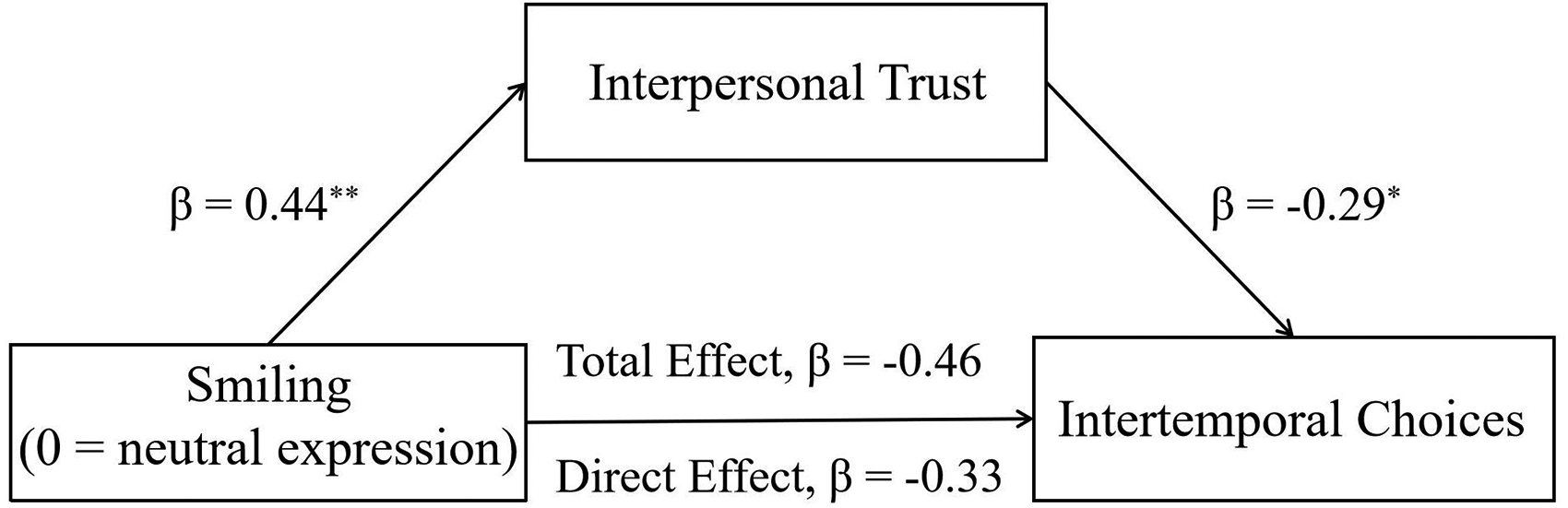
Mediation analysis of interpersonal trust: mediating role of interpersonal trust in the effect of smiling on individual intertemporal choices.
Ruling out the Mediating Effect of Positive Emotions
First, for pre-test positive emotions, no significant difference between smiling (M = 31.71, SD = 6.32) and a neutral expression (M = 30.15, SD = 6.09) was observed, t(102) = 1.28, p = .204, d = 0.25. The mediating role of post-test positive emotions was tested to exclude the alternative hypothesis that positive emotions would be the mediator between smiling and intertemporal choices. Likewise, the impact of general trust (IGTS) and trust propensity (PTS) were controlled. Applying a mediation model (bootstrap method, repeated sampling 5,000 times, using Model 4 in the PROCESS macro; see Preacher & Hayes, 2004, 2008), and coding facial expressions (independent variable) as dummy variables (smiling = 1, neutral expression = 0) and intertemporal choice (dependent variable) and post-test positive emotions (mediating variable) as continuous variables, revealed that smiling cannot significantly predict positive emotions, β = 2.51, SE = 1.36, t = 1.85, p = .069, 95% CI [−0.19, 5.22], and positive emotions cannot significantly predict the discounting rate, β = 0.03, SE = 0.01, t = 1.98, p = .051, 95% CI [−0.01, 0.06]. The total effect of smiling on intertemporal choices was significant, β = −0.46, SE = 0.18, t = −2.57, p = .012, 95% CI [−0.81, −0.10], and the direct effect was also significant, β = −0.53, SE = 0.18, t = −2.97, p = .004, 95% CI [−0.88, −0.17]. The indirect effect was not significant, β = 0.07, SE = 0.06, 95% CI [−0.01, 0.22], indicating that the mediating role of post-test positive emotions was not significant (see Figure 6).

Mediation analysis of positive emotion: mediating role of post-test positive emotion in the effect of smiling on intertemporal choices.
To test the alternative hypothesis—that is, that smiling increases positive affect, which then increases interpersonal trust and intertemporal choices—and examine whether positive emotions and interpersonal trust mediated the relationship between facial expressions and intertemporal choices log-transformed delayed discount rate (lnk), a serial mediation analysis was conducted using Hayes’ (2018) PROCESS macro (Model 6). The impact of general trust (IGTS) and trust propensity (PTS) were controlled. The results indicated that the direct effect of facial expressions on log-transformed delayed discount rate (LNK) was significant, β = −0.40, SE = 0.18, t = −2.20, p = .031, 95% CI [−0.76, −0.04]. Smiling cannot significantly predict positive emotions, β = 2.51, SE = 1.36, t = 1.85, p = .069, 95% CI [−0.19, 5.22]. However, except for the indirect effect of smiling on intertemporal choices through interpersonal trust being significant, all other indirect effects were non-significant as their 95% CIs included zero. The result of sequential mediation model in Experiment 2 was shown in Table 2 and Figure 7.
Sequential Mediation Effect Test in Experiment 2.

Note. CI = confidence interval; LNK = ln-transformed k.

Sequential mediation model in Experiment 2.
Experiment 3
Experiment 3 investigated the moderating role of environmental uncertainty in the mediation effect of interpersonal trust.
Participants
The required sample size was 179 for a two-factor between-subjects analysis of variance, based on G*Power 3.1 (Faul et al., 2007), with an effect size of f = 0.25, a statistical test of power 1 – β = 0.80, and a two-sided test of α = 0.05. Based on Cohen's (1988) classification of effect sizes, this study adopted a medium effect size (f = 0.25), as it represents an effect that is neither trivially small nor impractically large. A total of 200 college students were recruited from a university in China to participate in the experiment. Five participants with no changes in their intertemporal choices were excluded, leaving 195 valid participants—63 males, with an average age of 24.73 years (SD = 6.95), and 132 females, with an average age of 22.72 years (SD = 6.02). This sample provided 80% power to detect an effect as small as f = 0.20 in a between-subjects analysis of variance with a 5% false-positive rate.
Design
A 2 (smiling versus neutral expression) × 2 (uncertainty versus control condition) between-subjects design was implemented, with intertemporal choices as the dependent variable. The participants were randomly assigned to four groups. The smiling control group included 49 participants: 20 males, with an average age of 25.75 years (SD = 8.82), and 29 females, with an average age of 24.31 years (SD = 7.53). The neutral control group included 49 participants: 13 males, with an average age of 23.85 years (SD = 6.56), and 36 females, with an average age of 22.17 years (SD = 4.64). The smiling-uncertainty group included 49 participants: 14 males, with an average age of 25.00 years (SD = 7.41), and 35 females, with an average age of 23.71 years (SD = 7.53). The neutral-uncertainty group included 48 participants: 16 males, with an average age of 23.94 years (SD = 4.04), and 32 females, with an average age of 20.81 years (SD = 2.80). There were no significant differences in the ages of the participants, F (1,191) = 2.31, p = .077, or the gender ratio, χ2 = 2.71, p = .439, among the four experimental conditions.
Manipulation of Smiling
This was the same as for Experiment 2.
Manipulation of Environmental Uncertainty
The participants were randomly assigned to the environmental uncertainty (n = 97) or control condition (n = 98). For the environmental uncertainty condition, the participants read an article entitled “Post-Pandemic: An Uncertain World,” which introduced economic uncertainty, epidemic instability, and turbulent international relations to prime perceived environmental uncertainty. In the control condition, the participants read an article about an asteroid belt, which introduced the origins, forms, and rotational cycles of asteroid belts. Both articles were written in the style of a People's Daily news article, which is an authoritative and influential newspaper in China. After reading the articles, both groups completed the environmental uncertainty questionnaire (Mittal & Griskevicius2014). An independent samples t-test showed that the environmental uncertainty manipulation was successful since uncertainty was higher in the experimental (M = 17.19, SD = 2.50) than the control (M = 15.48, SD = 3.89) condition, t (193) = 3.64, p < .001, d = 0.52.
Measurement of Intertemporal Choices
Intertemporal choices were measured in the same way as in Experiment 2. Based on Ma et al.’s (2012) study, there was a total of 16 choices, such as “¥400 today versus ¥404 half a month later”, “¥400 today versus ¥412 half a month later”, and “¥400 today versus ¥20 half a month later.” The specified amount difference rates between the alternatives were 1%, 3%, 5%, 10%, 15%, 25%, 35%, and 50%. Thus, there were 8 intertemporal choices in each comparison scenario—“today versus half a month later” and “today versus one month later.” The delay discounting rate across all 16 monetary choices was calculated as the index of the intertemporal choices. And, as in Experiment 2, we applied an log transformation to the estimated k values before proceeding to statistical testing.
Trust Game
The investment game (often called the trust game; Berg et al., 1995) was implemented to measure the trust between the participants and the HR managers. The participants were asked to invest (as a measure of trust) in the HR managers, who were represented with the same pictures as in Experiment 2 (16 pictures, 8 males and 8 females). At the beginning of each game, the participants were given ¥100 and could invest any integer multiple of 10 between 0 and 100 (e.g., 0, 10, 20, … 90, 100) in the HR managers (i.e., trustees), who would get three times the invested amount. The trustees would then decide whether to return the investment and how much of it to return to the participants. The participants’ final gain was equal to “¥100 − the invested amount + the returned amount.”
Control Measurements
The IGTS and PTS were also used, as in Experiment 2, to control the influence of general trust and trust propensity, respectively.
Procedure
When the participants arrived at the laboratory, they signed an informed consent form and were randomly divided into four groups. The experiment then proceeded as follows:
Results
Effects of Smiling and Environmental Uncertainty on Interpersonal Trust
To examine the moderating effect of environmental uncertainty on the influence of smiling on interpersonal trust, a 2 (smiling versus neutral expression) × 2 (uncertainty versus control condition) between-subjects analysis of variance was performed. The results showed a significant interaction effect between smiling and environmental uncertainty, F (1, 191) = 6.88, p = .009, η2 = 0.04, but both the main effects of smiling, F (1, 191) = 0.27, p = .608, η2 = 0.001, and environmental uncertainty, F (1,191) = 1.70, p = .195, η2 = 0.01, were not significant (see Figure 8). Simple effect analysis revealed that interpersonal trust for the smiling faces was significantly higher than for the neutral expressions, F (1, 191) = 4.95, p = .027, η2 = 0.03, only under the control condition and not under the uncertainty condition, F (1, 191) = 2.24, p = .139, η2 = 0.01.

Interaction effect: effect of facial expressions on interpersonal trust under environmental uncertainty and control conditions.
Effect of Interpersonal Trust on Individual Intertemporal Choices
The mean of the ln-transformed delay discounting is −4.75 (SD = 0.78), with values ranging from −6.76 to −3.58. A linear regression was conducted to examine the effect of interpersonal trust on individual intertemporal choices, with interpersonal trust as the independent variable and intertemporal choices as the dependent variable. The results showed that interpersonal trust significantly predicted intertemporal choices (β = −0.40, t = −5.98, p < .001), indicating that the higher the interpersonal trust, the lower the delay discounting rate in intertemporal choices.
Analysis of Moderated Mediation Effect
Tests of Moderated Mediation for the Effects of Smiling on Intertemporal Choices (n = 195).

*p < .05*. ***p < .001.
Smiling significantly predicted interpersonal trust, β = 0.57, 95% CI [0.03, 1.11]; interpersonal trust significantly predicted intertemporal choices, β = −0.24, 95% CI [−0.31, −0.16]; and the effect of the interaction between environmental uncertainty and smiling on interpersonal trust was also significant, β = −0.96, 95% CI [−1.73, −0.20]—that is, environmental uncertainty had a significant moderating effect on the influence of facial expression on interpersonal trust.
A simple slope test demonstrated that smiling was a positive predictor of interpersonal trust under the control condition, β = 0.57, 95% CI [0.03, 1.12], but not the environmental uncertainty condition, β = −0.40, 95% CI [−0.93, 0.15], indicating that the positive effect of smiling on interpersonal trust disappeared under environmental uncertainty.
The moderated indirect effect was 0.23, 95% CI [0.04, 0.43]. The results suggested that environmental uncertainty moderated the mediation of interpersonal trust between smiling and intertemporal choices. The mediating effect of interpersonal trust was further examined under the environmental uncertainty condition and the control condition, respectively. The relative indirect effect of smiling on intertemporal choices was significant under the control condition, effect = −0.14, 95% CI [−0.30, 0.00], but not under the environmental uncertainty condition, effect = 0.09, 95% CI [−0.02, 0.21]. Specifically, under the control condition, smiling induced higher interpersonal trust, which made the participants more willing to choose the larger-but-later options. However, this effect disappeared under the environmental uncertainty condition.
General Discussion
It is crucial to know whether and how smiling affects recipients’ intertemporal choices during human interactions. Across three experiments, the present study found that smiling at others nudged them to make farsighted choices in intertemporal choices; interpersonal trust mediated the effect of smiling on intertemporal choices; and the mediating role of interpersonal trust was moderated by environmental uncertainty.
We found that smiling led to the recipients making more far-sighted choices than neutral expressions through increasing interpersonal trust, which was consistent with Hypotheses 1 and 2. As a typical positive social signal, smiling faces have demonstrated a consistent “halo effect” in many research areas, which tends to positively influence the accompanying objects or subsequent behaviors, causing individuals to have positive expectations of the accompanying objects or subsequent behaviors (Oosterhof & Todorov, 2008). Positive expectations are the basis of trust. According to Rousseau et al. (1998), trust is a psychological state comprising the intention to accept vulnerability based on positive expectations of the intentions of the behavior of another. Therefore, smiling increases trust. Previous research has demonstrated that higher levels of trust are associated with lower risk perceptions (Cruwys et al., 2021; Lu et al., 2015; Ryu et al., 2018; Siegrist & Bearth, 2021; Zavareh et al., 2022). When making intertemporal choices, an individual needs to have sufficient trust in the realizability of the delayed option, otherwise they will choose the immediate option. Intervening to increase community trust resulted in significantly more favorable far-sighted choices in intertemporal choices among poor individuals in Bangladesh (Jachimowicz et al., 2017). Increasing trust can change individuals’ perceptions of values, motivations, and long-term goals, and promote far-sighted choices in intertemporal choices. Therefore, smiling could encourage far-sighted choices through the mediation of interpersonal trust.
We also found that the mediating role of interpersonal trust was moderated by environmental uncertainty, which supported Hypothesis 3. In the control condition, interpersonal trust meditated the effect of smiling on intertemporal choices, whereas in the environmental uncertainty condition, this effect disappeared. Uncertainty may reduce an individual's sense of control and decrease patience (Mittal & Griskevicius, 2014), indicating the negative effects of uncertainty on individual cognition and behavior. According to uncertainty avoidance theory (Hogg, 2000), people instinctively dislike ambiguous responses and desire a firm answer to a question; they will strive to reduce uncertainty about information about themselves, society, and the world to ensure predictable behavioral outcomes. When faced with external threats or pressures (time pressure, uncertainty, etc.), people generally develop a stronger need for cognitive closure to minimize information ambiguity (Kruglanski & Webster, 1996). Thus, under the condition of environmental uncertainty, the participants generated a strong need for cognitive closure to reduce uncertainty. To reduce uncertainty, people tend to reduce trust and subsequently prefer the immediate option in intertemporal decisions.
This study makes several theoretical contributions to the literature. First, it is among the first to examine the effect of smiling on recipients’ intertemporal choices and expands the field of research on intertemporal choices by examining the impact of prosocial behavior on intertemporal choices in the context of human interactions. Second, the present research revealed the effect of interpersonal trust on intertemporal choices by examining the mediating role of interpersonal trust in the effect of smiling on intertemporal choices, which suggests the importance of interpersonal trust for intertemporal choices. Intertemporal decisions rely on the fundamental assumption that a future reward will be delivered as promised, which is also an important premise for individuals when making intertemporal choices. The current results provide more direct evidence for the important role of interpersonal trust. Third, previous studies have nudged people to choose more far-sighted intertemporal options by altering physical environments—such as using a blue font (Zhang et al., 2025), setting up blue-light environments (Geng et al., 2022), or adopting vertical temporal displays (Romero et al., 2019)—or modifying decision architectures—for example, by using the explicit penalty format (Faralla et al., 2017) or the present-improved frames (Faralla et al., 2024). Few studies have considered the nudging effect of the interpersonal environment on far-sighted choices. Our study offers a new perspective for nudging far-sighted decision-making.
In practice, the present research found that when environmental uncertainty is low, smiling can nudge people into making far-sighted choices. For example, in salary negotiations, maintaining a smile can enhance the other party's level of trust in you, thereby guiding the other party to choose options that are more conducive to the long-term development of your relationship. However, under high environmental uncertainty, the nudging effect of smiling disappears—in other words, merely smiling is no longer enough to enhance others’ interpersonal trust. It may require more powerful approaches than smiling to achieve the same level of interpersonal trust that may be needed to facilitate far-sighted choices. In summary, the results provide an effective nudging tool to help people make far-sighted choices during human interactions.
The current research has some limitations. First, we chose pictures from the Chinese Affective Picture System database, using the database of valence, arousal, dominance, and attractiveness instead of measuring these variables directly. Thus, we could not control these variables in analyzing the effect of smiling on intertemporal choices. The valence, arousal, dominance, and attractiveness of pictures should be measured directly in the future. Second, we only manipulated smiling related to benevolence and did not control the proposers’ competence and integrity, which could also influence trustworthiness. Future work could examine how the proposers’ competence, benevolence, and integrity interactively influence trust and intertemporal choices. Third, in this study, the smiles were manipulated through the presentation of images rather than being real-life smiles, which may have reduced the effect of smiling on positive affect. Future work could use more real smiling to investigate this effect thoroughly.
Conclusion
Across three experiments, the present study found that (1) smiling at others nudged the recipients to make more far-sighted choices through the mediation of interpersonal trust—that is, smiling led to the recipients’ higher level of trust, which further led to farsighted choices—and (2) interpersonal trust acted as the mediator, moderated by environmental uncertainty—that is, interpersonal trust meditated the effect of smiling on intertemporal choices under the control condition, whereas the effect disappeared under environmental uncertainty. In conclusion, smiling is one type of prosocial behavior that can nudge farsighted choices through increasing interpersonal trust, but only when environmental uncertainty is low.
Footnotes

Ethical Considerations
The studies were conducted according to the guidelines of the Declaration of Helsinki and complied with the ethical charter of Hangzhou Normal University's Department of Psychology.
Consent to Participate
Written informed consent was obtained from all the participants.
Consent for Publication
On images of human face included in the manuscript, we consent to publish.
Funding
The authors disclosed receipt of the following financial support for the research, authorship, and/or publication of this article: This research was supported by the HZNU scientific research and innovation team project (grant number: TD2025011).
Declaration of Conflicting Interests
The authors declared no potential conflicts of interest with respect to the research, authorship, and/or publication of this article.
Submission Declaration
The work described has not been published previously. It is not under consideration for publication elsewhere.
Disclosure of Experimental Conditions and Variables
We have reported all implemented experimental conditions and disclosed all measured variables. We have reported all of the studies that they have run on the research question of the paper.