



Abstract
Cooperative behavior plays a crucial role in organizational outcomes, and its formation process is significantly influenced by cultural differences. This study aimed to investigate whether the rice theory can account for the formation of cooperation. Through three studies involving public goods experiments, we demonstrated that the cooperative behaviour of participants from rice regions (participants from wheat regions) was more in line with collectivism (individualism), when they were primed by money reminders. In Study 1, participants from rice regions and wheat regions were paired (either with strangers or friends) to engage in public goods games without the influence of the money prime. The results showed that in the friend condition, the participants from rice regions cooperated significantly more than the participants from wheat regions. In Study 2, it was demonstrated that when exposed to a money prime, the participants from rice regions cooperated significantly less with strangers compared to the participants from wheat regions. However, participants from both cultures cooperated equally with friends. In Study 3, we reconfirmed that this activation of money thinking further enhanced the effect of rice culture on cooperation when there was a money prime. Additionally, when thinking about monetary loss, the participants from rice regions cooperated significantly more with friends than the participants from wheat regions.
Introduction
Cooperation is crucial for the success of organizations (Chen et al., 1998; Dorrough et al., 2016; Xie et al., 2023), especially in the context of cross-disciplinary and cross-functional teams as well as inter-organizational and international collaborations and alliances (Manz & Sims, 1987). Cultural differences are vital factors that influence cooperation (Smith et al., 1995). For example, some literature has shown that collectivists are more cooperative and less inclined to “free ride” than individualists (Cox et al., 1991; Earley, 1993). The Rice Theory of Culture (RT) explains a unique form of cultural differences (Talhelm et al., 2014; Talhelm & Dong, 2024). The RT considers that the ancestorial people of rice regions collaborated to build elaborate irrigation systems, coordinated water use, shared the cost of construction and maintenance, and thus practiced comprehensive collaboration and coordination with one another, where neighbors formed tight reciprocal relationships and avoided conflict; thus, after thousands of years of this farming practice, people living in rice-cultivating regions developed a higher degree of interdependence and collectivism compared to those living in wheat areas. The RT sheds new light on understanding cross-cultural psychology and behavior due to agricultural systems.
In this study, we explored whether the RT explains cooperative decision-making after controlling for other processes known to be determinants of cooperation by conducting behavioral experiments. Rather than merely dealing with confounding variables, the utilization of incentivized economic games instead of vignettes has the potential to enhance the method. Vignettes might not accurately reflect real behavior, whereas economic games with actual incentives can boost validity. The study also took into account cultural effects on cooperation within different relationships and the moderating role of money. The aim was to resolve RT-related disputes and gain a deeper understanding of the cultural impacts on human behavior. Additionally, we incorporated data on the effect of money priming, considering how the concept of money can influence cooperative behavior. We expanded the tests to include loss framing, which further enriched our comprehension of the factors influencing cooperation. Through these efforts, we intended to explore whether the RT can explain cooperative decision-making through behavioral experiments while also controlling for other determinants of cooperation.
Meanwhile, to analyze the explanatory power of the RT for cooperation in the context of China, we also investigated the cultural effects of rice vs wheat societies on cooperation within different relationships. One defining feature of collectivistic cultures is that they draw a sharp distinction between friends and strangers (Triandis, 1995). Whether people from different cultures cooperate with strangers or friends equally is still unknown. In the present study, we contrasted cooperation with or without relationships. Moreover, the concept of money was considered in our study. The idea of money activates feelings of self-sufficiency which makes people less likely to request help and less likely to be concerned about others’ approval (Vohs et al., 2006). Money may strengthen cultural effects and thus the moderating effect of the concept of money on culture-cooperation relationships was considered in this study (Falicov, 2001). Our study contributes to the existing theories by integrating the fields of culture, money, and cooperation, resolving mixed findings regarding the RT, and identifying the conditions for the RT, thereby allowing a deeper understanding the effect of culture that impact on human behaviors.
Theoretical Background and Hypotheses
Rice-Wheat Cultures, Relationships, and Cooperation
We examined the effects of rice-wheat culture by relying on one well-established cultural theory, that is, individualism-collectivism (Hofstede, 1980; Triandis, 1995). Some previous studies on the RT considered that farming rice makes cultures more collective, whereas farming wheat makes cultures more individualistic, indicating that collectivism occurs more in people from rice regions and less in wheat areas (Talhelm et al., 2014). Individualists (or people from wheat regions) and collectivists (or people from rice regions) have different cooperative performances. Culture can affect cooperation through the mediation of certain cooperation mechanisms (Smith et al., 1995). For example, one can say that collectivists tend to share common goals and have a stronger group identity, more group accountability, communication, and an egalitarian reward system. These cooperation mechanisms have been specified to account for cultural effects. Whether directly or through the mediation of mechanisms, cultures are posited to have a straightforward and deterministic effect on cooperation (Chen et al., 1998).
Chen et al. (2013) summarized the main findings of over 200 journal articles on Chinese relationships (guanxi). The ubiquitous term “guanxi” literally means relationships and refers to, separately or simultaneously, relational entities and the relationships within them (Bian & Ang, 1997; Tsui & Farh, 1997), the social practices of building and using personal relationships to get through life and work (Chen & Peng, 2008), the strategy for organizations to gain competitive advantage (Li et al., 2009; Luo et al., 2012), and as a mechanism of contracting and transacting (Lovett et al., 1999). Scholars have discussed broad typologies of guanxi (Luo, 2011; Song et al., 2012), in this study, we discussed the specific characteristics of a relationship between two parties: strangers and friends.
According to Triandis (1995) theory of individualism-collectivism, one important attribute is the extent to which people make distinctions between in-group and out-group members, that is, in-group favoritism and out-group denigration (Leung, 2014). Individualists (or people from wheat regions) make little distinction between strangers and friends, while collectivists (or people from rice regions) make a sharp distinction between the two. According to the institutional view of culture (Yamagishi, 2003), collectivist people often prefer to belong to groups and place group interests above their own interests, not because of an intrinsic tendency, but because there exists a system of formal and informal mutual monitoring and sanctioning in the group. Once such a system is absent, which occurs when groups consist of complete strangers, people's behaviour is no longer confined or constrained by the concerns of others, and they become more willing to reveal their egoistic sides and behave accordingly.
It can thus be inferred that people from rice regions are more cooperative with friends and less cooperative with strangers, but that for people from wheat regions, there is little cooperative difference between friends and strangers. According to Triandis’ (1995) theory of individualism-collectivism, it can be reflected in several specific aspects. Firstly, in economic decision-making scenarios, such as investment cooperation or sharing economic resources, people from wheat regions do not exhibit a significant preference for friends over strangers. They make decisions mainly based on objective factors like potential returns and risks rather than interpersonal relationships. Secondly, in social activities, when it comes to tasks like community volunteer work or group projects, the cooperation levels of people from the wheat regions do not show a great difference whether they are working with friends or strangers. They focus more on the task itself and their own personal interests in contributing to the activity.
Regarding the influence of interpersonal distance on prosocial behavior (such as cooperation and trust), it is true that in many cases, the closer the interpersonal distance, the stronger the prosocial behavior. The above inference about people from wheat regions is still reasonable. In individualistic cultures, people value personal independence and self-interests more. Their cooperative behaviors are often driven by personal goals and rational considerations rather than the proximity of interpersonal relationships. So, the lack of a significant difference in cooperation between friends and strangers for people from wheat regions is a manifestation of their individualistic cultural characteristics.
In the current study, we explore the differences in cooperation between people from rice regions and wheat regions. It is worth noting that there are two additional relevant studies that have also delved into this cultural difference. Dong et al. (2019) found that when compared with students from wheat regions, students from rice regions tended to think more holistically, treated a close friend better than a stranger, and exhibited lower implicit individualism. Moreover, these differences persisted among the post-2000 generation. Zhang et al. (2021) discovered that high-status people from wheat regions were more individualistic and analytic-thinking compared to those from rice regions. These findings provide additional evidence for the difference between rice and wheat regions cultures, which are significant to our study's exploration of the cooperative relationship between cultures. We built on these previous studies to further investigate the role of culture and money in cooperative decision-making.
The Moderating Role of Money Ideas
Observing that cooperation takes place in all societies, a more sophisticated view of cultural differences should focus on the social environment in which cooperation is initiated and maintained. This leads us to consider a secondary moderator—one that focuses on the interactions between monetary ideas and culture.
Studies on the psychology of money found that thoughts of money made people less likely to offer or request help and that they preferred to play alone, work alone, and place more physical distance between themselves and a new acquaintance (Gasiorowska et al., 2012; Vohs et al., 2006). That is to say, ideas of money lead to a strong desire to pursue personal goals and a weak desire to care about social relationships. Zhou et al. (2011) proposed a “cultural value as a form of currency” indicating that cultural value and monetary value overlap in evolutionary functions, neurological correlations, behaviors, and cognition of humans. This view provides us with a new perspective in which to predict the interaction between culture and money. By interaction, we mean the monetary ideas that moderate the role of cultures. That is, ideas of money, monetary gain, or monetary loss activate the same brain regions as cultural values. For example, the activation of the medial prefrontal cortex (MPFC) strengthens the reflection of self-knowledge (Ochsner et al., 2005), processing self-reputation (Izuma et al., 2008), judging self-descriptive adjectives (Moran et al., 2006), and evaluating one's own personality (Saxe et al., 2006).
These social cognitive functions hold a crucial position in the formation of self-concept. In addition, based on Swann's theory of self-verification, people tend to seek out social contexts that can offer them self-confirmatory feedback. This is achieved through selective interaction, by displaying identity cues, and by adopting appropriate interaction strategies (Swann et al., 2002). As a result, reminders related to monetary gain and loss enhance the self-concept of individuals from different cultures.
Consistent with the cultural differences in self-concept, the motives of individualists (or people from wheat regions) concentrate on actualizing their true or potential selves, while the motives of collectivists (or people from rice regions) are centered around the dedication of the self to the collective (Markus & Kitayama, 1991). Mok and De Cremer (2016) showed that the effect of priming others to act warmly with the incentive of money occurs by activating a social norm. Their experiments suggest that money ideas may induce norm salience. For this reason, after thinking about money (e.g., gain or loss), people from rice-cultivating regions are more likely to fulfill the needs and preferences of the collective than people from wheat region. Based on these features, we propose the following hypothesis:
Materials and Methods
Three studies using a public goods game were conducted to test our hypotheses. A public goods game is particularly suitable for studies that compare the cooperation of rice and wheat cultures because the individual vs. collective dilemma embedded in these games puts the target participant in a situation of stress. This stress makes cultural element (e.g., individualism-collectivism) more salient in individuals’ decision-making (Chen & Li, 2005). Furthermore, the high level of interdependence involved in public goods games forces people to think about the consequences of their own choices for the group and other members. The propensity to relate to others is also culturally cultivated (Markus & Kitayama, 1991). Moreover, in public goods games, an equality distribution rule is used once the public good is established (Di Cagno et al., 2016); and the extent to which an equality rule is accepted is also related to cultural beliefs and norms (Chen, 1995; Leung & Bond, 1984). Finally, computerized experiments in a laboratory are better for controlling for confounding factors such as communication and decision structure (Carpenter, 2007; Shinada & Yamagishi, 2007; Sutter & Strassmair, 2009).
Using rice-wheat as a proxy for culture and a two-person public goods game as the decision-making context, Study 1 placed participants in a social relationship with either friends or strangers and tested Hypotheses 1a and 1b. Building on the results of Study 1, Study 2, and Study 3 manipulated money reminders in two ways: reminders of receiving money and reminders of having spent money, respectively. These two experiments tested hypotheses related to how money cues interact with culture in public goods games.
In the three experiments of this study, the effect sizes were estimated via F-tests and presented in each experiment's results section. For example, in Study 1, the two-way analysis of variance (ANOVA) on relationship and culture yielded an effect size for relationship of F(1,156)= 82.29 and an effect size for the interaction between relationship and culture of F(1,156)= 6.07. Similar effect sizes obtained from F-tests were also presented in Study 2 and Study 3.
Regarding the sample size, it was set according to the minimum of 30 people. In actual operation, considering the reliability of the research and statistical power, the sample size of each experiment exceeded 30 participants. Taking Study 1 as an example, 80 students from rice regions and 80 students from wheat regions were recruited, with a total of 160 participants. Such a sample size setting can not only meet the basic statistical requirements, ensuring that the research results are representative to a certain extent, but also improve the statistical test power, reduce the probability of making mistakes, and enhance the reliability of the research conclusions. Study 2 and Study 3 also recruited corresponding numbers of participants based on similar considerations to ensure the effectiveness of the research.
In addition, it should be noted that there is no indication in the experimental design and implementation process that the subjects who participated in the experiment in the rice area tended to assume that the strangers were from the rice area. The experimenters determined the participants’ regions (rice region or wheat region) based on their birthplaces and the places where they spent most of their childhood through questionnaires. And in the experiment, when manipulating the relationship between participants (friends or strangers), for the manipulation of strangers, participants were randomly assigned into groups.
To balance the influence of peers’ identities, the experimenters took several measures. Firstly, for the purpose of this study, the definition of “friends” among the participants was clarified, which helps to ensure that the friend relationship in the experiment is relatively consistent. Secondly, in all three experiments, the members of each pair were of the same gender to prevent the interference of gender factors. Thirdly, by recruiting students from the same university, the experimenters were able to more or less hold constant factors like age, education, and standardized test scores, which may also have an impact on the experimental results and the influence of peer relationships. Fourthly, in the experimental design, a factorial experimental design was adopted. For example, in Study 1, a 2 (Relationship: friends vs. strangers) × 2 (culture: rice regions vs. wheat regions) between-subjects factorial experimental design was used. This design allows for the examination of the main effects of relationship and culture as well as their interaction effects, helping to analyze and control the influence of different factors including peer identities.
Study1
Participants
Based on the RT findings of Talhelm et al. (2014), Han Chinese people from rice regions are more holistic thinking and interdependent, while those from wheat regions are more analytical thinking and independent. In this study, we used rice and wheat regions as proxies for culture.
The participants included 80 students from rice regions and 80 students from wheat regions. All participants were informed of the study's purpose and gave their consent. The wheat regions participants were mainly students from Jilin (20), Gansu (15), Shandong (25), Liaoning (15), and Heilongjiang (5) provinces, where most farmlands are devoted to wheat. The rice regions participants were mainly from the Zhejiang (25), Jiangxi (15), Hunan (20), and Jiangsu provinces (20), where most of the farmland is devoted to rice paddies (Talhelm et al., 2014). Besides region information, we only collected the basic demographic information of the participants, including their mean age of 21.24 years (SD = 2.48) and gender distribution (56.3% were female).
Obviously, we determined the regions based on the participants’ birthplaces. To measure this, we used the following key question: “Where were you born?” In addition, we also asked the participants about the place where they spent most of their childhood to confirm. Notably, during the data collection process, we found that for the vast majority of the participants, their places of birth and growth were identical. This high degree of consistency simplifies the categorization process, as it eliminates potential confounding factors that could have arisen from differences between birthplace and upbringing location. Through these questions, we could accurately categorize the participants into either the rice regions or wheat regions groups, ensuring the integrity and reliability of our research data.
The students were from the Zhejiang University of Finance and Economics. By recruiting students from the same university, we were able to more or less hold constant factors like age, education, and standardized test scores. To prevent the interference of gender, members of each pair were of the same gender. For the purpose of this study, when referring to “friends” among the participants, we defined them as individuals with whom the students had an extremely close and familiar relationship, having spent a significant amount of time together over an extended period, often sharing daily activities, personal experiences, and deep-seated conversations. Most students were majoring in management and volunteered to participate in the experiment. The mean age of students for both samples was 21.24 years (SD =2.48), and 56.3% were female. All the participants received monetary compensation for their performance during the experiment.
Experimental Design
The study employed a 2 (Relationship: friends vs. strangers) × 2 (culture: rice regions vs. wheat regions) between-subjects factorial experimental design. The experimental procedures were equal for the rice regions participants and wheat regions participants. Half of the rice regions (wheat regions) participants took part in the experiment with their friends, while the other half took part with strangers. To manipulate the relationship of friends, we asked participants to bring their familiar others/friends to the lab (Chen & Li, 2005), we assigned them a stranger by randomly assigning participants into groups for the manipulation of strangers (i.e., not in the same college; check the partner's name before the experiment).
Procedure
In this study, the public goods game was conducted using the computer program z-Tree (Zurich Toolbox for Ready-made Economic Experiments; Fischbacher, 2010). z-Tree is a versatile program that allows studies to program a wide range of economic games and customize them according to their needs. Each participant interacted through a computer that was connected to the experimenter's computer, enabling the researcher to control the game, monitor the progress of each participant, and access the data file.
The voluntary contribution mechanism of the public goods games closely followed that used by Fischbacher and Gächter (2010). All participants were randomly assigned to play the game. In stage 1, a formed group was asked to arrive 10 min before the experiment started. Upon arrival, they were seated in sound-proof individual cubicles containing a computer workstation. The experimenter handed out the instructions to the participants and slowly read them aloud line by line, which took approximately 15 min. Participants were not allowed to talk or use any communication device during the experiment. After reading the instructions, participants were asked to solve a series of quizzes to ensure that they clearly understood the instructions.
Next, participants were told that they would play against their partner (one-on-one) and repeat nine rounds of each public goods game. In each round, participants were given a personal endowment of 100 units and made investment decisions in a hypothetical work environment.
If a participant chose investment A, they would receive a payoff that was the amount of A multiplied by 1.05. If they chose investment B, they would receive a payoff that was the total amount of B (the sum of all participants’ contributions to B) multiplied by 0.6. This creates a social dilemma. On one hand, choosing A guarantees a certain level of personal gain based on one's own investment. On the other hand, choosing B has the potential for a greater overall return for the group but also depends on the cooperation of others. The payoffs are shown in Table 1.
Payoffs of Experiment in Study 1.

Payoffs of Experiment in Study 1.
Before entering the next round, participants are able to see the contributions of the other players to the account-B in the previous round. Within 60 s, they must choose actions that influence their and their partner's earnings. They might choose to adjust their own investment strategy based on what the other player contributed in the previous round. If a participant notices that the other player contributed a large amount to B, they might be more inclined to contribute to B as well, hoping to maximize the overall payoff. On the other hand, if the other player contributed little to B, they might be more tempted to choose investment A for a more certain personal gain. The participants’ choice in the next round will have a significant impact on the subsequent experiments. It will determine the immediate payoffs for both the participant and their partner in that round. These payoffs will accumulate over the nine-round experiment, influencing the overall outcome of the game for each pair. Moreover, the choices made in the following round can also affect the dynamics between the participants. If a participant consistently makes choices that seem self-serving, it could lead to a breakdown in trust and cooperation with their partner, potentially changing the strategies both players use in the remaining rounds. The task presented to participants concerned a choice between investment A and investment B. Essentially, participants were told that if producers invested A, they would receive a payoff that was the amount of A multiplied by 1.05, whereas if producers invested B, they would receive a payoff that was the total amount of B multiplied by 0.6.
A more comprehensive process of public goods game is presented in Figure 1.
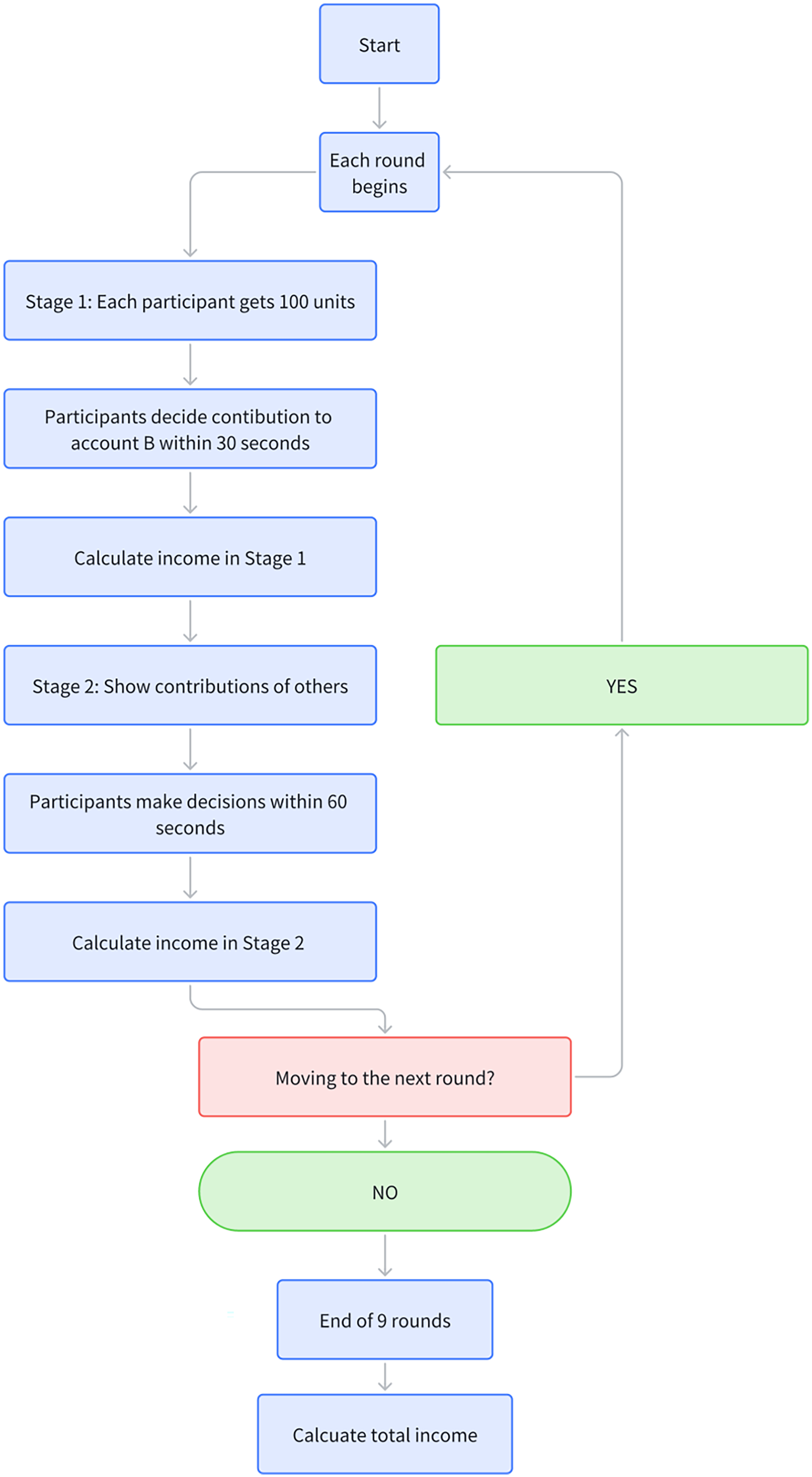
Process of Public Goods Game.
This diagram shows that in each round of the public goods game, it starts with participants receiving a capital of 100 units. In Stage 1, they decide how much to contribute to account-B within 30 s, then their income in Stage 1 is calculated. In Stage 2, participants can see the contributions of other participants, and then make decisions within 60 s to influence earnings. The income for Stage 2 is calculated, and then it is determined whether to move to the next round. After 9 rounds, the total income is calculated, and the game ends.
The difference between the two coefficients is significant. The coefficient for investment A is 1.05, which implies a relatively modest increase in the amount invested for personal gain. However, this higher return in investment B is conditional on the collective action of all involved. The difference in these coefficients creates a social dilemma. On one hand, choosing A guarantees a certain level of personal gain based on one's own investment. On the other hand, choosing B has the potential for a greater overall return for the group but also depends on the cooperation of others. This difference in coefficients is crucial as it drives the strategic decision-making process of the participants, especially considering factors like the repeated nature of the game (nine rounds) and cultural influences on cooperation.
Despite A seeming more rewarding, there are several reasons why someone might still put money in B. Firstly, the game was a repeated one with nine rounds. In such a setting, participants might aim to build trust and cooperation over time. If one always chose A, the other player could retaliate in later rounds, resulting in a worse outcome for both in the long run. Secondly, it was a social dilemma where the overall outcome for the pair was more favorable when both contributed to B. Although the individual return on A seemed higher, the combined benefit from B could be greater for the group. Finally, cultural factors played a role. For instance, collectivists, like those from rice regions, might be more inclined to contribute to B as they value the group's well-being and social relationships more than immediate personal gain, even if the individual payoff was lower. Eventually we collected the data from the nine rounds and determined the free-rider index (FRI) by averaging the amount of A, in line with Leuthold's studies (Siegel & Leuthold, 1993).
After finishing the public goods games, participants were given feedback on each member's decision and their own payoff. They then signed a confidentiality form and were thanked, debriefed, paid, and dismissed individually. The entire experiment lasted approximately 30 min and participants received an average of 15 RMB.
More details of the experimental procedure are presented in Appendix A.
Figure 2 and Table 2 present the main results of study 1. The FRI from the z-Tree program with which participants engaged in the two situations was used as an index of their cooperativeness in decision-making (the larger the number, the less cooperative). A more thorough explanation for it is as follows: In the public goods game, participants choose between investment A (keeping for self) and B (contributing to the common pool). A higher amount of A means more self-interested behavior. The overall FRI is the average of amount A over nine rounds. A high FRI indicates less cooperation, while a low one shows more cooperation. The FRI for each round is shown in Figure 2. The FRI is clearly floating but is not characterized by complete free riding. Thus, the index curves of the four groups can be easily distinguished.

The Free-Rider Index for Study 1.
Results from Study 1: Overall Free-Rider Index as a Function of Culture (Rice Region vs. Wheat Region) and Relationship (Friend vs. Stranger).
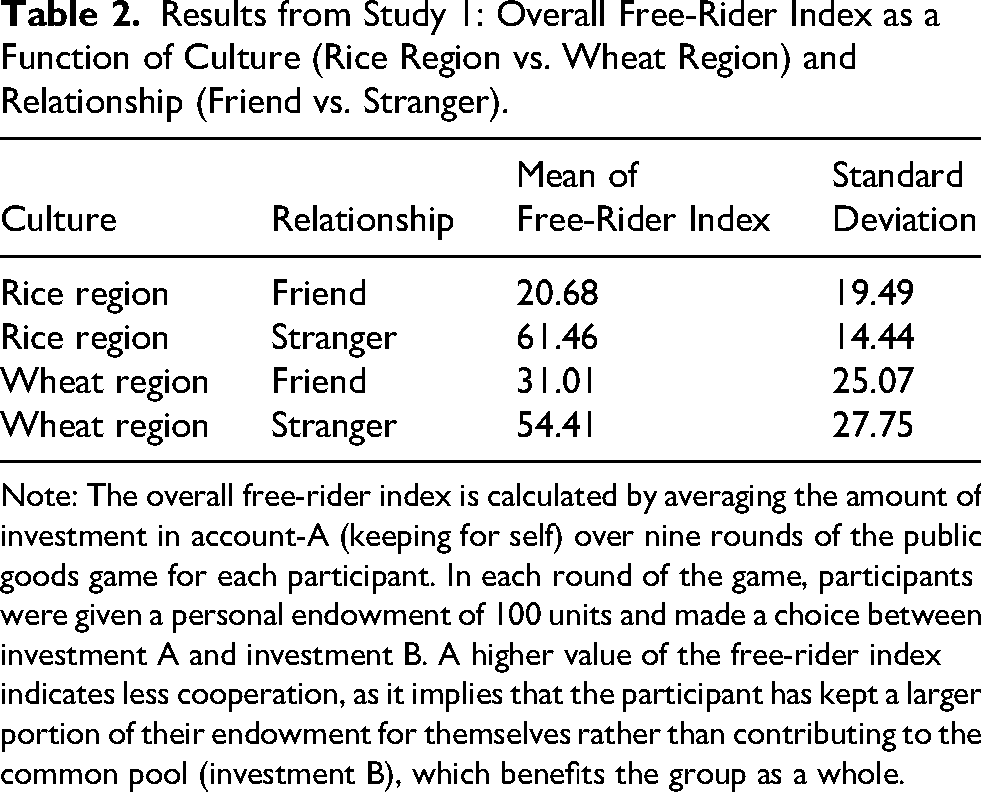
Note: The overall free-rider index is calculated by averaging the amount of investment in account-A (keeping for self) over nine rounds of the public goods game for each participant. In each round of the game, participants were given a personal endowment of 100 units and made a choice between investment A and investment B. A higher value of the free-rider index indicates less cooperation, as it implies that the participant has kept a larger portion of their endowment for themselves rather than contributing to the common pool (investment B), which benefits the group as a whole.
Moreover, the average account-A in nine games was used as the overall FRI for further analysis. A two-way analysis of variance (ANOVA) on relationship and culture was conducted to test Hypotheses 1 and 2. The analysis revealed two significant effects. Relationship decreased FRI, F(1, 156) = 82.89, p < 0.001, η2 = 0.35, 95%CI = [0.2492, 0.4311], and the interaction between relationship and culture was significant, F(1, 156) = 6.07, p = 0.01, η2 = 0.04, 95%CI = [0.0040, 0.0971]. Other effects were not significant at the level of 0.05. Rice regions participants engaged in free-riding (mean = 42.71, SD = 28.79) as much as the wheat regions participants did (mean = 41.07, SD = 26.67), F(1,156) = 0.22, p = 0.64, η2 = 0.001, 95%CI = [0.000, 0.0262].
A closer look at Table 2 indicates that these results provided support for Hypothesis 1a in that: (1) When their partner was a friend, the rice regions participants did less free-riding (mean = 20.68, SD = 19.49) than wheat regions participants (mean = 31.01, SD = 25.07), F(1, 78) = 4.29, p = 0.043, η2 = 0.051, 95%CI = [0.0006, 0.0807]. (2) When their partner was a stranger, the rice regions participants (mean = 61.46, SD = 14.44) were less cooperative than wheat regions participants(mean = 54.41, SD = 27.75), however, the difference was not significant, F(1, 78) = 2.028, p = 0.158, η2 = 0.025, 95%CI = [0.0000, 0.1057]. These results fit with Hypothesis 1.
In Figure 2, the influence of the peers was considered. The relatively small difference in the FRI among different conditions in the first round might be due to participants’ initial unfamiliarity with the game and their partners. As the rounds progressed, the influence of peers’ feedback became more prominent. For instance, if a participant observed that their partner contributed a large amount to account-B in the first round, they might be more likely to contribute in the next round, hoping to maximize the overall payoff. Conversely, if the partner's contribution was small, the participant might be more inclined to choose investment A to ensure a certain personal gain. This shows that participants’ decision-making behavior was influenced by their peers’ actions, and they adjusted their strategies based on the feedback they received.
The results of Study 1 provided support for our hypotheses, that is, there are considerable differences between rice and people from wheat region in terms of their cooperative behaviour in public goods games. When friends were involved, rice regions participants were more cooperative than their wheat regions counterparts, whereas, for the stranger sample, no significant difference was found. These results support Hypothesis 1a.
This study has two potential limitations. The first problem is the limited generalizability of our results. Regarding the research design, it is difficult to compare our findings with those of previous research as our study used more tangible decisions about money rather than hypothetical scenarios. Moreover, cooperative decision-making has not been considered in previous research. Study 1 used a paradigm that included a measurement of cooperation (or free-riding), which has been widely adopted in the behavioral economics literature. The finding that cultures had no impact on the free-rider indices of participants from two agricultural areas may be due to a different research technique and different sample sources. All participants were from the same university in Eastern China. In Studies 2 and 3, we lead a money-prime task to test whether the same pattern of results would be replicated.
The second problem with Study 1 was related to cultural hybridization and pluralism. Although we observed cultural differences when friends were implicated, Study 1 was not completely consistent with the general assumption behind H1b that collectivists (or people from rice regions) cooperate less with out-group members (Triandis, 1995). In fact, they cooperate with friends more than individualists (or people from wheat regions). However, no significant difference was found between the strangers. The reasons are manifold. Firstly, cultural hybridization and pluralism make it hard to study distinct cultural effects, blurring the expected differences between rice and people from wheat region when interacting with strangers. Secondly, the study's unique techniques, like more tangible money decisions and different ways of defining friend-stranger relationships compared to prior research, could have influenced the results. Finally, the sample's homogeneity, as all participants were from the same university, might have concealed any potential disparities in cooperation with strangers.
Culture is becoming increasingly de-territorialized and penetrated by elements from other cultures. This results in cultural hybridization and pluralism, making it more difficult to study cultures as they become diffused. To overcome this problem, in Studies 2 and 3, we issued money reminders (or a money prime) before the public goods games and examined whether they strengthened the cultural effects on individual decision-making.
Study 2
Participants
Eighty-two Chinese undergraduate students from rice regions (40 males and 42 females) and 86 students from wheat regions (42 males and 44 females) volunteered to participate in the experiment. All participants were informed of the study's purpose and gave their consent. The rice regions participants were mainly from the Fujian (15), Sichuan (15), Zhejiang (20), Jiangxi (12), Hunan (10), and Jiangsu (10) provinces, where most farmland is devoted to rice paddies. The wheat regions participants were mainly students from Beijing (10), Jilin (20), Gansu (15), Shandong (20), Liaoning (10), and Heilongjiang (11) provinces, where most farmlands are devoted to wheat. The majority of the students were in their second year of study and majoring in economics, finance, and management. The mean age of the participants was 21.12 years (SD =1.52). All students received monetary rewards during the experiment.
Experimental Design
The study employed a 2 (relationship: friend or stranger) × 2 (culture: rice regions or wheat regions) × 2 (prime: counting money or counting paper) factorial experimental design, resulting in four experimental conditions in each prime. We learned that the bottle problem in Study 1 might suggest that money reminders are important for the cultural effect, which manifest in the following three aspects. First, the research techniques deviated from prior studies. It adopted more practical money-related decision-making tasks and a novel way of defining the friend-stranger relationship. Participants were required to bring friends to the lab or were randomly paired with strangers, which might have affected the results and made it hard to compare with other research. Second, the sample source was overly homogeneous as all participants were from the same university in Eastern China. This homogeneity might have masked the potential differences in cooperation between people from rice and wheat regions, thus limiting the generalizability of the study's findings. Finally, resulting from cultural hybridization and pluralism, it was difficult to study the pure cultural effects. The results did not fully conform to the assumption that collectivists (people from rice regions) cooperate less with out-group members (strangers), complicating the interpretation of the cultural influence on cooperation. Therefore, we set a prime task before the public goods games.
Procedure
Upon arriving at the laboratory, participants were given the instructions booklet to understand the public goods games and they were told that they would participate in several unrelated studies.
Next, participants were randomly assigned to one of the four experimental conditions, and they were asked to perform the pre-task before the experiment. Half of them were assigned to the condition of counting money, whereas the other half were allocated to the condition of counting paper. Those in the money condition counted out 80 CNY¥100 pristine bills from a stack provided by the experimenter, whereas participants in the paper condition counted out 80 pieces of paper. Each piece of paper was as large as the CNY100 bill.
After finishing the pre-task, similar to Study 1, all participants were asked to make a choice regarding the public goods games by indicating the extent to which they wanted to invest 100 units in account-B (relative to account-A, i.e., keep for themselves) and then completed nine rounds in pairs. The FRI was calculated by averaging the amount of A. In this study, the first-round data also showed little difference in the FRI across different conditions. The initial uncertainty might have led to this situation. However, as the experiment continued, the feedback from peers played a role. In the money-prime conditions, participants might have been more sensitive to their partners’ behaviors, as the concept of money made them more concerned about their own and the group's payoffs. They might have adjusted their cooperation levels according to their partners’ contributions, indicating that peer feedback influenced their decision-making process.
Finally, the participants were given feedback on each member's decision and their own payoff. They then signed a confidentiality form and were thanked, debriefed, paid, and dismissed individually. The entire experiment lasted approximately 40 min, and participants received their payoffs.
More details of the experimental procedure are presented in Appendix B.
Results
This section focuses on individual behaviour. Participants were asked to make their choice by investing a number in account-B to indicate the portion of their 100 units to invest in the common pool. The FRI for each round is shown in Figure 3. Although index curves of eight groups can be distinguished to some extent, the FRI with friends of rice regions people under the counting paper condition was close to that of the counting money condition. These results indicate that cultures and money interact with the FRI.

The Free-Rider Index for Study 2.
The average number in account-A in nine rounds was used as the overall FRI (the larger the number, the less cooperative). The mean cooperativeness of the two samples is shown in Figure 4. A 2 × 2 × 2 three-way ANOVA revealed a significant main effect of relationship (F1, 160= 93.59, p < 0.001, η2 = 0.37, 95%CI = [0.2726, 0.4508]), and the interaction effect of prime × relationship (F1, 160 = 5.55, p = 0.02, η2 = 0.04, 95%CI = [0.0028,0.0903]) was significant. Moreover, with a repeated-measures analysis, there was a significant effect of culture × relationship × prime (F1, 160 = 14.91, p < 0.001, η2 = 0.085, 95%CI = [0.0283, 0.1592]).

The Results of the ANOVA for Study 2.
We further analyzed this three-way interaction by conducting simple effect ANOVAs with four conditions. (1) When their partner was a friend, in the counting money condition, participants from rice regions scored similar overall FRI (Mean = 25.37, SD = 23.48) compared to those from wheat regions (Mean = 29.29, SD = 18.48). The results of repeated-measures analysis showed that F1, 40 = 0.356, p = 0.554, η2 = 0.009, 95%CI = [0.0000, 0.1048]).
However, in the counting paper condition, which was similar to Study 1, when their partner was a friend, the two samples did score significantly differently on the overall for the rice regions (Mean = 25.99, SD = 22.05) and wheat regions (Mean = 38.76, SD = 21.07). The results of repeated-measures analysis showed that F1, 40 = 3.67 p = 0.06,η2 = 0.084, 95%CI = [0.0000, 0.2344]). When a stranger was implicated, in the counting money condition, the analysis yielded a significant main effect of the culture: participants from rice areas had a higher overall (Mean = 78.62, SD = 19.48) than those from wheat areas (mean =53.71, SD = 22.35), F1, 38= 13.771, p < 0.001, η2 = 0.266, 95%CI = [0.0829, 0.4284]. Nevertheless, in the counting paper condition, participants from the rice regions (Mean = 51.86, SD = 24.65) and wheat regions (Mean = 60.13, SD = 12.39) were equally cooperative with their partners. The results of repeated-measures analysis showed that F1, 42 = 1.975 p = 0.06,η2 = 0.045, 95%CI = [0.0000, 0.1756]).
Study 2 revealed evidence that supported the hypothesis that the idea of money could alter cultural effects on cooperative behaviour in public goods games. In the counting paper condition, that is, the non-money prime, we replicated the finding of Study 1 that that with friends, participants from rice regions indicated higher levels of cooperation (lower FRI) than participants from wheat areas. This finding suggests that people from more collectivist rice regions become less willing to reveal their egoistic sides when a friend (i.e., an informal system) is implicated. These results support the explanation based on the culture of collectivism (Earley, 1993 Triandis, 1995;) and the RT (Talhelm et al., 2014), replicating the findings of Study 1.
As expected, the reminders of pristine money intensified these effects. Hypothesis 1b predicted that people from rice regions would be less cooperative than their wheat regions counterparts when a stranger was involved. As a result, rice regions participants indicated a higher FRI with strangers after receiving a money prime. When participants were primed with money, people from rice regions had higher free-riding scores with strangers than those from wheat areas, suggesting that people from rice regions are more collectivist because collectivists tend to cooperate less with out-group members. These results are consistent with the RT and collectivism. Therefore, Hypothesis 1b was confirmed only in the money-prime condition.
Study 2 confirmed the prediction that the RT could be conditional. Participants in the money and non-money conditions valued group members differently. Activating the idea of money appeared to highlight the prominence of the cultural self and urged rice regions participants (wheat regions participants) to behave in alignment with collectivism (individualism). Thus, Hypothesis 2a is verified. Study 2 also had the benefit of moving to a prime task in which the money reminders and non-reminders took place, which improved the internal validity of our hypotheses testing. Considering the pre-task in Study 2, which refers to the idea of gaining money, the effect of losing or spending money should be considered as a money reminder or thoughts of acquiring money. To further improve experimental validity, we conducted Study 3 to recheck these findings by adopting another priming paradigm.
In Study 2, the pre-task of counting money was used to prime the idea of gaining money. However, the impact of money loss or spending money also holds significance in understanding the relationship between money and cultural effects on cooperation. Money loss or spending can serve as alternative money reminders, potentially triggering different psychological processes compared to the idea of gaining money. For instance, thoughts of spending money might make individuals more cautious about resources, while money loss could heighten self-awareness and concern for personal gain. To enhance experimental validity and comprehensively explore these aspects, we conducted Study 3. In this study, we adopted a new priming paradigm, asking participants to list their monetary expenditures or write about weather conditions. This approach allowed us to examine whether the effects of different money-related primes on cultural-cooperation relationships were consistent or distinct, further enriching our understanding of this complex dynamic.
Study 3
Participants
80 Chinese undergraduate students from rice regions (40 males and 40 females) and 80 students from wheat regions (40 males and 40 females) volunteered to participate in the experiment. All participants were informed of the study's purpose and gave their consent. Rice regions participants were mainly from Fujian (15), Sichuan (15), Zhejiang (20), Jiangxi (12), Hunan (10), and Jiangsu (8) provinces, where most of the farmland is devoted to rice paddies. Wheat regions participants were mainly from Beijing (10), Jilin (20), Gansu (15), Shandong (20), Liaoning (10), and Heilongjiang (5) provinces, where most farmlands are devoted to wheat. The majority of students were in their second year of study and majoring in economics, finance, or management. The mean age of participants was 21.32 years (SD =1.52). Only basic demographic information was collected, and other in-depth demographic data were not obtained. All students received monetary rewards during the experiment.
Experimental Design
The study employed a 2 (relationship: friend or stranger) × 2 (culture: rice region or wheat region) × 2 (prime: list monetary expenditures or list weather condition) factorial experimental design, resulting in four experimental conditions in each prime. We predicted that reminders of spending money would have a marked impact on the cultural self as counting money.
Procedure
Upon arriving at the laboratory, participants were given the instructions booklet to comprehend the public goods games and were told that they would participate in several unrelated studies.
Next, participants were randomly assigned to one of the four experimental conditions, and they were asked to perform the prime task before making decisions. Half of the participants were first instructed to list their monetary expenditure for the past 30 days, and the other half the weather of the past 30 days. In this study, the money prime task require participants to list their expenditures over the past 30 days. When writing about expenditures, participants were asked to recall the date, amount, and purpose of each expense as accurately as possible. For example, they might write down, “January 1st, 2025, $100, groceries”. This was intended to prime the concept of money and its spending. By listing their expenditures, participants were made more aware of their financial outflows, which could potentially influence their subsequent decisions in public goods game. This task was designed to explore how the thought of money spending affects the cooperative relationship between cultures.
In the “thinking weather” condition, participants were asked to write down the weather conditions over the past 30 days on a provided sheet. The instructions were as follows: “Please recall and record the weather conditions for each day over the past 30 days as accurately as possible. You can include information such as sunny, rainy, cloudy, etc. If there were significant weather changes during the day, you can also describe them in more detail.” There was no minimum amount to write. Some participants might write a brief note for each day, like “January 1st, 2025, sunny,” while others might add more details such as “January 1st, 2025, sunny in the morning, then cloudy in the afternoon”. Participants were given 6 min to complete the task.This task was designed to serve as a control condition compared to the money-priming task, helping to isolate the effects of money-related primes on cultural-cooperation relationships.
While it's true that most people have difficulty recalling the exact weather conditions from several weeks ago purely from memory, special events that occurred during that time might serve as a pleasing reminder. For example, if they had a picnic 30 days ago, they might remember that it was a sunny day. So, in all likelihood, participants did rely mainly on memory, but also drew on associated factors to fulfill the task of writing about the weather conditions over the past 30 days.
After finishing the priming task, similar to Study 2, all participants were asked to make a choice regarding the public goods games by indicating the extent to which they wanted to invest 100 units in account-B (relative to account-A) and then complete nine rounds in pairs. The FRI was determined by averaging the amount of A.
Finally, participants signed a confidentiality form, which holds multiple important significance. On one hand, it further ensures that studies protect the personal information of participants, clearly specifying the ways of data handling, such as secure storage, and exclusive use for the purposes of the study. On the other hand, it also protects the information of studies, such as specific hypotheses, experimental design details, and new methods, preventing the leakage of information by participants from compromising the integrity of the study. In addition, the confidentiality form can prevent participants from disclosing the research details to potential future participants, avoiding the introduction of biases that could affect the research results. In this study, the entire experiment lasted approximately 40 min, and all participants received their corresponding payoffs.
More details of the experimental procedure are presented in Appendix C.
Results
In total, we have observations of 160 subjects. Each subject participated in nine rounds. Figure 5 presents the dynamic results of study 3. The lack of significant difference in the FRI in the first round among different conditions could be attributed to participants’ unfamiliarity with the game and the prime tasks. As the experiment advanced, participants’ decisions were likely affected by their peers’ feedback.

The Free-Rider Index for Study 3.
The FRI varies over nine periods under eight conditions. Eight curves of the FRI were separated in the latter eight periods. This indicates that culture and money jointly trigger variations in public cooperation.
Figure 6 presents the overall results of study 3. A 2 (relationship: friend or stranger) × 2 (culture: rice region or wheat region) × 2 (prime: reminded of losing money or reminded of weather conditions) between-participants ANOVA on the FRI revealed a significant main effect of the relationship condition, F1, 152 = 106.07, p < 0.001, η2 = 0.41, 95%CI = [0.3129, 0.4913]. The main effect of culture was not significant, F1, 152 = 0.40, p = 0.53, η2 = 0.003, 95%CI = [0.0000, 0.0321]. What is more important, a significant culture × relationship × prime interaction was found (F1, 152 = 25.51, p < 0.001, η2 = 0.15, 95%CI = [0.0672, 0.2286]).
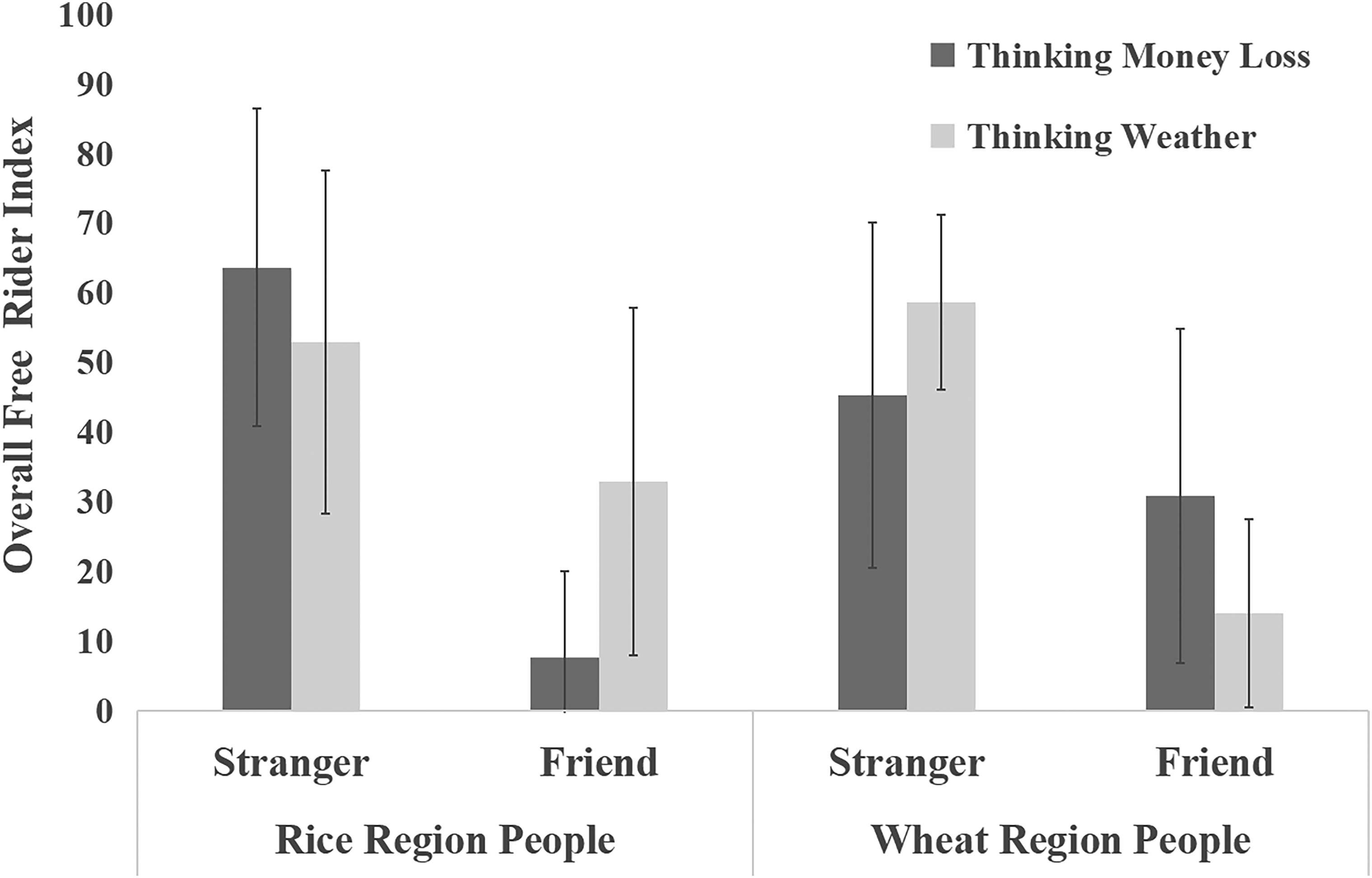
The Results of the ANOVA for Study 3.
To further analyze the three-way interaction, we conducted a simple effect of ANOVAs with four conditions.
When their partners were friends, in the weather condition, participants from the rice region had a higher overall FRI (Mean = 32.91, SD = 24.96) than those from the wheat region (Mean = 14.01, SD = 13.48). The results of repeated-measures analysis showed that F1, 38= 8.892, p = 0.004, η2 = 0.19, 95%CI = [0.0362,0.3559]. These results reveal the weather had natural significance for crops. In the monetary expenditure condition, the analysis yielded a significant main effect of culture. Under the list money condition, When a friend was involved, participants from rice areas had a lower overall FRI (Mean = 7.66, SD = 12.38) than those from wheat regions (Mean = 30.83, SD = 23.95), F1, 39 = 14.757, p < 0.001, η2 = 0.28, 95%CI = [0.0911, 0.4344]. When the partner was a stranger, in the weather condition, participants of the two samples score no significantly differently on overall FRI (Mean = 52.84 vs. 58.62 for rice regions and wheat regions respectively), F1, 38 = 0.871, p = 0.357, η2 = 0.022, 95%CI = [0.0000, 0.1426]. While in the list money expenditure condition, participants from the rice regions had a higher overall FRI (Mean = 63.59, SD = 22.77) than those from wheat regions (Mean = 45.28, SD = 24.08). The results of repeated-measures analysis showed that F1, 38 = 5.913, p = 0.02,η2 = 0.135, 95%CI = [0.0119, 0.2983]). Thus, Hypothesis 2b was confirmed.
Study 3 retested whether the idea of money would moderate the relationship between culture and cooperation in public goods games. We found that money loss reminders strengthened the distinctions between friends and strangers for people from rice regions and reduced the distinctions between those from wheat areas. This result confirms the RT (Talhelm et al., 2014), which states that people from rice regions make a sharp distinction between strangers (out-group members) and friends (in-group members), and people from wheat regions make less distinction between the two. We observed that when money loss was reminded, wheat-area participants were more individualistic and rice regions participants were more collectivistic. In the non-money and friends condition, we replicated the finding of Study 2 that rice regions participants cooperate less than wheat regions participants. We speculate that money reminders highlighted cultural effects and led participants to actively abide by it via cooperation. These results suggest an important boundary condition for the RT.
The current study provided convergent evidence for the moderating hypothesis, that is, the idea of money strengthens the relationship between culture and cooperation, which presumes that people from rice regions reminded of money would be less (more) cooperative with strangers (friends) than those not reminded of money in public goods games. Study 2 showed that after being reminded of money, which presumably evoked the idea of acquiring and gaining money, rice regions participants had lower cooperation with strangers in public goods games. Although the meaning of gaining money is the opposite of the meaning of losing or spending money, Study 3 demonstrated that not only being reminded of having spent money made them more cooperative with friends, but also more FRI with strangers. Therefore, the idea of money, gaining money, or losing money made subtle distinctions among these results.
General Discussion
Compared with explanations of cooperative behaviour based on collectivist-individualist cultures, the RT proposes a new analytical perspective. This study uses rigorous laboratory experiments with public goods games to explore the formation of human cooperative behaviour from the perspective of farming culture.
Theoretical Contributions
Study 1 produced two main findings. First, the FRI of participants from rice regions was lower than that of participants from wheat regions when they were cooperating with friends. Second, these indices were not significantly different between the rice regions and wheat regions participants when they cooperated with strangers. Cross-cultural research holds that China is a paragon of highly collectivist societies (Hofstede, 1980). These results indicate that the RT can also predict cooperative behaviour in relation to public goods. These findings were robust because the results of counting paper conditions in Study 2 and weather conditions in Study 3 both repeated the findings of Study 1.
These counter intuitive findings differ from those of previous studies. The finding that people from rice regions are not less cooperative with strangers is somewhat contradictory to the broad view of the RT that they are generally more collective and cooperative than people from wheat regions. Talhelm et al. (2014) found that people from rice and wheat provinces did not differ in their treatment of strangers, while people from rice regions reward their friends more than people from wheat regions in the loyalty/nepotism task. Furthermore, they also adopted the RT to explain the differences in innovation across countries and even within countries. It can be referred to a similar research, which presents novel evidence regarding the connections between historic farming practices and current norms of cooperative behavior. In this research, the hypothesis posits that the cooperation demanded by rice farming leads to the formation of strong cultural norms of cooperativeness. To test this hypothesis, the researchers conduct a comparison between participants from prefecture cities where rice cultivation is predominant and those from non-rice regions. A public goods game, both with and without punishment mechanisms, serves as the primary measure for cooperative behavior. The results demonstrate a strong and robust positive influence of rice farming on cooperative behavior and pro-social punishment. Additionally, complementary and consistent evidence obtained from a natural field experiment and a survey further enriches the data set.
The discrepancy between our findings and those of others regarding cultural effects is intriguing. Three explanations seem plausible. The first comes from the research approach. We performed laboratory experiments and strictly controlled the unrelated influential factors. The laboratory experiments did not have large-scale samples like in survey studies (Talhelm et al., 2014), this is a shortcoming of our study. The second explanation is that different dependent variables were involved in previous research from the one in the present study. Most previous dependent variables excluded behaviors such as cooperative decision-making. In our study, cooperative decision-making was the dependent variable, whereas there was no analogous study in the current literature. Therefore, these findings contribute to the theory and help resolve mixed findings regarding the RT by retesting it in public goods games. Moreover, the current studies applied RT to explain cooperative decision-making, and this contributed to the literature by integrating the field of rice culture and cooperation.
The third explanation relates to cultural de-territoriality. Modern communication results in cultural diffusion via films and television. The internet, commerce, and other factors also facilitate cultural diffusion. Rice culture is becoming increasingly de-territorialized and penetrated by elements of wheat culture. A previous study showed that 1,162 Han Chinese participants in six sites supported the RT (Talhelm et al., 2014). For this reason, our small sample size in eastern China contains cultural hybridization: the people from rice regions may have become more individualistic and less collective than they were after near four decades of the “open and reform” policy and the increasing economic development of China. Thus, the people from rice regions would be more cooperative with out-group members (i.e., strangers) as people from wheat regions.
While both Studies 2 and 3 produced similar findings regarding money priming before cooperative decision-making with money priming vs non-money priming, the view of “cultural value as a form of currency” provides a deeper understanding of how the people from rice regions would be more collective by nature, while the people from wheat regions would be more individualistic in essence. Our study enriches the existing literature. Zhou et al. (2023) provided novel evidence for links between historic farming practices and current norms of cooperative behaviour. They compared participants from rice-cultivating and non-rice regions using a public goods game with and without punishment. Our study, on the other hand, focuses on the moderating role of money ideas in the relationship between rice-wheat cultures and cooperation. By introducing money-priming tasks, we explore how the concept of money can influence cooperative decision-making in different cultural contexts. This is a unique aspect that was not covered in Zhou et al. (2023)'s study, which mainly concentrated on the direct link between rice farming and cooperative norms.
A deeper assumption behind this view rests on the overlap of money and culture in evolutionary functions, neurological correlations, behaviors, and cognition. As Zhou et al. (2011) discussed in their article, it was the same brain regions that were stimulated that represented monetary and cultural values. Following the same line of reasoning, we contend that it is money priming that intensified the cultural effects on public cooperation in our experiment.
The lack of money prime has been examined in Studies 2 and 3, which have characterized rice regions participants as lower free-riders with friends than wheat regions participants. When people are primed by gaining money or losing money, people from rice regions cooperate less with strangers than people from wheat regions.
Moreover, the losing money condition led the people from rice regions to be more likely to cooperate with friends, while in the gaining money condition, no difference was found between the two samples. This difference in the effect of gaining money and losing money may be attributed to human loss aversion. Because cultural and monetary values are entrenched with similar motivational-emotional-neuro-endocrine mechanisms underlying loss aversion (Zhou et al., 2011), people from rice regions exhibited greater sensitivity to losing money than to gaining money and led them to want to cooperate with in-group members by nature in our experiment. Therefore, the third contribution to the literature is the identification of the money priming condition for the RT.
Practical Implications
The current research shows that cooperative decision-making is determined by culture and money cues. Although it is difficult to change culture, money cues are feasible. Money reminders are restrained by the social environment (e.g., economic development, policy propaganda, and incentive bonuses), and different social environments may confuse the prediction of cooperation.
This study clears the disputes surrounding the RT and indicates that the reinforcement of the RT needs to consider the influence of money psychology. The results of the current research can be used to forecast cooperative behaviors related to gaining money. Take corruption as an example: Bribers abuse their power to gain money. According to the results, we predict that with money reminders, when the briber is a stranger, bribe-takers in rice regions would be less cooperative than wheat regions bribe-takers, and vice versa. This type of assumption can also be predicted in cooperative behaviors such as tip-offs and demolition compensation and needs to be verified by empirical analysis in the future.
The results of this study can be used to predict cooperative behaviors related to losing money. Take public investment projects as an example: This type of project uses financial allocation that is partly from tax and fundamentally the public's money. According to the results, we predict that with money reminders, the public in rice regions will have lower cooperative intentions than the wheat regions public when the government has a bad public relationship, while the opposite is true when the government has a good relationship with the public. Additionally, elections, education, and charity can be regarded as cooperative behaviors related to losing money.
Limitations and Future Direction
The present study has several limitations. First, it was conducted in a laboratory in which many factors were manipulated, yet the scenarios were overly simplified. In future research, we will employ mixed-methods approaches, integrating empirical studies with case studies, grounded theory, and qualitative comparative analysis, to more systematically elucidate the mechanisms underlying the formation of cooperative behavior from the perspective of the RT.
Second, our participants were university students who might be more individualistic and competitive than the general population. Future studies could recruit representative samples encompassing diverse occupations, ages, and social backgrounds to mitigate biases arising from the specificity of university student populations. Incorporating field surveys or large-scale social sampling, comparative analyses between experimental results from university students and real-world behavioral data of the general population can be conducted.
Third, hypothetical public goods games were used; participants might not be as engaged as in real-life situations. Future studies could introduce real monetary incentives to enhance participants’ engagement, making public goods games more analogous to real-life decision-making contexts. Incorporating field experiment designs, conducting public goods games in real communities or organizations can mitigate behavioral biases arising from hypothetical scenarios. Adopting a longitudinal approach to track participants’ strategic choices in repeated games, coupled with real-world public resource utilization data, can validate the external validity of experimental findings.
Fourth, we did not check whether our experimental manipulation achieved psychological effects on norm salience. These features of the current study raise concerns regarding the external validity of the findings.
Finally, according to the findings of Study 3, taking into account the weather, the cooperation between friends is higher in wheat regions than in rice regions. The possible reason is that rice farming is more susceptible to weather than wheat. Weather changes may cause people in rice regions to seek outside opportunities, potentially reducing cooperation with regional friends. Therefore, we can focus on the interaction of weather and culture, as well as the cooperation between strangers and friends across regions, and further expand the exploration of the RT.
Conclusion
To summarize, the results of three substantive studies provide strong empirical support for the reliability, stability, and validity of the RT and the cultural effects (rice vs. wheat)on cooperative decision-making and demonstrate that people from rice regions (vs. people from wheat regions) were more aligned with collectivism (vs. individualism) when they were primed by reminders about money. In organizational and work contexts, monetary incentives and punishments are typically tied to task productivity rather than the consideration of others. Hence, money should be a factor that cues employees from rice and wheat cultures to prioritize demonstrating their cooperation. Together, our findings contribute to the literature by helping to integrate the fields of culture, money, and cooperation, resolve mixed findings regarding the RT, and identify the conditions for the RT.
Supplemental Material
sj-docx-1-pac-10.1177_18344909251386075 - Supplemental material for Can the Rice Theory Explain Cooperation? Considering the Moderating Effects of Relationships and Money Ideas
Supplemental material, sj-docx-1-pac-10.1177_18344909251386075 for Can the Rice Theory Explain Cooperation? Considering the Moderating Effects of Relationships and Money Ideas by Weijiong Wu, Jing Xi, Yuxiang Hong and Yitong Wu in Journal of Pacific Rim Psychology
Supplemental Material
sj-docx-2-pac-10.1177_18344909251386075 - Supplemental material for Can the Rice Theory Explain Cooperation? Considering the Moderating Effects of Relationships and Money Ideas
Supplemental material, sj-docx-2-pac-10.1177_18344909251386075 for Can the Rice Theory Explain Cooperation? Considering the Moderating Effects of Relationships and Money Ideas by Weijiong Wu, Jing Xi, Yuxiang Hong and Yitong Wu in Journal of Pacific Rim Psychology
Supplemental Material
sj-docx-3-pac-10.1177_18344909251386075 - Supplemental material for Can the Rice Theory Explain Cooperation? Considering the Moderating Effects of Relationships and Money Ideas
Supplemental material, sj-docx-3-pac-10.1177_18344909251386075 for Can the Rice Theory Explain Cooperation? Considering the Moderating Effects of Relationships and Money Ideas by Weijiong Wu, Jing Xi, Yuxiang Hong and Yitong Wu in Journal of Pacific Rim Psychology
Footnotes
Ethical Approval
All procedures performed in studies involving human participants were in accordance with the ethical standards of the institutional and/or national research committee and with the 1964 Helsinki declaration and its later amendments or comparable ethical standards.
Funding
The authors disclosed receipt of the following financial support for the research, authorship, and/or publication of this article: This work was supported by the National Natural Science Foundation of China, Post-funding Project of Philosophy and Social Sciences in Guangdong Province, Key Project of the China Society of Business Economics (grant number 71902042, GD25HLJ02, 2024001).
Declaration of Conflicting Interests
The authors declared no potential conflicts of interest with respect to the research, authorship, and/or publication of this article.
Data Availability
The datasets can be accessed via the following link: https://osf.io/hjcrp (Study 1); https://osf.io/2qnjz (Study 2);  (Study 3).
Supplemental Material
Supplemental material for this article is available online.
Notes
References
Supplementary Material
Please find the following supplemental material available below.
For Open Access articles published under a Creative Commons License, all supplemental material carries the same license as the article it is associated with.
For non-Open Access articles published, all supplemental material carries a non-exclusive license, and permission requests for re-use of supplemental material or any part of supplemental material shall be sent directly to the copyright owner as specified in the copyright notice associated with the article.
